

Zaha Hadid Architects and Block Research Group 3D-Print a Mortar-Free Concrete Footbridge in Venice
Striatus combines robotic fabrication with ancient masonry logic to build a 16-meter bridge from 53 unreinforced concrete blocks in a Venetian park.


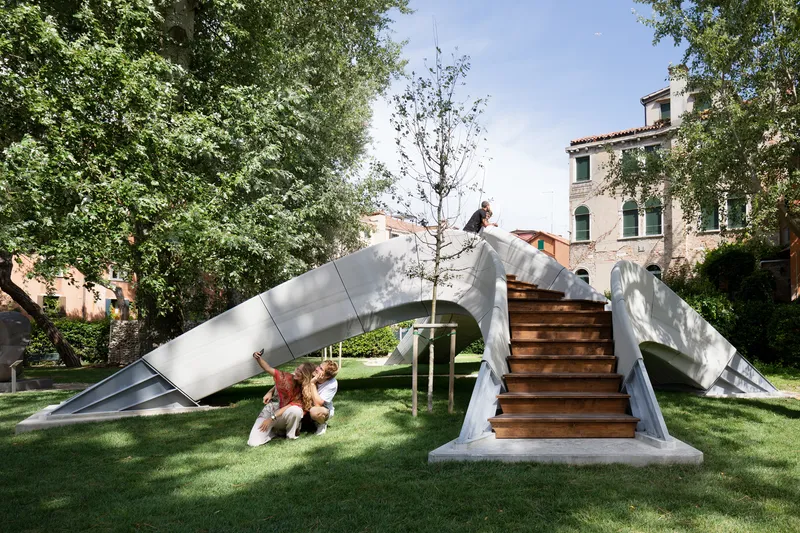
A footbridge that uses no mortar, no reinforcement, and only a fraction of the concrete a conventional structure would demand sounds like a provocation. Striatus, a collaboration between Zaha Hadid Architects' Computation and Design Group (ZHACODE) and the Block Research Group (BRG) at ETH Zurich, is exactly that: a 16-by-12-meter arched footbridge assembled from 53 hollow, robotically 3D-printed concrete blocks that hold themselves up through compression alone. Installed in the Giardino della Marinaressa during the 2021 Venice Architecture Biennale, the bridge proposes that the most advanced digital fabrication tools and the oldest structural principles in architecture can converge on a single, buildable object.
What makes Striatus genuinely interesting is not the spectacle of a robot printing concrete, which by now is a familiar demonstration. It is the structural argument underneath. The bridge is a funicular shell: its geometry is derived from thrust network analysis so that all forces travel in compression, the way a Roman vault or a Catalan tile arch works. Because the blocks carry only compressive loads, they need no steel rebar and no adhesive. Neoprene pads sit between the dry-stacked voussoirs, steel tension ties absorb the horizontal thrust at the supports, and gravity does the rest. The result uses roughly 30 percent of the concrete and 10 percent of the steel that a flat reinforced slab of the same span would require. And because nothing is bonded, the entire bridge can be taken apart, moved, and reassembled elsewhere, or its materials separated and recycled at end of life.
Compression as Geometry
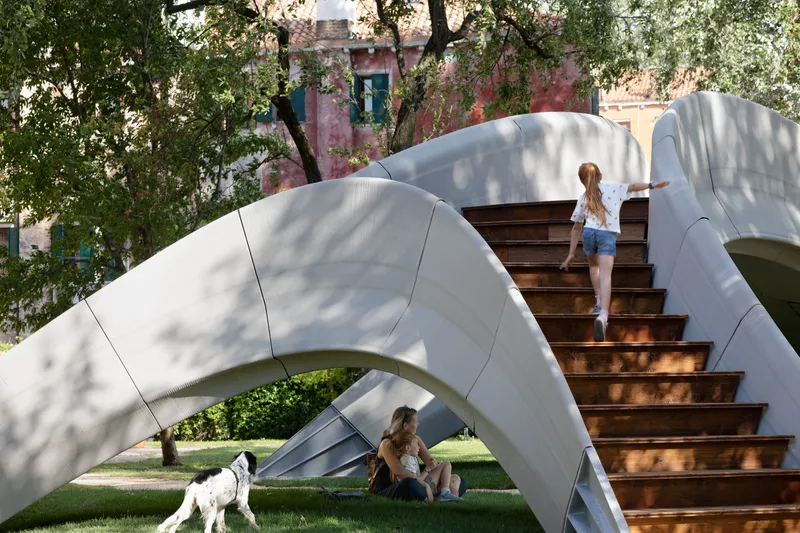
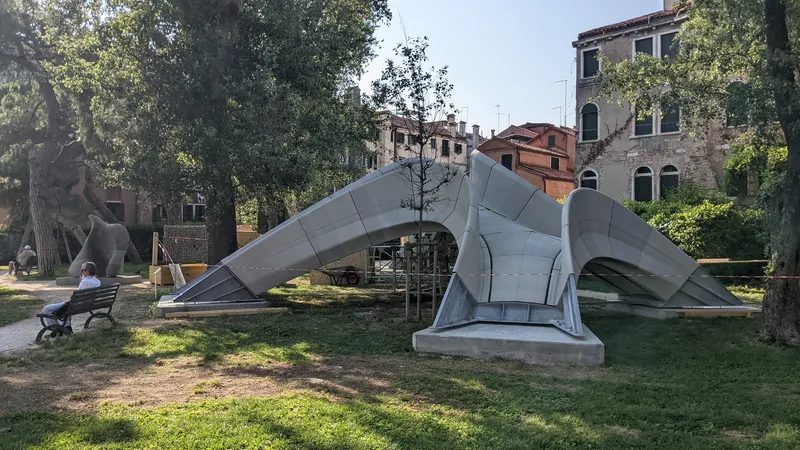
The name Striatus refers to the striated texture of the printed layers, but it also signals the structural logic at work. Each of the 53 blocks was printed by a single six-axis robotic arm in layers oriented orthogonal to the principal compressive forces, not simply stacked horizontally as in most additive manufacturing. That alignment means the layer interfaces are perpendicular to the load path, keeping them in compression and eliminating the weak shear planes that plague conventional layered prints. The printing took about 84 hours in total, roughly one to two hours per block, and the blocks were fabricated off-site before being lifted into position on a temporary timber falsework.
The double-curved deck, with its swooping stepped entry points, reads as a single flowing surface, but it is in fact an assembly of discrete pieces locked together by geometry and weight. Deep arches in plan transfer horizontal loads to the supports in pure compression, a trick borrowed from historical vaulted masonry but made possible here at this geometry only through computational form-finding. The visual effect is something between a folded shell and a stone vault, familiar in its logic, alien in its precision.
Material Economy and Circularity

Reinforced concrete is the world's most consumed building material after water, and the steel reinforcement embedded within it is a major contributor to both embodied carbon and end-of-life waste. Once rebar is cast inside a slab, there is no practical way to separate the two materials for recycling. Striatus sidesteps this problem entirely. The special concrete ink, developed by Holcim, incorporates a high percentage of recycled construction waste, and because the blocks are hollow, material is deposited only where the structure demands it. The 500-layer resolution of each block means wall thicknesses vary continuously in response to local stress, an optimization that solid casting cannot achieve.
The dry-assembly strategy is the real sustainability play. Disassembly is not an afterthought here; it is intrinsic to the design. Every block can be cataloged, transported, and re-erected on a new site, or ground down and fed back into a new print mix. In a discipline that talks endlessly about circular economies but rarely delivers reversible connections at the structural scale, Striatus offers a working proof of concept.
The Underside Tells the Story
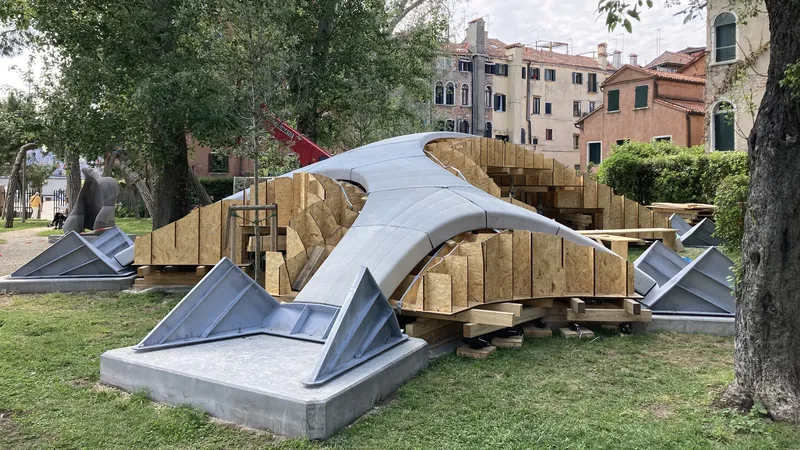
Seen from below, the bridge reveals what the top surface conceals. The curved shell reads clearly as a vault, the striated print lines radiating outward along the compressive flow like the ribs of a leaf. The exposed timber framework visible during exhibition serves as a reminder that this is still a prototype, an installation meant to be studied as much as crossed. Yet even at this scale, the soffit has a confidence that most experimental pavilions lack. The geometry is not decorative; every curve corresponds to a force path resolved by the computational model.
Walking underneath Striatus in the dappled shade of the Giardino della Marinaressa, visitors encountered something that felt simultaneously ancient and speculative. The arched form is as old as the Pont du Gard; the tooling is as new as the latest firmware update on a KUKA robot. That tension is precisely what gives the project its resonance.
Between Venice and Everywhere Else
Biennale pavilions come and go, and most leave behind only photographs and press releases. Striatus was designed from the outset to outlast its exhibition context. The fact that it can be disassembled and moved is not a gimmick; it is a direct demonstration of the reuse thesis. A 35-day construction timeline, including foundation casting, block assembly, and stair and deck installation, suggests that the logistics of erection are not dramatically more complex than those of a conventional precast structure. The bottleneck is in the design and fabrication pipeline, not on site.
The collaboration itself is worth noting. ZHACODE brought computational geometry and formal ambition; BRG contributed decades of research into equilibrium methods and funicular structures; incremental3D (in3D) handled the robotic printing; and Holcim supplied the low-carbon concrete ink. That four-way partnership, spanning an architecture practice, an academic research lab, a fabrication startup, and a materials manufacturer, is likely the real model for how this technology scales beyond one-off installations.
Plans and Drawings

The site plan situates Striatus within the park landscape, showing the bridge's double-arched footprint and its relationship to the surrounding trees and topography. The drawing makes visible what the photographs cannot: the lateral thrust lines converging on the abutments and the overall compactness of the 16-by-12-meter footprint. For a structure that feels expansive when you stand on it, the plan reveals how economically it occupies ground.
Why This Project Matters
Striatus matters because it closes the gap between three conversations that usually happen in separate rooms: computational structural optimization, robotic fabrication, and circular construction. Each of those topics has generated its own body of research, prototypes, and conference papers. Rarely are all three resolved in a single built artifact that people can actually walk across. By proving that a compression-only, unreinforced, dry-assembled, robotically printed bridge can stand and carry load at a meaningful span, the project moves the discussion from theory to engineering reality.
It also reframes what 3D-printed concrete can be. Most printed structures to date have been walls, houses, or pavilions that treat additive manufacturing as a substitute for formwork. Striatus treats it as a way to deposit material along force flows with sub-centimeter precision, creating hollow, variable-thickness voussoirs that would be prohibitively expensive to cast conventionally. If the construction industry is going to cut its carbon footprint in half within a generation, it will need approaches that use less material, not just different material. Striatus shows what that looks like at the scale of infrastructure.
Striatus Bridge, designed by Zaha Hadid Architects (ZHACODE) and Block Research Group (BRG, ETH Zurich), with fabrication by incremental3D (in3D) and concrete by Holcim. Located at Giardino della Marinaressa, Venice, Italy. 16 m × 12 m. 2021. Photography by naaro, in3d, Alessandro Dell'Endice, and Tom van Mele.
About the Studio
Share Your Own Work on uni.xyz
If projects like this are the kind of work you want to make, uni.xyz is a place to publish your own, find collaborators, and enter design competitions.


Popular Articles
Popular articles from the community

Extended Shell: Retrofitting Kolkata's Balconies as Living Urban Thresholds
A modular retrofit system recovers the social and environmental intelligence of Kolkata's historic verandas for contemporary Park Street residents.

Cloaked Colonization: A Mobile Underwater Habitat That Moves Like a Fish
Micah Abaya's shortlisted EHC Pacific entry reimagines ocean settlement as a dispersed network of self-sustaining architectural organisms.

The Amber Palace Opera: A Geological Fiction Surfaces on Tallinn's Baltic Waterfront
Pierre Brillard reimagines a Baltic legend as a public landscape, opera house, and waterfront promenade rooted in Tallinn's coastal identity.
Temporary Home for Dogs: A Reversed Zoo Rethinks Animal Shelter Architecture
In Bucharest, a sinuous corridor and freed landscape flip the logic of containment, designing a shelter that works to make itself unnecessary.

Similar Reads
You might also enjoy these articles


Hodi-Mandai Geram
Project Function: Preservation and revitalization of the Intangible heritage and socio-spatial identity of the Hodi by Housing, Cultural Memory Center, Sacred Grove, landscape, local tourism economy


Olio Towers: A Mid-Rise for Performers That Fuses Housing, Rehearsal, and Stage
Located blocks from Houston's Theater District, this modular tower stacks living units around a central performance atrium.

Oasis: Modular Green Housing Carved into Dhaka's Urban Fabric
A shortlisted Plugin Housing entry reclaims unauthorized settlements in Dhaka with stepped concrete volumes, green roofs, and ventilation-driven design.

Black Hole: A Floating Megastructure for the Post-Physical Era
Emiliano Mazzarotto envisions a spherical, self-scaling arena where e-sports, digital hotels, and holographic stadiums replace traditional public space.

Explore Mechanical Bridge Competitions
Discover active competitions in this discipline

Challenge to reimagine the Iron Throne

Photograph architecture without architects

Illustrate the lost glory of Angkor Wat - Render Challenge

Design challenge to reuse E-waste
Comments (0)
Please login or sign up to add comments
No comments yet. Be the first to comment!