

Studio 10 Carves Cave-Like Pavilions into a Bamboo Canopy on the Longyou Wetlands
An 85-square-meter discovery pavilion on China's Qu River shoreline fuses rammed earth towers with a woven bamboo lattice canopy.


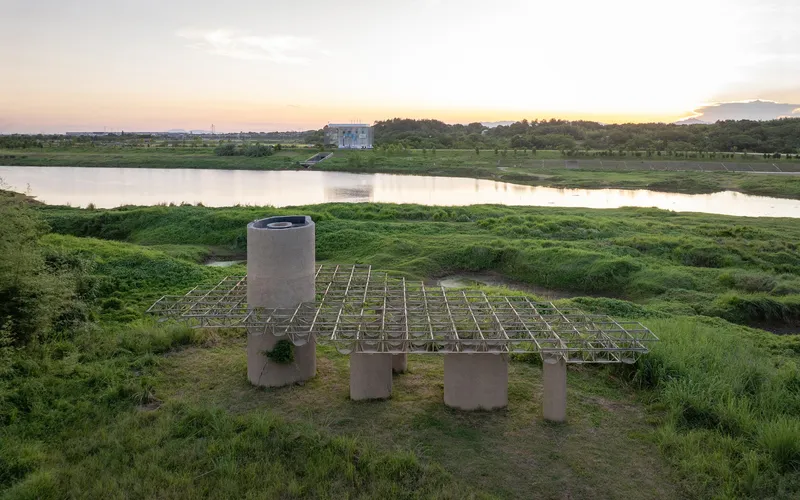
The Qu River has spent centuries carving the terrain around Chuanchang Island in Longyou County, Quzhou City, leaving behind mudflat meadows, eroded gullies, and the famous ancient cave sites that give the region its name. Studio 10, led by Shi Zhou, took that geological narrative literally: the Wetland Caves Pavilion is a cluster of cylindrical rammed earth columns punctured by organic, teardrop-shaped voids, sheltered beneath a sprawling bamboo lattice canopy that hovers over a field of yellow wildflowers like a second, porous sky.
What makes the project genuinely interesting is the tension between its two material systems. The earthen towers are heavy, opaque, cave-like. The bamboo canopy is light, transparent, almost textile in character. Neither system dominates. Instead they produce a pavilion that reads differently at every distance: from afar, a low canopy floating over the meadow; up close, a series of inhabitable grottoes casting dappled shadows onto gravel and grass. At just 85 square meters, the building proves that a discovery pavilion does not need to be large to restructure how visitors perceive an entire landscape.
Borrowed from the River's Erosion
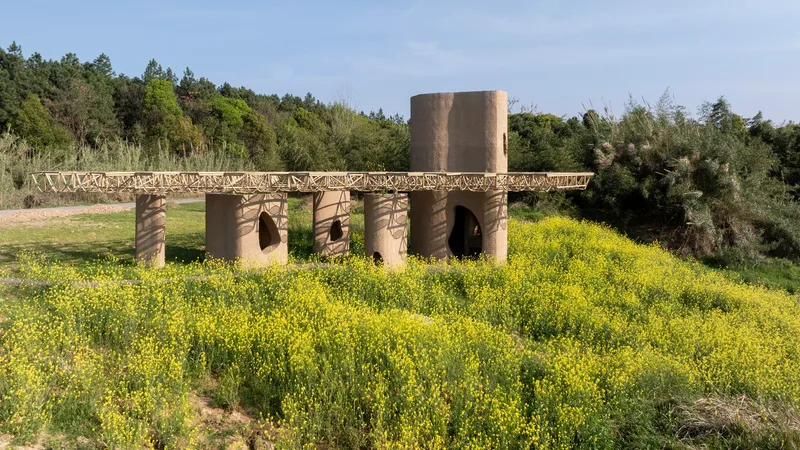
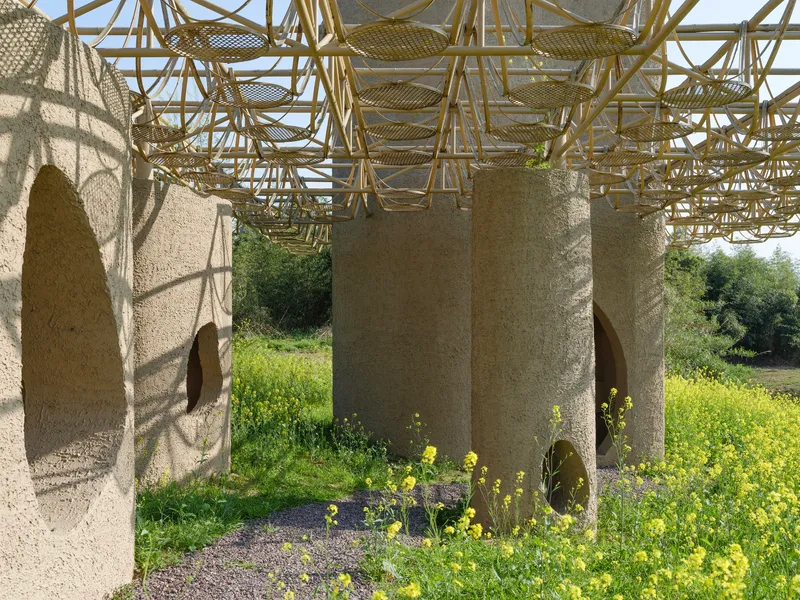
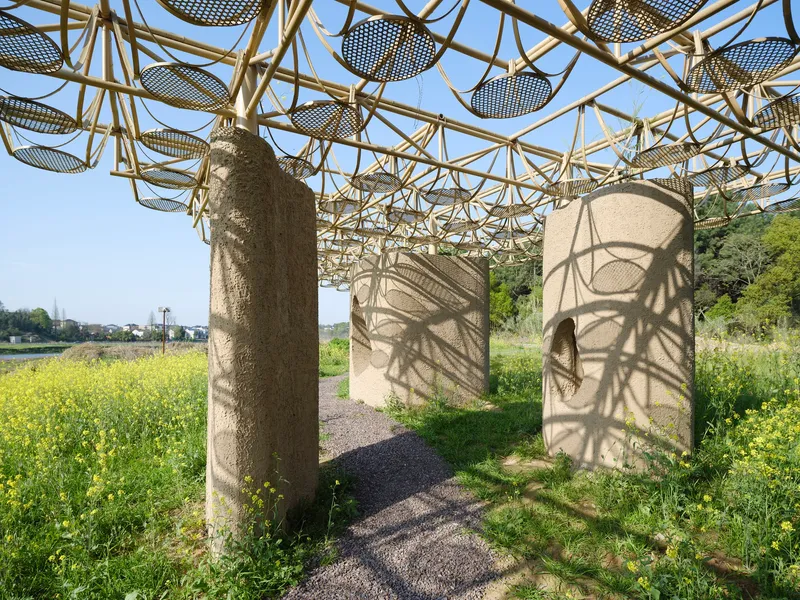
The cylindrical columns are the pavilion's anchoring gesture, clustered in a loose formation that avoids grid regularity. Their arched and teardrop-shaped openings recall the erosion patterns carved into the Longyou Caves over millennia, abstracted just enough to function as framed views and sheltered niches rather than geological replicas. The proportions are squat and generous, sized for a person to step inside or lean against.
Rammed earth, or a textured concrete mix that reads similarly from a distance, gives the columns a rough, striated surface that absorbs the shifting light of the wetland setting. In spring, when the surrounding meadow erupts with yellow wildflowers, the earth tones of the columns ground the pavilion against a vivid backdrop that might otherwise overwhelm a lighter structure.
A Second Sky in Bamboo
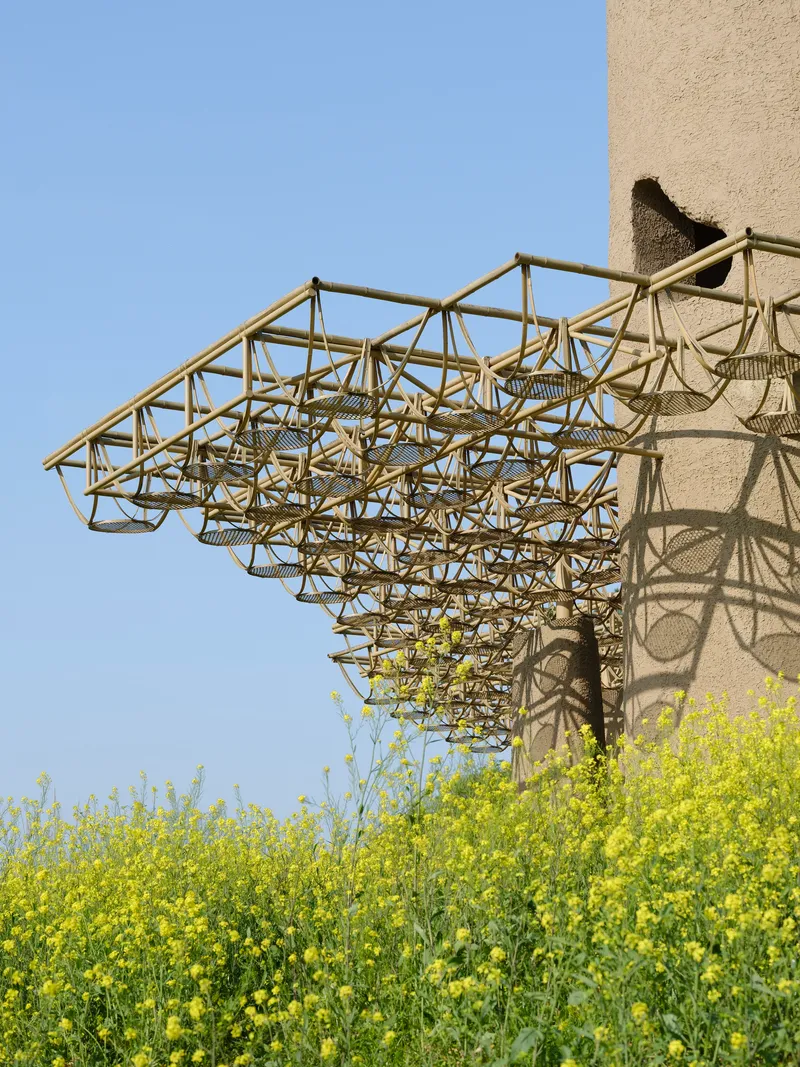
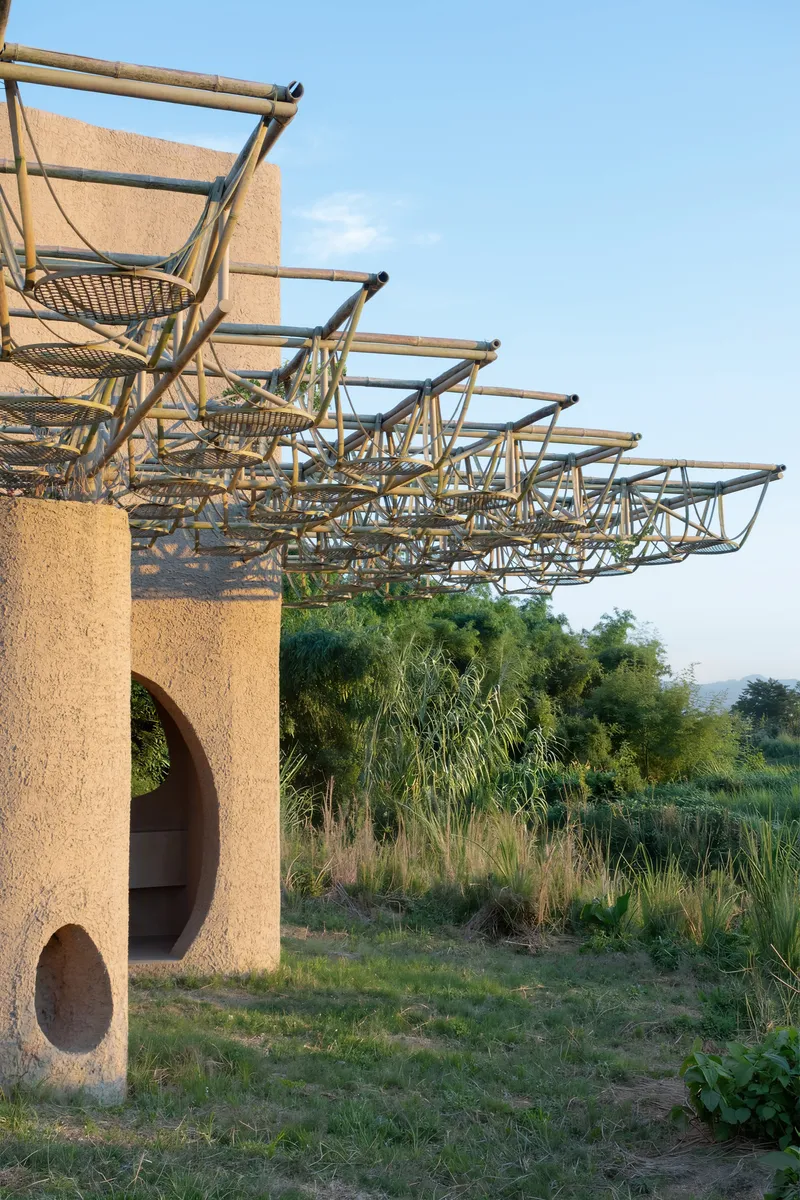
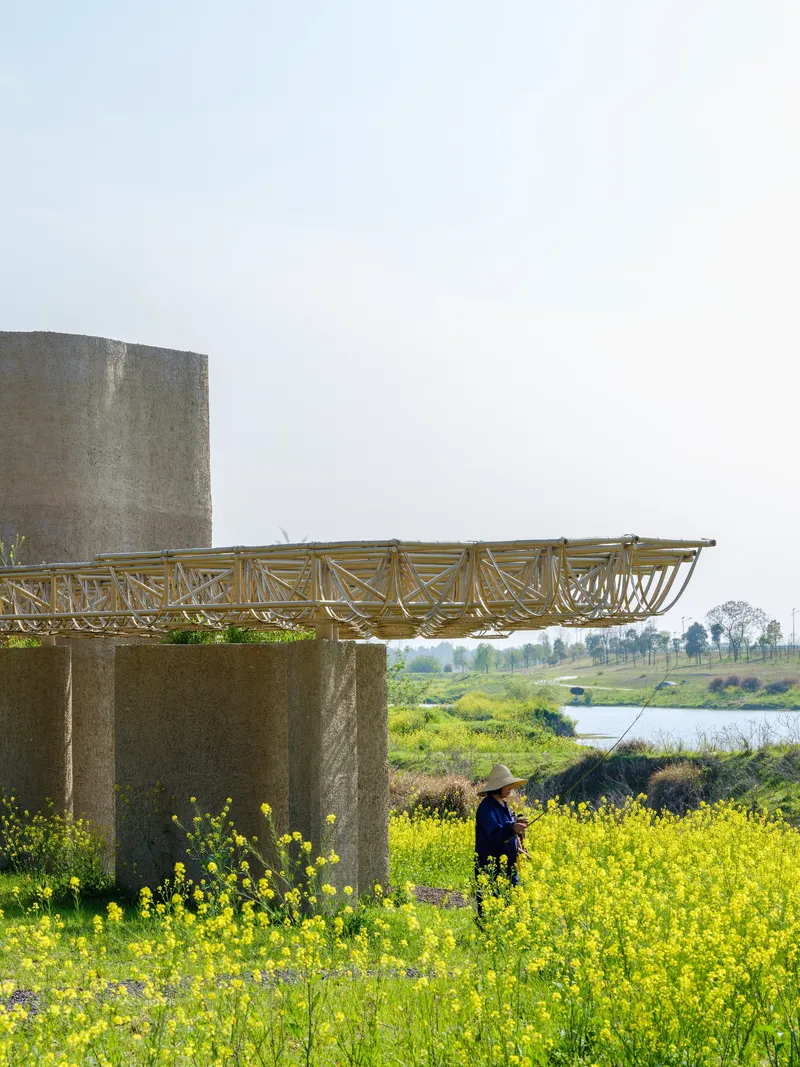
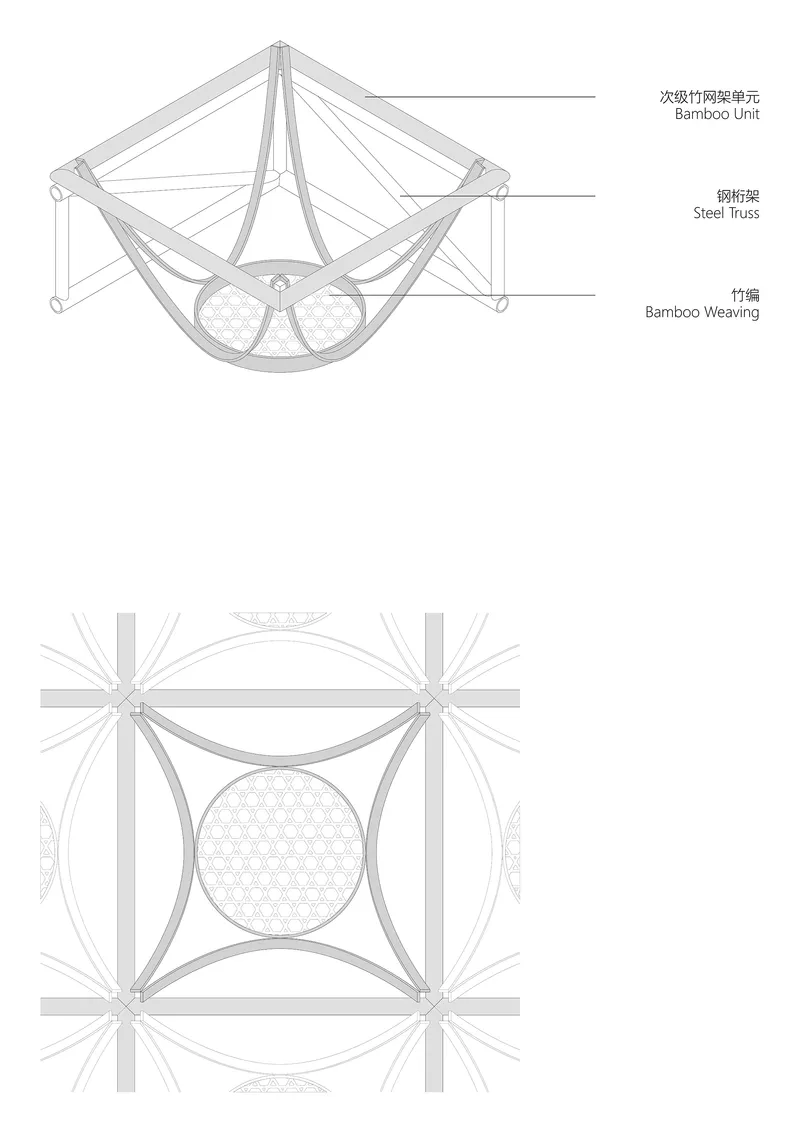
The canopy is the project's defining spatial move. Engineered in collaboration with Shanghai Jingdao Bamboo Construction Design Co. LTD, it is a bamboo lattice frame supported by steel trusses and filled with woven bamboo panels. The result is a filtering screen that breaks direct sunlight into a constantly shifting pattern of dappled shadows, turning the ground plane beneath into an animated surface that changes with the hour and the season.
Structurally, the canopy works independently from the earthen columns. It extends well beyond their footprint, creating a generous shade zone that turns the surrounding wildflower meadow into an outdoor room. Visitors walking along the gravel path experience the canopy first, then the columns, then the landscape beyond: a deliberate sequence that slows the body down before releasing it into the open wetland.
Interior Grottoes
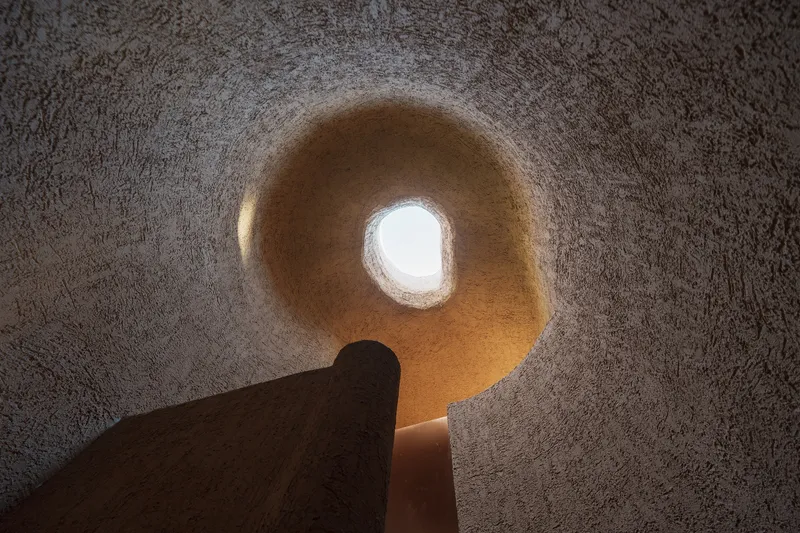
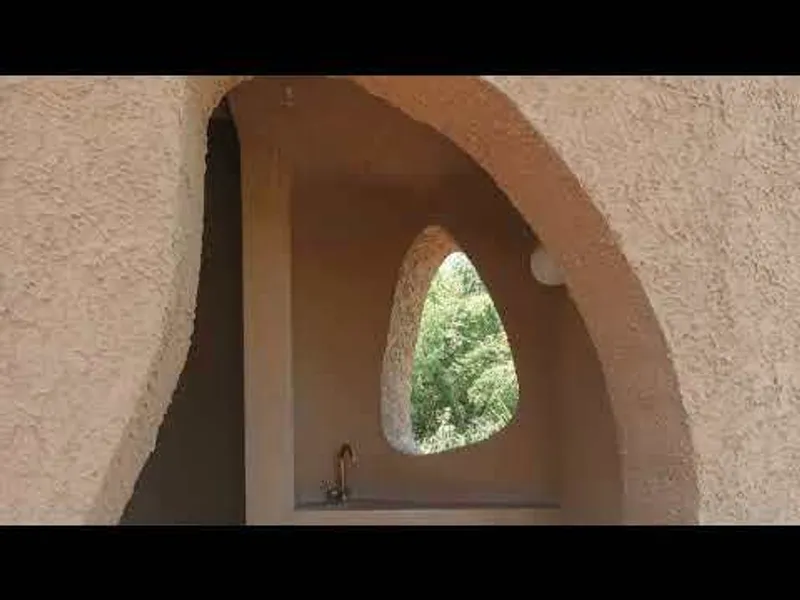
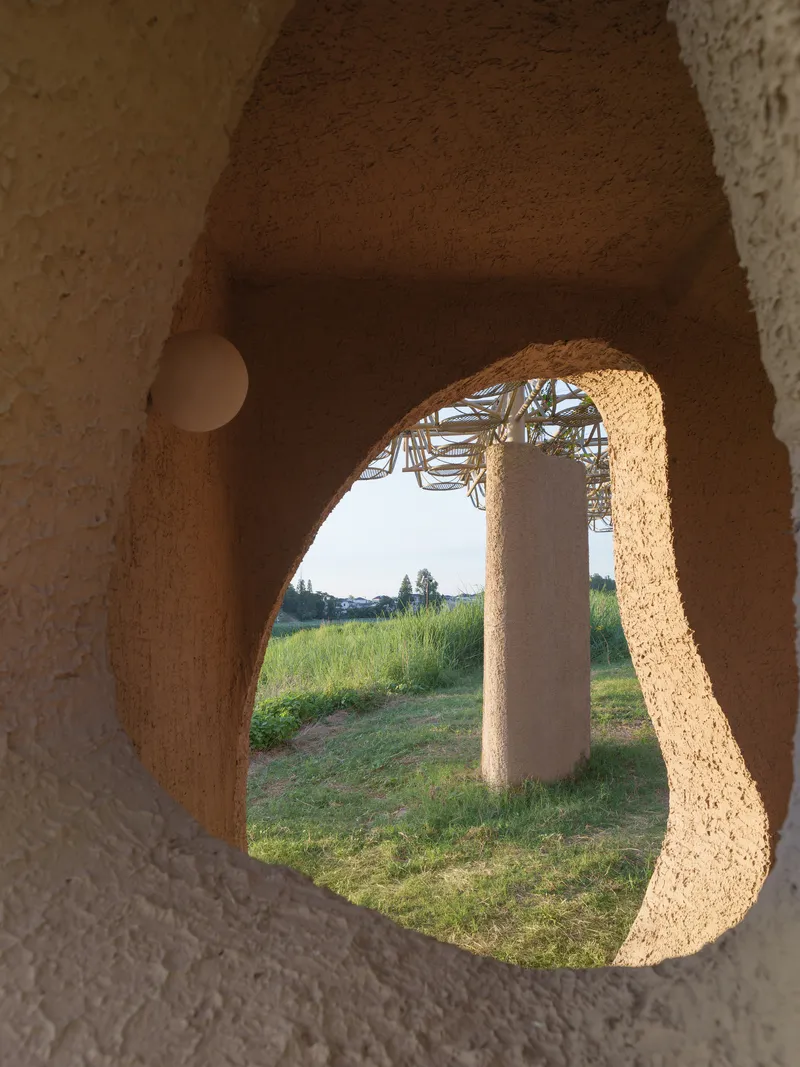
Step inside one of the cylindrical towers and the mood shifts entirely. The textured walls curve inward to a domed ceiling, a single pendant light hangs from a circular skylight, and the sounds of the wetland recede. These interiors are deliberately cave-like, invoking the ancient Longyou Caves without attempting to reproduce them. The organic window openings frame vegetation and sky with the care of a composed painting.
The vaulted niches are perhaps the project's most successful spatial detail. Where the canopy is about diffusion and openness, these interiors are about compression and focus. Together, the two conditions give the pavilion a range of experiential registers that belies its modest footprint.
Landscape as Co-Author
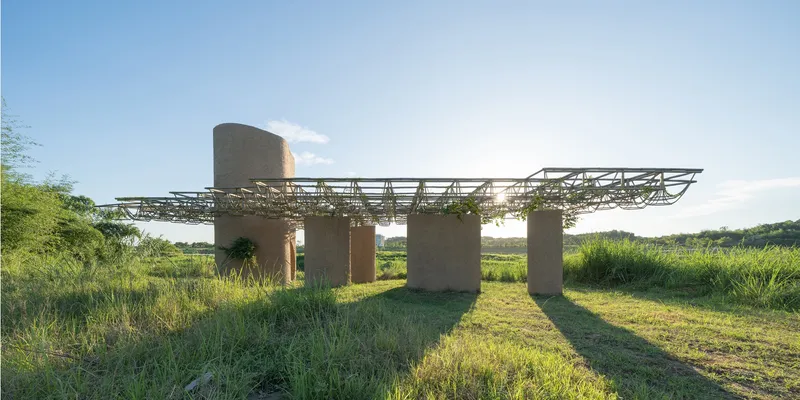
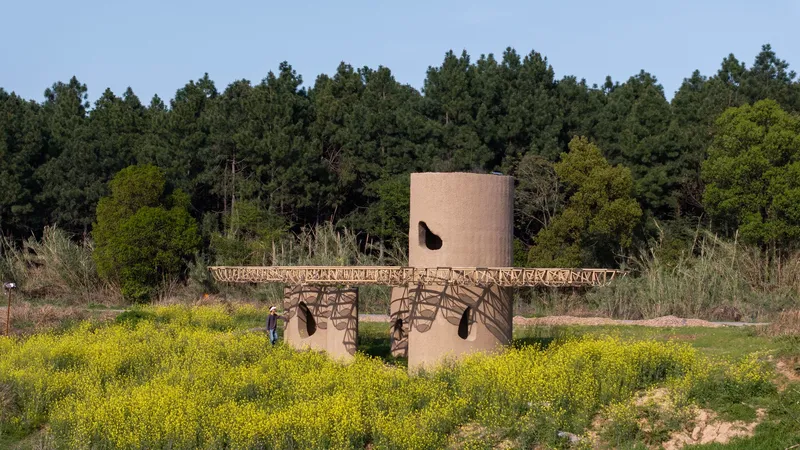
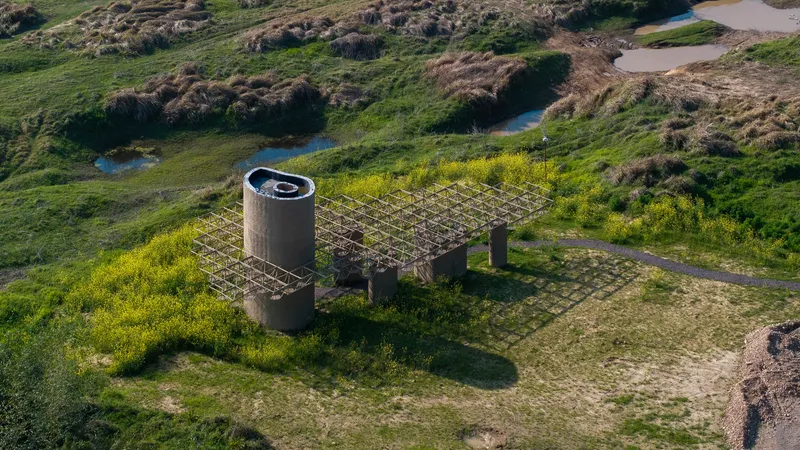
Aerial views reveal how carefully the pavilion is sited. It sits on the edge between meadow and marshland, oriented toward the river and the distant treeline. The surrounding landscape, with its flowing green grasses, wildflower patches, and water channels, is not a neutral backdrop but an active participant in the design. The pavilion channels and frames it rather than competing with it.
At sunset, the silhouette of the bamboo canopy against a pink horizon collapses the distinction between architecture and terrain. The columns become outcrops; the canopy becomes a low cloud. It is a deliberate effect, calibrated by Studio 10 to make the pavilion feel like something the river might have deposited rather than something a construction crew assembled.
The Observation Platform
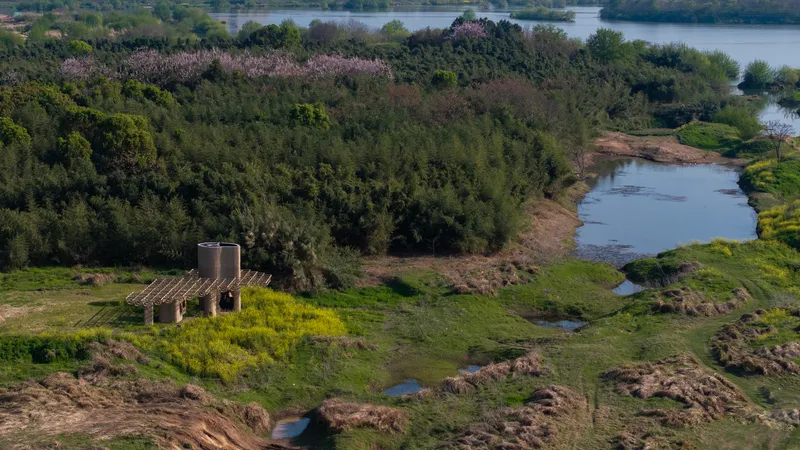
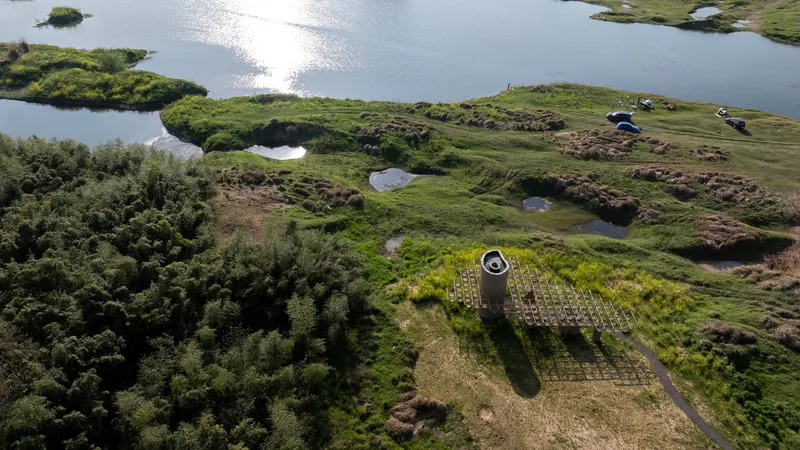
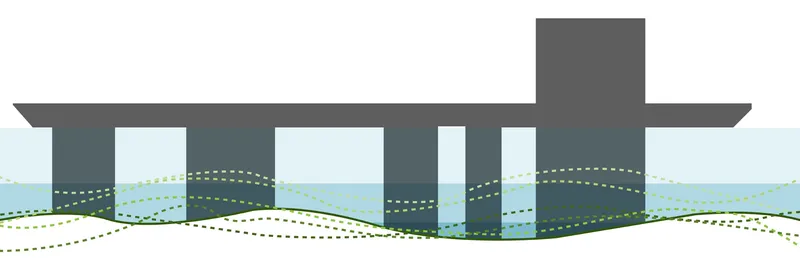
A secondary element, an elevated platform on concrete piers, extends the pavilion's reach toward the river. Raised above the marshy ground, it provides an unobstructed vantage over the wetland water channels and the broader Qu River valley. The timber grid decking is deliberately utilitarian, a counterpoint to the more sculptural language of the main pavilion cluster.
From above, the platform and the pavilion together form a loose constellation of structures scattered across the shoreline, connected by paths but never consolidated into a single mass. The strategy respects the fragility of the wetland terrain by distributing weight and traffic across multiple light touches rather than one heavy footprint.
Plans and Drawings
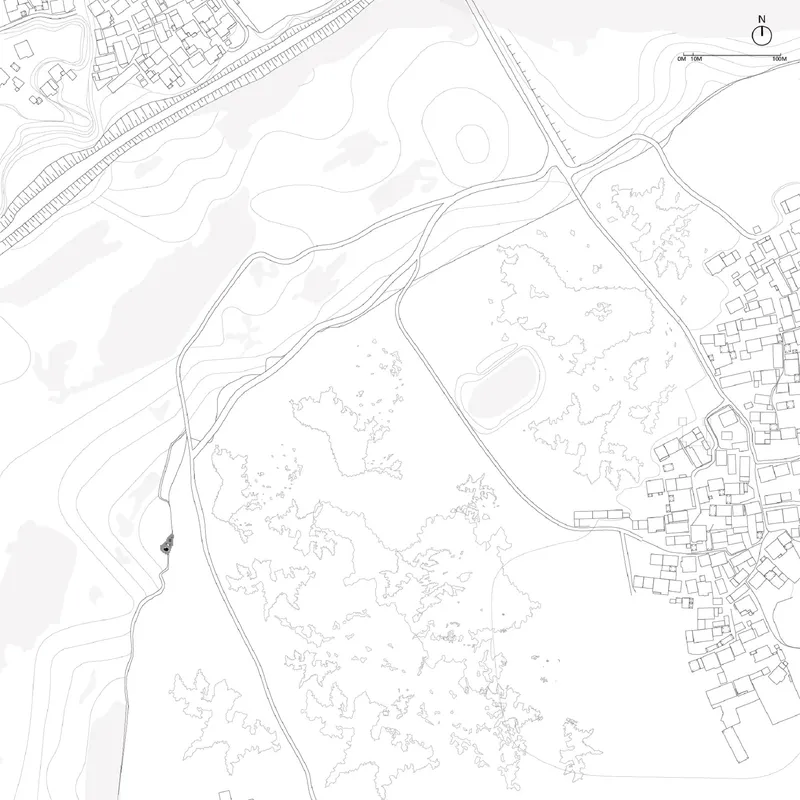
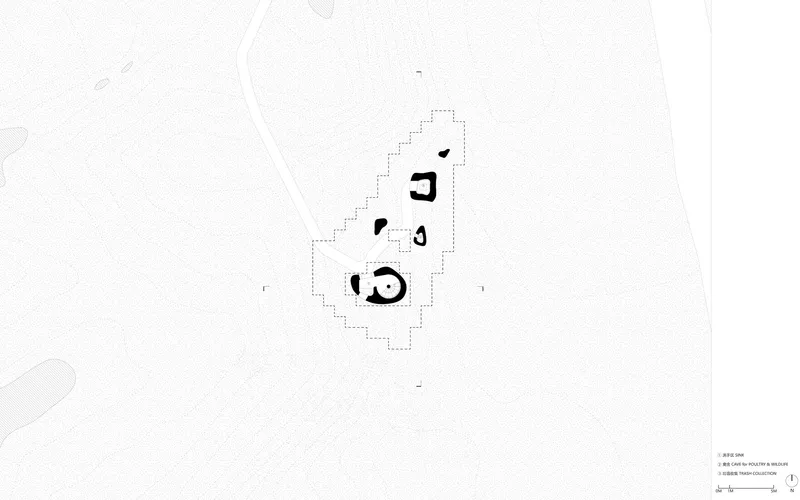
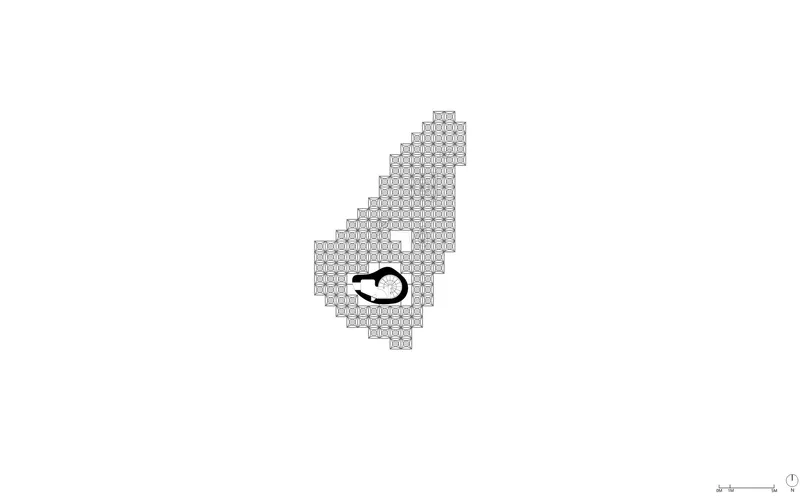
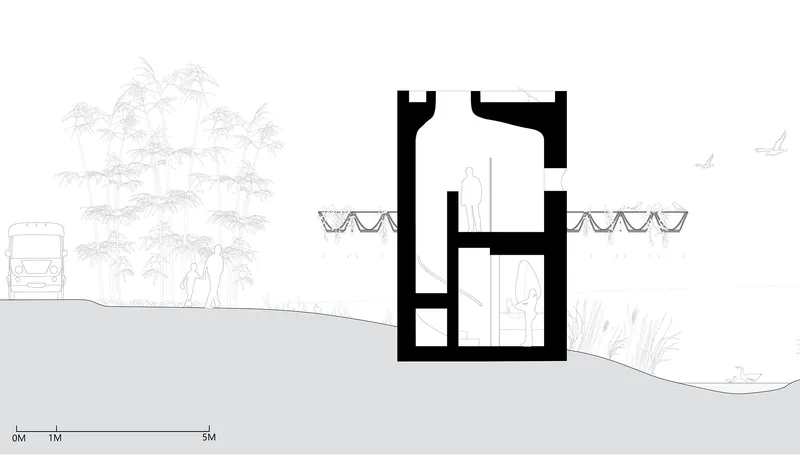
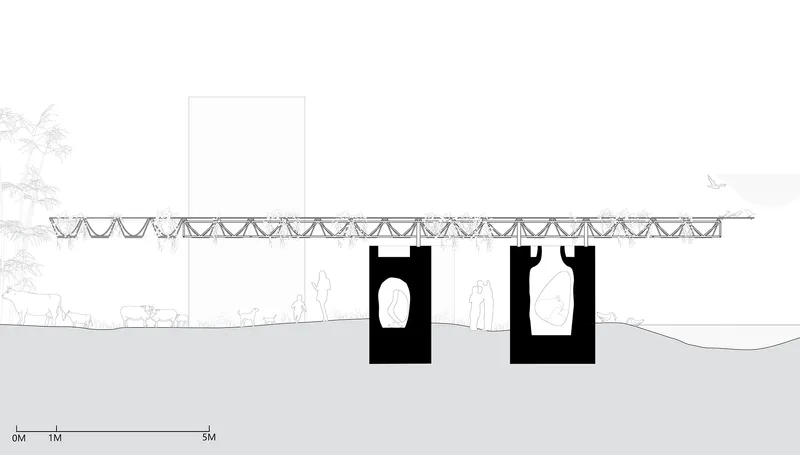
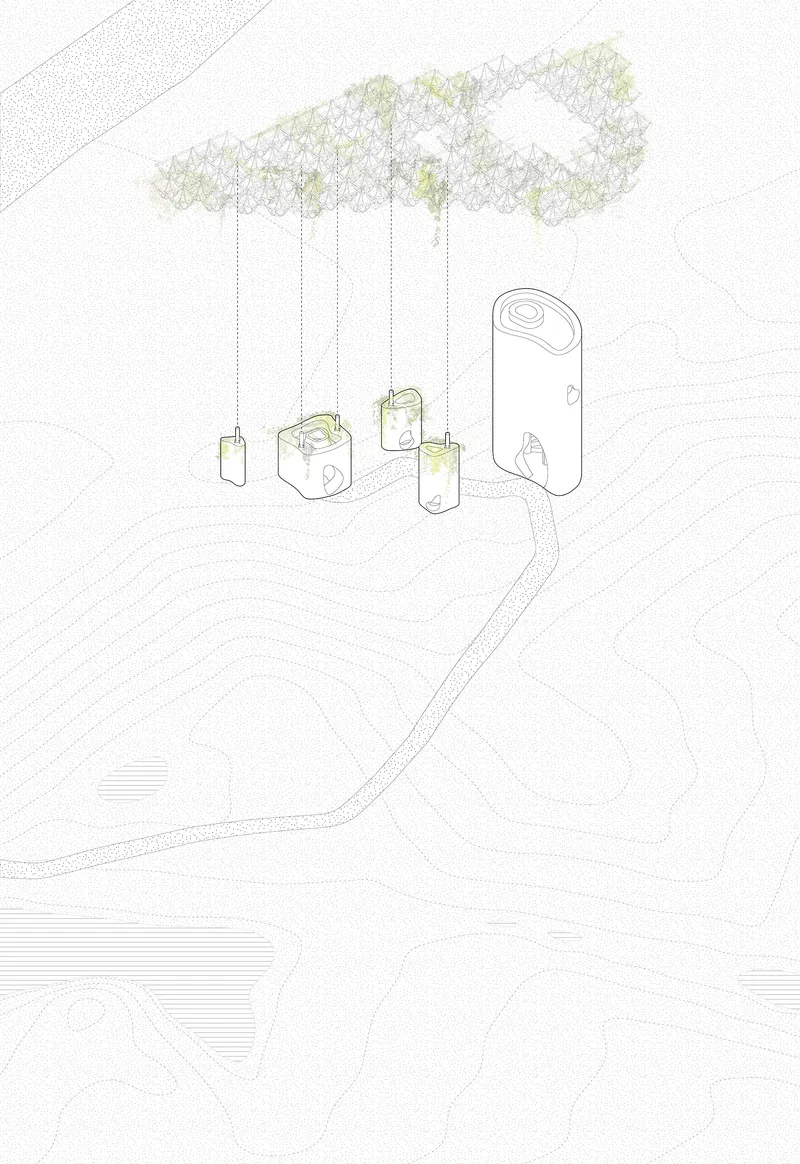
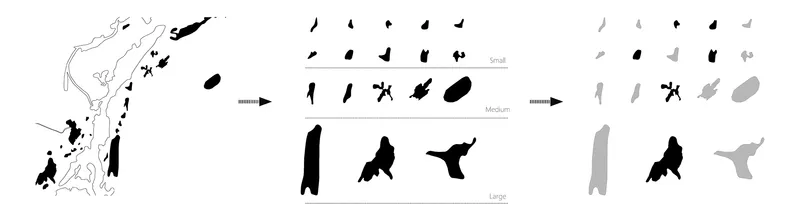

The drawings reveal the design logic with admirable clarity. A diagram traces the abstraction process from the organic, irregular forms found on the site to the simplified geometric footprints of the four clustered pavilion volumes. Another shows the progressive transformation of a solid earthen mass into a columned structural frame, punched through with voids until it reaches the final configuration. The axonometric confirms that the canopy and the columns are two independent structural systems that simply overlap.
The construction details of the bamboo canopy are particularly instructive: bamboo units sit on a steel truss framework, with woven bamboo fill panels spanning between members. It is a hybrid system that uses bamboo where it performs best, in compression and as a screen, while relying on steel where spans demand it. The section drawings show the pavilion partially embedded in sloping terrain, clarifying how the building mediates between the raised shoreline and the lower river channel.
Why This Project Matters
Tourism pavilions in China's protected natural areas have a troubled track record. Too many default to either photogenic gesture or invisible restraint, ending up as either Instagram follies or forgettable shelters. Studio 10's Wetland Caves Pavilion threads a difficult needle: it is visually memorable without being loud, materially specific without being precious, and deeply rooted in its site without collapsing into pastiche of the nearby Longyou Caves.
The real lesson is in the relationship between the two structural systems. The heavy earthen columns and the light bamboo canopy are not just a contrast for its own sake. They produce two genuinely different spatial experiences, compression and diffusion, that unfold as visitors move through the pavilion. At 85 square meters, the project delivers a richer sequence of spaces than many buildings ten times its size, and it does so with materials and construction systems that acknowledge the wetland context rather than overriding it. That is what a discovery pavilion should do: make you pay closer attention to the place you came to see.
A Discovery Pavilion in the Longyou Wetlands (Wetland Caves Pavilion) by Studio 10, led by Shi Zhou. Located in Quzhou, China. 85 m². Completed in 2023. Structural Design Consultant: Shanghai Jingdao Bamboo Construction Design Co. LTD. Photography by Chao Zhang and Guowei Liu.
About the Studio
Share Your Own Work on uni.xyz
If projects like this are the kind of work you want to make, uni.xyz is a place to publish your own, find collaborators, and enter design competitions.


Popular Articles
Popular articles from the community


FCC Arquitectura Expands a Portuguese Granite House with a Board-Marked Concrete Wing
In Portugal, JV House pairs a cleaned-up whitewashed and granite dwelling with a timber-shuttered concrete extension, courtyards and a garden pool.

graciastudio Turns a Viewless Tijuana Lot Inward Around a Courtyard of Concrete, Timber and Trees
In Tijuana, Jorge Gracia's GA2 House stacks a timber-clad private floor over exposed concrete and replaces a missing view with a planted interior patio.

ETEH Reworks the Shared Spaces of São Domingos School in Brazil Around Timber, Color and Hanging Plants
At São Domingos School in Brazil, 436 m² of hall, refectory and library are recast with timber joinery, a yellow and blue code and trailing greenery.


Aquadapt: An Underwater Habitat That Rewrites Its Rooms by the Hour
Curved modules ring the seabed while one shell shifts from breakfast room to cinema, farm and football pitch as residents' needs change.

Similar Reads
You might also enjoy these articles

LAVA Architecten Gives Vocational Education a Sawtooth-Roofed Face on a Mechelen School Campus
In Mechelen, Belgium, a 2,053 m² STEM school on a 6×6 m grid turns workshops and classrooms into rooms that can be rearranged as teaching changes.

KEMA Studio Turns a Derelict Marvila Attic into a 60 m² Lighthouse Apartment Above Lisbon
In Lisbon's Marvila district, a rebuilt roof, four skylights and two plywood volumes turn an unlivable attic into a bright home facing the Tagus.

Pixel Gardens: One Repeated Module Stacked Into a Terraced Social Housing Tower for Famagusta
Salem Bader's shortlisted housing tower builds a vertical neighbourhood from one repeated module, offsetting units to carve terraces, light and air.

Bao Huynh Watercolor Atelier: A Serene Art Retreat in Hội An
Bao Huynh Watercolor Atelier in Hội An blends multifunctional art spaces, sustainable design, local materials, and family-friendly living in a serene environment.

Explore Wetland Competitions
Discover active competitions in this discipline

Challenge to design a portable theatre

Challenge to design a portable music platform

Challenge to design an open learning module for the elderly

Design challenge to reuse E-waste
Comments (0)
Please login or sign up to add comments
No comments yet. Be the first to comment!