
Studio 10 Scatters Colorful Sports Pavilions Across a Volcanic Island Waterfront in Fujian
Three rotated volumes clad in glass block and mosaic tile serve kayakers and adventurers on Zhangzhou's Double Happiness Island.


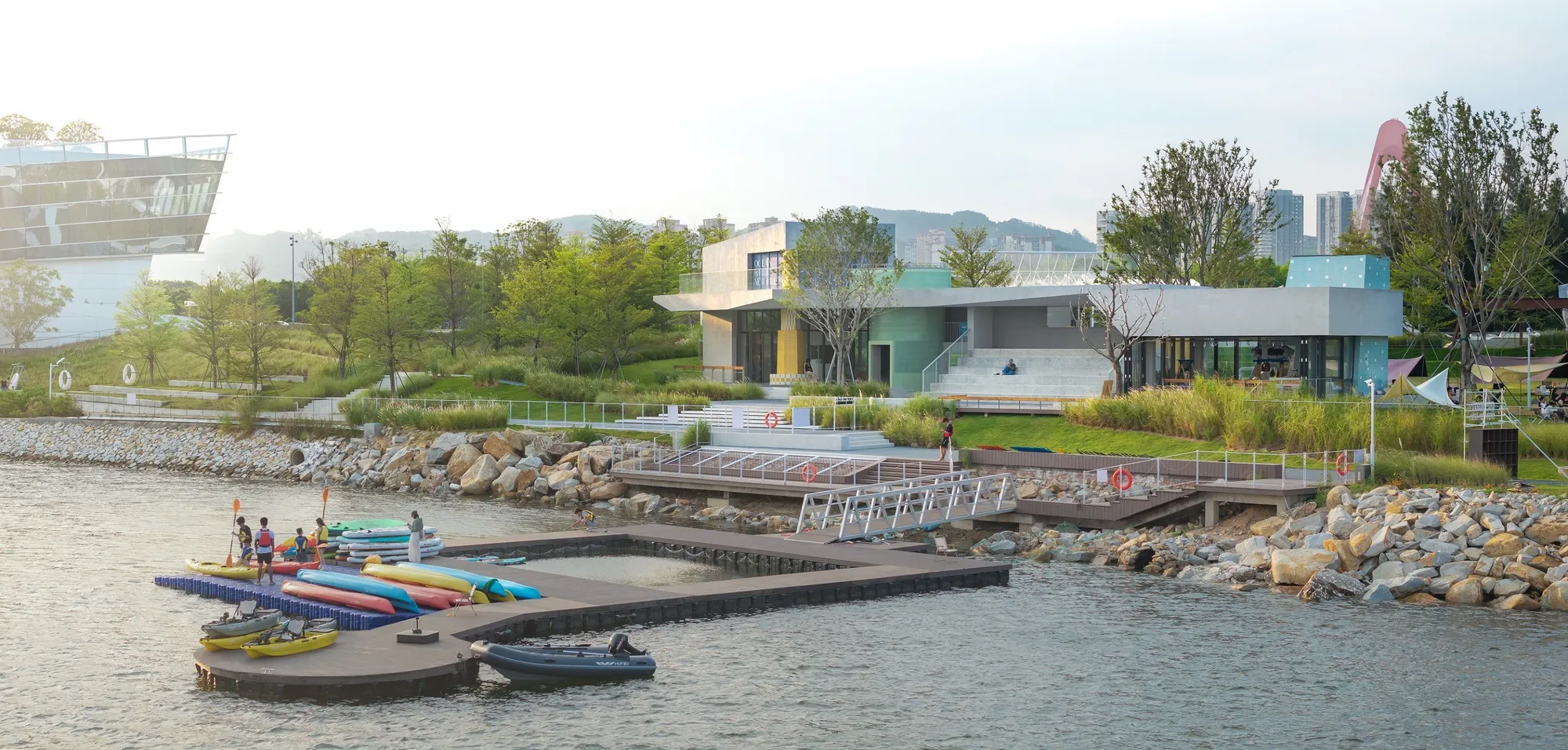
Double Happiness Island, a volcanic outcrop off the coast of Zhangzhou in Fujian Province, is the kind of site that resists a single architectural gesture. The shoreline is rough, the vegetation subtropical, and the program, a set of water sports support facilities for a venture called Nerve Lab, demands something loose and informal rather than monumental. Studio 10, led by Shi Zhou, responded with three small buildings totaling just 219 square meters, each one rotated slightly off-axis from the others to open sightlines to the water and slot around existing trees. The result reads less like a campus and more like a scattering of objects that happened to land well.
What makes the project worth studying is the tension between its playful surface palette and a surprisingly rigorous structural logic. Cantilevered concrete floor slabs, deep soffits, and ribbon windows give the pavilions a taut, midcentury posture, while curved glass block walls, checkered mosaic columns, and saturated tile cladding in mint green and mustard yellow push the whole composition toward something almost pop. The buildings serve kayakers, paddle-boarders, and casual visitors, but their real function may be proving that recreational architecture in China does not have to default to either brutalist severity or theme-park whimsy.
Three Volumes, Three Rotations
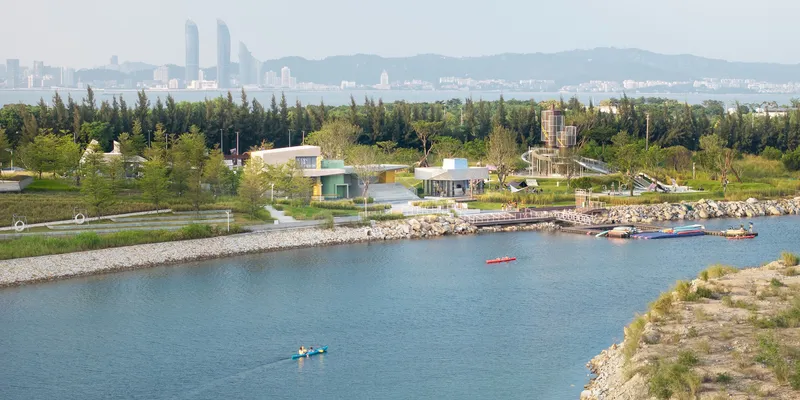
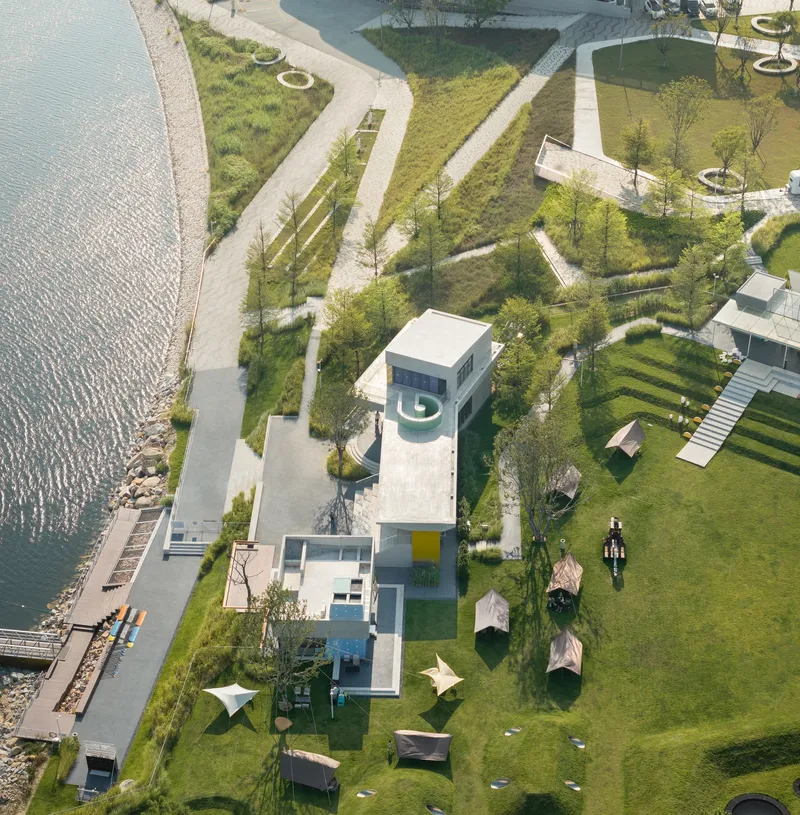
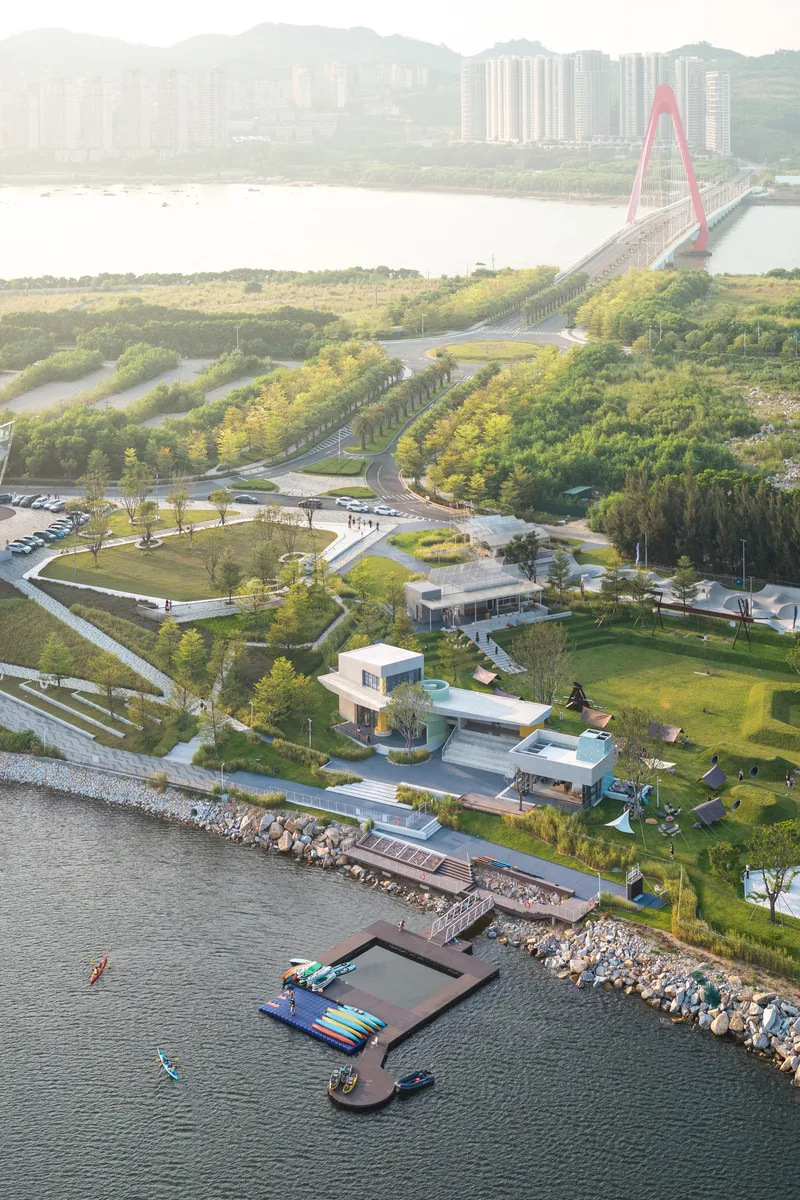
Seen from the air, the compositional strategy is immediately legible. Three rectangular volumes sit within a soft landscape of mounded lawns, gravel paths, and existing trees, each one pivoted a few degrees from its neighbor. The rotation does real work: it prevents any single facade from blocking the others' water views, it creates wedge-shaped outdoor rooms between the buildings, and it allows the floating dock and kayak launch to be reached from multiple angles without a dominant circulation spine.
The arrangement also gives each structure a distinct relationship to the shoreline. One pavilion faces the dock head-on, another turns its flank to the water, and the third opens toward the red suspension bridge and forested hillside beyond. From a distance the cluster resembles a loose mineral formation rather than a planned facility, which seems exactly right for a volcanic island.
Tile, Glass Block, and the Art of the Surface
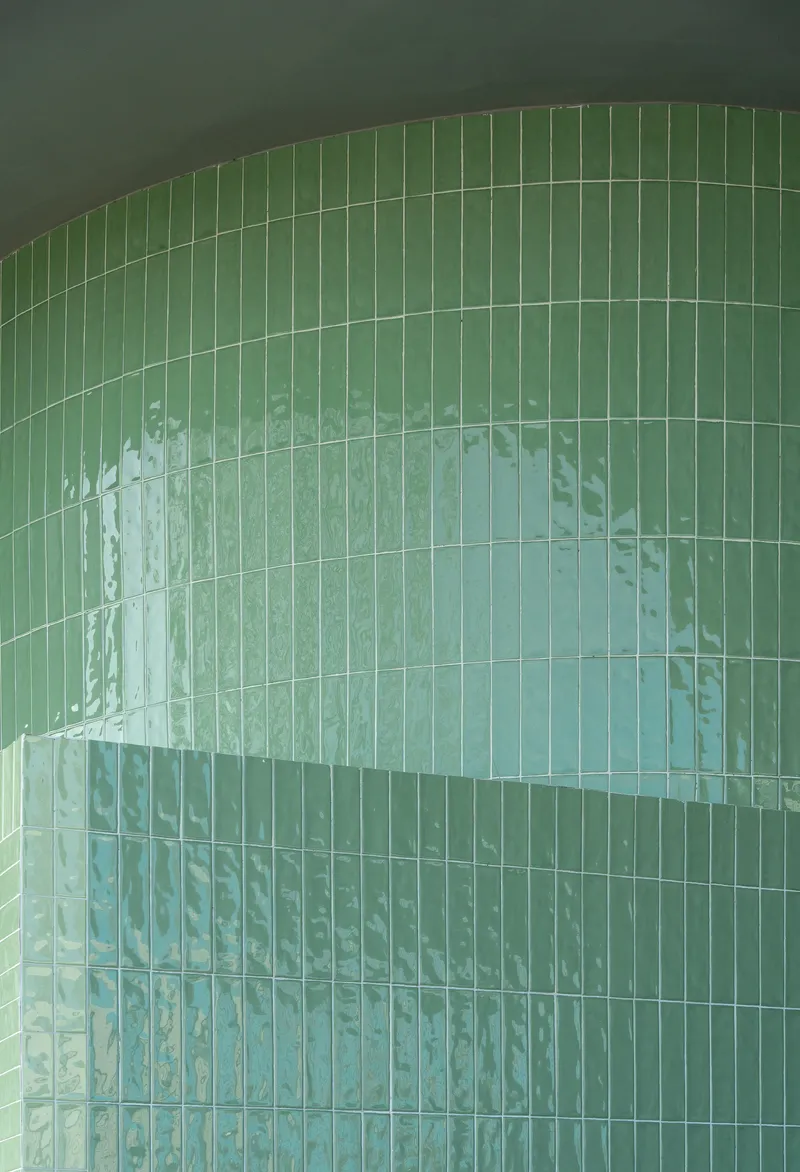
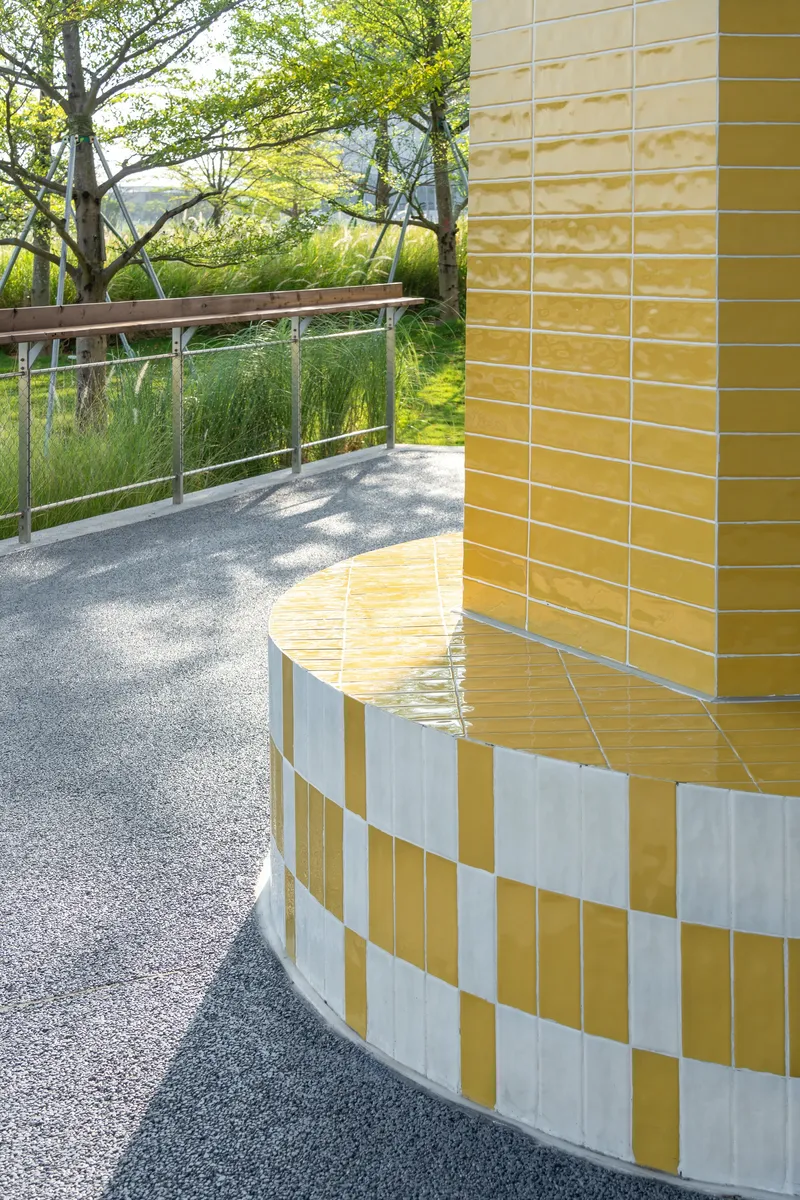
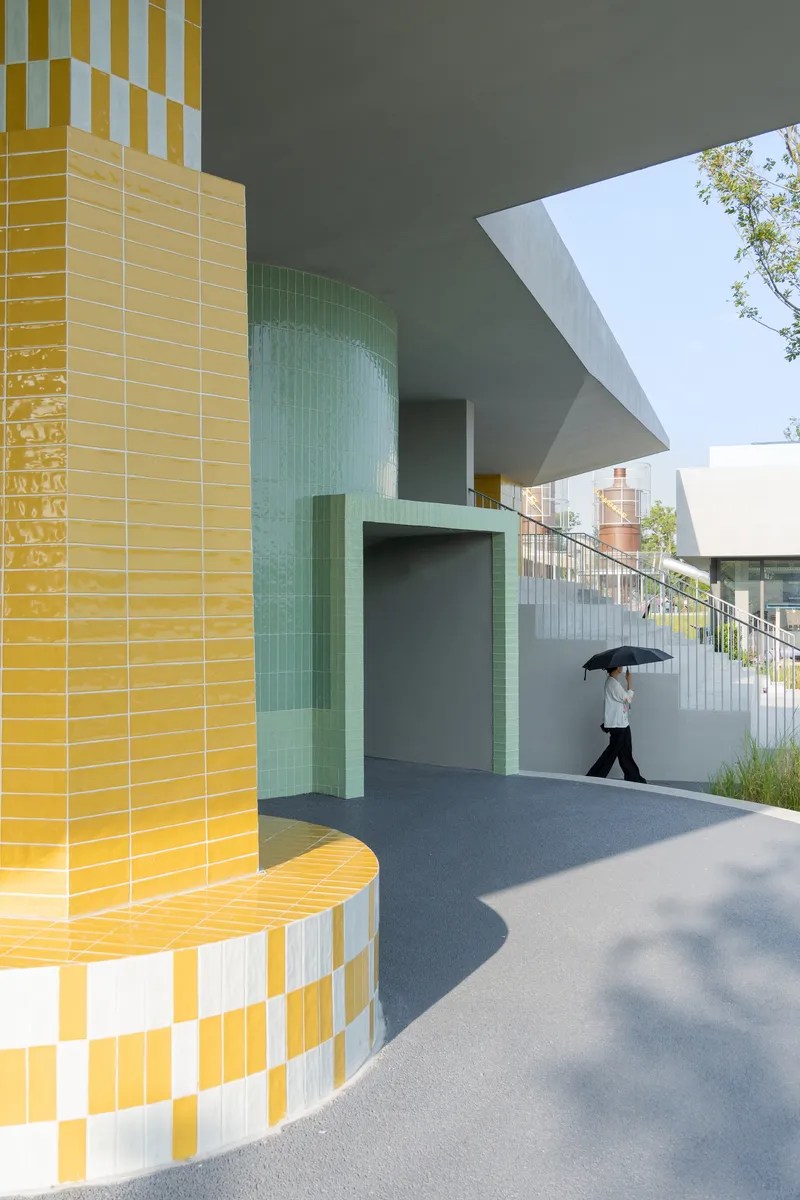
The material palette is the project's most provocative decision. Curved walls of pale green glass block catch light and scatter it across concrete soffits. Cylindrical stair cores are wrapped in mint subway tile, their horizontal mortar joints accentuating the curvature. Columns at the covered walkways alternate between yellow pixelated mosaic and a yellow-white checkerboard pattern that would not be out of place in a 1960s Italian gelateria.
None of this registers as gratuitous. The tile is durable, easy to clean after salt spray, and provides visual orientation: you know which building you are approaching by its dominant color. The glass block, meanwhile, gives the primary stair volume a lantern quality at dusk, signaling the entrance from the water. Studio 10 is using surface not as ornament but as a wayfinding system embedded in the architecture itself.
Staircase as Protagonist
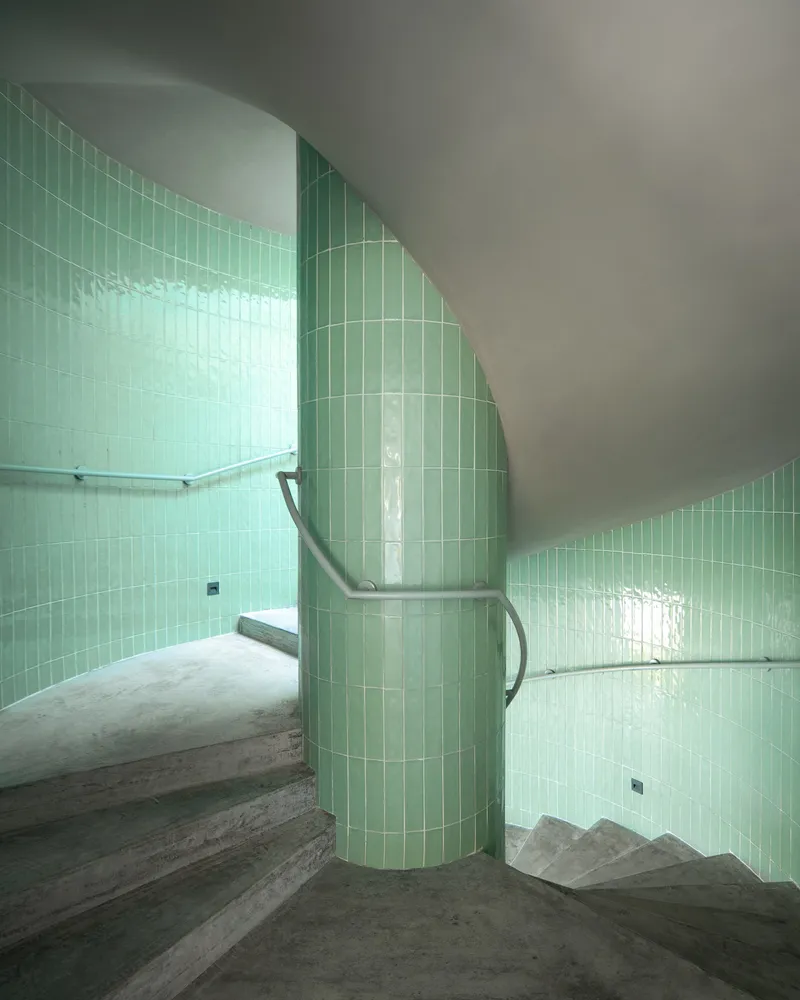
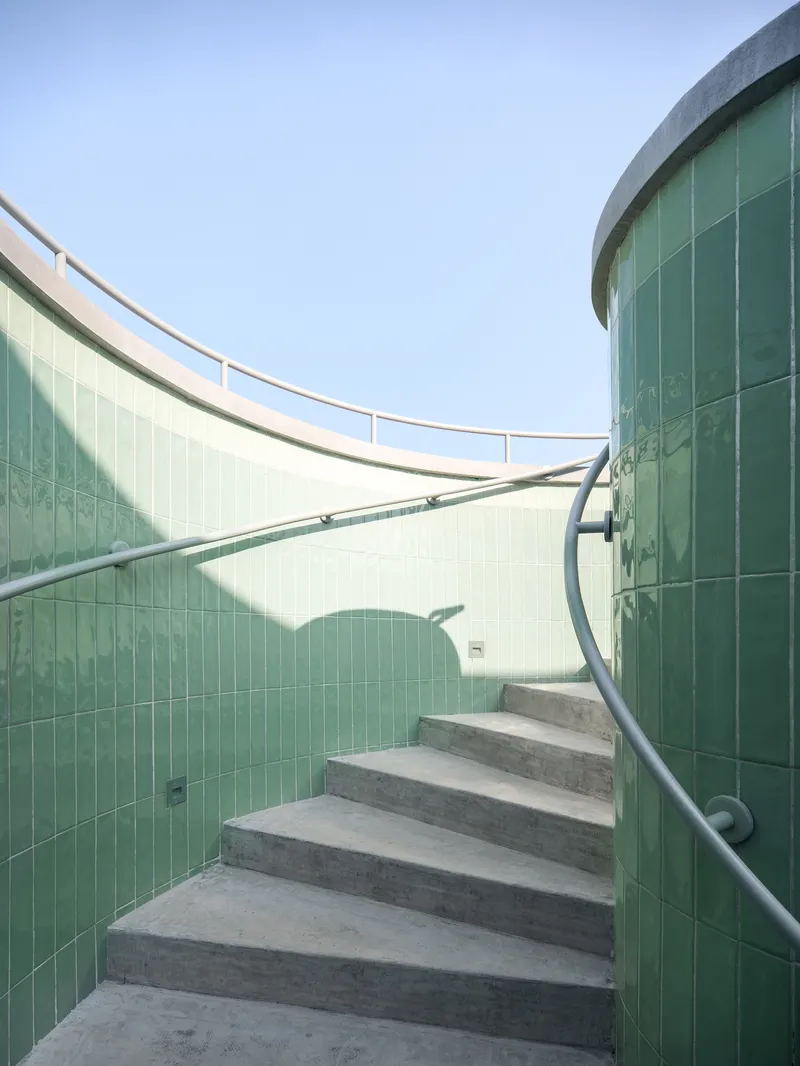
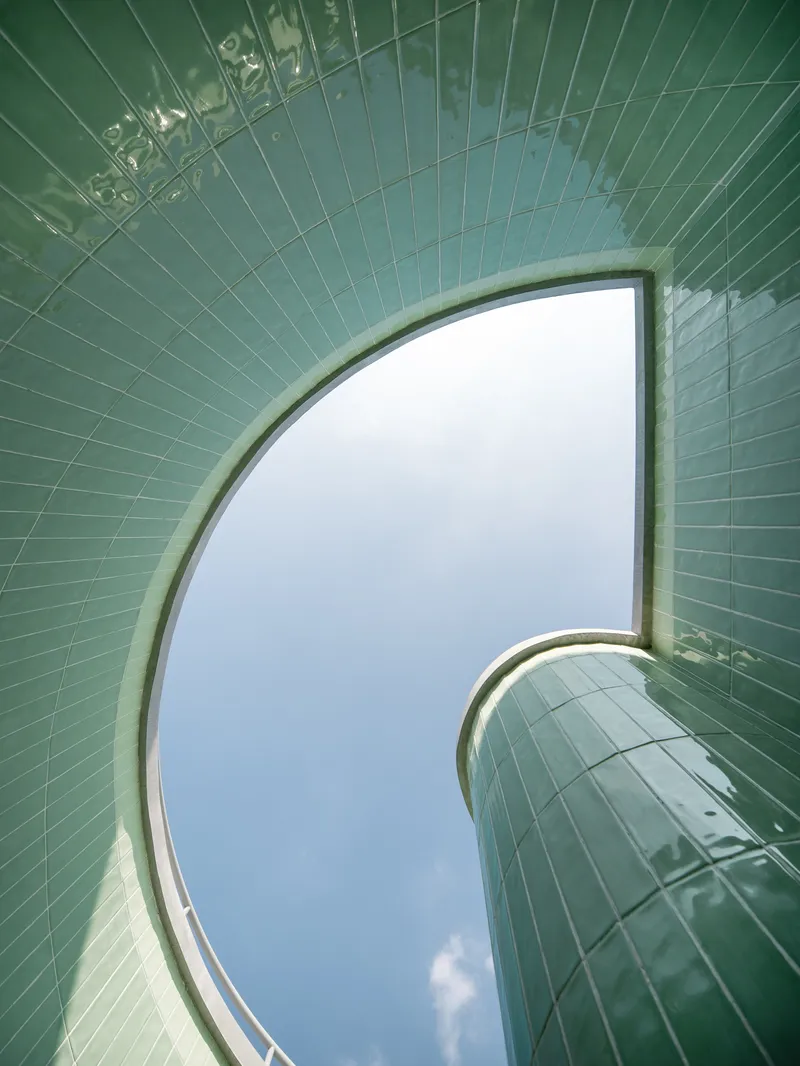
In a building of just 219 square meters, devoting this much volume to a spiral staircase is a bold call. The curved concrete treads wrap upward between twin walls of green glass block, open to the sky at the top through a circular oculus that frames nothing but cloud. It is the one moment where the architecture turns inward, away from the waterfront spectacle, and asks you to notice light, material, and the sensation of ascent.
The staircase also solves a practical problem. It connects a lower entry level to the elevated terrace where most of the activity spaces sit, and its cylindrical plan allows it to act as a hinge between the rotated volumes. Structurally, the cylinder stiffens the cantilevered floor slab. Formally, it is the one piece that could belong to any of the three buildings, anchoring the composition without dominating it.
The Elevated Terrace and Its Deep Soffit
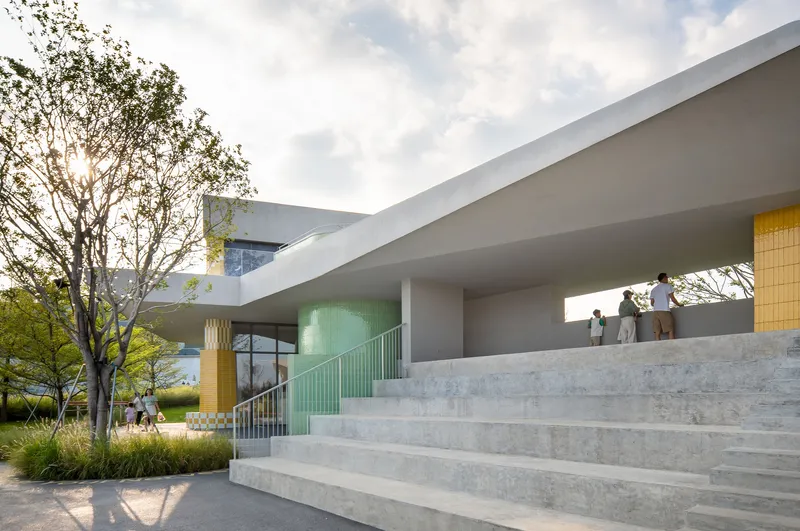
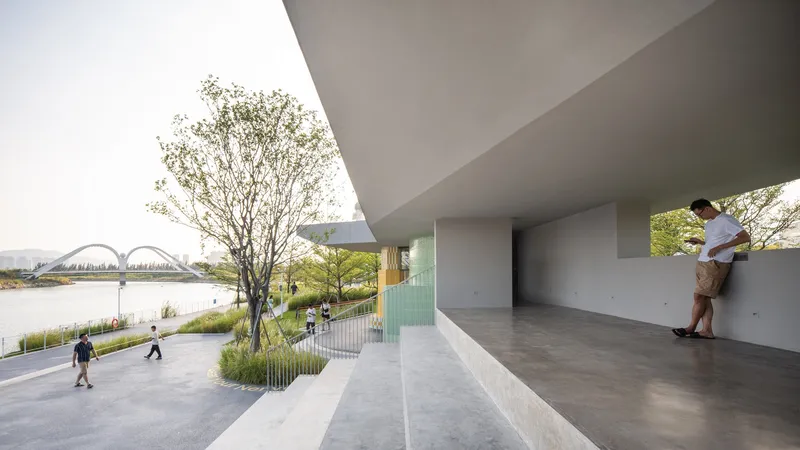
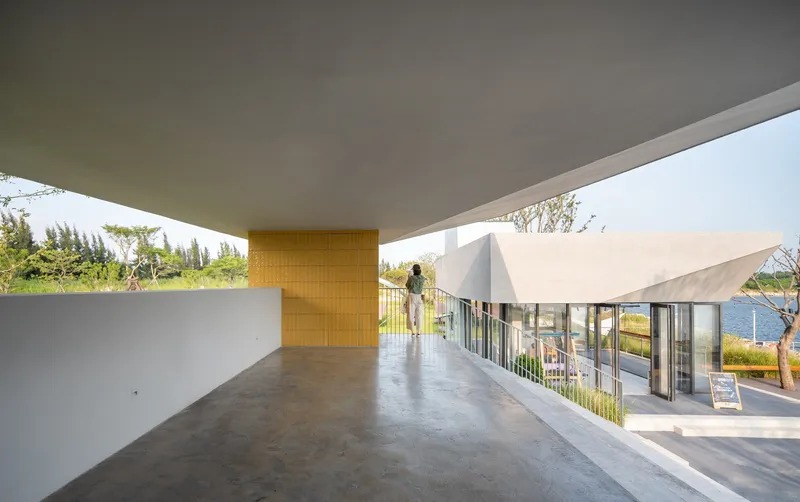
Lifting the main program a full story off the ground creates a generous covered zone at grade: a shaded entry, equipment storage, and a sheltered path that connects the buildings without requiring enclosed corridors. The deep concrete soffit overhead is left raw, its formwork texture visible, offering a deliberate contrast to the glazed and tiled surfaces wrapping the volumes above.
Up on the terrace, the spatial character changes. The concrete canopy is thinner, the glazing more generous, and the views out to the waterfront are unobstructed. Yellow tiled columns punctuate the terrace edge like oversized bollards, framing the lawn and water below. There is a civic generosity to this upper level that belies the modest program. It feels like a belvedere, not a changing room.
Landscape as Infrastructure
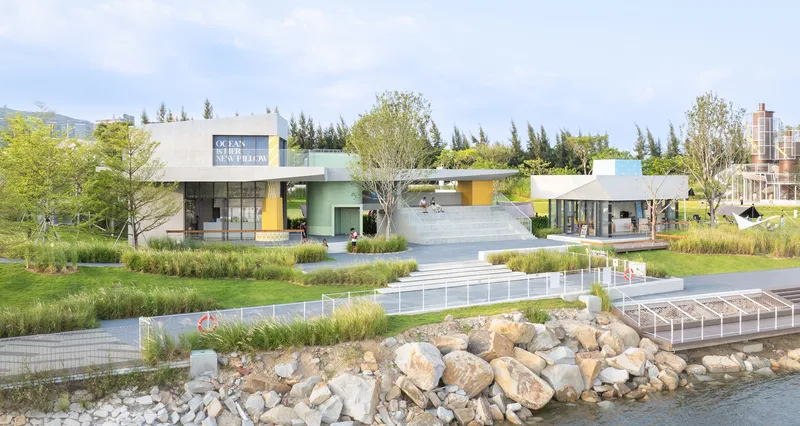
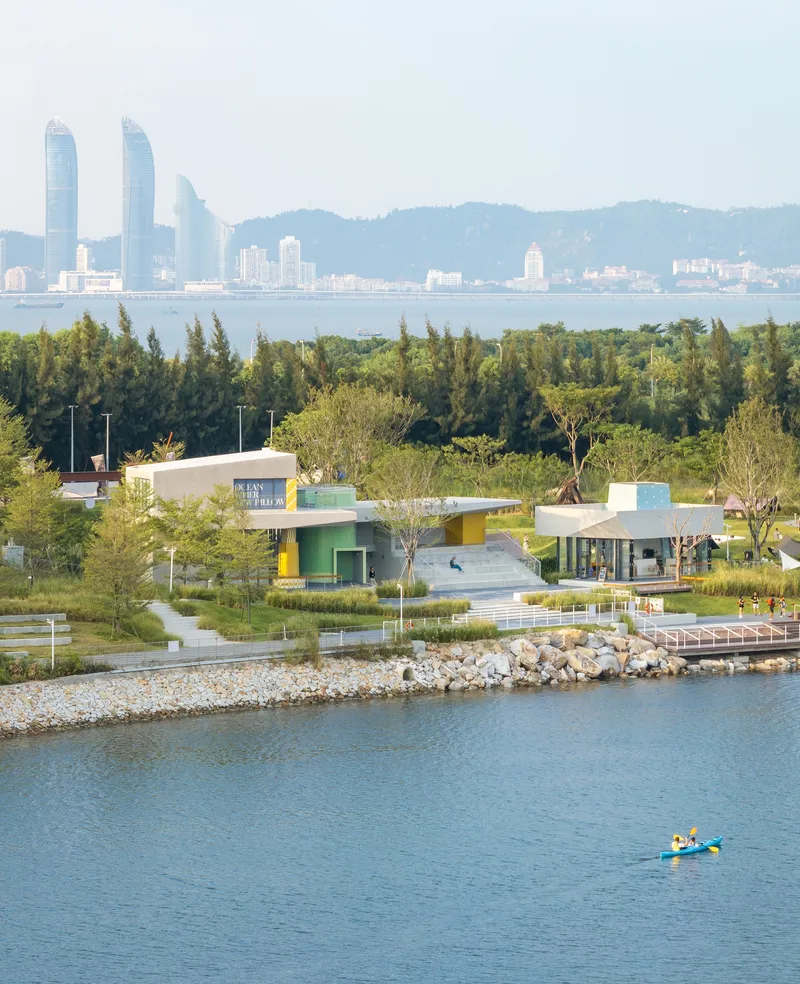
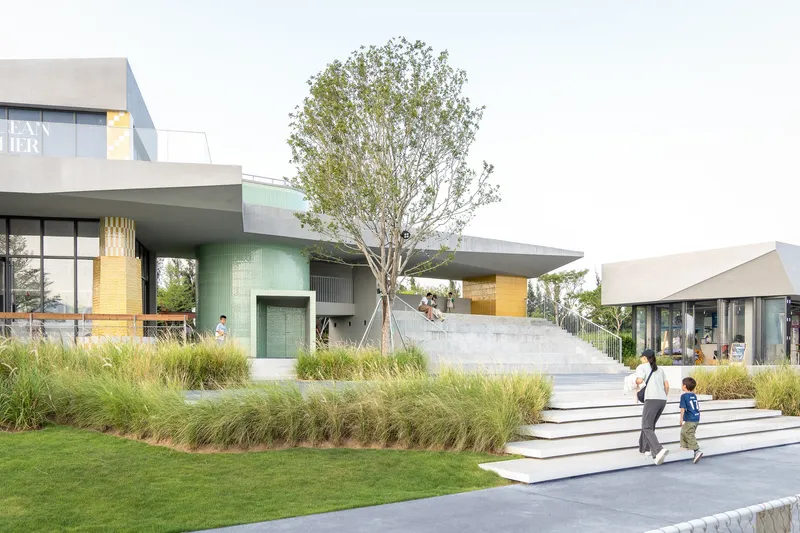
The rock-edged shoreline, native grasses, and mounded lawn beds are not incidental to the project. They do the heavy lifting of erosion control and stormwater management while softening the transition from architecture to water. Kayak paths emerge naturally from the gaps between planted berms, and the wide concrete staircase that ascends from the shore doubles as informal seating for spectators watching the water.
Studio 10 resisted the temptation to hardscape the waterfront into a marina. Instead, the landscape maintains the island's rough, semi-wild character, and the buildings sit within it like guests rather than hosts. The distant view from the water, with colored volumes peeking above the grasses, is arguably the project's best elevation.
Color and Context at Twilight
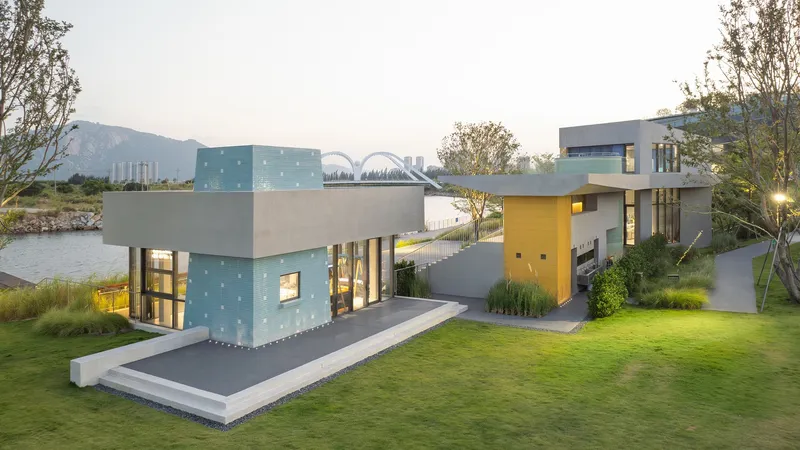
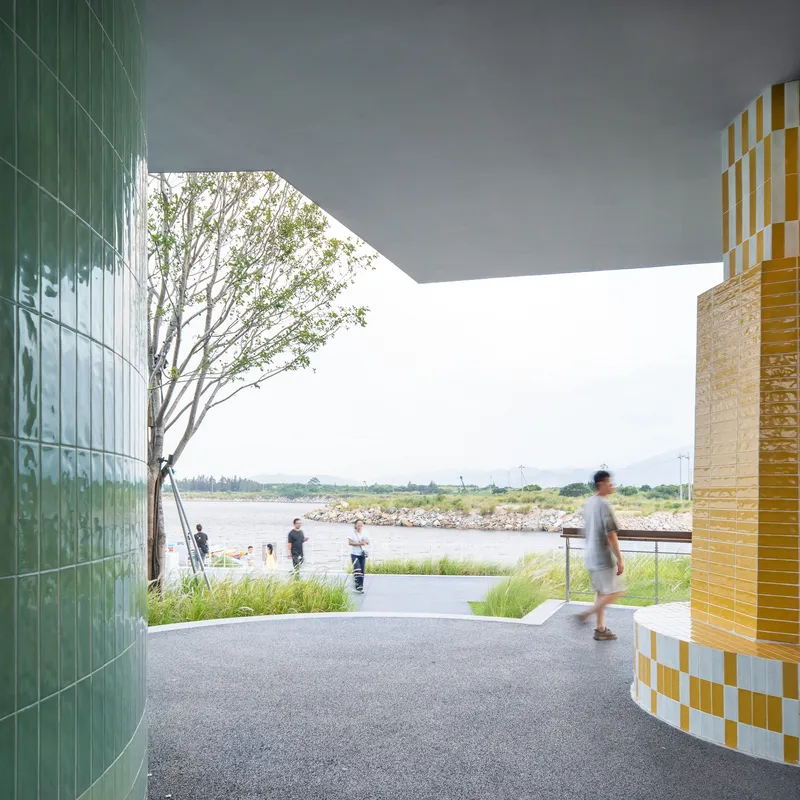
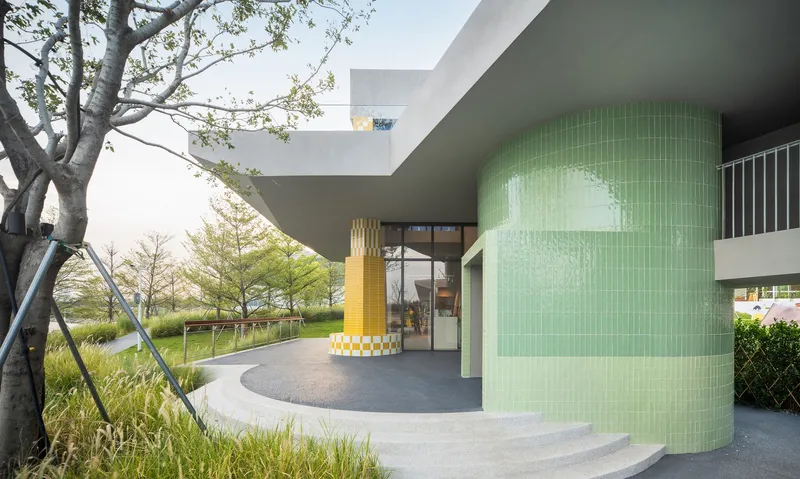
At dusk, the glass block volume glows from within and the yellow columns warm under artificial light, transforming the pavilions from daytime sports facilities into something closer to a waterfront lantern. The covered walkways, framed by green tile and mosaic, become luminous corridors that pull visitors toward the water's edge.
The color choices also connect the project to a broader regional tradition. Fujian's vernacular architecture is famously polychromatic, from the red brick of Minnan houses to the painted eaves of Hakka tulou. Studio 10's palette is obviously contemporary, but the willingness to use saturated color on exterior surfaces acknowledges a local appetite for visual intensity that white-box minimalism tends to suppress.
Plans and Drawings
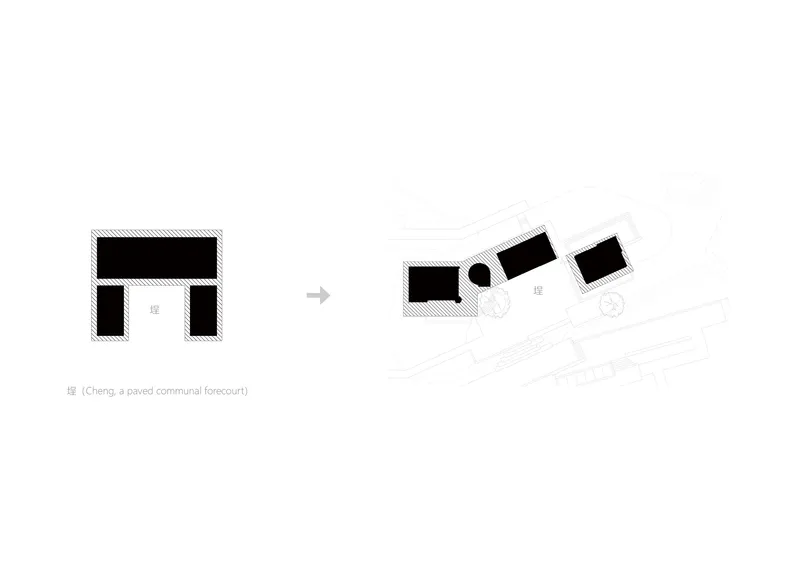
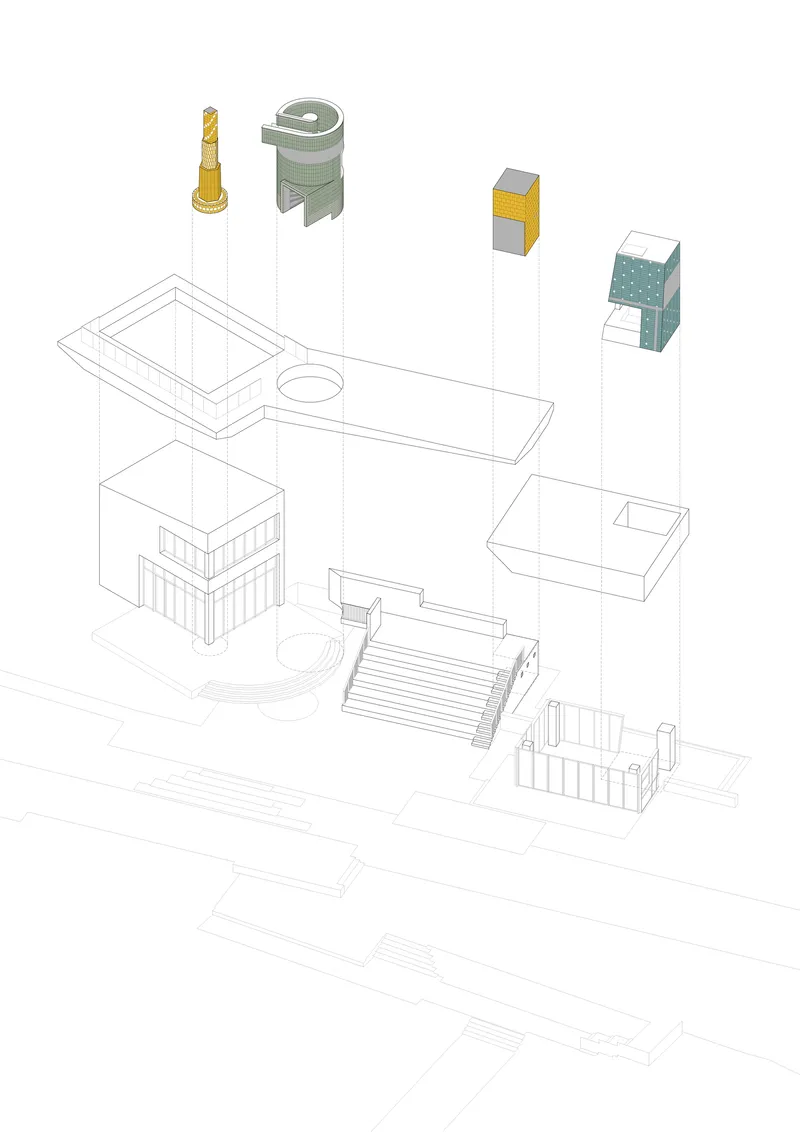
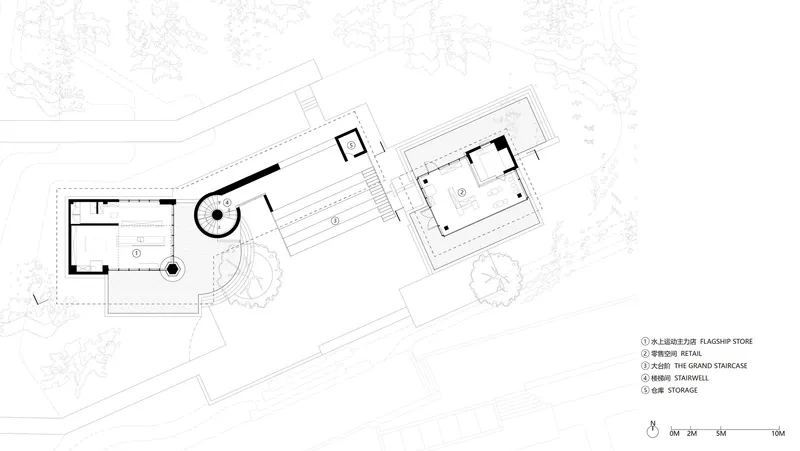
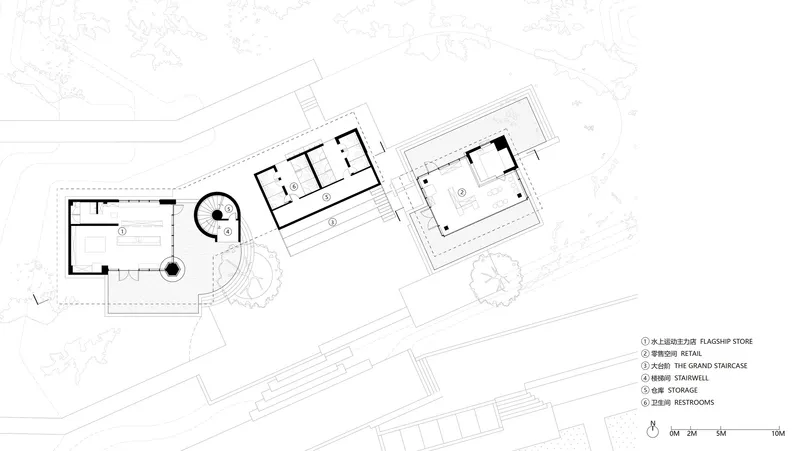
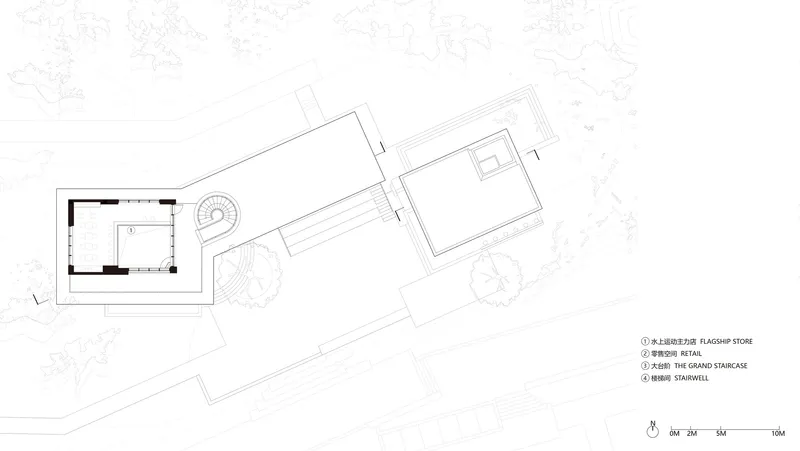
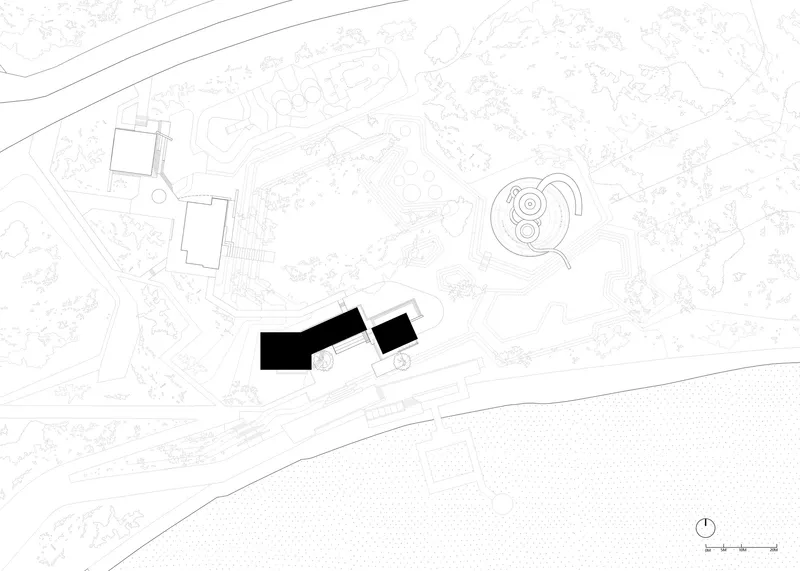
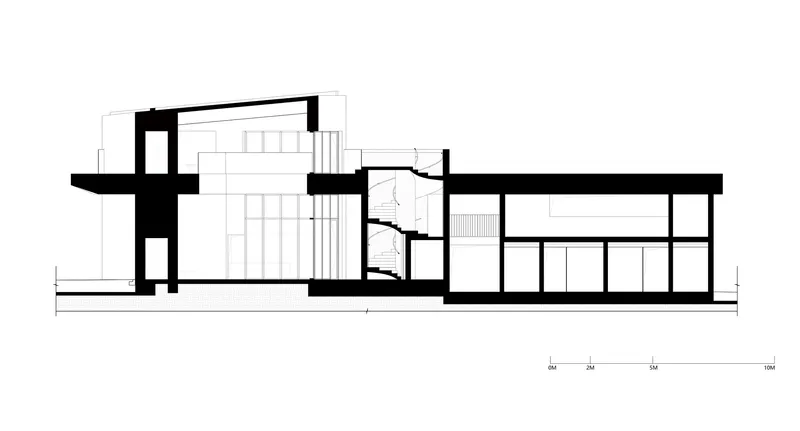
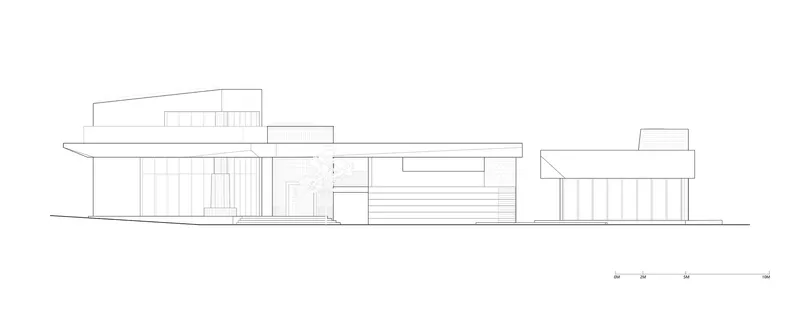
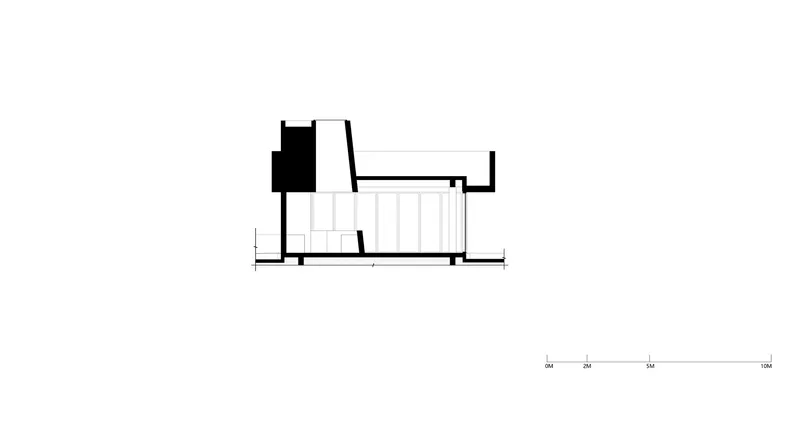
The rotation diagram is the key drawing. It shows the three volumes starting from a shared orthogonal grid, then pivoting outward like the blades of a fan. The exploded axonometric reveals a tight kit of parts: concrete slabs, glass block cylinders, tile-clad screen walls, and steel canopies, each separated into a distinct material layer. Floor plans confirm that the interiors are deliberately minimal, with circulation and services concentrated in the cylindrical cores, leaving the rectangular volumes as open, flexible rooms.
The sections tell the story of ground-to-terrace movement most clearly. A stepped floor in one building and a spiral stair in another give each volume a slightly different sectional profile, which reads from the exterior as a varied roofline. The site plans place the buildings within a larger network of docks, paths, and topographic contours, reinforcing the idea that architecture here is one layer in a multi-system landscape.
Why This Project Matters
Recreational architecture is often treated as disposable: temporary shelters for seasonal activities, built cheaply and replaced within a decade. Nerve Lab refuses that logic. At 219 square meters it is tiny, but the investment in material quality, structural ambition, and landscape integration suggests a building intended to outlast its first programmatic cycle. If the kayak rental folds, these pavilions could become a cafe, a gallery, or a community meeting point without a single wall needing to move.
More importantly, Studio 10 demonstrates that small-scale projects on peripheral sites can carry genuine architectural ideas. The rotational composition, the glass block stair-as-lantern, and the tile-as-wayfinding strategy are all transferable concepts that deserve attention beyond this particular island. In a discipline that too often reserves invention for prestige commissions, Nerve Lab is a reminder that a water sports shed on a volcanic outcrop can be a laboratory for architecture itself.
Nerve Lab. Experimental Sports Support Buildings on Double Happiness Island by Studio 10 (lead architect: Shi Zhou). Zhangzhou, Fujian Province, China. Completed 2025. 219 m². Photography by Chao Zhang.
About the Studio
Share Your Own Work on uni.xyz
If projects like this are the kind of work you want to make, uni.xyz is a place to publish your own, find collaborators, and enter design competitions.



Popular Articles
Popular articles from the community


Conexión: Biophilic Design Reimagines High-Rise Living in Hong Kong
Conexión reimagines high-rise living in Hong Kong through biophilic design, green facades, shared spaces, daylight, water and nature within.

Play: Fragments of Their World
Familiar architecture becomes modular playground design, creating safe spaces where displaced children can learn, connect, imagine and play.

Co-life: Sustainable Architecture for Age-Friendly Community Living
Co-life reimagines sustainable architecture for seniors through courtyards, rammed earth, shared gardens, and spaces designed for belonging.

Lunar Spiral: Space Architecture Shaped by the Mathematics of the Universe
Lunar Spiral reimagines space architecture through Fibonacci geometry, lunar regolith, levitating habitats, and self-sustaining Moon living.

Similar Reads
You might also enjoy these articles

Bao Huynh Watercolor Atelier: A Serene Art Retreat in Hội An
Bao Huynh Watercolor Atelier in Hội An blends multifunctional art spaces, sustainable design, local materials, and family-friendly living in a serene environment.

Atelier Macri Concept Store Interior Design by CASE-REAL
Atelier Macri store features a "ko" counter, walnut wood details, cork displays, blending retail, gallery, and seamless customer experiences.

Manuel Vargas Izquierdo Stadium and High-Performance Sports Center: Architectural Excellence in Jalpa de Méndez
The Manuel Vargas Izquierdo Stadium blends sustainable design, inclusive sports facilities, and cultural-inspired architecture, revitalizing Jalpa de Méndez’s public spaces.

KAKR Buluh Awar Hall: Revitalizing Community and Ecology Through Bamboo Architecture
Community built bamboo hall revitalizes Buluh Awar village, empowering youth, restoring ecology, celebrating vernacular craftsmanship through sustainable architecture and culture.




Comments (0)
Please login or sign up to add comments
No comments yet. Be the first to comment!