
Studio Andrew Trotter Turns Two Pugliese Farm Buildings into a Three-House Retreat in the Olive Groves
Borgo Gallana channels centuries of southern Italian building tradition into an ascetic countryside bed and breakfast near Oria, Puglia.


Most hospitality projects in Puglia lean on the region's white stone vernacular as a kind of aesthetic shorthand: vaults, arches, lime plaster, done. Studio Andrew Trotter goes further at Borgo Gallana by treating the vernacular not as a look but as a construction logic. Two existing farm structures on an olive-dotted plot near Oria were extended and subdivided into three self-contained houses, each with its own bedroom, kitchen, living area, private garden, and outdoor masonry bath. Over fifty local craftsmen built the additions using tufo sandstone, an age-old material pressed from volcanic ash, and traditional techniques that keep the new work virtually indistinguishable from the old.
What makes the project worth studying is its restraint. There is no imported marble, no statement lighting, no accent wall. The palette is cement floors, copper taps, bespoke stone sinks, and terracotta pots. Every surface reads as continuous with the landscape: white walls dissolve into white sky, gravel courtyards blur into native grass, and arched openings frame olive trunks like paintings that change with the season. Borgo Gallana is a reminder that luxury in architecture can be measured not by addition but by the discipline of leaving things out.
White Walls and Olive Canopies
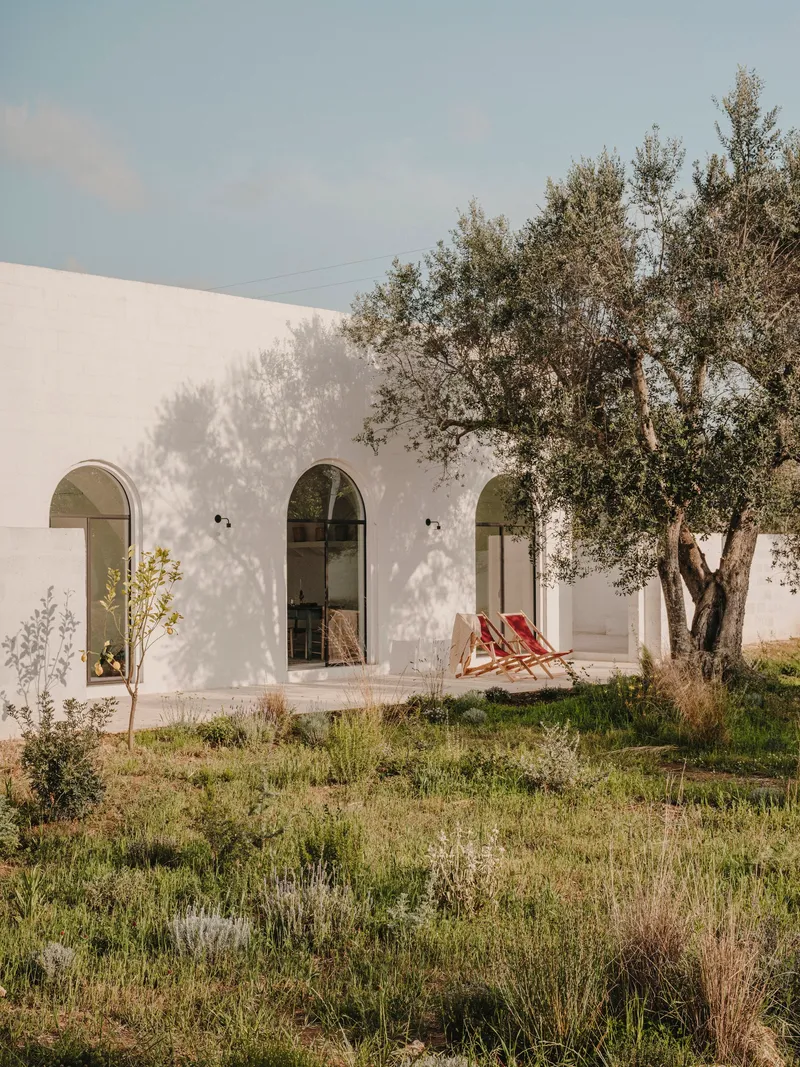
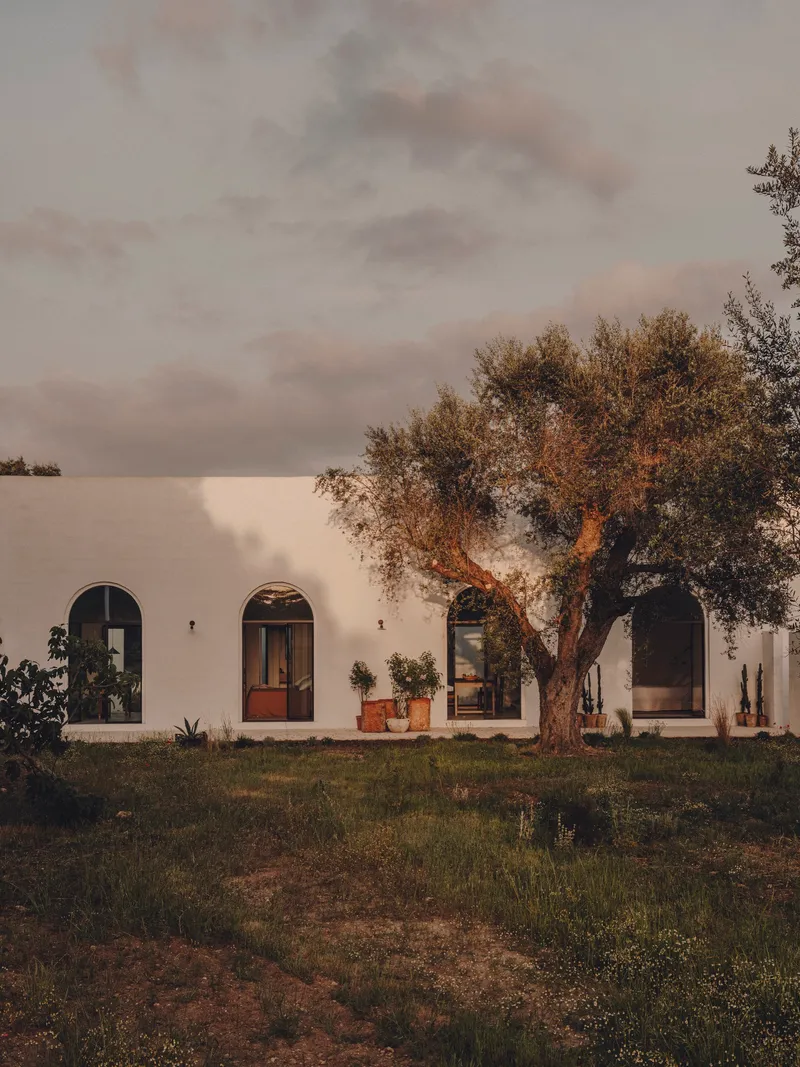

The facades are almost confrontationally plain. Stepped parapets, arched doorways, and white sandstone walls repeat across the three houses with the calm regularity of a small village that grew organically over decades. The decision to render everything in a single continuous white finish erases the seam between existing masonry and new extension, so the complex reads as a single settlement rather than a renovation project with a visible before and after.
Olive trees do the heavy lifting as ornament. Their silver-green canopies break the monochrome with dappled shadow, and their gnarled trunks provide the only curves that aren't architectural arches. At dusk, when warm light spills from the arched glass doors, the relationship inverts: the trees become dark silhouettes, and the buildings glow like lanterns set in the grove.
Courtyards as Connective Tissue


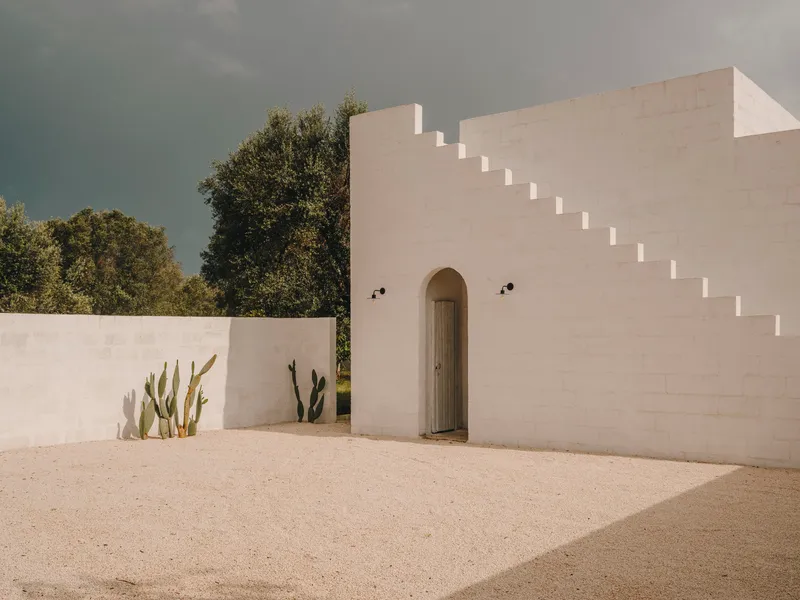
The pebbled courtyard between the two original structures is the social and spatial spine of Borgo Gallana. Thick walls channel movement through narrow passages that widen into planted clearings, creating a sequence of compression and release borrowed directly from the medieval hill towns scattered across Puglia. Potted cacti and young citrus trees punctuate the gravel, their geometry sharp against the soft plaster.
Staircases on both sides of the courtyard lead to rooftop terraces, adding a vertical layer to what could otherwise feel flat and contained. The stairs themselves are sculptural: cantilevered slabs of white concrete that climb rendered walls without railings, relying on the thick flanking walls for both structure and safety. It is a detail that looks minimal but is actually deeply considered, requiring the kind of precise engineering that disappears when done well.
Outdoor Living and the Masonry Bath


Each house has its own outdoor bathing area with a sunken masonry tub and copper rain showerhead, set within a private walled garden. The idea sounds indulgent on paper, but in practice it reads as the most natural thing in the world: you are in southern Italy, it is warm, and you are behind a wall that nobody can see over. The copper fixtures will patina over time, pulling them closer to the earth tones of the terracotta and dried grass beyond the walls.
The outdoor kitchens and dining terraces follow the same logic. Built-in stone benches, linen tablecloths, and potted succulents compose scenes that feel less designed than discovered, as though someone simply started cooking outside one summer and never stopped. A 40-square-meter pool anchors the far end of the property, framed by arched openings in a low wall that borrow a view of the olive grove without sacrificing privacy.
The Pool and Its Frame


The pool terrace is the one moment where the project permits itself a degree of spectacle. A rectangular opening punched through the perimeter wall frames a composition of cacti and distant trees, turning a simple boundary into a picture window. Lounging at the pool, you look through this aperture as through a camera viewfinder, the landscape compressed into a single rectangle that shifts in color from silver-green at midday to warm gold at sunset.
Vaults, Arches, and the Rhythm of Interior Space
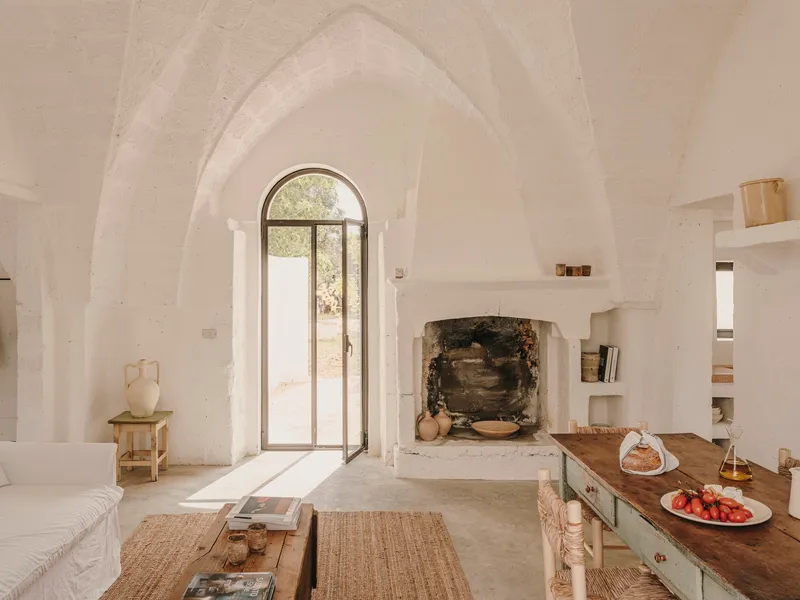


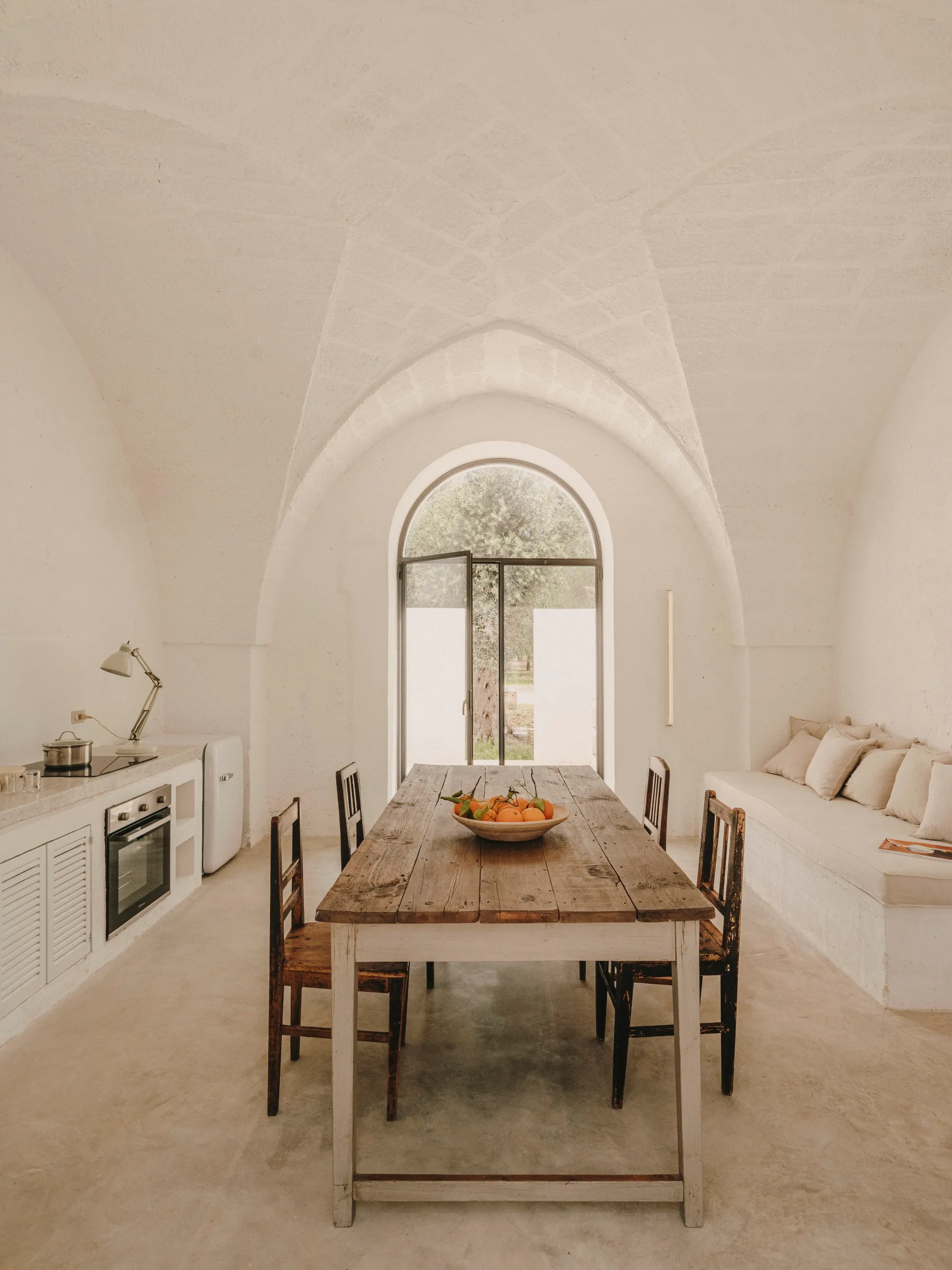
Inside, star vaults and barrel vaults define every room, their geometry exposed beneath a thin coat of white plaster. The vaults do more than look good: they carry load, span masonry walls without steel, and create an acoustic softness that absorbs the echo you might expect from hard concrete floors. In the living spaces, arched doorways frame successive rooms in a deep perspective, each vault slightly different in profile, giving the interiors a rhythm that unfolds as you walk through.
Furnishing is deliberately sparse. Rustic timber tables, woven rush chairs, and a stepped fireplace niche in one of the living rooms are the only furnishings competing for attention with the architecture. The stone fireplace surrounds are original, left exposed as a quiet record of the buildings' agricultural past. Pendant lamps hang low over dining tables, their warm glow pooling on wood and leaving the vaults in soft shadow overhead.
Bedrooms That Open to the Grove

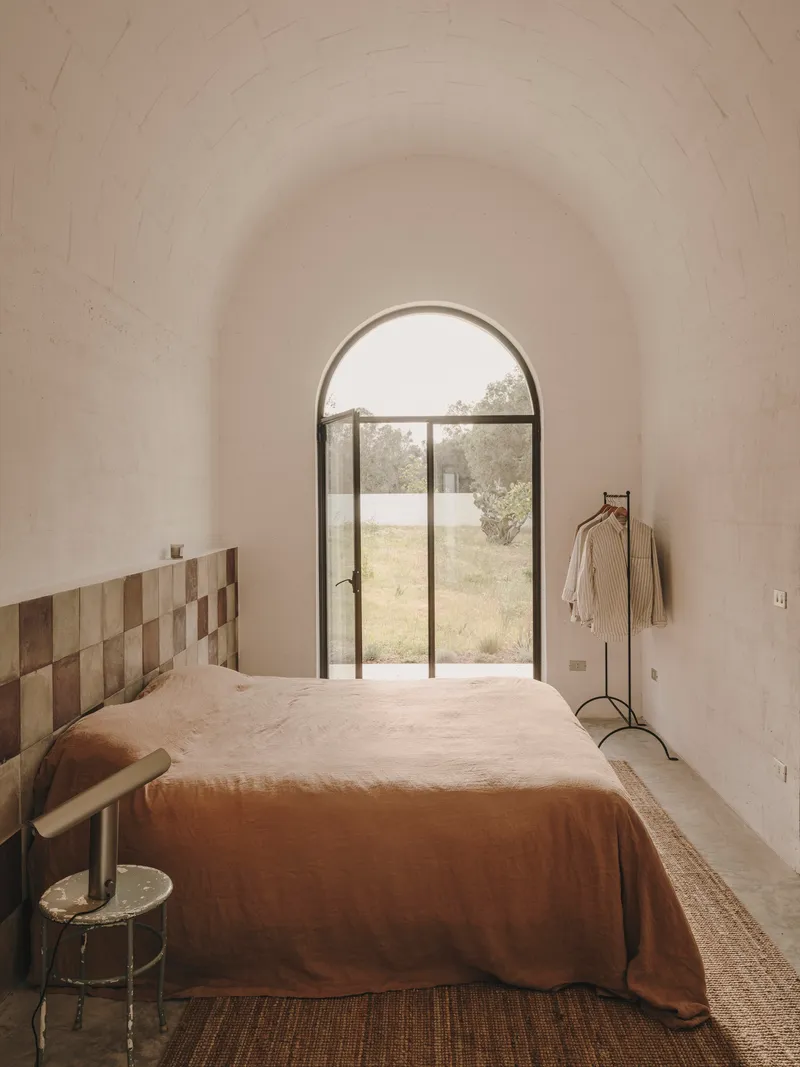

Every bedroom connects to the landscape through full-height arched steel-framed glass doors. The steel frames are painted dark, a deliberate contrast to the white plaster that gives the openings a graphic precision. When the doors swing open, the boundary between interior and garden dissolves entirely, and you sleep with the smell of olive leaves and warm earth drifting across linen bedding.
Headboards range from patchwork timber planks to chequered tiles, each house receiving its own character without breaking the overall tonal discipline. Louvered shutters and freestanding clothing racks replace built-in wardrobes, keeping the rooms open and airy. The polished concrete floors are cool underfoot, a practical comfort in a climate where summer temperatures regularly push past 35 degrees.
Craft in the Details: Kitchens and Bathrooms
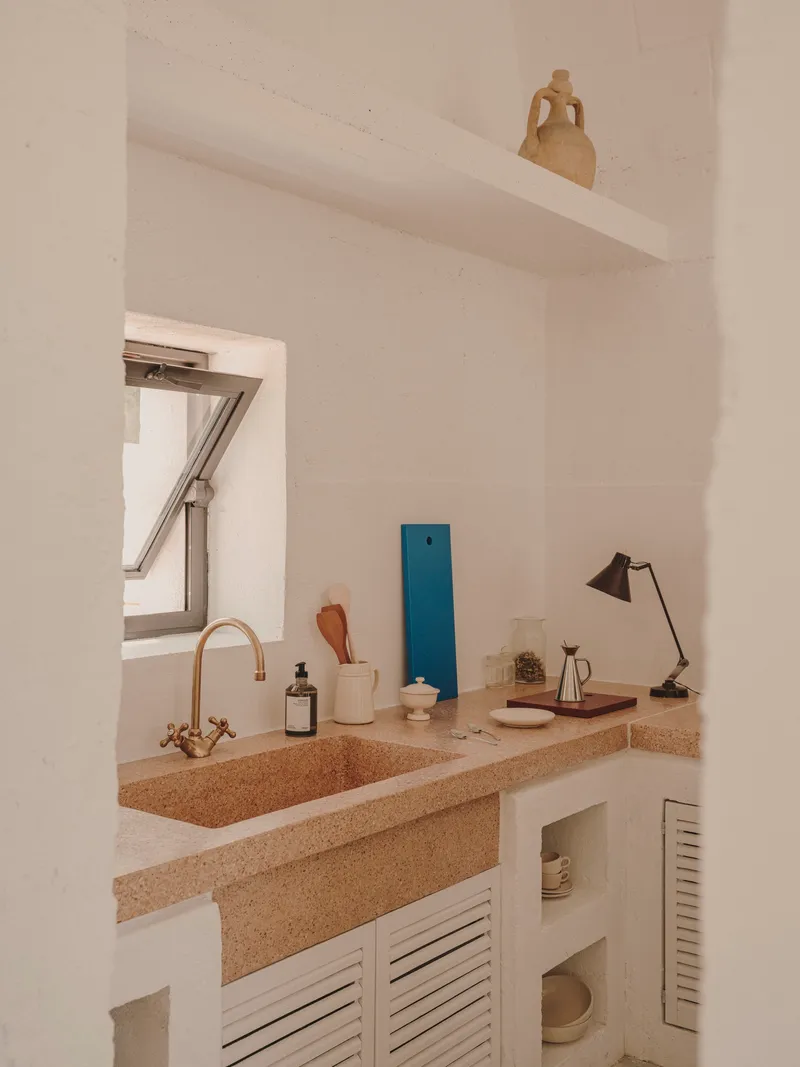


The bespoke bathroom sinks and kitchen countertops were designed by the studio and fabricated by local stone workers, a collaboration that keeps the money and the skill within the region. Terrazzo surfaces, brass faucets, and louvered cabinet doors form a material palette that is simultaneously contemporary and rooted in the workshop traditions of southern Italy. A skylight above one kitchen counter pulls a column of daylight into the room, illuminating the terrazzo surface so it reads almost like a piece of furniture.
In the bathrooms, arched shower alcoves with timber benches continue the vault motif at a domestic scale. The brass fixtures will age alongside the building, their patina tracking the passage of seasons in a way that chrome or stainless steel never could. It is a small choice, but it communicates a position: nothing here is meant to look new forever.
Thresholds and Passages
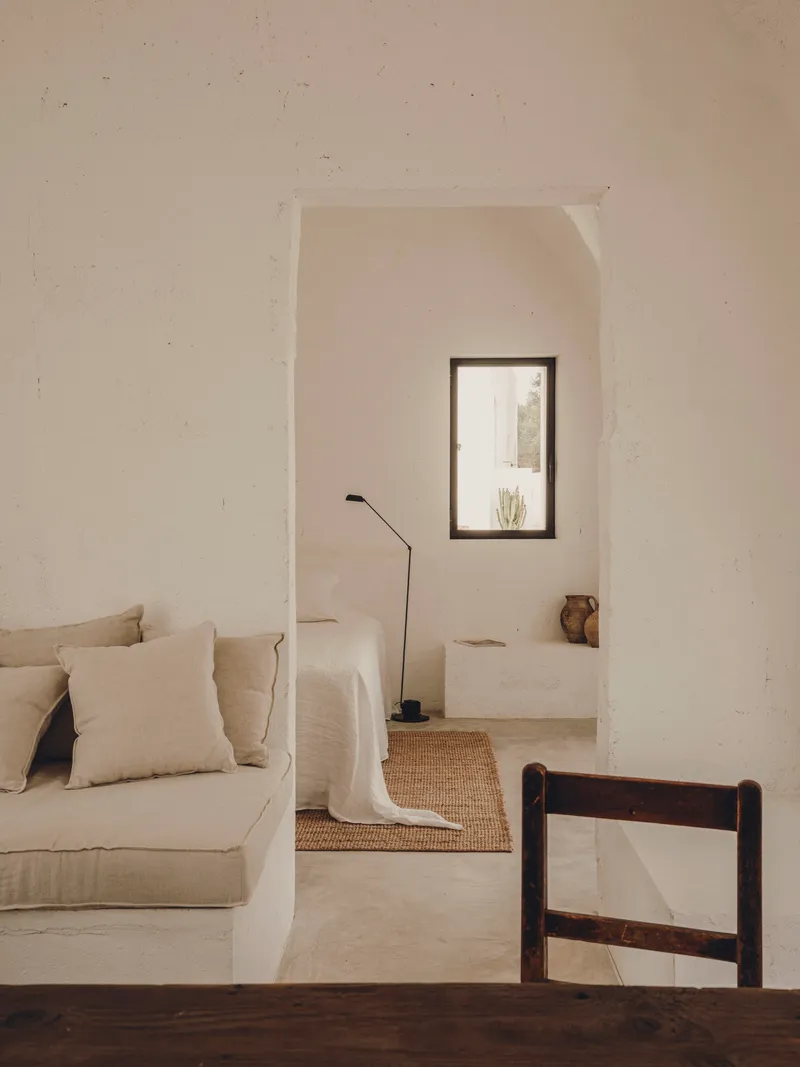


Some of the strongest moments at Borgo Gallana happen in the thresholds between inside and out. Arched doorways with full-height glazing frame vaulted alcoves, portrait windows, and courtyard views with a painterly precision. Terracotta pots of cacti are placed at the base of these openings, their spiny forms catching the same dappled sunlight that filters through the olive canopy above.
These in-between spaces, not quite rooms, not quite gardens, are where the project's design philosophy is most legible. The architecture does not compete with the landscape or try to transcend it. It simply builds a series of frames, solid enough to shelter you from the wind, transparent enough to remind you why you came to Puglia in the first place.
Stairs and Terraces


The cantilevered staircases ascending the courtyard walls are among the most photographed elements of the project, and for good reason. They are structural theater disguised as simplicity: solid white slabs projecting from rendered walls without any visible support, climbing toward rooftop terraces where built-in benches and climbing vines wait. The terraces themselves are furnished with the same restraint as the interiors: a stone bench, a citrus tree, a view.
Interiors in Context


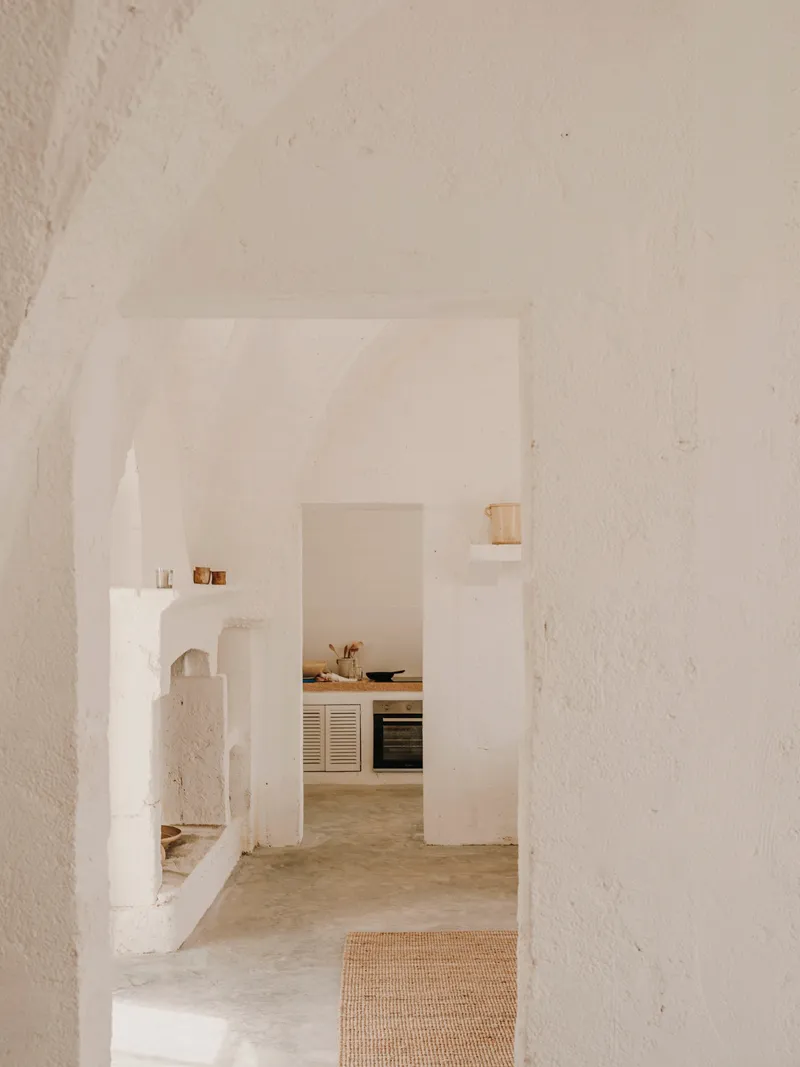
Across the three houses, the interiors maintain a consistent tone while allowing subtle variation. One dining room pairs a rustic timber table with woven chairs beneath a barrel vault; another frames a view of the olive grove through a single arched door. The kitchens are compact and functional, their white plaster walls and concrete floors connecting seamlessly to the adjacent living spaces. Doorways between rooms are never closed off; instead, arched openings maintain sightlines that let light and air circulate freely.


The bedrooms at dusk are perhaps the most evocative spaces in the project. With steel-framed doors open to the garden, the rooms fill with the blue-gold light of a Pugliese evening, the linen bedding catching the last warmth of the day. Metal clothing racks and louvered closet doors keep the dressing areas visually light, avoiding the heaviness that a built-in wardrobe would bring to these small, vaulted rooms.
Landscape Details
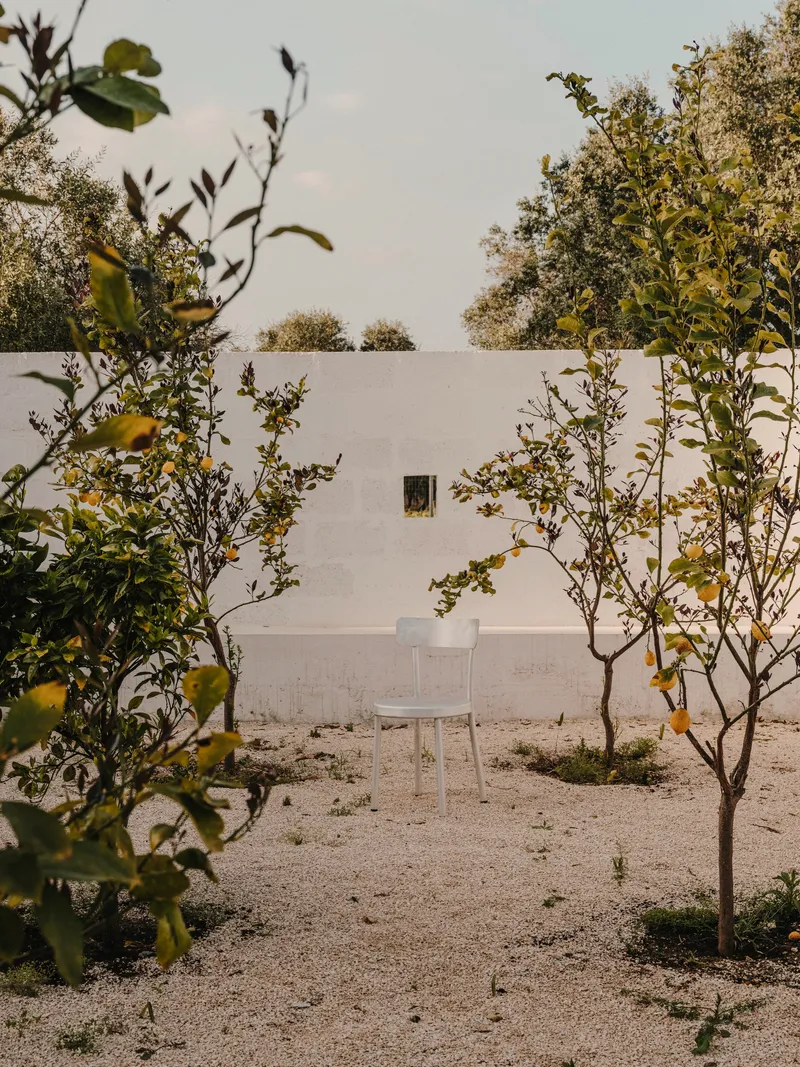

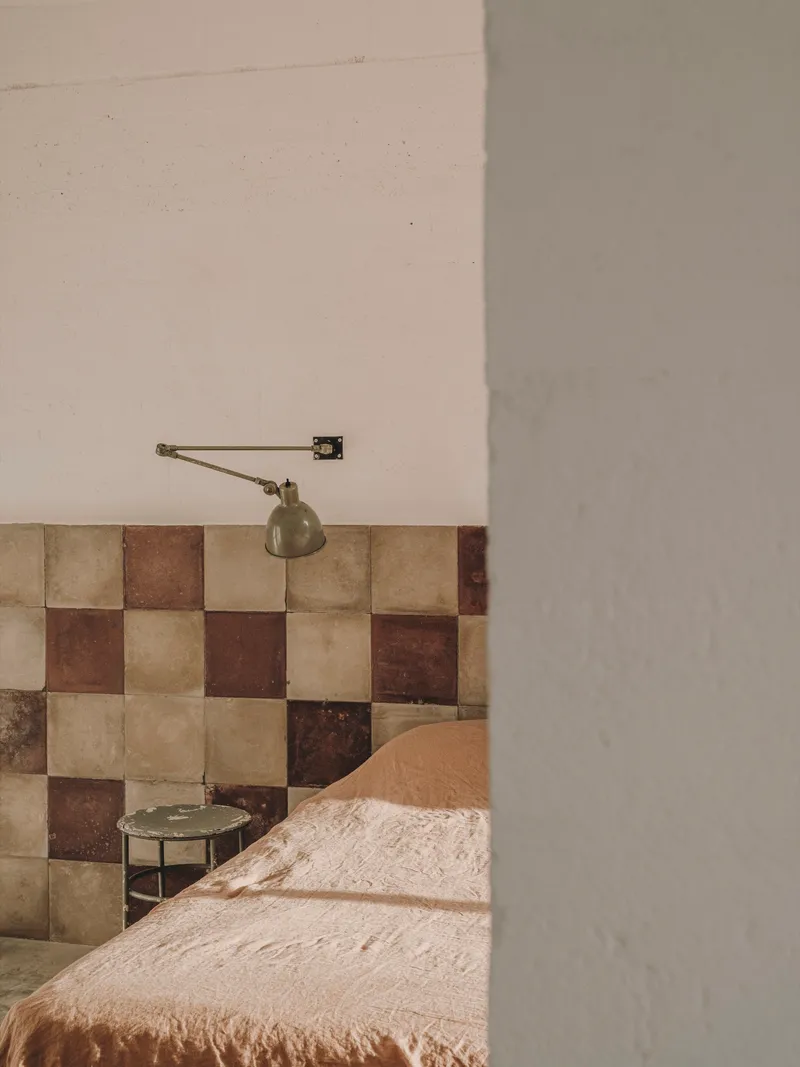
The landscape strategy at Borgo Gallana is one of selective framing rather than wholesale planting. Native grasses, young citrus trees, and established olives are allowed to grow with minimal intervention, their informality counterbalancing the precision of the architecture. Covered terraces with built-in sinks and benches extend the kitchens outdoors, blurring the line between cooking space and garden. Small details, a brass wall lamp beside a plastered column, a chequered tile headboard, reveal themselves slowly, rewarding the kind of attention that only comes with an unhurried stay.
Why This Project Matters
Borgo Gallana matters because it demonstrates that working within a tradition does not mean being trapped by it. Studio Andrew Trotter uses tufo sandstone, star vaults, arched openings, and cement floors not as nostalgic references but as active structural and climatic strategies, engaging over fifty local craftsmen in a process that keeps regional skills alive while producing architecture that feels genuinely contemporary. The project avoids the two traps that plague most hospitality work in southern Italy: the rustic-chic cliché of exposed stone and designer furniture, and the minimalist resort that could be anywhere from Ibiza to Bali.
What distinguishes this project is its commitment to a single idea carried through to every detail. The white palette, the local stone, the bespoke sinks, the copper taps that will patina with age: everything points toward a building that will grow more beautiful as it weathers, settling deeper into its landscape rather than fighting against it. For architects and designers working in heritage contexts, Borgo Gallana offers a clear lesson: restraint is not the absence of ambition, it is the hardest kind.
Borgo Gallana Bed & Breakfast, designed by Studio Andrew Trotter, Oria, Puglia, Italy. Completed 2022. Photography by Salva López.
About the Studio
Share Your Own Work on uni.xyz
If projects like this are the kind of work you want to make, uni.xyz is a place to publish your own, find collaborators, and enter design competitions.




Popular Articles
Popular articles from the community


Co-life: Sustainable Architecture for Age-Friendly Community Living
Co-life reimagines sustainable architecture for seniors through courtyards, rammed earth, shared gardens, and spaces designed for belonging.

The Ocean Hive: Sustainable Architecture for a Self-Sufficient Civilization at Sea
The Ocean Hive imagines sustainable architecture at sea, where modular habitats, algae, wave power and ocean waste sustain a growing colony.

The Earth Pod: 3D Printed Homes for Resilient Refugee Communities
The Earth Pod reimagines refugee housing through 3D printed homes made from clay, combining resilience, self-sufficiency, and rapid shelter.

Riyadh For All: Intergenerational Urban Design for Active Aging in Rabat
Riyadh For All reimagines urban design in Rabat with intergenerational co-living, adaptive courtyards, and Moroccan cultural exchange today.

Similar Reads
You might also enjoy these articles

Bao Huynh Watercolor Atelier: A Serene Art Retreat in Hội An
Bao Huynh Watercolor Atelier in Hội An blends multifunctional art spaces, sustainable design, local materials, and family-friendly living in a serene environment.

Atelier Macri Concept Store Interior Design by CASE-REAL
Atelier Macri store features a "ko" counter, walnut wood details, cork displays, blending retail, gallery, and seamless customer experiences.

Manuel Vargas Izquierdo Stadium and High-Performance Sports Center: Architectural Excellence in Jalpa de Méndez
The Manuel Vargas Izquierdo Stadium blends sustainable design, inclusive sports facilities, and cultural-inspired architecture, revitalizing Jalpa de Méndez’s public spaces.

KAKR Buluh Awar Hall: Revitalizing Community and Ecology Through Bamboo Architecture
Community built bamboo hall revitalizes Buluh Awar village, empowering youth, restoring ecology, celebrating vernacular craftsmanship through sustainable architecture and culture.


Explore Interior Design Competitions
Discover active competitions in this discipline


Challenge to design mud housing for contemporary communities


Challenge to design luxury tourism on rails


VR headsets Storefront design competition


Designing a staircase for a client
Comments (0)
Please login or sign up to add comments
No comments yet. Be the first to comment!