
Studio Ben Allen Carves a Cocktail Library into the Heart of a Kent Farmhouse
A former farmhouse in rural Kent is rewired with bold color, carved timber alcoves, and a glazed conservatory that opens to the garden.


English farmhouses accumulate. A wall gets moved, a kitchen gets tacked on, a corridor appears where a room once was. Over decades the logic of the original plan dissolves into a sequence of compromises. Studio Ben Allen's renovation of a former farmhouse in rural Kent starts from exactly this problem: a house whose cellular rooms had been reshuffled so many times that its circulation made little sense and its spaces spoke to no one in particular. Rather than strip everything back or bolt on a single grand gesture, the studio reconfigured the interior around a new center of gravity, a cocktail library carved from solid oak and oak veneer, stained blue on its inner curves, with bookshelves and seating scooped from a single oblong form.
The result, completed in 2024 at 235 square meters, is a house that feels both whimsical and deliberate. A bright palette of reds, yellows, blues, and greens threads through every room, from an oversized yellow extraction hood in the kitchen to red steel balusters on the landing. Openings, hatches, and internal windows break down the old cellular boundaries, stitching disparate rooms into a sequence of framed views. A birch plywood conservatory, pale green against solid oak rafters, extends the house into the garden. The project is proof that domestic renovation need not choose between restraint and personality.
The Blue Library at the Center
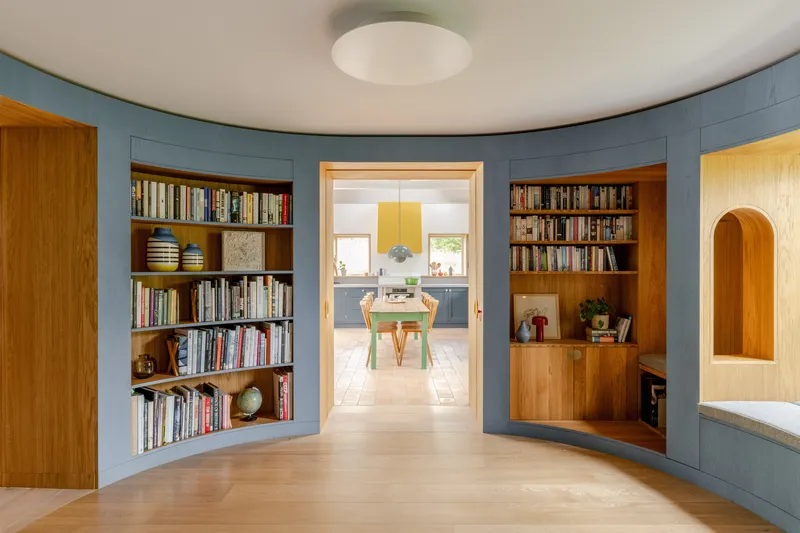
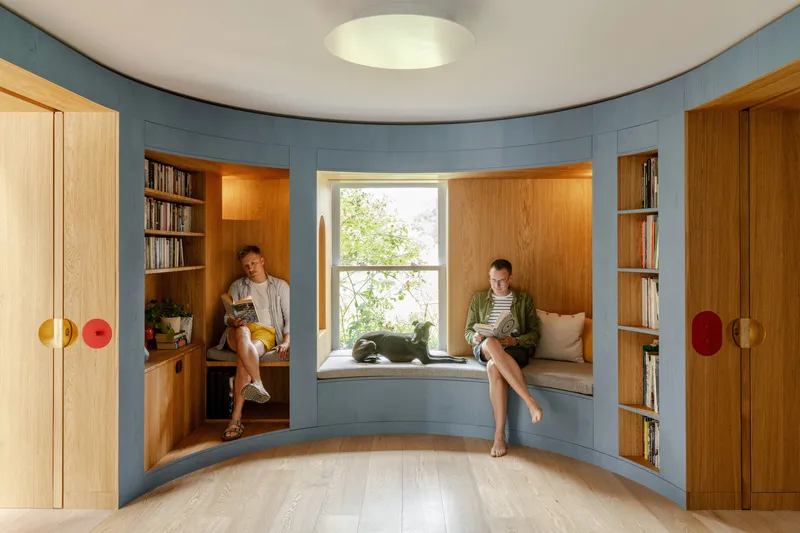
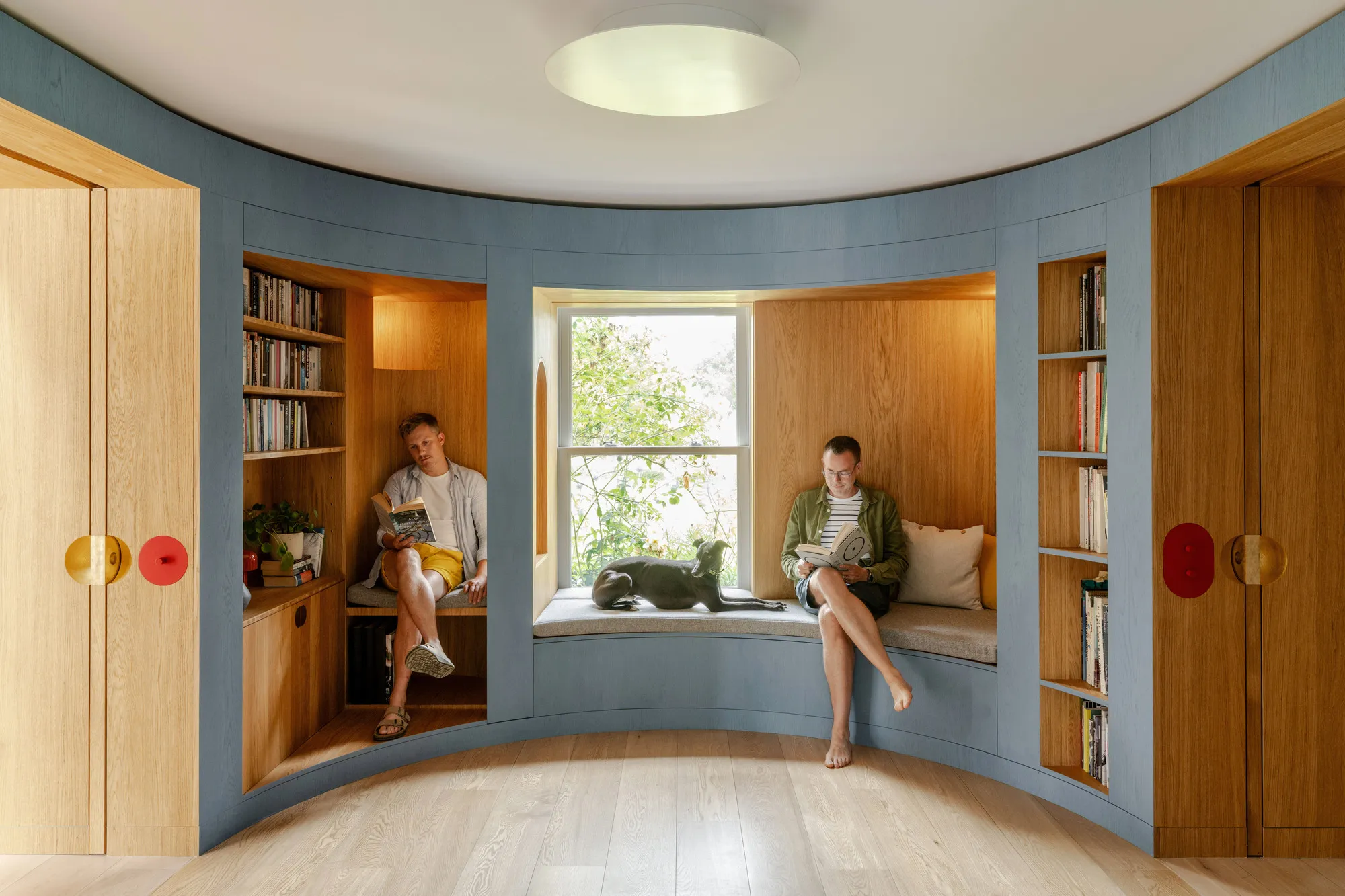
The cocktail library is the move that makes the whole project click. By reconfiguring circulation on the ground floor, Studio Ben Allen placed this room at the crossing point between the entrance hall, the dining hall, and the kitchen, turning what could have been a pass-through into the social nucleus of the house. The shelves and seating are carved from an oblong, pill-shaped form, giving the walls a gentle curve that softens the acoustics and draws your eye around the room rather than through it.
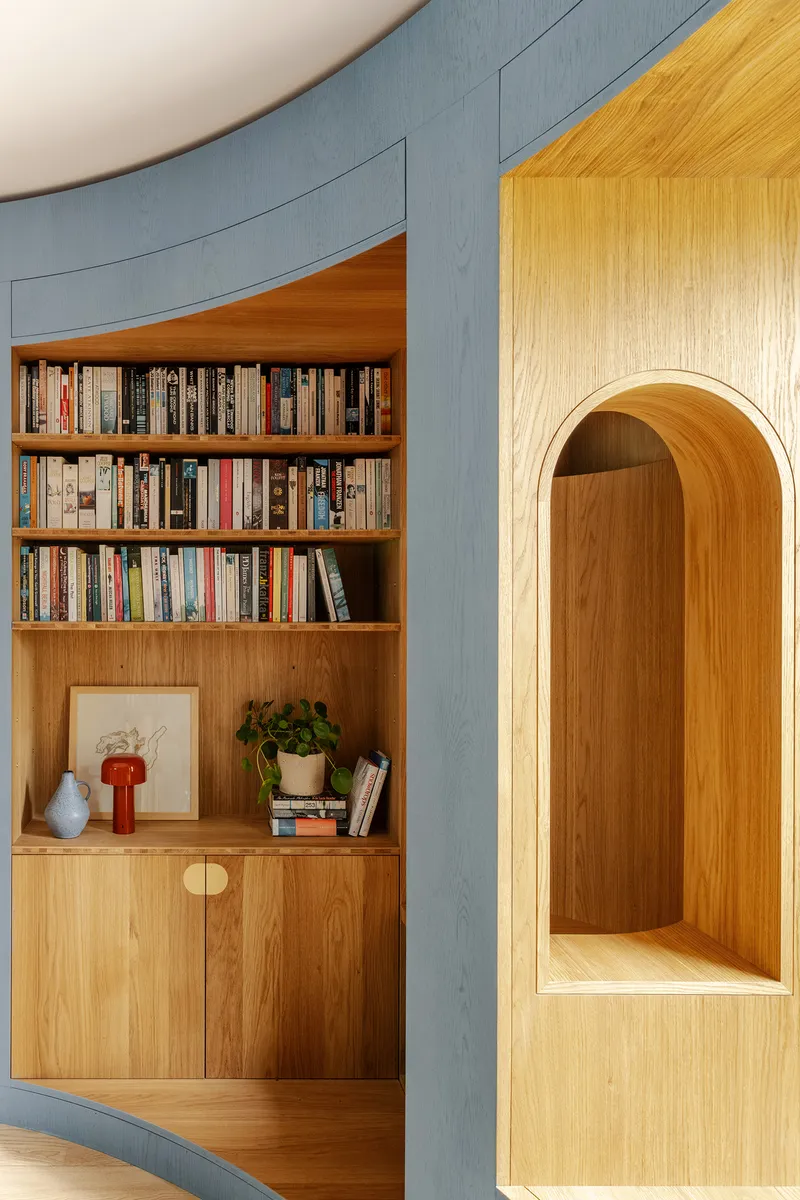
Blue stain on the inner curved surfaces distinguishes the library's timber from the warm oak tones elsewhere in the house. A concealed cocktail cabinet hides within the blue-stained walls, rewarding anyone curious enough to look closely. Joinery by Tim Gaudin achieves a level of craft that makes the curved forms feel inevitable rather than forced, each shelf and alcove resolving into a precise, inhabitable niche. The library's arched reading nook, visible in detail, suggests a Victorian inglenook reinterpreted in plywood and pigment.
Openings That Stitch Rooms Together
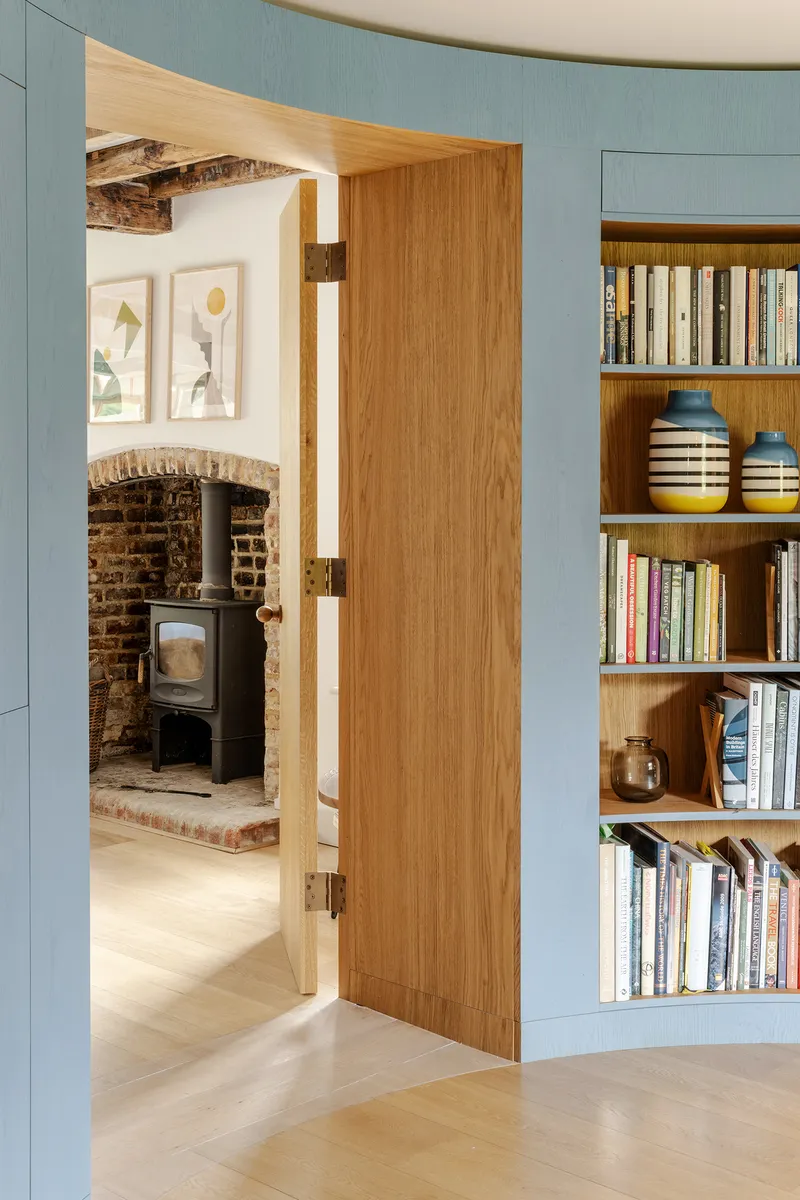
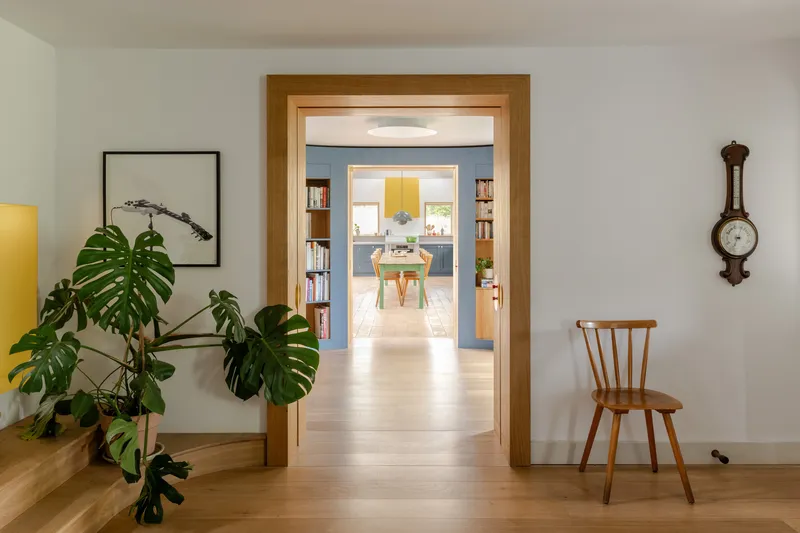
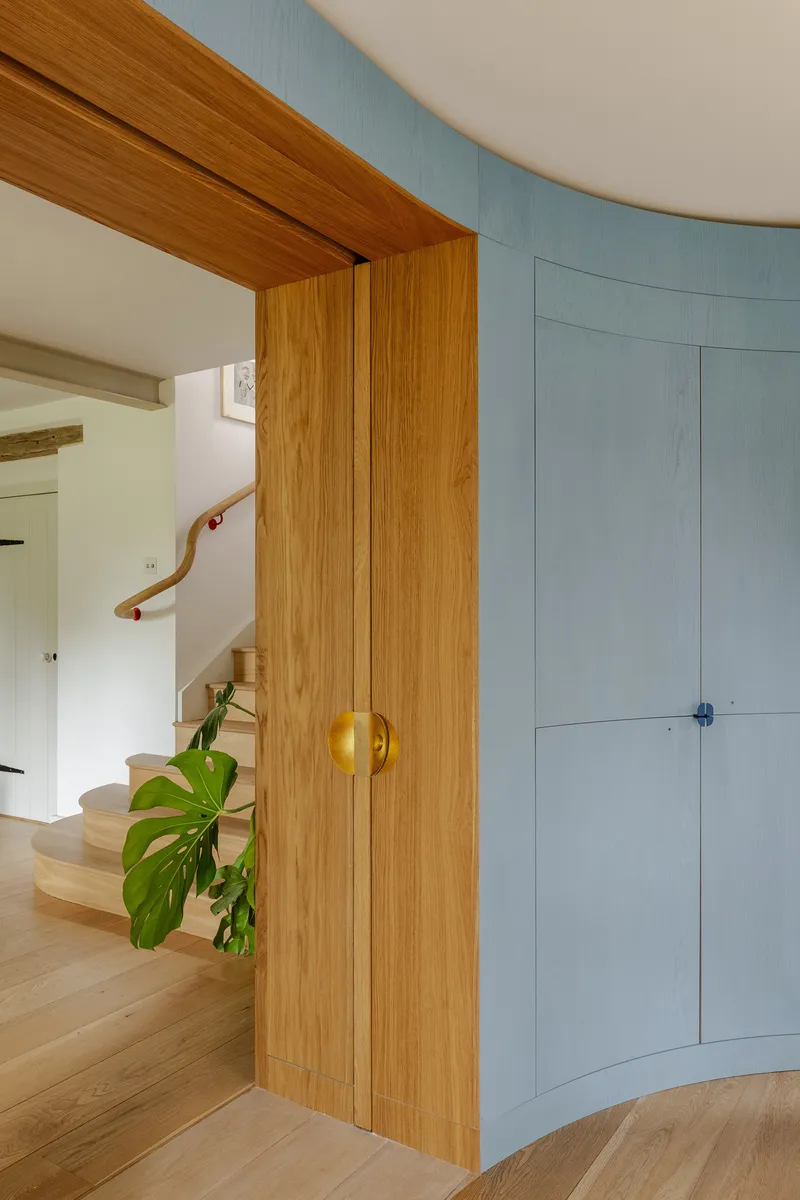
The original farmhouse suffered from a common affliction: too many walls, not enough conversation between rooms. Studio Ben Allen's strategy was to punch a series of carefully framed openings that break down cellular boundaries without demolishing them entirely. From the entrance hall, an axial view runs through the library to the dining hall and kitchen beyond. Upstairs, small yellow doors open from a study to overlook the kitchen below. A small internal window links the living room to the conservatory.
These are not open-plan gestures. Each room retains its enclosure and its character. The openings simply ensure that the house communicates with itself, offering diagonal sightlines, borrowed light, and the ambient awareness of other people in other rooms. The oak-framed doorways, with their spherical brass handles and curved walls, treat each threshold as a small event rather than a mere transition.
A Kitchen Under the Vault
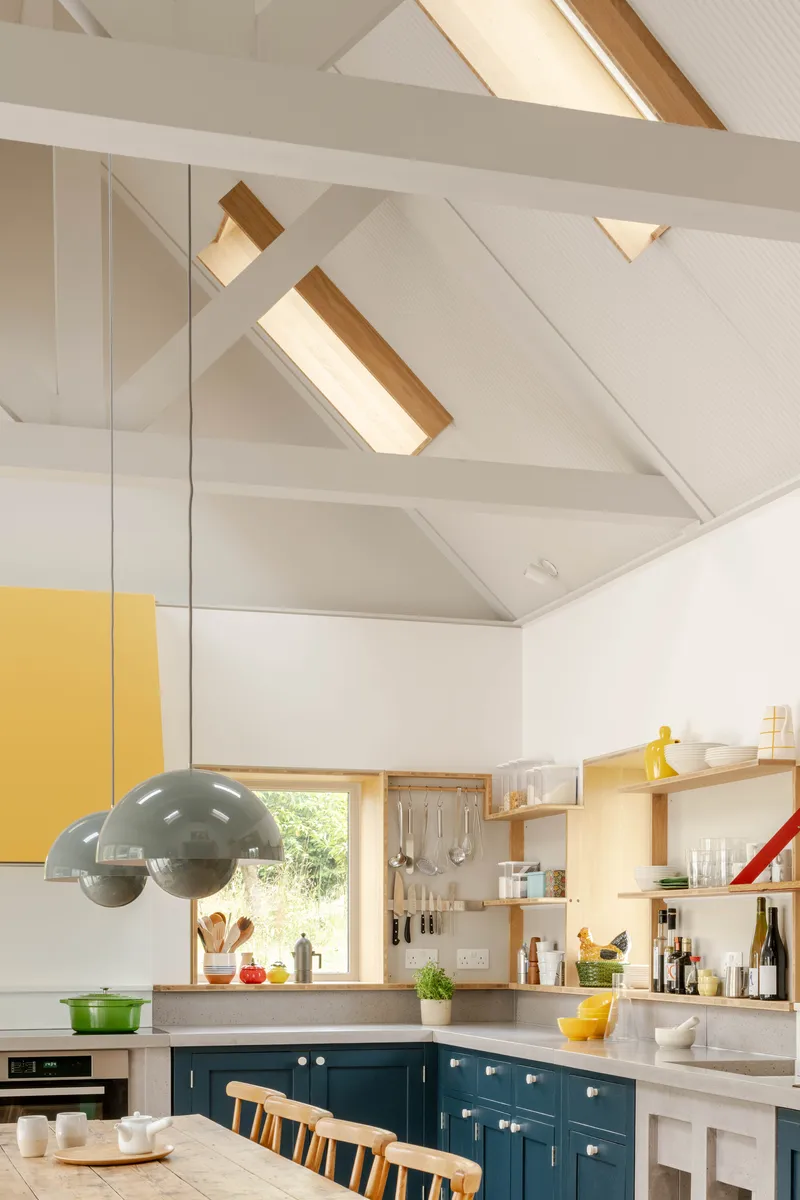
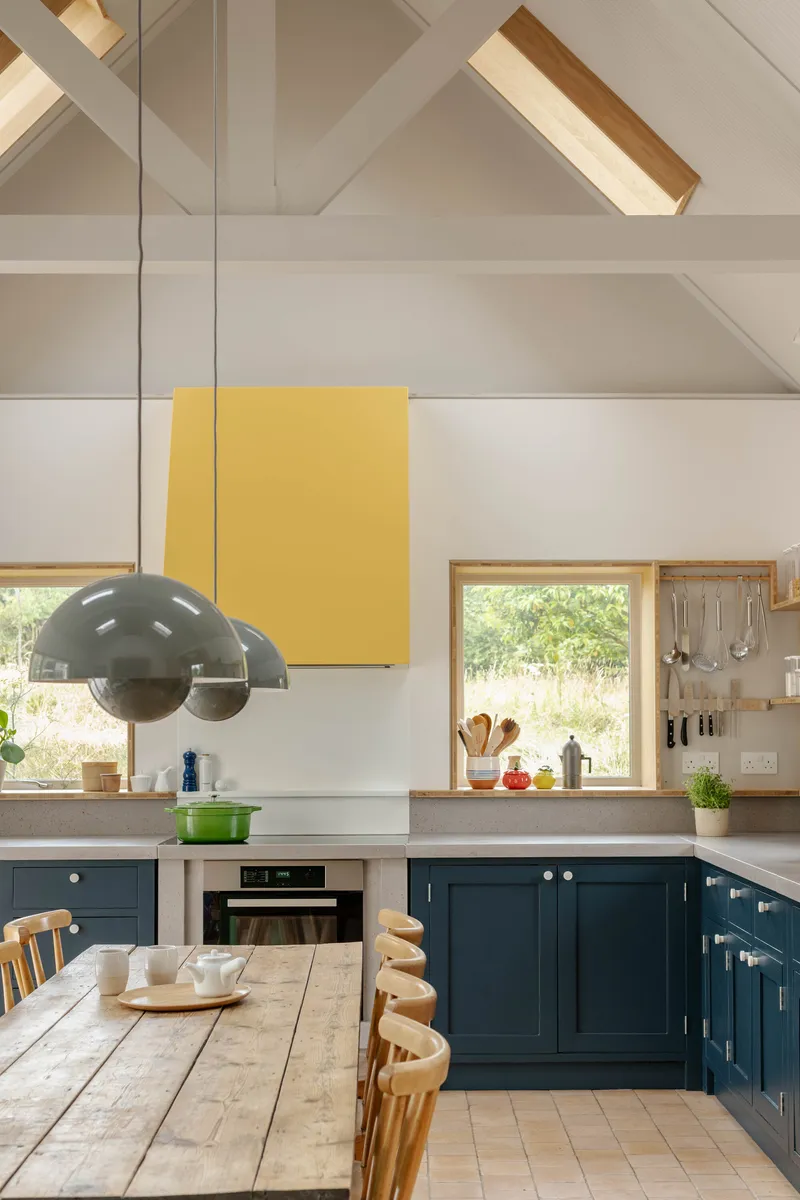
The kitchen occupies a vaulted white volume punctured by skylights, its teal cabinetry set against concrete countertops by Concreations. An oversized bright yellow extraction hood floats above the cooker like a pendant lamp scaled up to furniture, anchoring one end of the room while a timber dining table extends toward the garden view at the other. The palette is assertive but never chaotic: the yellow hood, the teal cabinets, and the warm oak all hold their own without competing.
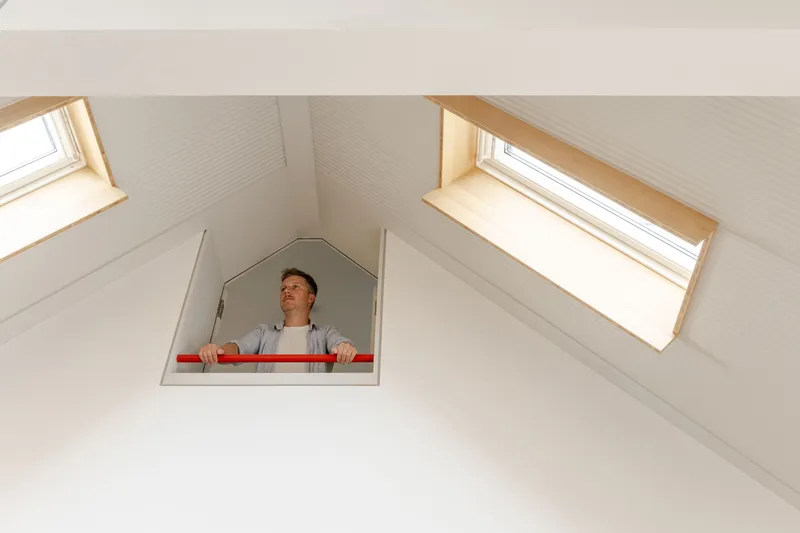
Above, a pentagonal hatch in the ceiling connects the kitchen to the upstairs study, allowing a person on the upper floor to look down into the room below. It is the kind of detail that reads as playful but serves a real purpose, collapsing the vertical separation between floors and letting light and sound travel between them. The gesture recalls the servant hatches of the Victorian house but reverses their power dynamics: here, the opening exists for connection, not surveillance.
The Conservatory and Its Pergola
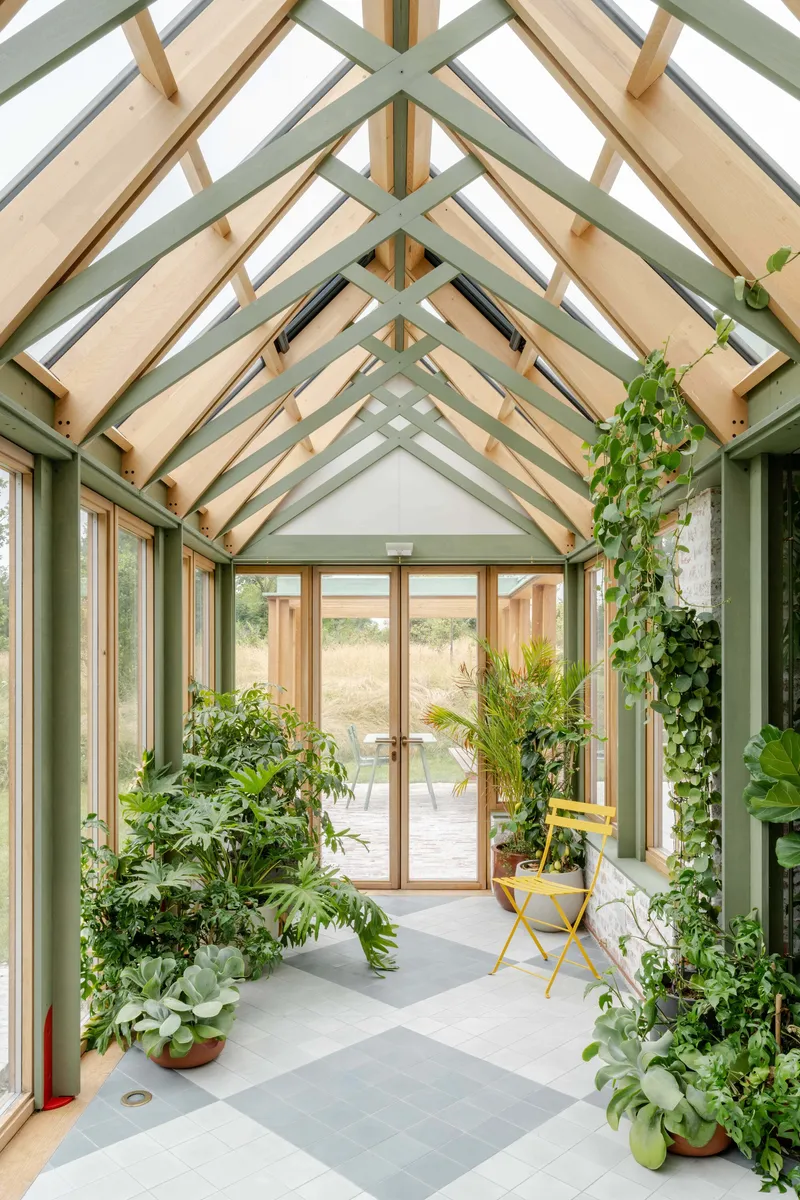
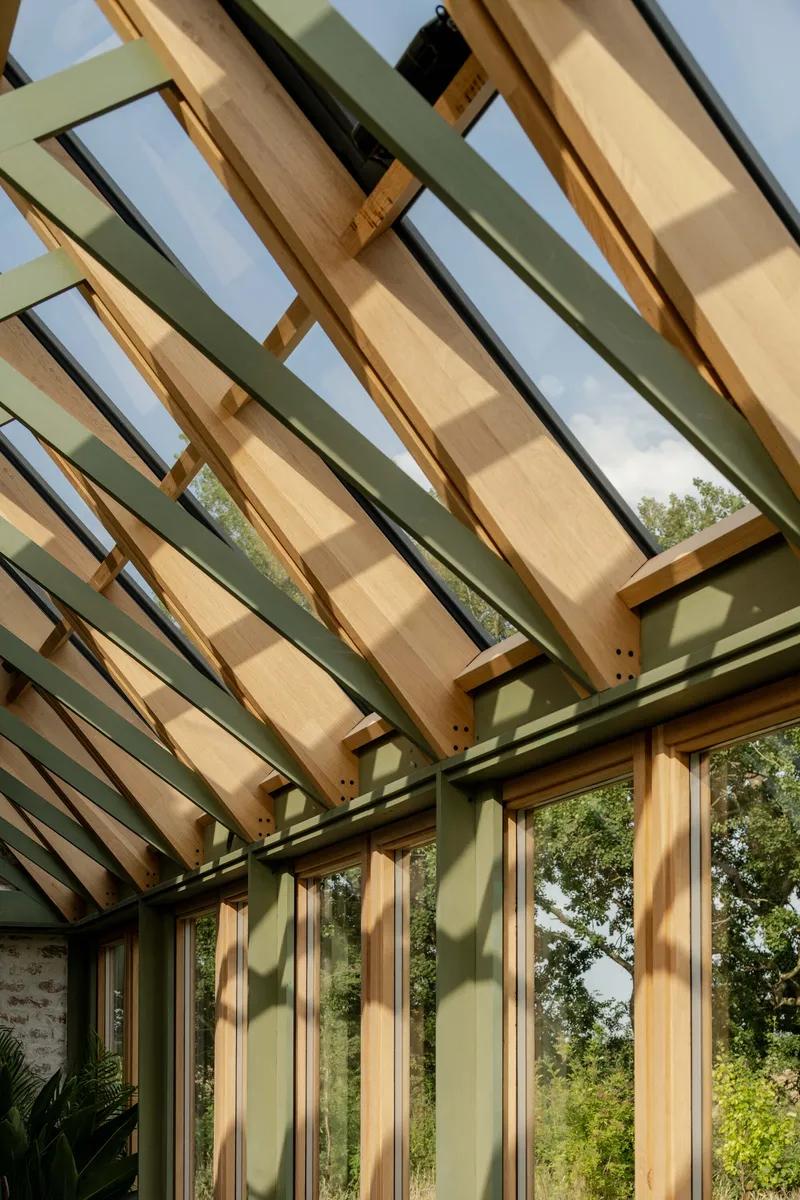
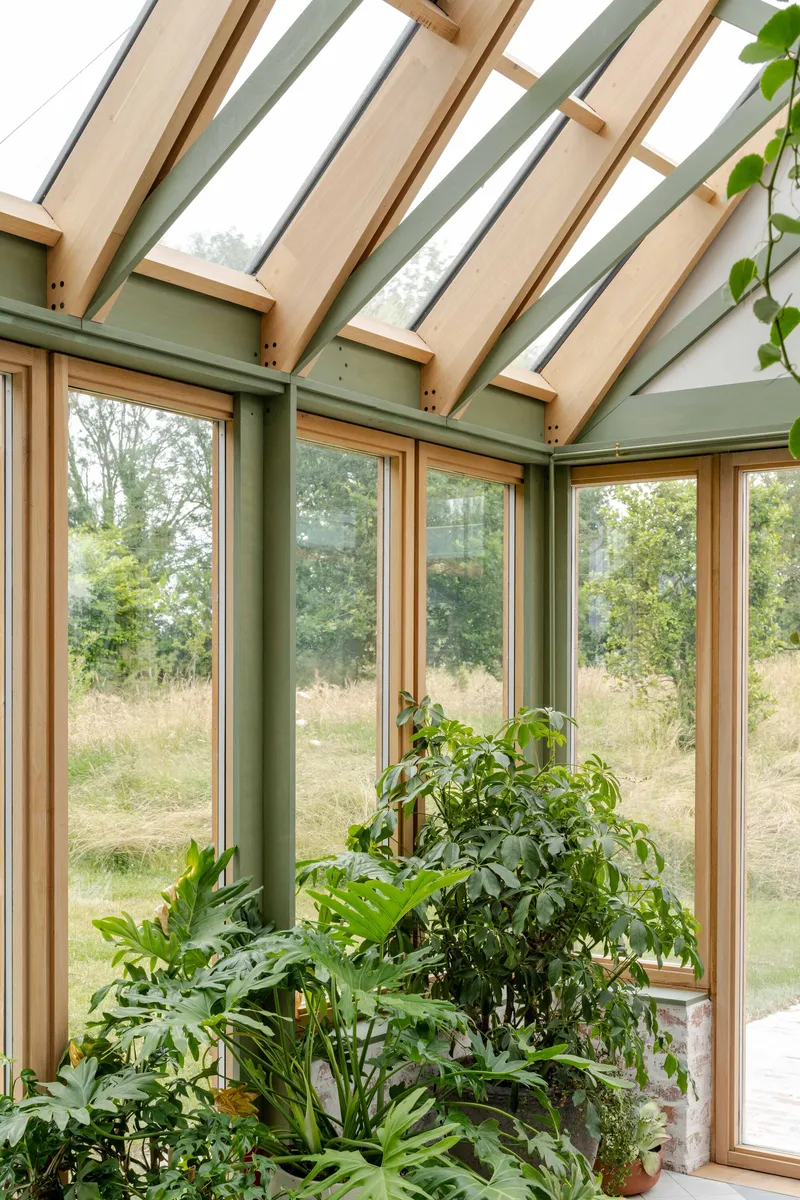
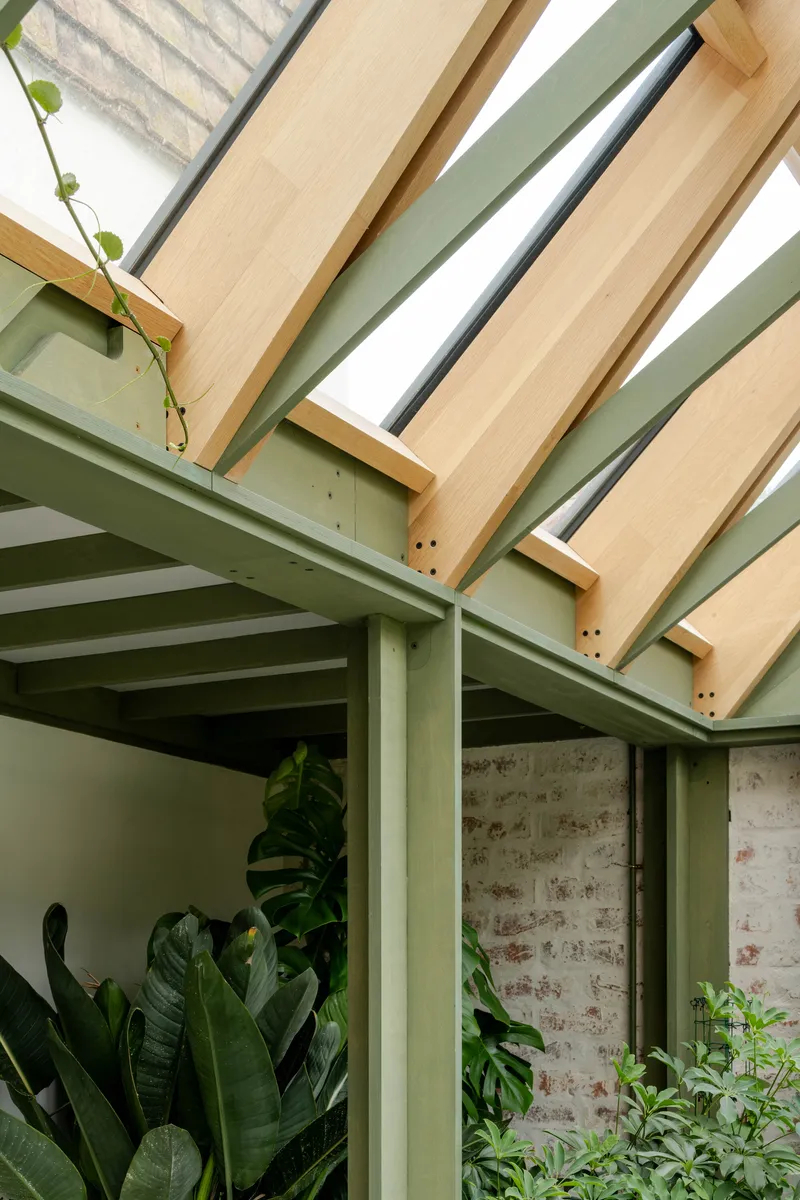
Studio Ben Allen's conservatory references the Victorian glasshouses that once proliferated across English country estates, but the detailing is contemporary: birch plywood panels stained pale green, solid oak rafters left exposed, and a red steel pull-up bar slotted discreetly into the structure. The green-painted columns and the angled roof panels throw diagonal shadow patterns across the interior, creating a room that changes character with the movement of the sun.
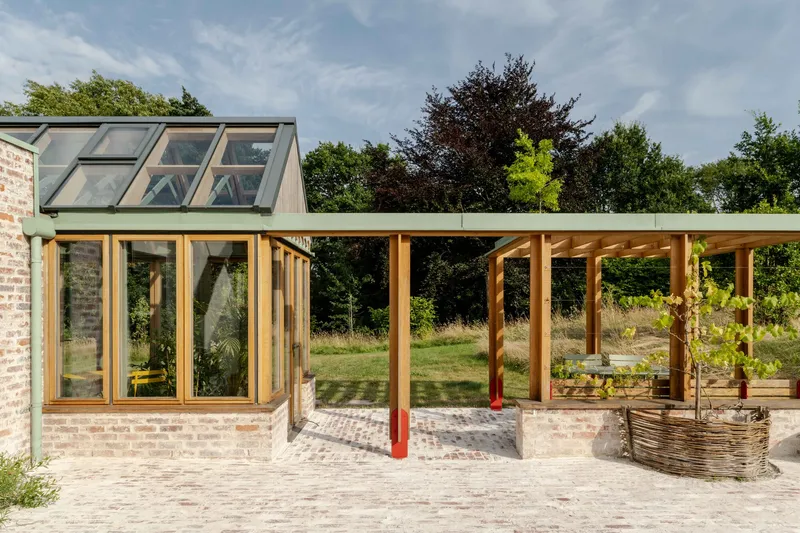
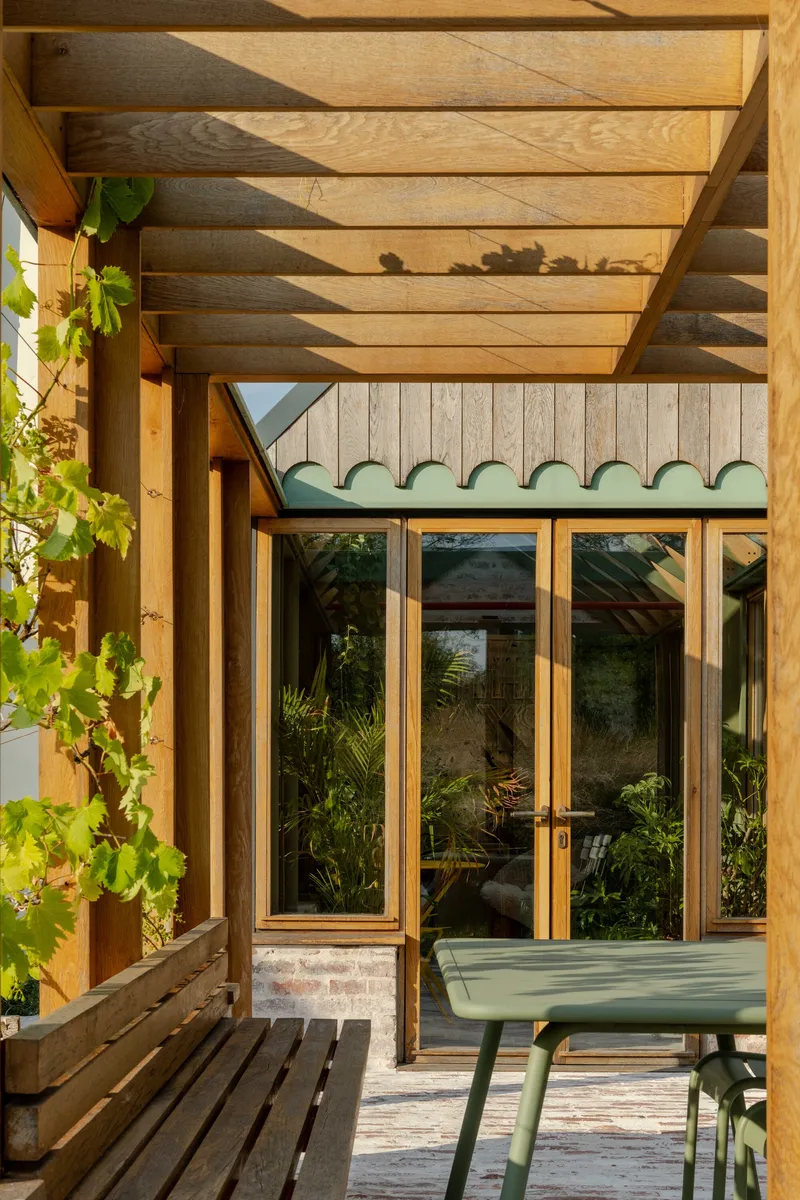
Outside, a solid oak pergola extends from the conservatory to frame a terrace seating area, mediating between interior and garden. The scalloped green trim above the glazed doors and the climbing vines threading through the timber frame give the space a cultivated looseness. Folding doors open fully to merge the conservatory with the garden on warm days, while the brick base and glass roof keep it viable year-round. The metalwork, fabricated by Fish Fabrications, adds subtle industrial texture to an otherwise horticultural composition.
Color as Structure
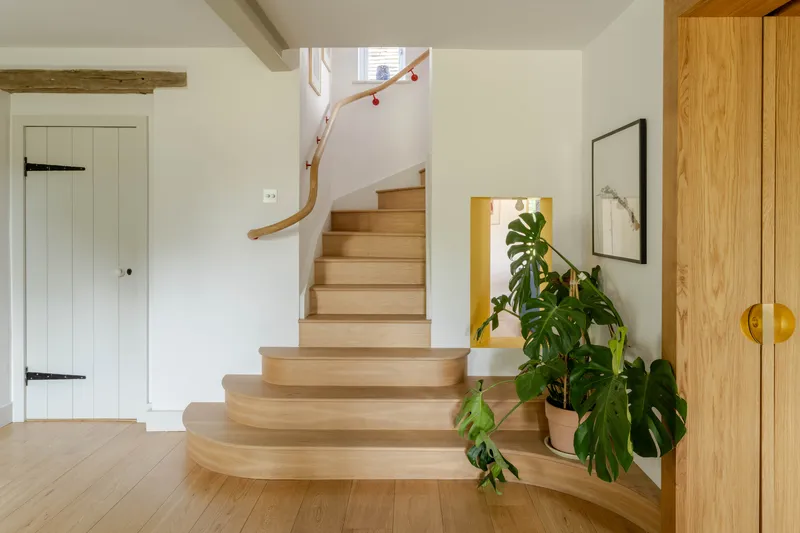
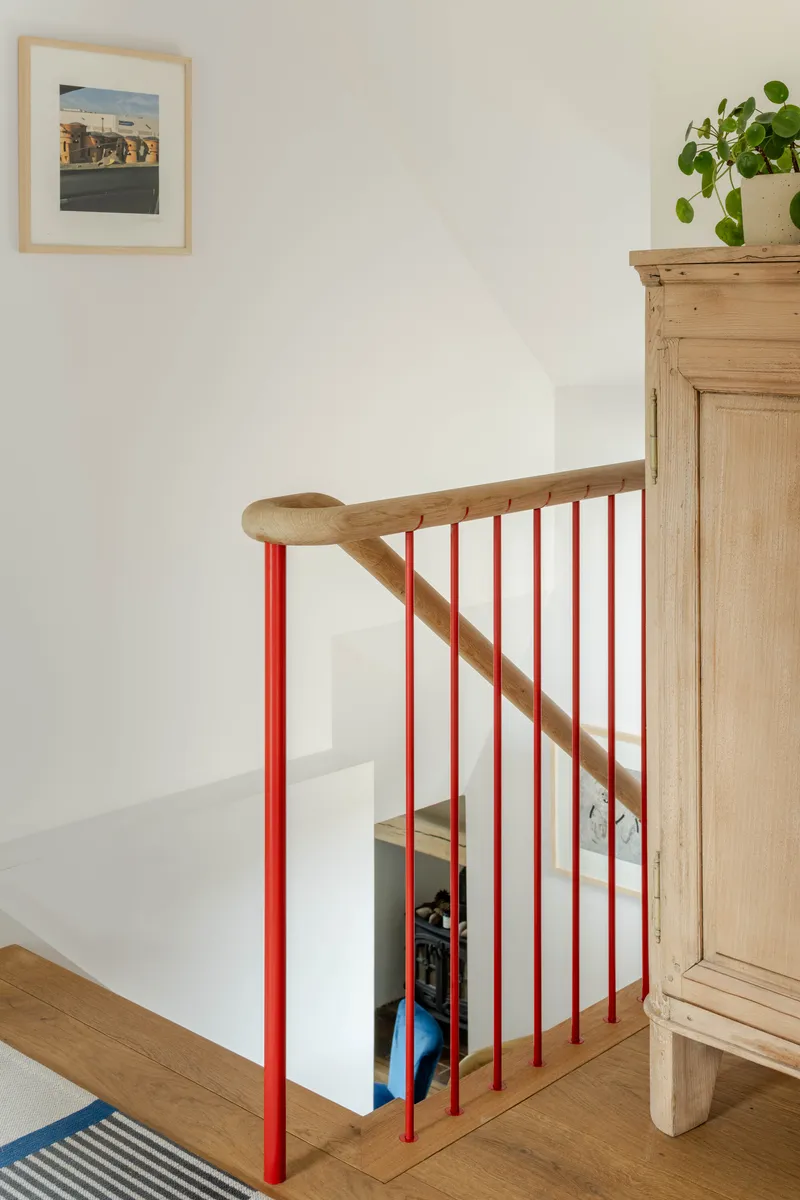
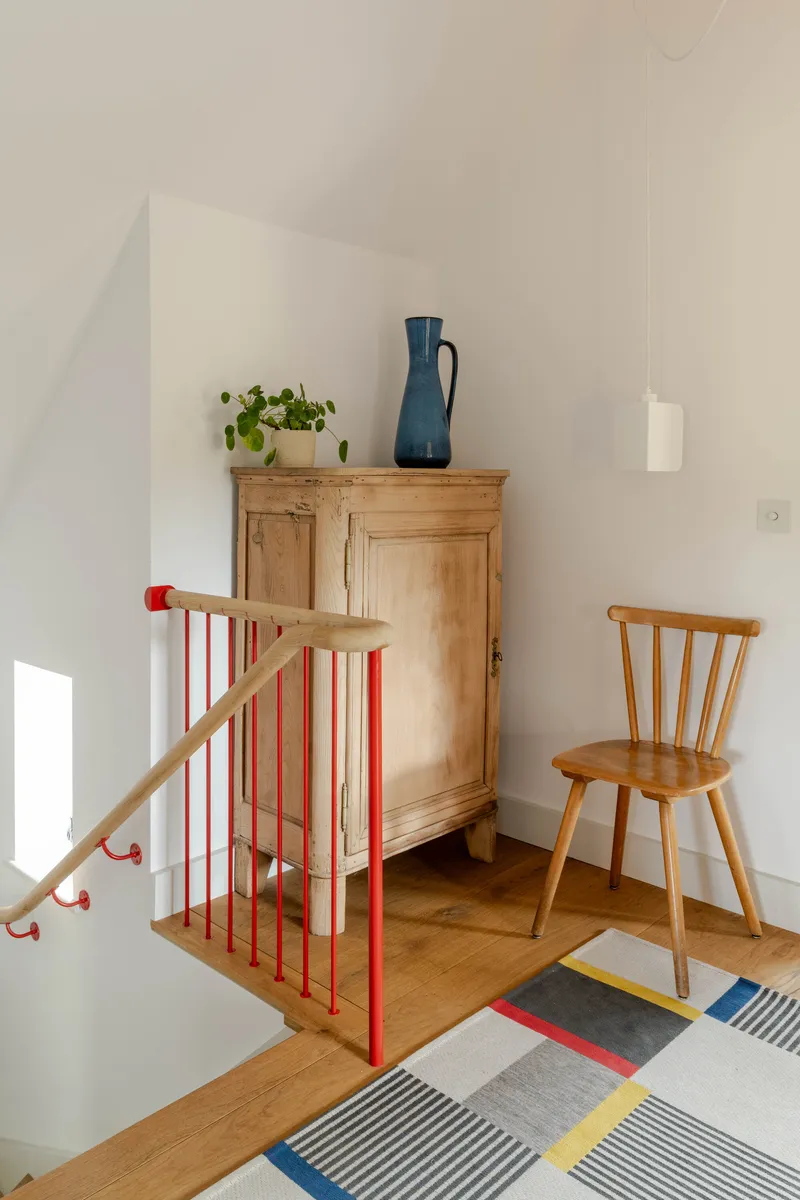
The staircase, rebuilt on the original setting out with sweeping, wider steps at the bottom, establishes the project's attitude toward color as soon as you enter. Red vertical balusters on the upper landing, yellow-edged openings, and a house-shaped wall cabinet with a yellow door panel all contribute to a palette that is coded rather than decorative. Each color marks a different kind of element: red for steel and structural metalwork, yellow for openings and thresholds, blue for the library's inner world, green for the conservatory and its connection to the garden.
This chromatic strategy prevents the house from tipping into whimsy. The colors are bright but systematic, applied with enough consistency that they begin to function as a spatial language. You learn to read the house through its hues: yellow means a view is about to open up, blue means you have arrived at the center, green means the garden is close.
Bathrooms with Character
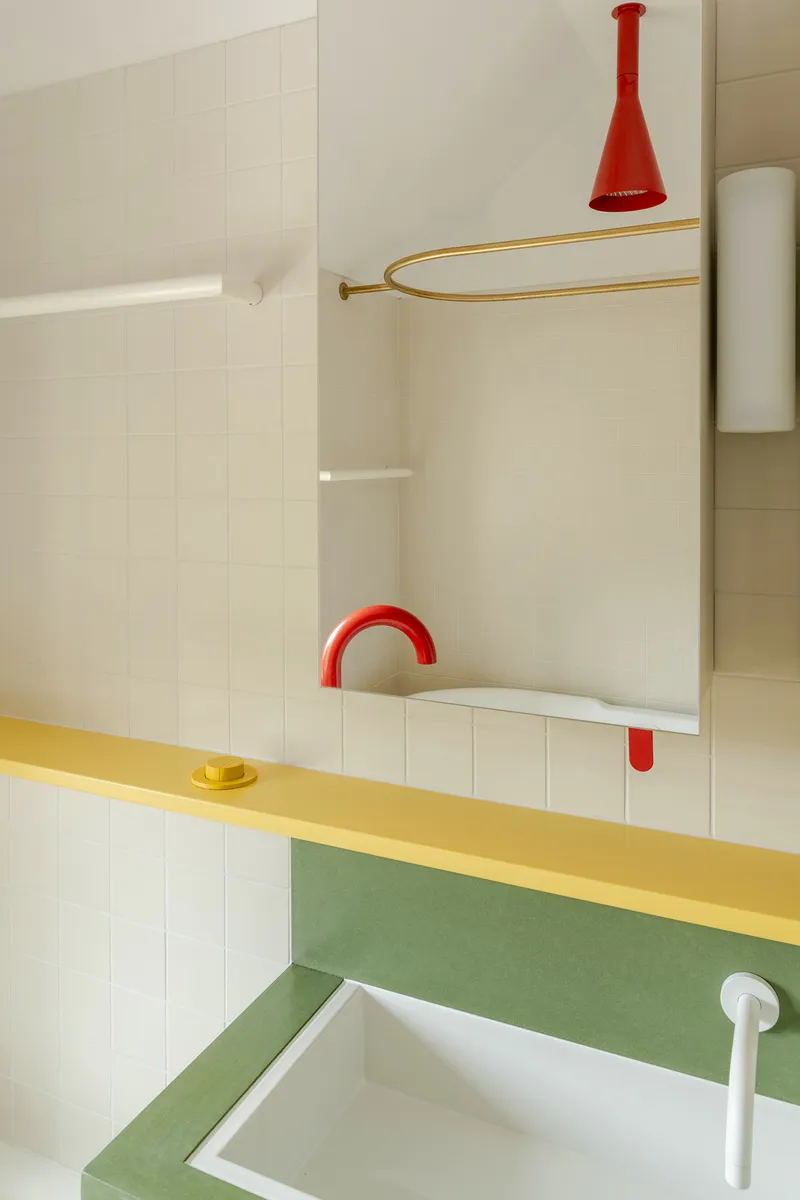
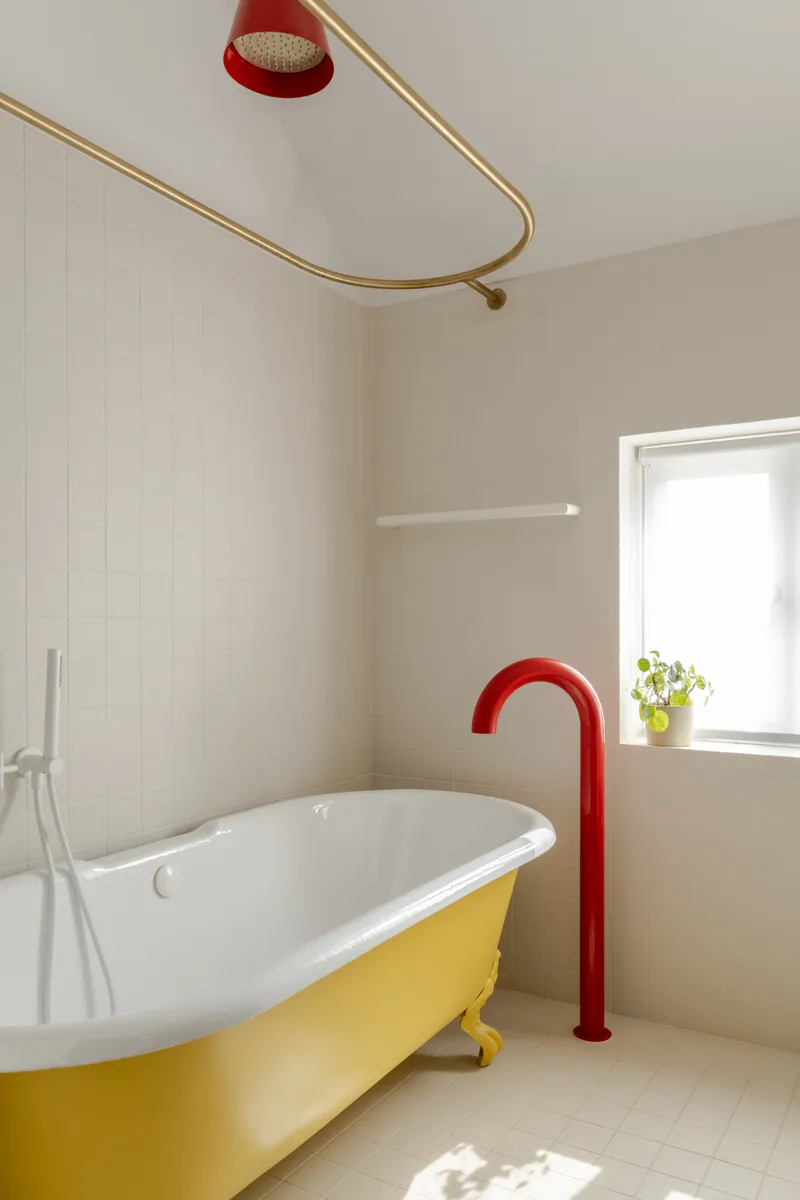
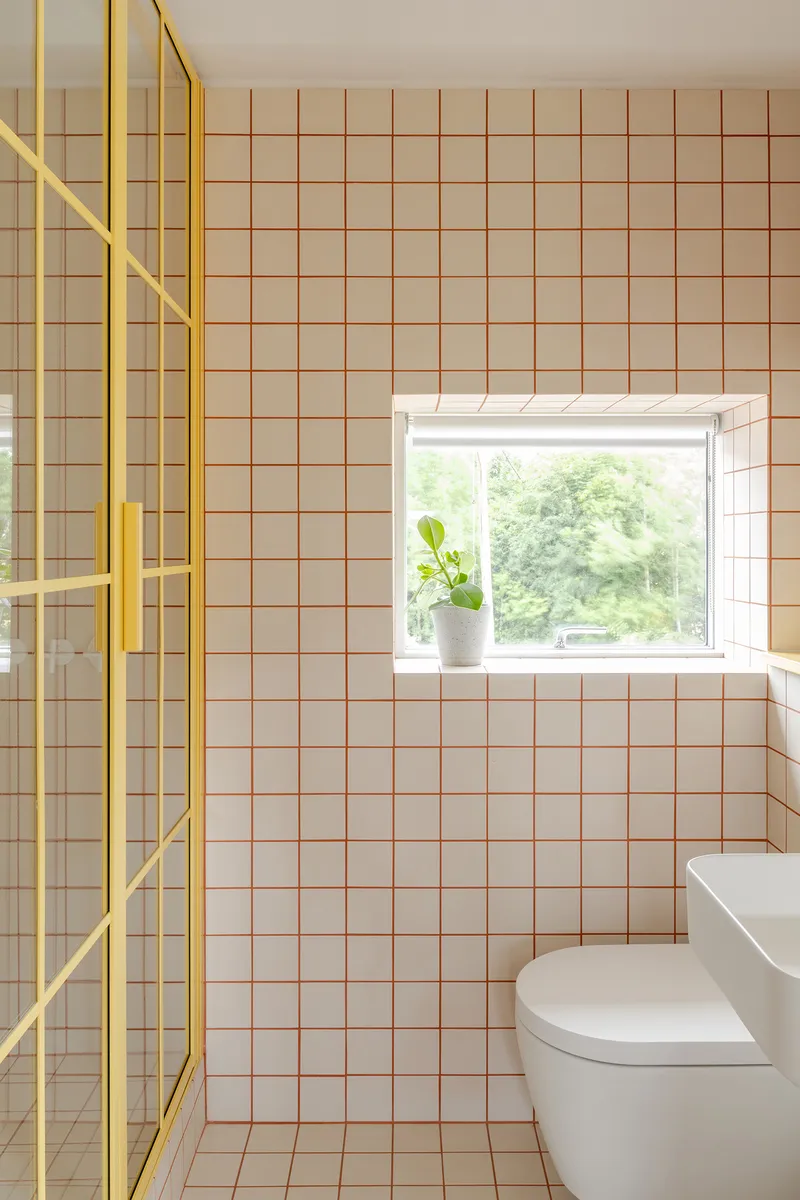
The bathrooms carry the same confidence as the rest of the house. A freestanding tub sits on a yellow base with a red floor-mounted tap, its brass shower rail curving overhead. Elsewhere, pink square tiles meet a yellow shower partition, and a green terrazzo surround frames a wall-mounted basin. These are not neutral backgrounds; they are rooms with opinions. The red arched faucet at one vanity, set against a green backsplash and yellow counter edge, could easily overwhelm, but the proportions are tight enough to hold everything in tension.
The House in Its Landscape
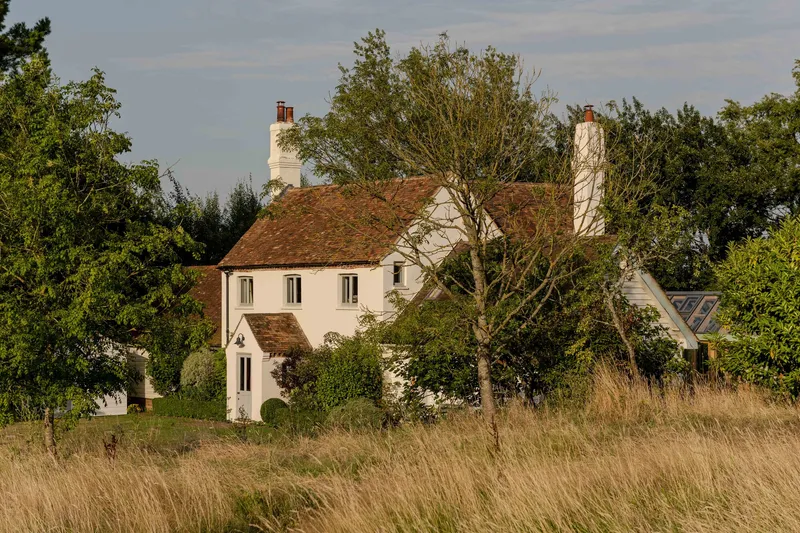
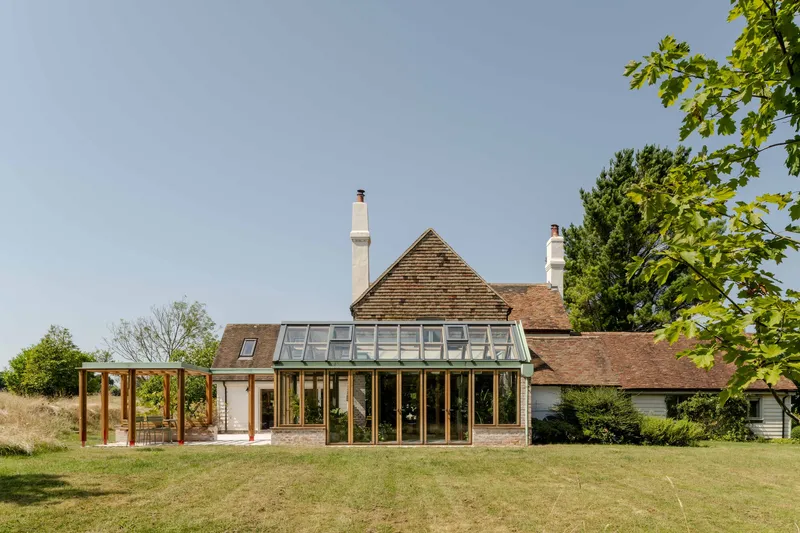
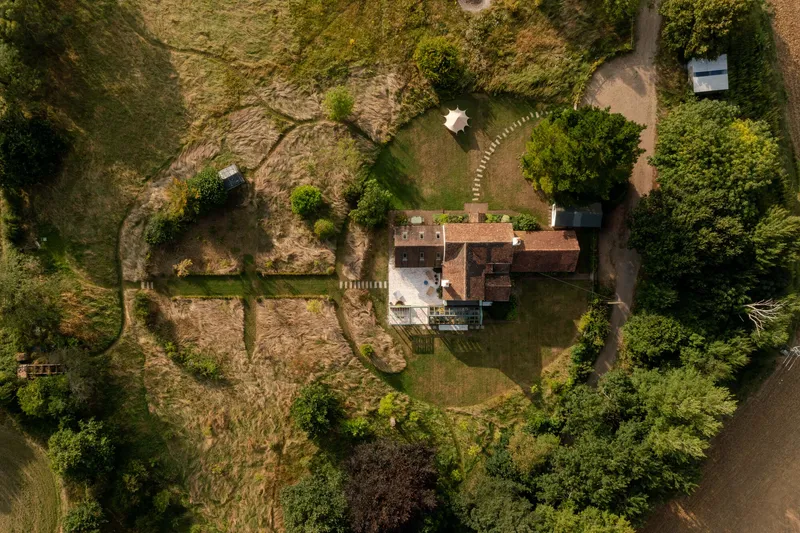
From outside, the house reads as quiet. White rendered walls, a terracotta tile roof, mature trees, and tall grasses at dusk compose an image that gives little indication of the chromatic intensity within. The aerial view reveals the compound nature of the plan: pitched volumes cluster around the conservatory and pergola, forming a loose courtyard arrangement that opens toward the garden. The restraint of the exterior makes the interior all the more surprising, a deliberate contrast that rewards entry.
Plans and Drawings
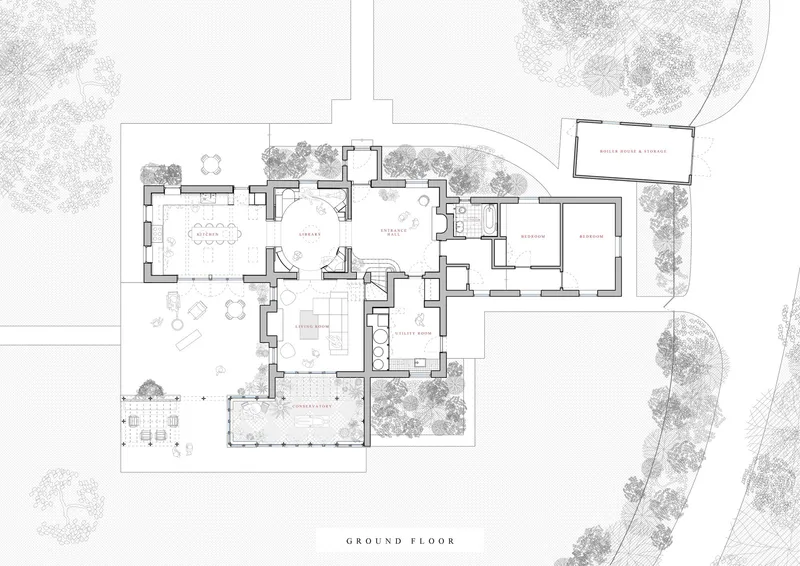
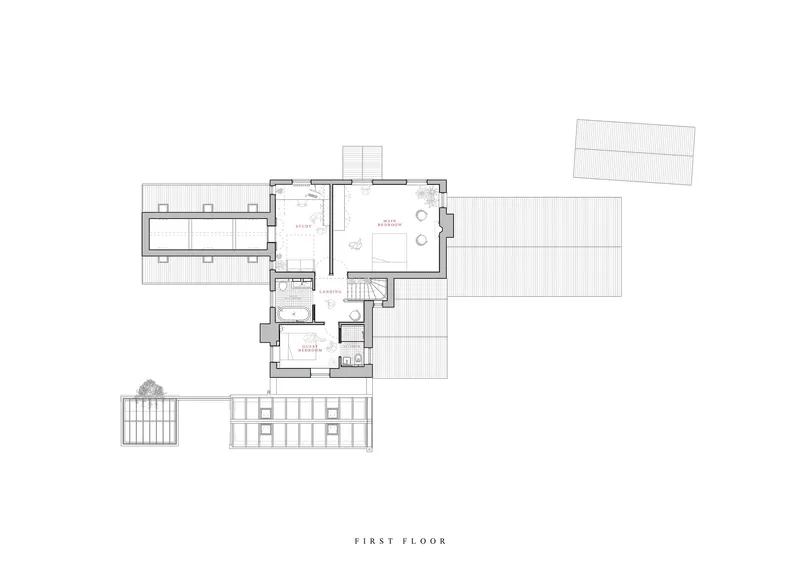
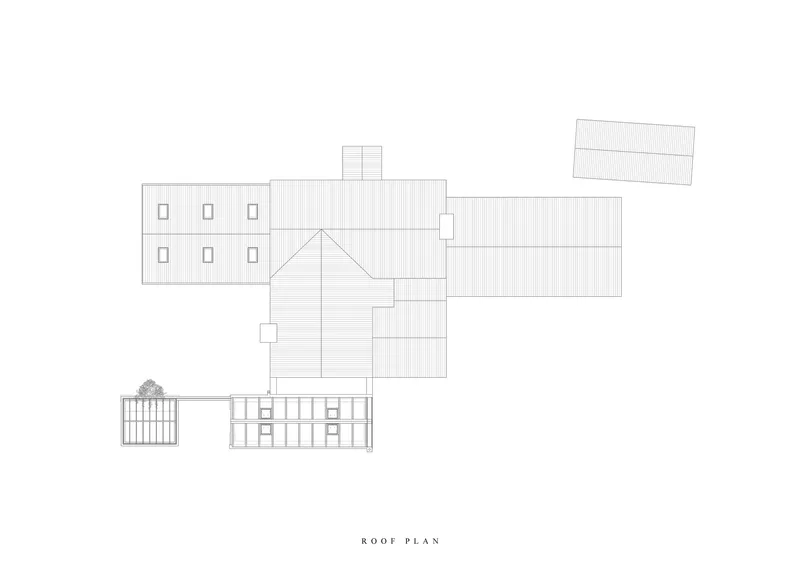
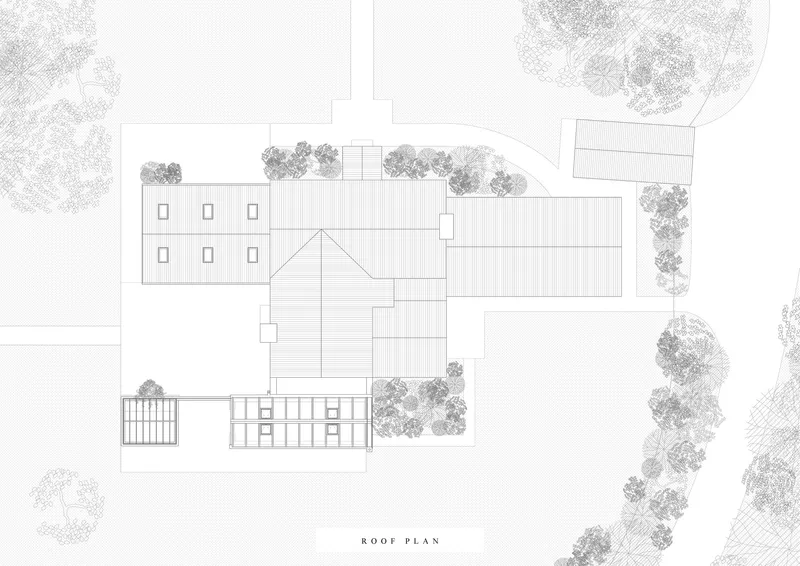
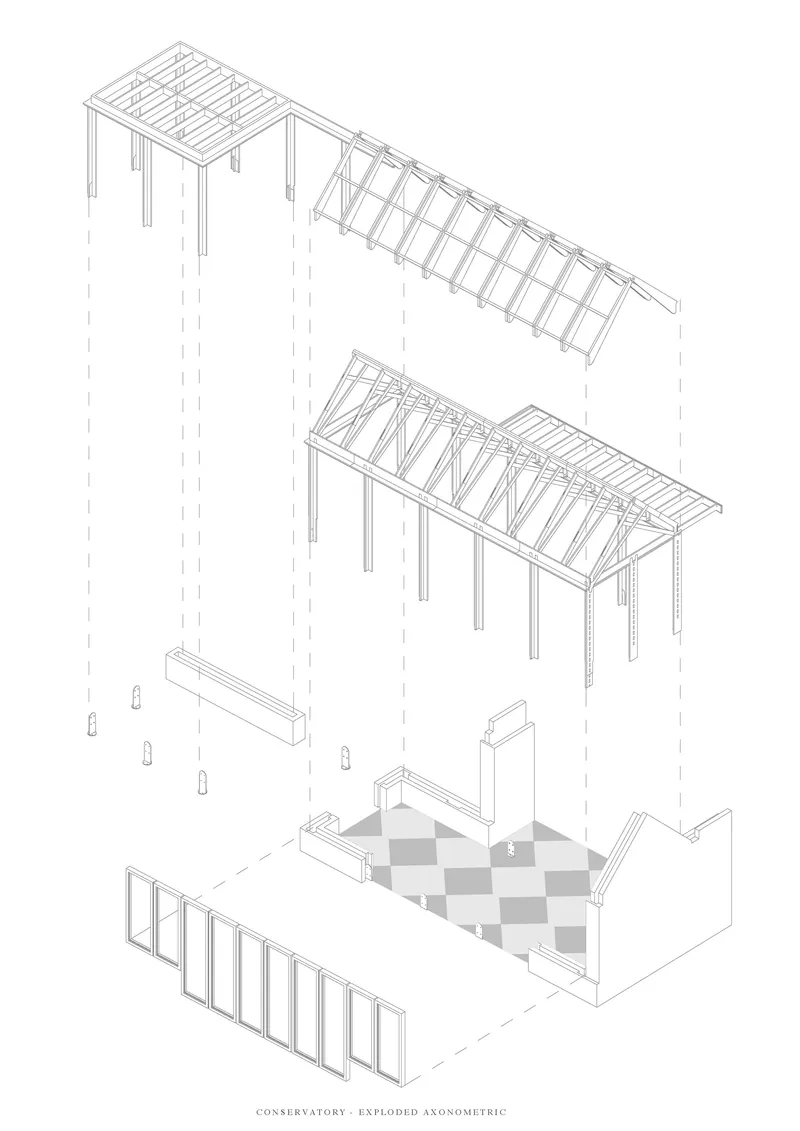
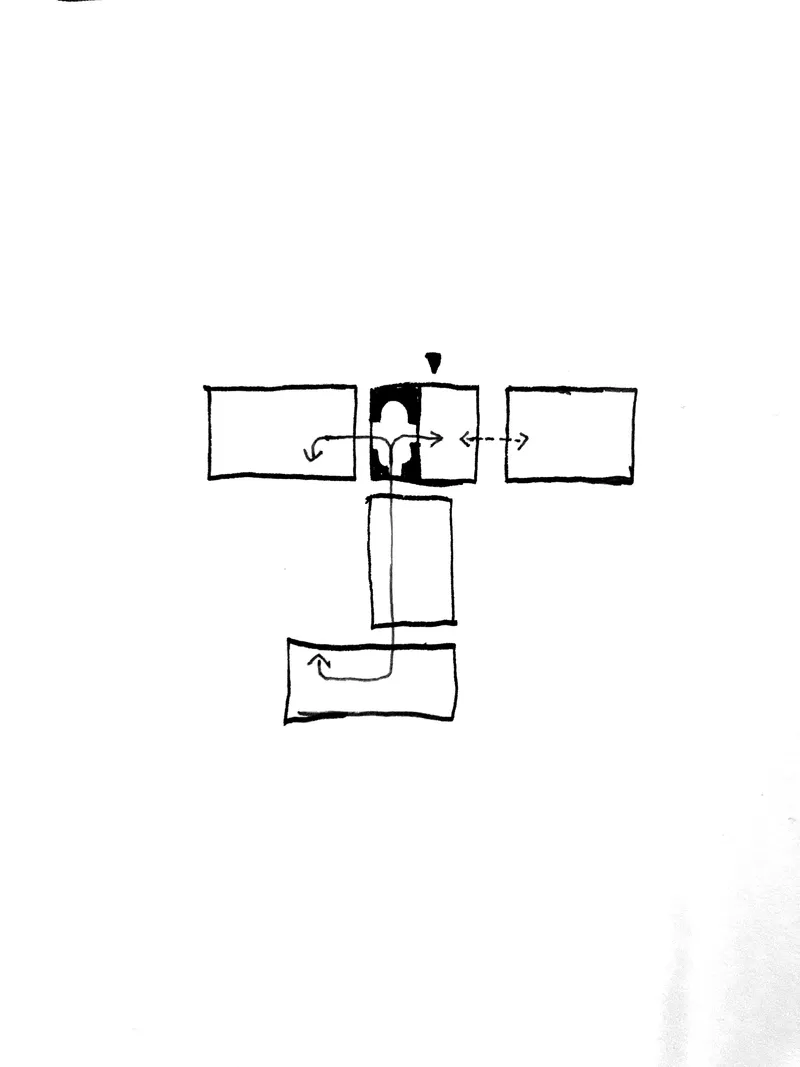
The ground floor plan reveals how the library sits at the intersection of the house's primary axes, drawing together entrance, dining, and kitchen into a legible sequence. The first floor plan shows the reconfigured upper level, where wasted circulation space has been absorbed into the main bedroom and study, both of which are now generously proportioned. The exploded axonometric, with its chequered tiled floor panel and exposed timber frame, makes visible the layered construction logic: distinct structural systems for the original house, the conservatory, and the pergola, each with its own material identity.
The conceptual sketch diagram, with its room adjacencies and circulation arrows, offers a rare glimpse into the design thinking before it resolved into built form. The arrows trace the same axial views that the finished house delivers, confirming that the framed openings were strategic from the outset rather than discovered during construction.
Why This Project Matters
Domestic renovation in England often defaults to one of two modes: the tasteful neutral restoration that defers entirely to the existing fabric, or the glass box extension that announces its contemporaneity with maximum contrast. Studio Ben Allen's Kent farmhouse refuses both templates. It is unambiguously new in its interventions, with a color palette and material language that belong to no historical period, yet it works with the grain of the existing plan rather than against it. The cocktail library, the carved openings, the pentagonal hatch: each gesture is specific to this house and its particular history of accumulated alterations.
What makes the project genuinely instructive is its demonstration that boldness and care are not opposites. Every saturated surface is precisely calibrated, every playful detail resolves a spatial problem. The house proves that residential architecture can be joyful without being frivolous, colorful without being chaotic, and deeply personal without being self-indulgent. For a discipline that often treats domestic work as minor, this is a reminder that the house remains one of architecture's most demanding and rewarding briefs.
A Place in the Country by Studio Ben Allen. Kent, United Kingdom. 235 m². Completed 2024. Photography by French + Tye. Structural engineer: Format. Contractor: Sprinks Construction. Library joinery: Tim Gaudin. Interior metalwork: Fish Fabrications. Interior concrete: Concreations.
About the Studio
Share Your Own Work on uni.xyz
If projects like this are the kind of work you want to make, uni.xyz is a place to publish your own, find collaborators, and enter design competitions.



Popular Articles
Popular articles from the community


Co-life: Sustainable Architecture for Age-Friendly Community Living
Co-life reimagines sustainable architecture for seniors through courtyards, rammed earth, shared gardens, and spaces designed for belonging.

Lunar Spiral: Space Architecture Shaped by the Mathematics of the Universe
Lunar Spiral reimagines space architecture through Fibonacci geometry, lunar regolith, levitating habitats, and self-sustaining Moon living.

The Ocean Hive: Sustainable Architecture for a Self-Sufficient Civilization at Sea
The Ocean Hive imagines sustainable architecture at sea, where modular habitats, algae, wave power and ocean waste sustain a growing colony.

Hill & Cross Opera: Sculptural Opera House Architecture Shaped by Tallinn’s Landscape and Identity
Hill & Cross Opera reimagines opera house architecture in Tallinn through its sculptural hill, civic plaza, glass wave and a luminous cross.
Similar Reads
You might also enjoy these articles

Bao Huynh Watercolor Atelier: A Serene Art Retreat in Hội An
Bao Huynh Watercolor Atelier in Hội An blends multifunctional art spaces, sustainable design, local materials, and family-friendly living in a serene environment.

Atelier Macri Concept Store Interior Design by CASE-REAL
Atelier Macri store features a "ko" counter, walnut wood details, cork displays, blending retail, gallery, and seamless customer experiences.

Manuel Vargas Izquierdo Stadium and High-Performance Sports Center: Architectural Excellence in Jalpa de Méndez
The Manuel Vargas Izquierdo Stadium blends sustainable design, inclusive sports facilities, and cultural-inspired architecture, revitalizing Jalpa de Méndez’s public spaces.

KAKR Buluh Awar Hall: Revitalizing Community and Ecology Through Bamboo Architecture
Community built bamboo hall revitalizes Buluh Awar village, empowering youth, restoring ecology, celebrating vernacular craftsmanship through sustainable architecture and culture.





Comments (0)
Please login or sign up to add comments
No comments yet. Be the first to comment!