

Studio Edwards Builds an Entire Office from Scaffolding, OSB, and Recycled Sailcloth in Melbourne
A 900 square metre workspace on the 12th floor of a Collingwood tower designed for zero waste and full disassembly.


It is rare for an office fitout to carry any conviction beyond the cosmetic. Most commercial interiors treat sustainability as a checklist item, slotting in a recycled panel here or a certified carpet tile there while the rest of the budget disappears into plasterboard and laminate. Studio Edwards took a harder line with Today Design Workspace, a 900 square metre coworking space on the 12th floor of a B-Corp tower in Collingwood, Melbourne. The practice eliminated plasterboard, laminate, and MDF entirely, building the entire interior from materials that arrive in standard sheet sizes and scaffolding components that bolt together without applied finishes. Every wall is movable. Every partition is designed for disassembly.
What makes the project genuinely interesting is the refusal to let the material austerity become a hairshirt exercise. OSB, corrugated translucent sheeting, recycled denim acoustic panels, and repurposed sailcloth screens are not hidden behind some polite veneer. They are the architecture. Scaffolding pipes and clamps do double duty as structure and furniture. Blue plywood, cast aluminium chairs, and stainless steel kitchen surfaces inject real colour and tactile pleasure into a raw palette. The result is a workspace that reads as confident rather than unfinished, and that can literally reshape itself around different team sizes and project demands.
The Entry Sequence and Reception

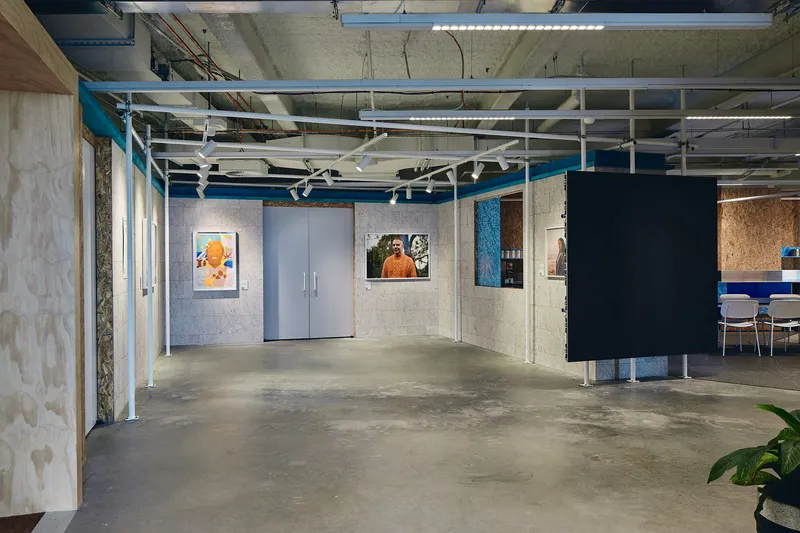
Arrival is theatrical. A tapered timber portal compresses the sightline before releasing visitors into a reception area anchored by a circular desk clad in rolled blue felt cylinders. The desk is a quiet showpiece: handmade, tactile, and unmistakably not purchased from a catalogue. Behind it, concrete columns wrapped in natural fibre and corridor walls displaying artwork guide circulation deeper into the floor plate.
The move is smart because it immediately tells you the rules have changed. There is no glossy bulkhead, no backlit logo wall. Instead, the raw concrete ceiling, polished floor, and exposed steel beams remain visible, and the new elements read as furniture scaled up to architecture rather than walls pretending to be permanent.
OSB as Spatial Language

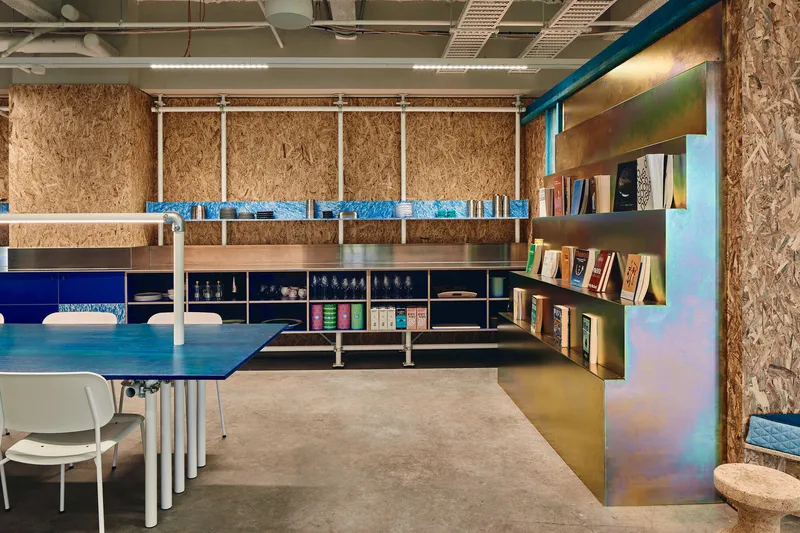

Oriented strand board is the dominant surface material, and studio edwards uses it with real discipline. Every interior wall is 2.4 metres tall, matching the standard sheet size so that cutting waste drops to near zero. The exposed edges and visible grain give the space an unambiguous honesty. You know exactly what these walls are made of, how thick they are, and, critically, that they are not structural. They are furniture, and they behave like it.
The decision to limit wall height to sheet size has spatial consequences that go beyond waste reduction. A gap between partition tops and the concrete soffit allows mechanical services, air, and sightlines to flow freely overhead. It also makes every room feel like a zone within a larger field rather than a sealed box, which is exactly the right instinct for a creative coworking environment where visual energy and ambient awareness matter.
Translucent Partitions and Light
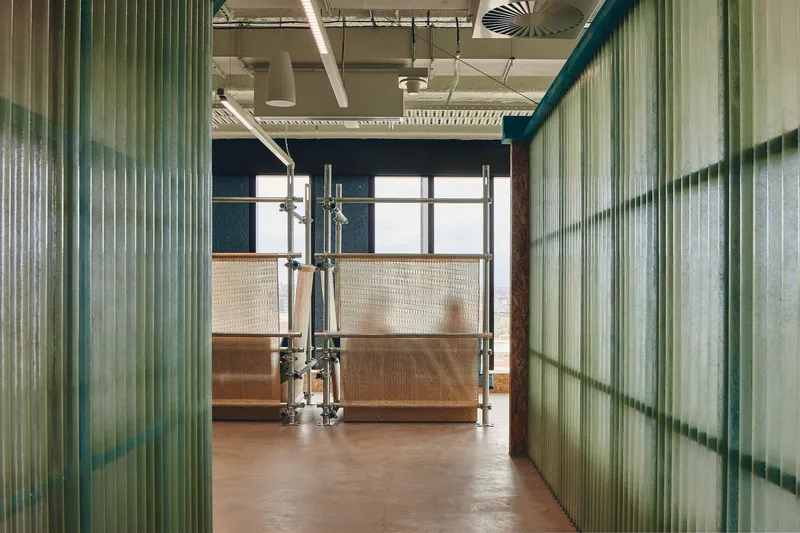


Corrugated translucent fibreglass sheeting, held in green steel frames, forms the second partition system. These panels divide the open floor without blocking light, turning the deep floor plate into a sequence of luminous corridors. The effect is part greenhouse, part warehouse, and it works because it refuses to be polite. The corrugations are industrial, the green frames are unapologetic, and the light that filters through is soft and diffused enough to make a desk beside them genuinely pleasant.
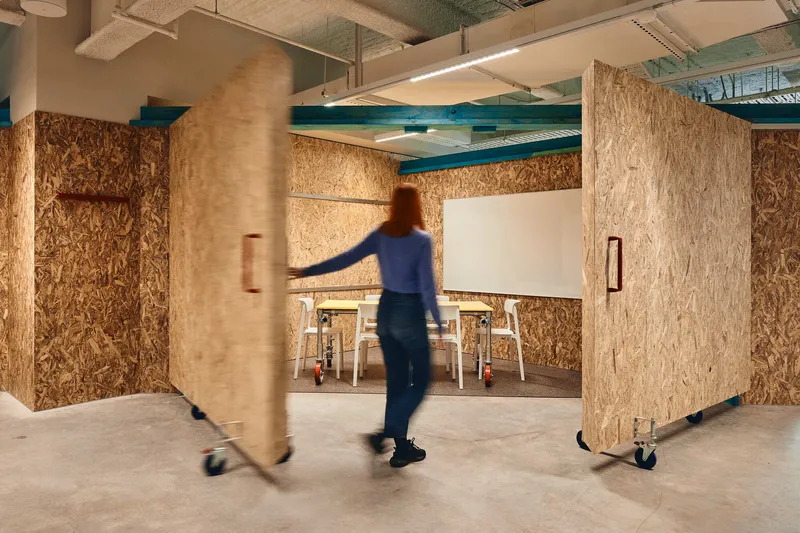
Where full opacity is needed, recycled sailcloth screens drop from overhead tracks. The sailcloth has a papery translucency of its own, and it introduces a welcome softness into a palette that could otherwise tip toward the harsh. Privacy is analog here: you pull a curtain, you slide a panel, you roll a wall on castors. Nothing requires a booking app.
Scaffolding as Furniture and Structure


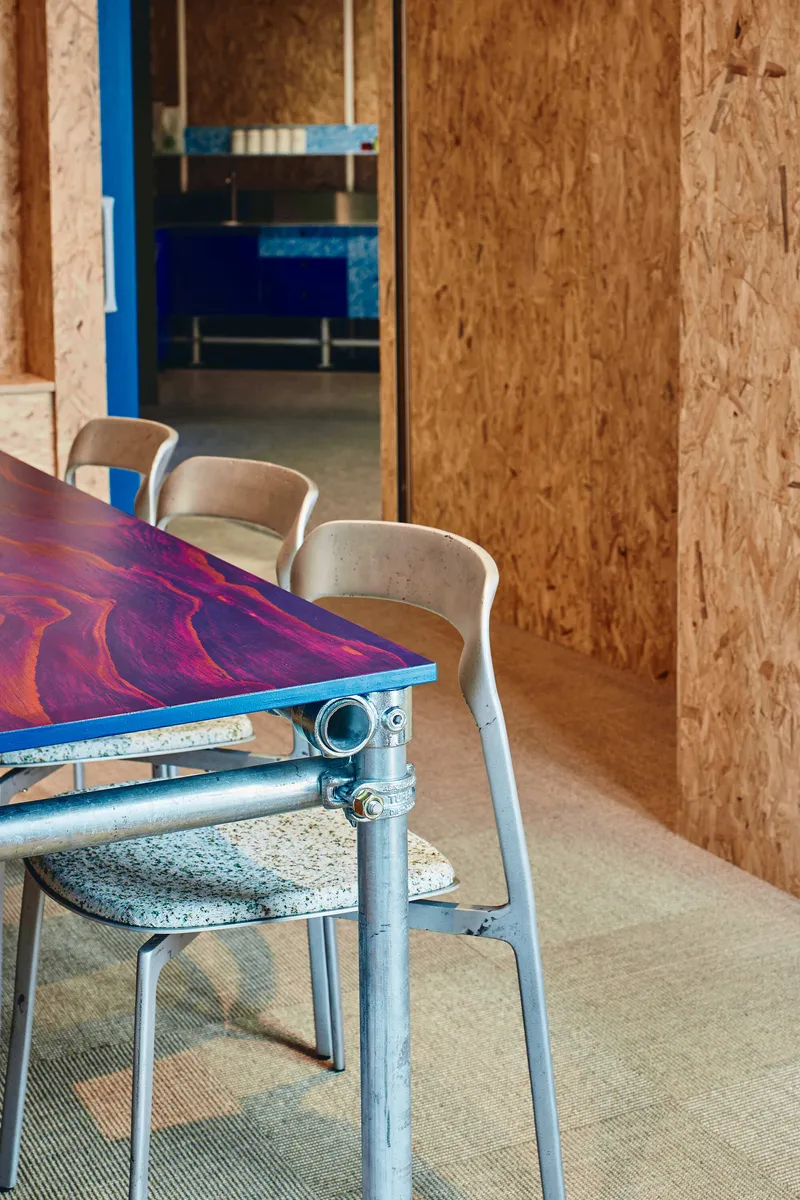
The most provocative material choice is the scaffolding. Chrome pipes and industrial clamps support partitions, textile screens, and table legs throughout the workspace. These are not decorative references to construction. They are actual scaffolding components, standardized, reusable, and designed to be taken apart and reassembled in a different configuration the next week if needed.
The marbled resin tabletops resting on scaffolding legs are a sharp detail. They pair a precious surface with a deliberately temporary base, making the impermanence explicit. Studio edwards treats the temporary not as a problem to solve but as a design strategy to celebrate. In a commercial lease where tenants change and teams grow, this approach is more realistic than any bespoke joinery solution could be.
Meeting Rooms and Work Pods


Clusters of meeting pods and video conferencing suites encircle the central stair core. The pods are framed in turquoise corrugated metal and screened with translucent curtains, giving them a visual lightness that belies their acoustic performance. Recycled denim panels line critical surfaces for sound absorption, keeping conversations contained without sealing the rooms into silence.
Individual work booths framed in blue steel with OSB and cork panelling offer a quieter retreat. The cork ceiling in the larger meeting rooms is a warm counterpoint to the exposed concrete slab elsewhere. These are rooms that understand their purpose: short bursts of focused work or collaborative discussion, not eight-hour confinement. The hinged walls and sliding panels mean each one can open up to the floor when the meeting ends.
Flexibility in Action
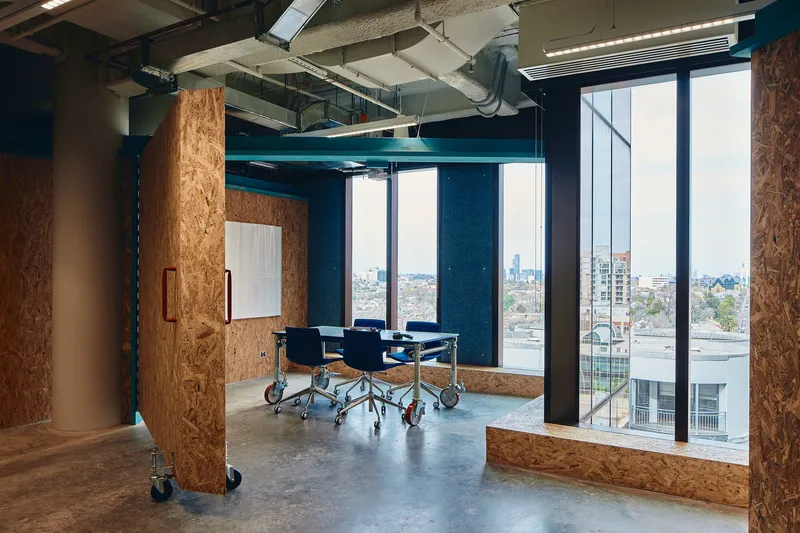
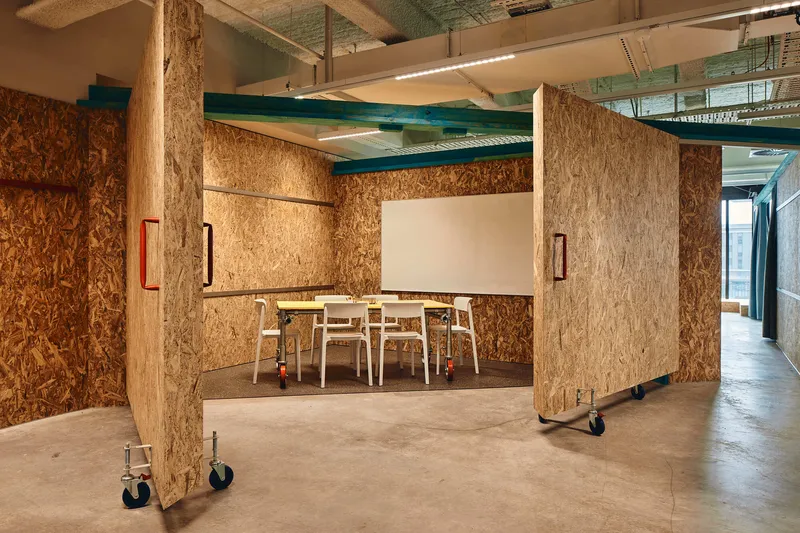

The movable partition panels on industrial castors are the clearest expression of the project's philosophy. Walls roll. Rooms expand and contract. A presentation area for twenty people on Monday becomes three huddle rooms by Wednesday. The constraint of not being able to mechanically fix to the building's perimeter fabric led studio edwards to use magnets for securing removable panels, a low-tech workaround that keeps the base building intact and the fitout fully reversible.
Overhead sliding tracks, hinged whiteboard surfaces, and operable acoustic curtains add further layers of reconfigurability. The result is not a single design frozen at the moment of completion but a kit of parts that the occupants can tune. It takes a certain confidence to hand that control over to the user, and the design earns it by making the mechanisms visible and intuitive.
The Perimeter and Urban Views

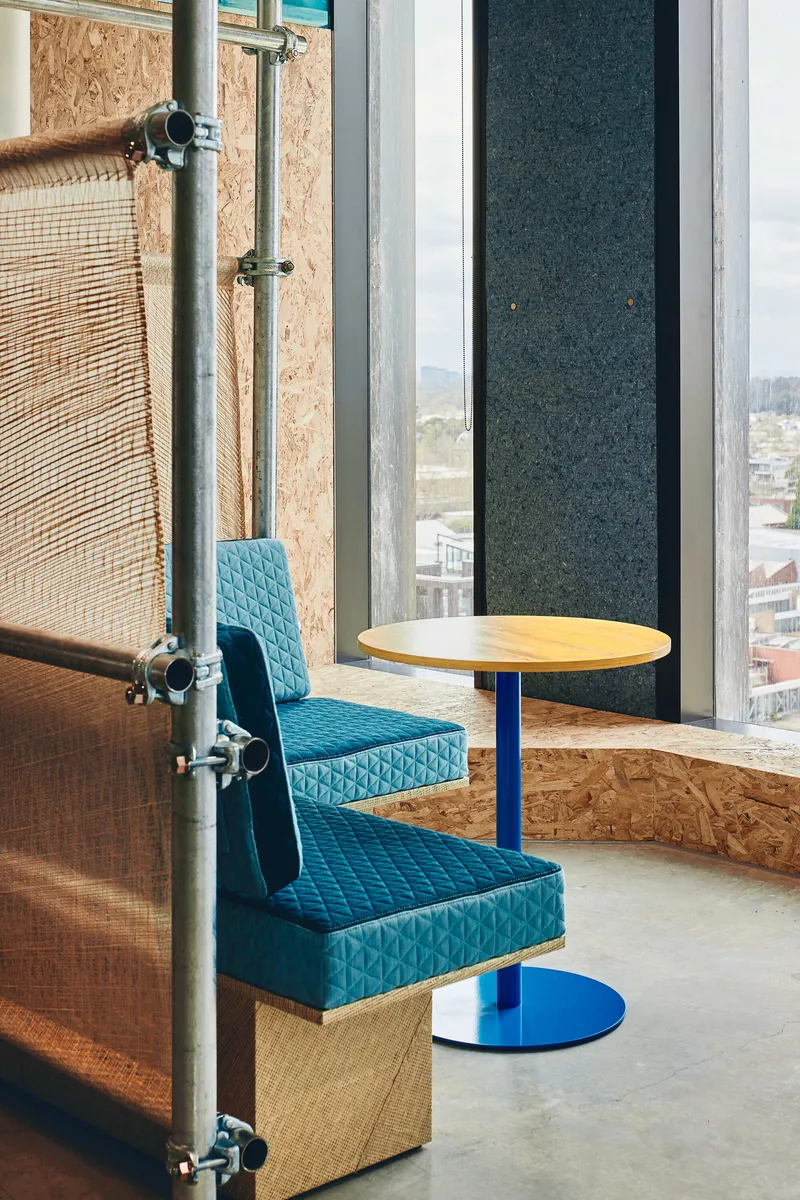

The northern perimeter is given over to informal work and lounge settings with full-height glazing overlooking the Collingwood roofscape. Window seats with upholstered benches, low tables with yellow tops, and seating clusters on OSB bases create a domestic register along the edge. These are the best seats in the house, and the project is smart enough not to wall them off for management.
The turquoise cushions and painted concrete columns inject colour into what could be a monotone landscape of chipboard. The palette is deliberate: blue, green, yellow, and cork tones appear at moments of rest and social exchange, signaling a shift in activity without any change in spatial scale.
Plans and Drawings


The floor plan reveals the organizational logic: angled rooms and workspaces radiate from a central circulation core, with the entry sequence at one end and the kitchen and library forming a social anchor at the far wall. The axonometric drawing is especially revealing, mapping furniture layouts and material zones across the two connected rectangular volumes. You can read the hierarchy of permanence directly: the building's concrete core and columns are fixed, the OSB partitions are semi-fixed, and the scaffolding modules and curtain screens are fully mobile. Three speeds of change, one coherent system.
Why This Project Matters
Commercial interiors are among the most wasteful building typologies. Lease cycles of five to ten years mean that millions of square metres of plasterboard, carpet, and laminate are demolished and sent to landfill every year, often in perfectly good condition. Today Design Workspace offers a credible alternative by treating the fitout as an assembly of standard components rather than a bespoke construction. Nothing is glued, plastered, or applied in a way that prevents reuse. When this tenant leaves, the walls roll away, the scaffolding unbolts, and the materials go to their next life.
What separates this project from other demountable or circular-economy experiments is that it does not look like a prototype. The spatial quality is high, the colour palette is considered, and the flexibility is genuinely useful rather than theoretical. Studio Edwards has demonstrated that designing for disassembly does not require an aesthetic of sacrifice. It requires a material intelligence that most offices never bother to develop.
Today Design Workspace by studio edwards. Collingwood, Australia. 900 m². Completed 2023. Photography by Peter Bennetts.
About the Studio
Share Your Own Work on uni.xyz
If projects like this are the kind of work you want to make, uni.xyz is a place to publish your own, find collaborators, and enter design competitions.


Popular Articles
Popular articles from the community


Opera by the Sea Estonia: Three Shells Dissolving Architecture into Tallinn's Coastline
A winning opera house proposal replaces monumental form with interconnected shells that blur the boundary between building, park and Baltic Sea.

Tsunami Convergenics: Turning Catastrophic Ocean Forces into Underwater Housing Infrastructure
A speculative underwater settlement off the coast of Onagawa, Japan, treats tsunamis and typhoons as energy sources rather than threats.

Faces of the Soviet Avant-Garde: Turning Moscow's Street Names into an Open-Air Museum
A network of sculptural installations across a Moscow residential district transforms forgotten architect names into spatial encounters with cultural memor

Manzana Morphosis: Stretching Barcelona's Grid into a Living Landscape for 2050
A radical reworking of the Eixample manzana turns density into a tool for generous public space, vertical ecology, and environmental performance.

Similar Reads
You might also enjoy these articles

Bao Huynh Watercolor Atelier: A Serene Art Retreat in Hội An
Bao Huynh Watercolor Atelier in Hội An blends multifunctional art spaces, sustainable design, local materials, and family-friendly living in a serene environment.

Atelier Macri Concept Store Interior Design by CASE-REAL
Atelier Macri store features a "ko" counter, walnut wood details, cork displays, blending retail, gallery, and seamless customer experiences.

Manuel Vargas Izquierdo Stadium and High-Performance Sports Center: Architectural Excellence in Jalpa de Méndez
The Manuel Vargas Izquierdo Stadium blends sustainable design, inclusive sports facilities, and cultural-inspired architecture, revitalizing Jalpa de Méndez’s public spaces.

KAKR Buluh Awar Hall: Revitalizing Community and Ecology Through Bamboo Architecture
Community built bamboo hall revitalizes Buluh Awar village, empowering youth, restoring ecology, celebrating vernacular craftsmanship through sustainable architecture and culture.

Explore Co-Working Competitions
Discover active competitions in this discipline

Challenge to design luxury tourism on rails

VR headsets Storefront design competition

Designing a staircase for a client
Comments (0)
Please login or sign up to add comments
No comments yet. Be the first to comment!