
Studio for Architecture and Regional Urbanism Rebuilds a Childhood Home from Memory in Tamil Nadu
At the foothills of the Nilgiris, reclaimed brick and Burmese teak give physical form to four personal tales of place and belonging.


There is a particular kind of project that resists description because its logic is not spatial so much as autobiographical. Tales of Saru, a 3,200 square foot house in Mettupalayam at the foothills of India's Nilgiri range, belongs to that category. Designed by Studio for Architecture and Regional Urbanism, the house sits on the exact ground where its client grew up. The brief was not a program list but a set of memories: childhood scenes, thermal qualities, the rhythm of coconut palms against sky. The result is a compact dwelling organized around four distinct architectural narratives, each one a spatial retelling of lived experience.
What makes the project genuinely interesting is its material discipline. Rather than importing finishes, the architects dismantled the existing boundary wall for its bricks, excavated soil on site for earthen plasters, and sourced reclaimed Burmese teak from dismantled regional structures. The final plaster coat incorporates black oxide and crushed plant seeds, a technique that gives the walls an almost biological texture. None of this reads as austerity. The house feels warm, specific, and deeply rooted in its climate and vegetation, which is the whole point.
Street Face and Threshold

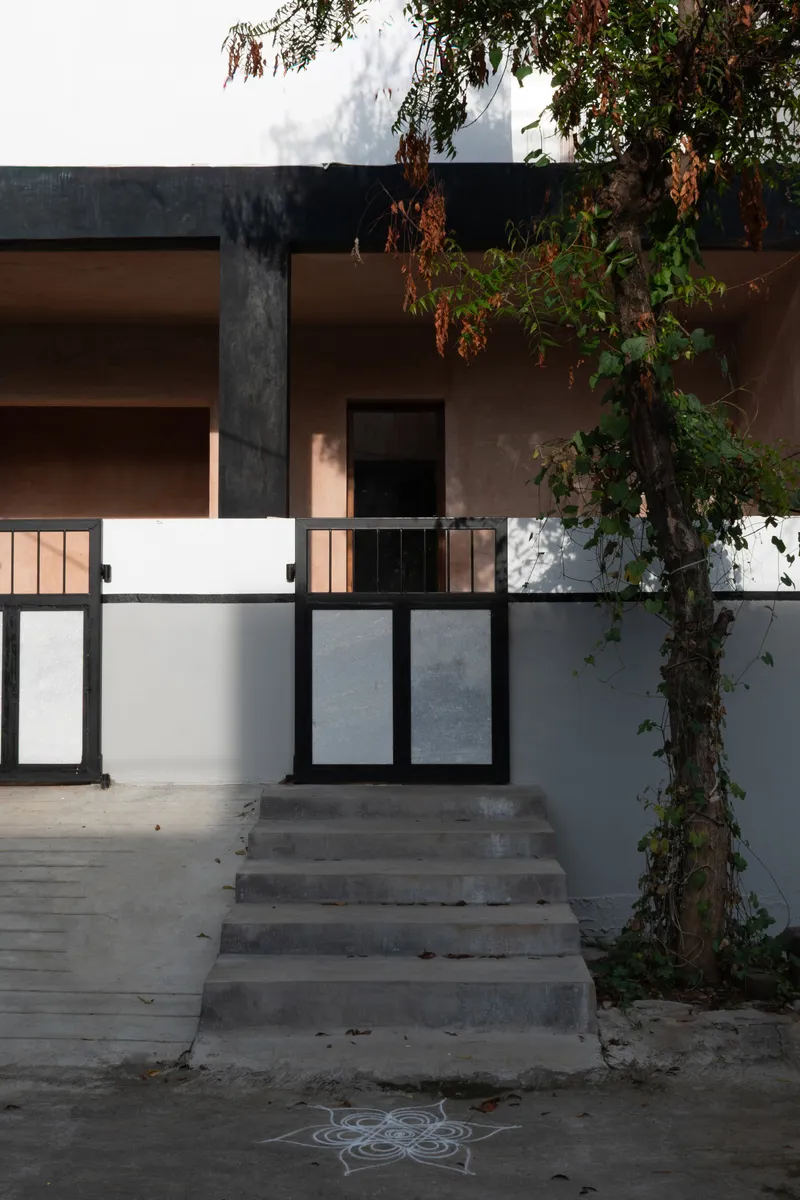
From the street, the house presents a restrained white facade punctuated by projecting concrete window boxes. The palette is intentionally muted against the canopy of coconut palms overhead, letting vegetation do most of the visual work. A metal gate and concrete steps at the entrance set a domestic, almost rural tone. The elevated floor plane at the threshold, flanked by potted plants, makes the transition from public lane to private interior feel like a physical ascent into a different register of attention.
The compact projecting volumes that read so crisply from outside serve a double purpose: they bring controlled light deep into the bedrooms while reinforcing the wall's thickness as something experiential rather than merely structural.
Courtyards as Narrative Rooms


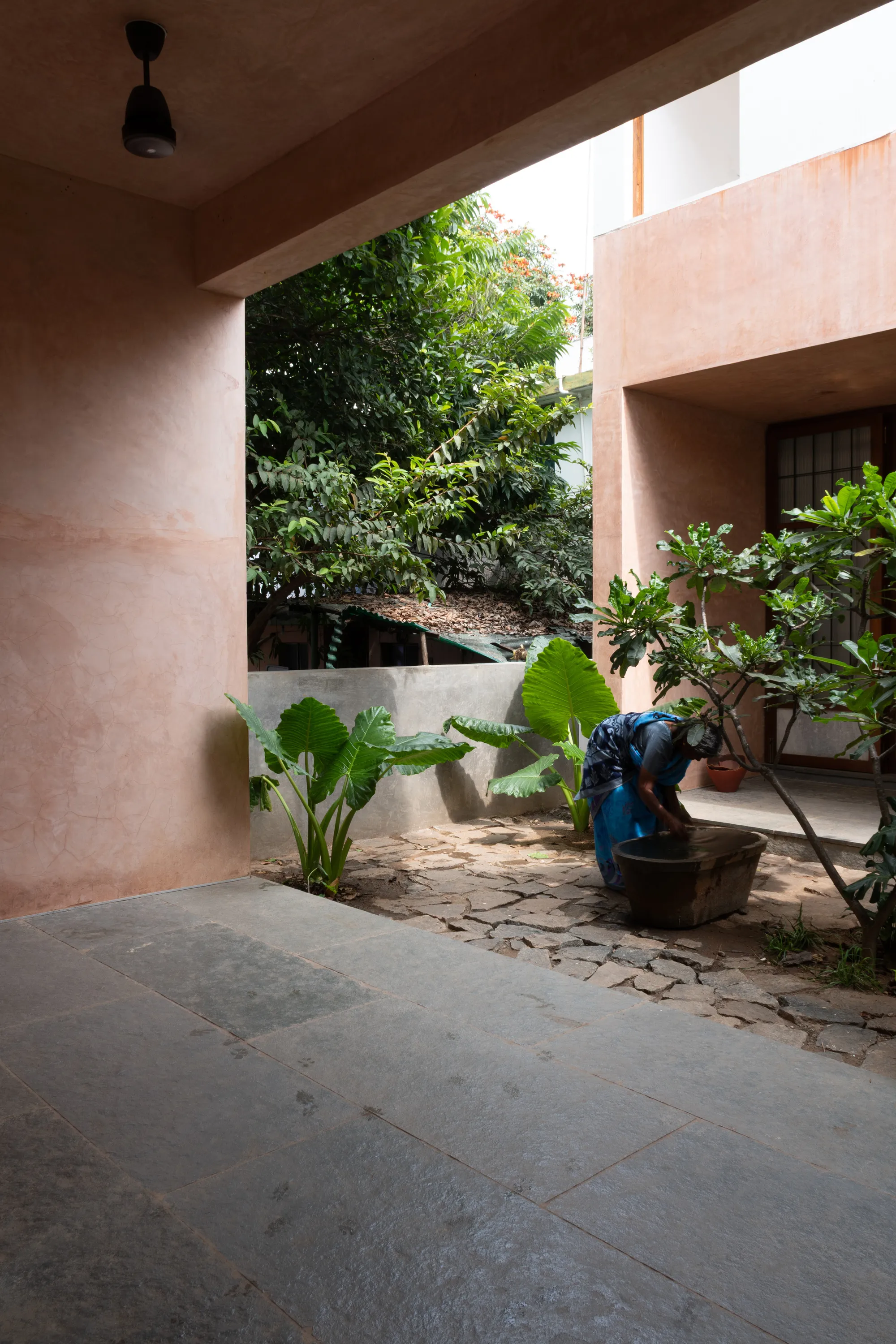
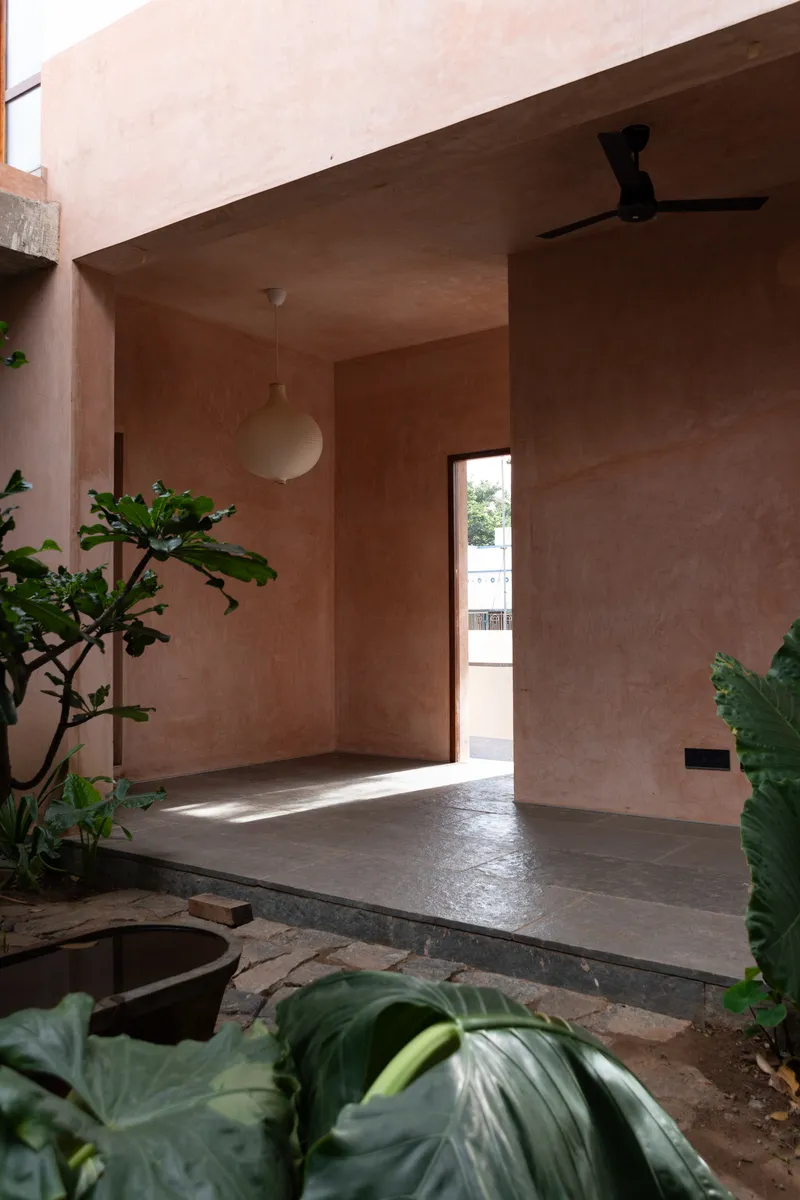
The heart of the house is not a single courtyard but a sequence of them, each with a different character. One is framed by pink plastered walls and stone paving with a central frangipani tree. Another is darker, more enclosed, with gridded sliding doors and a ceramic pot beneath an earthen plaster ceiling. The progression between these spaces is the primary experience of the house: you move from quiet compression to generous openness and back again.
The pink render, which appears on several interior and threshold surfaces, is a deliberate departure from the white exterior. It reads as something between terracotta and dusk light, a color drawn from regional vernacular traditions that shifts throughout the day as the sun moves through the palm canopy overhead.
Borrowed Landscape and Tropical Planting


The architects explicitly reference the Japanese principle of Shakkei, or borrowed landscape, to describe how the surrounding coconut palms are framed as part of the composition without being planted by the project. This is a smart move in a town where the existing vegetation is the strongest spatial asset. Areca palms, frangipani, bird-of-paradise, and cascading vines fill the courtyard pockets, while the arched openings in earthen plaster walls create frames that collapse the boundary between garden and architecture.
A courtyard pool with a dark granite edge serves as a grounding element, reflecting sky and foliage. The lotus pond and roof garden mentioned in the program are part of a vertical landscape strategy that keeps the house breathing at every level. These are not decorative features. In the Nilgiri foothills, where heat and humidity are constant companions, landscape is climate infrastructure.
Material Reclamation as Method


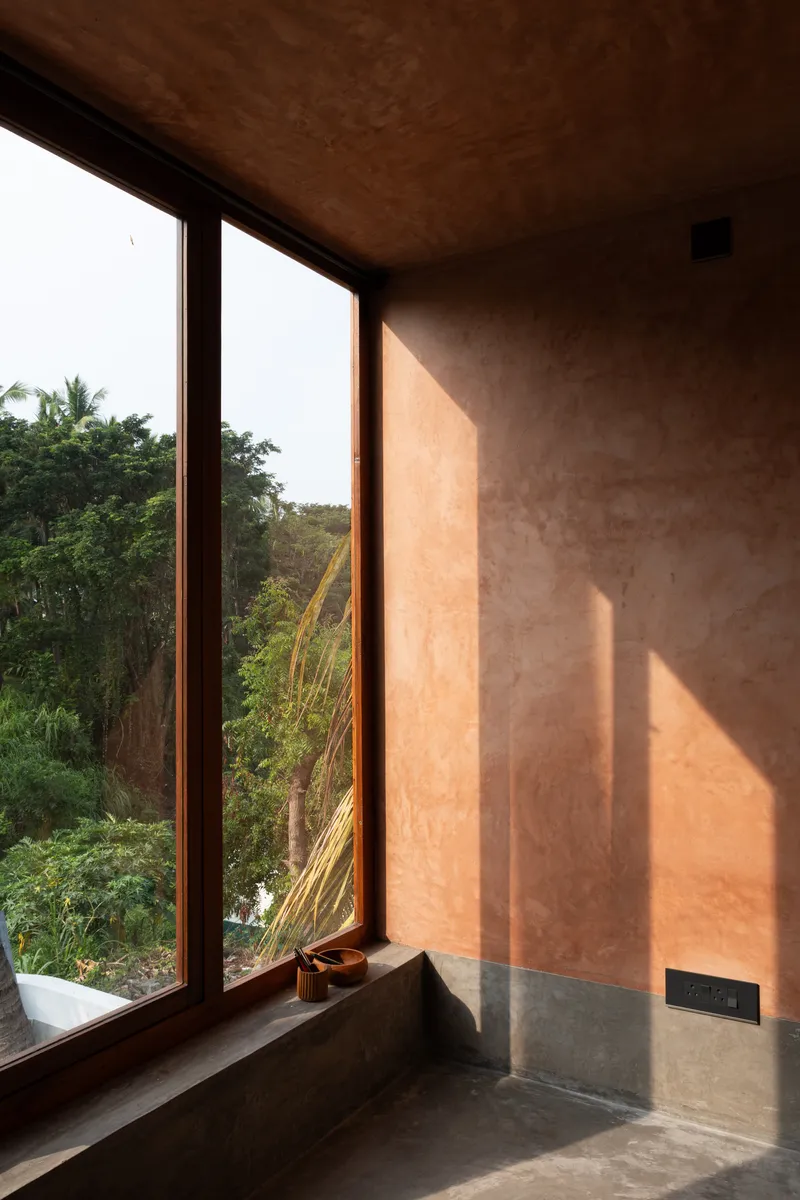
The reclaimed Burmese teak deserves close attention. It appears everywhere: as door frames, window mullions, sliding panels, and structural members. The wood carries the patina of its previous life, and the architects have not tried to hide that. Timber trim against white and pink plaster creates a visual warmth that is impossible to replicate with new materials. The window boxes, where concrete frames hold timber-trimmed openings with sliding panels, are the most refined detail in the project.
Lime plaster and the black oxide seed finish on walls are not cosmetic choices. They create breathable surfaces that support passive thermal regulation, a critical strategy in this region. The walls absorb and release moisture slowly, moderating interior temperatures without mechanical systems. The decision to excavate and use site soil closes a material loop that gives the house an almost geological connection to its plot.
Interior Sequences and Changing Heights
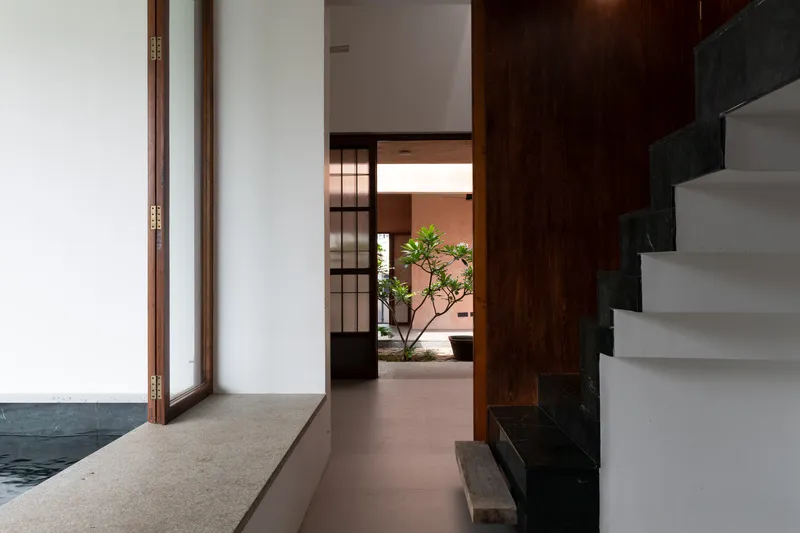


Inside, the spatial narrative unfolds through changes in ceiling height and enclosure. Low, intimate passages with grey stone steps lead to upper levels. Skylights cast angular shadows onto white walls at certain hours. A covered walkway with a gridded screen wall catches palm shadows in morning light, turning the corridor into a kind of sundial.
The progression from compressed to open is deliberate: quiet, low-ceilinged zones give way to social areas with taller volumes and more generous glazing. The architects treat circulation not as leftover space but as the primary place where the house's four tales unfold.
Living and Sleeping
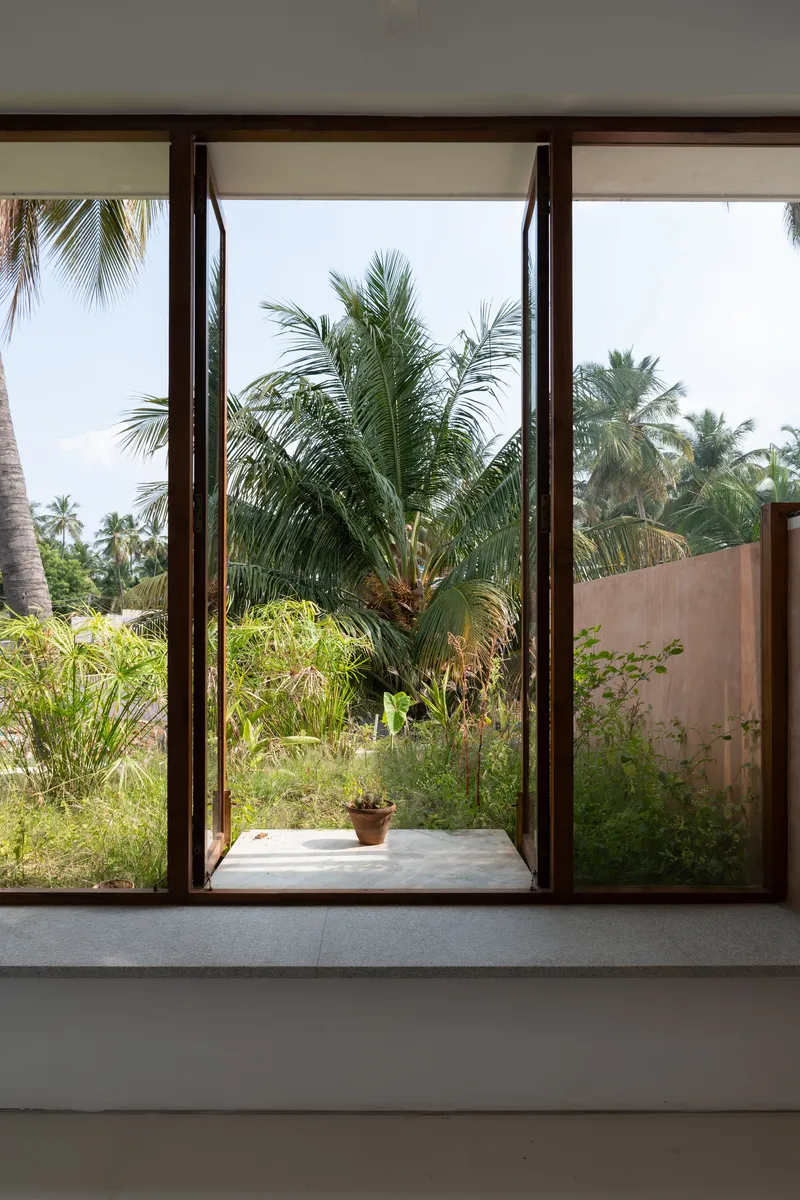
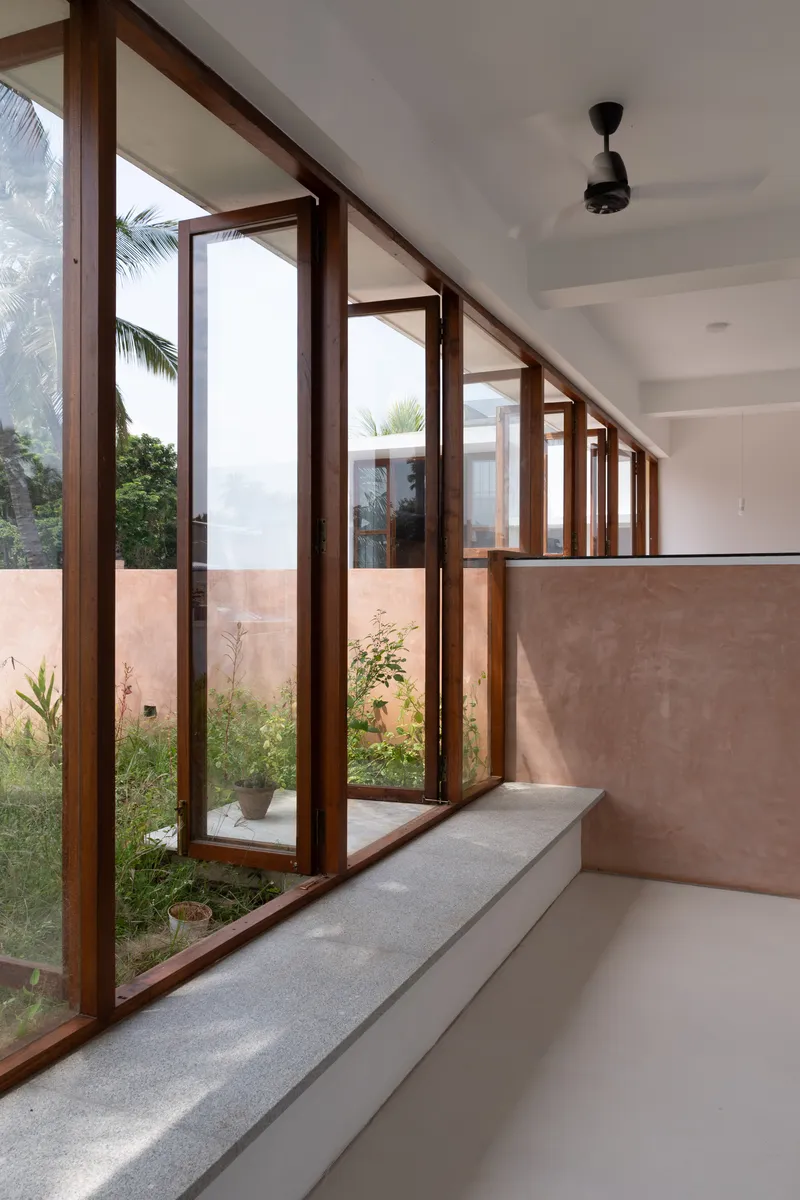

The social rooms open generously to the courtyards through rows of timber-framed glazed doors with stepped sills. Views are layered: an interior room looks through a glazed opening onto a pink courtyard, which in turn frames the palm canopy beyond. This depth of field is the project's strongest spatial quality. You are never simply inside or outside; you are always between layers.
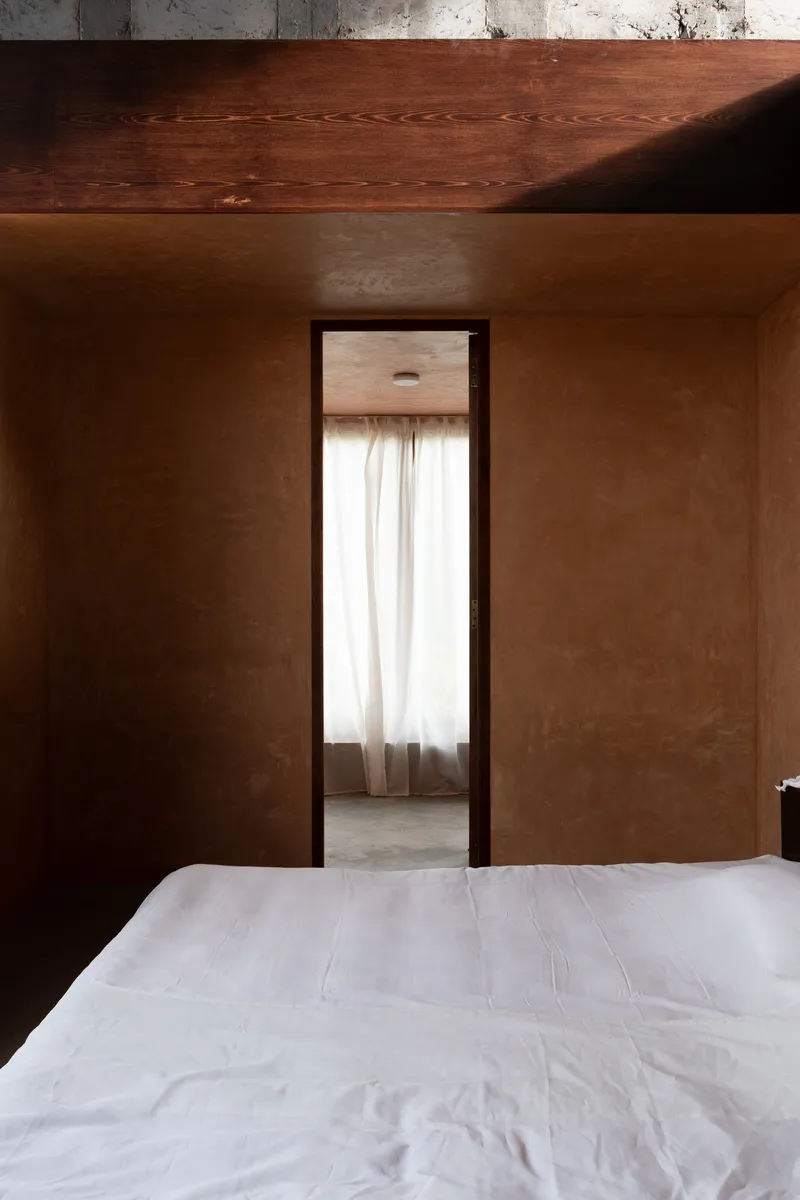
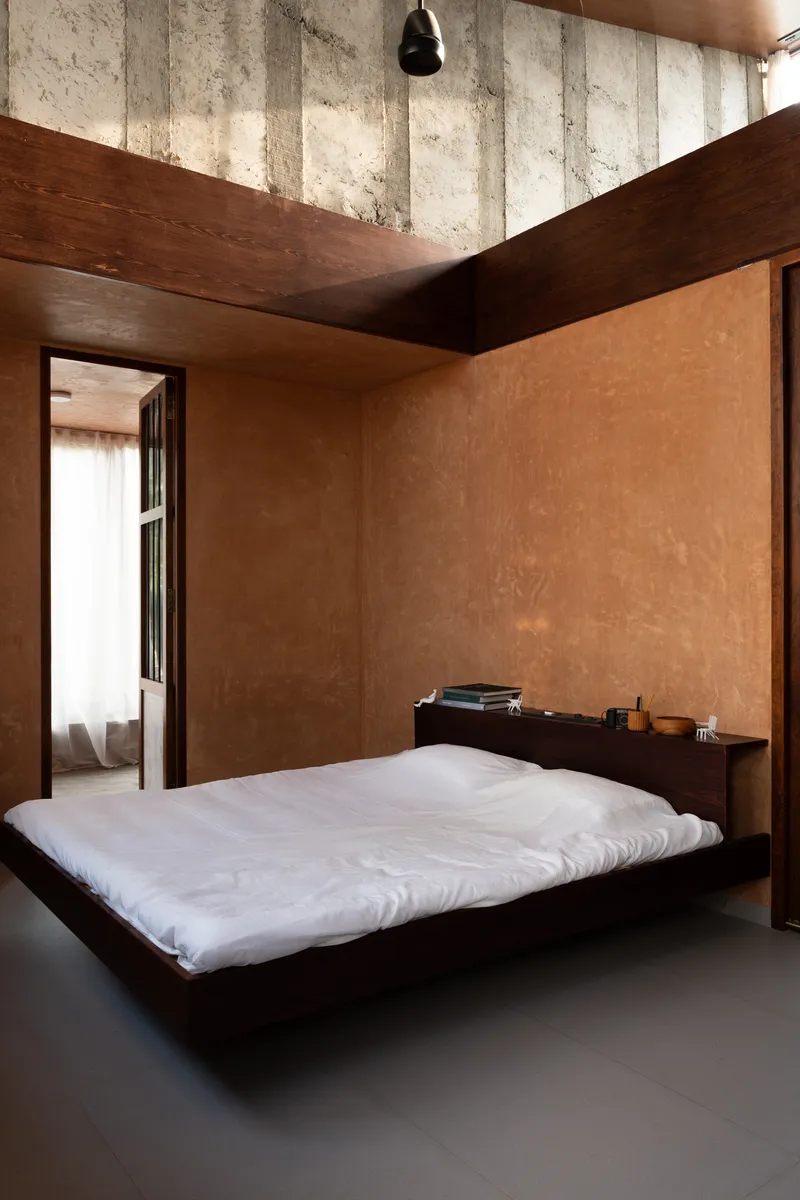

The bedrooms are more contained. Pink plaster walls and timber-lined ceilings wrap the sleeping spaces in warmth. A low platform bed beneath exposed concrete beams and timber ceiling planes creates a room that feels sheltered without being closed. The cantilevered balcony, where a person stands beside trailing foliage, extends the private room outward just enough to catch the breeze and a fragment of the surrounding landscape.
Openings and Light


Every opening in this house is calibrated. The earthen plaster portals act as deep frames, their thickness controlling the quality of light that enters. The gridded doors cast precise shadow patterns that shift through the day. A courtyard corner with a potted frangipani, broad-leafed ground plants, and a plaster soffit overhead condenses the project's ambitions into a single scene: material, vegetation, light, and enclosure working as one system.
Plans and Drawings


The plan drawings reveal what is not immediately obvious in photographs: the site is triangular. The architects have turned this constraint into the organizing principle, wrapping rooms around the perimeter and placing courtyards and planted areas in the residual spaces. The ground floor shows a tight choreography of entry, courtyard, and living spaces. The first floor is simpler, with bedrooms arranged to maximize exposure to the surrounding palm canopy.


The sections are revealing. Staggered roof heights create the varying interior experiences described above, while the lower section shows the house perched on a curved retaining wall above dense tropical vegetation. The building steps with the terrain rather than leveling it. This topographic sensitivity reinforces the project's central claim: that architecture can be an act of remembering rather than imposing.
Why This Project Matters
Tales of Saru is a small house, but its ambitions are not. It proposes that memory is a legitimate design methodology, not as sentimental decoration but as a way of generating spatial sequences, material choices, and relationships to landscape. The decision to rebuild on the site of a childhood home, using materials reclaimed from its own walls and from surrounding structures, turns nostalgia into something structural. This is architecture that takes the past seriously without becoming a replica of it.
For architects working in similar climates and cultural contexts, the project offers a practical lesson alongside its poetic ones. Passive thermal strategies, reclaimed materials, and the principle of borrowed landscape are not innovations here; they are regional intelligence, carefully applied. What Studio for Architecture and Regional Urbanism has done is demonstrate that specificity, both personal and geographic, produces better buildings than abstraction. In a discipline increasingly drawn to universal gestures, that is a position worth defending.
Tales of Saru, designed by Studio for Architecture and Regional Urbanism, Mettupalayam, Tamil Nadu, India. 3,200 sq ft. Completed 2025. Photography by Saru Kumar Kannan.
About the Studio
Share Your Own Work on uni.xyz
If projects like this are the kind of work you want to make, uni.xyz is a place to publish your own, find collaborators, and enter design competitions.




Popular Articles
Popular articles from the community


Hill & Cross Opera: Sculptural Opera House Architecture Shaped by Tallinn’s Landscape and Identity
Hill & Cross Opera reimagines opera house architecture in Tallinn through its sculptural hill, civic plaza, glass wave and a luminous cross.

The Earth Pod: 3D Printed Homes for Resilient Refugee Communities
The Earth Pod reimagines refugee housing through 3D printed homes made from clay, combining resilience, self-sufficiency, and rapid shelter.
EW PARK: Sustainable Architecture Reimagines the Future of Urban Parking
EW PARK reimagines city parking as a modular wooden tower combining automation, solar energy, electric mobility, and adaptable urban design.

AL-JANNAH: Sustainable Architecture and Permaculture for Afghan Widows
AL-JANNAH uses sustainable architecture and permaculture to create resilient oasis of housing, learning, work and renewal for Afghan widows.


Similar Reads
You might also enjoy these articles

Bao Huynh Watercolor Atelier: A Serene Art Retreat in Hội An
Bao Huynh Watercolor Atelier in Hội An blends multifunctional art spaces, sustainable design, local materials, and family-friendly living in a serene environment.

Atelier Macri Concept Store Interior Design by CASE-REAL
Atelier Macri store features a "ko" counter, walnut wood details, cork displays, blending retail, gallery, and seamless customer experiences.

Manuel Vargas Izquierdo Stadium and High-Performance Sports Center: Architectural Excellence in Jalpa de Méndez
The Manuel Vargas Izquierdo Stadium blends sustainable design, inclusive sports facilities, and cultural-inspired architecture, revitalizing Jalpa de Méndez’s public spaces.

KAKR Buluh Awar Hall: Revitalizing Community and Ecology Through Bamboo Architecture
Community built bamboo hall revitalizes Buluh Awar village, empowering youth, restoring ecology, celebrating vernacular craftsmanship through sustainable architecture and culture.
Comments (0)
Please login or sign up to add comments
No comments yet. Be the first to comment!