

Studio Frozen Music Replaces a Generic Nashik Tower with a Stepped Brick and Concrete Housing Block
A 53,000-square-foot apartment building in Nashik, India, trades the typical floor-plate tower for staggered terraces and perforated brick screens.


The original brief for this plot in Nashik's Badade Nagar neighborhood called for a standard 10-to-11-story tower: four mid-size apartments per floor, a commercial plinth, the usual maximized FSI play. Studio Frozen Music, led by Mahesh Deepak Shirke, refused the template. What they built instead is a 53,000-square-foot housing block that breaks the massing into staggered volumes, wraps them in perforated terracotta brick screens, and carves out an interior courtyard that brings air, light, and social life into the section.
The result is a building that reads less like a speculative apartment tower and more like a piece of inhabited topography. Concrete floor slabs project and recede at alternating levels, creating deep terraces that shade the units below. Brick jalis filter western sun and street noise without sealing residents off from the city. It is housing that argues for density without uniformity, and for economy without indifference.
A Facade That Breathes
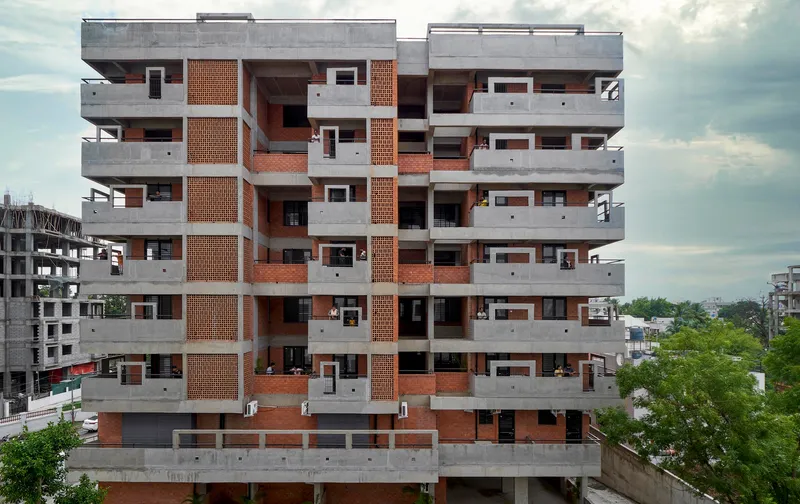
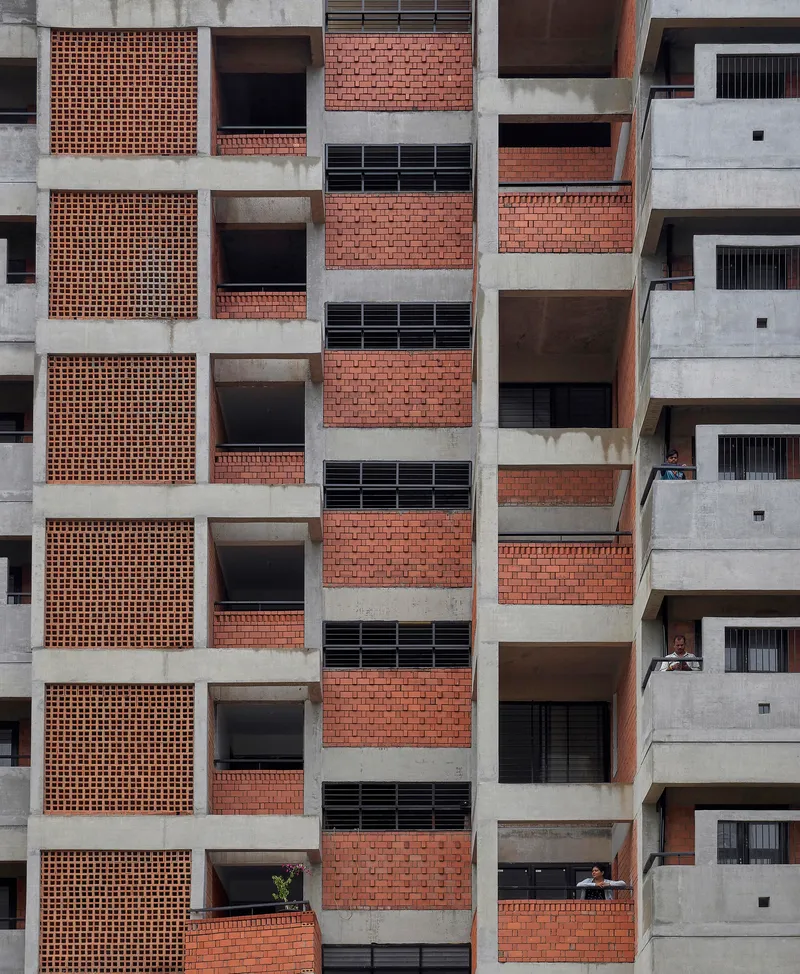
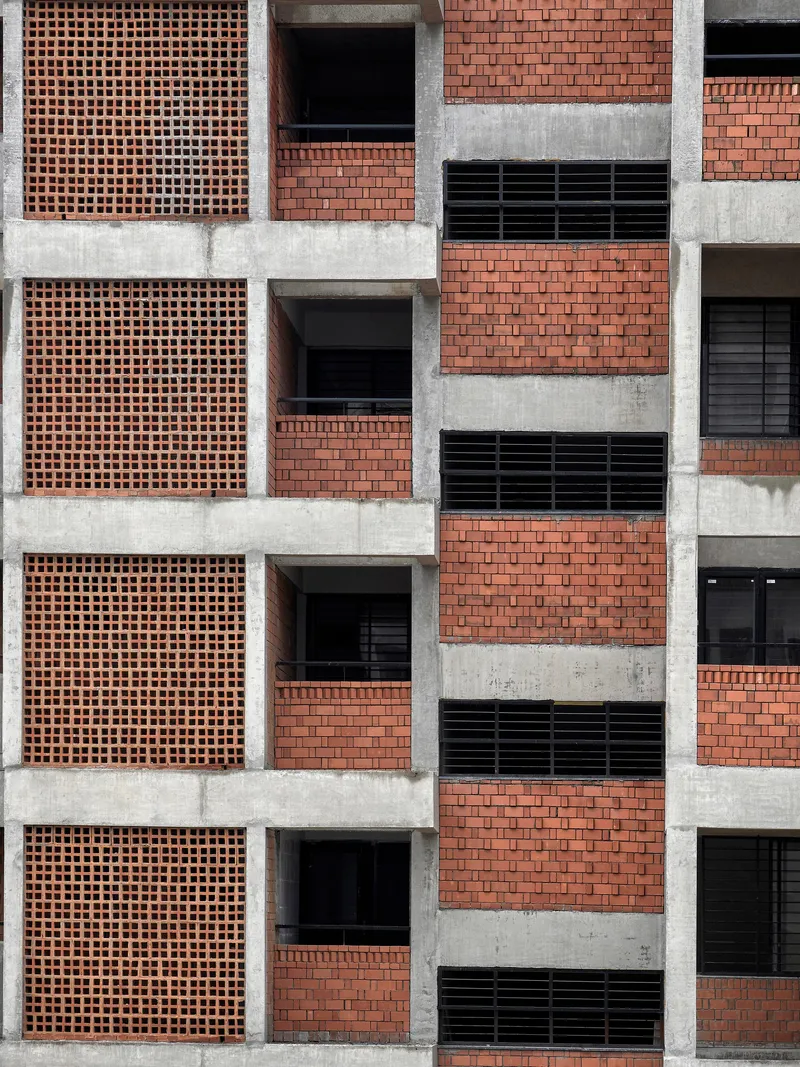
The most striking thing about the Badade Nagar facade is its layered depth. Concrete frames establish a primary grid, but within each bay the perforated brick screens sit at different planes, creating a moiré-like effect as you move past the building. The terracotta brick is not decoration applied over structure; it is a working element, filtering light and ventilation into living spaces while giving the facade a warm, granular texture that ages well in Nashik's hot-dry climate.
Horizontally, the composition alternates between solid concrete bands and the lighter, porous brick panels. The rhythm prevents monotony without relying on gimmicks. From a distance the building reads as a unified mass; up close it reveals a rich catalog of shadow, perforation, and material grain.
Staggered Terraces and Deep Recesses
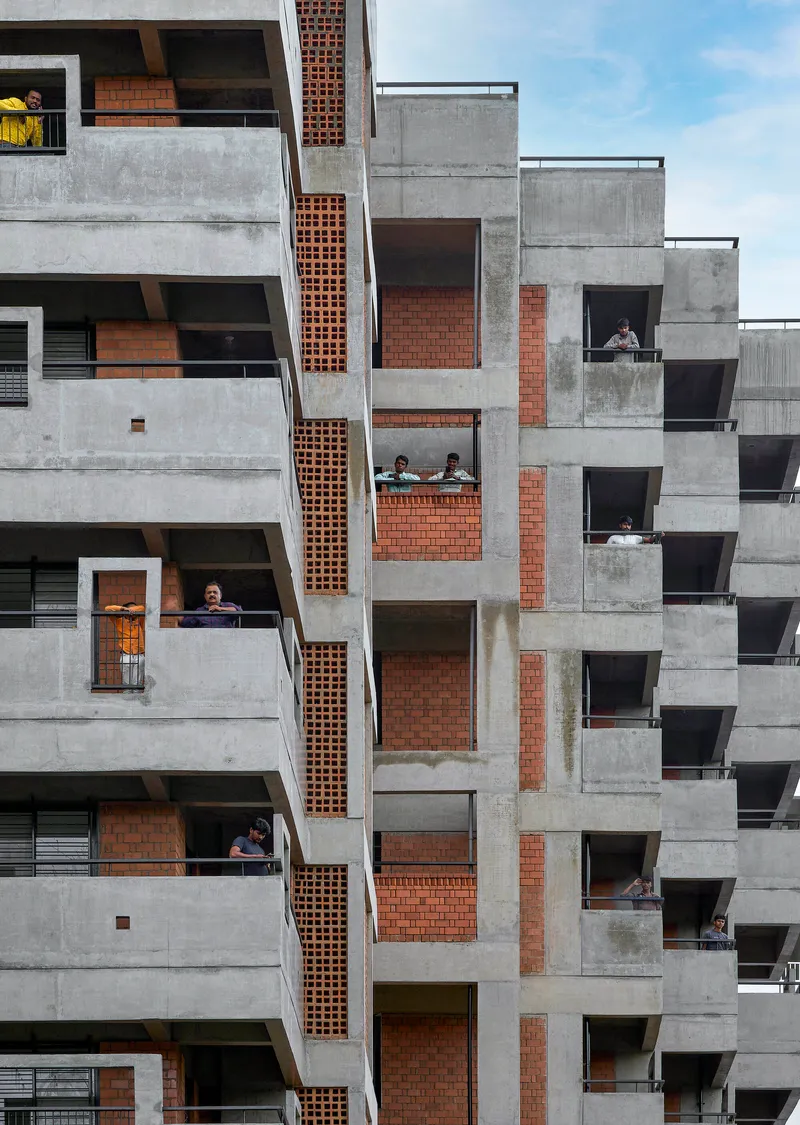
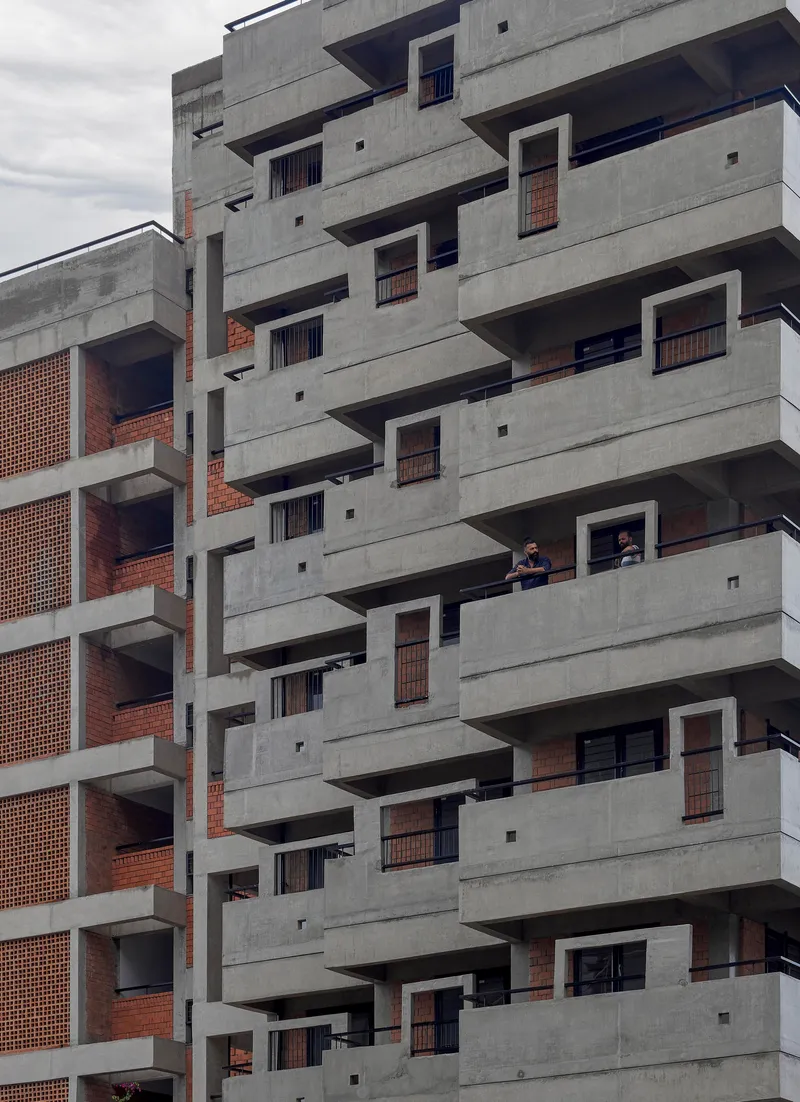
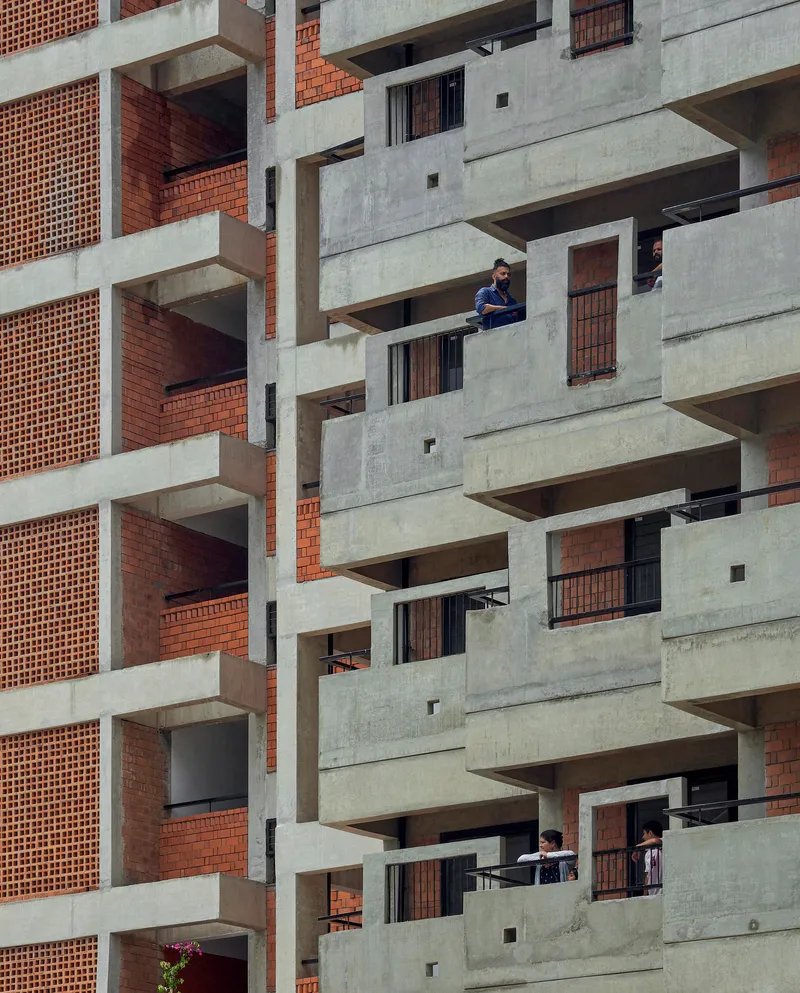
Rather than stacking identical balconies in a flat plane, the architects offset the concrete slabs so that each terrace oversails the one below. The effect is twofold. First, it creates generous shading for every level, cutting solar gain without mechanical intervention. Second, it gives each apartment a distinct spatial address. Residents occupy these outdoor rooms visibly, leaning on railings, sitting with morning coffee. The stagger makes the building feel inhabited and specific rather than anonymous.
The deep recesses also do structural work. The cantilevered slabs, built in reinforced cement concrete by contractors Vijay Sonavane and Ravi Jagtap, distribute lateral loads across the stepped profile. Structure and climate strategy overlap here in a way that keeps the section honest.
The Interior Courtyard
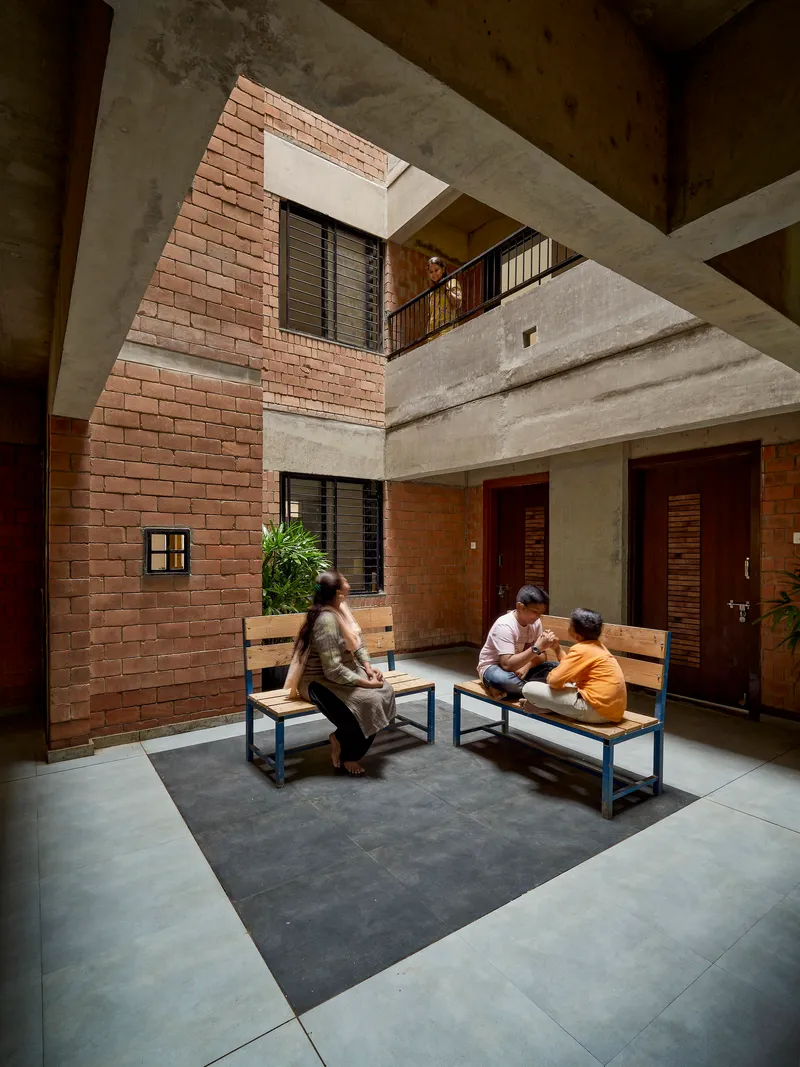
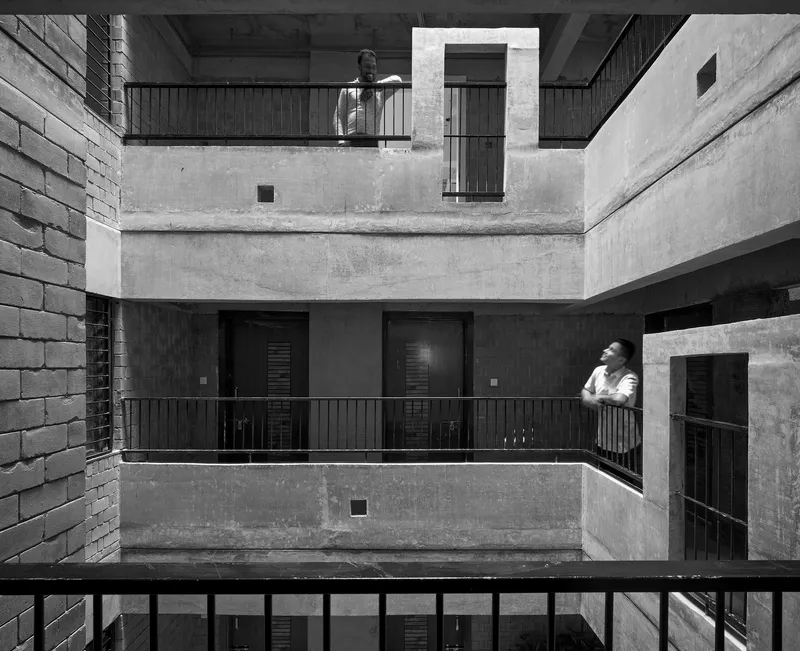
At the heart of the plan sits a courtyard that runs the full height of the building. Open at the top to a skylight slot, it pulls daylight down into the circulation core and the lower floors. Terracotta brick lines the courtyard walls, continuing the material palette from the exterior and giving the interior void a warm, ochre tone. Benches at ground level turn the space into an informal gathering spot, something rare in Nashik apartment buildings of this scale.
The courtyard also functions as a thermal chimney. Hot air rises and exits through the skylight opening, drawing cooler air through the apartments at the lower levels. It is a passive strategy rooted in the region's traditional residential architecture, scaled up here to serve a multi-story block.
Corner Conditions and Structural Expression
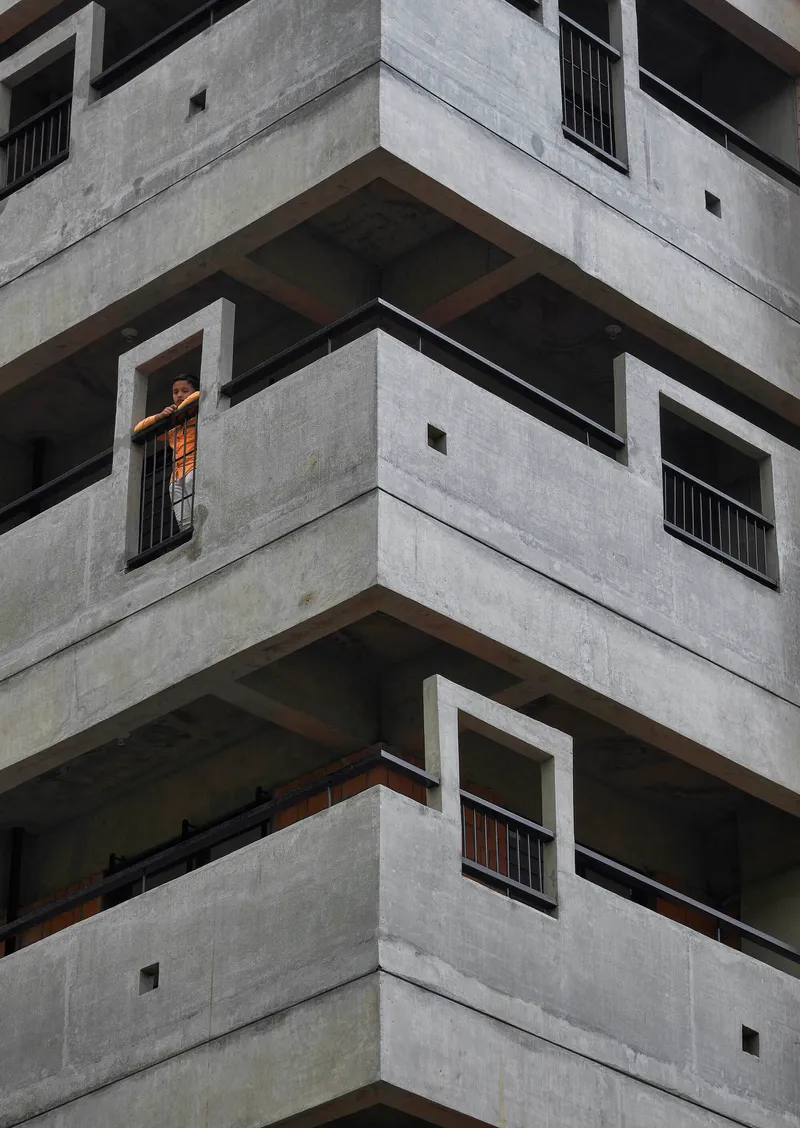
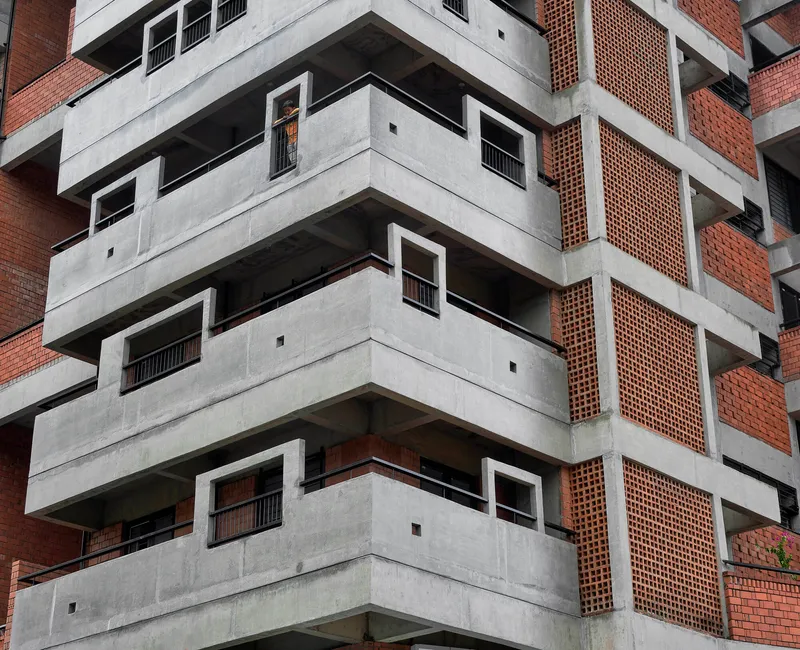
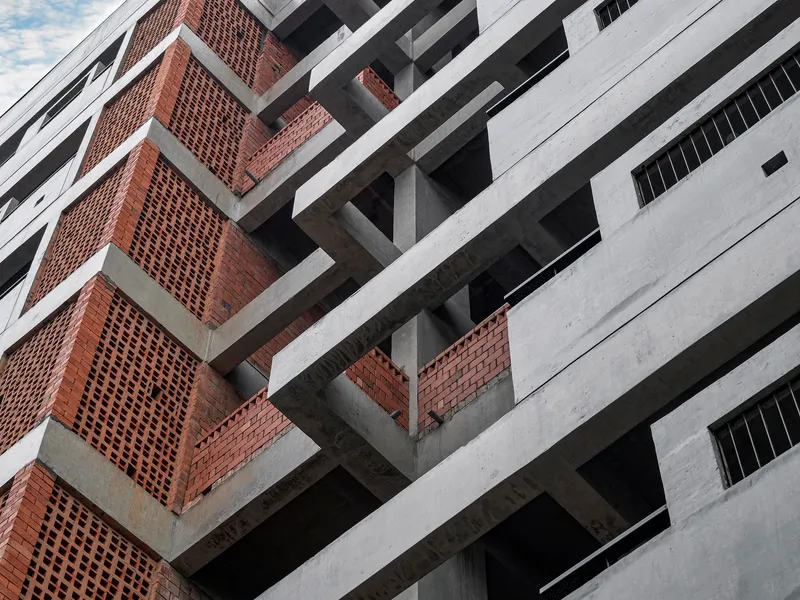
The corners of the building deserve close attention. Where the concrete slabs meet at right angles, the architects expose the raw slab edges and let the brick screens terminate cleanly against the column lines. There is no attempt to wrap the corners with a continuous skin; instead, the intersection of horizontal slab and vertical screen is celebrated as a joint. The structural grid, engineered by Sanjeev Patel of Reliable Consultants, is legible on the exterior. You can read the column spacing, the slab depth, and the infill hierarchy at a glance.
This frankness gives the building a tectonic clarity that many mid-rise apartments lack. The perforated brick panels sit between columns like curtains hung in a concrete frame, and the metaphor is apt: they are light, removable in principle, and subordinate to the primary structure.
Life on the Balconies
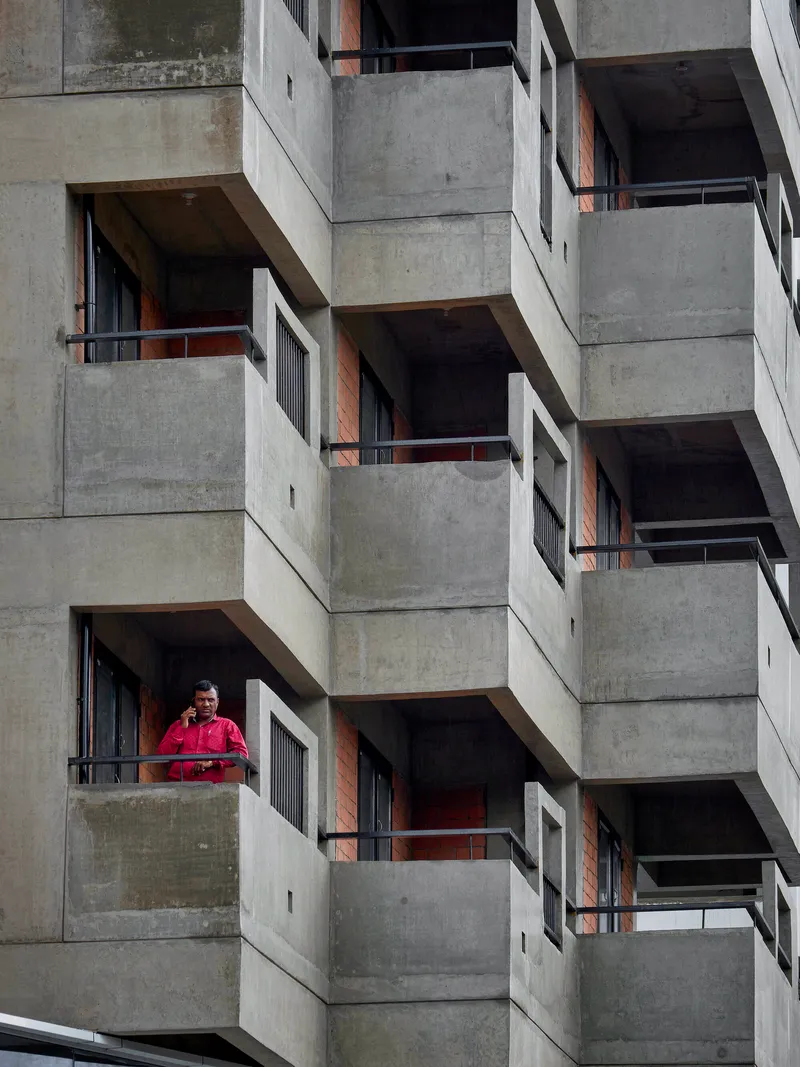
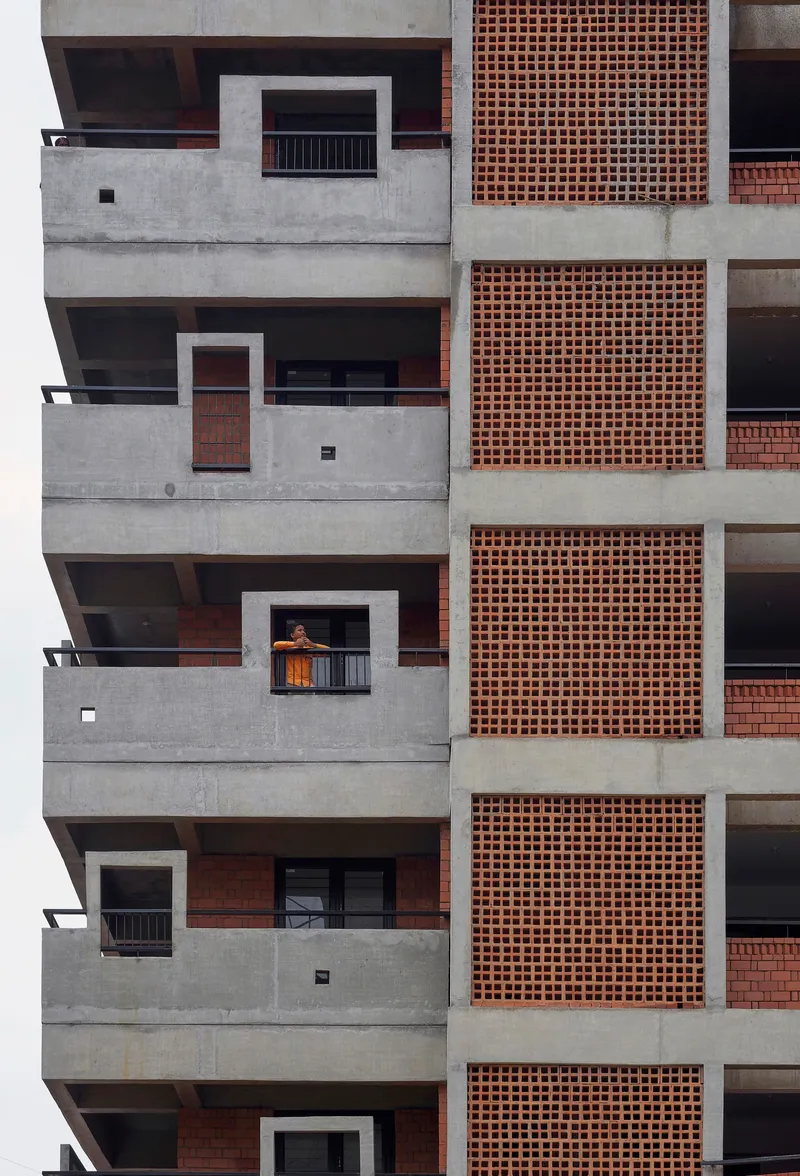
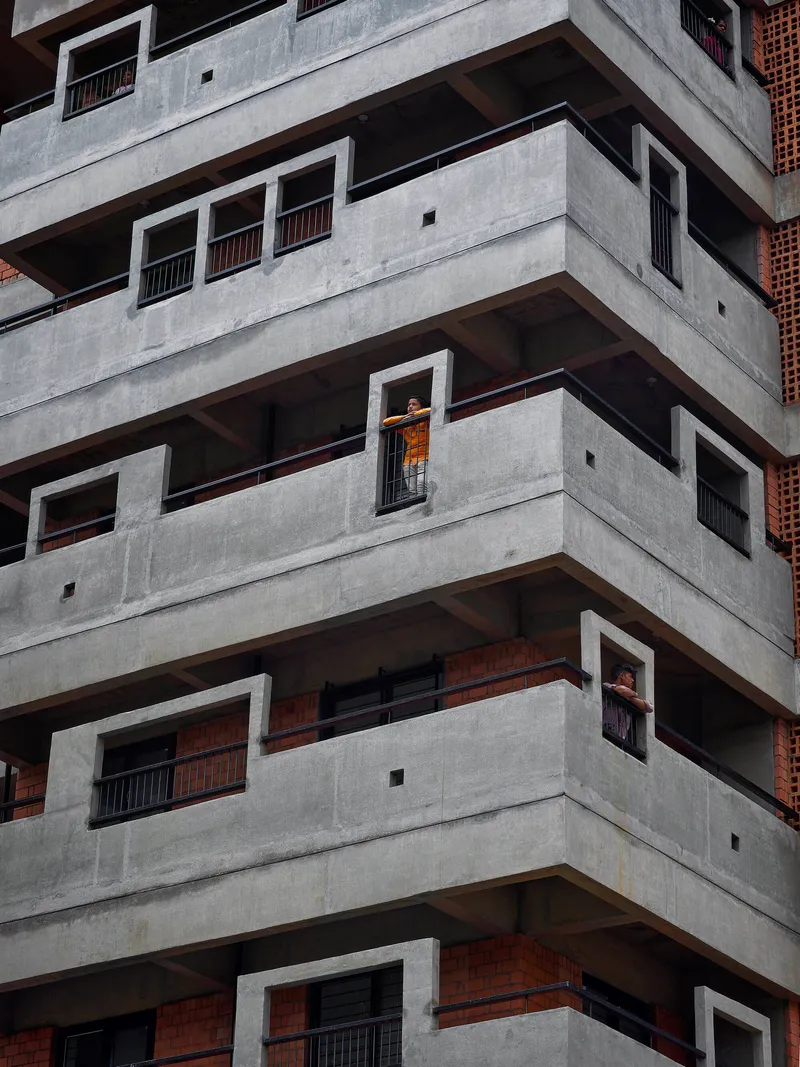
The photographs by Hemant Patil consistently show residents occupying the balconies: a figure in a red shirt looking out, another leaning on a railing, a third seated on the terrace. This is not staged atmosphere. It is evidence that the building's outdoor spaces actually work. The deep overhangs protect from monsoon rain and summer sun alike, while the brick screens provide enough visual privacy that residents feel comfortable using the terraces as extensions of their living rooms.
In a housing market that routinely treats balconies as afterthoughts, narrow ledges appended to maximize saleable carpet area, these terraces are generous. They are the building's primary amenity, and the architects sized them accordingly.
Looking Up
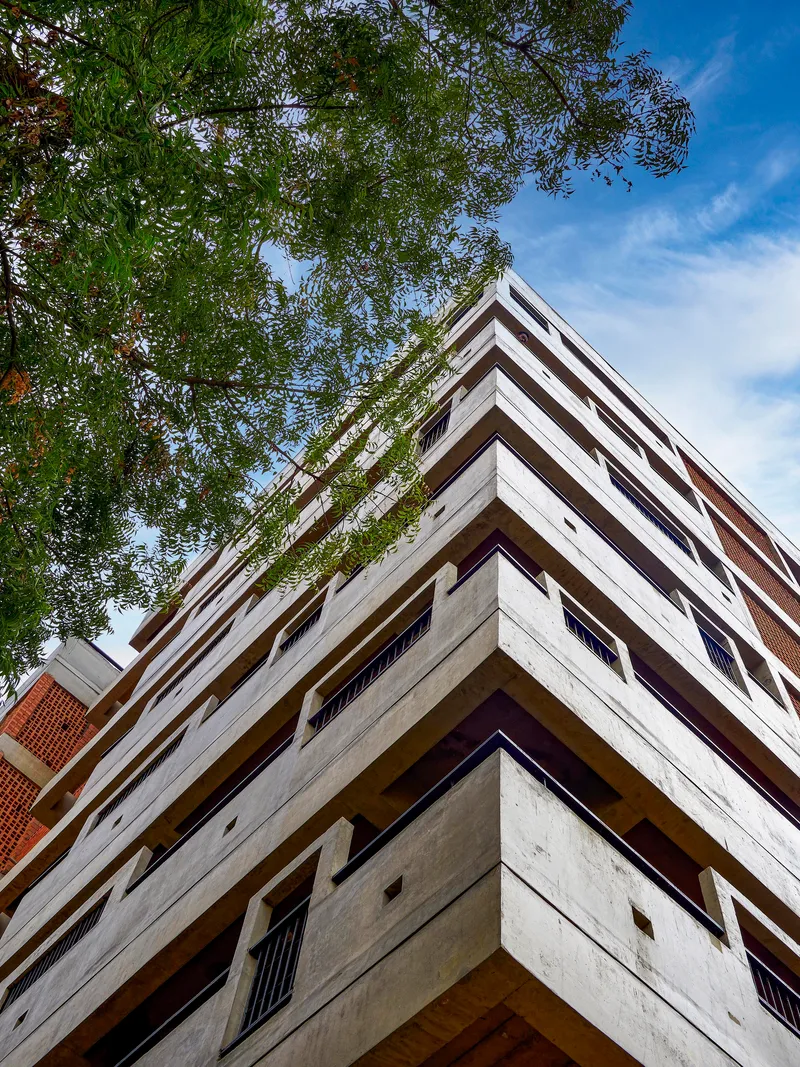
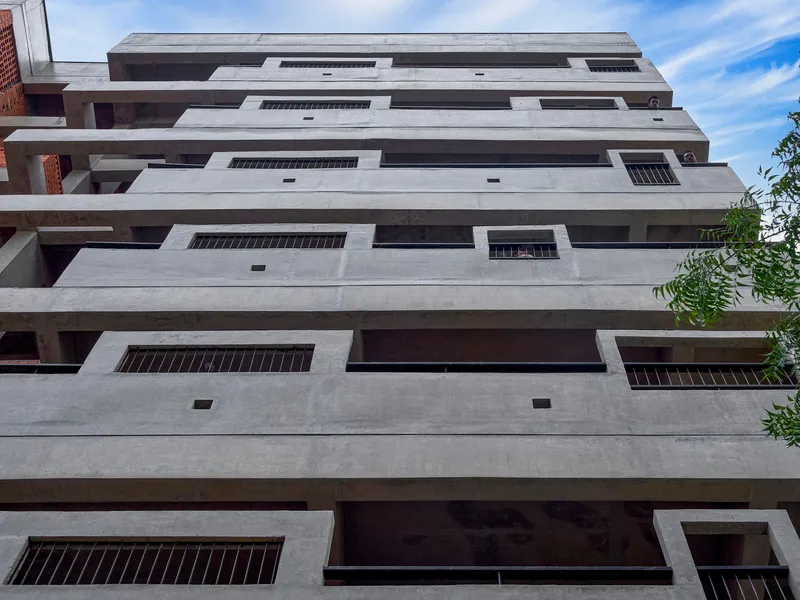
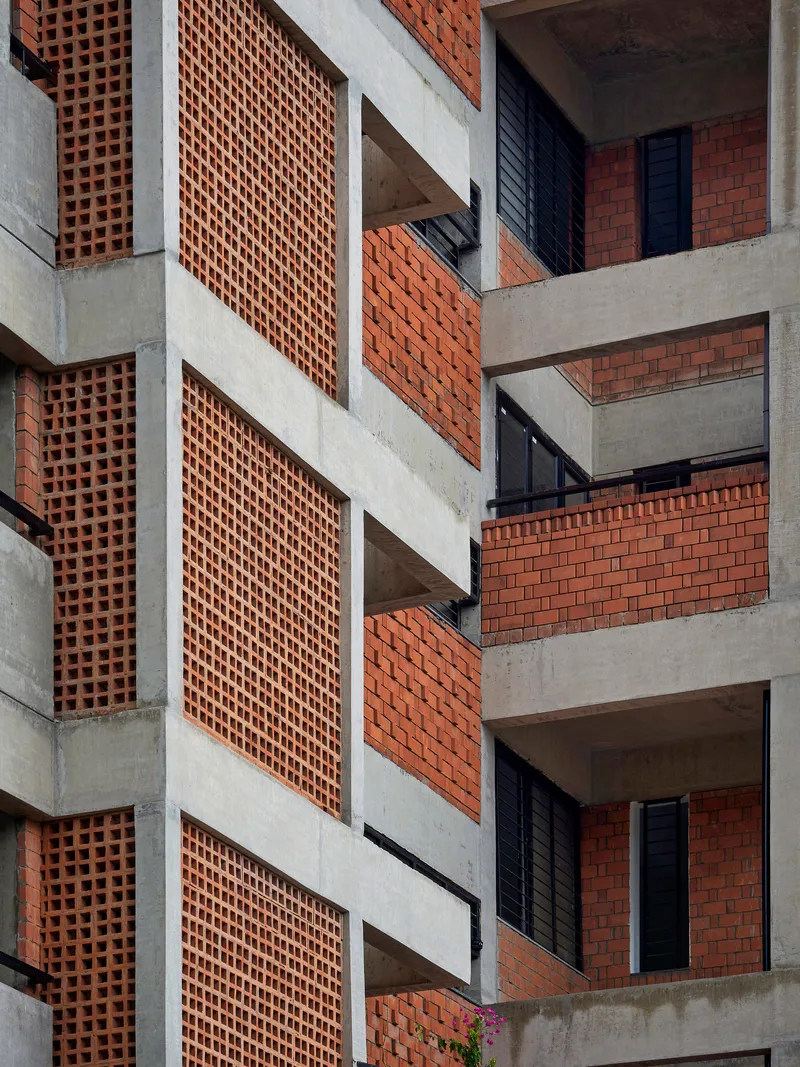
Seen from below, the building reveals its vertical logic most clearly. The stepped slabs create a sawtooth silhouette against the sky, and the underside of each cantilever is left in raw concrete, its formwork texture visible. Tree branches from the street edge into the frame, a reminder that the building sits in a neighborhood, not an abstract site. The upward views also show how the brick screens modulate in density: tighter perforations face the hotter orientations, looser ones face north.
Plans and Drawings
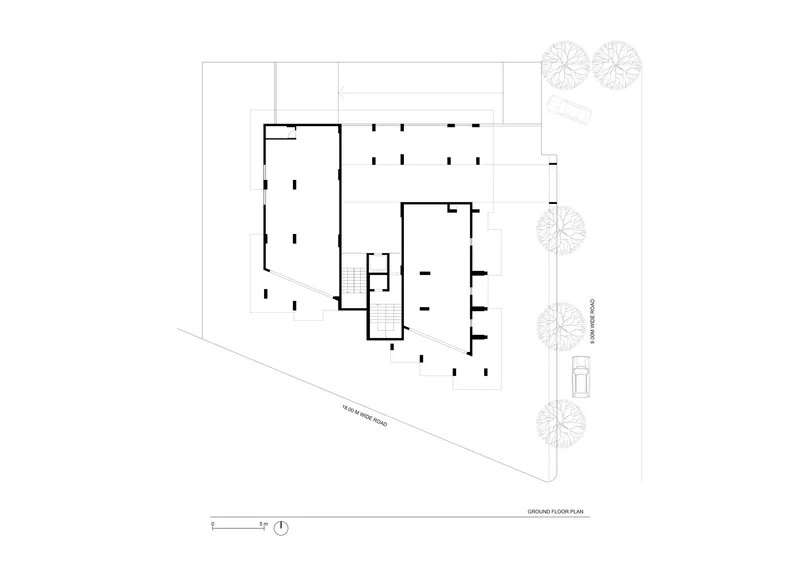
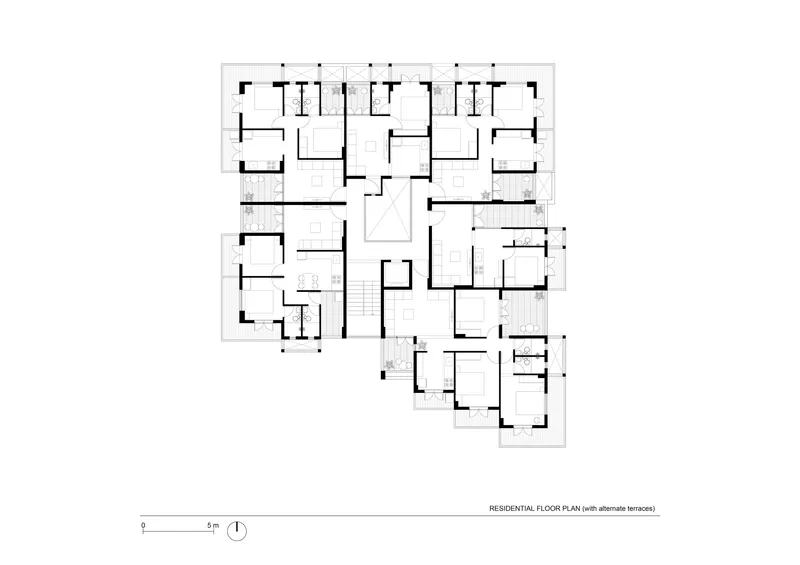
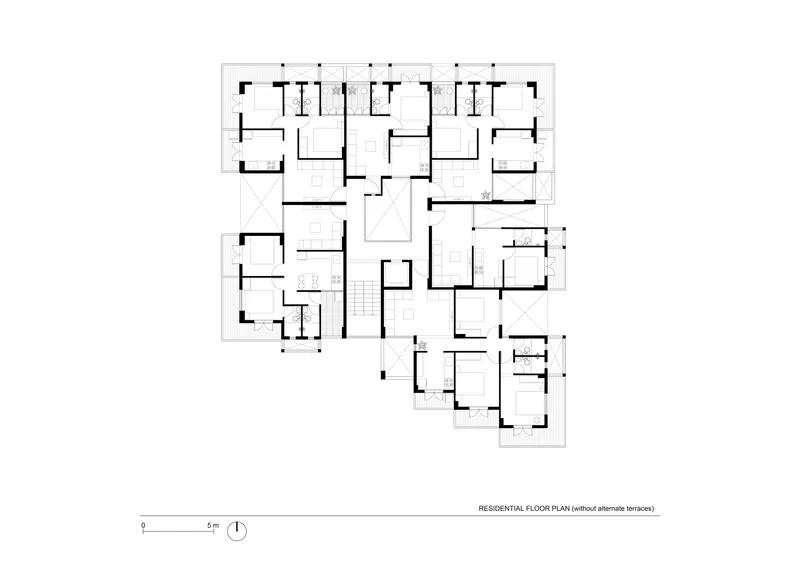
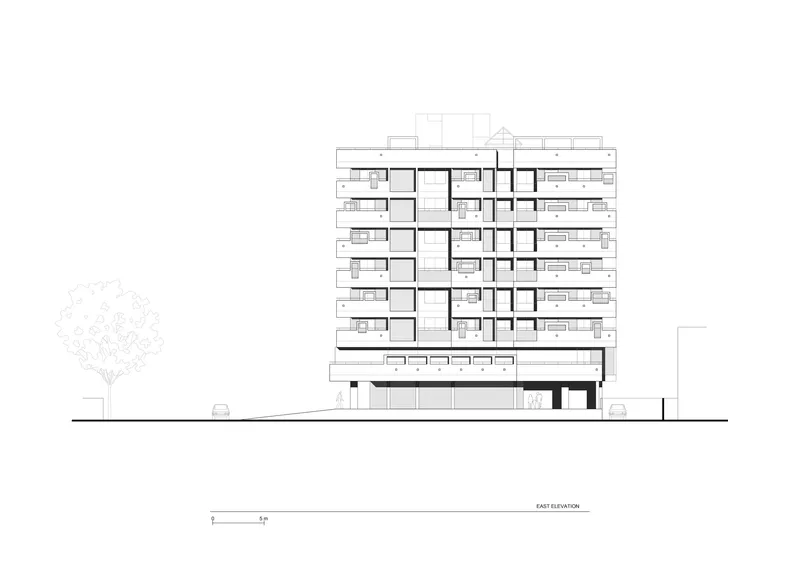
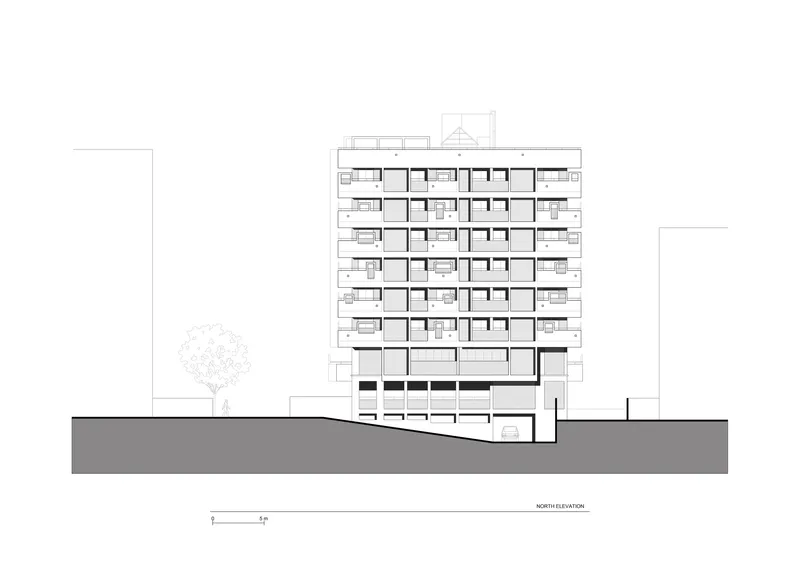
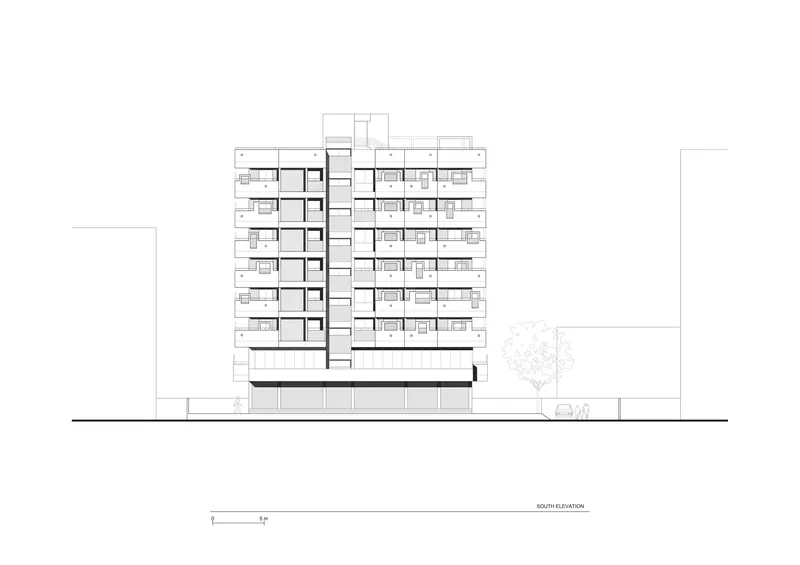
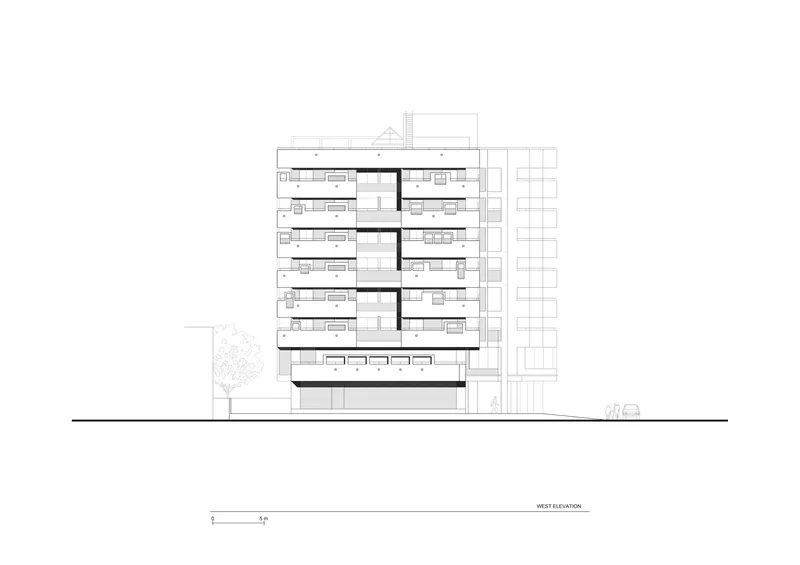
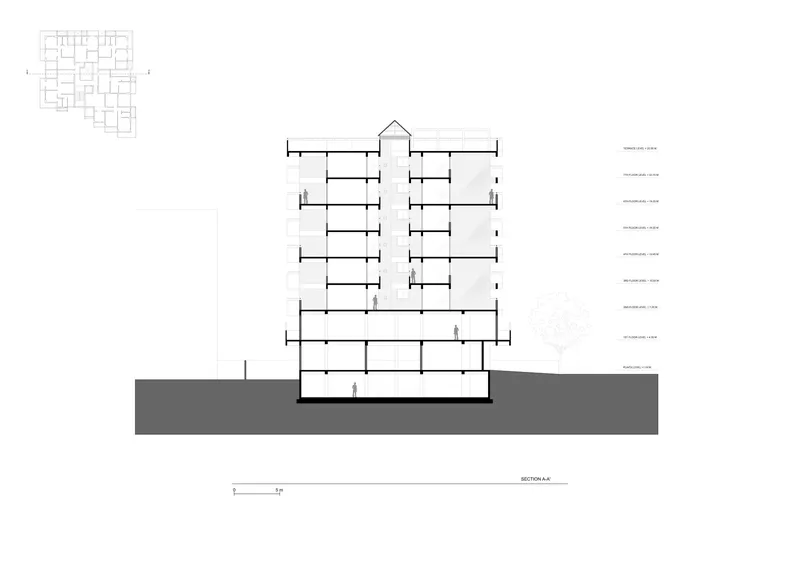
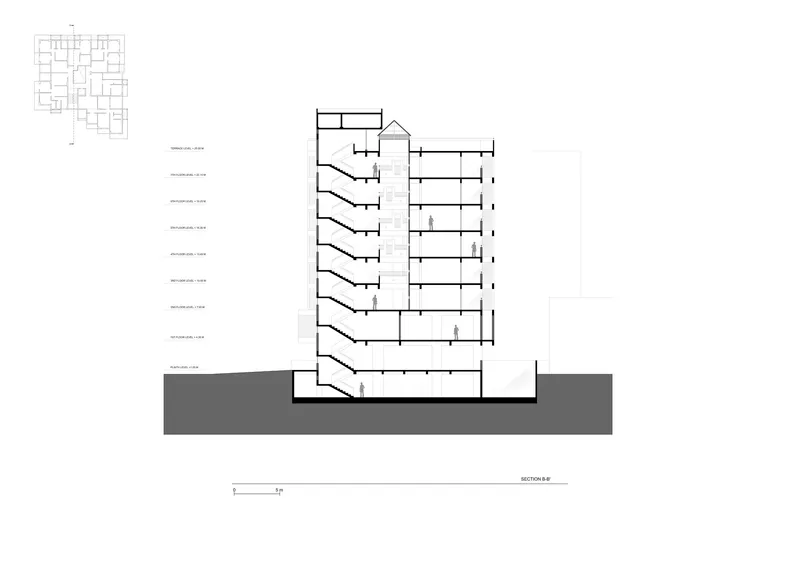
The ground floor plan shows two L-shaped volumes connected by a central stairwell, creating the courtyard void between them. Street trees line the adjacent road edge. Upper floor plans reveal a symmetrical arrangement of units around the circulation core, with alternate floors receiving terraces that shift position, generating the staggered facade. The elevations confirm the careful calibration of solid and void: east, north, and south faces each respond differently to solar orientation, with the brick screen density and balcony depth adjusted accordingly.
The sections are the most revealing drawings. They show the courtyard's full height, the curved balcony profiles on one side and the rectangular units on the other, and the way the central circulation core threads through the building as a vertical spine. The scale figures make clear just how deep the terraces are: generous enough to furnish, not merely to stand on.
Why This Project Matters
Indian cities are growing fast, and the default response is the repetitive tower on a podium: glass, aluminum composite, and air conditioning. The Badade Nagar apartments offer a counterargument grounded in material economy and climate logic. Mangalore tiles, Apollo steel, locally sourced brick, and straightforward RCC construction keep costs in line with the market while delivering spatial quality that the market rarely bothers to pursue. The building proves that density can be achieved without resorting to the floor-plate monoculture that dominates Nashik's skyline.
More broadly, Studio Frozen Music demonstrates that the mid-rise apartment block, the most common building type in India's Tier 2 cities, can be a site of serious architectural invention. The staggered terraces, the courtyard section, the brick jalis: none of these moves are novel in isolation, but their synthesis here produces a building that is legible, livable, and quietly ambitious. It is the kind of work that shifts expectations for what everyday housing can be.
Housing Apartment at Badade Nagar by Studio Frozen Music, led by Mahesh Deepak Shirke. Nashik, India. 53,000 sq ft. Completed 2022. Photography by Hemant Patil.
About the Studio
Share Your Own Work on uni.xyz
If projects like this are the kind of work you want to make, uni.xyz is a place to publish your own, find collaborators, and enter design competitions.


Popular Articles
Popular articles from the community


Manzana Morphosis: Stretching Barcelona's Grid into a Living Landscape for 2050
A radical reworking of the Eixample manzana turns density into a tool for generous public space, vertical ecology, and environmental performance.


Cube Design Draws an Ecological Corridor Between Two Shenzhen Hills with the Nankai Building
Beside Shenzhen's container docks, the Nankai Building pairs stacked balconies with a climbing green screen to connect two hillsides across its height.

Aquadapt: An Underwater Habitat That Rewrites Its Rooms by the Hour
Curved modules ring the seabed while one shell shifts from breakfast room to cinema, farm and football pitch as residents' needs change.

The Amber Palace Opera: A Geological Fiction Surfaces on Tallinn's Baltic Waterfront
Pierre Brillard reimagines a Baltic legend as a public landscape, opera house, and waterfront promenade rooted in Tallinn's coastal identity.

Similar Reads
You might also enjoy these articles

LAVA Architecten Gives Vocational Education a Sawtooth-Roofed Face on a Mechelen School Campus
In Mechelen, Belgium, a 2,053 m² STEM school on a 6×6 m grid turns workshops and classrooms into rooms that can be rearranged as teaching changes.

KEMA Studio Turns a Derelict Marvila Attic into a 60 m² Lighthouse Apartment Above Lisbon
In Lisbon's Marvila district, a rebuilt roof, four skylights and two plywood volumes turn an unlivable attic into a bright home facing the Tagus.

Pixel Gardens: One Repeated Module Stacked Into a Terraced Social Housing Tower for Famagusta
Salem Bader's shortlisted housing tower builds a vertical neighbourhood from one repeated module, offsetting units to carve terraces, light and air.

Bao Huynh Watercolor Atelier: A Serene Art Retreat in Hội An
Bao Huynh Watercolor Atelier in Hội An blends multifunctional art spaces, sustainable design, local materials, and family-friendly living in a serene environment.

Comments (0)
Please login or sign up to add comments
No comments yet. Be the first to comment!