
Studio P Builds a Moody Three-Generation Home Around a Courtyard on a Sydney Battle-Axe Block
In Wahroonga's leafy canopy, a 703-square-metre dwelling trades lightness for depth, wrapping dark materials around a single cloud tree.


Most large suburban houses in Sydney default to a white-and-timber palette that signals openness and airiness. The Carrington Rd Residence, designed by Studio P - Architecture with interiors by WRNS Studio, does the opposite. Set deep within a battle-axe lot in Wahroonga, hidden from the street, the 703-square-metre dwelling leans into a darker, heavier material language: black brick, off-form concrete, polished concrete floors, copper trims, and walnut-stained hardwood. The result is a house that feels more carved than assembled, more vault than pavilion.
What makes the project genuinely interesting is how it reconciles scale with intimacy. Designed to house two to three generations, parents and adult sons with a potential grandfather suite, the house had to offer real privacy without fragmenting into disconnected apartments. The answer is a courtyard plan that organizes the three-storey dwelling around a central open-air void containing a single sculpted cloud tree. Every major room borrows light and presence from that courtyard, so the dark palette never tips into oppression. The client, a former architecture student, arrived with a two-dimensional floor plan; Studio P's job was to turn it into architecture, and the distance between those two things is the story of this house.
The Courtyard as Organizational Engine
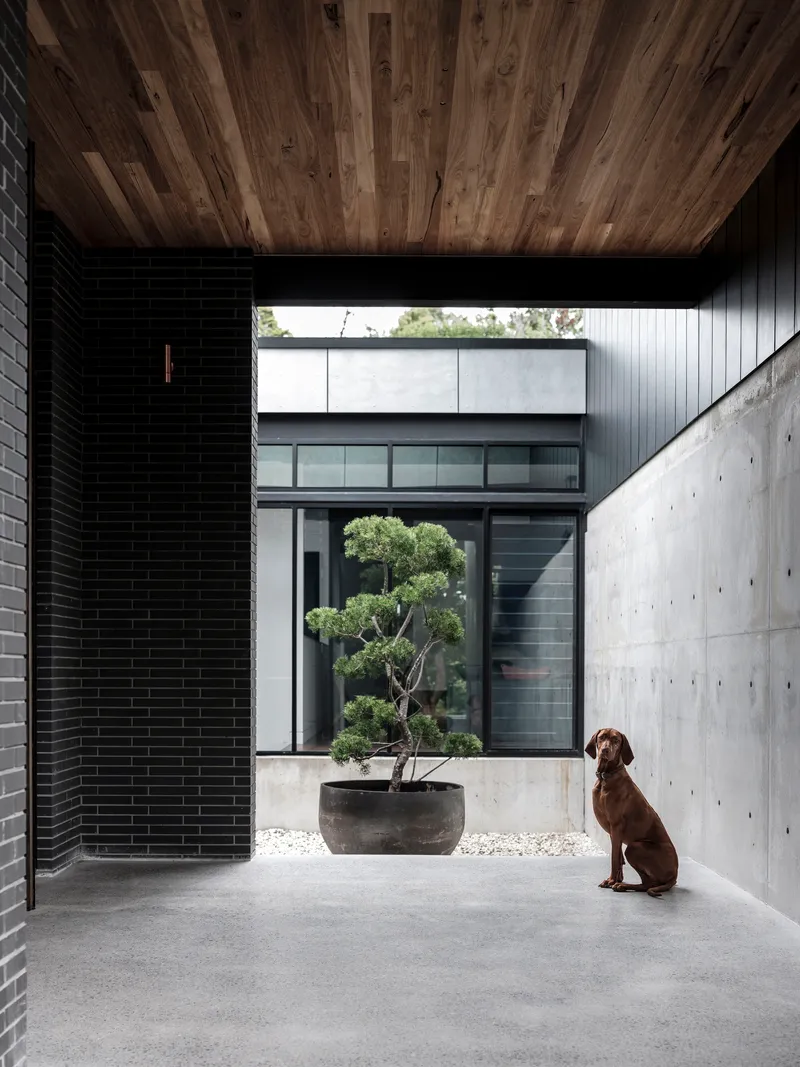
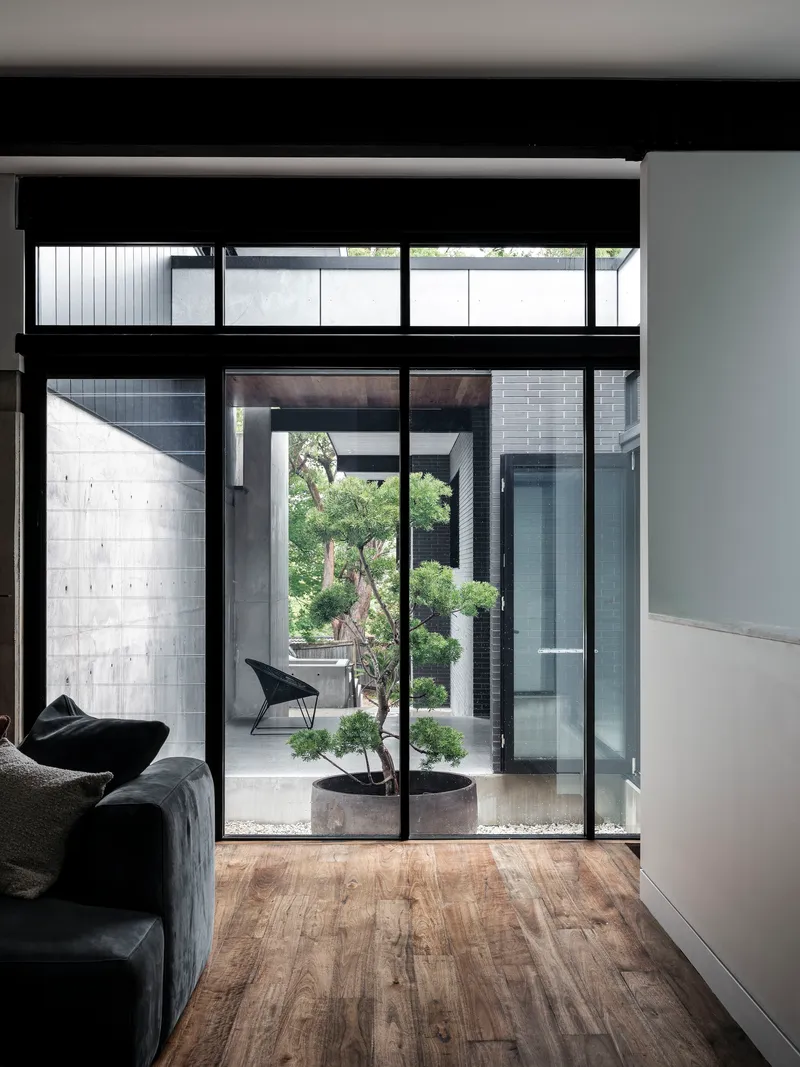
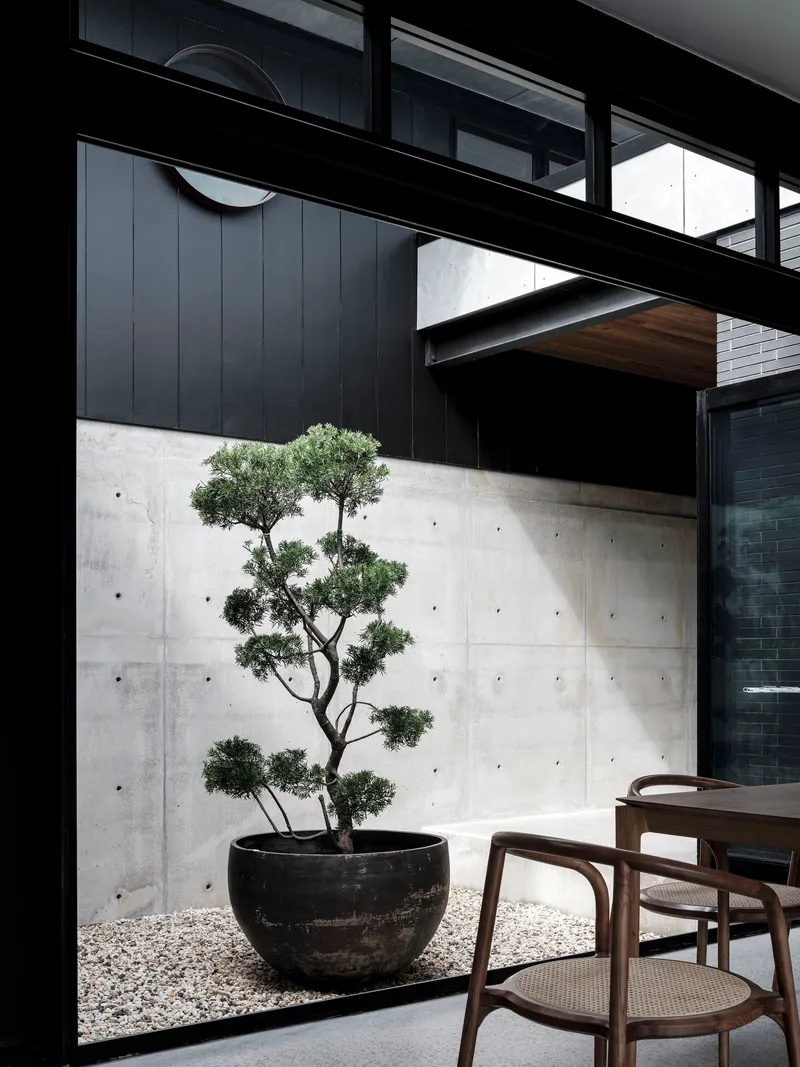
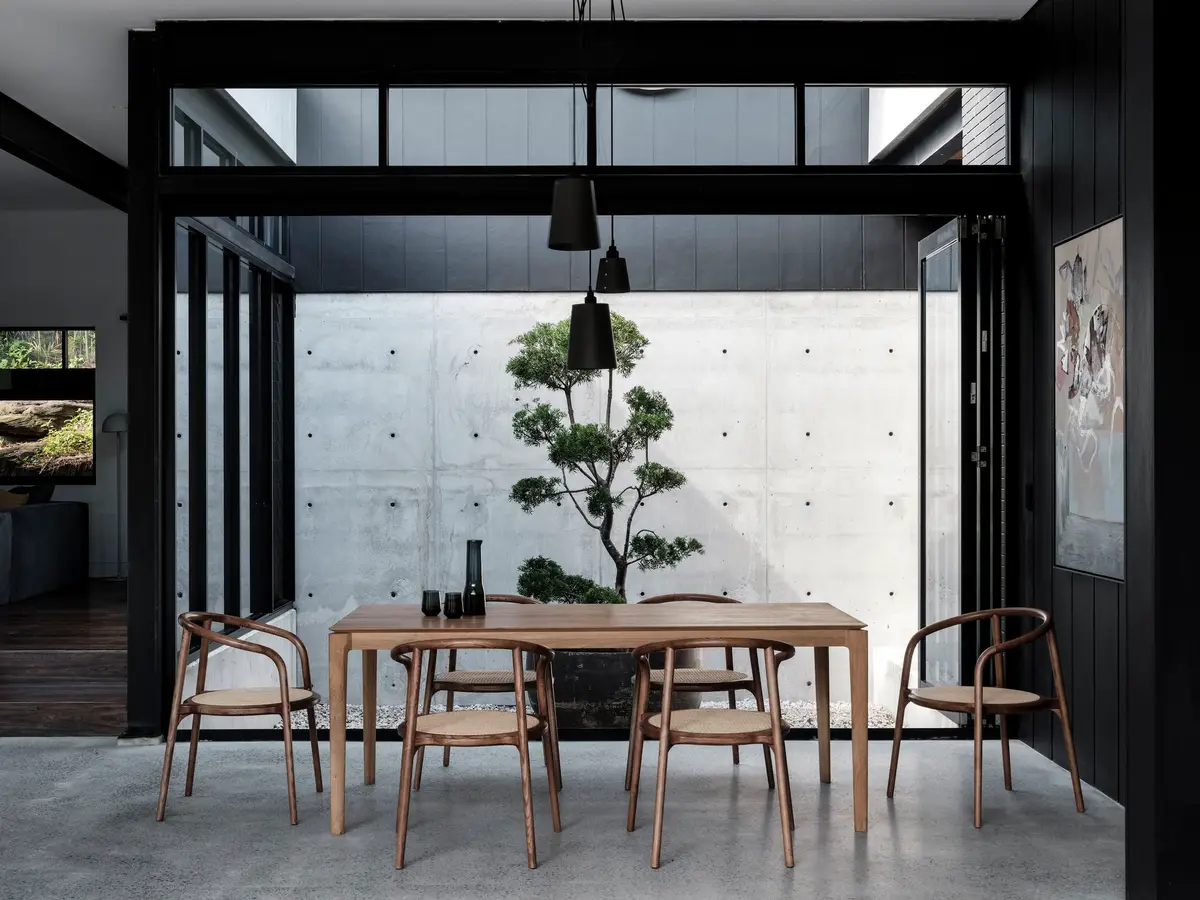
The entry courtyard does several jobs at once. It brings daylight into the center of a deep plan that would otherwise rely on perimeter windows. It creates a visual anchor visible from the kitchen, the dining room, and the upper corridors. And it gives the house a psychological center, a shared outdoor room that belongs to the whole family rather than to any one generation's private zone. The single cloud tree, planted in a black concrete planter against a board-formed concrete wall, acts as a kind of living column, a structural element of the composition rather than decoration.
Board-formed concrete on the courtyard walls picks up the grain of timber formwork and holds it permanently, creating a surface that reads as both natural and industrial. The polished concrete floor of the interior continues unbroken to the courtyard threshold, so the boundary between inside and outside dissolves at ground level. Full-height glazing panels fold back to open the dining room directly into the courtyard, turning the tree into a de facto dining companion.
A Dark Palette That Earns Its Weight
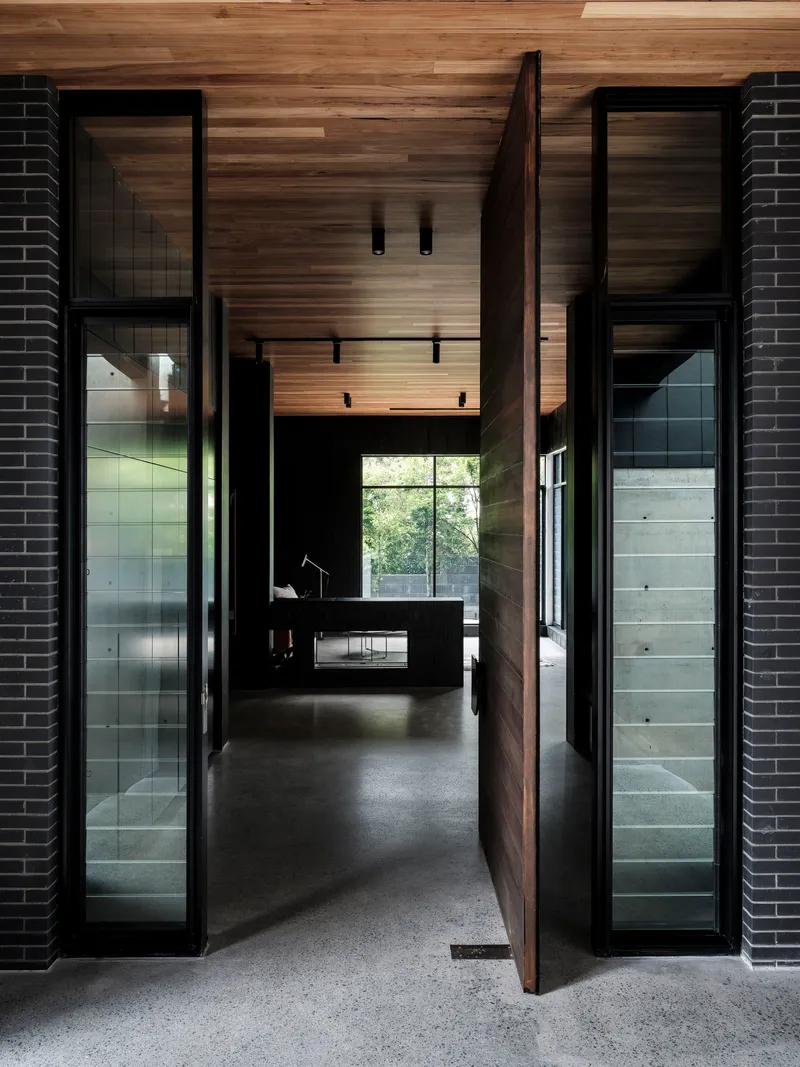
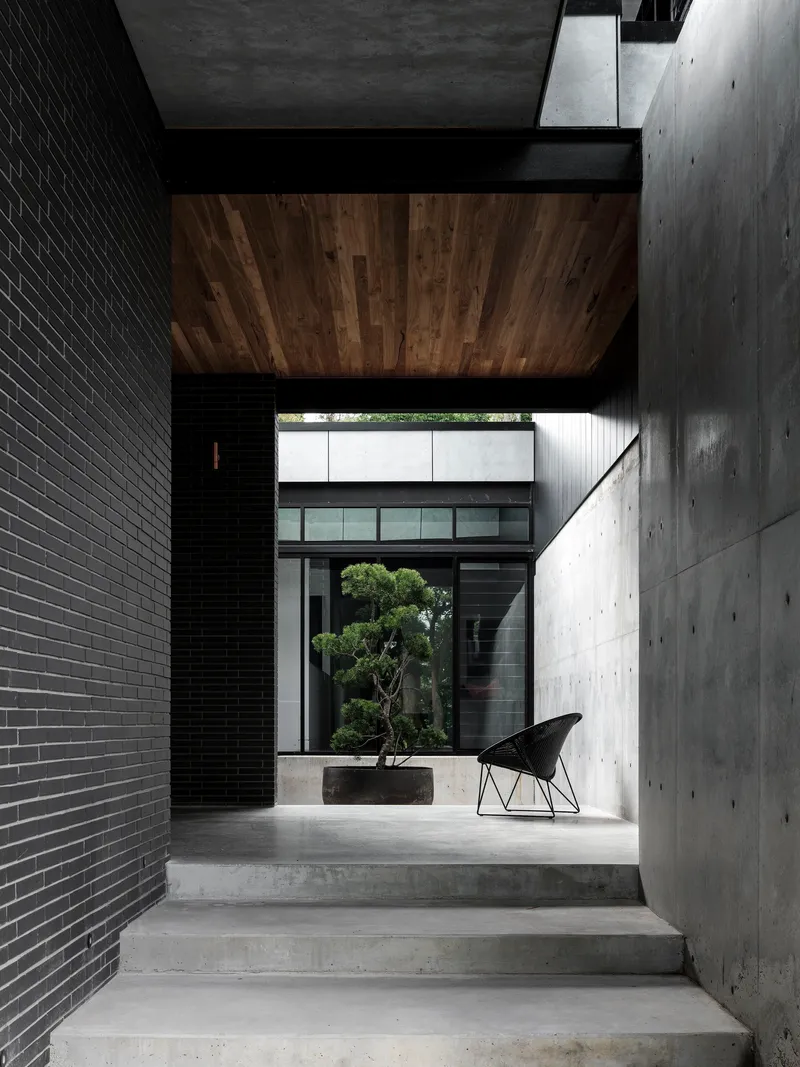
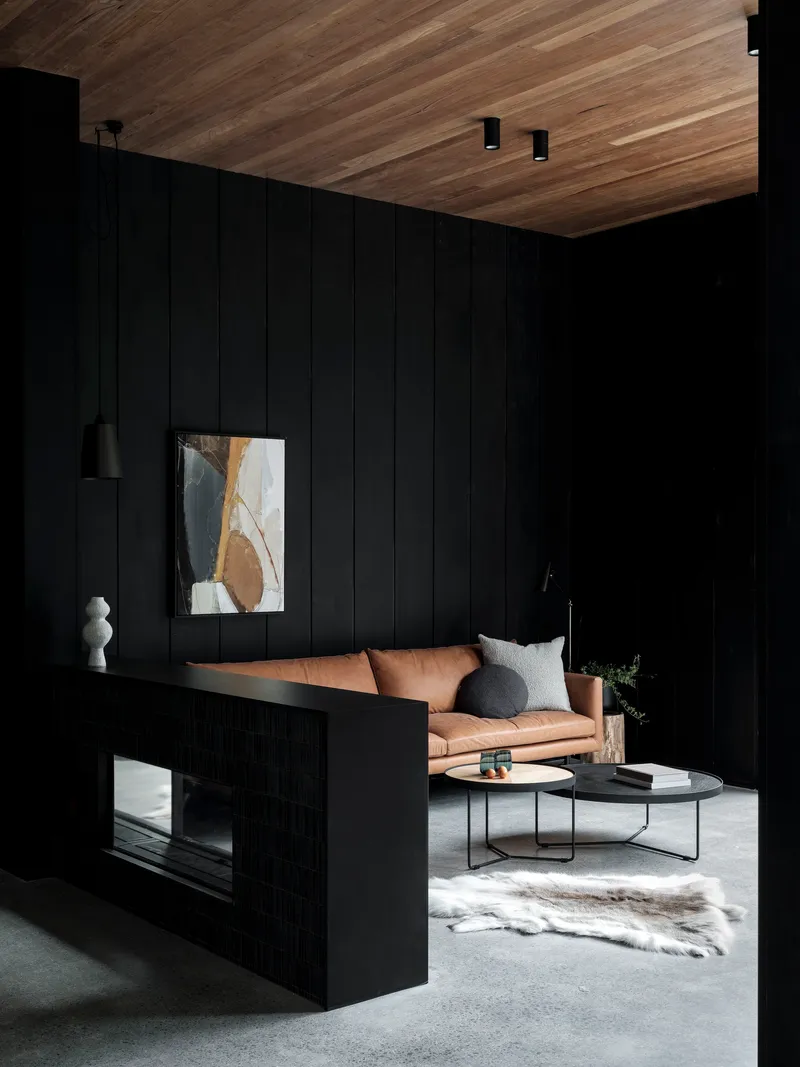
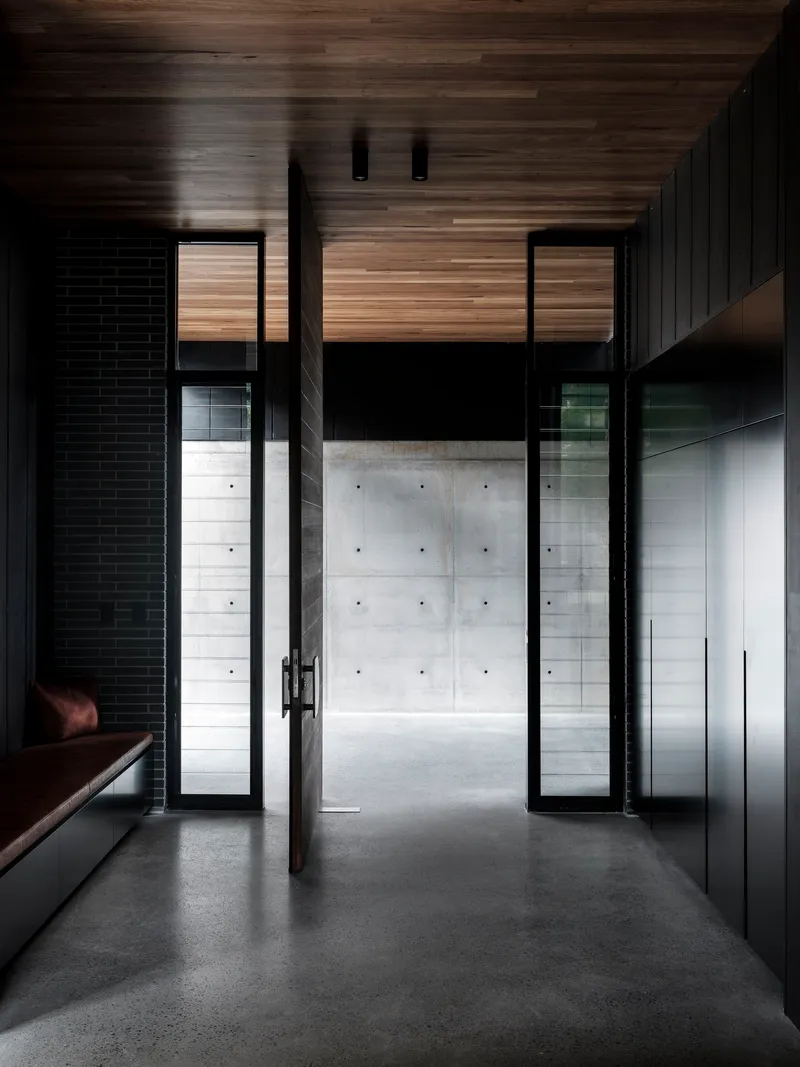
Darkness in residential architecture is a risk. Go too far and rooms feel compressed; skimp on material quality and the palette just looks cheap. Studio P manages it by pairing genuinely heavy materials, black brick, off-form concrete, dark timber paneling, with high ceilings and precisely placed clerestory windows. The entry hallway sets the tone: a timber-clad ceiling runs overhead while dark brick flanks a floor-to-ceiling pivot door. The staircase, ascending between a black brick wall and a board-formed concrete wall, is one of the strongest moments in the house, two contrasting textures meeting in a vertical slot of filtered light.
The word that keeps coming to mind is "sultry." The architects have spoken about wanting spaces that feel cozy despite their generous dimensions, and the dark material palette is the primary tool. Every structural element, concrete walls, steel beams, exposed ceiling joinery, is celebrated as a finish rather than concealed behind plasterboard. The honesty pays off in texture: you feel the construction rather than just seeing a surface.
Kitchen as Social Anchor
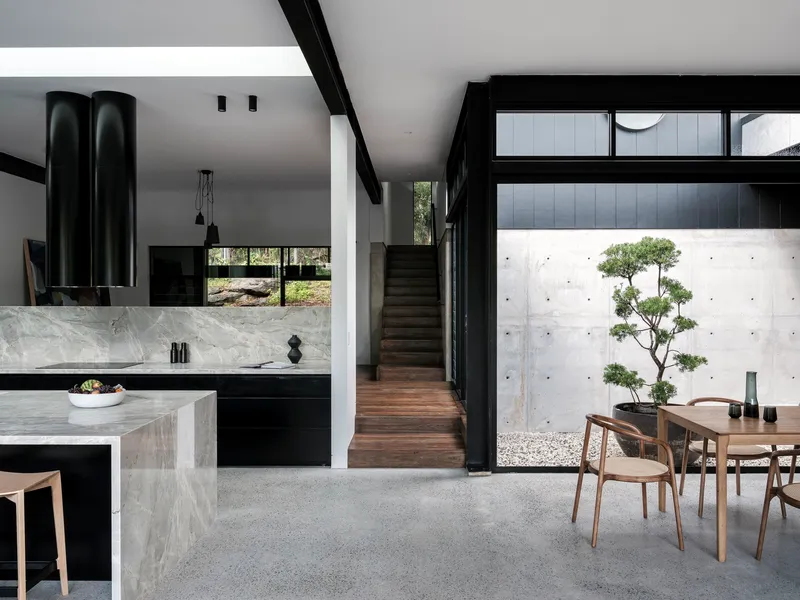
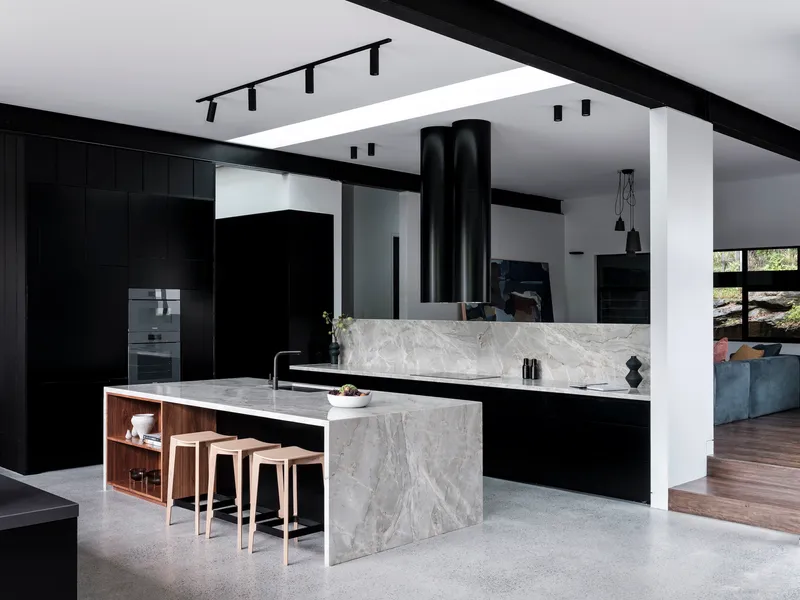
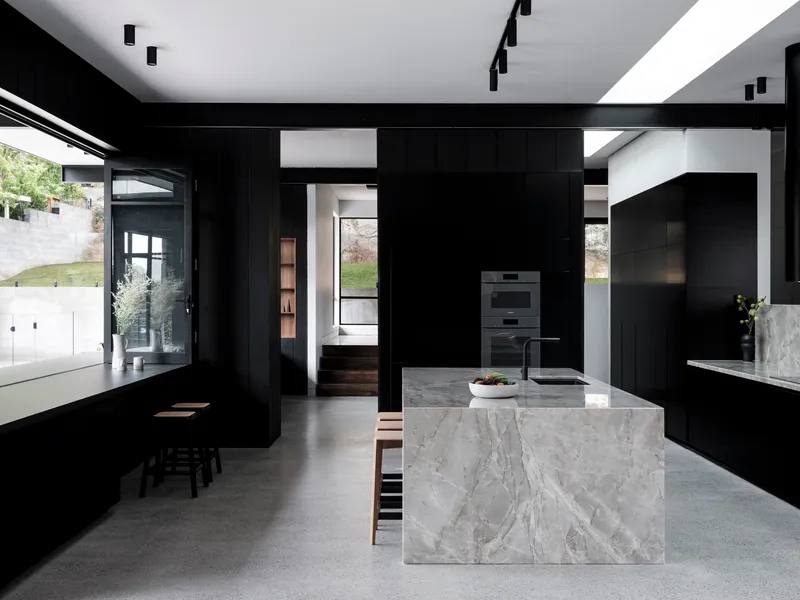
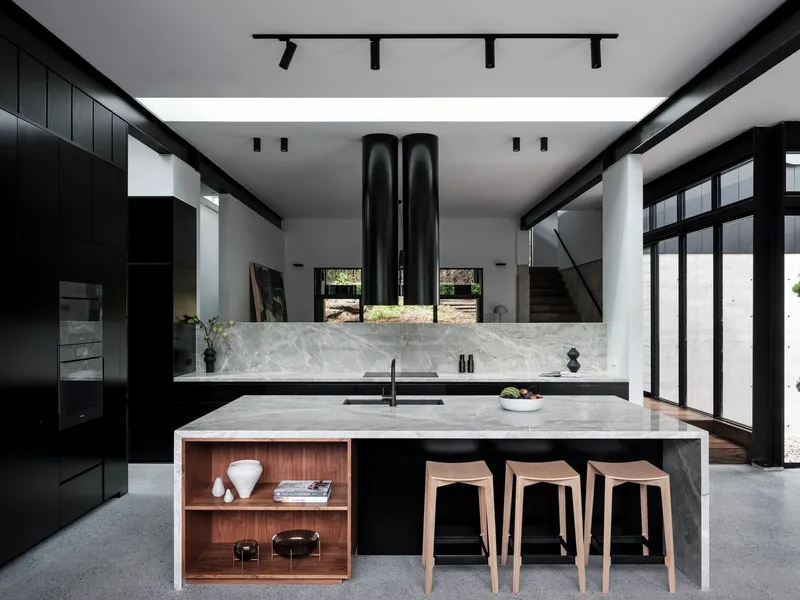
In a multi-generational house, the kitchen is the space that has to work hardest. Here it occupies the center of the ground floor plan, opening simultaneously to the courtyard, the dining table, and a living zone beyond. The quartzite island with its waterfall edge is the dominant gesture: a pale, veined slab set against black cabinetry and a cylindrical range hood. Skylights overhead wash the island in natural light, creating a bright counter within the darker surround. The contrast is deliberate and effective.
Timber veneer joinery, high clerestory windows, and black structural columns give the kitchen a layered depth that avoids the showroom feel common in houses of this size. A recessed shelving nook below the island adds a crafted detail that rewards close looking. Each element has been individually resolved rather than repeated from a standard kit.
Individual Rooms, Individual Character
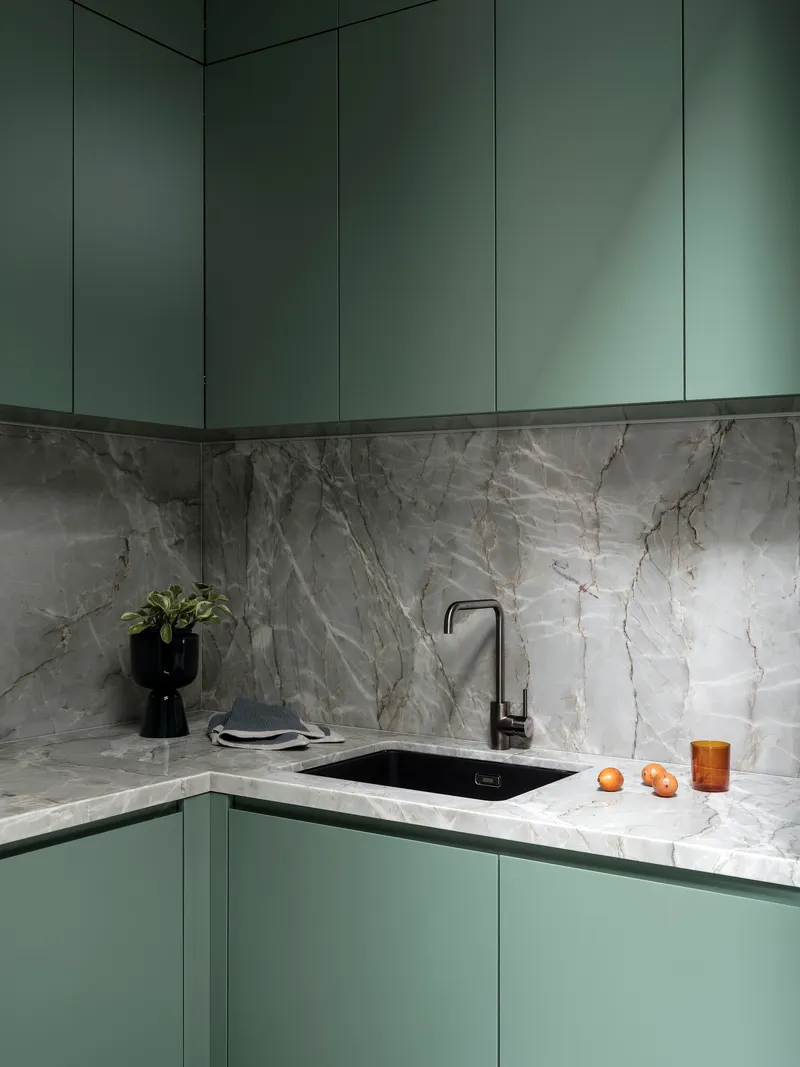
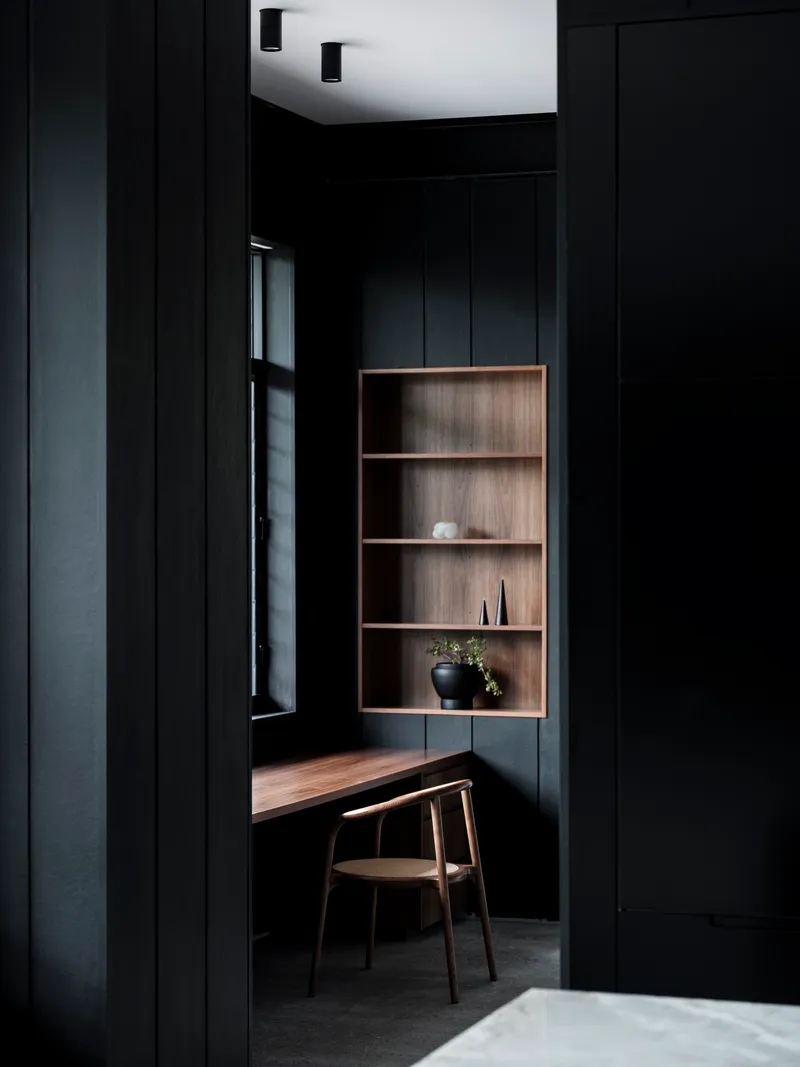
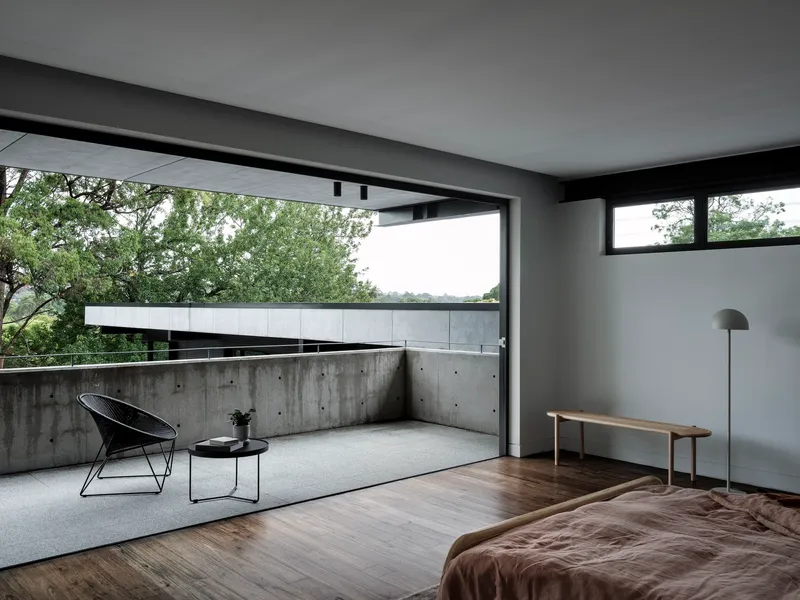
One of the sharpest decisions in the project is the refusal to repeat bedroom or bathroom finishes across the house. In a dwelling designed for distinct generations, each private zone gets its own material identity. A sage green kitchen with grey-veined marble backsplash belongs to one suite. A black-paneled study nook with recessed timber shelving and a floating desk belongs to another. A bedroom opens onto a concrete terrace overlooking the leafy canopy, framing a very different relationship with the landscape than the inward-looking courtyard rooms below.
This approach requires substantially more design effort than specifying one palette and rolling it out across every floor, but it solves a real problem. In oversized dwellings, identical rooms blur together and create a hotel-like anonymity. By differentiating each space, Studio P gives every occupant a sense of ownership and orientation within the larger house.
Bathrooms as Crafted Rooms
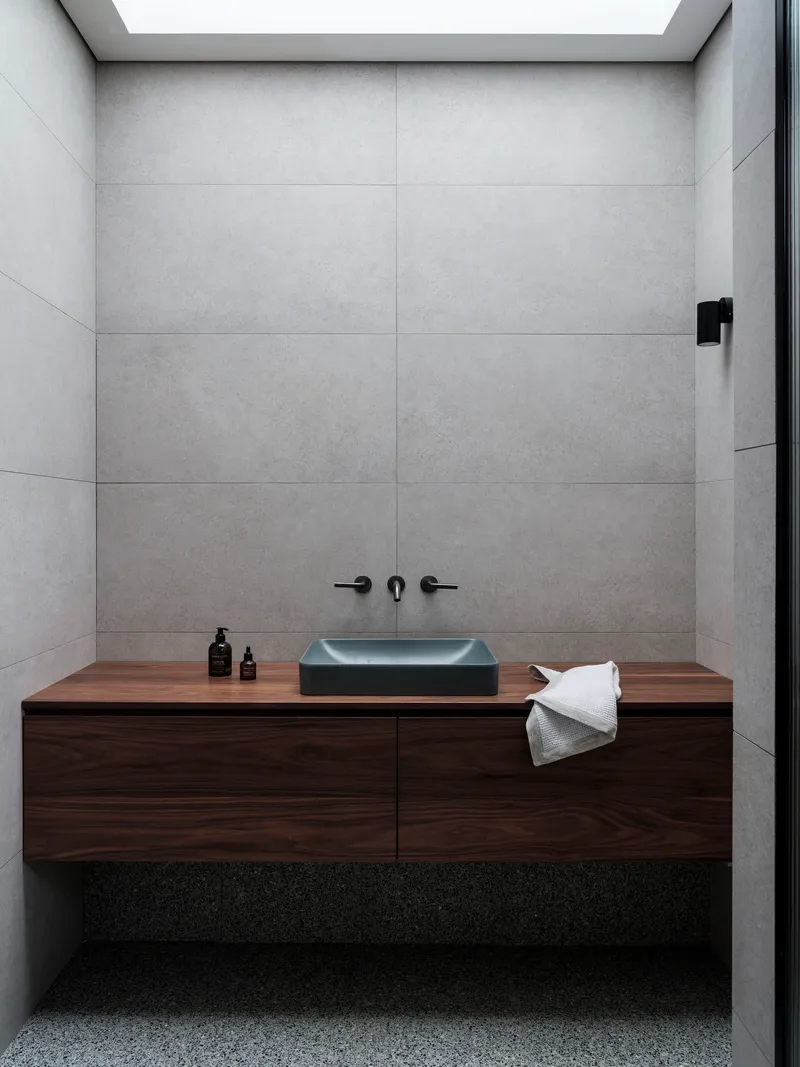
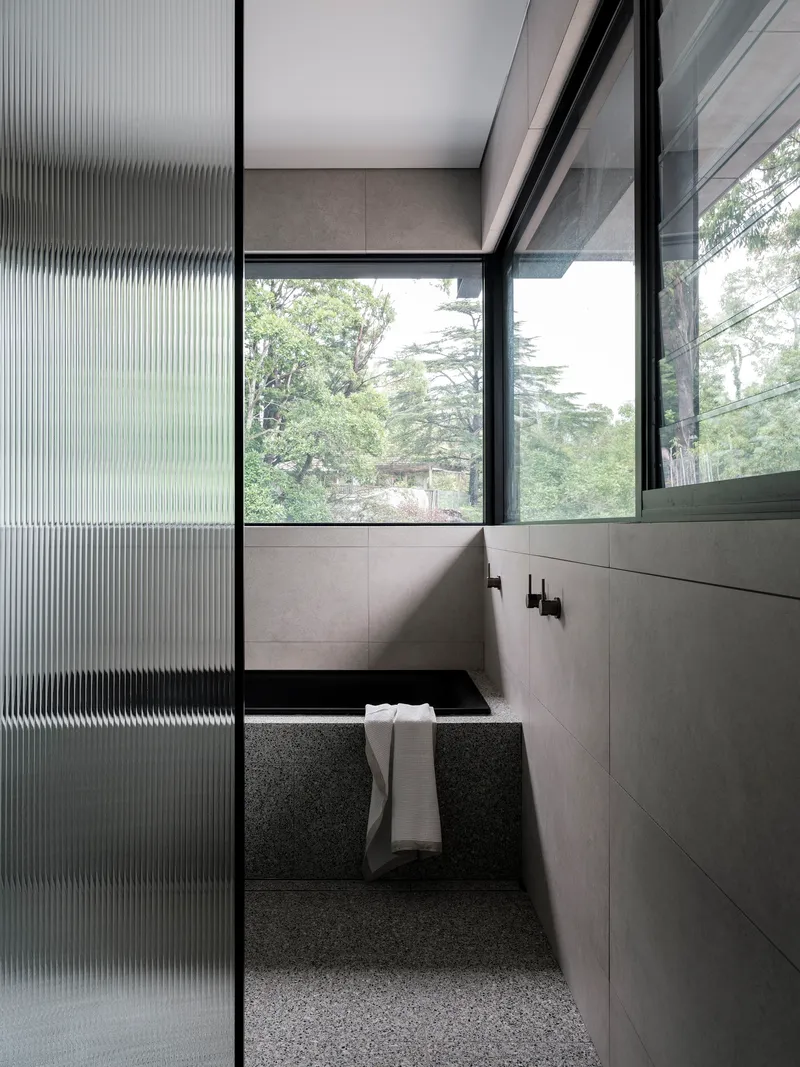
The bathrooms continue the logic of individual character. A floating walnut vanity with a charcoal basin sits below large-format concrete tiles, a combination that feels more like a gallery installation than a wet room. Elsewhere, a sunken bathtub with a terrazzo surround is framed by a fluted glass screen, filtering garden views into soft vertical bands of light. These are rooms designed for stillness, and the material choices, walnut, terrazzo, fluted glass, create surfaces that age well and reward touch.
Light, Circulation, and the Vertical Section
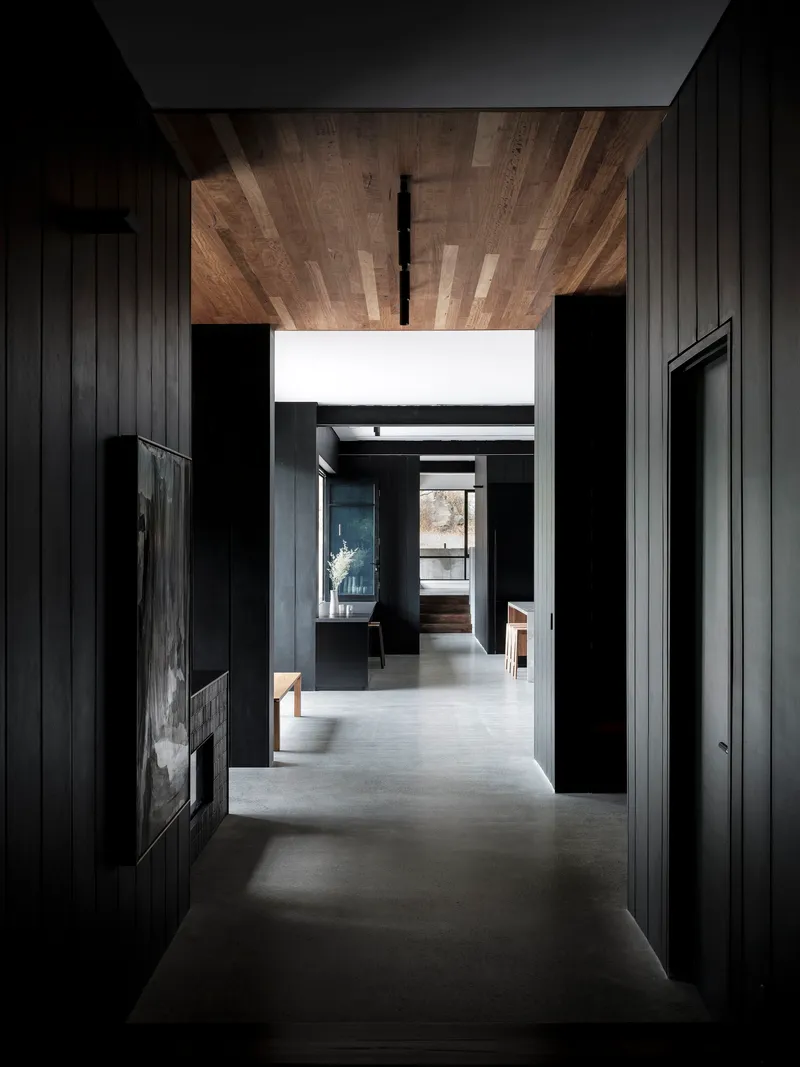
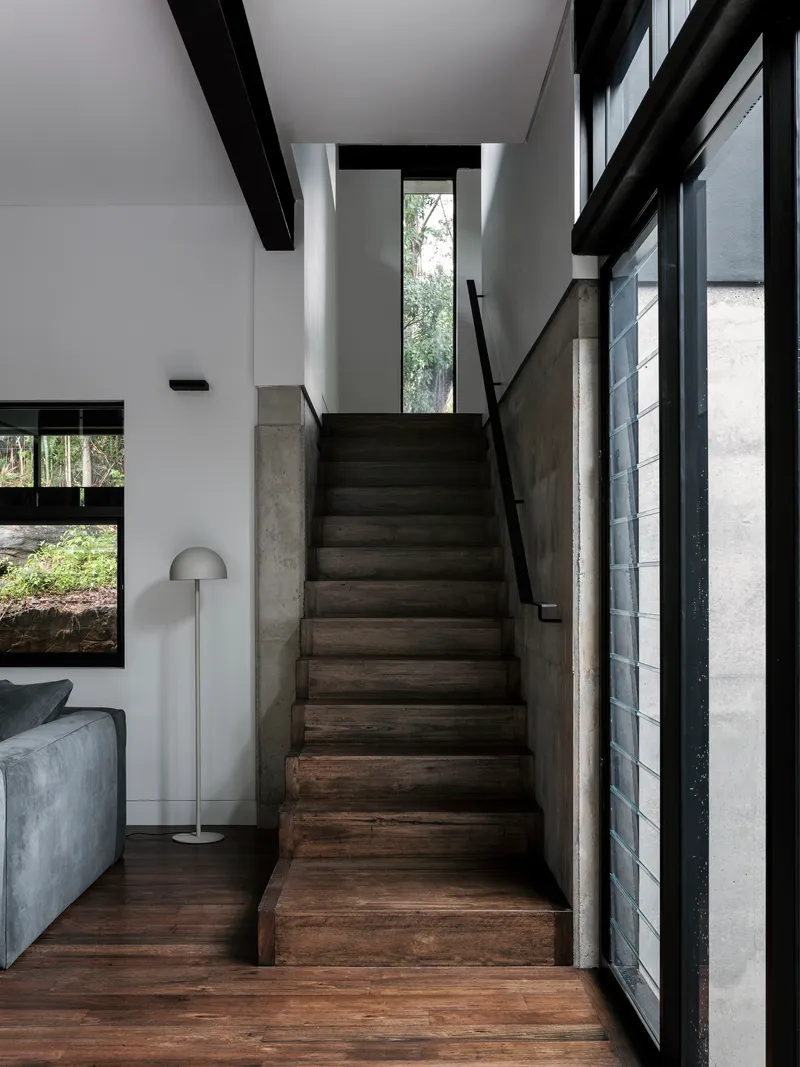
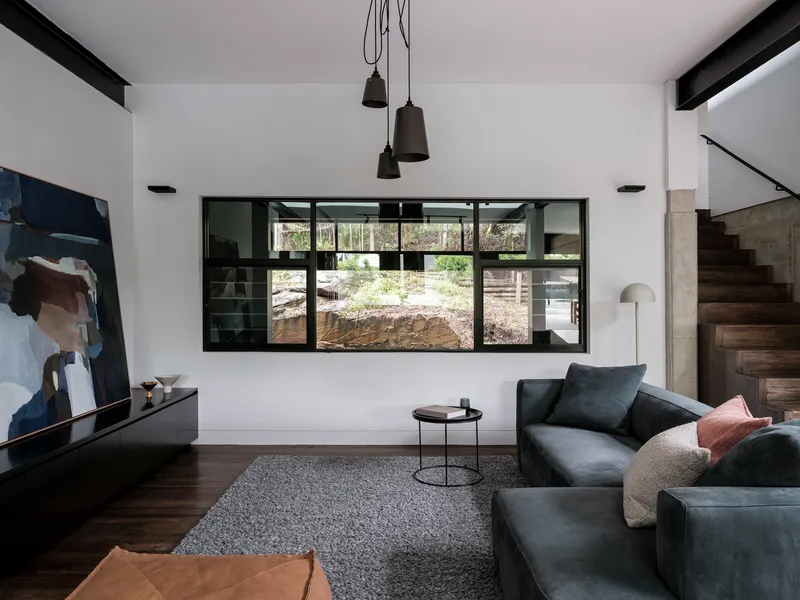
Corridors and staircases often get the least attention in residential design, but here they become some of the most atmospheric spaces. A timber plank ceiling stretches toward a glazed opening at the end of one corridor, drawing you forward with a slow gradient of natural light. The dark timber staircase with its concrete balustrade rises alongside a tall vertical window that functions almost like a light well, pulling illumination down through the section. A double-height living room overlooks an excavated courtyard, with a concrete retaining wall creating a raw backdrop that grounds the space.
The three-storey section allows the architects to play with level changes and sightlines across the house. You are never simply walking through a flat floor plate; you are ascending, descending, looking down into courtyards or up through skylights. The vertical dimension gives the dark palette its counterbalance: light enters from above, from the sides, from unexpected portholes, always in controlled quantities.
Threshold and Dining
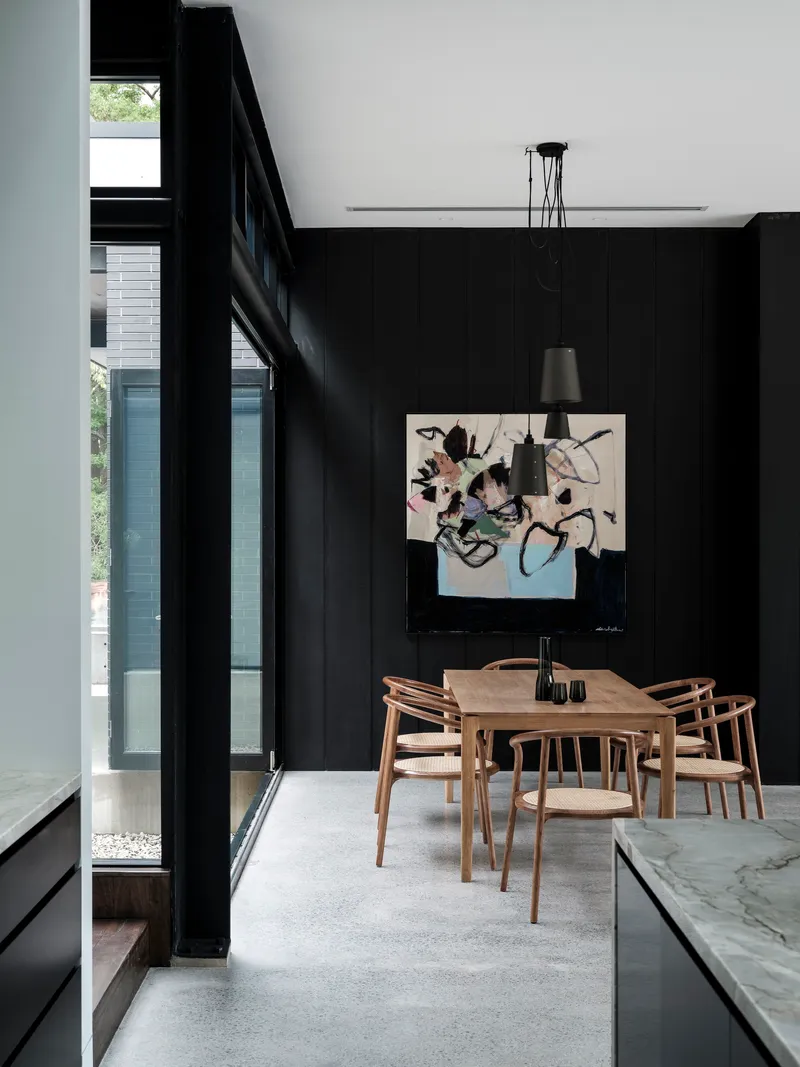
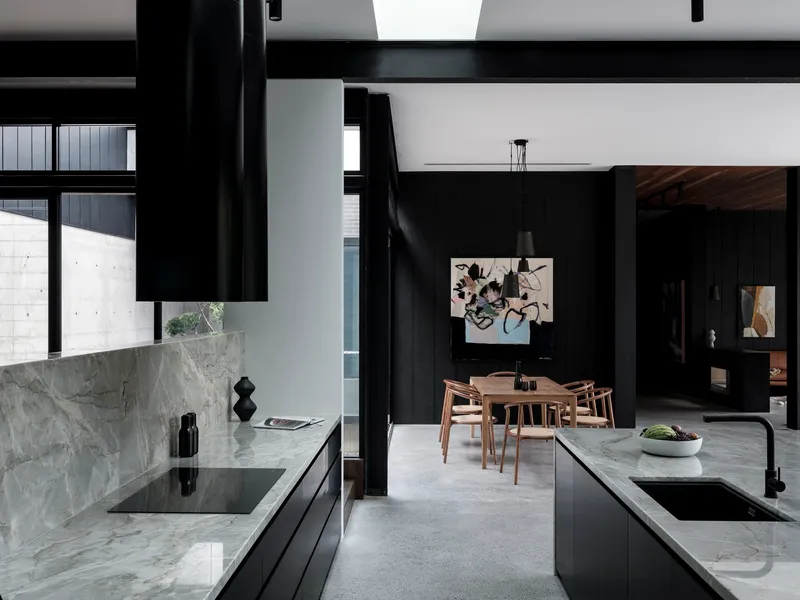
The dining zone sits at the intersection of courtyard and kitchen, a hinge point where the family converges. Black pendant lights hang above a timber dining table, with full-height glazing on one side washing the setting in lateral daylight. Folding glass doors on the courtyard side can open completely, erasing the wall and extending the table into the outdoor void. Even closed, the transparency keeps the courtyard tree in constant view.
Throughout the house, timber-clad hallways and glass doors manage transitions between interior zones and outdoor courtyards. Each threshold is a moment of material shift: polished concrete to raw concrete, timber ceiling to open sky, dark paneling to bright stone. These transitions are the fine grain of the architecture, the details that make the house feel designed rather than simply built.
Secondary Kitchen and Joinery Details
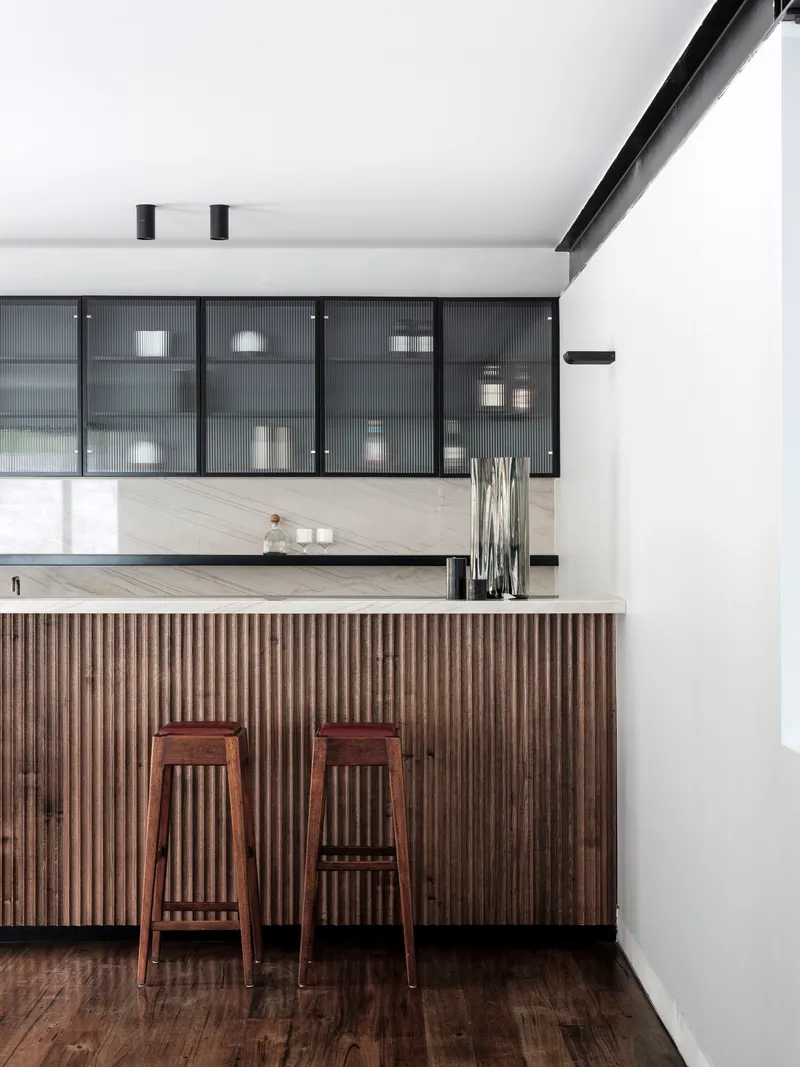
A secondary kitchen or bar area, clad in vertical timber slats with reeded glass cabinets above, serves one of the private zones. Wooden stools and a restrained palette of blonde timber and translucent glass give this space a lighter, warmer register than the main kitchen. It is a quiet acknowledgment that a multi-generational house needs more than one place to make coffee at seven in the morning.
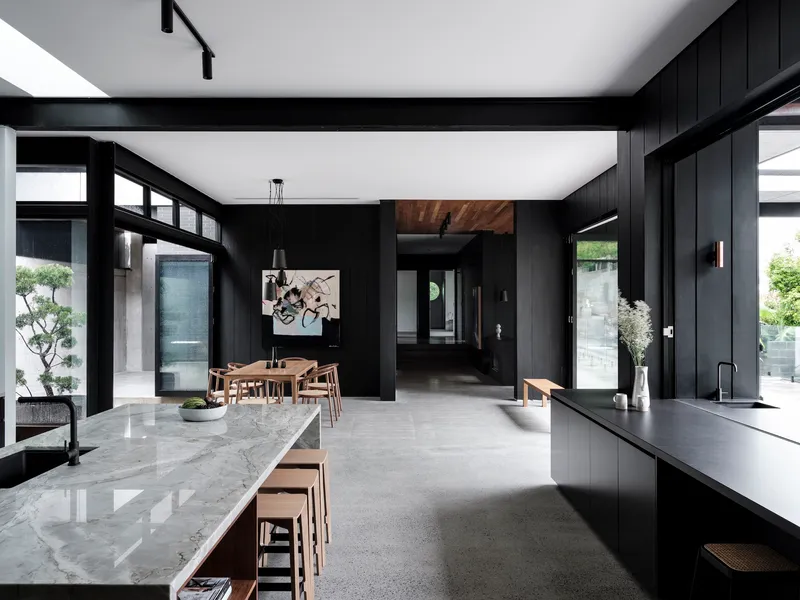
The marble island's underside reveals a terrazzo floor and a recessed timber shelving nook, the kind of hidden detail that demonstrates how thoroughly each element has been worked through. In the open-plan kitchen viewed from further back, black timber walls, high clerestory glazing, and the marble island compose a scene where no single material dominates. The architects have balanced weight against weight, dark against pale, rough against polished, throughout.
Plans and Drawings
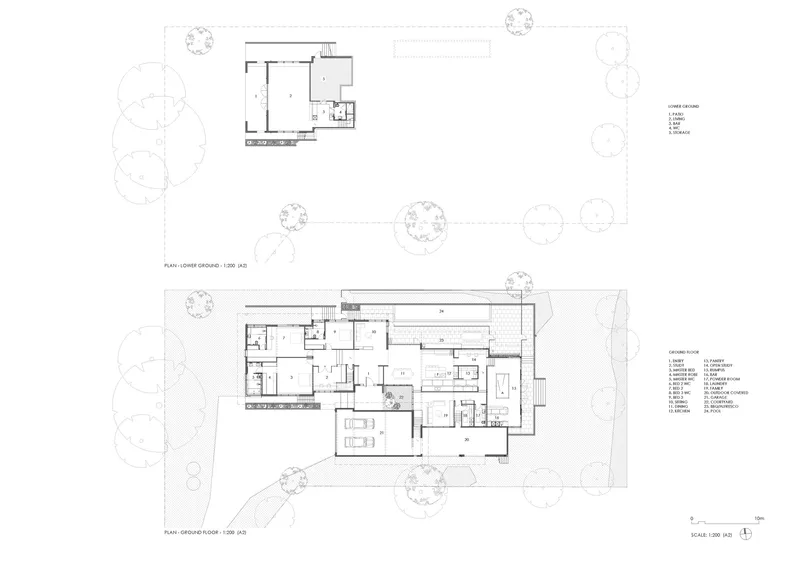
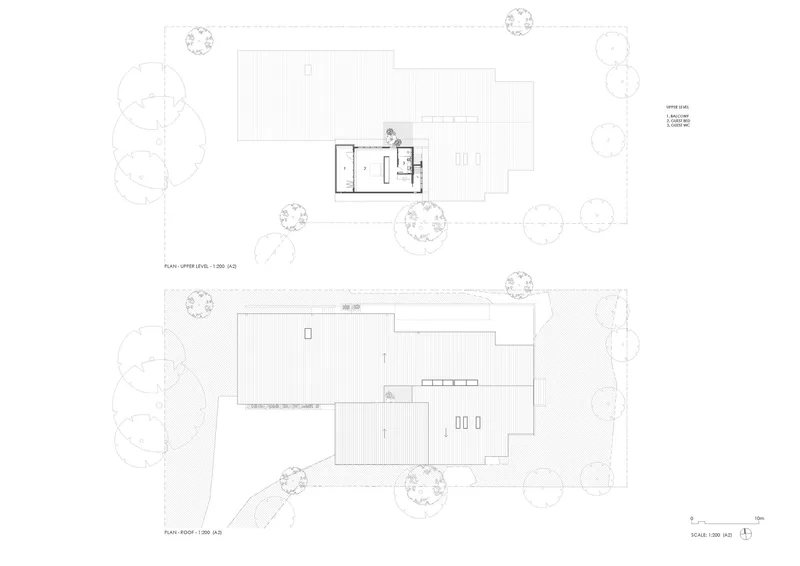
The floor plans reveal the battle-axe geometry clearly: a long access driveway leads to the building footprint set deep within the lot, surrounded by mature tree canopy indicated by circular overlays. The ground and upper level plans show the courtyard as a rectangular void punched through the center of the plan, with rooms wrapping around it on three sides. The upper level and roof plan show a linear roof pattern that follows the primary structural bays, while the roof level steps back to create terraces on the upper floors.
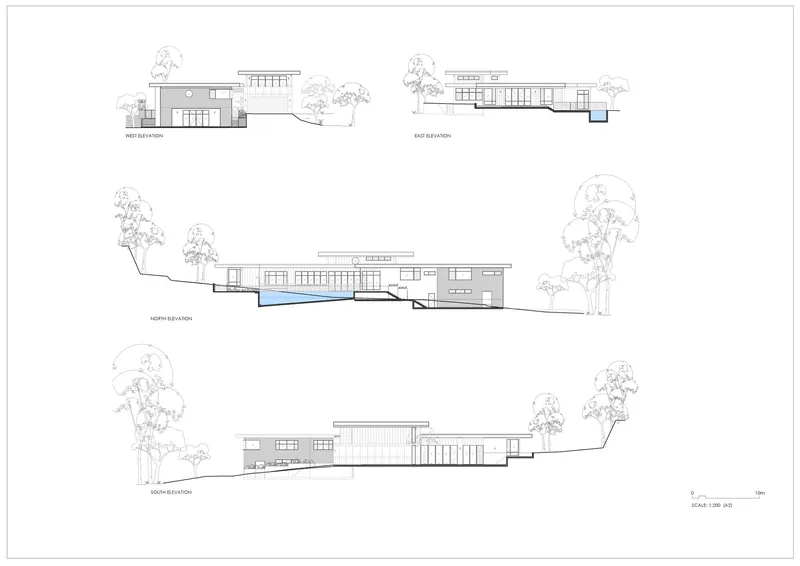
The four elevation drawings confirm how the house negotiates a sloping site, embedding the lower level into the terrain and using concrete retaining walls to carve out sunken courtyards. From every direction, the residence reads as a low-slung composition tucked beneath the tree line, its dark materials receding into the surrounding landscape rather than competing with it. The drawings also clarify the scale: on a 2,409-square-metre site, the building footprint is generous but not aggressive, leaving substantial garden around its edges.
Why This Project Matters
The Carrington Rd Residence is a counterargument to the prevailing idea that large Australian houses must be light-filled, white-rendered boxes. By committing to a darker, heavier material palette and investing the design effort to make each room distinct, Studio P demonstrates that scale and warmth are not mutually exclusive. The courtyard plan, with its single cloud tree and board-formed concrete walls, gives the house a center of gravity that holds the three-storey volume together.
More broadly, the project is a case study in how to design for multiple generations without resorting to the duplex model or the granny flat tacked on the back. Privacy, shared space, and individual identity are all handled through spatial organization and material differentiation rather than through separate entrances and divided lots. Six years from design to completion is a long gestation for a house, but the density of detail here suggests the time was well spent. Every room has been thought through as a place, not just a program.
Carrington Rd Residence by Studio P - Architecture with interiors by WRNS Studio. Wahroonga, Sydney, Australia. 703 m². Completed 2022. Photography by Tom Ferguson.
About the Studio
WRNS Studio
Official website of WRNS Studio, the interior designer behind this project.
wrnsstudio.comShare Your Own Work on uni.xyz
If projects like this are the kind of work you want to make, uni.xyz is a place to publish your own, find collaborators, and enter design competitions.


Popular Articles
Popular articles from the community


David Ortega Stacks a Two-Story Mexico City Penthouse Around a Steel Stair and a Pergola-Shaded Roof Terrace
In Colonia Roma, a 300 m² penthouse uses oak joinery, a planted steel stair and a slatted roof pergola to make a new-build apartment feel like a house.

Cube Design Draws an Ecological Corridor Between Two Shenzhen Hills with the Nankai Building
Beside Shenzhen's container docks, the Nankai Building pairs stacked balconies with a climbing green screen to connect two hillsides across its height.


Singing Woman: An Opera House That Performs Before the Curtain Rises
Ovidiu Cristian Pavel's conceptual opera house translates Estonia's choral identity into a sculpted waterfront landmark facing the Baltic Sea.

FCC Arquitectura Expands a Portuguese Granite House with a Board-Marked Concrete Wing
In Portugal, JV House pairs a cleaned-up whitewashed and granite dwelling with a timber-shuttered concrete extension, courtyards and a garden pool.

Similar Reads
You might also enjoy these articles

LAVA Architecten Gives Vocational Education a Sawtooth-Roofed Face on a Mechelen School Campus
In Mechelen, Belgium, a 2,053 m² STEM school on a 6×6 m grid turns workshops and classrooms into rooms that can be rearranged as teaching changes.

KEMA Studio Turns a Derelict Marvila Attic into a 60 m² Lighthouse Apartment Above Lisbon
In Lisbon's Marvila district, a rebuilt roof, four skylights and two plywood volumes turn an unlivable attic into a bright home facing the Tagus.

Pixel Gardens: One Repeated Module Stacked Into a Terraced Social Housing Tower for Famagusta
Salem Bader's shortlisted housing tower builds a vertical neighbourhood from one repeated module, offsetting units to carve terraces, light and air.

Bao Huynh Watercolor Atelier: A Serene Art Retreat in Hội An
Bao Huynh Watercolor Atelier in Hội An blends multifunctional art spaces, sustainable design, local materials, and family-friendly living in a serene environment.

Explore Residential Building Competitions
Discover active competitions in this discipline

Comments (0)
Please login or sign up to add comments
No comments yet. Be the first to comment!