
studiokian Wraps a Jakarta House in Terracotta Lattice to Build a Tropical Sanctuary
On a corner site overlooking a basketball park, the O16 House uses layered screens and a central void to domesticate Jakarta's heat and light.


Jakarta's residential complexes tend to push houses toward introversion: walled compounds, gated entries, interiors sealed from the street. The O16 House by studiokian takes the opposite approach. Sitting on a 300 m² corner lot that looks out toward a basketball park and a perimeter boundary lined with mature trees, the house opens itself selectively to its surroundings rather than turning away. Lead architects Kalvin Widjaja and Dian Indah stack four levels of living space, totaling 580 m², and then wrap the whole composition in terracotta lattice screens that filter Jakarta's relentless equatorial sun into something more gentle and inhabitable.
What makes O16 genuinely interesting is not the screens alone, which are almost a vernacular trope in Southeast Asian residential design at this point, but the way those screens interact with the house's section. A double-height void at the center of the plan pulls daylight down through a skylight and distributes it across polished concrete floors, while the lattice panels on the exterior turn that same light into shifting geometric patterns throughout the day. The result is a house where every room has a different relationship to the sun depending on the hour, the season, and the orientation of its walls.
A Corner Site, Fully Exploited
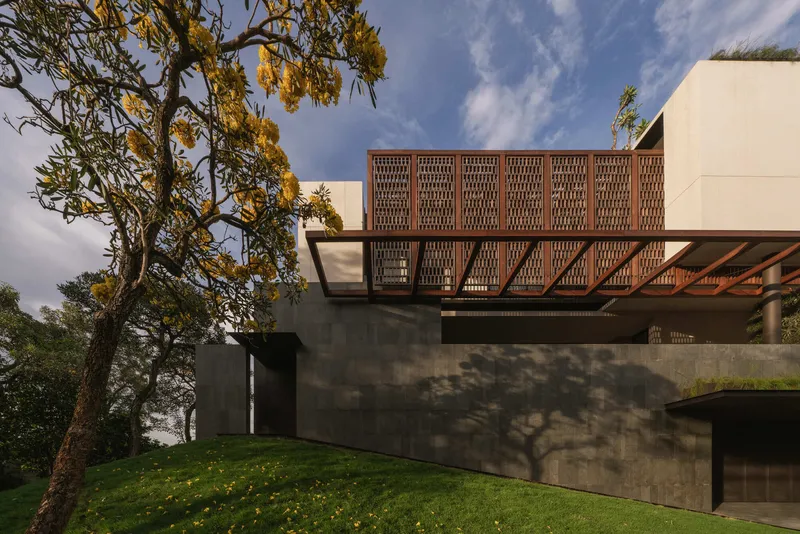
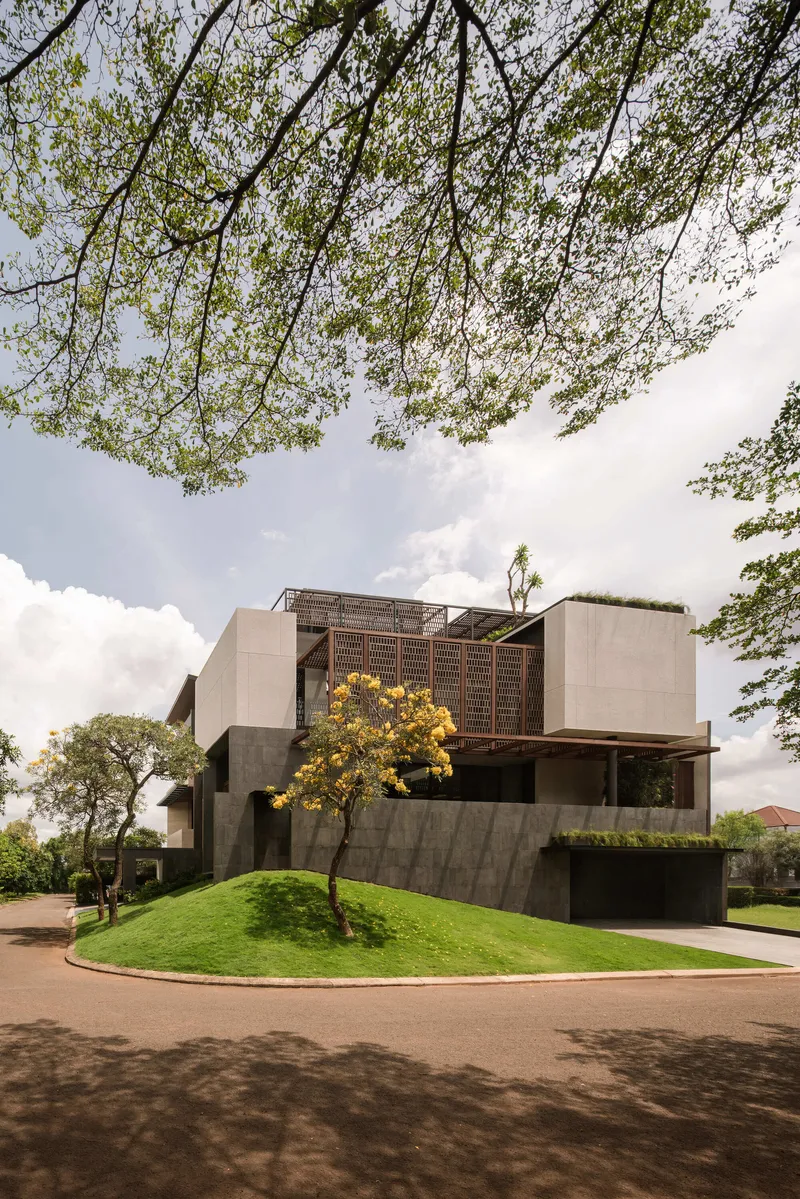
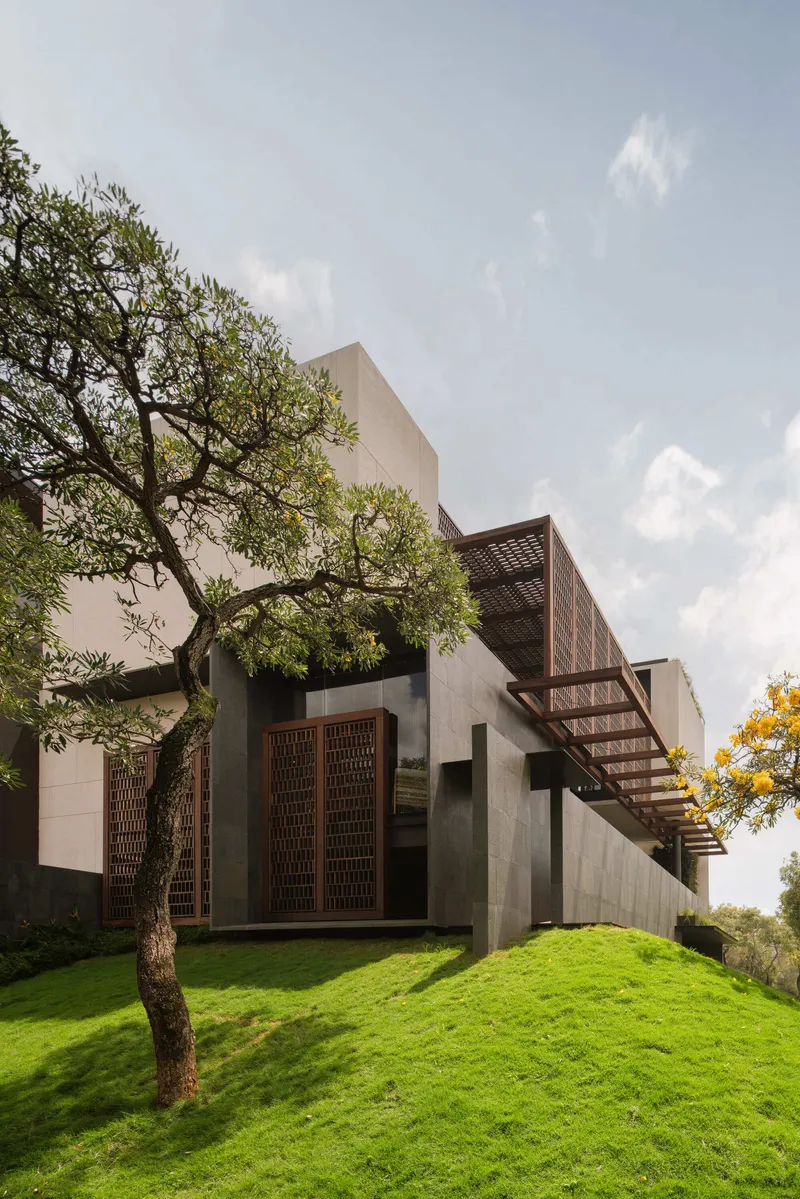
The corner condition gives O16 two public faces, and studiokian treats each differently. From one angle, the house reads as a stack of heavy concrete volumes with a cantilevered terracotta screen balcony floating above. From another, the composition dissolves into layers: lattice panels, canopy beams, and the yellow blooms of a tabebuia tree on the sloped lawn softening the boundary between the lot and the park beyond. The decision to leave the complex gateless, unusual for Jakarta, puts the architecture itself in the role of threshold. The screens do the work that walls and fences would normally handle, offering privacy without barricading the occupants.
The sloped lawn and the strategic positioning of flowering trees also deserve attention. They create depth in the foreground, so the house never reads as a flat facade from the street. Instead you perceive volume, shadow, and movement before you even register the building's geometry.
The Pool Deck as Social Core
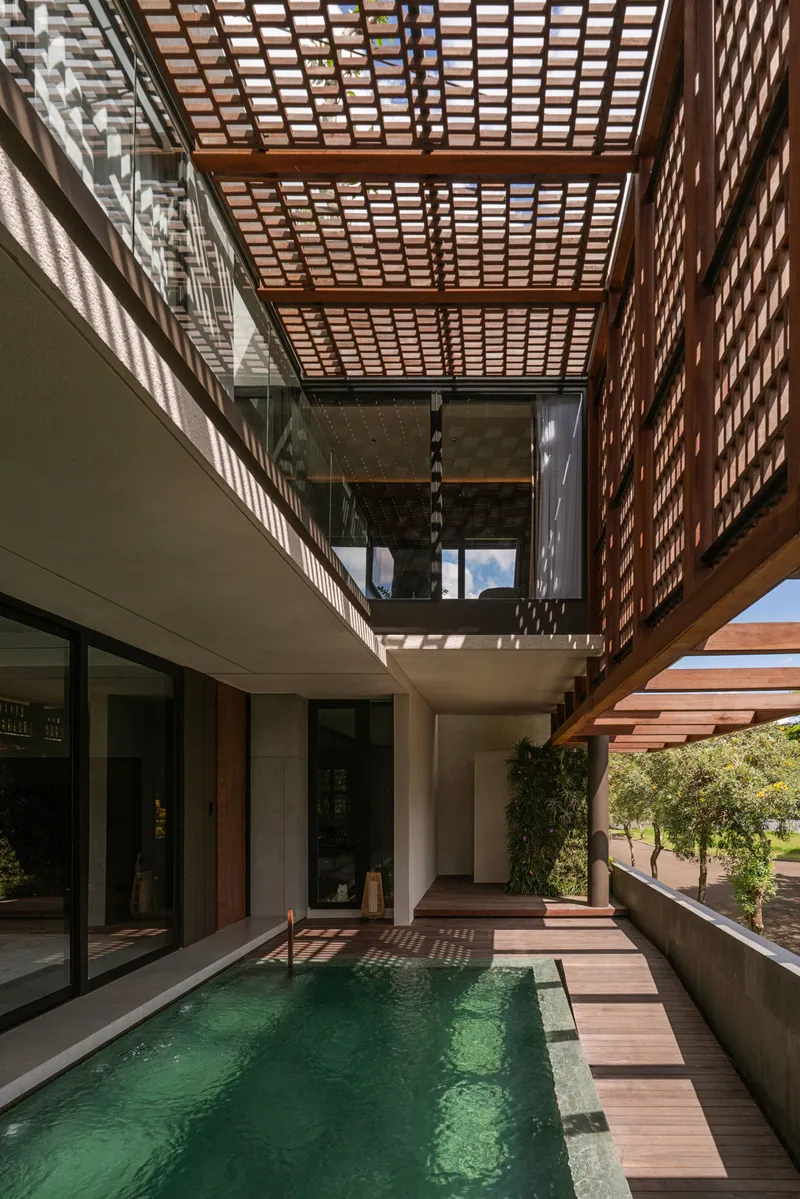
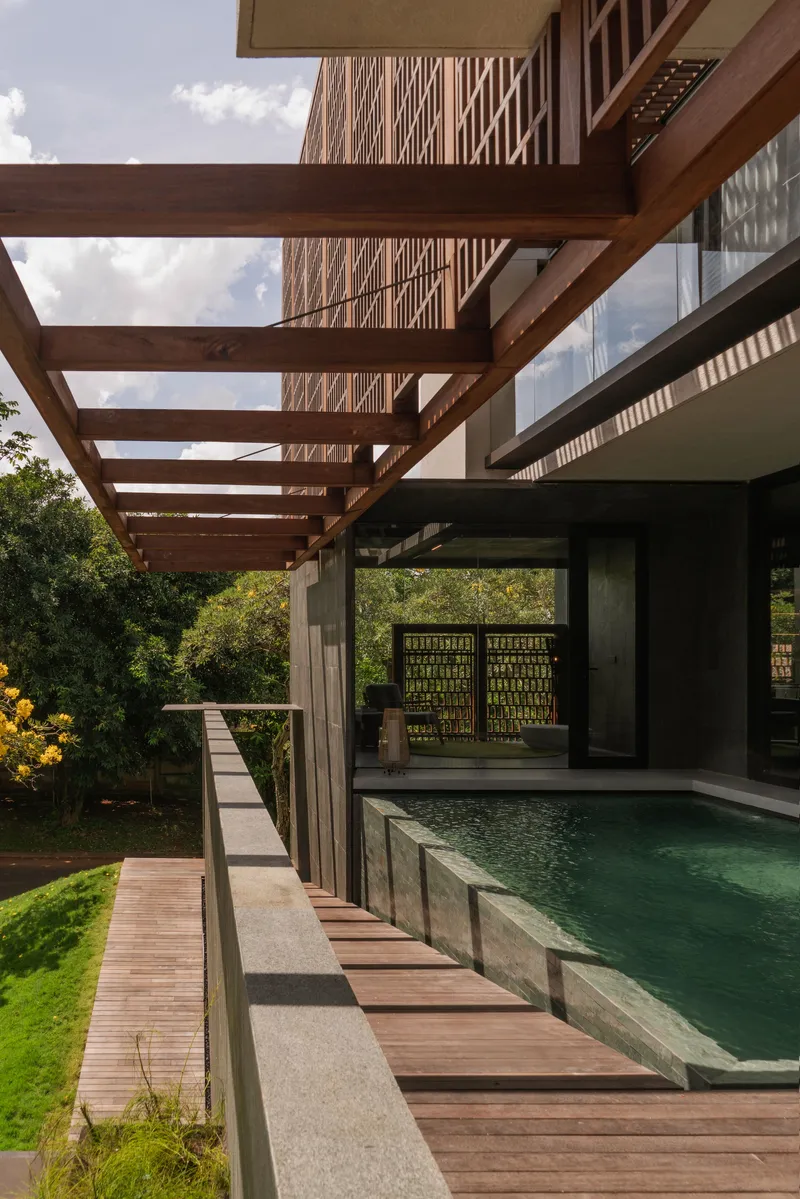
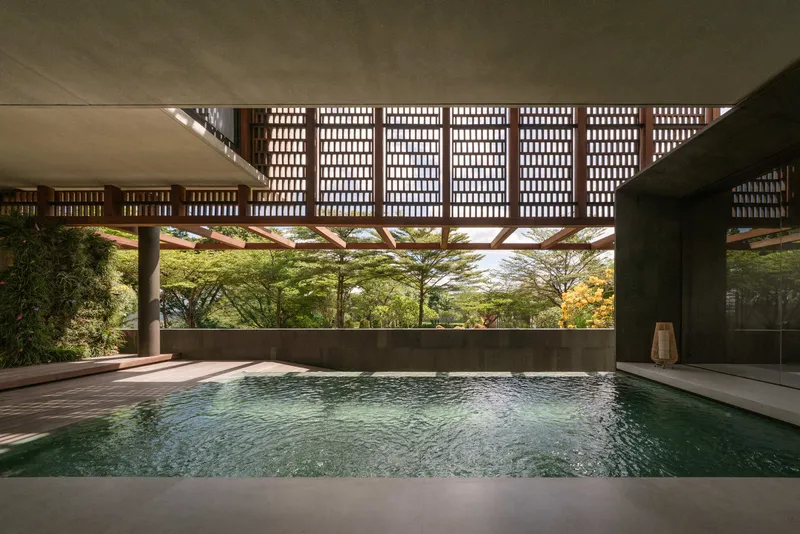
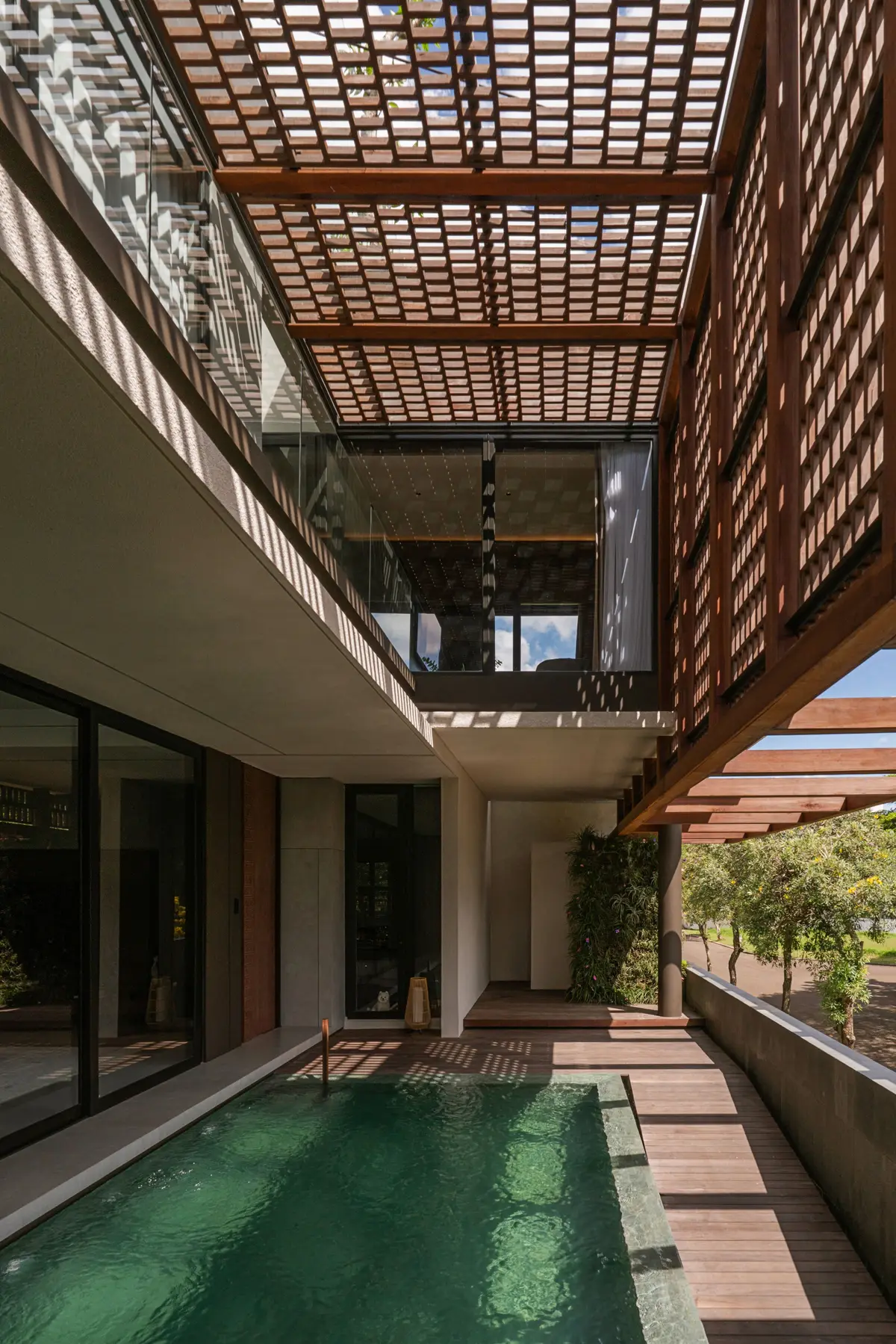
The pool terrace sits at the second level, wrapped by a timber lattice canopy that extends the interior living spaces outward. It is clearly the social heart of the house. Timber decking runs right up to the water's edge, and the pergola beams overhead cast a precise grid of shadows onto the surface, animating what could have been a static amenity. Beyond the concrete parapet, the surrounding trees are visible at eye level, a benefit of the elevated position that studiokian clearly anticipated in the section.
The canopy here is not merely decorative. It controls solar gain over the pool deck while maintaining air movement, a practical necessity at Jakarta's latitude. The timber members are spaced to produce a dappled light condition that shifts throughout the day, ensuring the terrace is usable from morning to late afternoon without becoming an oven.
The Double-Height Void and the Staircase
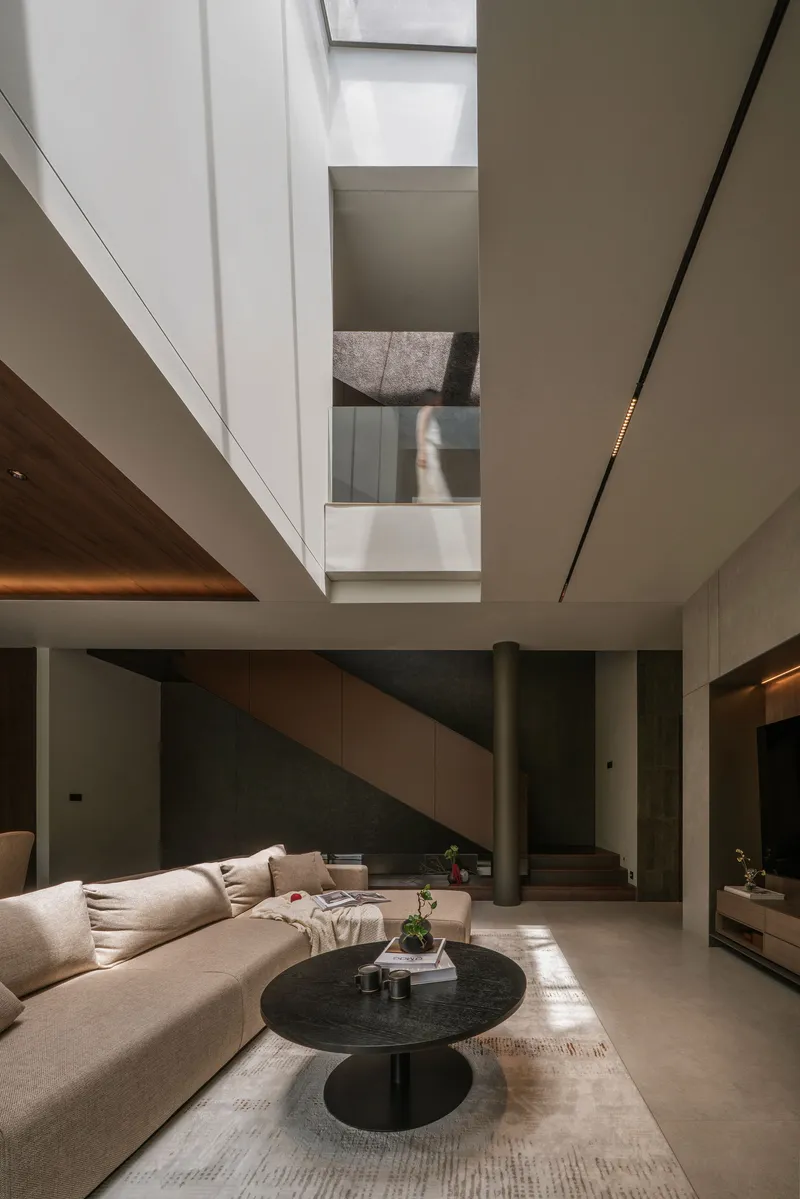
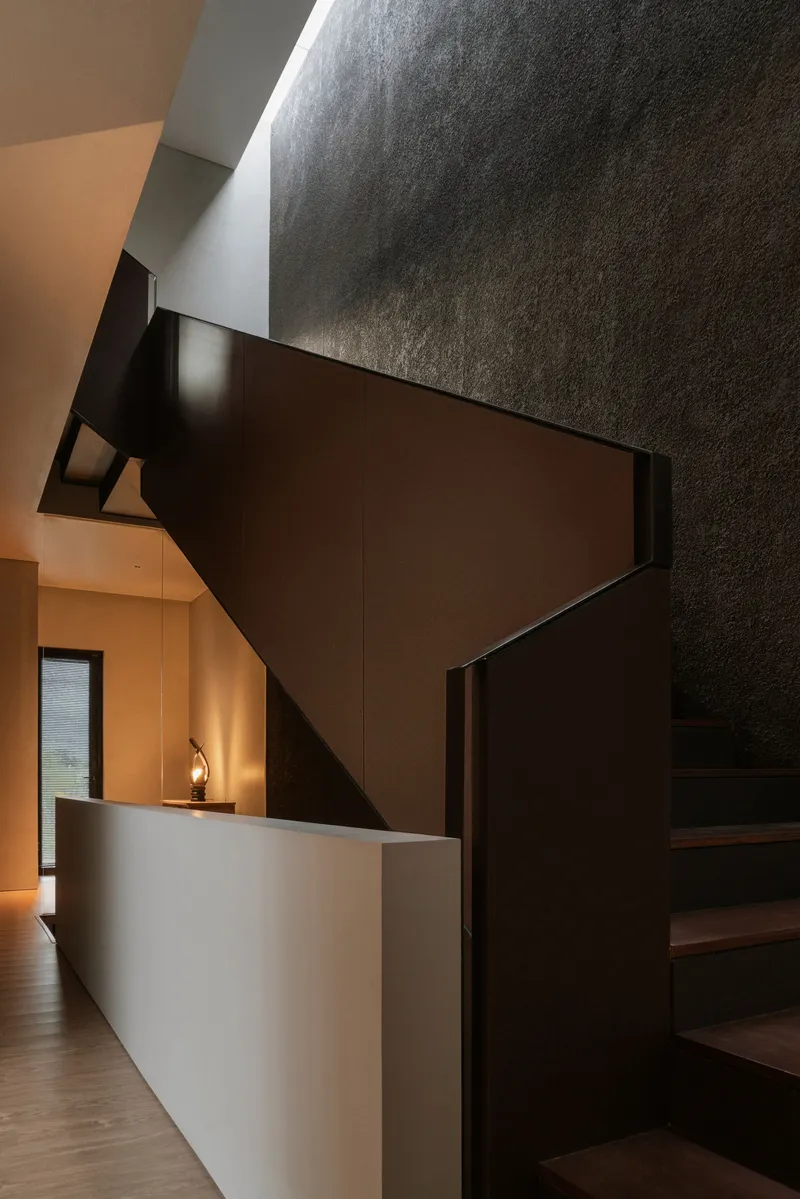
At the center of the plan, a double-height living room anchors the vertical circulation. A skylight crowns the void, sending a column of light down onto the polished concrete floor below. The central staircase rises through this space, its dark timber treads contrasting with the textured concrete walls that surround it. There is a restraint to the material palette here: concrete, timber, and natural light doing all the work, with no applied finishes competing for attention.
The staircase itself functions as more than circulation. Its position within the void means it participates in the thermal stack effect, encouraging warm air to rise and exit through the skylight while drawing cooler air up from the lower levels. It is an example of section-driven thinking that goes beyond formal drama, though the drama is certainly present when warm light spills up from below and catches the grain of the timber.
Lattice, Light, and the Interior Experience
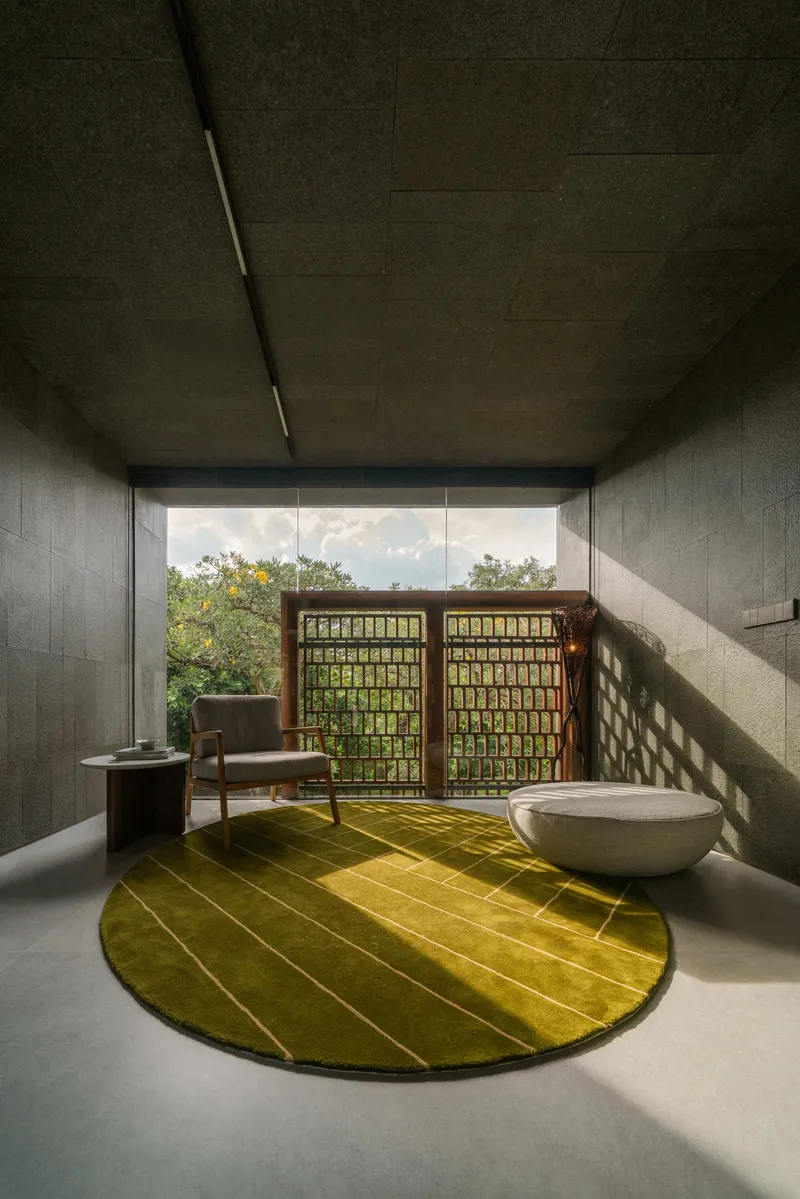
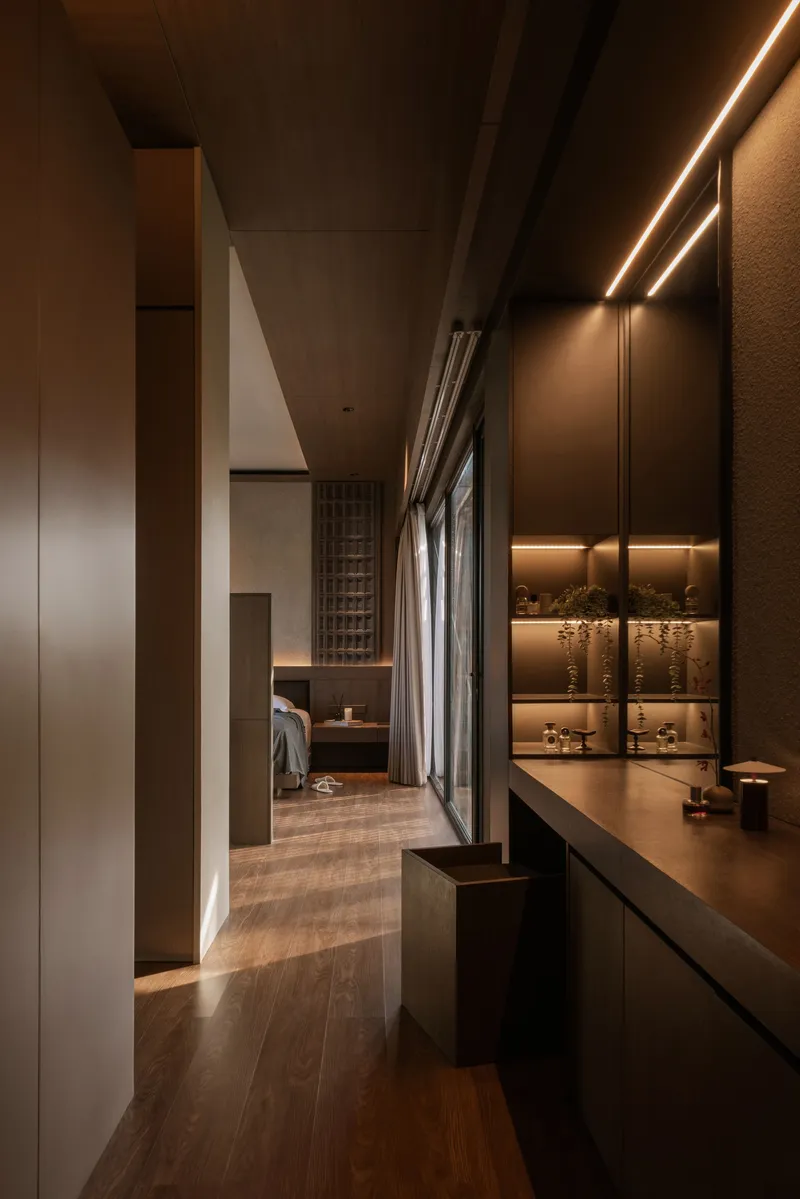
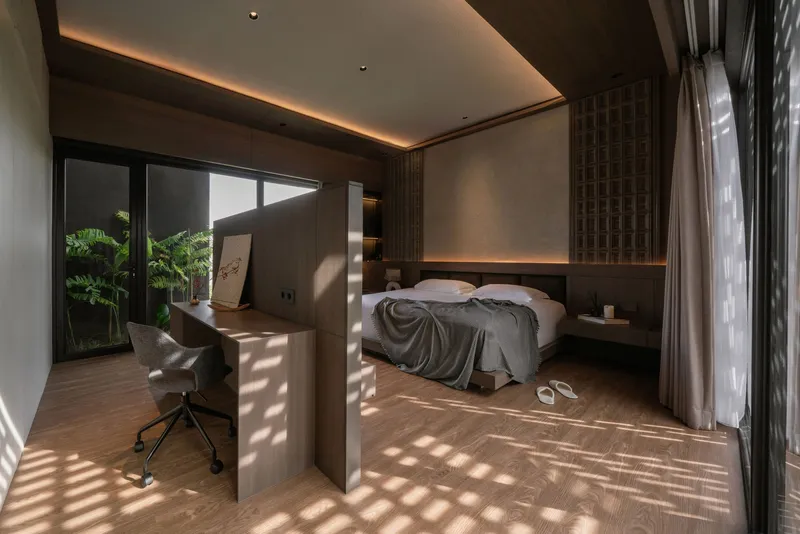
The terracotta and timber lattice screens are the defining gesture of O16, and their effect is most legible inside the house. In one room, a circular green rug catches patterned sunlight filtering through timber screens, transforming a simple concrete box into something luminous and constantly changing. Down the corridor, integrated lighting along display niches creates a gallery-like procession that leads toward the screened exterior. In the bedrooms, the lattice throws rhythmic shadow stripes across timber floors and bedding, turning the act of waking up into a sensory event.
The screens also provide the house's privacy gradient. Ground-floor rooms, closer to the street, use denser lattice patterns. Upper floors, where surrounding greenery already provides a visual buffer, allow more open configurations. It is a calibrated system rather than a uniform application, and it rewards occupants with distinct spatial characters on every level.
Evening Presence
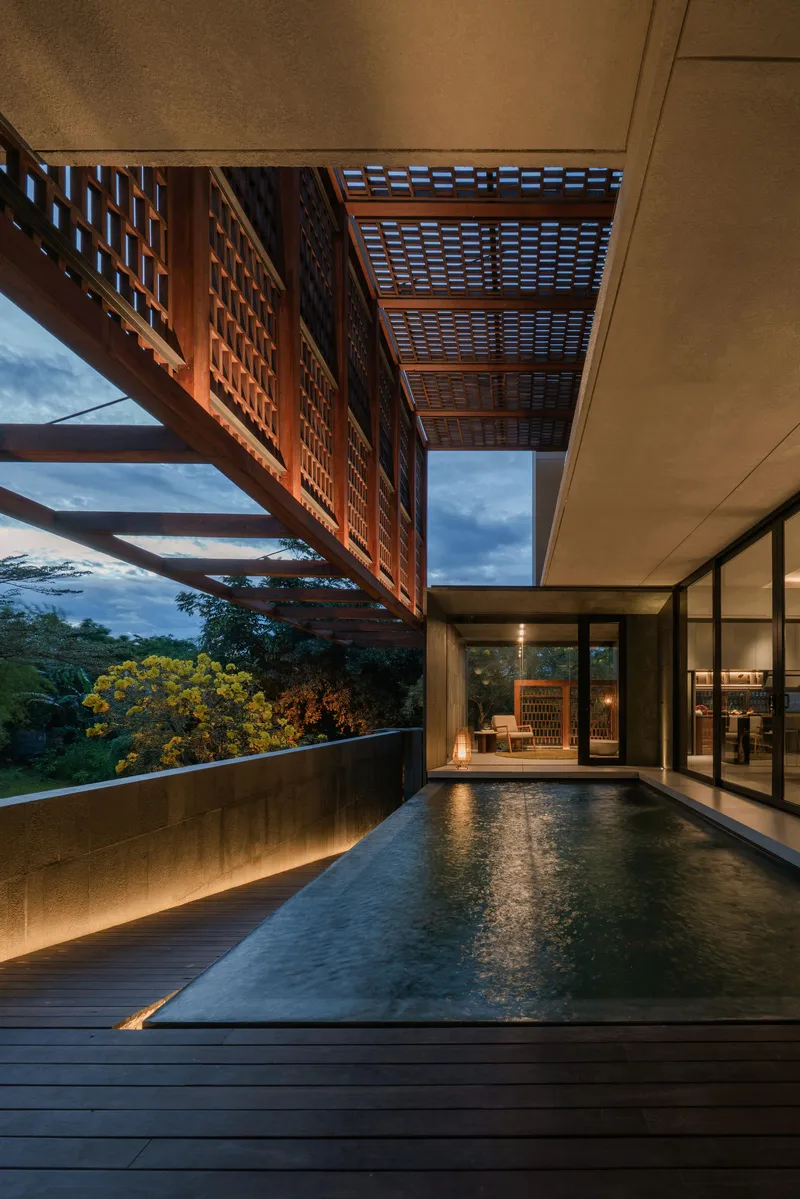
At dusk, the house inverts its daytime logic. The lattice canopy over the pool deck, lit from below, becomes a glowing lantern visible from the park and the surrounding complex. The glass-walled interior beyond broadcasts warm domestic life outward through the screen, turning the architecture into a filtered signal of inhabitation. The house is most generous to its neighborhood at this hour, contributing light and visual warmth to the streetscape without sacrificing the privacy of its occupants.
Plans and Drawings
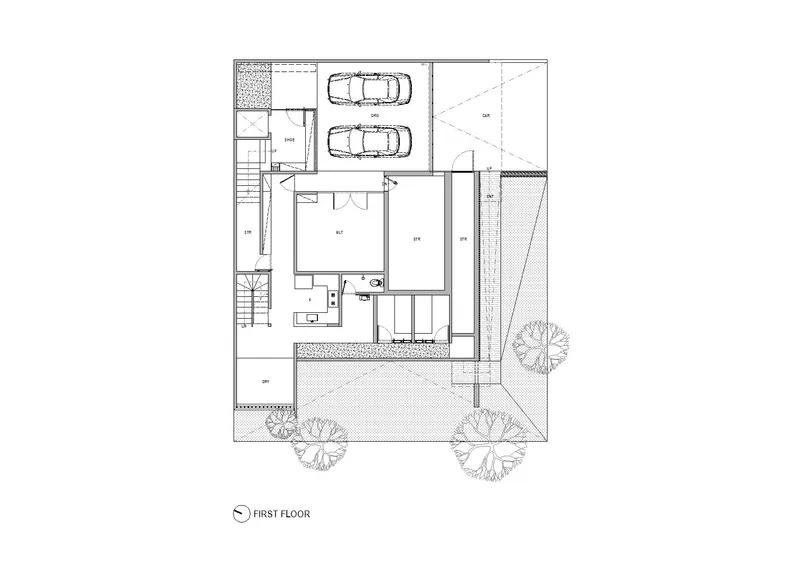
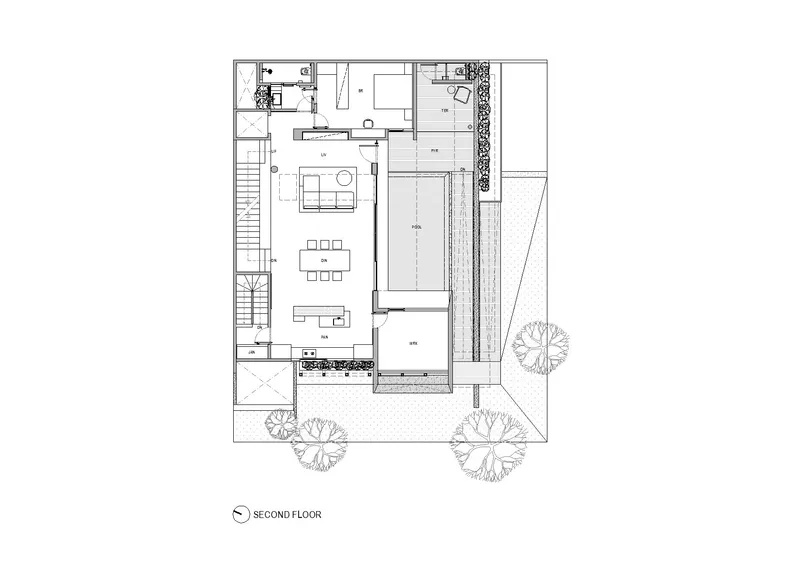
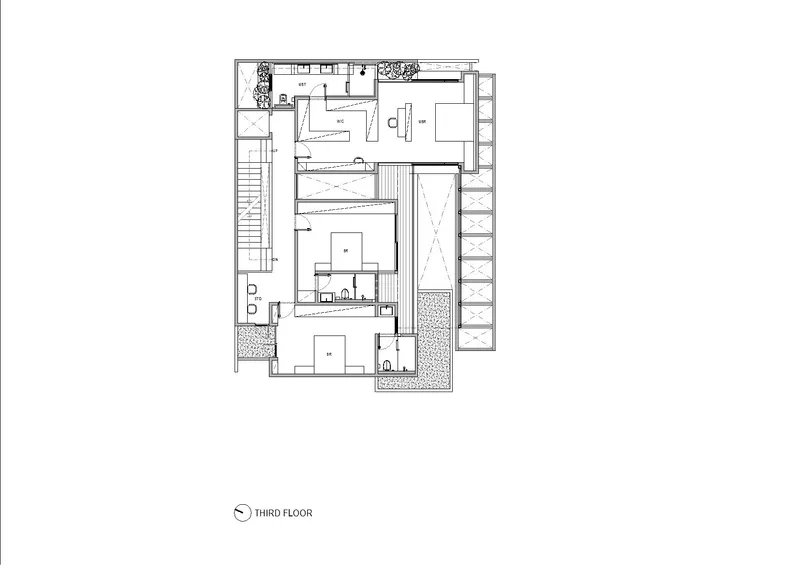
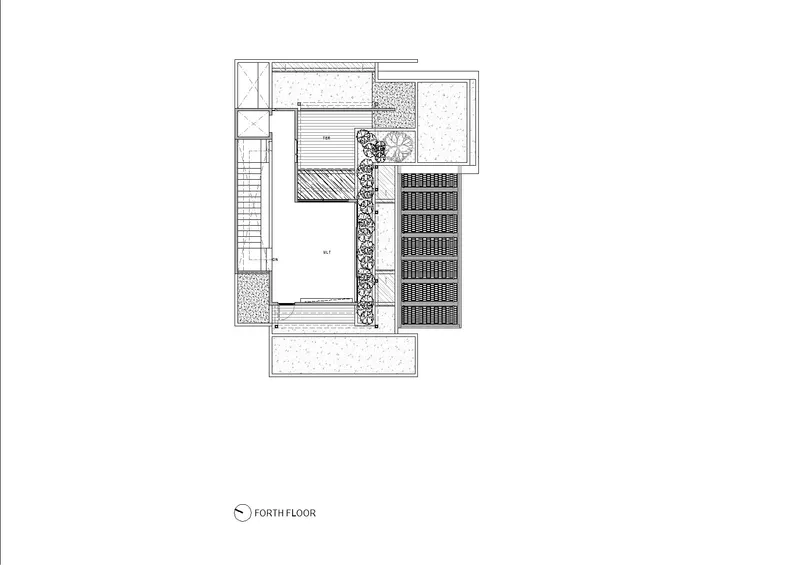
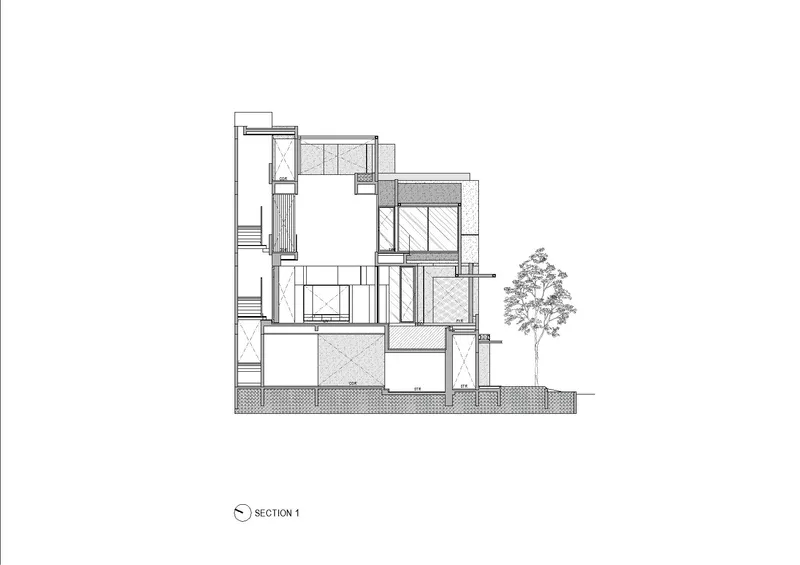
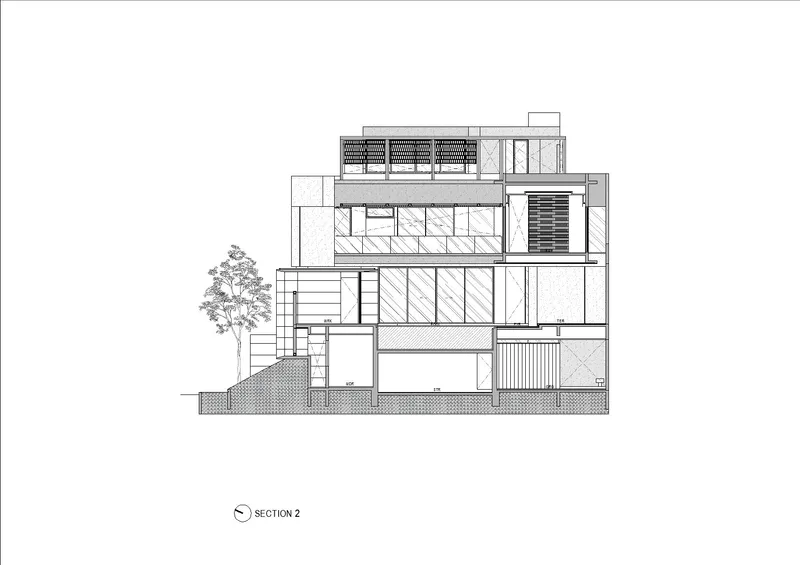
The plans reveal a four-level organization that is more nuanced than the compact site might suggest. The ground floor accommodates a double garage and service spaces alongside a landscaped courtyard planted with mature trees. The second floor opens up to the pool terrace and the main living and dining areas, placing social life at the level where surrounding greenery provides the best visual connection. Bedrooms occupy the third floor, organized around a central stairwell with planted terrace strips that bring vegetation right to the threshold of private rooms. The rooftop, shown in the fourth-floor plan, hosts a solar panel array and planted zones, acknowledging energy performance as part of the architectural agenda rather than an afterthought.
The two section drawings are the most revealing documents. They show how the double-height void creates a thermal chimney at the heart of the plan, and how each floor steps or cantilevers slightly to produce shading for the level below. The adjacent tree, drawn at full scale in the section, confirms that the landscape strategy is integral to the building's environmental performance. The rooftop solar panels visible in the section complete a picture of a house that takes its equatorial context seriously: screening, venting, shading, and generating energy in response to Jakarta's climate.
Why This Project Matters
The O16 House is not reinventing the tropical screen house. That lineage runs deep through Indonesian architecture and across Southeast Asia. What it does well is integrate that tradition with a rigorous sectional strategy and a layered material palette that avoids the overly polished minimalism common in Jakarta's high-end residential market. Concrete, timber, and terracotta are honest materials here, left to weather and patina in dialogue with the tropical climate rather than sealed against it.
studiokian also demonstrates that a compact corner lot in a dense residential complex can produce architecture with genuine spatial generosity. By stacking social space above the garage, threading a void through the center, and wrapping the whole composition in calibrated screens, Widjaja and Indah extract far more light, air, and privacy from 300 m² of land than most houses twice the size manage to achieve. That efficiency, coupled with rooftop solar and integrated planting, positions O16 as a credible model for tropical urban living that takes comfort and sustainability equally seriously.
O16 House by studiokian. Lead architects: Kalvin Widjaja, Dian Indah. Jakarta, Indonesia. 580 m². Completed 2025. Photography by Ernest Theofilus.
About the Studio
studiokian
Share Your Own Work on uni.xyz
If projects like this are the kind of work you want to make, uni.xyz is a place to publish your own, find collaborators, and enter design competitions.


Popular Articles
Popular articles from the community


The Ocean Hive: Sustainable Architecture for a Self-Sufficient Civilization at Sea
The Ocean Hive imagines sustainable architecture at sea, where modular habitats, algae, wave power and ocean waste sustain a growing colony.

Little Red Riding Hood: Architectural Design as a Journey Through Fear, Light, and Storytelling
Little Red Riding Hood reimagines the fairy tale through architectural design shaped by fear, light, scale, memory, uncertainty, and choice.

Lunar Spiral: Space Architecture Shaped by the Mathematics of the Universe
Lunar Spiral reimagines space architecture through Fibonacci geometry, lunar regolith, levitating habitats, and self-sustaining Moon living.

Conexión: Biophilic Design Reimagines High-Rise Living in Hong Kong
Conexión reimagines high-rise living in Hong Kong through biophilic design, green facades, shared spaces, daylight, water and nature within.

Similar Reads
You might also enjoy these articles

Bao Huynh Watercolor Atelier: A Serene Art Retreat in Hội An
Bao Huynh Watercolor Atelier in Hội An blends multifunctional art spaces, sustainable design, local materials, and family-friendly living in a serene environment.

Atelier Macri Concept Store Interior Design by CASE-REAL
Atelier Macri store features a "ko" counter, walnut wood details, cork displays, blending retail, gallery, and seamless customer experiences.

Manuel Vargas Izquierdo Stadium and High-Performance Sports Center: Architectural Excellence in Jalpa de Méndez
The Manuel Vargas Izquierdo Stadium blends sustainable design, inclusive sports facilities, and cultural-inspired architecture, revitalizing Jalpa de Méndez’s public spaces.

KAKR Buluh Awar Hall: Revitalizing Community and Ecology Through Bamboo Architecture
Community built bamboo hall revitalizes Buluh Awar village, empowering youth, restoring ecology, celebrating vernacular craftsmanship through sustainable architecture and culture.


Comments (0)
Please login or sign up to add comments
No comments yet. Be the first to comment!