
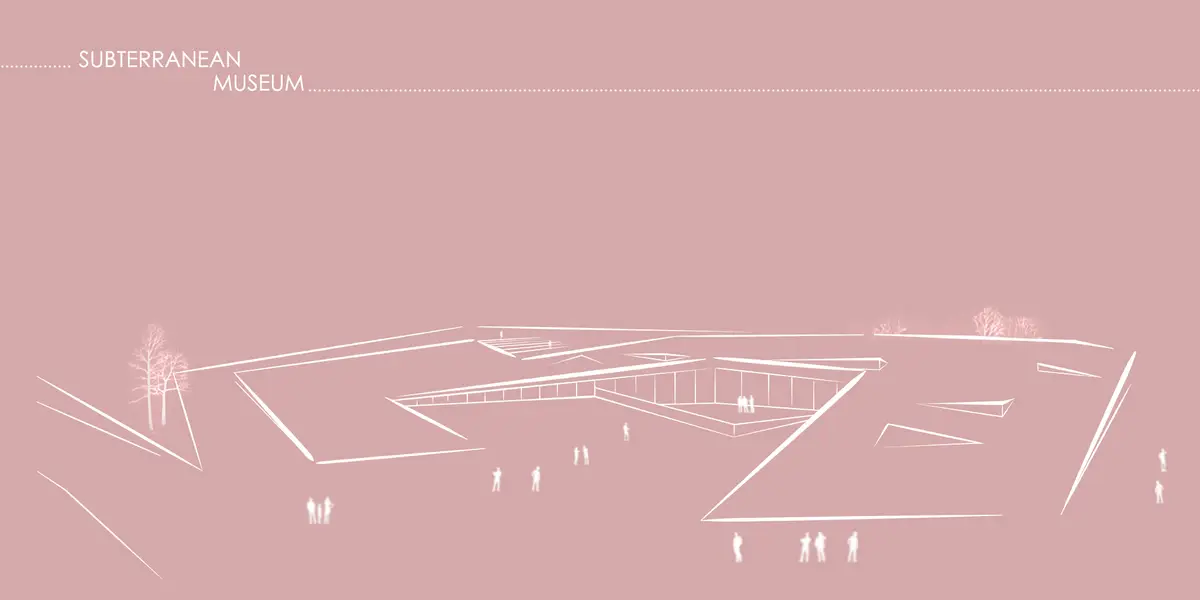
SUBTERRANEAN MUSEUM
Exploring Medieval living- beneath the ground

The underground cities in Cappadocia are among the most unique instances of Turkey’s ancient architecture. The brief challenged us to create a gallery/museum within the Kayseri region with a nod towards the ancient underground tunnel system in turkey. These mysterious spaces allowed many people to live their lives in complete secrecy. The main concept behind our proposal is to accumulate the seemingly contradicting notions of cohabitation and the desire for concealment, as perceived in the historic underground topologies. These conditions informed the decision to bury the structure into the landscape with minimal exposure above the ground.
The structure of the museum is carved into the site. Two quadrilateral openings on the landscape terrain begin an inclined transition from above the ground to the museum space below. The larger opening on the west side, functions as the main entry and is the most visible part of the structure above ground, detectible from the adjacent highway. Each opening leads into one of the two main zones of the program. The zones including gallery spaces and cafe/lounge are interlinked beneath the ground. The subsequent interior spaces feature distending ramps that bridge the different levels. The interconnected mechanism is inherited from the traditional topology of Cappadocia. The connected voids in between ramps echo the shapes of excavated caves in underground cities that inspired the narrative behind the museum.
A three-dimensional triangular grid is applied on the site to accommodate secondary openings into the spaces for natural light and ventilation. These openings frame different views of the sky that change throughout the day. By inviting natural light and topographical landscape below ground, a hidden yet dynamic space is created that encourages the visitors’ interaction.

Popular Articles
Popular articles from the community


David Ortega Stacks a Two-Story Mexico City Penthouse Around a Steel Stair and a Pergola-Shaded Roof Terrace
In Colonia Roma, a 300 m² penthouse uses oak joinery, a planted steel stair and a slatted roof pergola to make a new-build apartment feel like a house.

Juan García Correa, John González and Claudia Rueda Sink a Circular Amphitheater into a Manizales Engineering Building
On the La Nubia campus in Manizales, Colombia, the S1 Building folds labs and offices into a hillside of ramped lawns that double as a campus route.


Singing Woman: An Opera House That Performs Before the Curtain Rises
Ovidiu Cristian Pavel's conceptual opera house translates Estonia's choral identity into a sculpted waterfront landmark facing the Baltic Sea.

graciastudio Turns a Viewless Tijuana Lot Inward Around a Courtyard of Concrete, Timber and Trees
In Tijuana, Jorge Gracia's GA2 House stacks a timber-clad private floor over exposed concrete and replaces a missing view with a planted interior patio.

Similar Reads
You might also enjoy these articles

The Rhythm of Seasons
A Farmers' Market Connecting Nature and the City

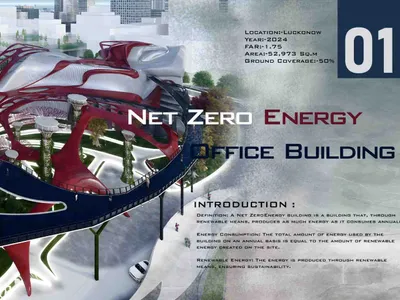
More Than a Building-Designing a Living System
More Than a Building-Designing a Living System
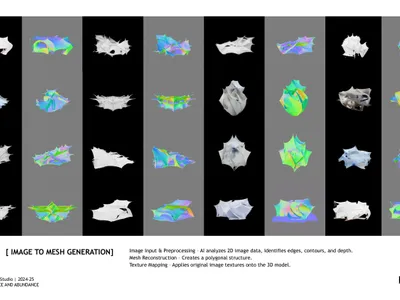
Base Beyond
DESERT COMPOUND ARID: TOURISM OF ABSENCE AND ABUNDANCE

Comments (0)
Please login or sign up to add comments
No comments yet. Be the first to comment!