

SUMMARY Builds a Prefab Concrete Grandstand That Doubles as a Community Spine in Aveiro
A modular precast training complex slots between four football pitches, using bold yellow wayfinding to separate public and private life.


Municipal sports infrastructure rarely gets a second glance from architecture culture. It tends to arrive as a budget exercise, a utilitarian slab dropped at the edge of town and forgotten. The Grandstand Building Training Complex in Aveiro, designed by Porto-based practice SUMMARY under the lead of Samuel Gonçalves, refuses that premise. Situated in the shadow of the existing Aveiro Municipal Stadium, the 1,500 square meter structure consolidates locker rooms, parking, a bar, public stands, and complementary amenities into a single linear volume that runs between four synthetic turf pitches. It is, simultaneously, a grandstand facing two directions and a social condenser stitching together the life of youth football.
What makes the project genuinely interesting is the decision to build everything from precast reinforced concrete modules manufactured off-site and assembled in place, treating a civic building like a kit of parts. The approach slashed construction time, allowed factory-level quality control, and produced a structure that is, in principle, demountable. That industrial logic is then counterbalanced by a precise color strategy: every element the public is meant to touch, climb, or pass through is drenched in a deep, bold yellow that recalls the local team's colors. The result is a building that reads as neutral concrete mass from a distance and reveals its social architecture only as you get close enough to follow the yellow.
A Long Bar Between Pitches
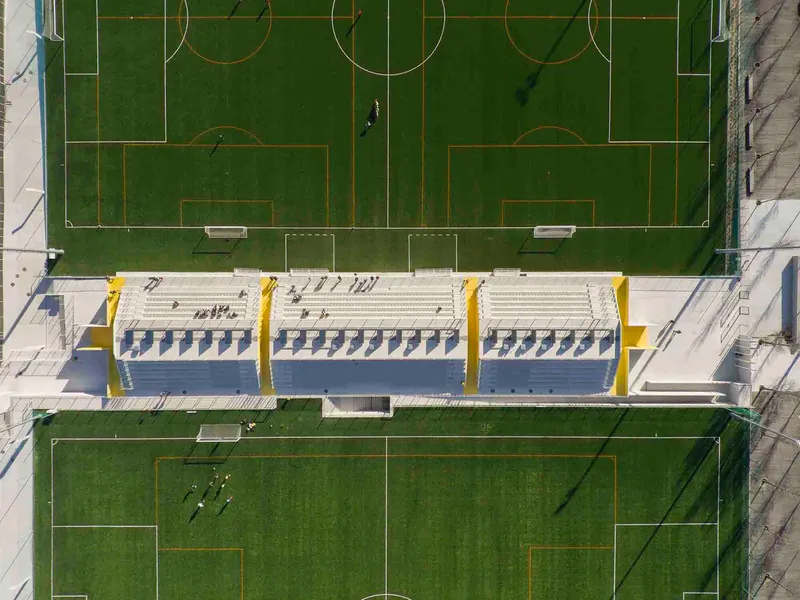


Seen from above, the complex reads as a single elongated bar parked between parallel playing fields. The bilateral orientation is the key move: grandstand seating faces outward to both sides, so the building serves two pitches at once while consolidating all program underneath a shared structure. Four football pitches fan out from this central spine, and the cantilevered canopy shelters spectators on each flank. It is a simple diagram executed without ambiguity.
The aerial perspective also reveals how restrained the footprint is. Rather than scattering separate pavilions for changing rooms, storage, and spectator seating, SUMMARY compressed everything into one continuous body. Less material, less ground consumed, fewer redundant corridors. The decision to merge rather than distribute is what keeps the complex from competing with the nearby municipal stadium, which looms large in Aveiro's sports landscape.
Precast Concrete as Civic Muscle
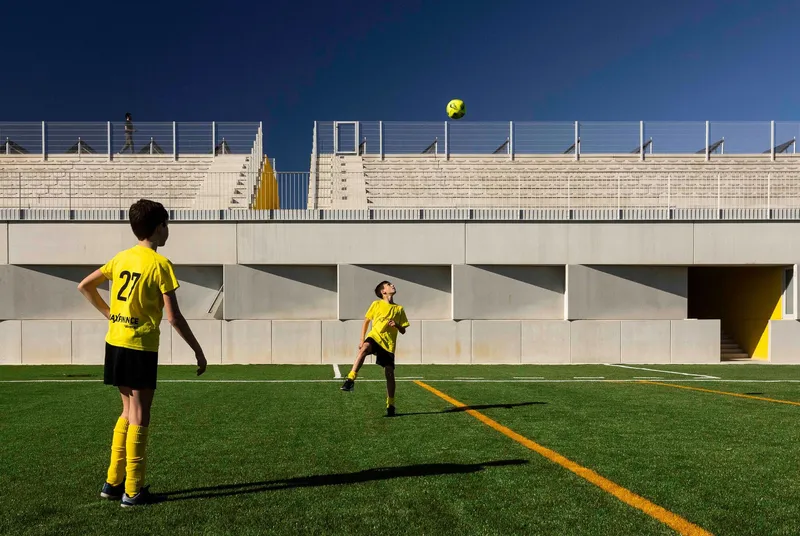


The structural logic is visible everywhere. Triangular supports march along the underside of the tiered seating, giving the grandstand its distinctive sawtooth rhythm when seen from pitch level. The concrete is left in its natural color, untreated and unfinished, so the joints between precast modules remain legible. There is no pretense that this is anything other than assembled parts.
Board-formed textures appear in the retaining walls, and the rhythmic column openings along the lower facade let air and light into the spaces below the stands. Cross-ventilation is not a marketing line here; you can see the apertures doing their work. The repetitive bay structure also means the building could, in theory, be extended or shortened by adding or removing modules, a flexibility that most poured-in-place concrete buildings cannot offer.
Yellow as Wayfinding, Yellow as Identity
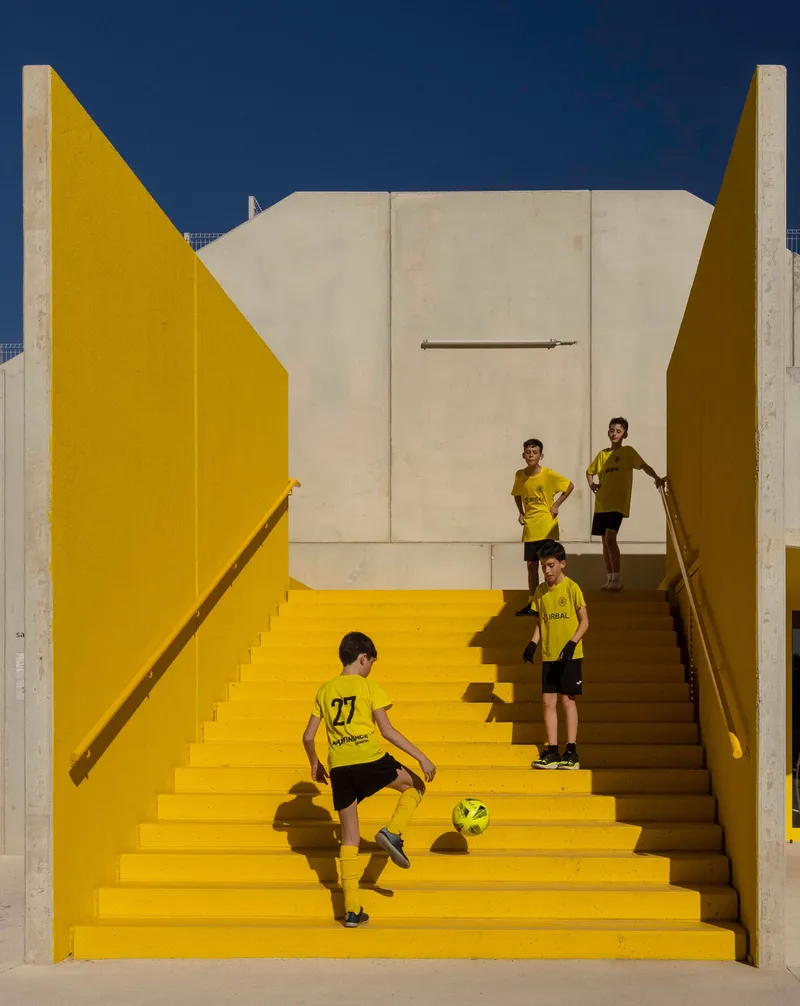

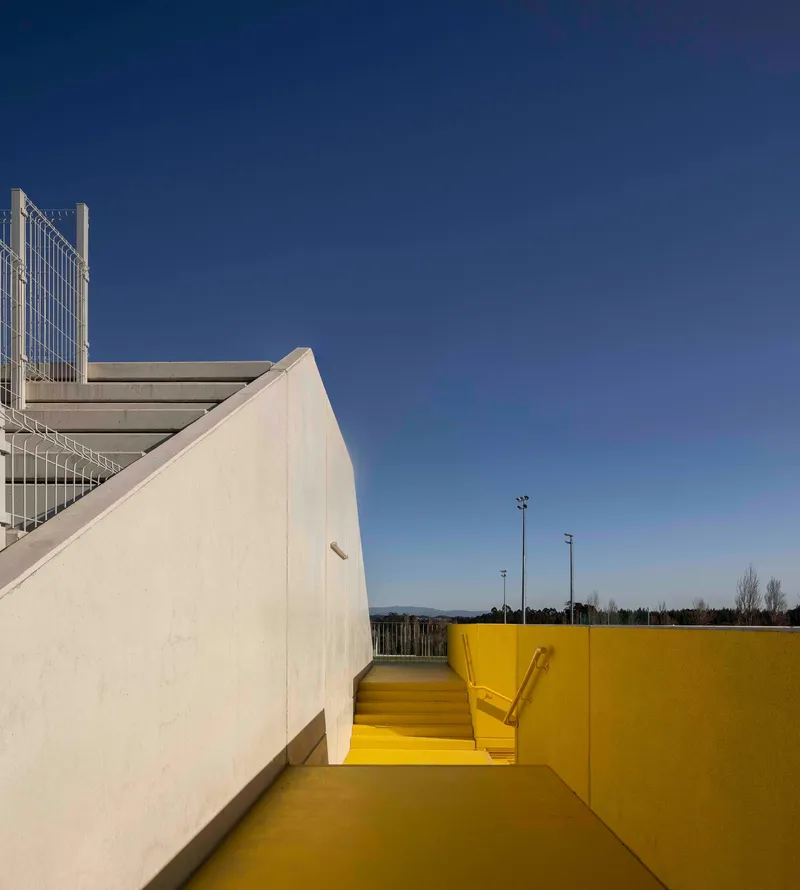
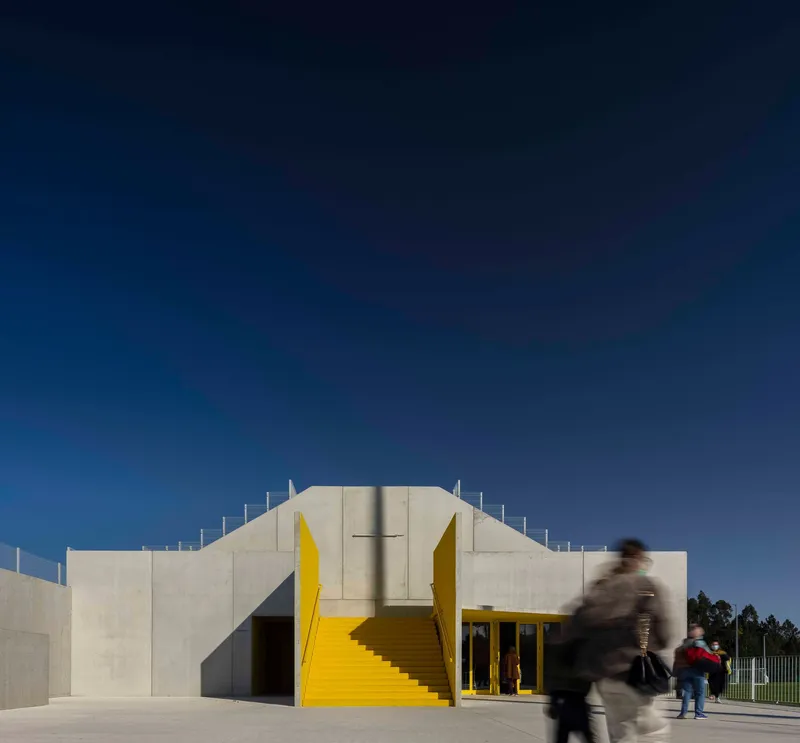
The color strategy is the most immediately legible design decision. Every public circulation element, staircases, handrails, entry portals, walkways, is painted the same saturated yellow. If it is yellow, you are allowed to be there. If it is raw concrete, you are likely in a service or restricted zone. This binary code eliminates the need for conventional signage and turns movement through the building into an intuitive act.
The yellow is not decorative; it is operational. It also happens to reference the team's colors, which grounds the palette in local identity rather than in an arbitrary branding exercise. Young players ascending and descending the central staircase become figures against a bold monochrome backdrop, and the effect is surprisingly cinematic for a training facility.
Thresholds and Passages


SUMMARY pays close attention to the moments of entry and transition. A yellow-framed portal punches through a concrete courtyard wall, casting sharp diagonal shadows that shift throughout the day. A board-formed retaining wall becomes an informal bench beside a stucco entry passage. Inside, a double-height corridor frames a yellow wire-glass window above a doorway, flooding the cast concrete interior with tinted light.
These thresholds enforce the project's strict separation between public and reserved areas without resorting to aggressive barriers. The architecture itself signals the boundary. A change in material, a shift in color, a narrowing of passage: these are the devices that sort crowds from athletes, spectators from staff. The separation feels spatial rather than bureaucratic.
Life on the Concrete Plinth


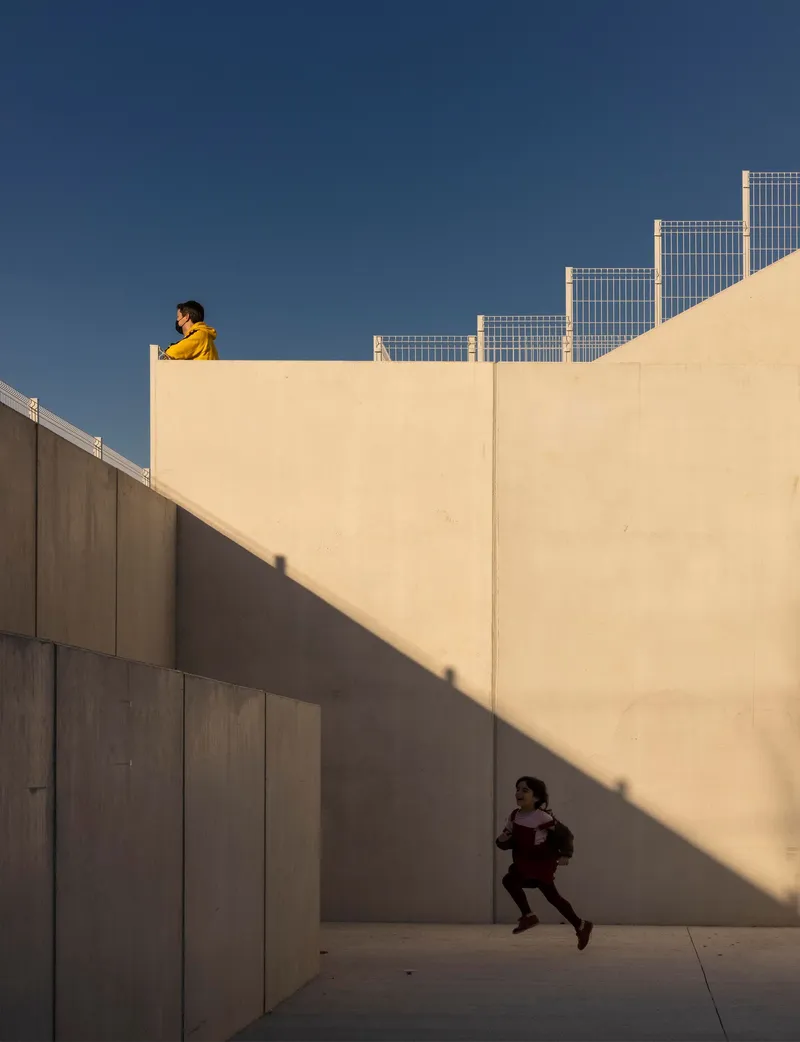
The building's upper level, the concrete plaza that doubles as a circulation spine, functions as a kind of elevated public ground. An aerial shot captures pedestrians casting long shadows across the surface, the yellow staircase bisecting the platform like a seam. At dusk, two figures cross an elevated walkway between white and yellow volumes, and the scene feels less like a sports facility and more like a small piece of city.
Children run across the sunlit pavement, figures lean on parapets, and the bar near the entrance anchors a zone of casual gathering. SUMMARY clearly designed the complex with the understanding that youth football training facilities are, in practice, community centers. Parents wait, siblings play, neighbors stop by. The configuration generates these situations deliberately, not as an afterthought.
Interior Circulation


Below the stands, a white corridor with fluorescent lighting and tiled ceiling runs the length of the building, connecting locker rooms and service areas. The space is deliberately plain: functional, easy to maintain, and clearly subordinate to the social spaces above. A figure with luggage walks toward the corridor terminus, reinforcing the building's identity as a place of arrival and departure for young athletes.
From the outside, the central yellow metal staircase reads as a vertical punctuation mark in the long concrete facade. Blurred figures at the entrance suggest the constant movement that the building is designed to process. The frontal view at dusk turns the staircase into a glowing beacon, its warm hue intensified against the cooling concrete and darkening sky.
Plans and Drawings
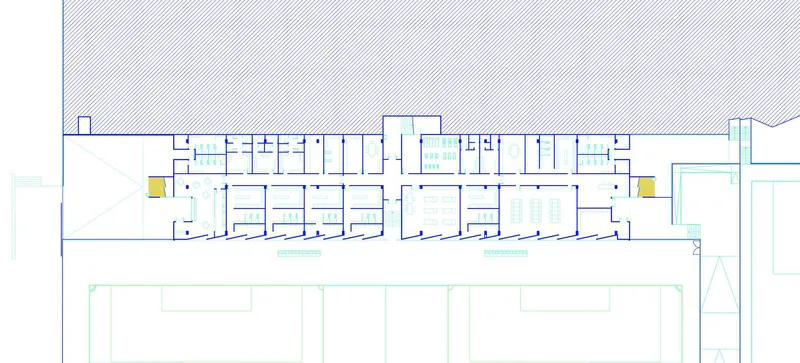
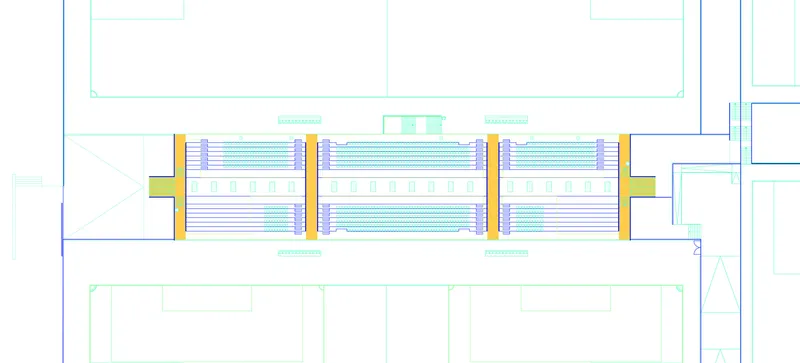
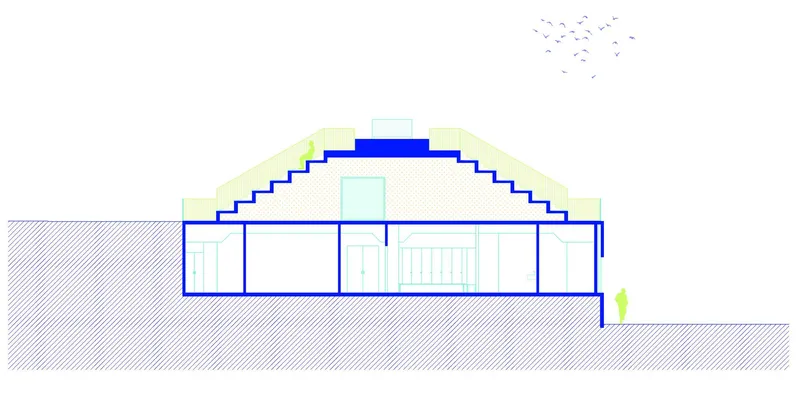

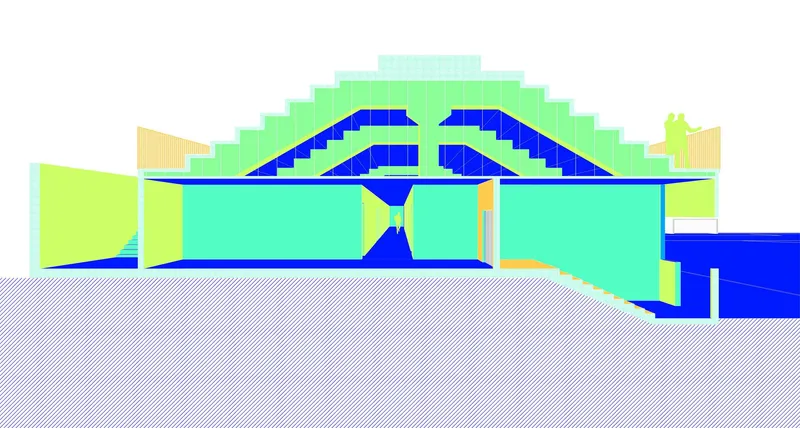


The floor plans confirm the bilateral logic: symmetrical rooms flank a central yellow circulation core, with locker rooms and service spaces organized in mirror arrangement beneath the two grandstands. The section drawing reveals the stepped seating profile beneath a gently curved roof, while the longitudinal section shows three connected pavilions with sawtooth roof monitors that bring daylight into the spaces below.
The axonometric drawings are particularly revealing. The elongated structure with parallel sawtooth roof monitors reads almost like a factory, which is fitting given the prefabrication logic that drove its construction. A detail axonometric illustrates how green-edged walkways intersect with the sports court markings below, showing the careful coordination between landscape, building, and playing surface. The color-coded elevation drawing distinguishes material zones, making the modular assembly strategy legible as a graphic system.
Why This Project Matters
The Aveiro grandstand complex matters because it demonstrates that prefabricated civic architecture does not have to look or feel disposable. SUMMARY took the constraints of a public budget and a tight construction timeline and turned them into a design methodology. The precast modules are honest about what they are, and the yellow wayfinding system transforms that honesty into legibility. The building does not try to be iconic; it tries to be useful, clear, and adaptable.
More broadly, the project reframes the youth sports facility as a piece of community infrastructure rather than a shed at the edge of a parking lot. By consolidating program, creating public space on its roof, and separating circulation through color rather than barriers, SUMMARY has produced something that functions as a small neighborhood institution. For a building type that is almost always treated as disposable, that ambition is rare and worth paying attention to.
Grandstand Building Training Complex of the Municipal Stadium in Aveiro, designed by SUMMARY, lead architect Samuel Gonçalves. Aveiro, Portugal. 1,500 m². Completed 2022. Photography by Fernando Guerra | FG+SG.
About the Studio
Share Your Own Work on uni.xyz
If projects like this are the kind of work you want to make, uni.xyz is a place to publish your own, find collaborators, and enter design competitions.


Popular Articles
Popular articles from the community


Manzana Morphosis: Stretching Barcelona's Grid into a Living Landscape for 2050
A radical reworking of the Eixample manzana turns density into a tool for generous public space, vertical ecology, and environmental performance.

Extended Shell: Retrofitting Kolkata's Balconies as Living Urban Thresholds
A modular retrofit system recovers the social and environmental intelligence of Kolkata's historic verandas for contemporary Park Street residents.

Faces of the Soviet Avant-Garde: Turning Moscow's Street Names into an Open-Air Museum
A network of sculptural installations across a Moscow residential district transforms forgotten architect names into spatial encounters with cultural memor

Opera on the Sea: Driftwood Logic Shapes a Timber Opera House on Estonia's Coast
Trevor Orgill's opera house translates the entangled drift of floating timber into a civic building where wood, water, and music converge.

Similar Reads
You might also enjoy these articles

Pixel Gardens: One Repeated Module Stacked Into a Terraced Social Housing Tower for Famagusta
Salem Bader's shortlisted housing tower builds a vertical neighbourhood from one repeated module, offsetting units to carve terraces, light and air.

Bao Huynh Watercolor Atelier: A Serene Art Retreat in Hội An
Bao Huynh Watercolor Atelier in Hội An blends multifunctional art spaces, sustainable design, local materials, and family-friendly living in a serene environment.

Atelier Macri Concept Store Interior Design by CASE-REAL
Atelier Macri store features a "ko" counter, walnut wood details, cork displays, blending retail, gallery, and seamless customer experiences.

Manuel Vargas Izquierdo Stadium and High-Performance Sports Center: Architectural Excellence in Jalpa de Méndez
The Manuel Vargas Izquierdo Stadium blends sustainable design, inclusive sports facilities, and cultural-inspired architecture, revitalizing Jalpa de Méndez’s public spaces.

Explore Stadium Competitions
Discover active competitions in this discipline

Challenge to design a barrier free sports center

Challenge to design an outdoor ice-rink and park
Comments (0)
Please login or sign up to add comments
No comments yet. Be the first to comment!