
Supergarten- The Kindergarten of tomorrow
IDEA BEHIND THE CONCEPT
Kindergartens just like schools of 21 century are facing difficulties how to keep up. The youngest amongst us in society were born in mass-media world overflowing with technologie and screens. We are loosing our connection to real life and to each other. Since nowadays children are given ipads or other devices at age of 2 or sometimes less we must unite them from technology and "teach" world without the "google" help. The kindergarten of tomorrow should focus on teaching methods like montessori or deutsch realschule and designer should help in that task with the building design.
The main goal of the design was to create a true place for growth of the human knowledge, since the beginning of life. Reinforce learning by knowledge with learning by doing. Also the important impact of the design was to emphasize the responsibility to know and to want to help the planet. By taking care not only about themselves, but also about every piece of the Earth.
THE FORM
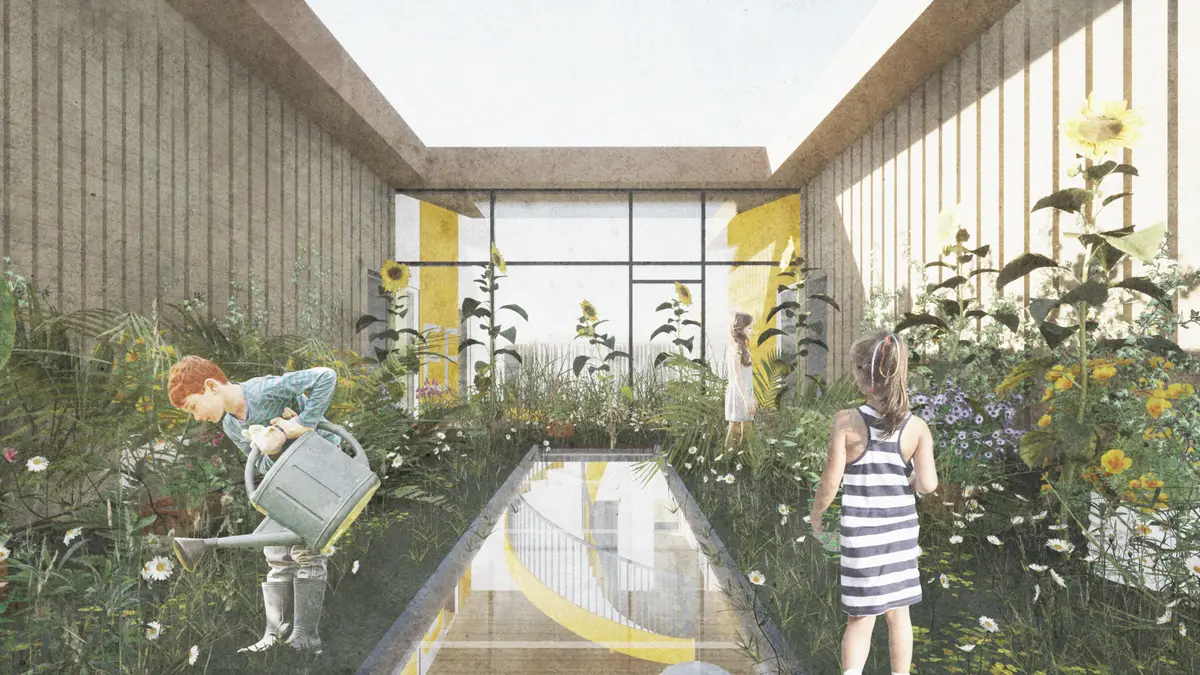
The form of the building emphasizes the connection to the landscape, but not directly. From the outside it's just a two stories rectangle building with straight fasades made out of wooden panels. But for anyone who uses the building or is it's guest this perspective changes from closed to connected. It's a trick of perception, made by a switch. Roof decreases reversed from the typical archetype- from outside to inside. Thanks to this concept rooms are more "open" to the surroundings and catch not only more light, especially from the south side, but also the view of the forest around the kindergarten (which is on the higher grounds). As a result children also get a solitarium- roof garden, disconnected from the sounds of the road or other classmates.
The Building itself is designed with 4 outdoor spaces on each side of the world. From the north- the delivery zone and staff entrance, from the east the welcome zone; west- the vegetables garden, and finally from the south the playground garden open to the forest.
THE CLASSES
All of the classes are independent structures that maintain safe care for all the children. They are equipped in toilets and cloakrooms. The youngest kids (2-3 years old) have at their disposal classes at ground level from the south side with direct connection to the playground and the vegetables garden. As for older children, all remaining classes (8) are situated on the 1st floor of the building. Each 4 classrooms have their own staircase and entrance to the roof garden. Spaces have module furniture which allow switching them depending on the purpose of the classes (ex. tables, nap beds etc.).
THE MULTI- PURPOSE SPACES (indoor)
Kindergarten has 4 multi-purpose zones ( main hall, room in front of the playground, dining room and roof garden) which can serve as an additional classrooms, auditoirum, mini theater or gathering place for meetings with parents.
THE GARDENS (outdoors)
The design proposes four types of vegetation:
1. The vegetables garden from the west side, which is directly attached to the dining room. It serves not only as an outdoor biology classroom for the youngest, but also teaches them how to take care of and use plants. It teaches biodiversity, but also shows since the first years the eco-friendly approach to upcoming global changes in the food economy.
2. The playground garden from the south side designed with variety of trees similar to eco-system in near forest
3. The trees hedge as a buffer between kindergarten and the road.
4. The roof garden shall act as a shelter to children and place to calm the nerves or just take a break from classes. But also it will function as an additional retention and water reservoir in the rainy periods.
MATERIALS AND COLOUR PALETTE
The structure of the building would be with wood and concrete (especially foundation, because of the ground levels difference). Thanks to the native soil from excavation we would be able to create "the small hills" which can be used as a part of the playground for fun and also help ease on the eyes the level difference, since kindergarten is located on the uneven grounds.
Facedes made from wood panels would cover totally the slope of the roof.
Interior design would embrace the earth's and mind-positive stimulating colours (like green or yellow) and materials. Concept envisions a constancy of character in accordance with a haptic approach to interior design. different textures and opposing colour palettes.

Popular Articles
Popular articles from the community

Opera by the Sea Estonia: Three Shells Dissolving Architecture into Tallinn's Coastline
A winning opera house proposal replaces monumental form with interconnected shells that blur the boundary between building, park and Baltic Sea.

Faces of the Soviet Avant-Garde: Turning Moscow's Street Names into an Open-Air Museum
A network of sculptural installations across a Moscow residential district transforms forgotten architect names into spatial encounters with cultural memor

The Amber Palace Opera: A Geological Fiction Surfaces on Tallinn's Baltic Waterfront
Pierre Brillard reimagines a Baltic legend as a public landscape, opera house, and waterfront promenade rooted in Tallinn's coastal identity.
Cloaked Colonization: A Mobile Underwater Habitat That Moves Like a Fish
Micah Abaya's shortlisted EHC Pacific entry reimagines ocean settlement as a dispersed network of self-sustaining architectural organisms.

Similar Reads
You might also enjoy these articles
The Rhythm of Seasons
A Farmers' Market Connecting Nature and the City

More Than a Building-Designing a Living System
More Than a Building-Designing a Living System
Base Beyond
DESERT COMPOUND ARID: TOURISM OF ABSENCE AND ABUNDANCE

Comments (0)
Please login or sign up to add comments
No comments yet. Be the first to comment!