

Studio Dali Architects Wraps an Agricultural Lab Around a Curved Courtyard in Yuhang's Rice Fields
A steel-and-timber hybrid workshop in rural China dissolves the boundary between research space and farmland through a spiraling inner courtyard.


Most buildings placed in agricultural land treat the landscape as backdrop. The Agronomy Workshop by Studio Dali Architects does something rarer: it treats the farm roads and field ridges already crossing its site as organizing forces, letting them shape the building's internal geometry. The result is a 555 square meter single-story research lab in Yuhang, China, whose orthogonal exterior obediently follows the building red line while its interior carves out a sinuous, arc-shaped courtyard that mirrors the organic paths running through the surrounding rice paddies.
Completed in 2022 for Shanxing Agricultural Technology, the project sits on an irregular 300 square meter plot bisected by a small farm road and bordered by a pond. Lead architect Ye Li, working with design team member Peng Sun, chose not to regularize the site but to absorb its contradictions. The building wraps, spirals, and opens, producing a semi-public space that functions as a research facility, a farmers' rest stop during harvest season, and a venue for cultural markets during holidays. It is an argument that agricultural architecture does not need to look utilitarian, and that rural public space does not need to wait for urbanization.
Sitting Low in the Paddy
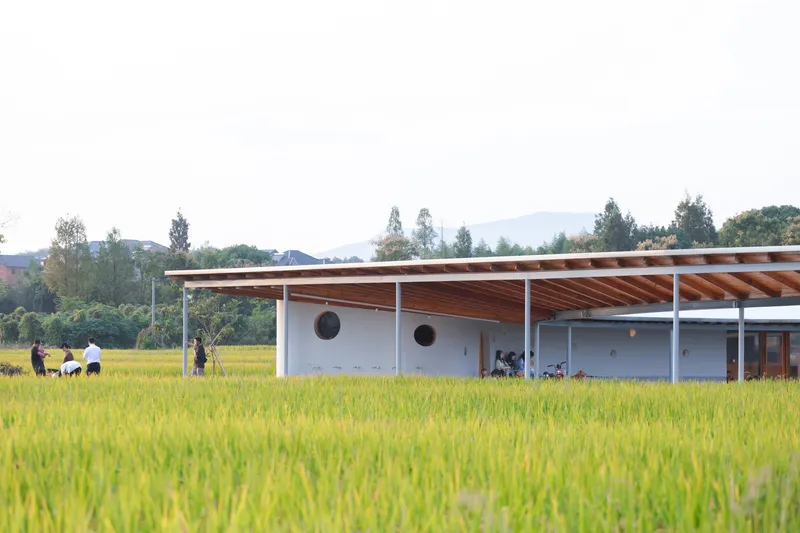

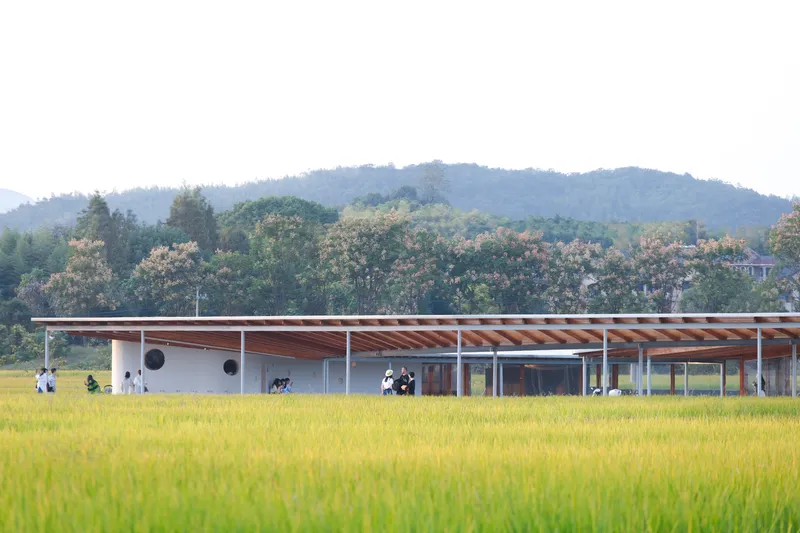
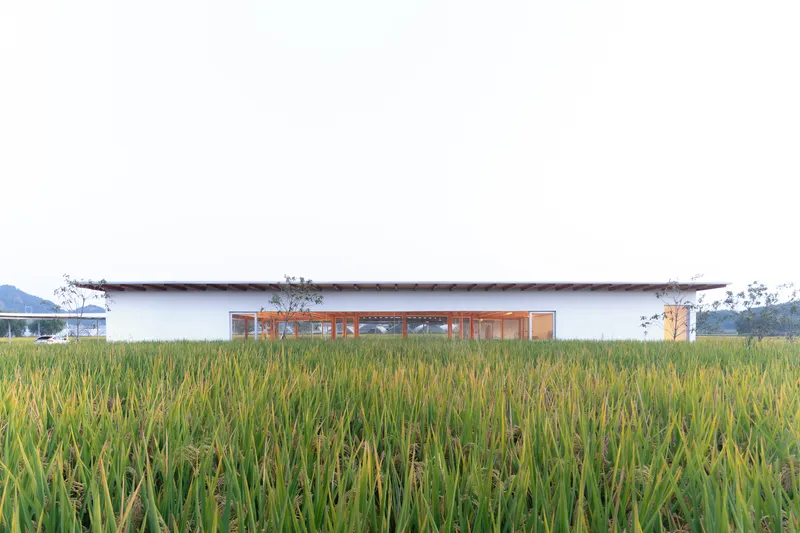
From any distance, the workshop reads as a thin horizontal line. The building's single-story volume and broad overhanging roof keep its profile below the tree line, so the surrounding rice fields remain the dominant visual element. Seen across golden paddies at dusk or through morning mist, the pavilion almost disappears into its context. This is deliberate restraint: the architecture never competes with the landscape, instead anchoring itself as a calm datum against the shifting textures of ripening grain.
The distant views also reveal the project's strategy with overhead infrastructure. Power lines cross the site, and rather than pretending they do not exist, the low profile lets these elements pass above the roofline without collision. It is a pragmatic acknowledgment that rural China is not a pastoral fantasy but a working landscape with its own logistical realities.
The Curved Courtyard as Spatial Engine
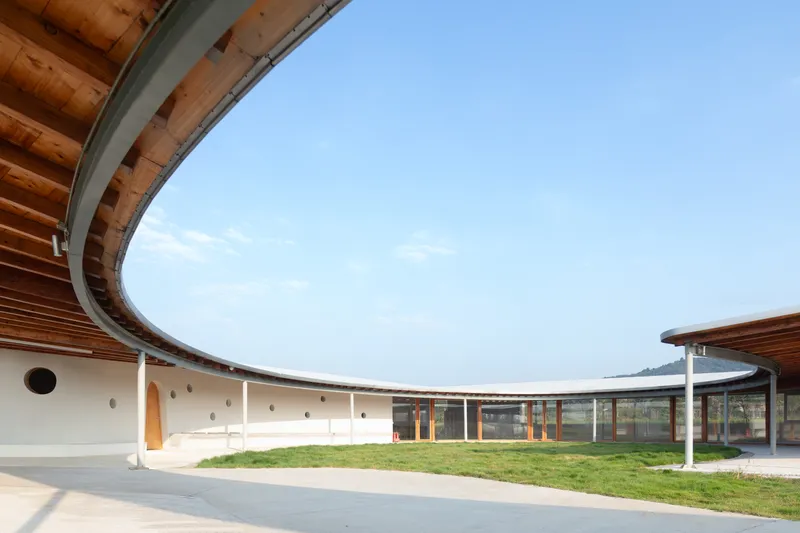
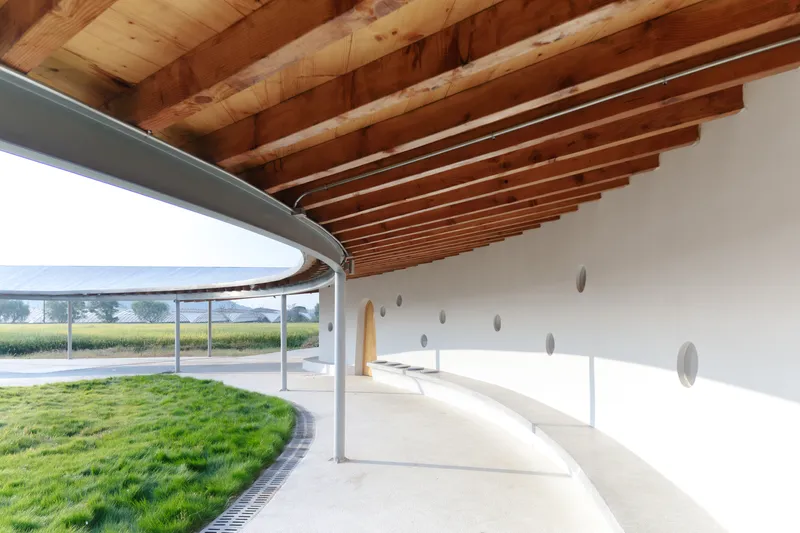
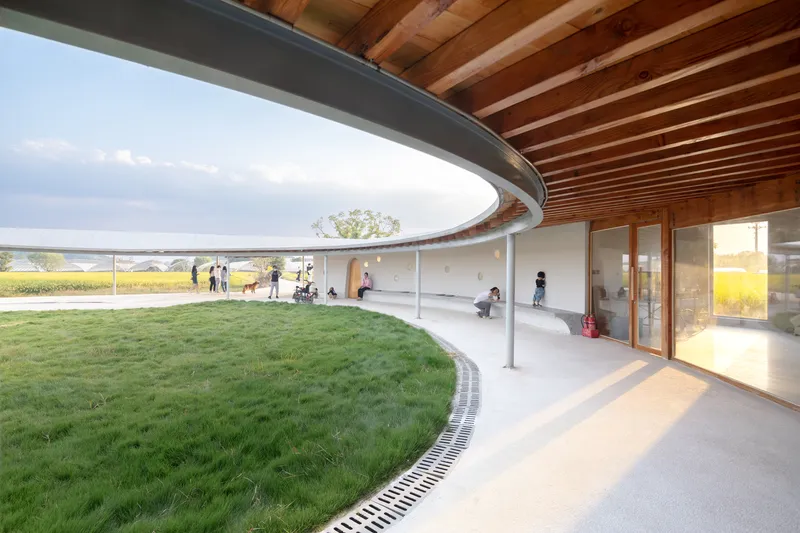
The most consequential design decision is the semi-open spiral courtyard at the building's center. Where the exterior walls form right angles to comply with the site boundary, the interior walls peel away in smooth curves, generating a grass-filled void that pulls natural light and air deep into the plan. The courtyard is not a symmetrical circle but a slightly spiraling form, its edges defined by the inward-curving arcs that echo the field paths outside.
Walking the covered corridor around this courtyard produces a continuously shifting perspective. The curved timber soffit overhead narrows and widens, the view alternates between enclosed passage and open sky, and the grassed surface in the center acts as a soft datum that orients the visitor without signage. A narrow drainage channel rings the lawn, a small detail that doubles as a visual threshold between inside and outside, marking the transition without blocking it.
Steel Spine, Timber Skin
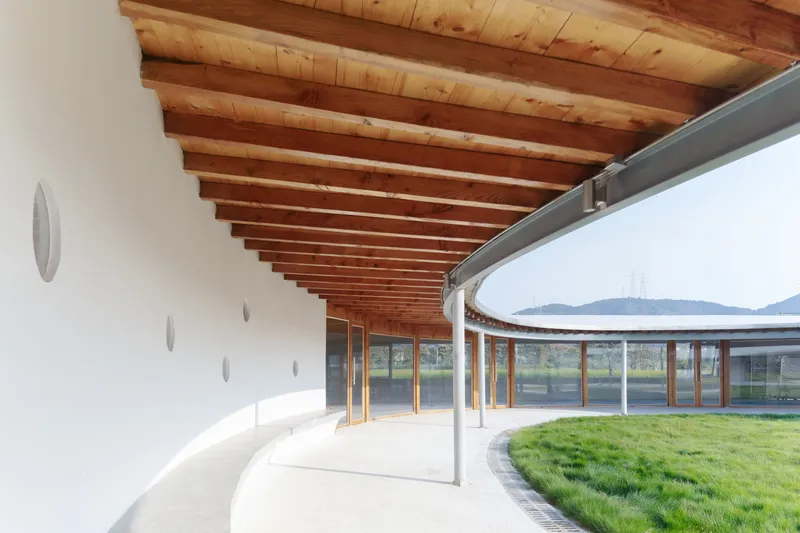
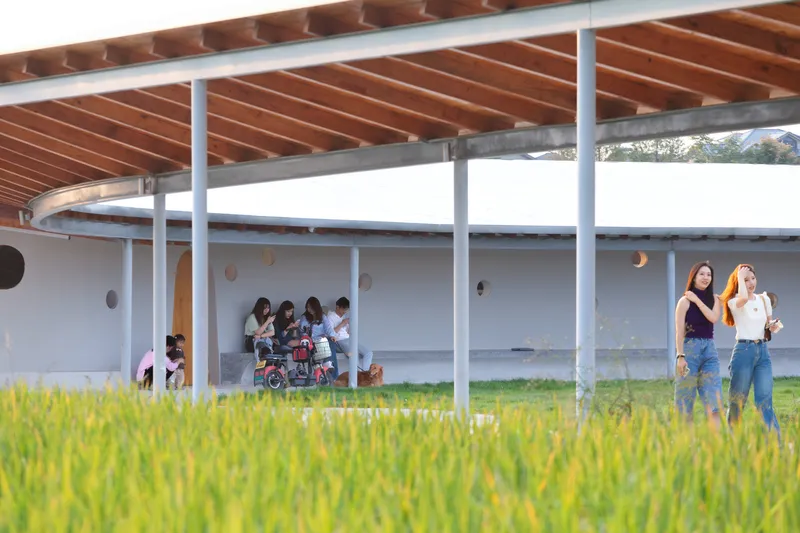
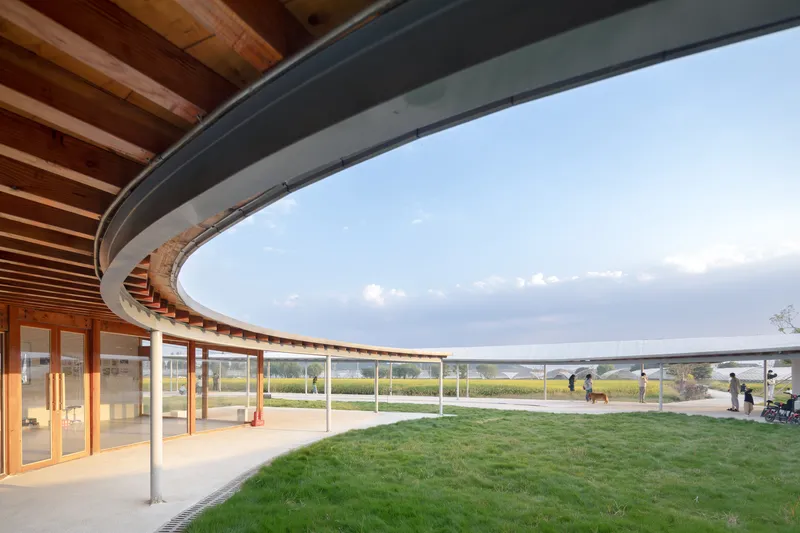
The hybrid steel-wood structure is the technical backbone of the project. Steel beams carry the irregular curved portions of the roof where timber alone could not follow the geometry without excessive depth. Wooden rafters then take over in the straighter segments, joined together to form the inward-sloping ceiling surfaces that give the covered walkways their distinctive profile. The largest rafters span nine meters, their cross-sections varying along their length as structural calculations demand, so material is placed only where forces require it.
Slender steel columns line the corridor edges, and at dusk the interplay between warm timber overhead and cool metal below becomes especially legible. The columns are thin enough to avoid interrupting sightlines toward the fields, while the exposed rafters overhead give the ceiling a directional rhythm that pulls movement along the walkway. Insulation is embedded within the structural layer rather than applied as an additional finish, which allows the rafter height in the inner corridor to be reduced to a uniform 200mm. The ceiling stays close and intimate without sacrificing thermal performance.
Framing the Fields
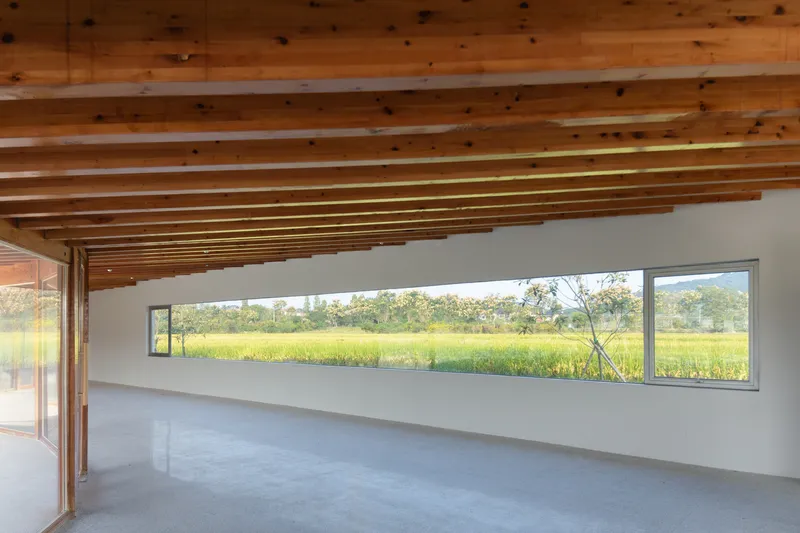
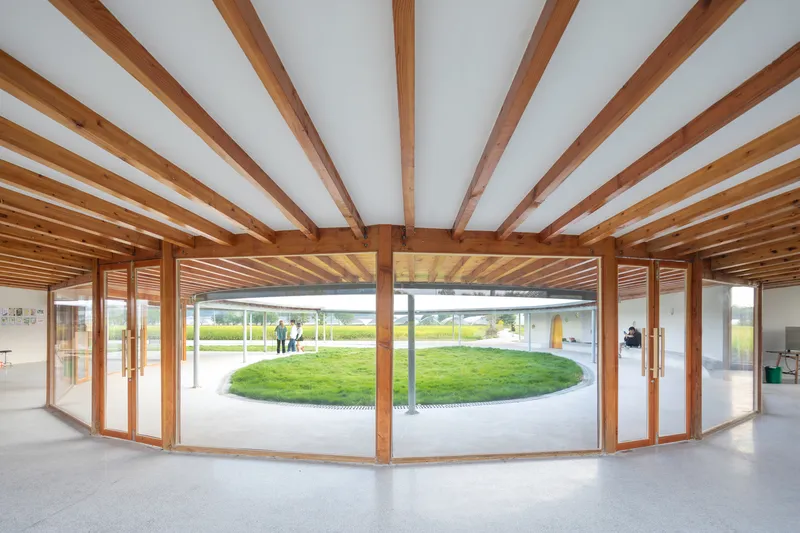
The glazing strategy is calibrated to specific views. Interior gallery spaces feature long horizontal windows that frame the rice paddies like landscape paintings, the exposed timber ceiling pressing the eye outward toward the golden stalks. From the courtyard side, full-height glass panels dissolve the wall between the circulation corridor and the central lawn, so that the two green surfaces, courtyard grass and distant paddy, read as a continuous ground plane at different scales.
Continuous glazing along the outer edge of the pavilion transforms the building into a lantern at dusk, its warm interior glow advertising its presence as a communal gathering point without any need for signage. Viewed through the rice stalks, the illuminated pavilion looks almost weightless, the flat roof hovering above the transparent walls.
Community Use Beyond the Brief
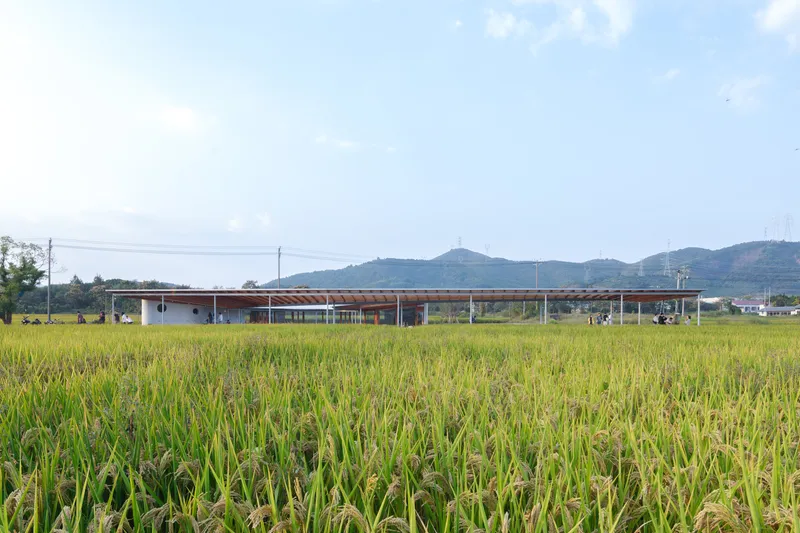
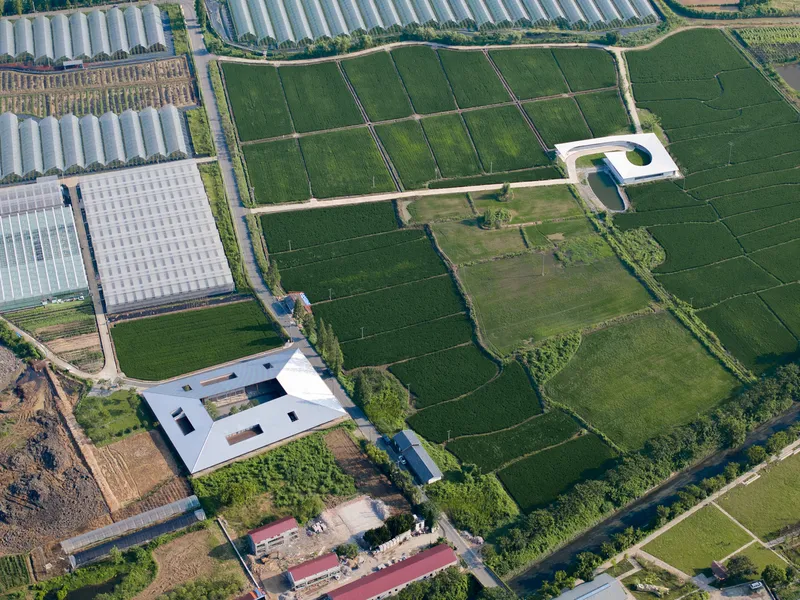
Commissioned as a research laboratory, the building has quietly expanded its role. During harvest, the sheltered walkways and semi-open spaces beneath the overhanging roof serve as rest areas for field workers. During holidays and festivals, the courtyard becomes a venue for cultural markets. The architecture accommodates these unscripted uses because its spatial organization is generous and non-prescriptive: covered outdoor space, open courtyard, and enclosed rooms offer a gradient of shelter rather than a sequence of locked doors.
The aerial view confirms the building's relationship to its surroundings. The white rectangular roof with its carved-out central void sits within a patchwork of green and gold fields, the pond to one side, the farm road still visible as it passes through the site. The building does not block the road; it incorporates it. That gesture, small in plan but significant in principle, is what separates this project from the standard approach of clearing a site and starting from zero.
Plans and Drawings
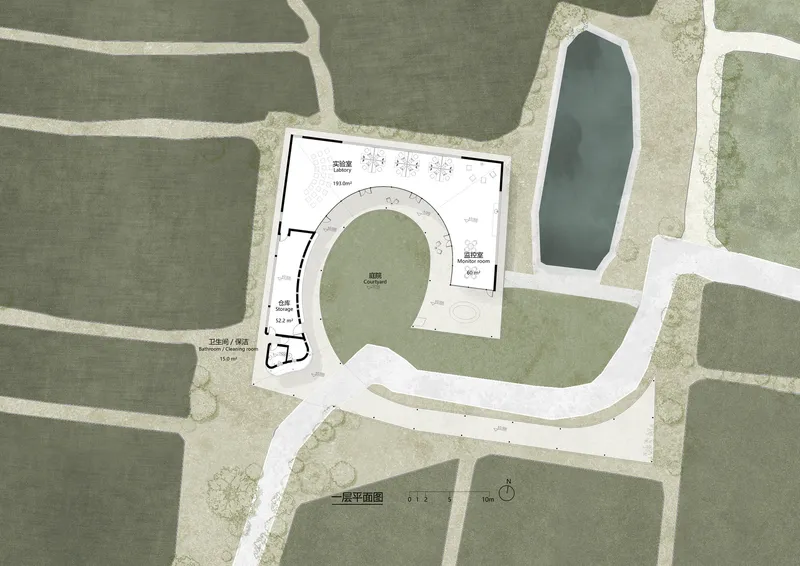
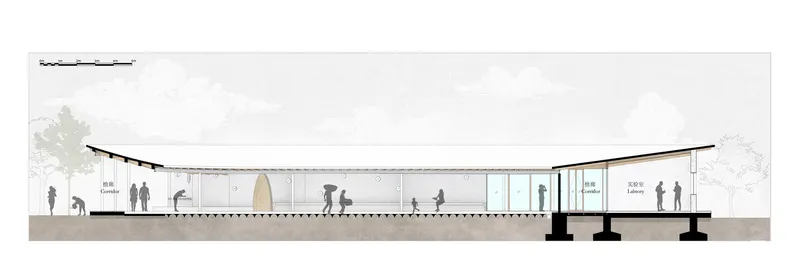
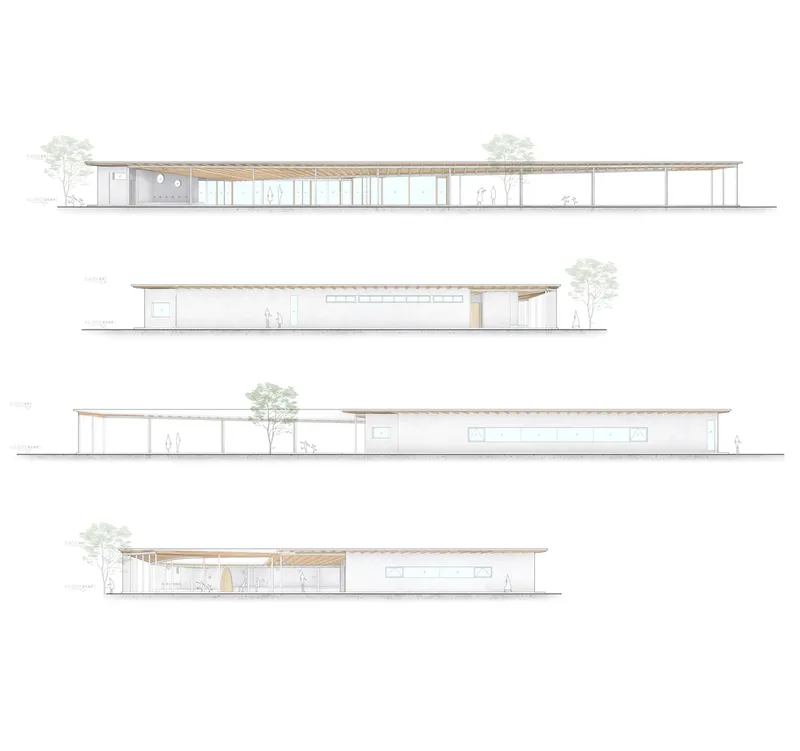
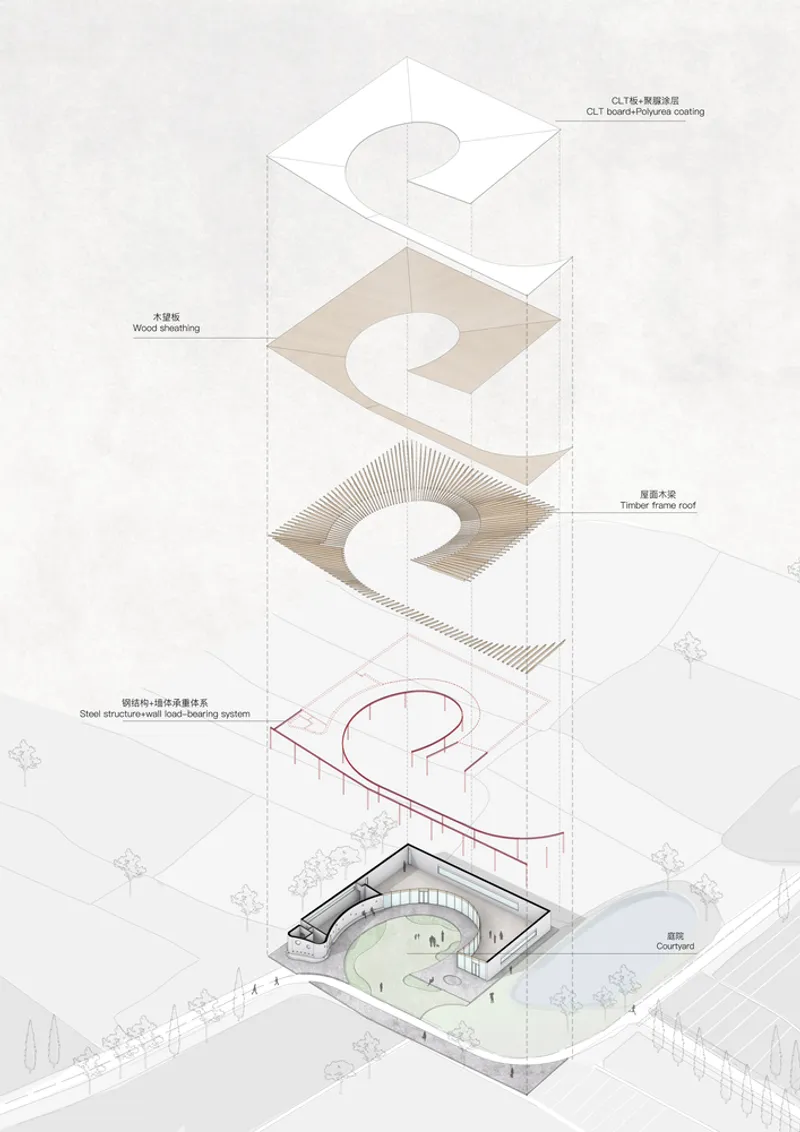
The site plan makes the design logic immediately legible. The curved courtyard void sits asymmetrically within the rectangular footprint, creating varying depths of interior space around its perimeter. Wider zones accommodate the lab and gallery functions; narrower zones become circulation. The section drawing reveals the roof's gentle curvature and the tight integration of structure and insulation, while the four elevations confirm just how low the building sits, its roofline barely rising above a human figure. The exploded axonometric is the most instructive drawing, peeling apart the layered roof construction to show how the curved central void is carved from an otherwise straightforward rectangular volume, with surrounding trees drawn in to emphasize the building's absorption into its landscape.
Why This Project Matters
The Agronomy Workshop demonstrates that agricultural architecture can be spatially ambitious without being formally aggressive. By accepting the site's irregularities, its bisecting roads, its field ridges, its adjacency to a pond, and folding them into the building's internal logic, Studio Dali Architects produced a structure that belongs to its place in a way that a clean-sheet design never could. The hybrid steel-wood structure is genuinely efficient rather than performatively green, and the decision to embed insulation within the structural depth rather than adding bulk is the kind of detail that separates considered sustainability from branding.
Perhaps most importantly, the project resists the temptation to over-program rural public space. The semi-open courtyard and covered walkways work for research, for rest, and for community gathering without needing to be reconfigured. That adaptability is not the result of flexible partitions or movable furniture; it comes from getting the proportions, the shelter gradient, and the relationship to the ground right in the first place. In a landscape where agricultural buildings are typically afterthoughts, the Agronomy Workshop makes a quiet case that they deserve the same spatial intelligence as any urban institution.
Agronomy Workshop by Studio Dali Architects (Lead Architect: Ye Li; Design Team: Peng Sun). Yuhang, China. 555 m². Completed 2022. Structural Engineering: LuAnLu Partner Structure Consulting.
About the Studio
Share Your Own Work on uni.xyz
If projects like this are the kind of work you want to make, uni.xyz is a place to publish your own, find collaborators, and enter design competitions.




Popular Articles
Popular articles from the community


Co-life: Sustainable Architecture for Age-Friendly Community Living
Co-life reimagines sustainable architecture for seniors through courtyards, rammed earth, shared gardens, and spaces designed for belonging.

AL-JANNAH: Sustainable Architecture and Permaculture for Afghan Widows
AL-JANNAH uses sustainable architecture and permaculture to create resilient oasis of housing, learning, work and renewal for Afghan widows.

Co-Life: Senior Housing Design That Reconnects Older Adults With the City
Co-Life reimagines senior housing design through healing gardens, shared streets, workshops, and a sustainable community across generations.

The Ocean Hive: Sustainable Architecture for a Self-Sufficient Civilization at Sea
The Ocean Hive imagines sustainable architecture at sea, where modular habitats, algae, wave power and ocean waste sustain a growing colony.

Similar Reads
You might also enjoy these articles

Bamboo Housing Challenge 2026: Design Affordable, Sustainable Homes Using Bamboo
An international design competition by Bamboo U and IBUKU inviting architects and designers to reimagine affordable housing using bamboo — with the winning design built full-scale in Bali.

Computational Design & Education: Beegraphy Design Awards Introduces 7th Category (Featuring Jiyun's Innovative Approach)
Dive into Beegraphy’s 7th Design Awards category, where computational design meets education to create immersive, interactive learning tools, inspired by Jiyun’s work.

From Parametric Lighting to Urban Furniture: Join the 2nd Workshop in Beegraphy’s Computational Design Series
Dive into Cutting-Edge Design Techniques and Practical Applications with Industry Experts

Last Call: Unleash Your Architectural Genius in SHAK's Kindergarten Design Competition
Urgent call for architects to join SHAK's kindergarten design competition before the looming deadline


Explore Green Architecture Competitions
Discover active competitions in this discipline



Challenge to reimagine the Iron Throne


Photograph architecture without architects


Illustrate the lost glory of Angkor Wat - Render Challenge


Design challenge to reuse E-waste
Comments (0)
Please login or sign up to add comments
No comments yet. Be the first to comment!