

Moon of Koh Phangan Airport: A Curved Terminal That Treats Departure as Public Space
A crescent roof traces a Koh Phangan promontory, threading check-in, security and boarding through gardens and timber columns into a place to linger.


Most airports are built to be left behind. Moon of Koh Phangan Airport argues the opposite: a terminal can be somewhere you want to stay. The proposal bends a single sweeping roof along the edge of a promontory and gathers the machinery of flight beneath it. Check-in, security, boarding and arrivals sit under that roof alongside gardens, cafés and open seating. The result reads less like a processing plant and more like a covered landscape that happens to have aircraft parked along one side.
Designed by Max Campi and Giuseppe D'Albenzio of Giuseppe D'Albenzio Architects, the project was shortlisted in the First Window competition. The site is a promontory on Koh Phangan, overlooking dense vegetation and an open coastal horizon. The designers treat that setting as the brief's real constraint. The terminal is meant to serve the island's residents as much as its visitors, and it is pitched as a destination and civic landmark rather than a transient node.
A Single Curve Drawn Across the Promontory
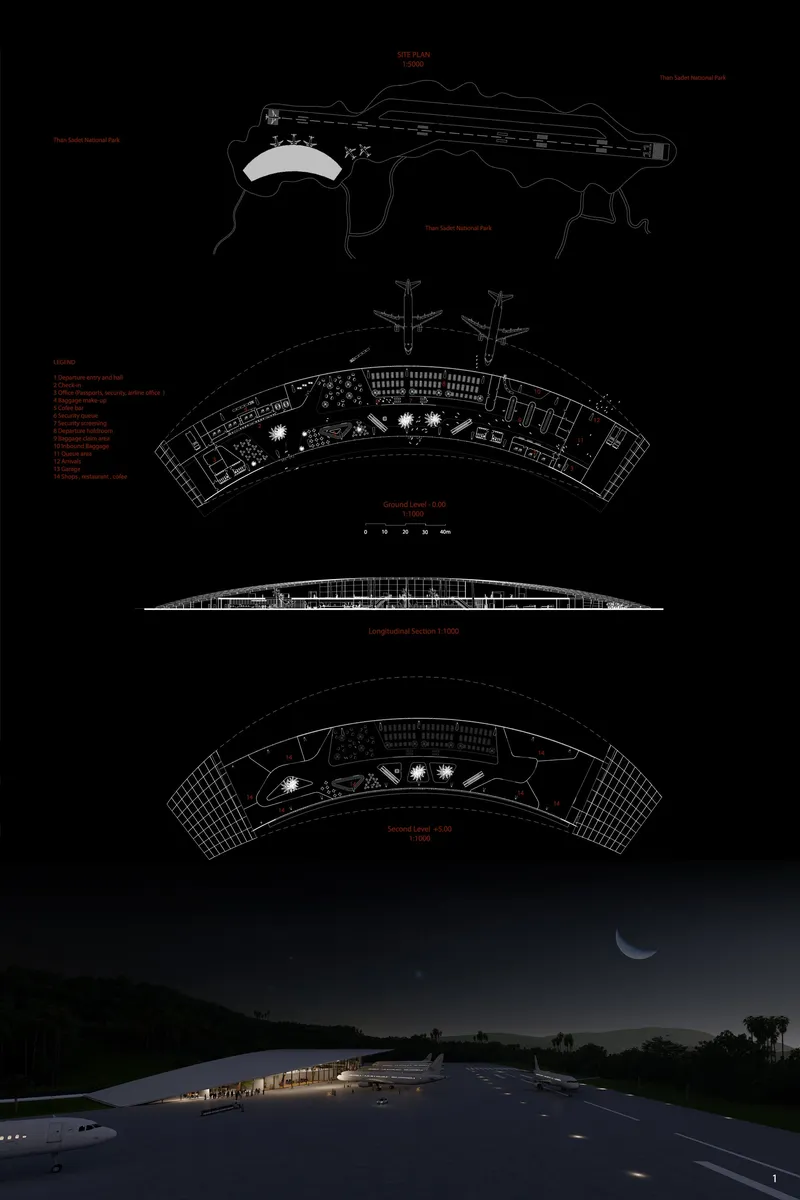
The presentation board makes the organising idea legible at a glance. In the site plan, two floor plans and longitudinal section, the terminal appears as one continuous arc rather than a cluster of sheds and piers. The section shows a building that stays low and follows the ground, consistent with the designers' stated aim of tracking the curvature of the landscape so the topography is disturbed as little as possible. The night render below, with a crescent moon hanging over the glowing roofline, gives the project its name and its mood. It quietly makes the case that an airport can have an atmosphere, not just a capacity figure.
A White Canopy That Works as a Climate Device
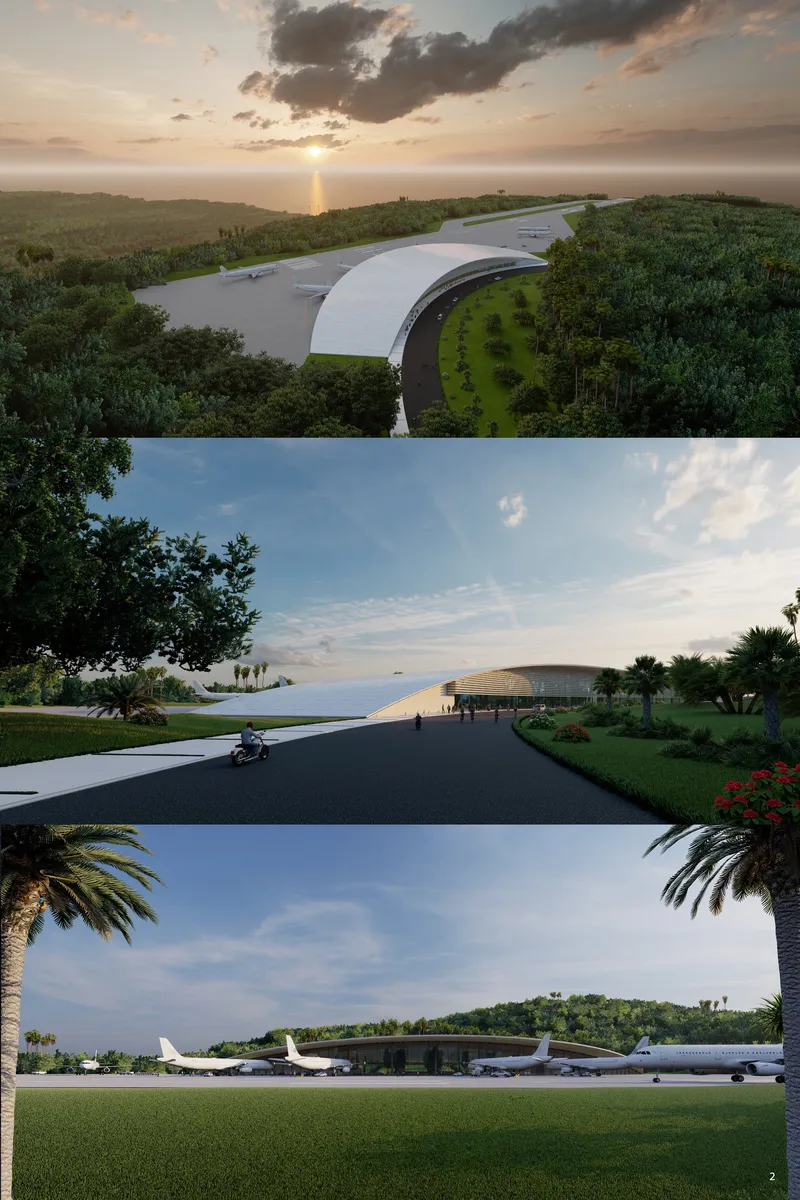
Seen from above at sunset, along the approach road and across the apron, the curved white roof does most of the architectural work. The designers describe it as both a protective canopy and a climatic mediator: it cuts solar heat gain on a tropical island while letting filtered daylight into the halls below. That double role is the project's strongest sustainability move, because it is structural rather than applied. The roof is not a surface waiting for panels; its shape, overhang and shading are themselves the passive strategy, working alongside natural ventilation and daylight optimisation to push the building toward the energy self-sufficiency the designers set as a goal.
Timber Columns, Indoor Palms and the Calm Hall
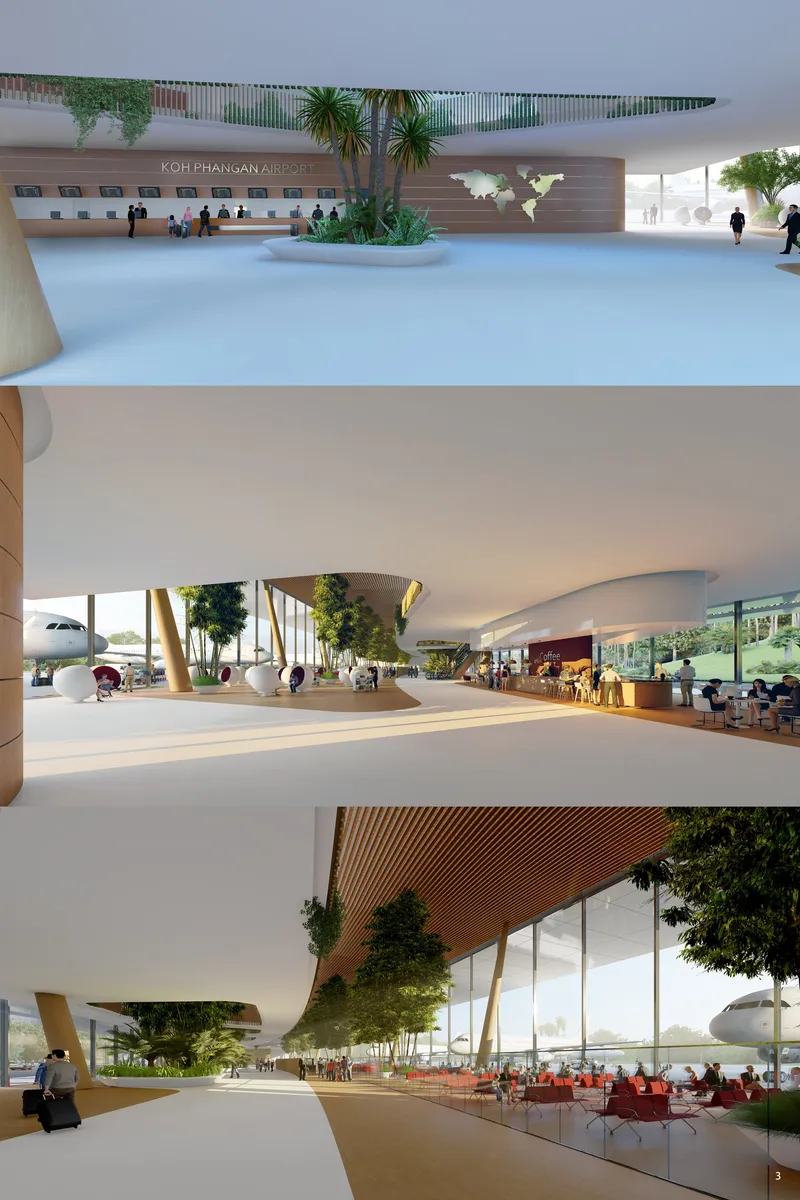
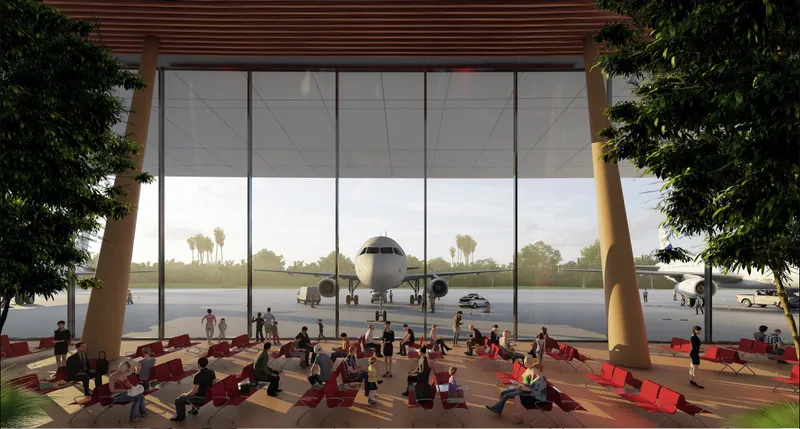
Inside, the palette narrows to wood, steel and glass, chosen for tactility, durability and recyclability. The interior renders show a check-in hall with few partitions, long sightlines and a glazed wall that keeps parked aircraft constantly in view. That visibility does the job signage usually does: passengers can read where they are headed before they read a sign. The designers say advanced systems run discreetly in the background, and the renders bear this out; screens and hardware are kept out of the frame so the space feels unhurried.
The departure lounge is the most persuasive image of the set. Rows of red seats face the glass and the aircraft beyond, framed by tilted timber columns that read almost like tree trunks, with real trees planted among them. Vegetation is meant to penetrate the envelope and create microclimates that improve thermal comfort. Here it also softens the most anxious moment of any trip, the wait at the gate, into something closer to sitting in a shaded grove.
A Glazed Edge Between Garden and Apron
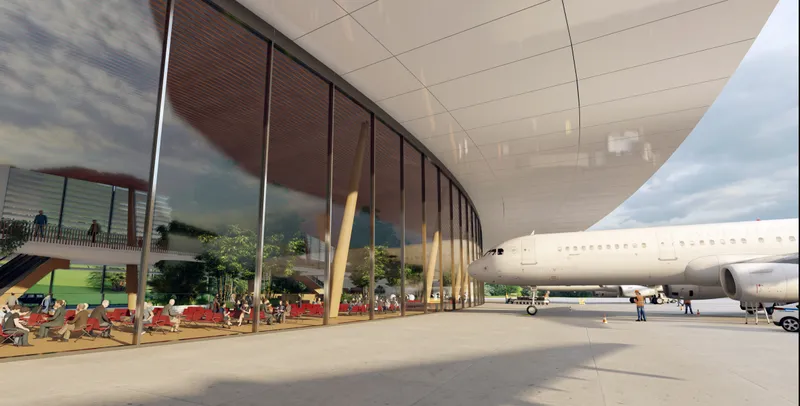
The low view along the terminal's glazed edge captures the hinge of the whole scheme. The curved white soffit sweeps overhead, the glass reflects the sky, and an airliner waits on the apron a few metres away. Many terminals build a thick buffer between passengers and aircraft. This one keeps the boundary thin and transparent, so the apron reads as part of the view rather than a back-of-house yard. The open question, which a later design stage would need to answer, is how that glass performs against tropical sun and apron noise. The roof's deep overhang is clearly the first line of defence.
A Linear Sequence Threaded With Social Space
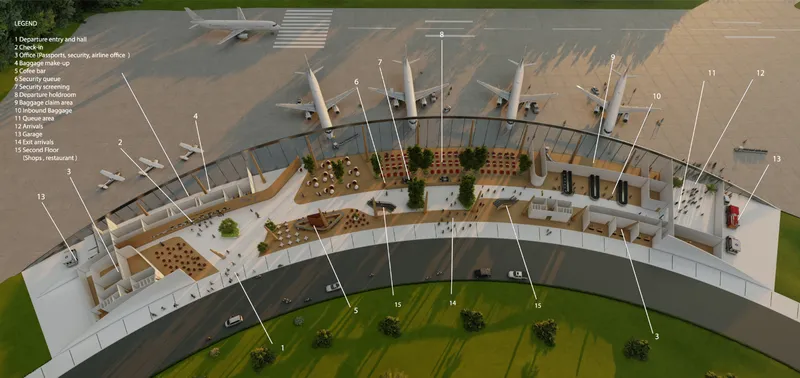
The aerial cutaway shows the operational logic underneath the softness. A numbered legend sets check-in, security, departure holdroom and arrivals in a clear linear sequence behind the curved roof edge, with aircraft lined up along the airside face. That linearity is what makes the rest possible. Because passenger flow is simple and readable, the designers can weave cafés, retail, gardens and open seating between the functional zones without creating confusion. The scheme's ambition of a contemporary agora, a place to work, meet or simply linger beyond flight-related activity, rests on this plain and disciplined plan.
Why This Project Matters
Moon of Koh Phangan Airport gets the order of priorities right. Instead of starting with throughput and decorating later, it starts with the promontory, the climate and the passenger's state of mind, then shows that a straightforward linear plan can serve all three. The roof as climate device, the landscape treated as primary architecture and the restrained material palette add up to a coherent position rather than a list of green features.
Its more provocative claim is social. By opening the terminal to the local community and filling it with places to pause, Campi and D'Albenzio question why airports should be spaces of anxiety and control at all. On a small island, where an airport is often the largest public building, that question carries real weight. The proposal leaves technical detail for later stages, but as a shortlisted competition entry it offers a clear and memorable model: infrastructure that behaves like a public room under a crescent of shade.
View the Full Project
About the Designers
Designers: Max Campi, Giuseppe D'Albenzio
Enter a Design Competition on uni.xyz
uni.xyz runs architecture and design competitions year-round that reward proposals with spatial conviction and real site intelligence.
Project credits: Moon of Koh Phangan by Max Campi, Giuseppe D'Albenzio.


Popular Articles
Popular articles from the community


Juan García Correa, John González and Claudia Rueda Sink a Circular Amphitheater into a Manizales Engineering Building
On the La Nubia campus in Manizales, Colombia, the S1 Building folds labs and offices into a hillside of ramped lawns that double as a campus route.

David Ortega Stacks a Two-Story Mexico City Penthouse Around a Steel Stair and a Pergola-Shaded Roof Terrace
In Colonia Roma, a 300 m² penthouse uses oak joinery, a planted steel stair and a slatted roof pergola to make a new-build apartment feel like a house.

GROUP A Strips a 1969 Rotterdam Harbor Headquarters to Its Frame and Wraps It in Timber Louvers
In Rotterdam's M4H harbor district, Ferro Offices reuses a 1969 frame, adds one timber storey and reaches BREEAM-NL Outstanding.

Cube Design Draws an Ecological Corridor Between Two Shenzhen Hills with the Nankai Building
Beside Shenzhen's container docks, the Nankai Building pairs stacked balconies with a climbing green screen to connect two hillsides across its height.

Similar Reads
You might also enjoy these articles
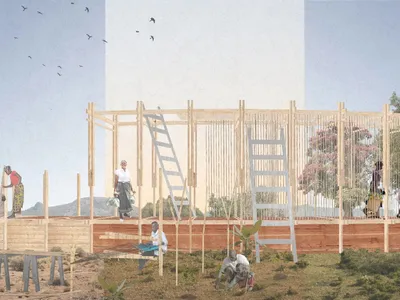
Healing Façade: A Modular Chapel System That Restores Ethiopia's Sacred Forests
Winner of the Eco-Chapel competition, this circular timber façade collects water from air to rebuild soil and reforest degraded Ethiopian landscapes.
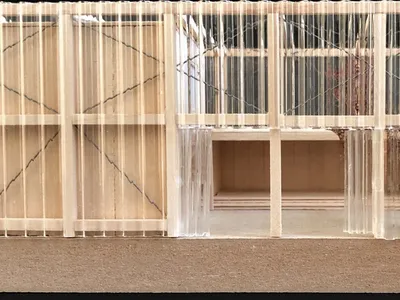
Kaffeebühnen: Where Coffee Shop Architecture Becomes a Civic Stage in Vienna
A linear sequence of timber boxes, transparent shells, and open yards turns the Viennese café tradition into a public performance space.
Eco Chapel: A Modular Forest Pavilion That Grows Like the Landscape It Protects
Hexagonal timber modules weave through existing trees, turning a chapel into a living system for prayer, education, and reforestation.


Urban Forest: A Vertical Ecosystem for 5,000 Workers in Singapore's Changi Business Park
Radially stacked pods and layered green decks turn a 7-acre plot into 47 acres of ecological workspace projected for 2040.

Comments (0)
Please login or sign up to add comments
No comments yet. Be the first to comment!