

Snowflake: Biomimetic Urban Planning for the Arctic Frontier
A radial settlement inspired by snowflake geometry deploys monorail transit, polygonal housing, and a botanical Snow Garden in extreme cold.


What happens when you zoom into the crystalline geometry of a snowflake and scale it up to the size of a settlement? You get a radial urban plan that treats the harshest climate on Earth not as a problem to overcome but as a pattern to learn from. The Snowflake Project takes the six-fold symmetry of ice crystals and translates it into a spatial framework for Arctic habitation, where every arm of the plan disperses heat and CO2 emissions outward while pulling community life toward a shared center.
Designed by Anna Bormotova, the project was shortlisted in the EHC - Arctic competition. The brief called for speculative yet grounded proposals for sustainable living in polar environments, and Bormotova responded with a biomimetic masterplan that integrates monorail transit, energy-efficient polygonal housing, and a central botanical greenhouse into a single coherent organism. It is a proposition that refuses to treat Arctic urbanization as an exercise in mere survival.
Elevated Transit Tubes Winding Through Illuminated Domes

The monorail system is the circulatory network of the entire settlement. Streamlined pods glide through enclosed transit tubes that follow what Bormotova calls the "tunnel principle," distributing structural load along an aerodynamic profile while shielding passengers from Arctic wind and cold. The tubes connect the settlement's radial arms, and at night the illuminated dome structures beneath them glow like cells in a living tissue. Electric mini-vehicles supplement the monorail for last-mile mobility, keeping the carbon footprint low and the connectivity high.
The Snow Garden: A Botanical Core Under Glass
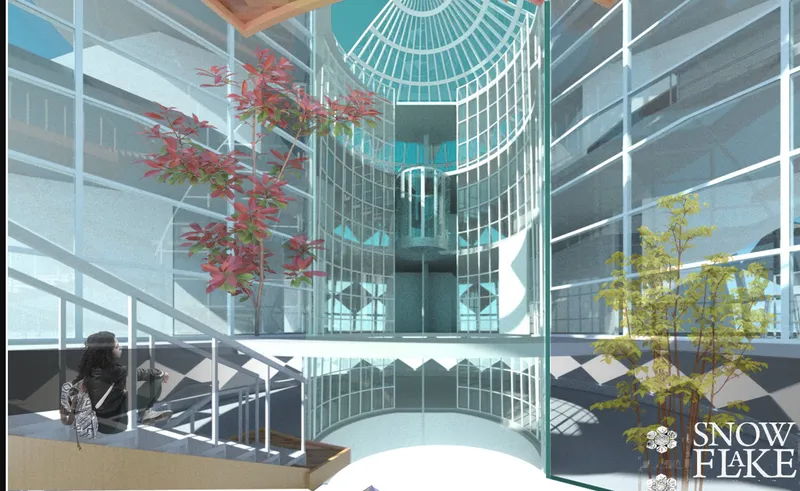

At the heart of the radial plan sits the Snow Garden, a central public hub that combines a botanical greenhouse, an amphitheater, and wellness spaces under one enclosure. The interior atrium, visible in the rendering, features a glass curtain wall rising over a circular pool flanked by deciduous trees in full autumn and spring foliage. It is a deliberate inversion: outside, the landscape is frozen and monochromatic; inside, seasonal color cycles remind residents of temperate life. The space doubles as a social condenser, pulling the community inward to gather, perform, and rest.
The accompanying presentation board lays out the spatial logic more clinically. Floor plans, sections, and axonometric views reveal teardrop-shaped glazed volumes arranged around the central core. Each volume appears to serve a distinct programmatic function while sharing a continuous thermal envelope, which is critical for energy conservation at polar latitudes.
Layered Construction: Unpacking the ZOM Housing Units

The exploded axonometric drawing dissects the building anatomy layer by layer: a latticed roof structure sits atop stacked floor plates, all organized around a central circular core that likely handles vertical circulation and services. The ZOM housing units use a polygonal geometry that maximizes surface-to-volume ratios favorable for heat retention, while special insulation materials allow the envelope to withstand extreme Arctic temperatures without demanding excessive energy input. The drawing makes visible what the renderings romanticize: a clear, buildable logic beneath the biomimetic metaphor.
Life Under the Grid: Interior Public Space and Aerial Mobility


Beneath a gridded glass roof, pedestrians walk alongside a linear water feature while transport vehicles pass overhead. The interior perspective suggests a public concourse scaled generously enough to feel urban rather than institutional, a space where the boundary between indoors and outdoors dissolves optically even as the glass envelope maintains a strict thermal barrier. The accompanying elevation drawings show the latticed dome roof profiles with structural ribbing converging on central glazing panels. These ribs do double duty: they carry gravity loads and channel natural light deep into the plan, reducing dependence on artificial illumination during the long polar summer.
Why This Project Matters
Arctic urbanization is no longer a fringe topic. Climate change is opening new shipping routes, resource extraction zones, and research stations across the polar north, and the people who inhabit those territories deserve more than prefabricated containers. The Snowflake Project argues that extreme environments demand extreme creativity: biomimetic planning, enclosed transit systems, and communal greenhouses are not luxuries but necessities when the thermometer drops below minus forty.
Bormotova's contribution is not just a formal exercise in snowflake geometry. It is a systems-level proposal that links transportation, energy, housing, and public life into a single feedback loop. The radial plan is the diagram; the monorail is the circulation; the Snow Garden is the heart. Whether or not a settlement exactly like this gets built, the underlying principle holds: designing with the Arctic, rather than against it, is the only path that makes ecological and human sense.
View the Full Project
About the Designers
Designer: Anna Bormotova
Enter a Design Competition on uni.xyz
uni.xyz runs architecture and design competitions year-round that reward proposals with spatial conviction and real site intelligence.
Project credits: Snowflake by Anna Bormotova EHC - Arctic (uni.xyz).


Popular Articles
Popular articles from the community


Temporary Home for Dogs: A Reversed Zoo Rethinks Animal Shelter Architecture
In Bucharest, a sinuous corridor and freed landscape flip the logic of containment, designing a shelter that works to make itself unnecessary.

Faces of the Soviet Avant-Garde: Turning Moscow's Street Names into an Open-Air Museum
A network of sculptural installations across a Moscow residential district transforms forgotten architect names into spatial encounters with cultural memor

Opera by the Sea Estonia: Three Shells Dissolving Architecture into Tallinn's Coastline
A winning opera house proposal replaces monumental form with interconnected shells that blur the boundary between building, park and Baltic Sea.

Tsunami Convergenics: Turning Catastrophic Ocean Forces into Underwater Housing Infrastructure
A speculative underwater settlement off the coast of Onagawa, Japan, treats tsunamis and typhoons as energy sources rather than threats.

Similar Reads
You might also enjoy these articles

Day and Night Park: A Time-Based Urban Newsstand in Beijing
A temporary urban newsstand in Beijing blending travel, light, and reading through poetic colors, compact form, and community-focused design.

Modernist Patio Renovation in El Masnou, Barcelona by Oliver Segura Arquitectura + Cebrià Arquitectura
Modernist patio renovation blending tradition and innovation with a movable pool, leveled floors, and Catalan materials in El Masnou.

Alto Residencial Coop: Cooperative Housing Development in Santiago de Compostela by Carbajo Barrios Arquitectos
A linear cooperative housing complex blending white volumes and perforated metal façades, enhancing community living, natural light, privacy, and urban integration.
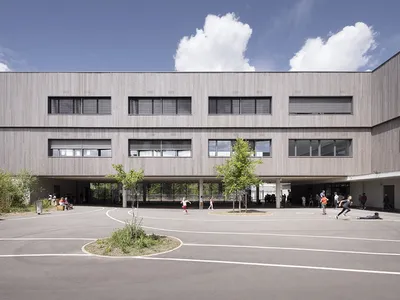
Vil Genis School by BPA ARCHITECTURE – Massy, France
Vil Genis School in Massy, France, features sustainable design, south-facing classrooms, community integration, accessible spaces, and modern educational architecture.


Comments (0)
Please login or sign up to add comments
No comments yet. Be the first to comment!