

Steffen Welsch Architects Wraps a Passive Solar Family Home Around a Northern Courtyard in Melbourne
Cloud Street in Northcote uses rammed earth, angled geometry, and native planting to achieve net-negative carbon over its lifecycle.


Most sustainable houses announce themselves. They wear their green credentials on their facade, bristling with solar panels and unusual forms that signal their difference from the neighbors. Cloud Street, a 341-square-meter family home in Northcote by Steffen Welsch Architects, takes the opposite tack. It dissolves into its suburban street, removes its front fence, plants native grasses where a lawn might have been, and lets timber cladding weather alongside the eucalyptus trees already on site. The ambition is not modesty for its own sake but a precise idea: the building should function as background, an organism that contracts and expands with the rhythms of a family rather than posing as an object.
What makes the project genuinely interesting is how many architectural strategies it stacks without any one of them becoming the headline. A rammed earth spine provides thermal mass and acoustic insulation. Angled walls and sloped ceilings break up visual bulk and push natural light into unexpected corners. A northern courtyard organizes the plan around passive solar gain. Two sleeping pavilions, one for parents at the rear and one for children at the front, bracket a communal dining core that opens in every direction. The result is a house that needs no mechanical heating or cooling to maintain a comfortable temperature year round. That claim alone would justify attention. But Cloud Street also achieves a dramatically reduced global warming potential across its lifecycle, which moves it from interesting to important.
Dissolving Into the Street
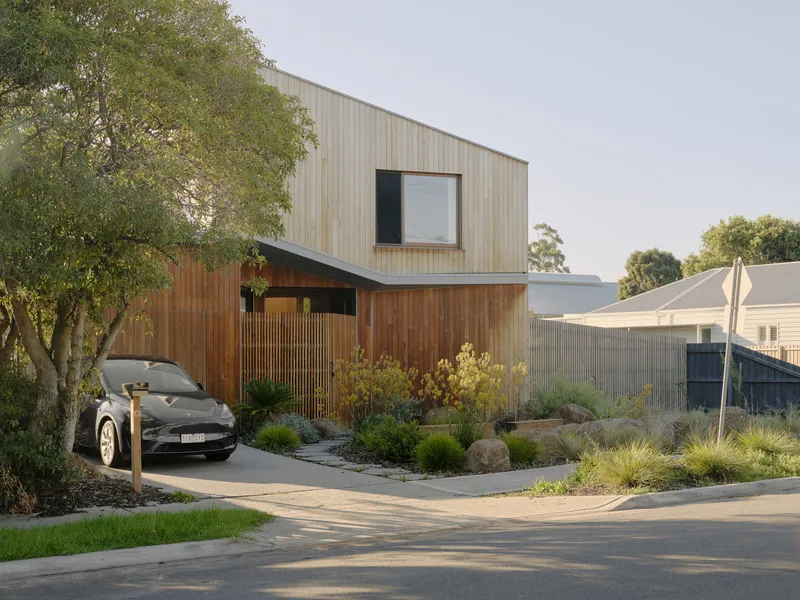
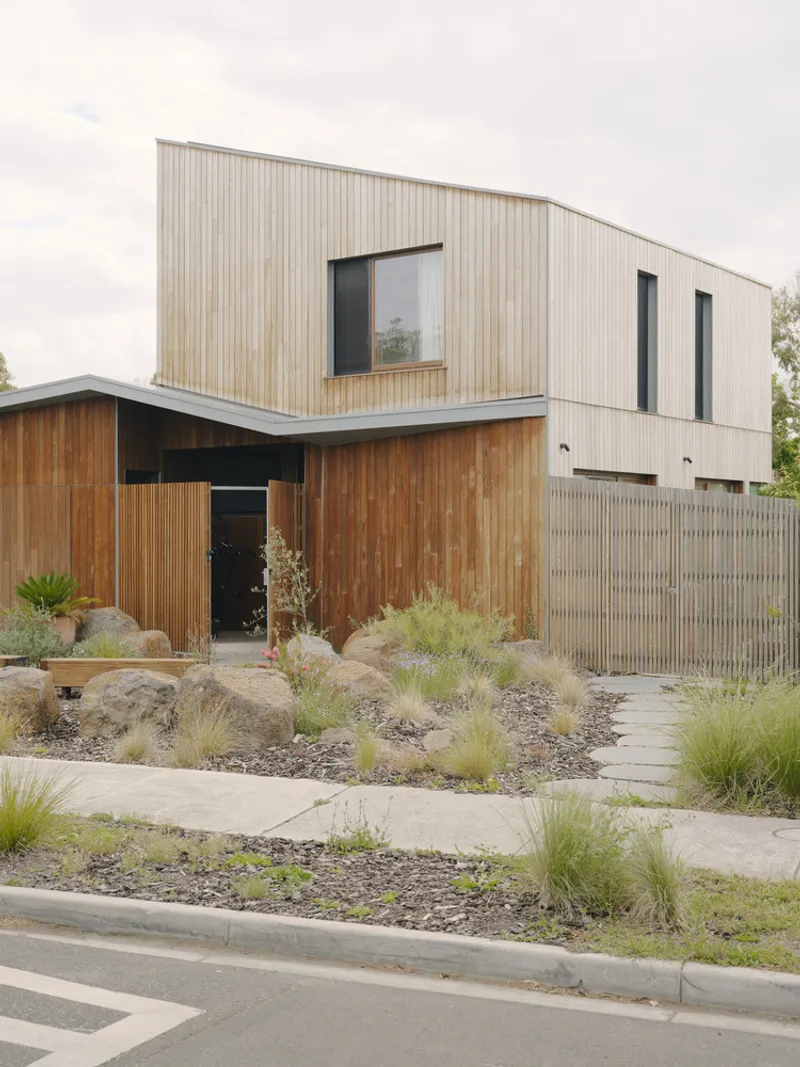
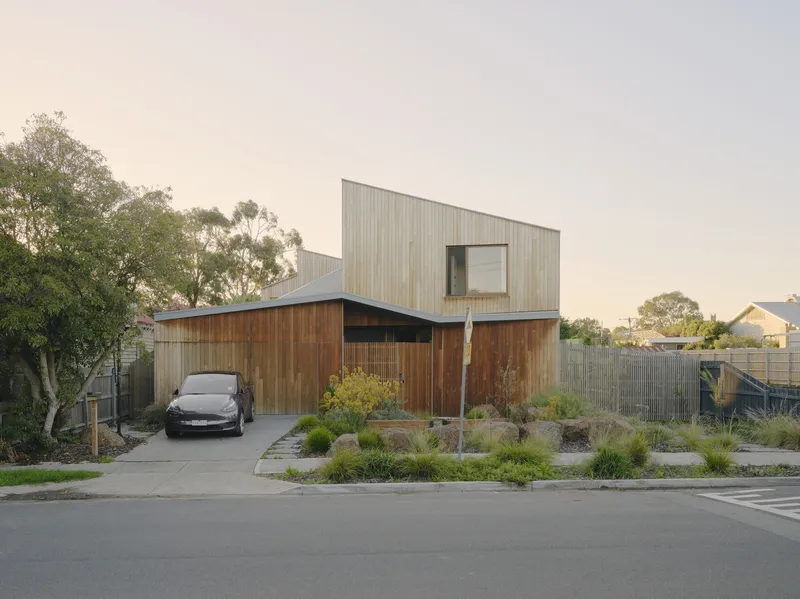
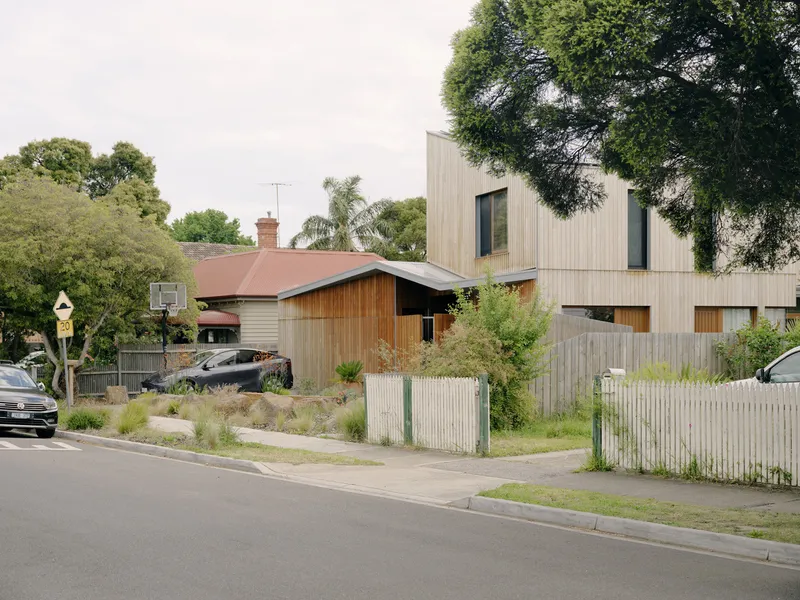
The streetscape strategy is one of the most deliberate moves in the project. By removing the front fence entirely and replacing it with a rockery of drought-tolerant native grasses, the house relinquishes the private-public boundary that defines most Melbourne residential lots. Landscape designer Lisa Armstrong selected local plant species typically found in native grasslands, supporting birdlife and providing habitat for smaller animals. Modern varieties of fruit trees, set back from the street, replace earlier plantings that could no longer adapt to a warming climate. The effect is generous: the garden belongs as much to the street as to the family.
From the sidewalk, the house reads as a cluster of timber-clad and corrugated metal volumes, their rooflines angled and overlapping, never presenting a single monolithic face. The carport tucks under the front pavilion, and vertical timber slats screen the entry without closing it off. This fragmented massing is the key to the 'building as background' ethos: nothing here is trying to dominate the relaxed suburban context of Northcote.
The Rammed Earth Spine
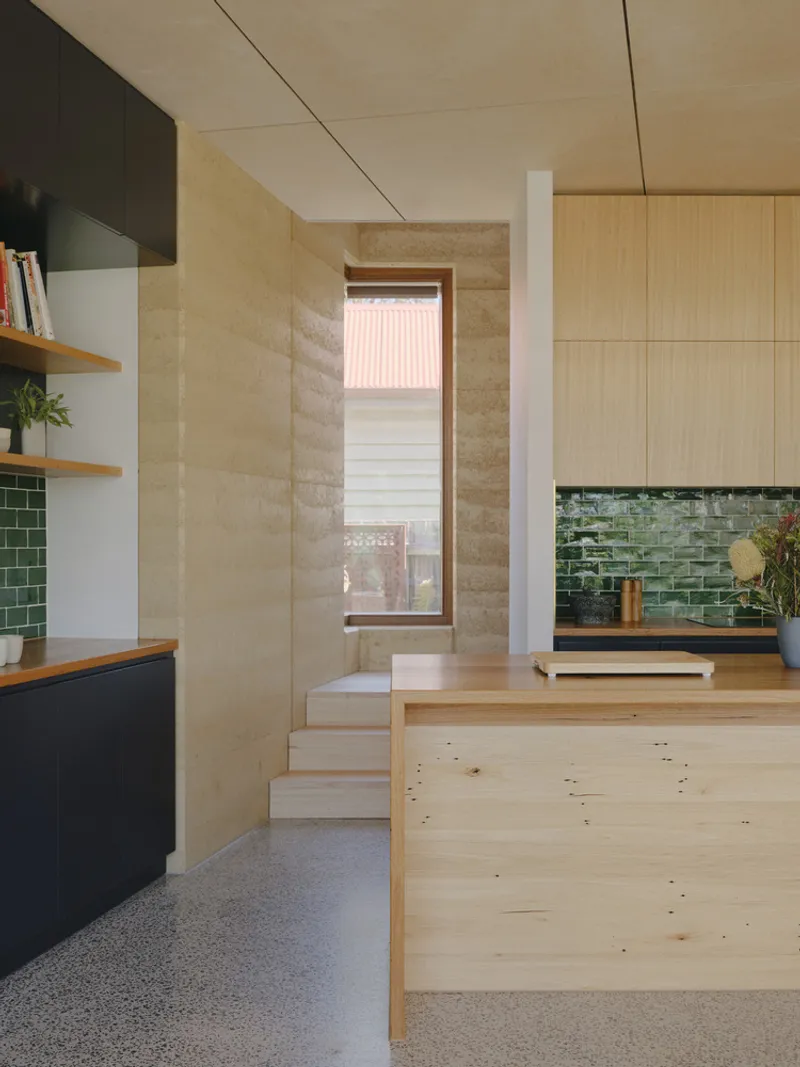
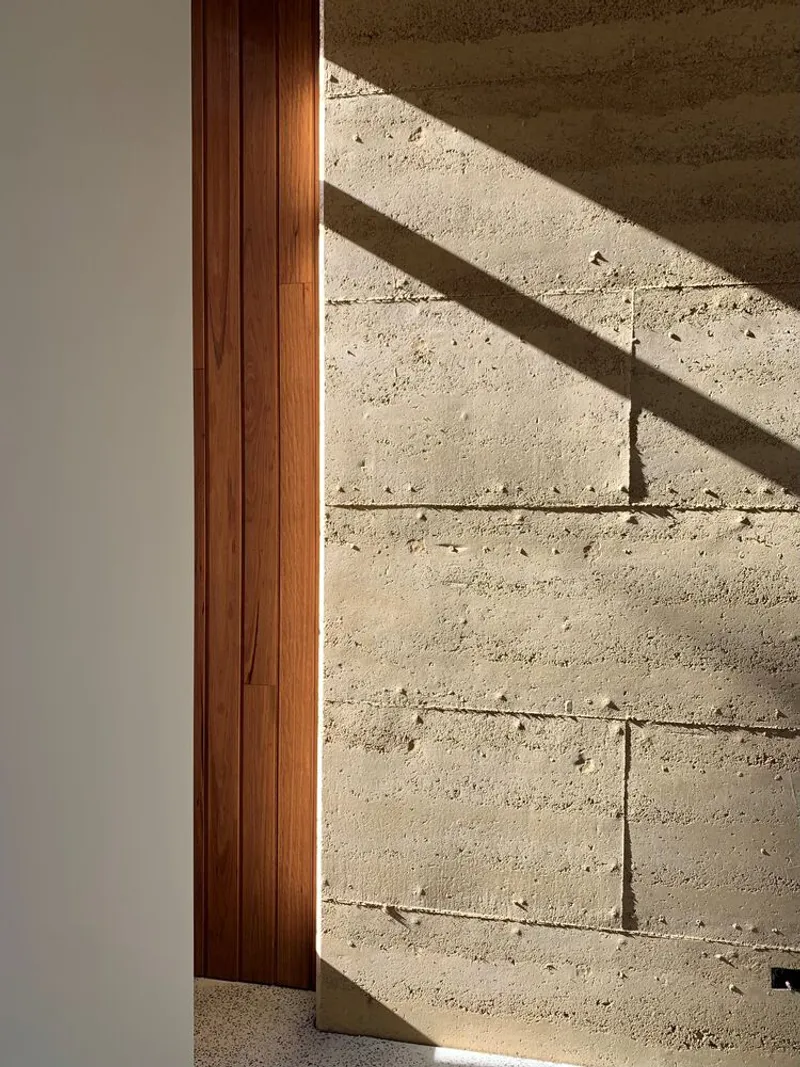
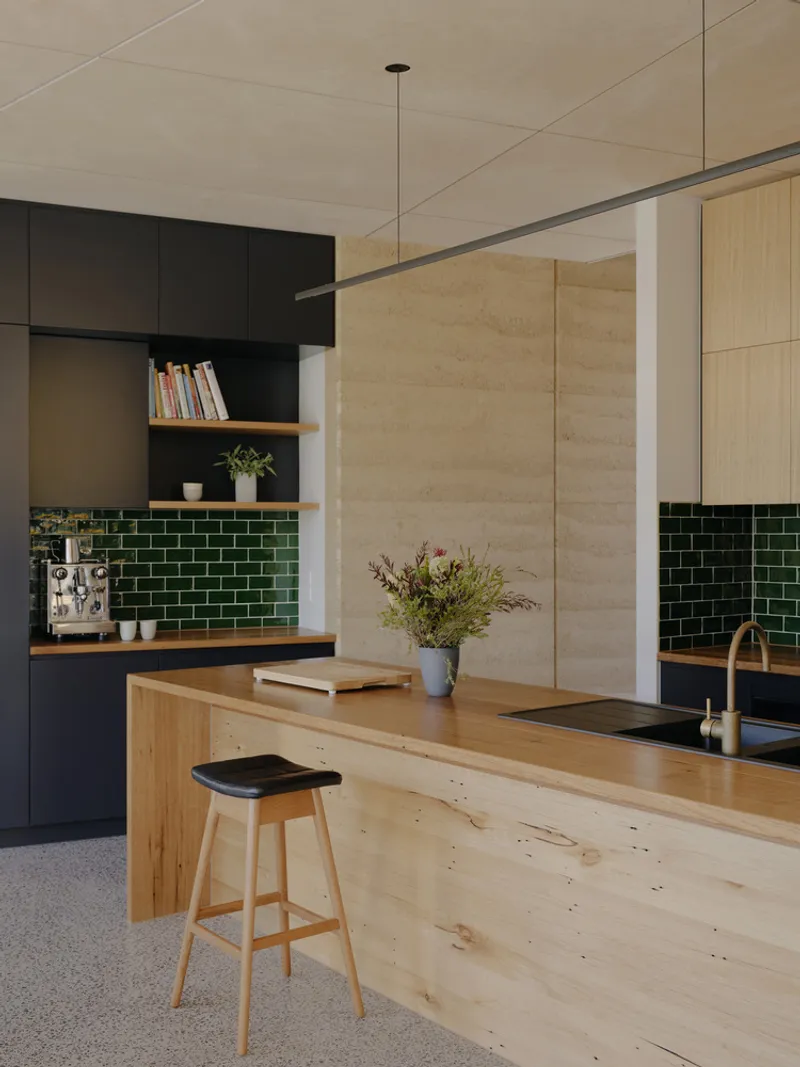
Running through the center of the house, a rammed earth wall constructed by Olnee Constructions does triple duty. Structurally, it forms the building's primary spine, an economical strategy that reduces the need for steel framing. Thermally, it absorbs solar heat during the day and releases it slowly overnight, stabilizing interior temperatures across Melbourne's variable seasons. Acoustically, its density dampens sound transmission between the communal zones and the sleeping pavilions.
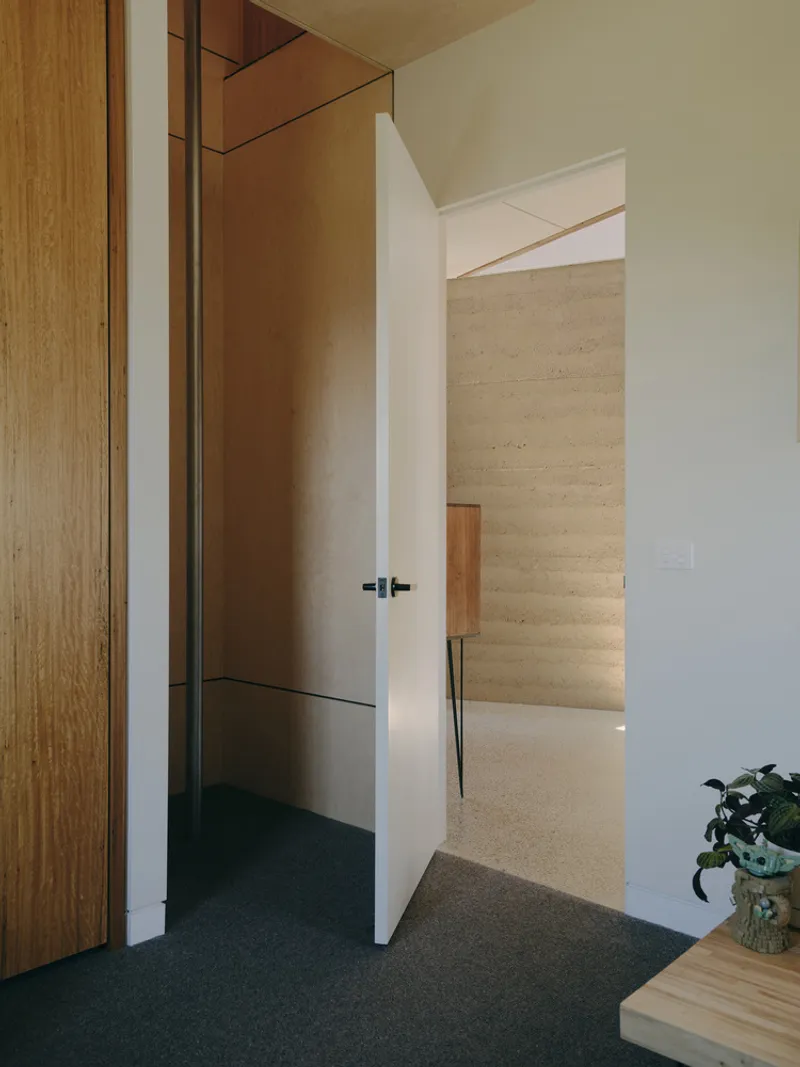
The material is also one of the house's most beautiful moments. Where afternoon sunlight catches the layered strata of compacted earth beside a timber door frame, the wall reads almost geological, a cross-section of sediment exposed in a domestic setting. It pairs with dark cabinetry in the kitchen and polished concrete floors to create an interior palette that feels grounded without being heavy. The low embodied carbon of rammed earth, compared to concrete block or brick, is central to the project's lifecycle emissions savings.
Communal Core, Private Wings
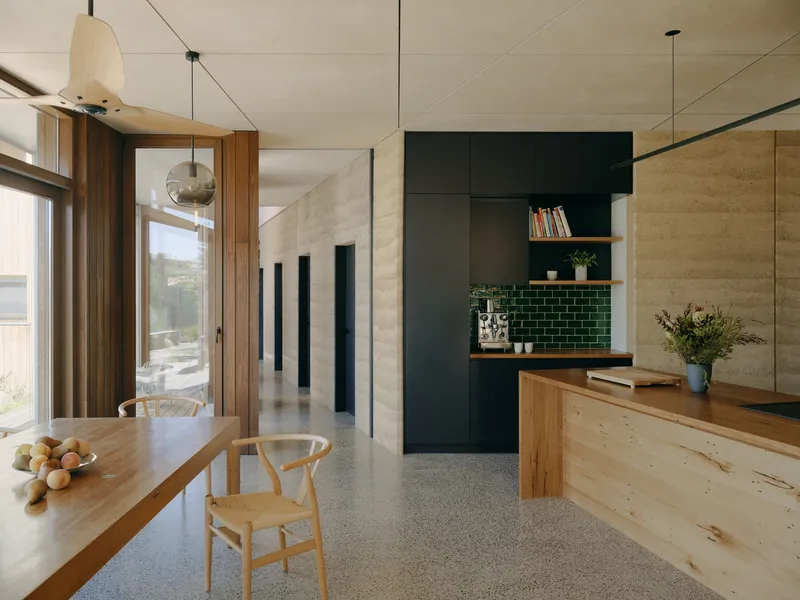
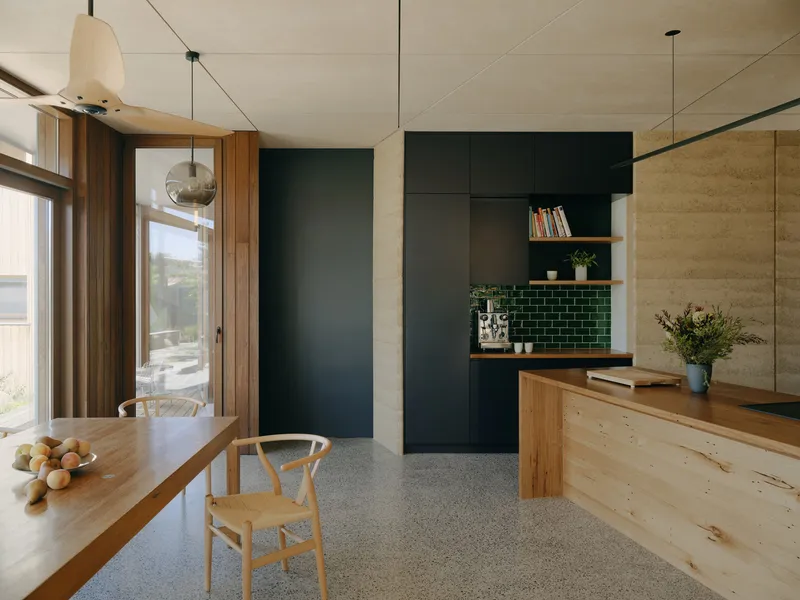
The spatial organization is deceptively simple on plan but rich in experience. The dining area sits at ground level at the home's center, with the kitchen island bench acting as the gravitational point of daily life. Plywood ceiling panels and green subway tile give the space warmth and specificity. To one side, a staircase tucked behind the kitchen leads up to the parents' bedroom and a private terrace. To the other, the children's wing occupies the front pavilion, its rooms opening directly onto the garden.
What elevates the plan beyond a standard zoned layout is the non-rectangular geometry. Walls angle and ceilings slope, so no room feels like a simple box. The triangular circulation space on the upper floor, visible in the plans, compresses and releases as you move through it. For a children's wing, that quality of spatial surprise is especially effective, compounded by playful elements like a fireman's pole and a circular timber staircase that wraps up through a skylit void.
The Children's Staircase
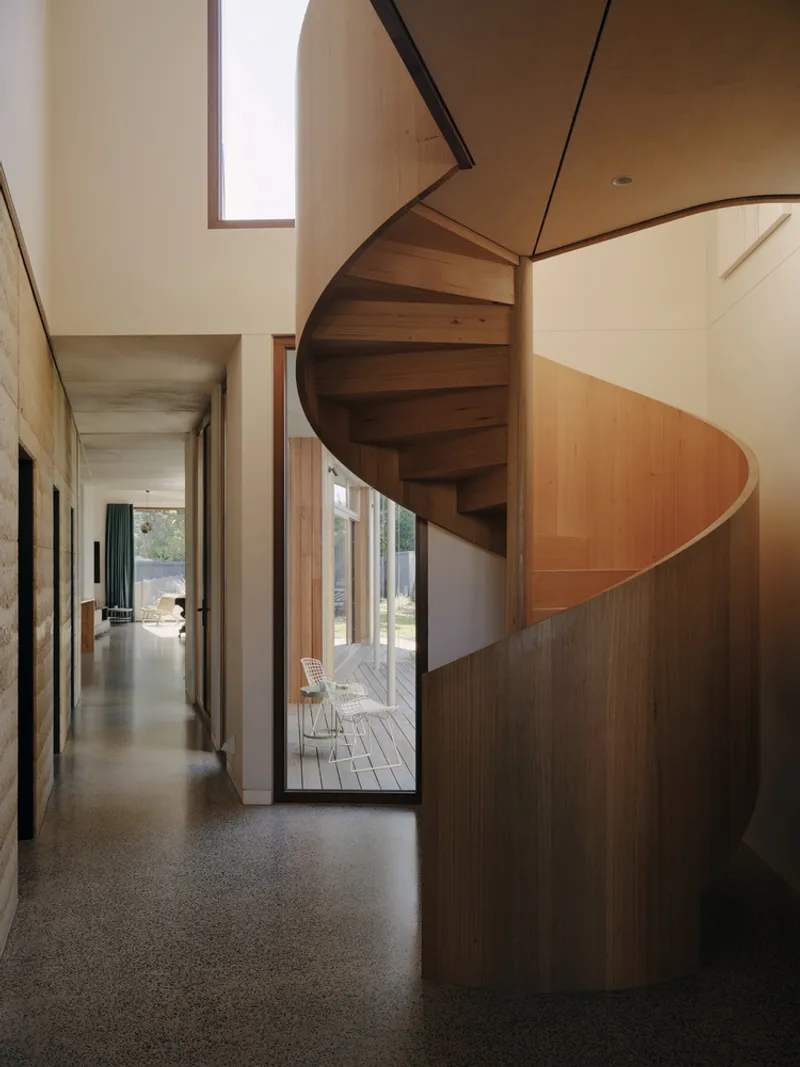
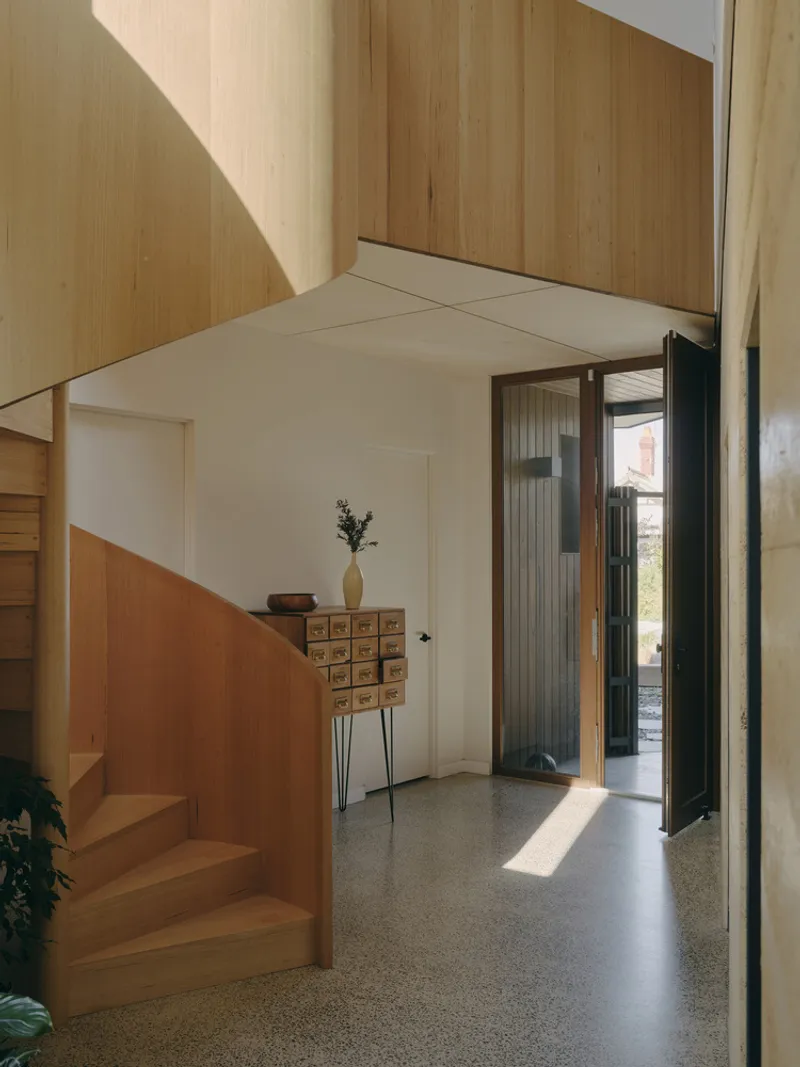
The spiral timber staircase in the children's wing deserves its own moment. Wrapped in plywood and lit from above by a skylight, it turns a simple vertical connection into a piece of inhabitable furniture. The curved surfaces catch raking light as the sun moves, and the proportions are scaled for both adults and children without condescension. It is one of those details that justifies the angled geometry: in a rectangular plan, this staircase would feel forced, but here it grows naturally from the angular logic of the whole house.
Courtyard and Passive Climate
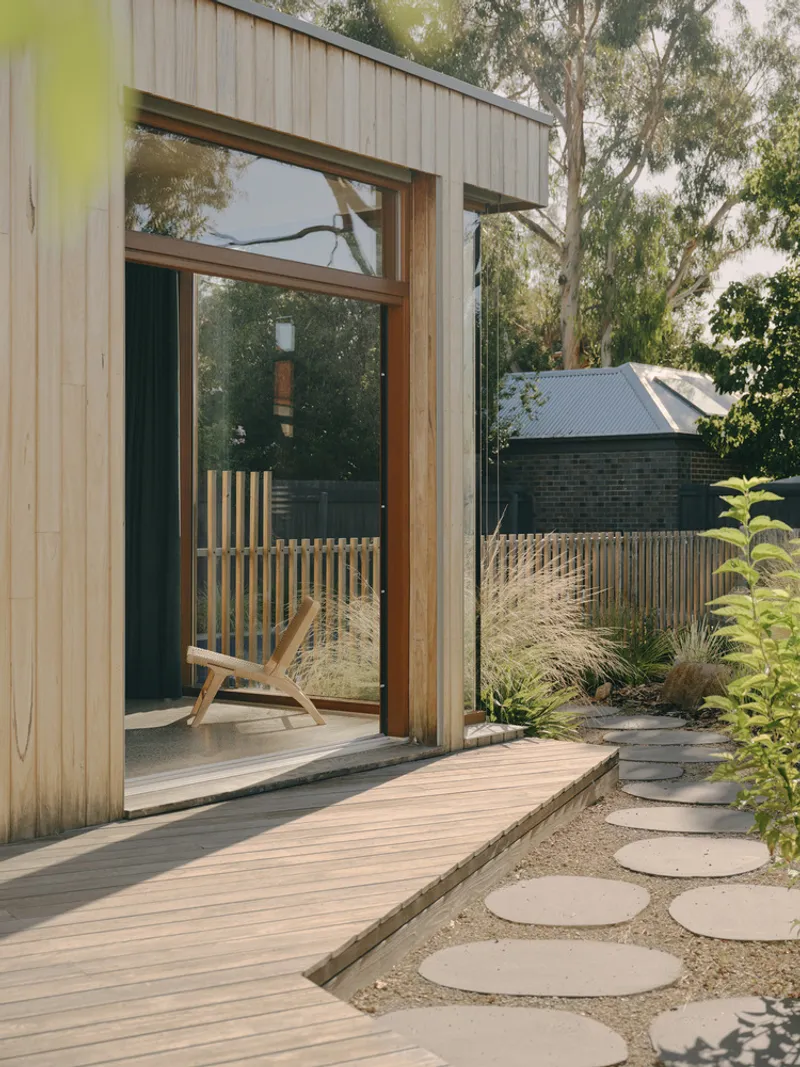
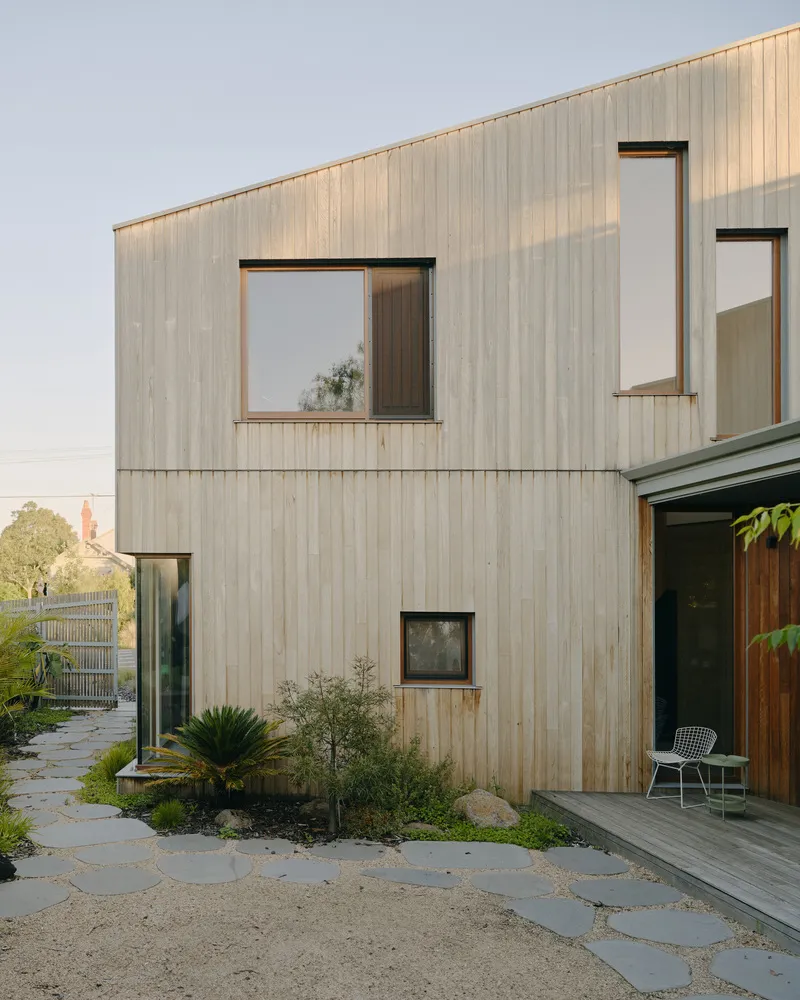
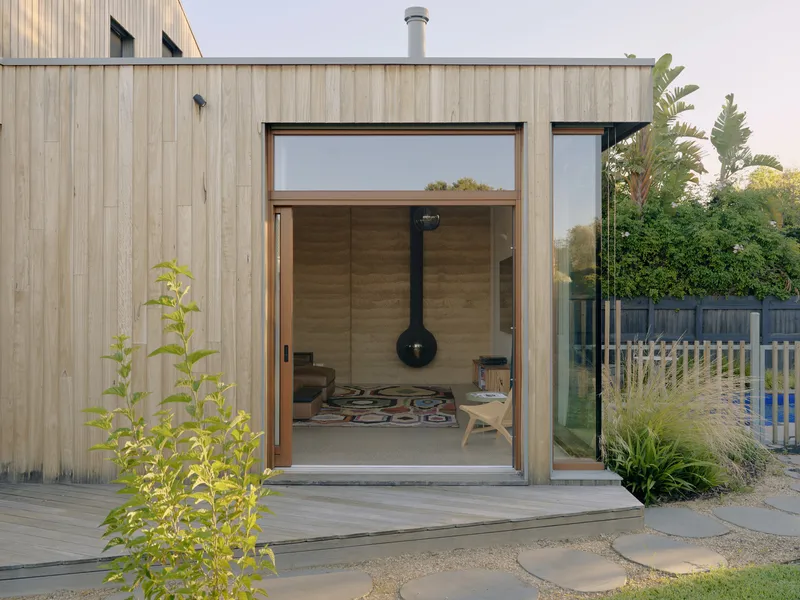
The northern courtyard is the engine of the passive climate strategy. By wrapping living spaces around a north-facing outdoor room, the architects maximize solar access in winter while the verandah and automated external awnings control summer heat gain. Strategically placed windows encourage cross-ventilation, and the thick rammed earth walls buffer temperature swings. The result, according to the architects, is a house that remains at a comfortable temperature throughout the year without mechanical heating or cooling.
Between the planted beds, concrete pavers, and circular stepping stones, the courtyard blurs inside and outside. Timber decking under the eucalyptus trees extends the dining space outward, while a glazed reading nook framed in rammed earth creates an interior moment that borrows the garden's atmosphere. The north-facing roof above generates solar energy sufficient for both the house and an electric vehicle, closing the energy loop.
Dusk and the Double Life of Facades
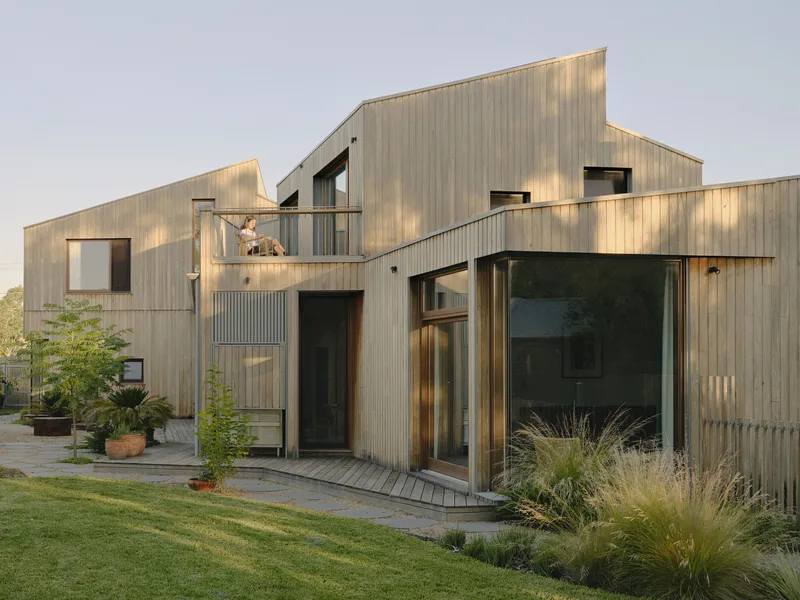
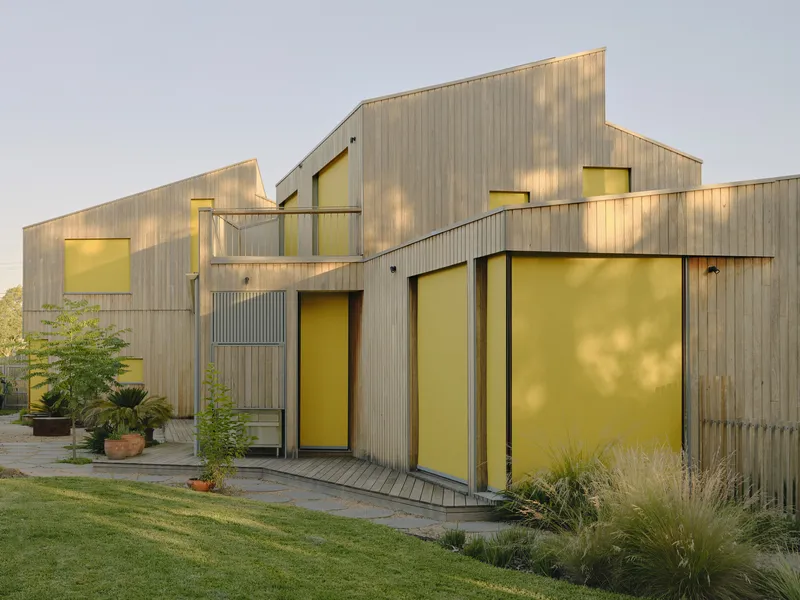
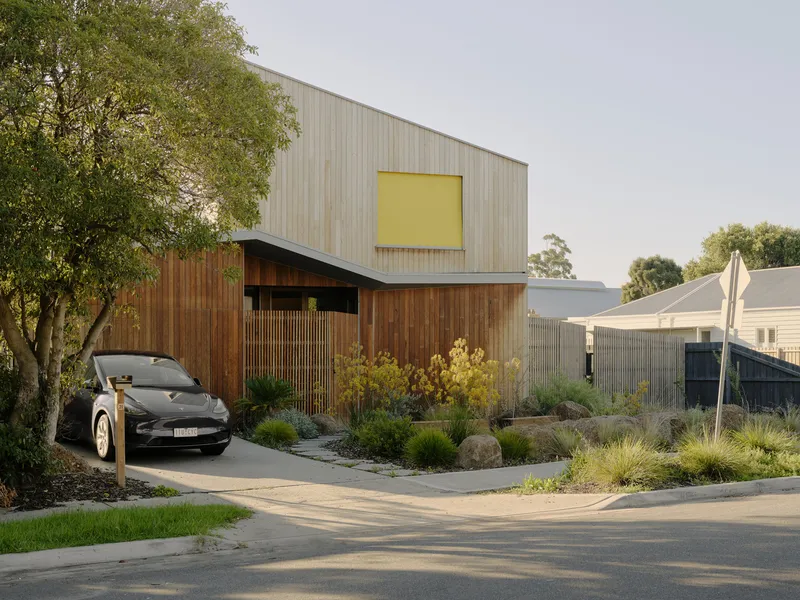
At dusk, the house reveals its second character. During the day, corrugated metal and weathered timber absorb into the neighborhood palette. At night, yellow-glazed openings and warm interior light turn the pavilions into lanterns. The rear elevation, with its terrace deck facing the lawn, opens up completely through sliding glass doors, dissolving the edge of the house into the garden. From the street, the yellow-paneled upper window and the glow behind vertical timber slats signal inhabitation without exposure.
This double reading, private by day and gently public by night, reinforces the community orientation of the project. The house communicates presence without surveillance, warmth without exhibitionism. It is a small thing, but in a suburb where front fences and hedges typically draw hard boundaries, it matters.
Interior Details and Material Logic
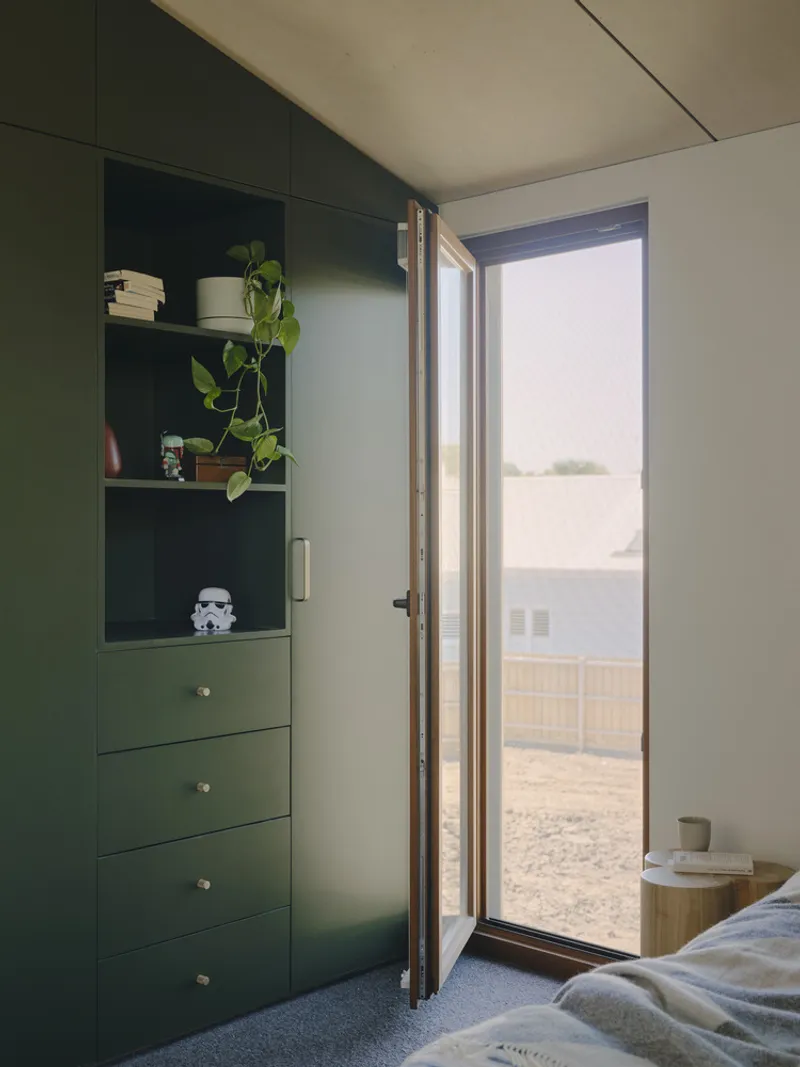
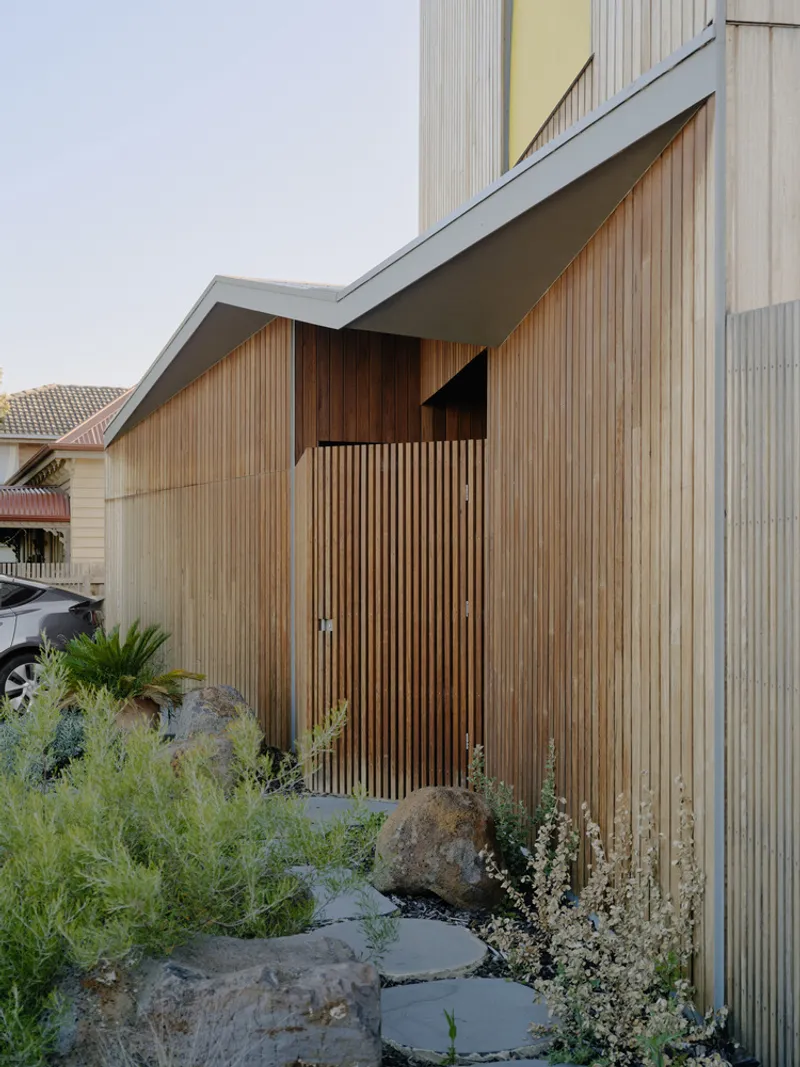
Inside, materials are kept to a tight palette: plywood, rammed earth, polished concrete, timber joinery, and occasional hits of color in the green built-in shelving and tile. The bedroom corner with its green shelving and tall door opening to a gravel courtyard shows how each room negotiates its own relationship with the outside. No space relies on artificial light during the day. The angular zinc roof above the planted rockery garden, seen from outside, translates internally into the sloped ceilings that give each room its particular character.
Plans and Drawings
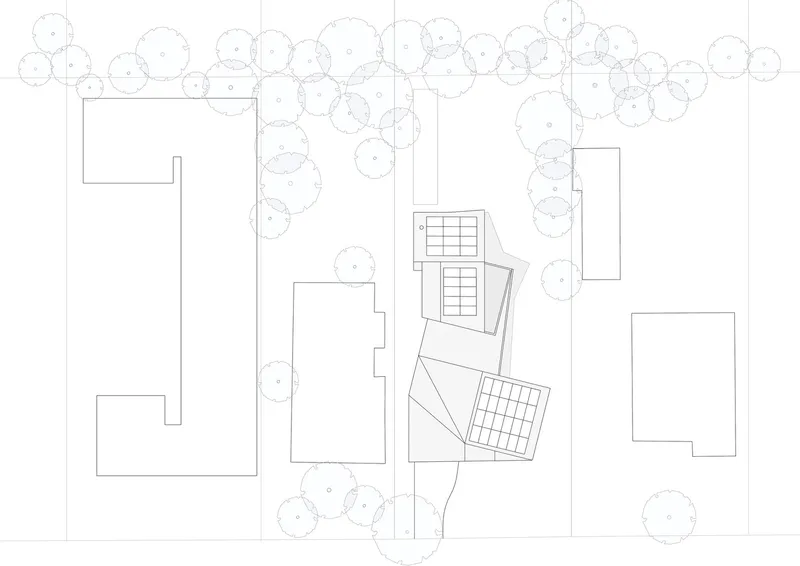
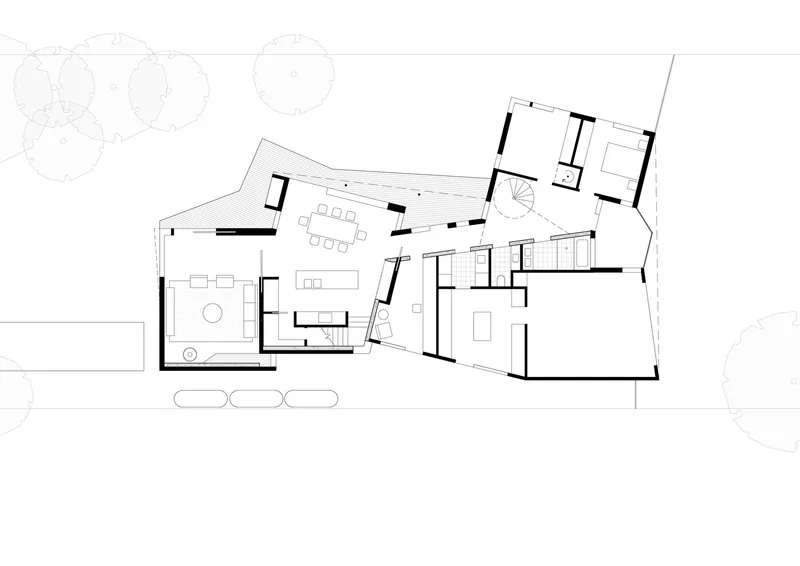
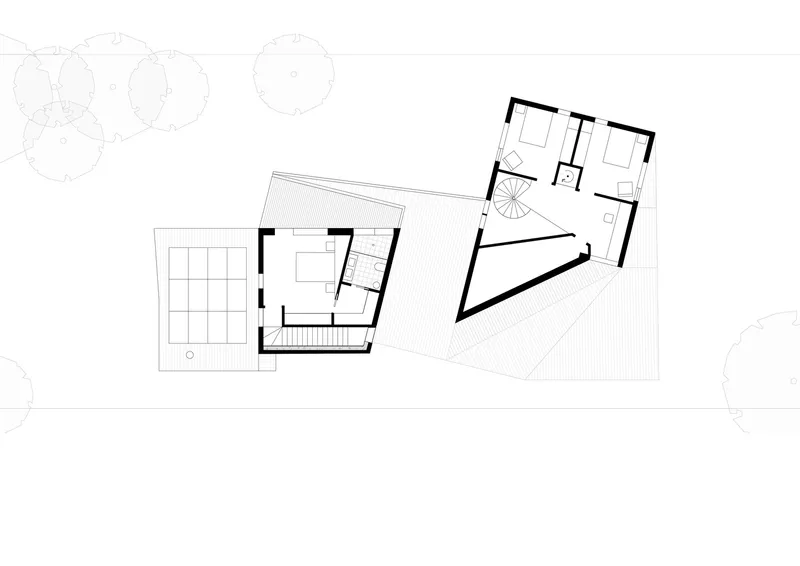
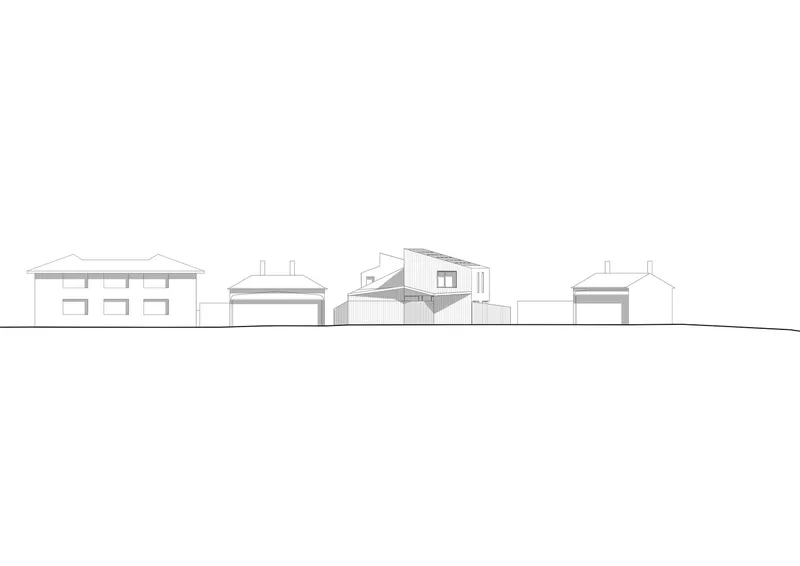
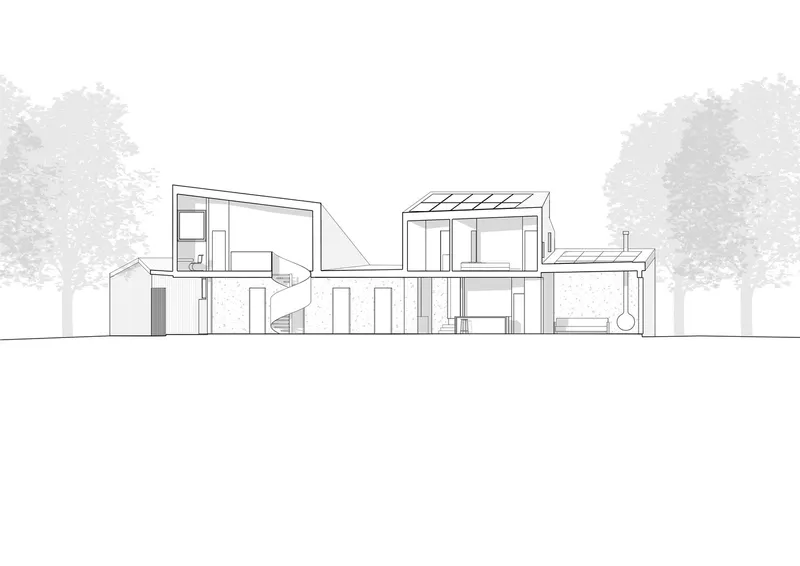
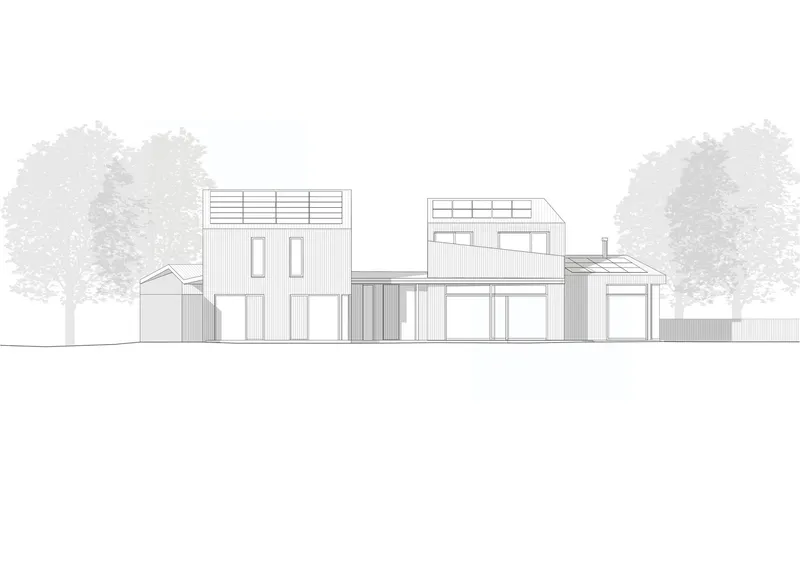
The site plan reveals how aggressively the building's footprint angles away from the orthogonal lot lines, creating wedge-shaped outdoor spaces on multiple sides. The ground floor plan shows the central kitchen as a hinge between the two pavilions, with the courtyard pulling the whole composition northward. On the upper floor, the triangular circulation space connecting the two bedrooms confirms that the angular geometry is not decorative but organizational: it is what allows the compact plan to feel loose and varied. The section drawing, with its spiral stair flanked by trees, captures the building's ambition to be read as part of its landscape rather than apart from it.
Why This Project Matters
Cloud Street matters because it refuses the false choice between high performance and architectural generosity. Too many sustainable houses treat comfort, spatial interest, and environmental responsibility as competing goals, parceling out each one grudgingly. Here, the passive solar strategy generates the plan, the rammed earth spine shapes the aesthetic, and the native landscape dissolves the boundary between house and street. Every sustainable move is also a design move. There is no green tax on the experience of living here.
For architects working on suburban family houses, the project offers a model that is both specific and transferable. The northern courtyard strategy is particular to Melbourne's climate. The rammed earth construction depends on local expertise. But the underlying idea, that a house should be an organism tuned to its site rather than a box dropped onto it, is universal. Steffen Welsch Architects have built a quiet argument that the most radical thing a suburban home can do is disappear into its neighborhood while performing at the highest environmental standard.
Cloud Street by Steffen Welsch Architects. Northcote, Melbourne, Australia. 341 m². 2021. Builder: Renovation One. Landscape design: Lisa Armstrong. Rammed earth construction: Olnee Constructions. Structural engineer: Maurice Farrugia and Associates. Photography by Tom Ross.
About the Studio
Share Your Own Work on uni.xyz
If projects like this are the kind of work you want to make, uni.xyz is a place to publish your own, find collaborators, and enter design competitions.


Popular Articles
Popular articles from the community


Manzana Morphosis: Stretching Barcelona's Grid into a Living Landscape for 2050
A radical reworking of the Eixample manzana turns density into a tool for generous public space, vertical ecology, and environmental performance.


graciastudio Turns a Viewless Tijuana Lot Inward Around a Courtyard of Concrete, Timber and Trees
In Tijuana, Jorge Gracia's GA2 House stacks a timber-clad private floor over exposed concrete and replaces a missing view with a planted interior patio.

Opera on the Sea: Driftwood Logic Shapes a Timber Opera House on Estonia's Coast
Trevor Orgill's opera house translates the entangled drift of floating timber into a civic building where wood, water, and music converge.

Cube Design Draws an Ecological Corridor Between Two Shenzhen Hills with the Nankai Building
Beside Shenzhen's container docks, the Nankai Building pairs stacked balconies with a climbing green screen to connect two hillsides across its height.

Similar Reads
You might also enjoy these articles

Bamboo Housing Challenge 2026: Design Affordable, Sustainable Homes Using Bamboo
An international design competition by Bamboo U and IBUKU inviting architects and designers to reimagine affordable housing using bamboo — with the winning design built full-scale in Bali.

Computational Design & Education: Beegraphy Design Awards Introduces 7th Category (Featuring Jiyun's Innovative Approach)
Dive into Beegraphy’s 7th Design Awards category, where computational design meets education to create immersive, interactive learning tools, inspired by Jiyun’s work.

From Parametric Lighting to Urban Furniture: Join the 2nd Workshop in Beegraphy’s Computational Design Series
Dive into Cutting-Edge Design Techniques and Practical Applications with Industry Experts

Last Call: Unleash Your Architectural Genius in SHAK's Kindergarten Design Competition
Urgent call for architects to join SHAK's kindergarten design competition before the looming deadline

Explore Staarch Architects Competitions
Discover active competitions in this discipline

Challenge to reimagine the Iron Throne

Photograph architecture without architects

Illustrate the lost glory of Angkor Wat - Render Challenge

Design challenge to reuse E-waste
Comments (0)
Please login or sign up to add comments
No comments yet. Be the first to comment!