
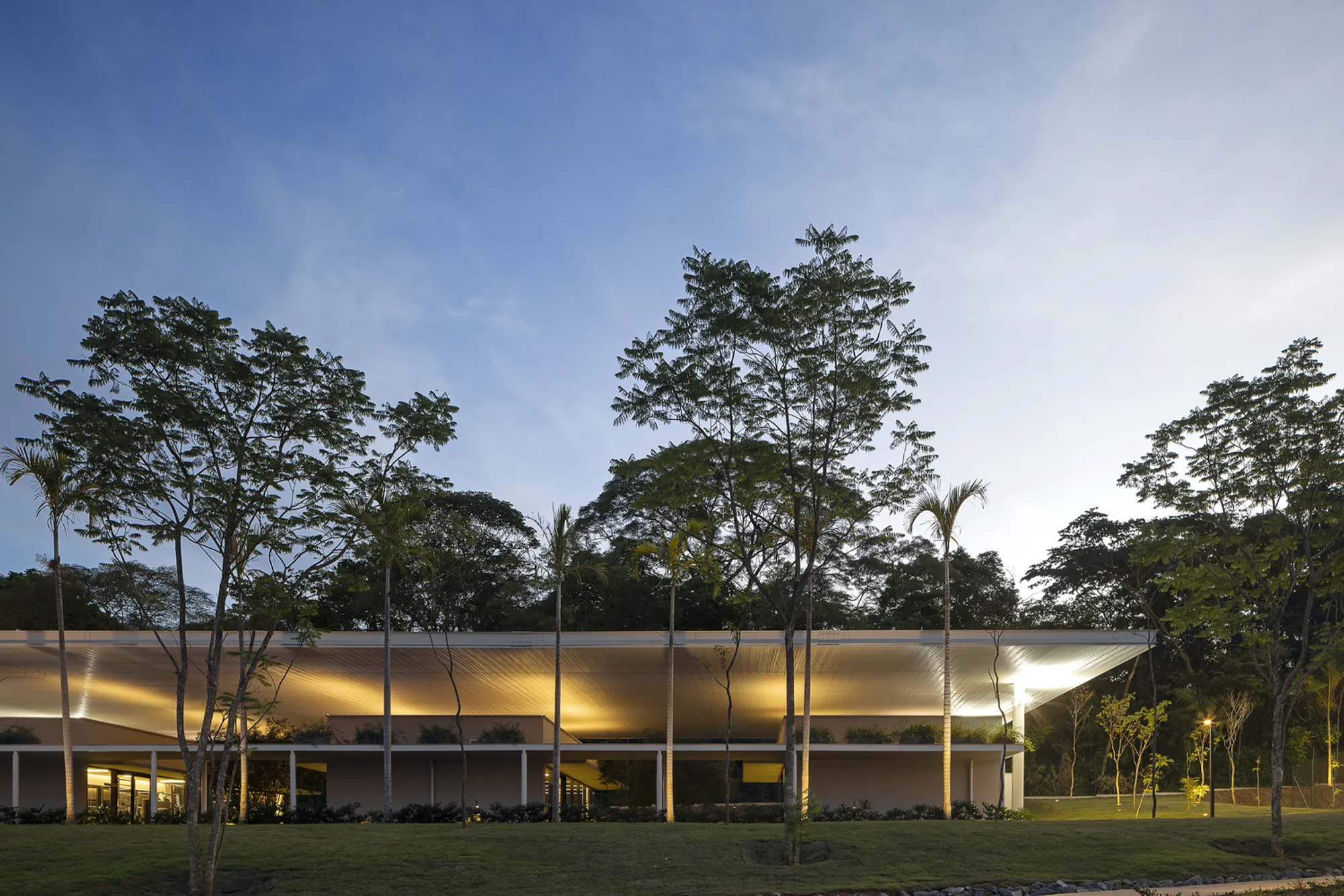
Capote Marcondes Longo Slides a Glass Fitness Pavilion Beneath a Forest Canopy in Ribeirão Preto
A translucent roof grid and courtyard plan let this Brazilian wellness center disappear into the surrounding tree line.


Fitness centers tend to be inward-looking boxes, sealed off from daylight by mirrors and marketing. Capote Marcondes Longo Arquitetura e Urbanismo took the opposite approach at Plateu D'or in Ribeirão Preto, Brazil, dissolving the building envelope into glass and letting a gridded translucent canopy do the work of a conventional roof. The result is a wellness campus that reads less as a gym and more as a clearing in the forest, organized around courtyards, planted mounds, and the trunks of preserved trees.
What makes the project genuinely interesting is not just its commitment to transparency but the way it handles the tension between openness and climate control in the subtropical interior of São Paulo state. The translucent panels filter harsh sun into striped shadow patterns, the cantilevered overhangs shade the glass walls, and the courtyard plan creates cross-ventilation corridors. Every environmental strategy doubles as an architectural move, which means nothing here feels bolted on.
A Roof That Behaves Like a Tree Canopy
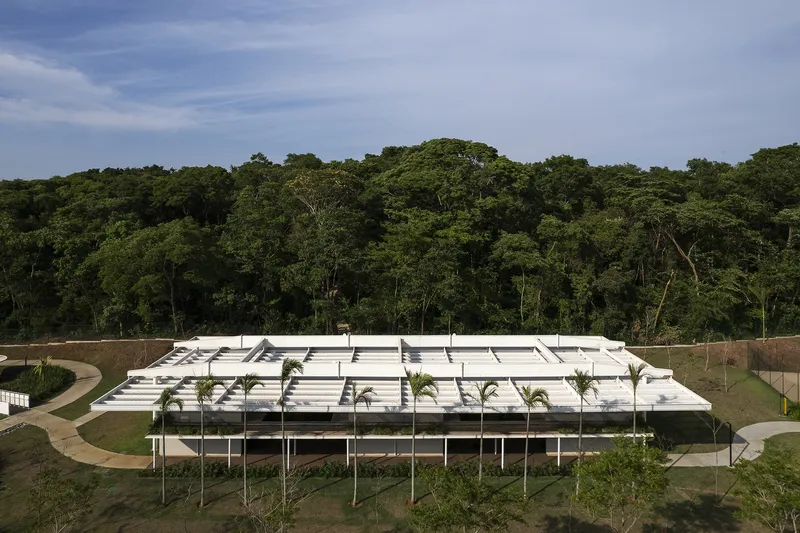
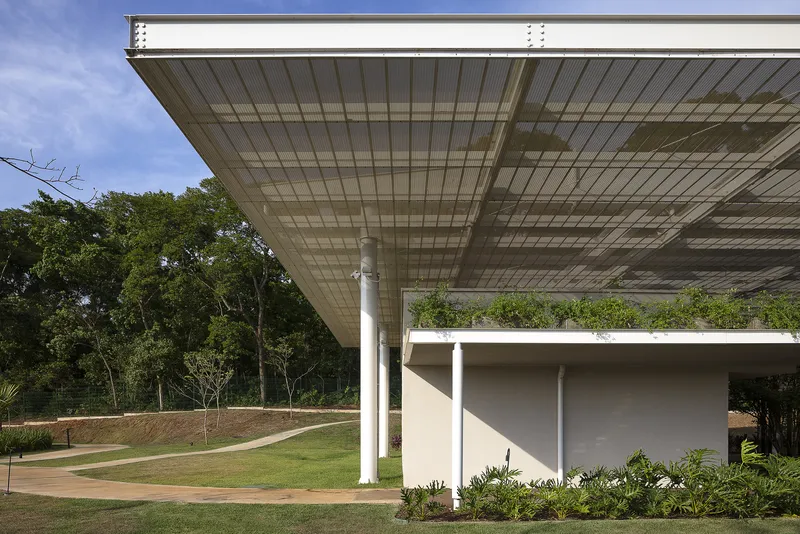
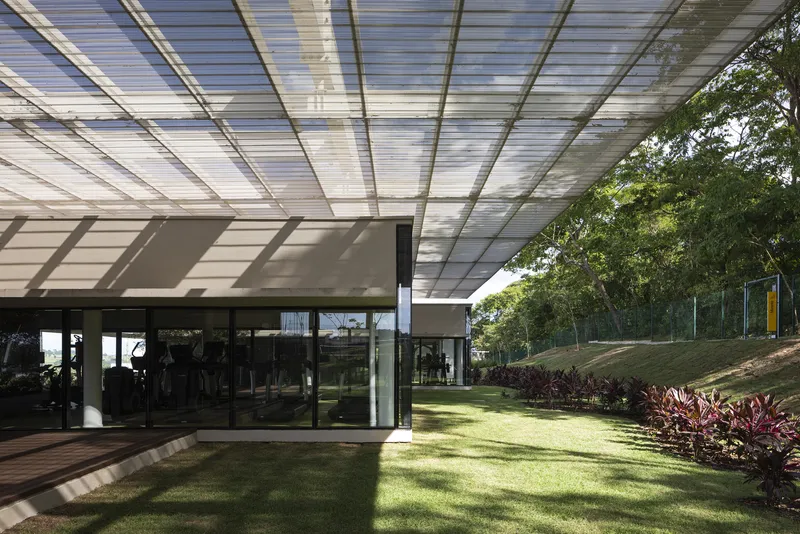
Seen from above, the building is almost entirely roof: a long, low rectangle of translucent panels set in a white steel grid, floating over the landscape on slender columns. The aerial view reveals how thoroughly the forest has been retained around the footprint, with mature trees pressing right up to the structure's edge. The canopy extends well beyond the enclosed volumes, sheltering garden beds and walkways the way a broad-crowned tree shelters its understory.
At ground level, the roof's presence is felt through light, not weight. The grid casts a rhythmic pattern of bright and shadowed stripes across glass walls, timber decks, and lawn. On a sunny afternoon the effect is almost textile, as if the building had been wrapped in a woven screen. The panels are translucent rather than transparent, so the light arrives soft and even inside while direct solar gain stays manageable without mechanical blinds on most elevations.
Courtyards as Organizing Principle
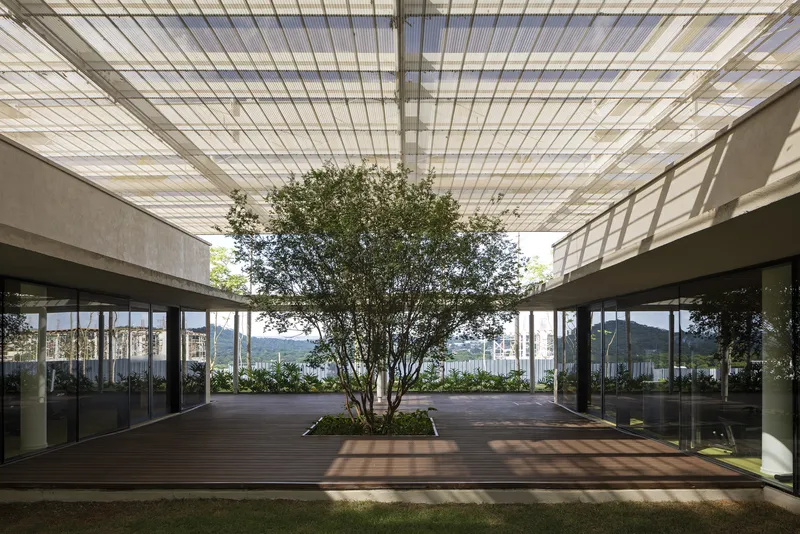
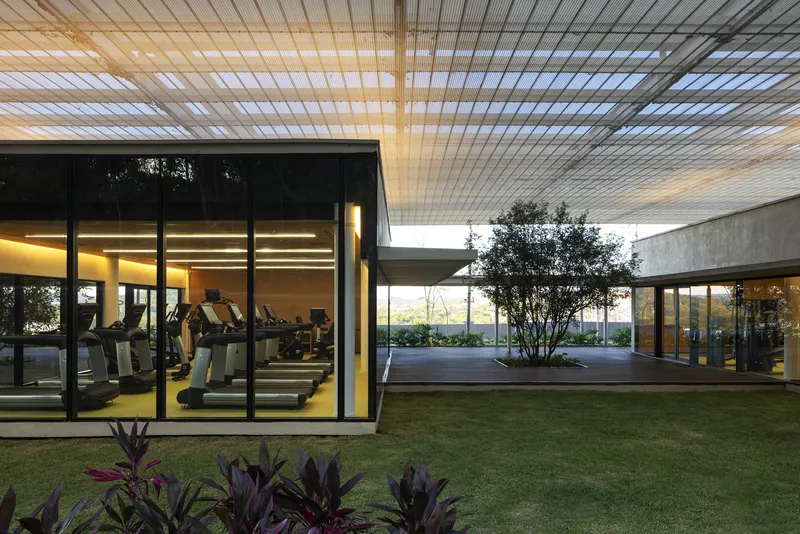
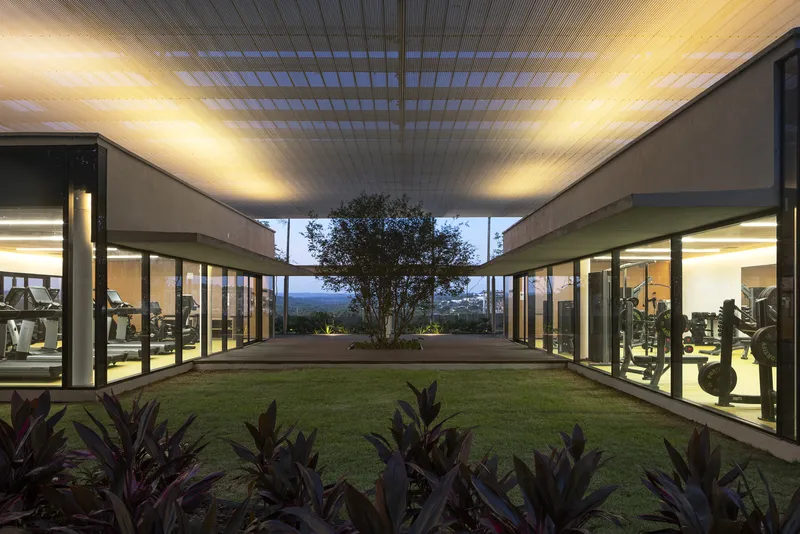
The plan splits the program into separate glass pavilions arranged around a central courtyard with a multi-stemmed tree rising through an opening in the timber deck. This is the hinge of the composition: two mirrored wings of fitness rooms face each other across a planted lawn, and the courtyard provides both a visual pause and a ventilation channel between them. At dusk, the illuminated wings glow symmetrically, turning the courtyard into an outdoor room defined entirely by light.
The decision to separate volumes rather than stack them means every exercise space has at least two glazed walls, and users are always looking through the building to landscape beyond. It is a generous use of land, but in this context generosity is the point: the campus is meant to feel restorative, not efficient.
Glass Walls and the Problem of Exposure
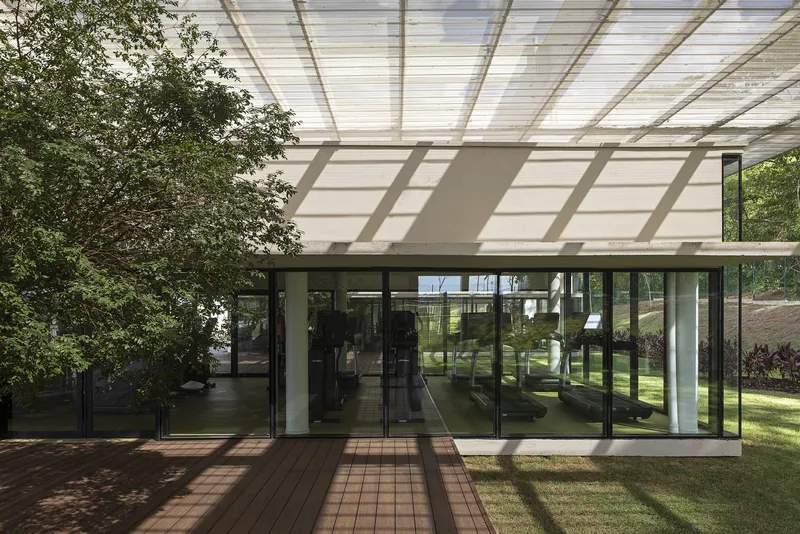
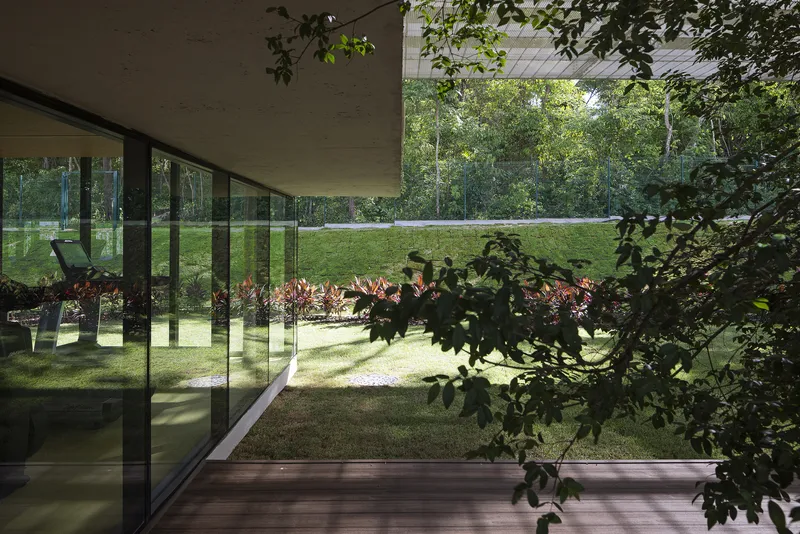
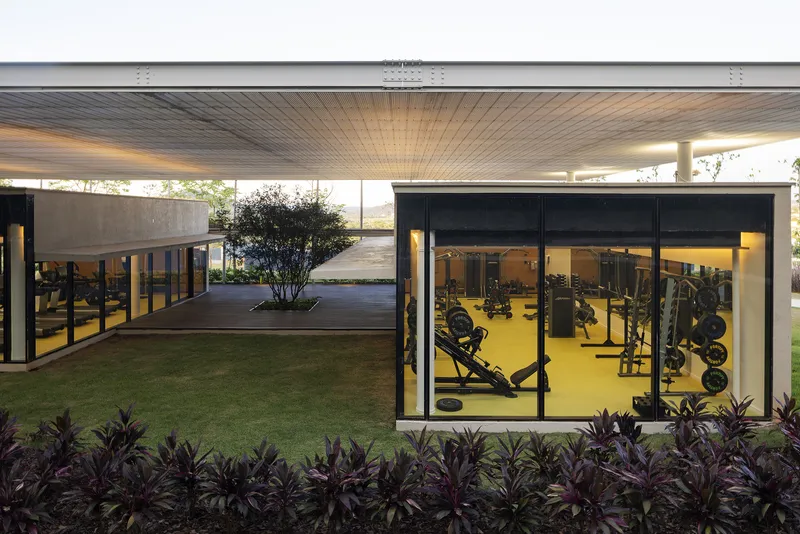
Floor-to-ceiling glass in a fitness environment raises obvious questions about privacy, glare, and thermal comfort. The architects answer all three simultaneously. The cantilevered roof shades the upper portion of each facade, the translucent panels overhead soften incoming light, and the deep purple foliage beds along certain elevations provide a visual buffer at eye level without requiring curtains. Reflections of the surrounding garden in the glass further blur the boundary between inside and out.
At the entrance facade, afternoon light pours through the canopy grid and rakes across timber decking, creating a threshold that is neither fully interior nor exterior. The glazed entrance wall catches these shadows and projects them into the lobby, so the act of arriving already feels immersive. It is a simple detail, but it sets expectations for the rest of the experience.
The Pool Pavilion
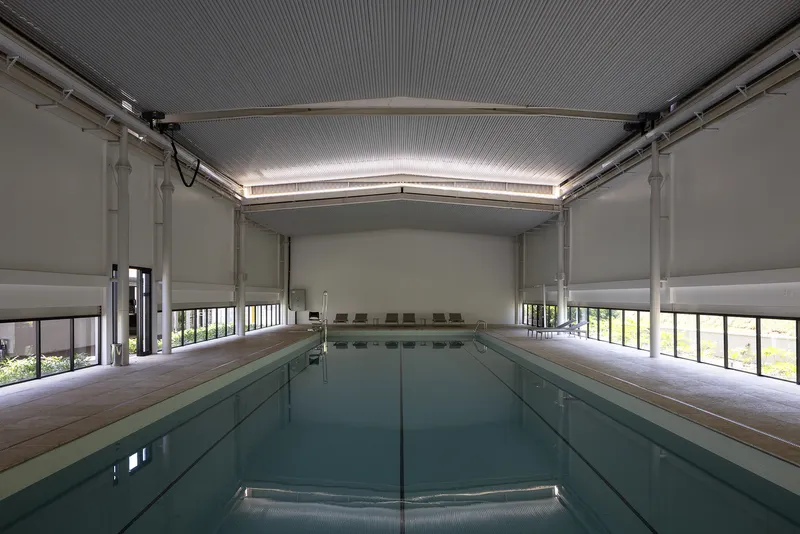
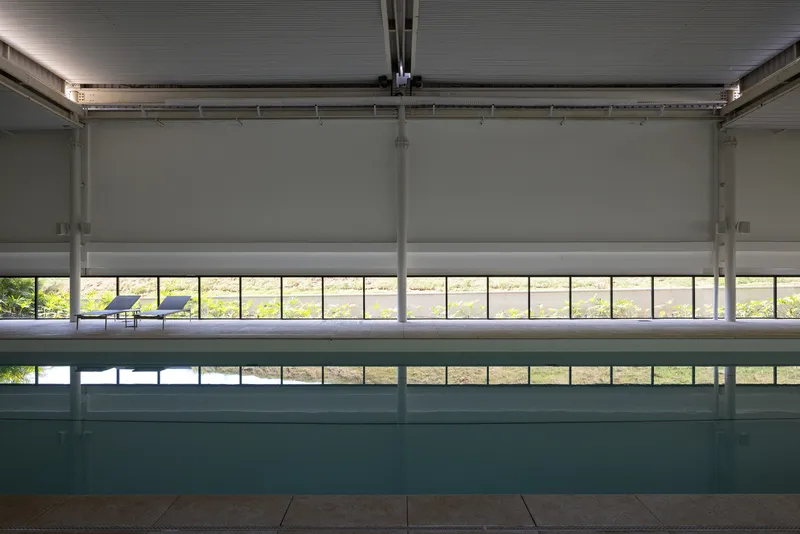
The lap pool sits in its own pavilion with a corrugated metal ceiling and a row of horizontal windows that frame views of the lawn. White roller shades offer adjustable privacy and glare control, a more pragmatic approach than the open glass strategy of the gym wings. The water surface picks up reflections from the window band, doubling the sense of depth in a relatively compact volume.
Separating the pool from the dry fitness spaces makes acoustic and environmental sense, but it also gives the campus a second architectural character. Where the gym pavilions are all transparency and dappled light, the pool building is quieter, more enclosed, more focused on the horizontal plane of water. The contrast keeps the campus from feeling monotonous.
Landscape as Architecture
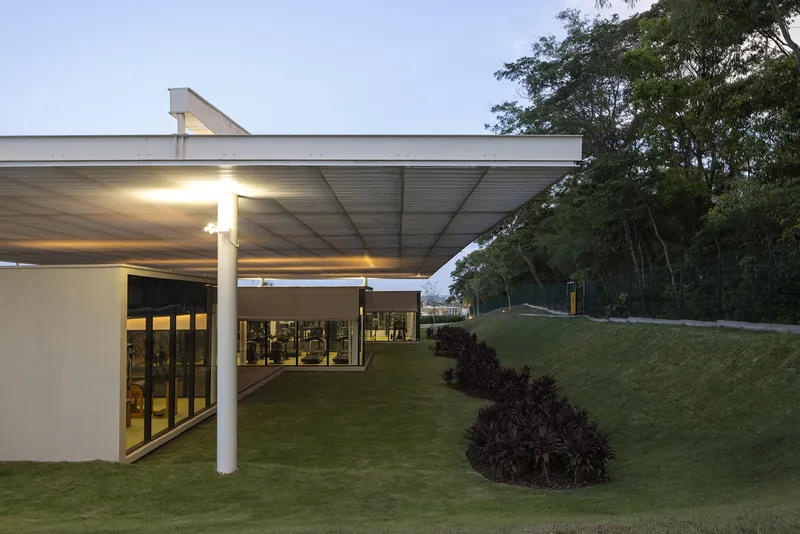
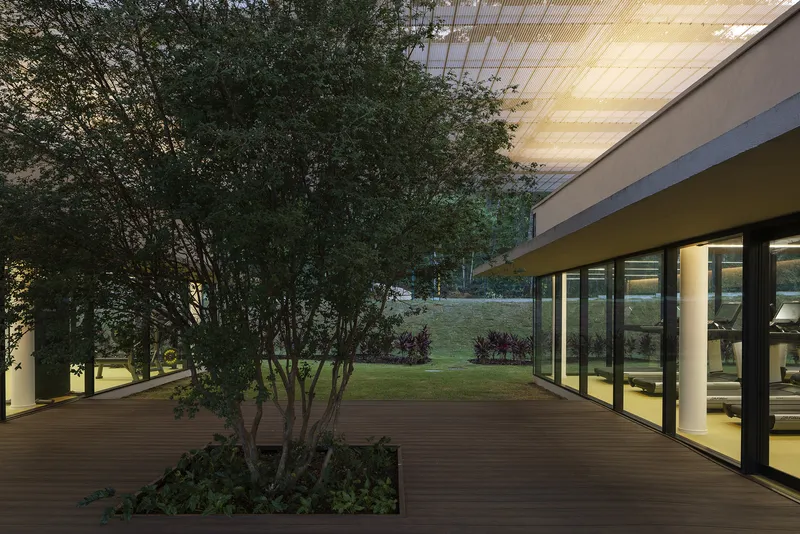
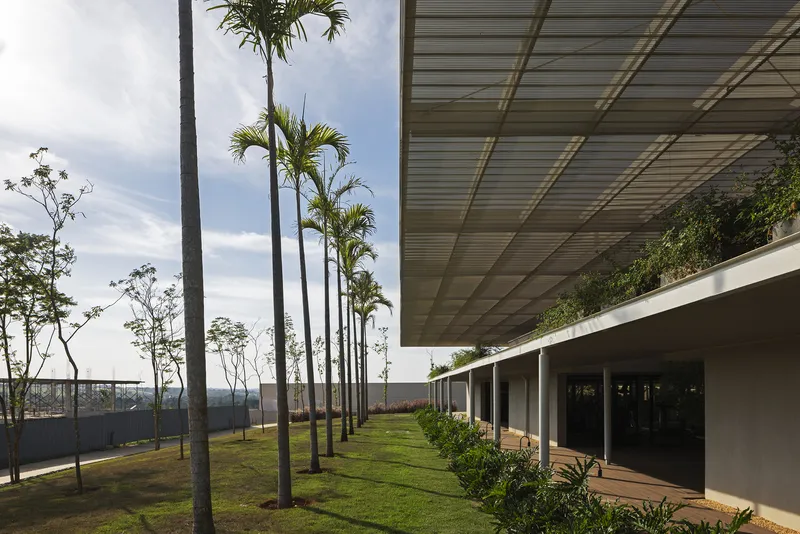
The planted mounds visible at dusk from the covered terrace are sculptural rather than decorative. They shape circulation, screen certain sightlines, and provide thermal mass near the glass walls. Young palms line the covered walkways, their vertical forms echoing the slender white columns that support the canopy. Timber decks wrap around planted beds and preserved tree trunks, treating the landscape not as a backdrop but as a co-equal element of the plan.
The louvered canopy along the covered terrace picks up the rhythm of the main roof grid but at a tighter spacing, filtering light even further for the semi-outdoor seating area. At twilight, when the interior lights come on and the garden goes dark, the pavilions appear to hover above the ground plane, the columns receding into shadow while the illuminated volumes float.
Dusk Reveals the Structure
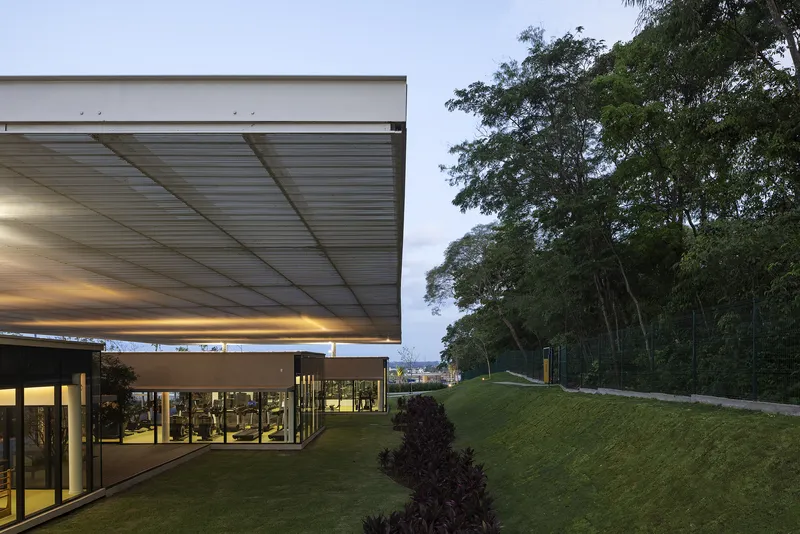
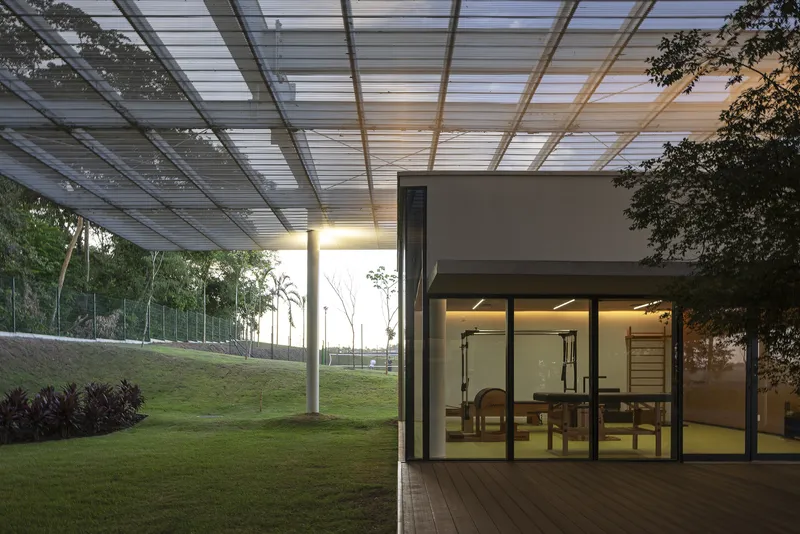
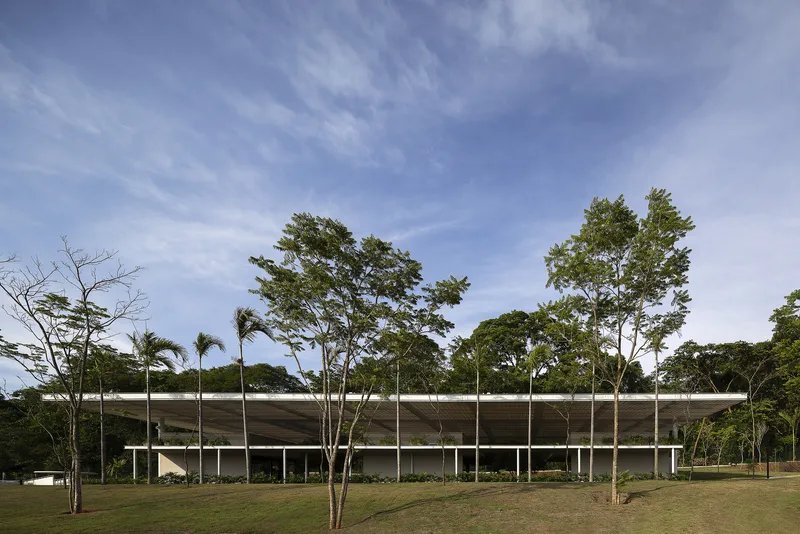
Several of the strongest images of this project are shot at dusk, and there is a reason. During the day, the translucent roof and reflective glass make it difficult to read the building's internal organization from outside. At twilight, the balance flips: interior lighting turns each pavilion into a lantern, and the structural frame of columns and cantilevered roof edges becomes suddenly legible against the darkening sky.
The cantilevered roof edge, in particular, gains drama at this hour. Its thin profile cuts a sharp line against the treetops, and the warm light spilling from beneath it traces the full extent of the overhang. What reads as a lightweight shelter during the day becomes a decisive horizontal gesture at night, anchoring the entire composition to its forest clearing.
Plans and Drawings
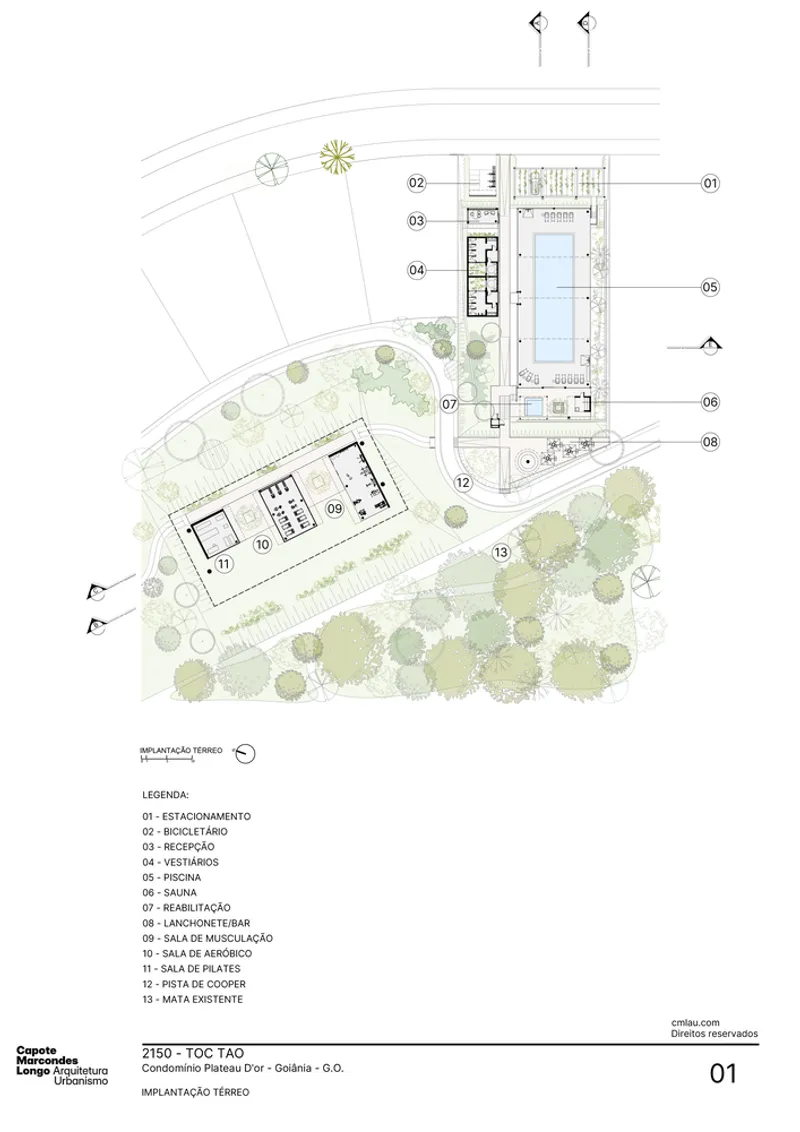
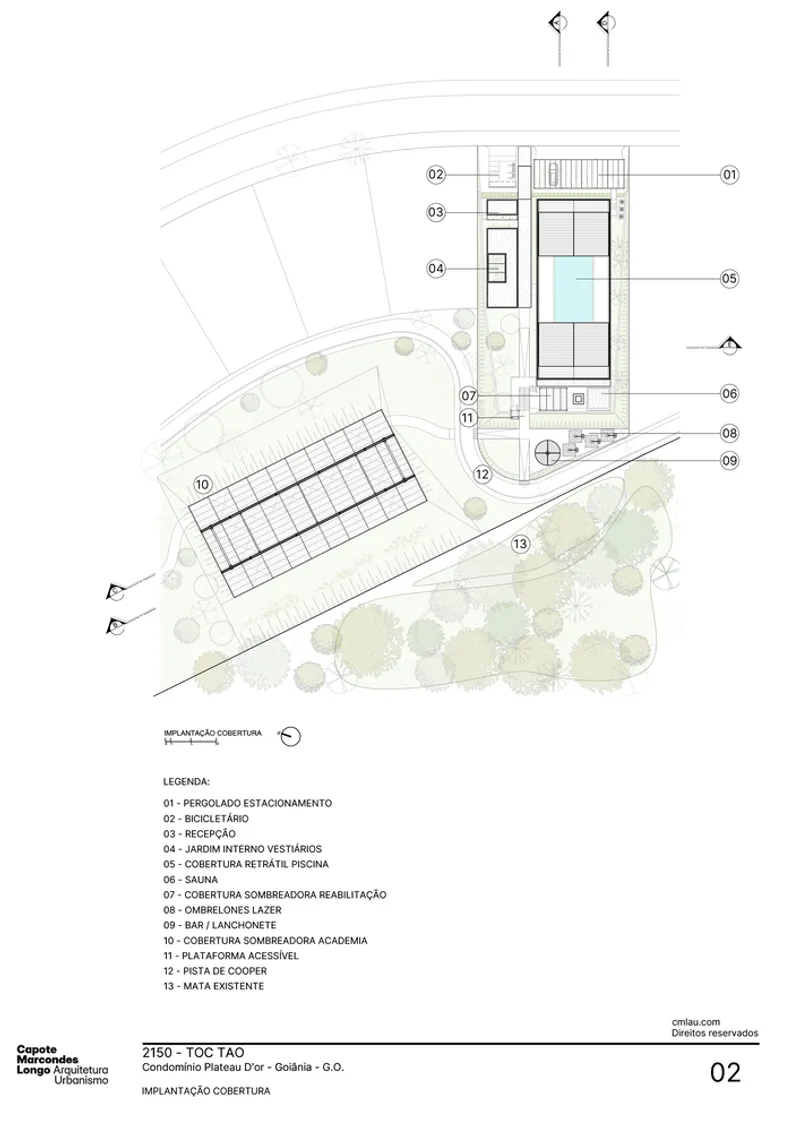
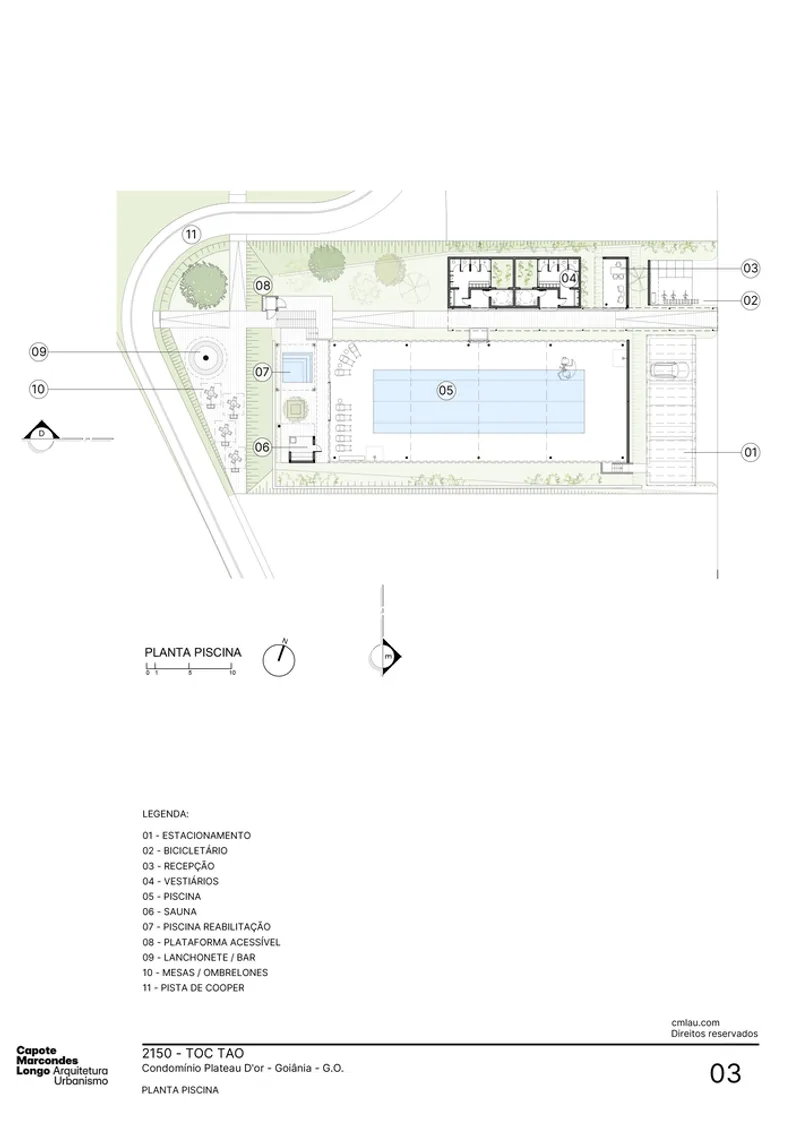
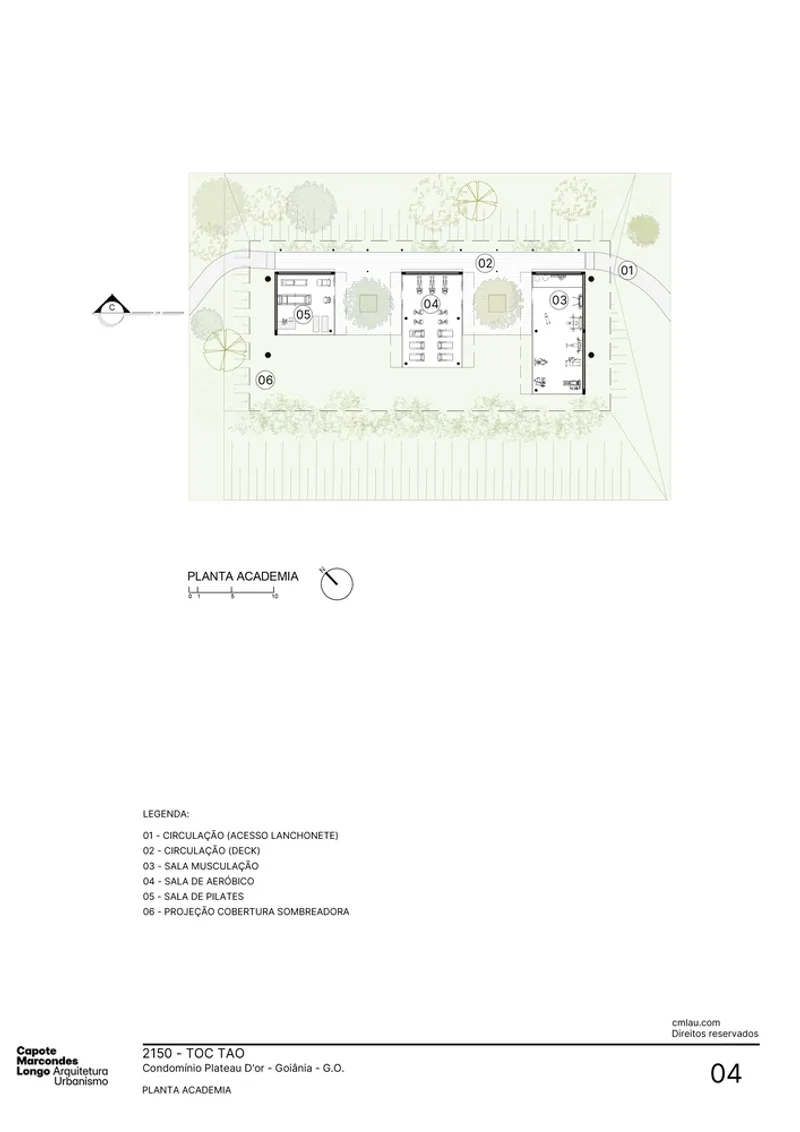
The site plan confirms the angular plot and the deliberate placement of buildings to preserve as many existing trees as possible. The pool pavilion and gym wings occupy distinct zones connected by covered walkways, with parking tucked under a separate canopy grid at the far end. The roof plan reveals the sheer scale of the translucent canopy relative to the enclosed footprint: the covered outdoor area is nearly as large as the conditioned interior. Floor plans of the pool pavilion and gym building show straightforward rectangular rooms, kept simple precisely because the spatial richness comes from the roof, the courtyards, and the landscape between volumes.
Why This Project Matters
Wellness architecture is a crowded category, often defined by marketing language rather than spatial ideas. Plateu D'or matters because it proposes a genuinely different model for fitness buildings: a dispersed campus that privileges landscape, daylight, and ventilation over centralized efficiency. The translucent canopy is the key invention, doing the work of shading, diffusing light, and unifying separate volumes into a single architectural gesture without sealing the spaces off from their surroundings.
The project also demonstrates that sustainability in the Brazilian interior does not have to mean heavy walls and small windows. By treating the roof as a filter and the courtyard as a climate device, the architects achieved a building that is almost entirely open to the outdoors while remaining comfortable year-round. That is a harder trick than it looks, and the precision of the execution, from the column spacing to the planting strategy, is what makes it work.
Plateu D'or Wellness Hub by Capote Marcondes Longo Arquitetura e Urbanismo, Ribeirão Preto, Brazil. Photography by Leonardo Finotti.
About the Studio
Share Your Own Work on uni.xyz
If projects like this are the kind of work you want to make, uni.xyz is a place to publish your own, find collaborators, and enter design competitions.




Popular Articles
Popular articles from the community


Lunar Spiral: Space Architecture Shaped by the Mathematics of the Universe
Lunar Spiral reimagines space architecture through Fibonacci geometry, lunar regolith, levitating habitats, and self-sustaining Moon living.

Co-life: Sustainable Architecture for Age-Friendly Community Living
Co-life reimagines sustainable architecture for seniors through courtyards, rammed earth, shared gardens, and spaces designed for belonging.

The Ocean Hive: Sustainable Architecture for a Self-Sufficient Civilization at Sea
The Ocean Hive imagines sustainable architecture at sea, where modular habitats, algae, wave power and ocean waste sustain a growing colony.

Riyadh For All: Intergenerational Urban Design for Active Aging in Rabat
Riyadh For All reimagines urban design in Rabat with intergenerational co-living, adaptive courtyards, and Moroccan cultural exchange today.


Similar Reads
You might also enjoy these articles


Hodi-Mandai Geram
Project Function: Preservation and revitalization of the Intangible heritage and socio-spatial identity of the Hodi by Housing, Cultural Memory Center, Sacred Grove, landscape, local tourism economy


Olio Towers: A Mid-Rise for Performers That Fuses Housing, Rehearsal, and Stage
Located blocks from Houston's Theater District, this modular tower stacks living units around a central performance atrium.

Oasis: Modular Green Housing Carved into Dhaka's Urban Fabric
A shortlisted Plugin Housing entry reclaims unauthorized settlements in Dhaka with stepped concrete volumes, green roofs, and ventilation-driven design.

Black Hole: A Floating Megastructure for the Post-Physical Era
Emiliano Mazzarotto envisions a spherical, self-scaling arena where e-sports, digital hotels, and holographic stadiums replace traditional public space.

Explore Architecture Competitions
Discover active competitions in this discipline



Challenge to reimagine the Iron Throne


Photograph architecture without architects


Illustrate the lost glory of Angkor Wat - Render Challenge


Design challenge to reuse E-waste
Comments (0)
Please login or sign up to add comments
No comments yet. Be the first to comment!