
Isla Architects Carve a Courtyard Into a Mallorcan Terrace House to Build the Mila House
In Esporles, Mallorca, the acquisition of a sliver of adjacent land unlocks light, air, and a guest house for a mid-terrace home.


Most renovation stories begin and end within the four walls you already own. Mila House, completed in 2024 by Isla Architects in the small Mallorcan town of Esporles, began the same way, as an interior refresh of a mid-terrace home wedged between a street and an alley. Then the architects did something that changed everything: they bought the neighboring plot, a strip of land 25 meters long and only 2.5 meters wide. That skinny acquisition cracked the house open, introducing a courtyard where there had been none and turning a dark, edge-to-edge dwelling into a compound of interconnected volumes awash in Mediterranean light.
What makes Mila House genuinely instructive is how it treats that narrow plot not as leftover space but as the engine of the entire project. The courtyard it creates reorients the house, pulling the kitchen toward it, flooding upper rooms through a catalog of aperture types, and providing the footprint for a tiny, self-contained guest house. The material palette is deliberately restrained: lime mortar, green-painted carpentry, and a custom Palladian floor of irregularly placed tiles that stitches old and new together. Every move here serves a double purpose, solving a functional problem while reinforcing a coherent aesthetic language rooted in local Mallorcan tradition.
A Courtyard Born from a Sliver of Land

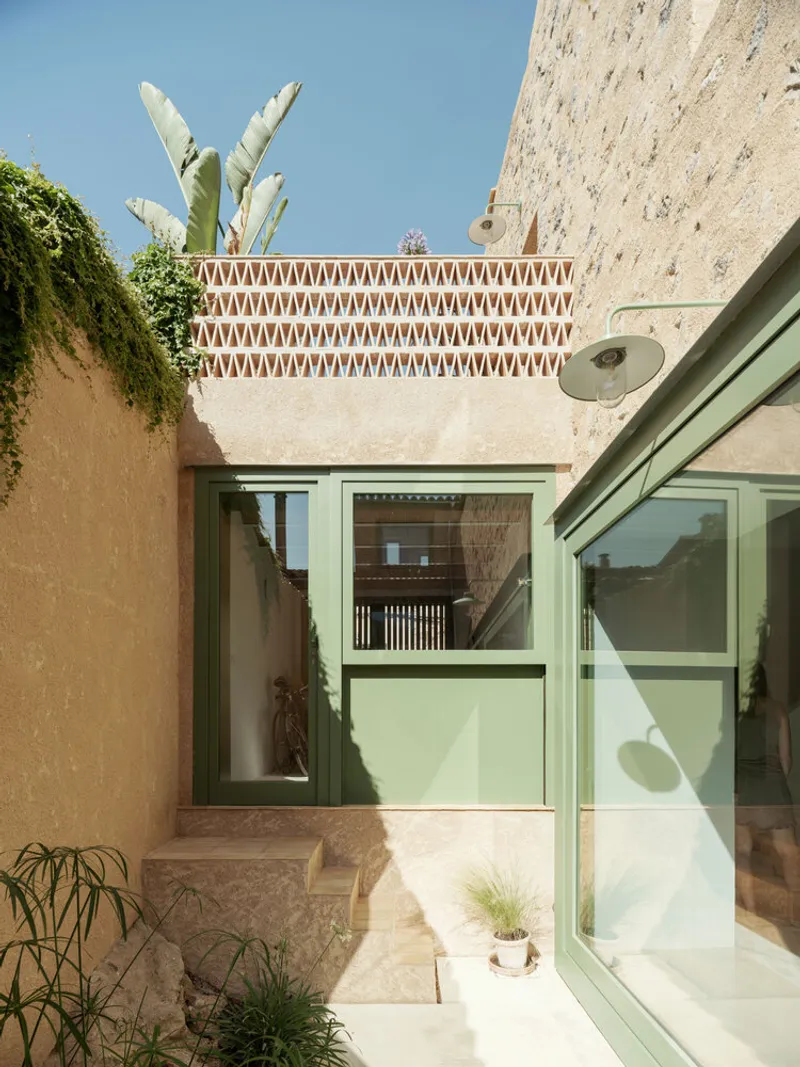

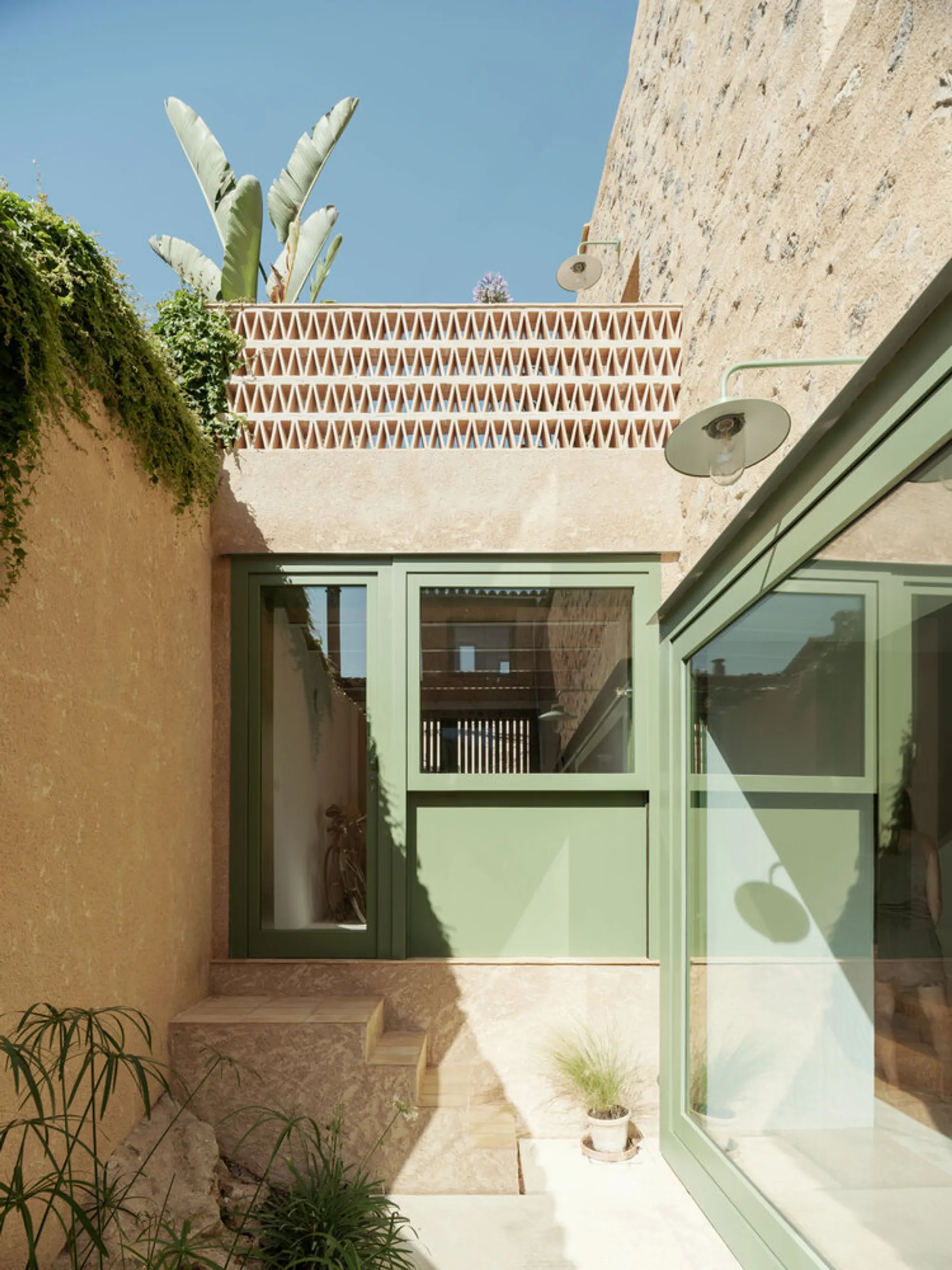
The courtyard is the fulcrum of the project. Before the adjacent plot was acquired, the house had no meaningful outdoor space and little cross-ventilation. Now, a planted void separates the main dwelling from the guest house and garage-studio, creating views, breezes, and a communal heart for the compound. Stone walls from the original construction meet new green-framed glazing and terracotta parapets, establishing a dialogue between textures and eras.
Banana plants, grasses, and potted greenery soften the hard edges without turning the space into a decorative garden. The courtyard works primarily as architecture, not landscaping: it is the mechanism by which the house breathes. Sliding doors from the kitchen and dining area open directly onto it, collapsing the boundary between inside and out in a gesture that is entirely natural for this climate.
A Catalog of Openings
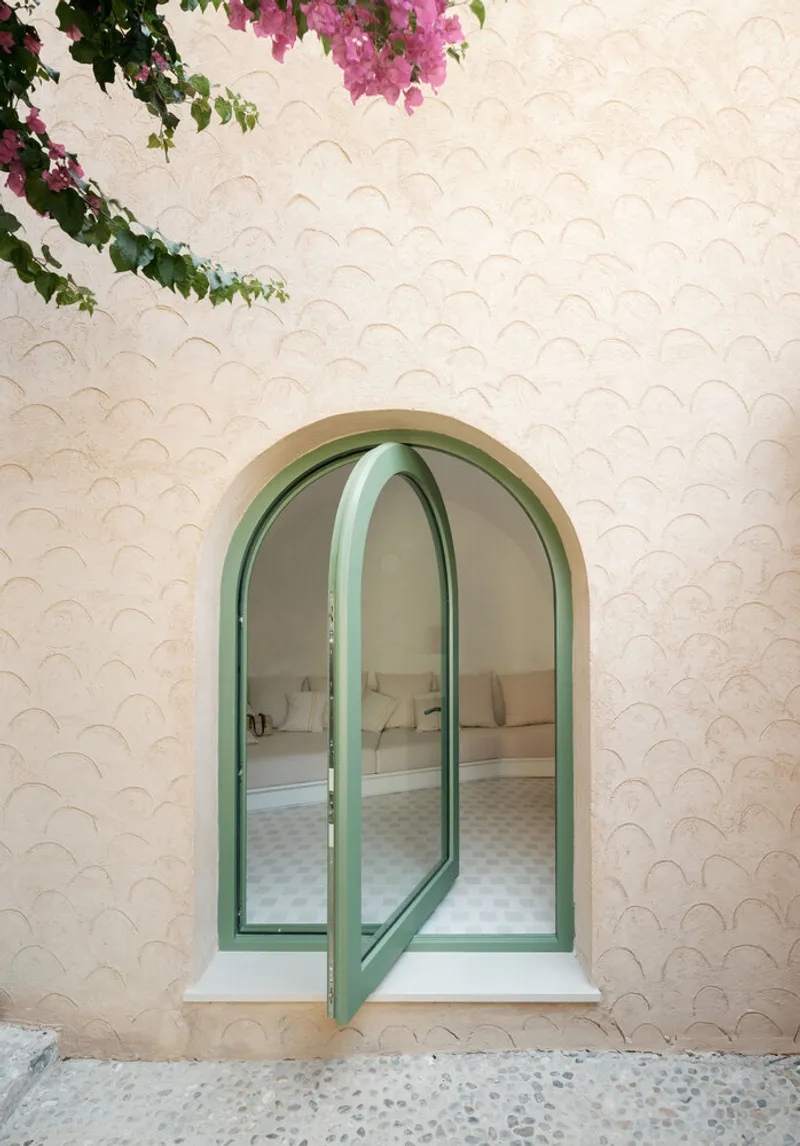


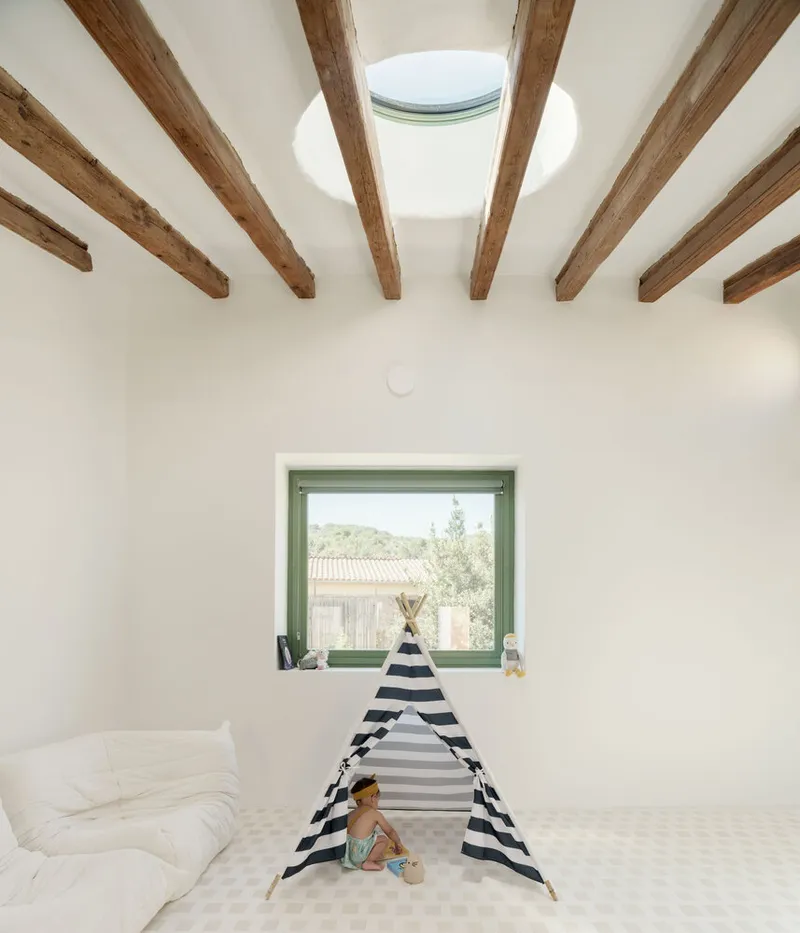
Isla Architects describe the project as an exploration of every possible way to bring light into a home, and the evidence is convincing. Circular skylights punch through roof planes, their green-edged glazing registering as precise incisions in the clay tile roofscape. Arched French doors reference the island's vernacular while pushing daylight deep into vaulted interiors. Guillotine windows, liftable panes, and flush sliding panels round out an inventory of aperture types that would be excessive if each one didn't solve a specific problem of orientation, ventilation, or privacy.
The variety avoids monotony. Rather than repeating a single window module, the architects calibrated each opening to its location: a large arch where a room faces the courtyard, a small oculus where overhead light is the only option, a slatted shutter where the street demands discretion. The result is a house that feels animated throughout the day as light shifts through its many apertures.
Green Carpentry as Connective Thread
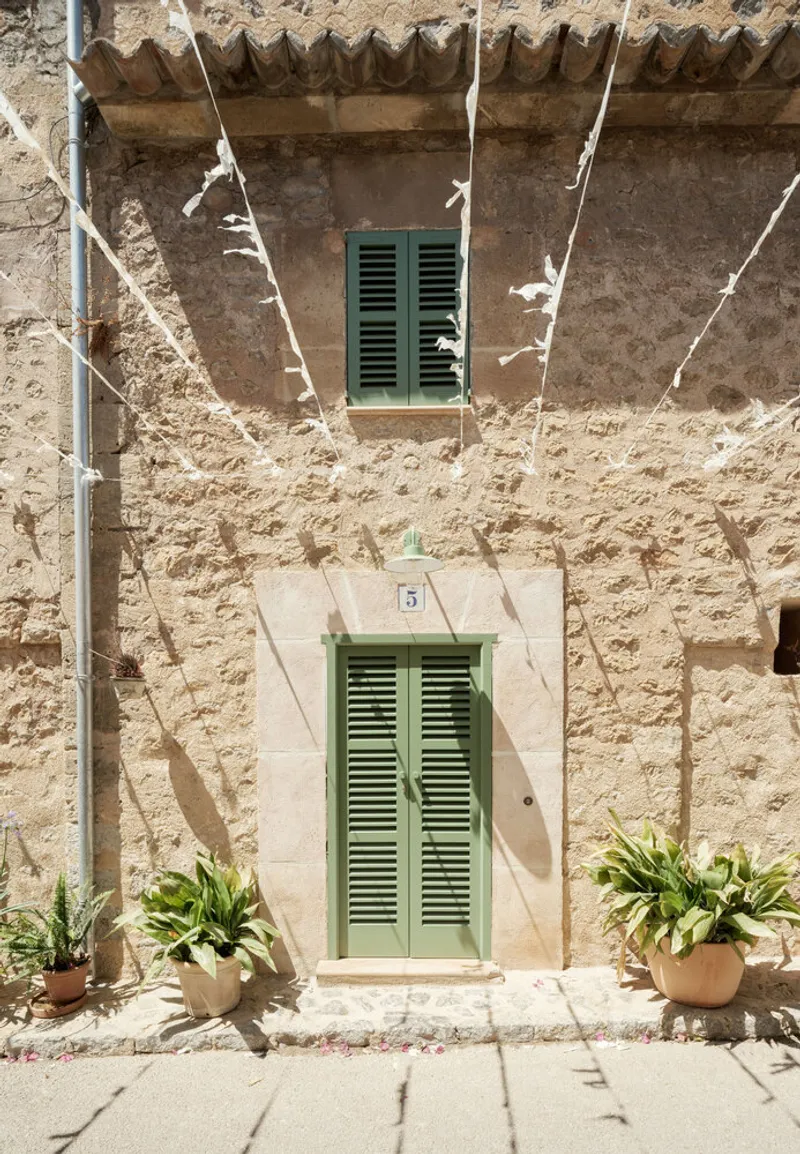
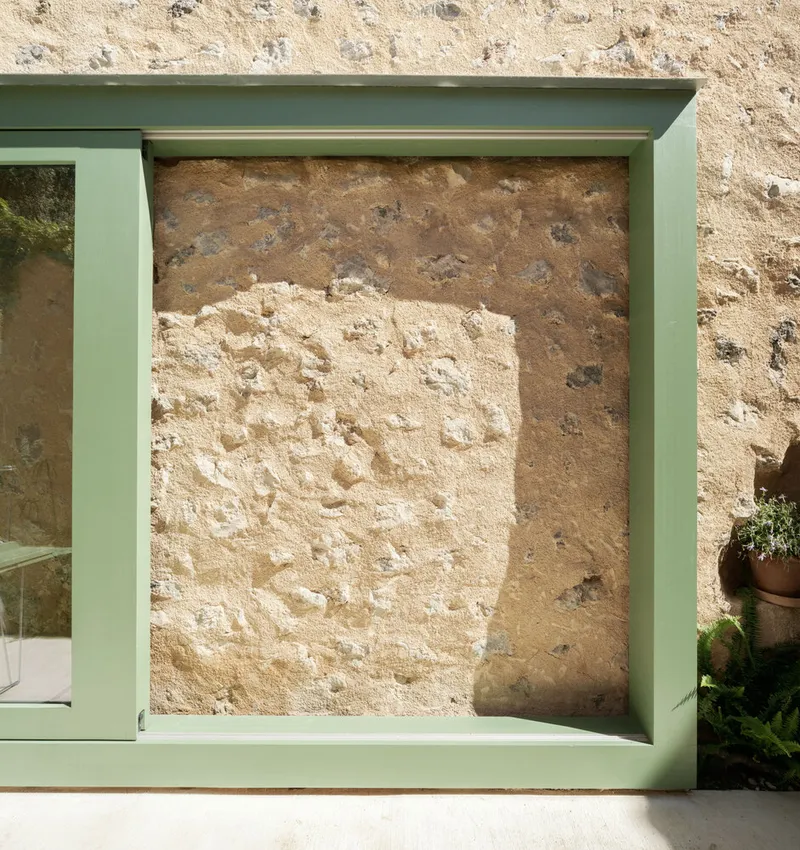

The decision to paint all carpentry in a single shade of green is a simple move with outsized impact. Shutters, door frames, window casings, gates, and even the kitchen cabinetry share this color, creating a visual thread that unifies a project scattered across multiple volumes. Against the pale lime mortar and raw stone of the facades, the green reads as both traditional and deliberate, recalling the painted timber details found across Mallorcan village architecture.
Seen from the street, the louvered shutters and terracotta cornice give nothing away. The house is polite, neighborly, entirely in keeping with the rhythm of Esporles. It is only once you step through the slatted gate and into the courtyard that the full scope of the intervention becomes legible. The architects understood that in a village context, restraint on the exterior is not conservatism but respect.
Reworking the Interior Sequence
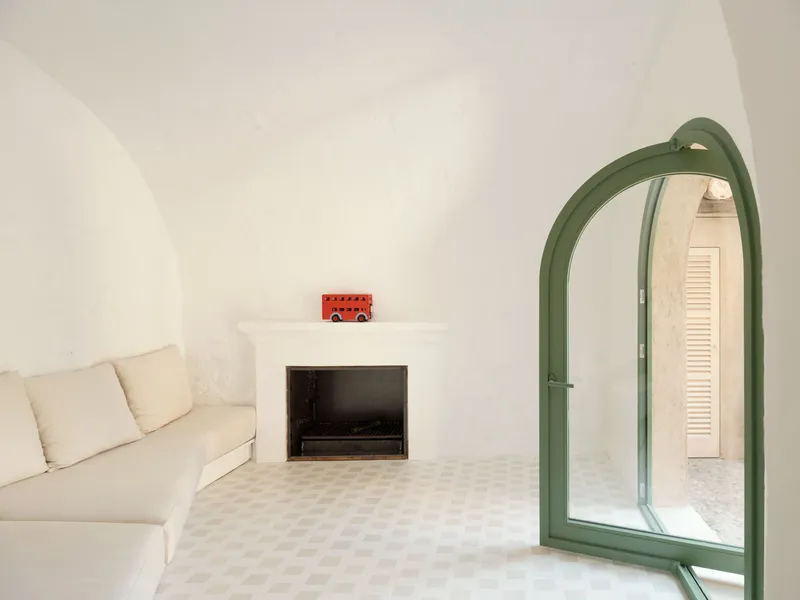
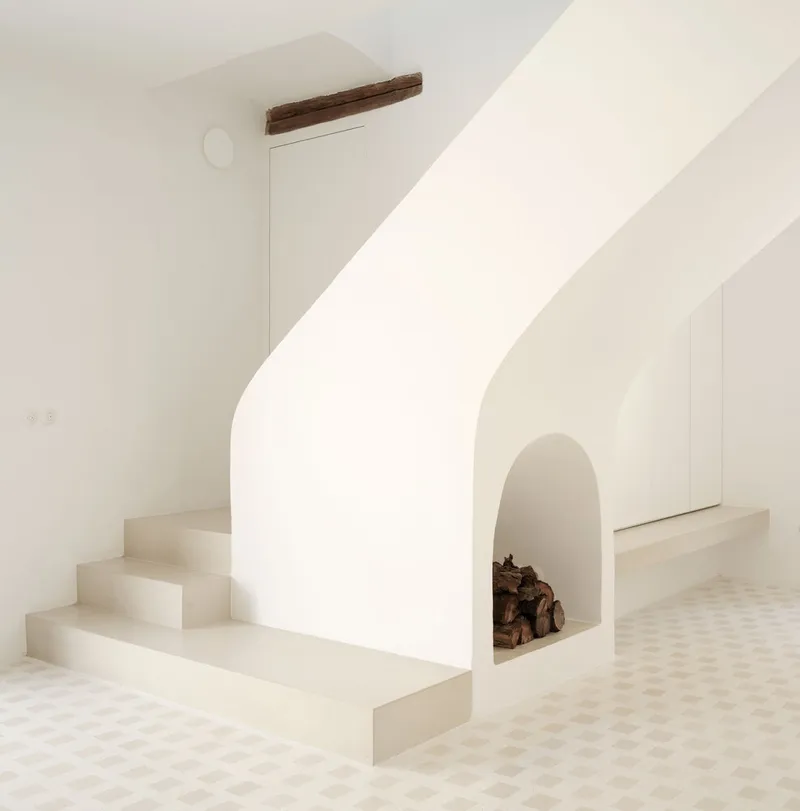

Inside the main house, the spatial reorganization is substantial. The old garage has been turned into a living room that opens onto the alley, and the kitchen has migrated to the courtyard side, where it spans the full width of the house. Upstairs, a playroom receives overhead light through a circular skylight, and bedrooms stack above in a compact vertical arrangement connected by new staircases.
Vaulted ceilings and arched niches give the interiors a sculptural quality that reads as Mallorcan rather than imported. A recessed fireplace at the base of a curved staircase is a particularly elegant detail, turning a circulation element into a domestic hearth. The white metal mesh balustrade on the stair strikes one of the project's few overtly contemporary notes, its industrial transparency contrasting with the solidity of lime-rendered walls.
The Guest House and Its Chiringuito Kitchen
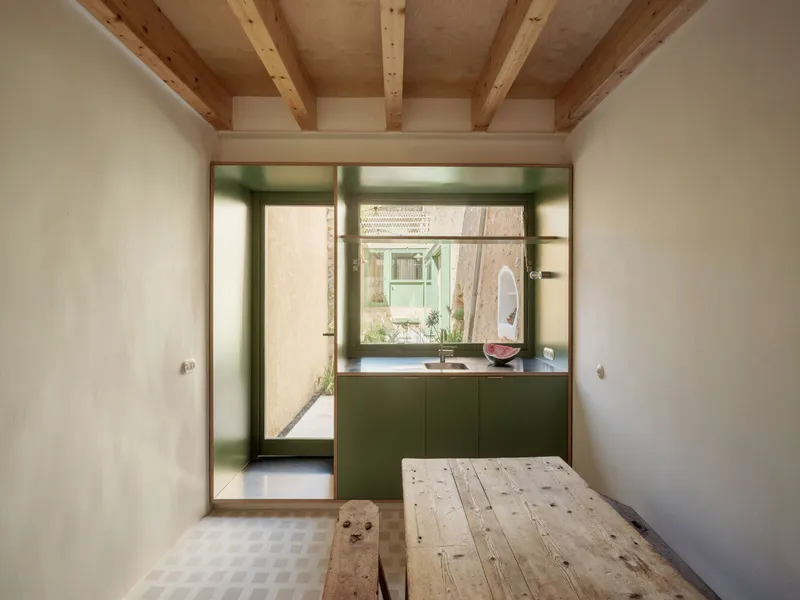
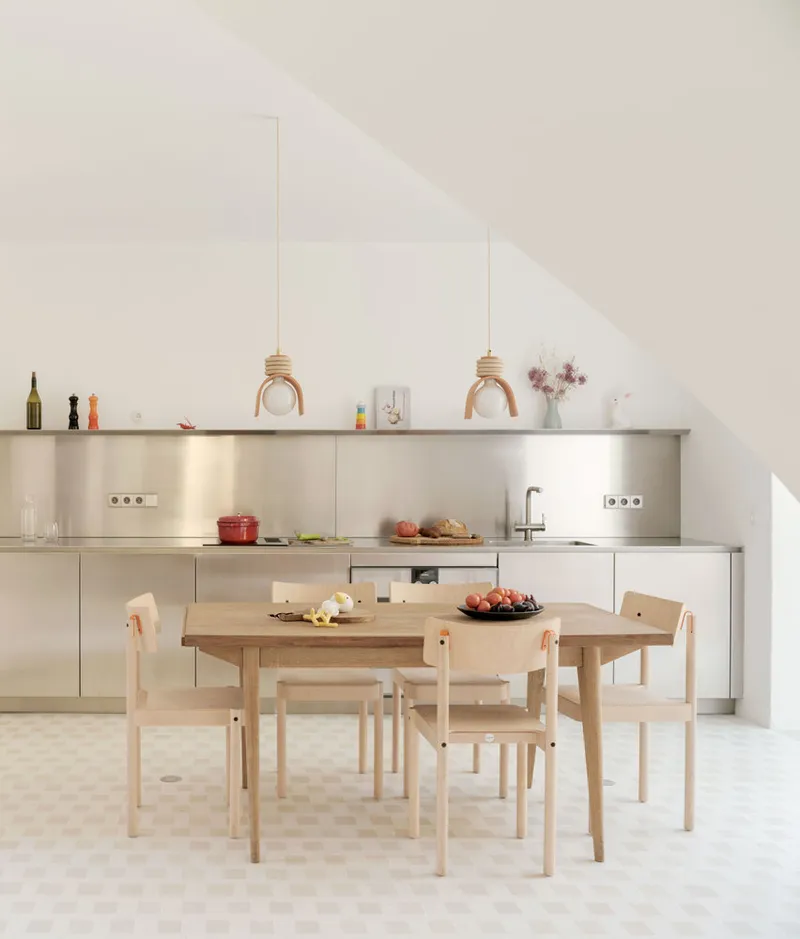
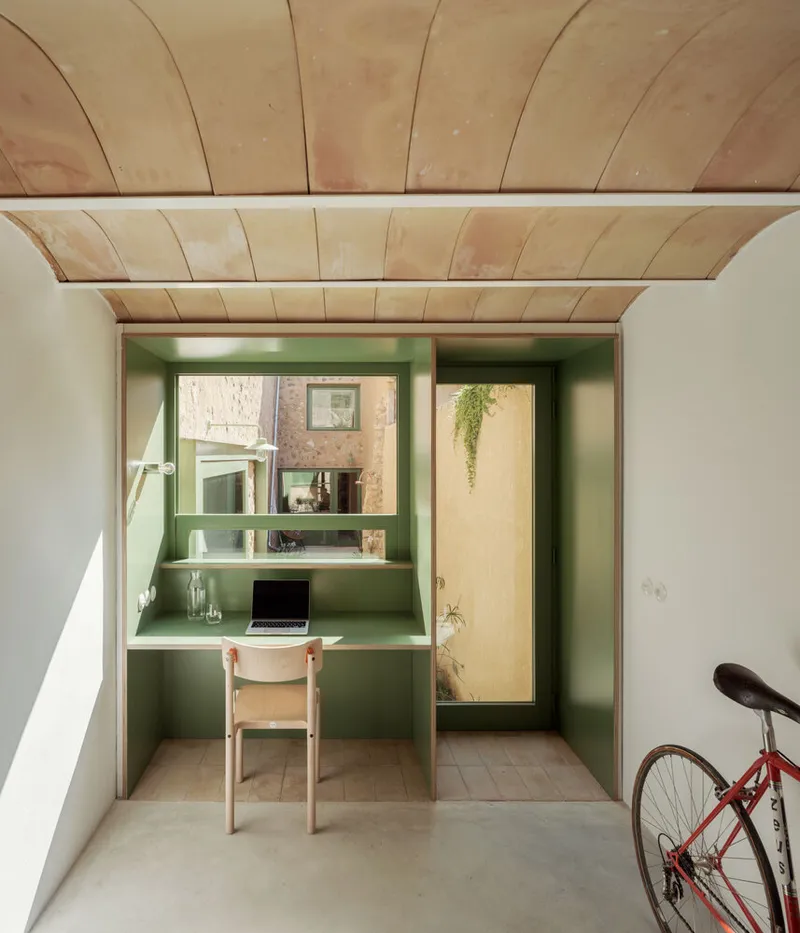
The guest house occupies the full 2.5-meter width of the adjacent plot, a dimension that forces the architecture into ingenuity. The kitchen, fitted with green cabinetry and an integrated sink framed by a timber opening, doubles as a "chiringuito," a beachside bar, via a liftable window that opens directly to the courtyard. It is a charming, practical gesture that acknowledges how life in Mallorca gravitates outdoors.
Upstairs, a double-height bedroom exploits the narrowness of the plan to create unexpected volume. A built-in desk alcove with green shelving beneath a curved plywood ceiling, and a bicycle parked casually alongside, suggest that this tiny dwelling is designed for real habitation, not just overnight guests. The southern end resolves neatly with a linear bathroom slotted between staircase and corridor, wringing every useful square foot from the strip.
Material Restraint and the Palladian Floor
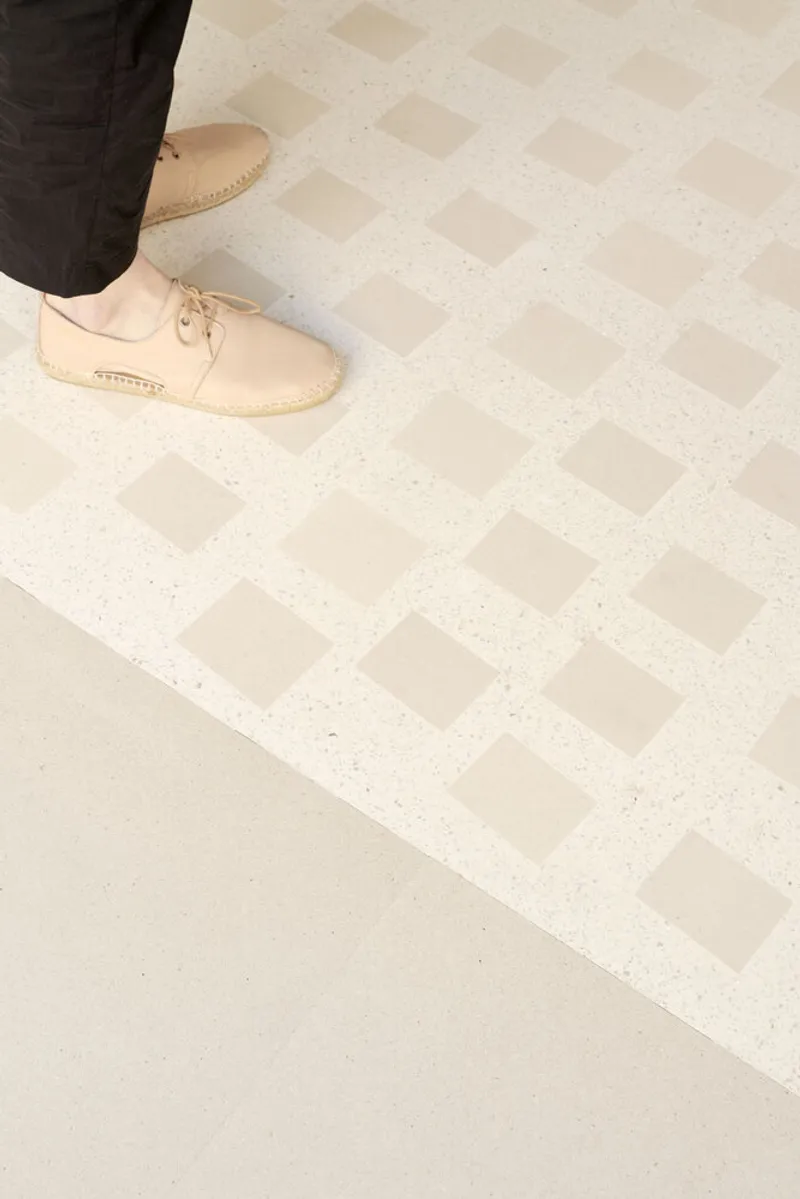
The material palette of Mila House can be described in three phrases: lime mortar, green carpentry, custom Palladian floor. The mortar shifts in character depending on where it is applied: smooth and white inside, earthy and textured on the facades. The floor, developed specifically for this project using locally made tiles, features a checkerboard of smooth and textured cream pieces placed with deliberate irregularity. It is the element that does the most work to unify the disparate spaces of the compound, flowing from the main house through the courtyard connection and into the guest house.
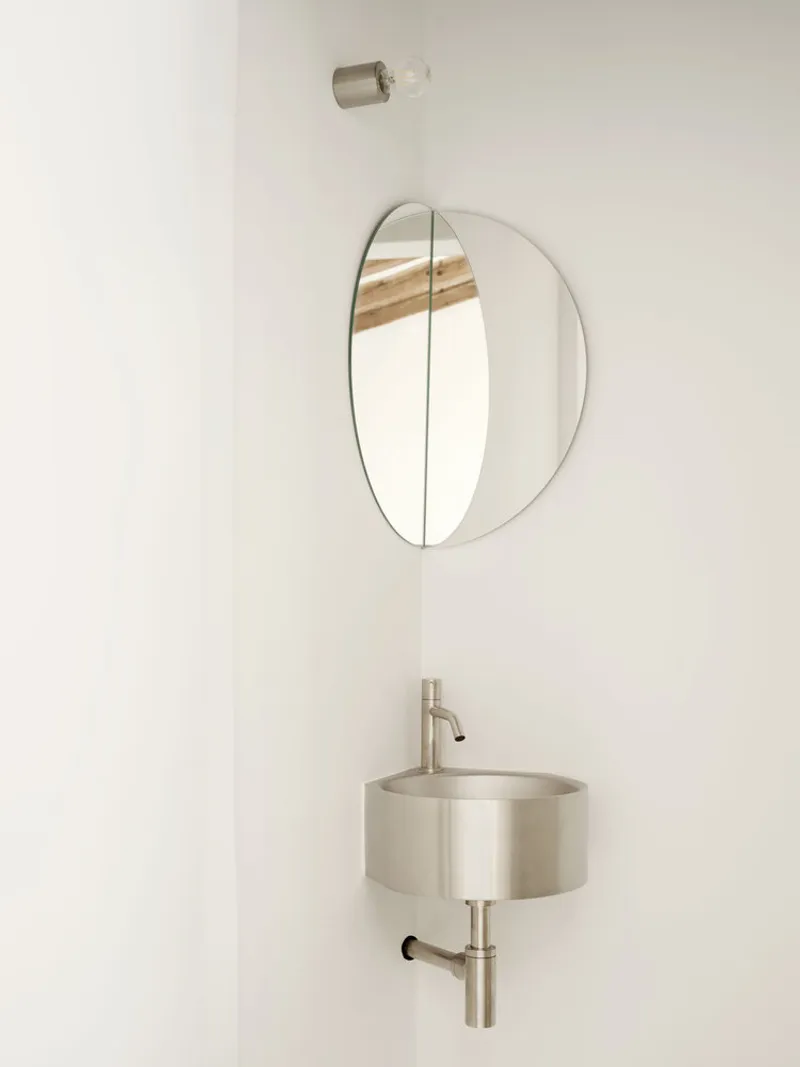
Fittings are equally considered. A wall-mounted round basin with brass fixtures and an oval mirror turns a small bathroom into a composition. Exposed timber ceiling beams, left unpainted, provide warmth and rhythm overhead. Nothing here is expensive for the sake of it. The luxury is spatial, not material, and that distinction matters when the subject is renovation and sustainability.
Street Presence and Village Context
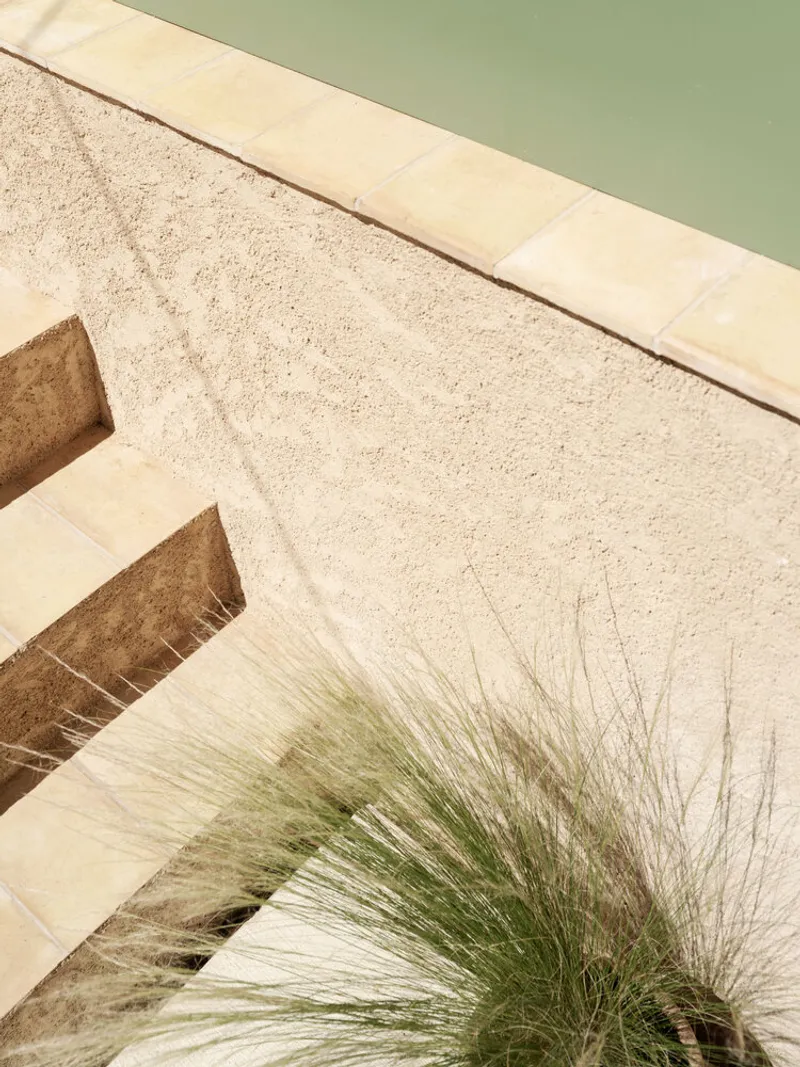
A stone stair with a tuft of grass growing beside a pale green wall; a scale-patterned white facade crowned by pink bougainvillea; louvered shutters catching dappled tree shadows. These moments are not incidental. They demonstrate how carefully Isla Architects calibrated the project's relationship to the village of Esporles, where narrow streets and dense building fabric demand a certain modesty.
The renovation never announces itself from the public realm. There is no cantilevered volume, no expanse of floor-to-ceiling glass, no rupture in the streetwall. The ambition is all internal, directed toward the courtyard and the sky. It is a strategy that more renovation projects in historic Mediterranean towns would do well to study.
Plans and Drawings

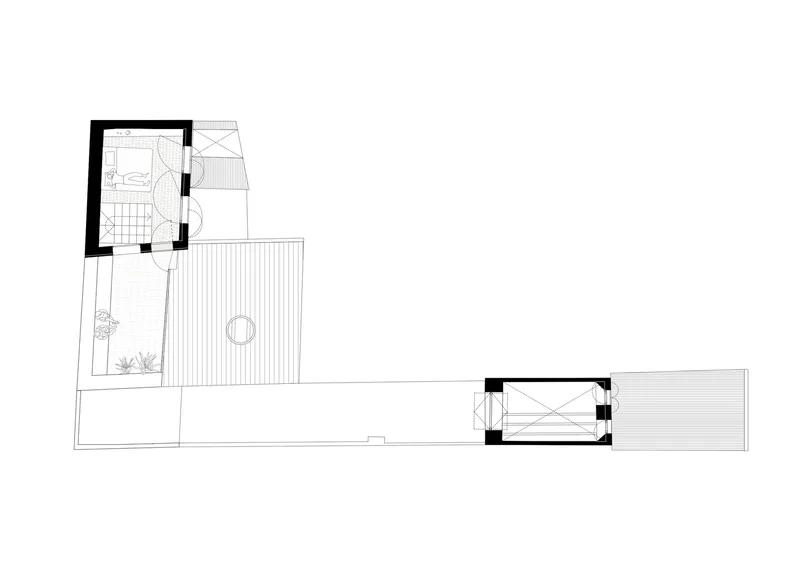
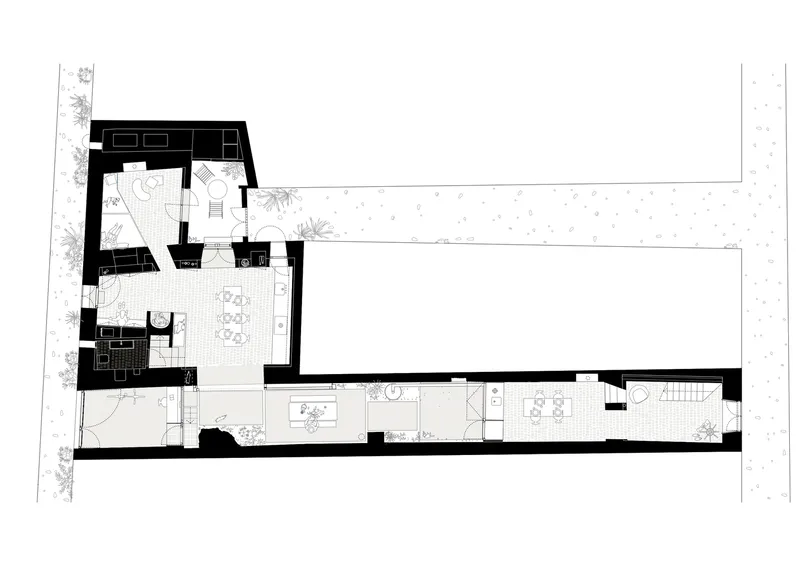
The floor plans reveal the project's essential logic. The L-shaped main house wraps the courtyard on two sides, while the narrow guest house occupies the adjacent plot along its full length. A covered terrace, planted perimeter beds, and an outdoor deck populate the gap between the two structures, demonstrating that the courtyard is not residual space but programmed territory. The multi-level drawing shows how the architects stacked rooms vertically in both buildings to compensate for the tight footprints, using internal staircases and half-levels to compress a generous amount of program into roughly 2,800 square feet.
Why This Project Matters
Mila House is a renovation that succeeds because it rewrites the site before it rewrites the building. The purchase of the adjacent strip was not a luxury but a strategic necessity, and everything downstream, the courtyard, the guest house, the garage-studio, the dozens of carefully varied openings, flows from that initial act of expansion. It is a reminder that the boundaries of a renovation project are not always fixed, and that sometimes the smartest design move happens at the property line.
Beyond its spatial ingenuity, the project offers a convincing model for sustainable renovation in Mediterranean villages. By limiting the material vocabulary to lime mortar, green carpentry, and locally made flooring, Isla Architects kept the carbon footprint low and the craft quality high. The result is a home that feels as though it has always belonged to Esporles while quietly demonstrating how much ambition a terrace house can absorb without losing its composure.
Mila House by Isla Architects. Esporles, Mallorca, Spain. 2,809 sq ft. 2024. Photography by Luis Díaz Díaz.
About the Studio
Share Your Own Work on uni.xyz
If projects like this are the kind of work you want to make, uni.xyz is a place to publish your own, find collaborators, and enter design competitions.




Popular Articles
Popular articles from the community

EW PARK: Sustainable Architecture Reimagines the Future of Urban Parking
EW PARK reimagines city parking as a modular wooden tower combining automation, solar energy, electric mobility, and adaptable urban design.

AL-JANNAH: Sustainable Architecture and Permaculture for Afghan Widows
AL-JANNAH uses sustainable architecture and permaculture to create resilient oasis of housing, learning, work and renewal for Afghan widows.

The Ocean Hive: Sustainable Architecture for a Self-Sufficient Civilization at Sea
The Ocean Hive imagines sustainable architecture at sea, where modular habitats, algae, wave power and ocean waste sustain a growing colony.

Conexión: Biophilic Design Reimagines High-Rise Living in Hong Kong
Conexión reimagines high-rise living in Hong Kong through biophilic design, green facades, shared spaces, daylight, water and nature within.


Similar Reads
You might also enjoy these articles


Hodi-Mandai Geram
Project Function: Preservation and revitalization of the Intangible heritage and socio-spatial identity of the Hodi by Housing, Cultural Memory Center, Sacred Grove, landscape, local tourism economy


Olio Towers: A Mid-Rise for Performers That Fuses Housing, Rehearsal, and Stage
Located blocks from Houston's Theater District, this modular tower stacks living units around a central performance atrium.

Oasis: Modular Green Housing Carved into Dhaka's Urban Fabric
A shortlisted Plugin Housing entry reclaims unauthorized settlements in Dhaka with stepped concrete volumes, green roofs, and ventilation-driven design.

Black Hole: A Floating Megastructure for the Post-Physical Era
Emiliano Mazzarotto envisions a spherical, self-scaling arena where e-sports, digital hotels, and holographic stadiums replace traditional public space.


Explore Architecture Competitions
Discover active competitions in this discipline



Challenge to reimagine the Iron Throne


Photograph architecture without architects


Illustrate the lost glory of Angkor Wat - Render Challenge


Design challenge to reuse E-waste
Comments (0)
Please login or sign up to add comments
No comments yet. Be the first to comment!