
Biome Environmental Solutions Rethinks a Bangalore Home as a Layered Courtyard Dwelling
A multi-storey renovation in Bangalore replaces a closed facade with planted terraces, slatted timber, and a central courtyard that pulls light deep into t


Renovations rarely get the editorial attention they deserve. New builds let architects project personality onto a blank canvas, but reworking an existing structure demands something harder: the discipline to subtract, the restraint to leave things alone, and the creativity to reimagine circulation and light within a fixed envelope. Biome Environmental Solutions, the Bangalore practice led by Chitra Vishwanath, took on exactly that challenge with Shruthi and Sunith's house, transforming a closed, introverted residence into a layered courtyard dwelling that breathes.
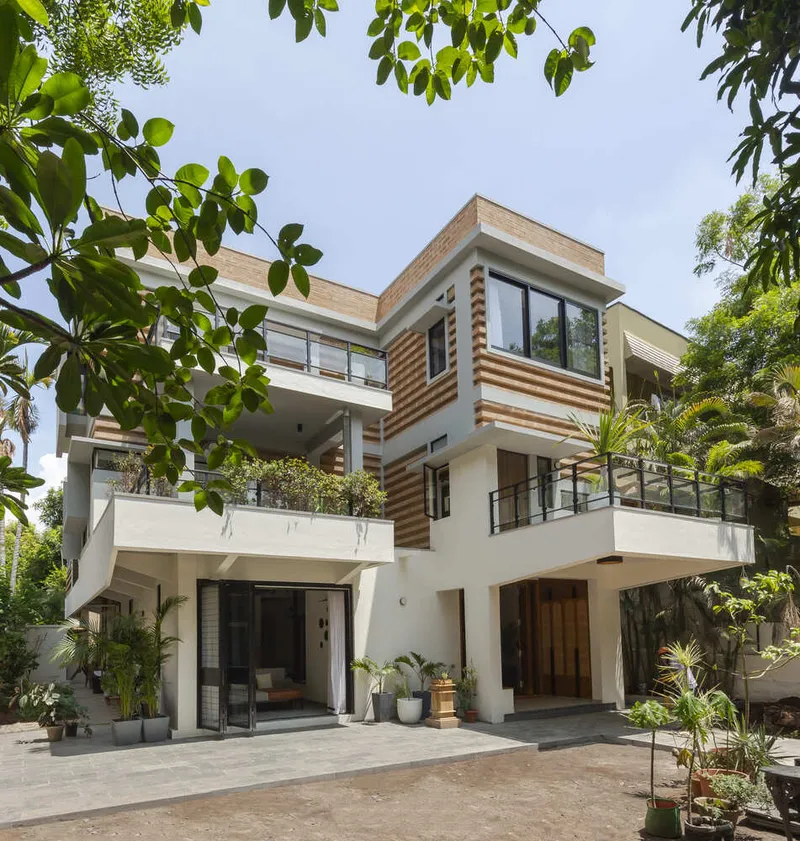
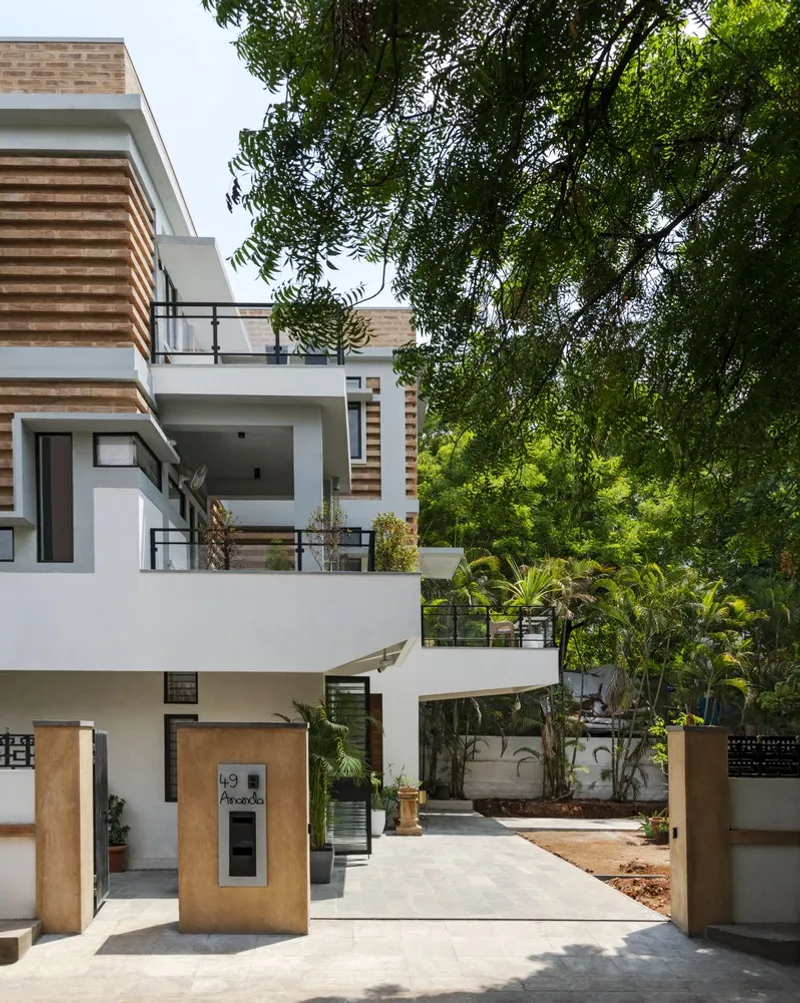
The before and after comparison tells the story plainly: what was once a flat, unremarkable street facade becomes a composition of horizontal timber banding, stacked balconies dense with planters, and white stucco panels that break the mass into legible layers. But the real work happened behind the facade, where Biome carved out a central courtyard and reorganized four floors around natural ventilation, daylight, and a staircase that functions as a vertical spine connecting the family's daily life.
A Facade That Earns Its Complexity
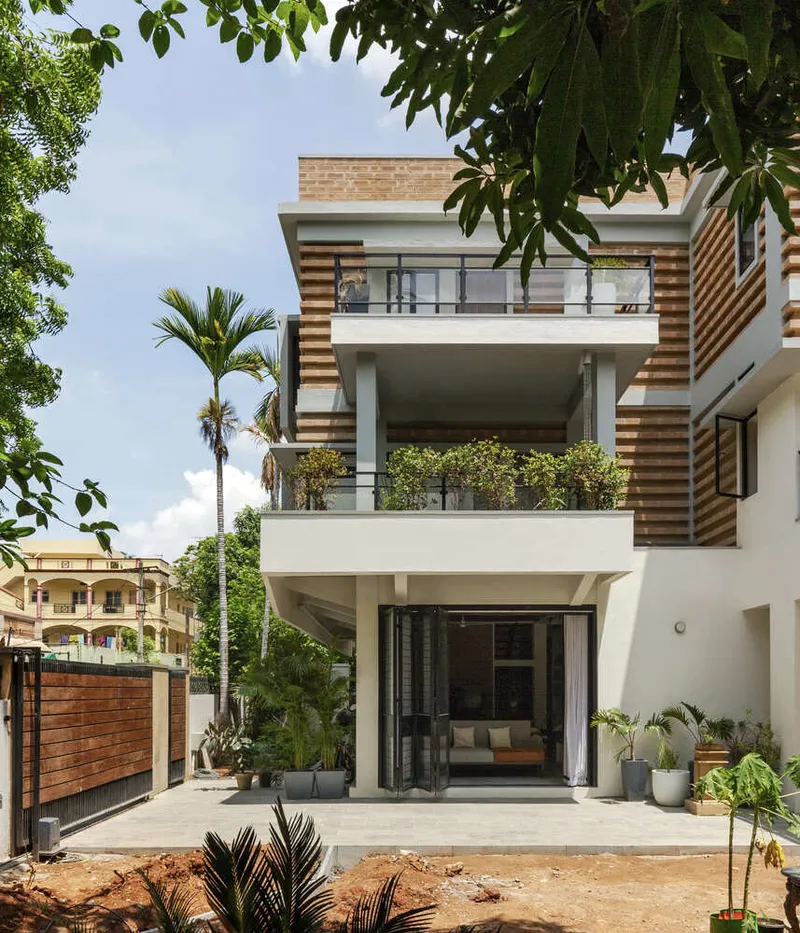


From the street, the house reads as a series of horizontal registers: white stucco fields alternate with bands of timber cladding, and projecting balconies with metal railings create deep shadows that shift through the day. Palms and other planting at multiple levels soften the edges and integrate the building into its neighborhood canopy. The composition avoids the monotony that plagues many multi-storey urban houses in Bangalore by breaking the elevation into distinct episodes, each with its own depth and material logic.
The side elevation reveals even more: stacked terraces with horizontal wood slat detailing create a rhythm of solid and void that allows air to pass through while maintaining privacy. It is a passive environmental strategy dressed in the language of craft, and it works precisely because the timber louvres are not decorative appliqué but functional elements that modulate light and ventilation.
The Courtyard as Engine
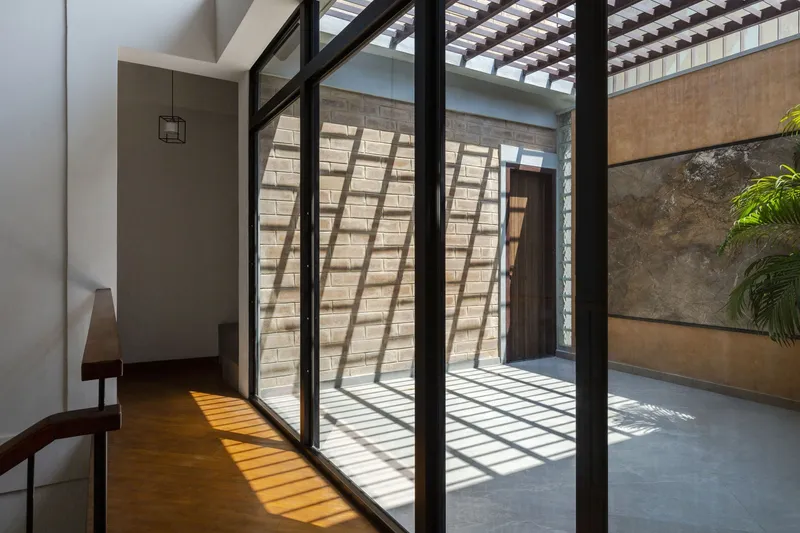
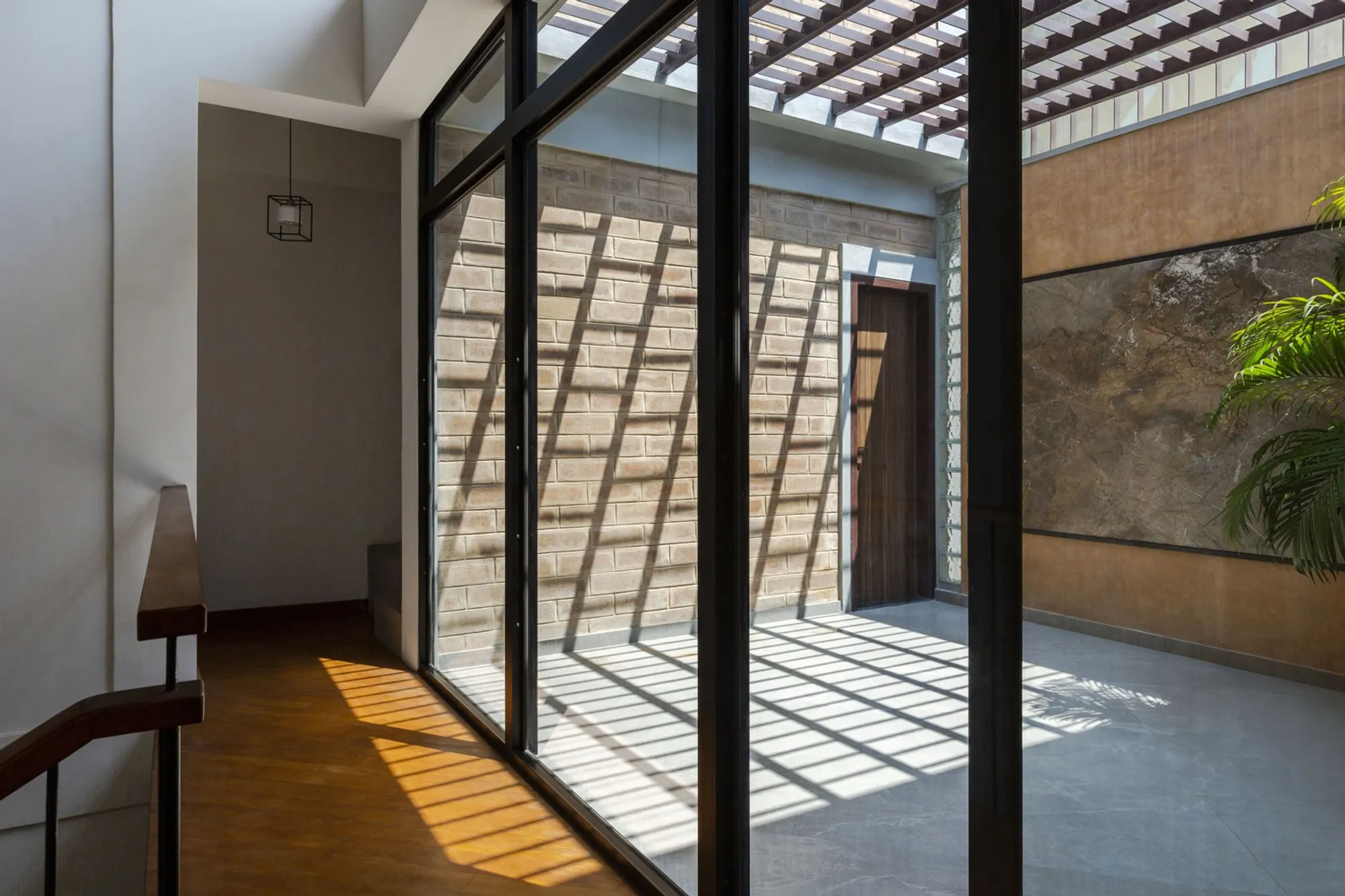
The courtyard is the move that transforms this house from a stack of rooms into an inhabited ecosystem. At the entry level, planted terraces and glass doors open onto a shaded space where a slatted pergola casts striped shadows across the floor, turning direct sunlight into a pattern that shifts with the hours. This is not a token light well; it is the primary organizing element of the plan, separating the two built volumes and providing every adjacent room with cross-ventilation and borrowed daylight.
Looking upward through the courtyard, you see the stacked terraces and overhanging tree canopy that give the house its vertical garden quality. Biome's insistence on integrating planting at every level means the courtyard's microclimate improves as you ascend, with each terrace contributing shade and evaporative cooling to the floors below. It is a simple thermodynamic argument made tangible through landscape.
Staircase as Spectacle
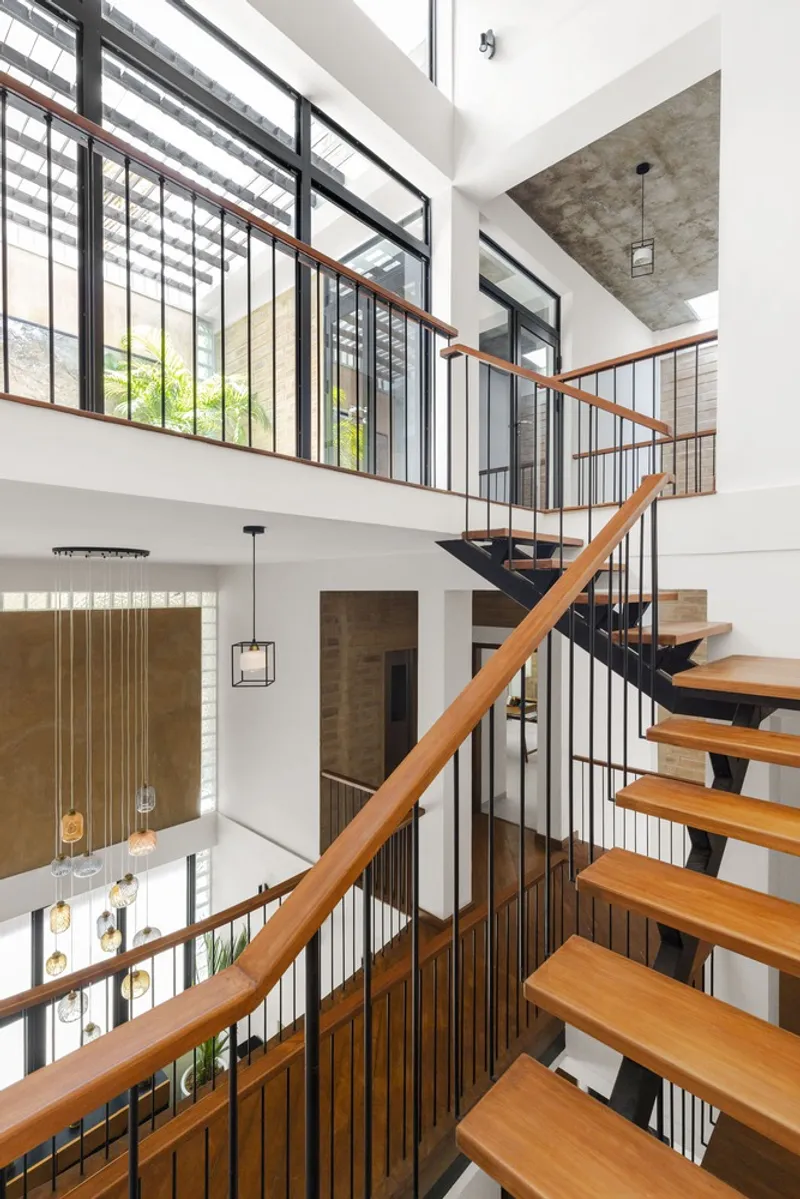
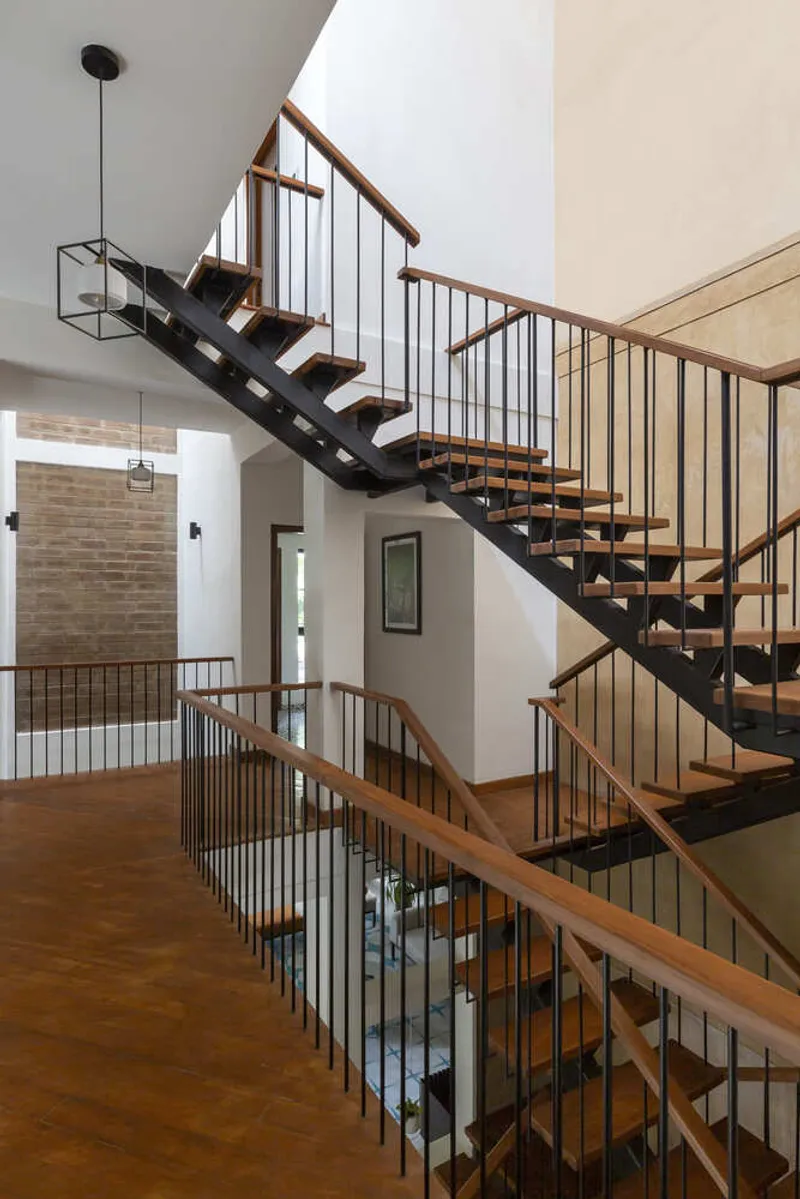
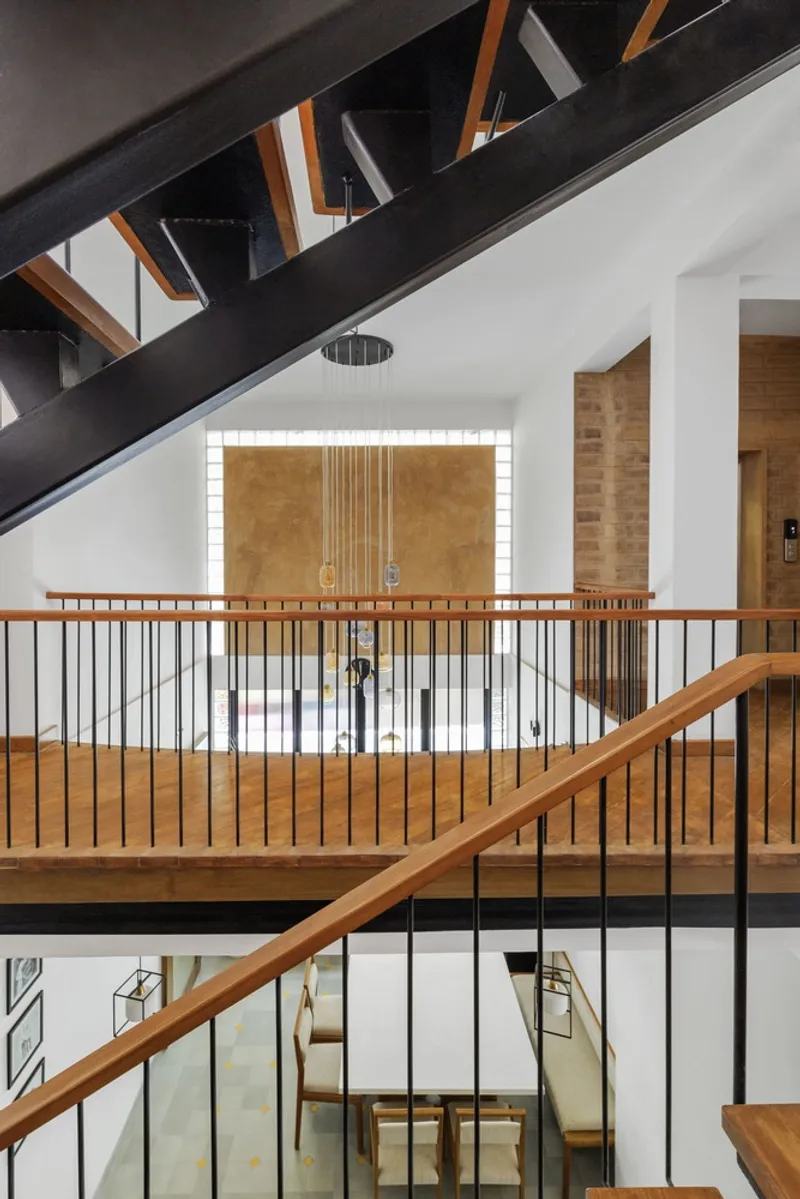
The double-height stairwell is the most spatially generous moment in the house. Timber treads float on black steel stringers beneath a slatted skylight that washes the entire volume in diffused light. The staircase functions as a chimney for warm air, pulling it upward and out through the roof opening, so its drama is not merely visual but thermodynamic. Biome has a track record of treating stairs as the lungs of a building, and this example is one of their most refined.
From the upper landing, a view through the railing frames a backlit brick wall and a pendant chandelier, creating a moment of compressed depth that rewards the climb. The interplay of steel, timber, and masonry here is restrained: three materials, each doing a distinct structural or finish job, none competing for attention.
Living Spaces That Invite Use
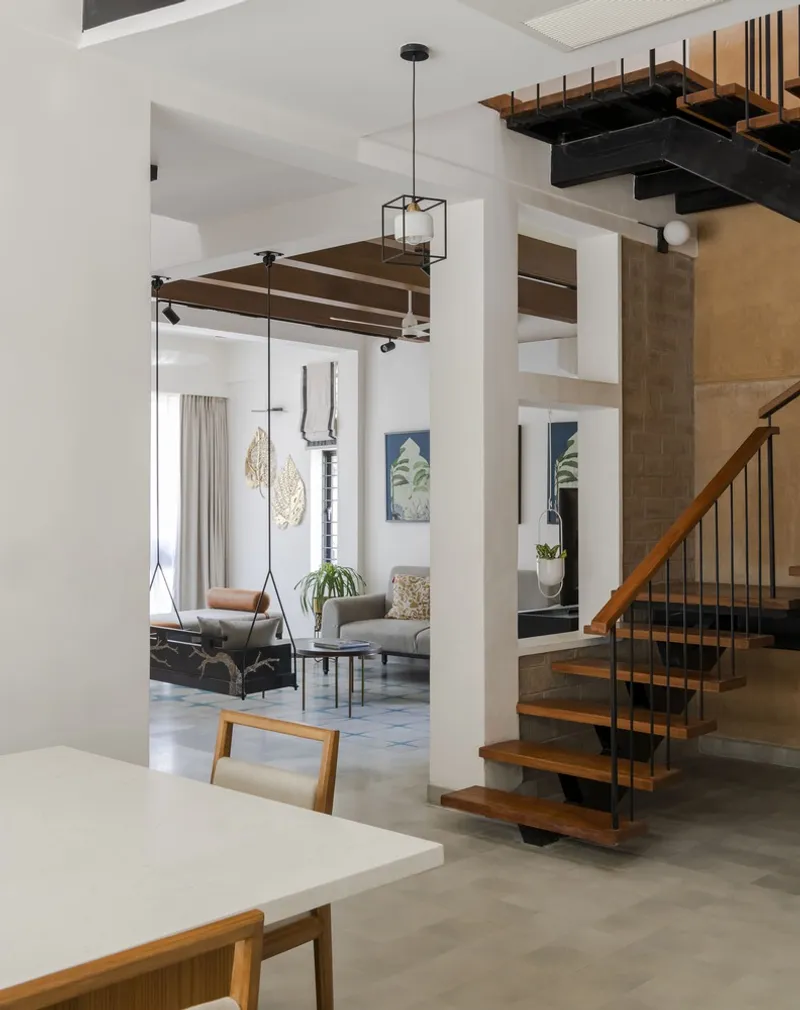
The open-plan living area downstairs is defined by the staircase on one side and a suspended swing chair and monkey bar on the other. These playful insertions signal that the house is designed for a family that actually lives in its spaces rather than curating them for photographs. The swing chair hangs from a structural beam, making it a permanent fixture rather than a styling prop, and the monkey bar suggests children's play was woven into the spatial brief from the start.
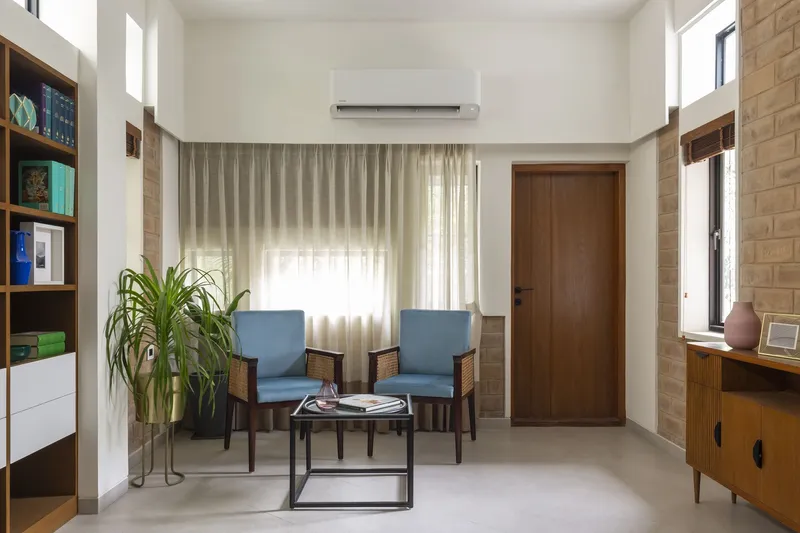
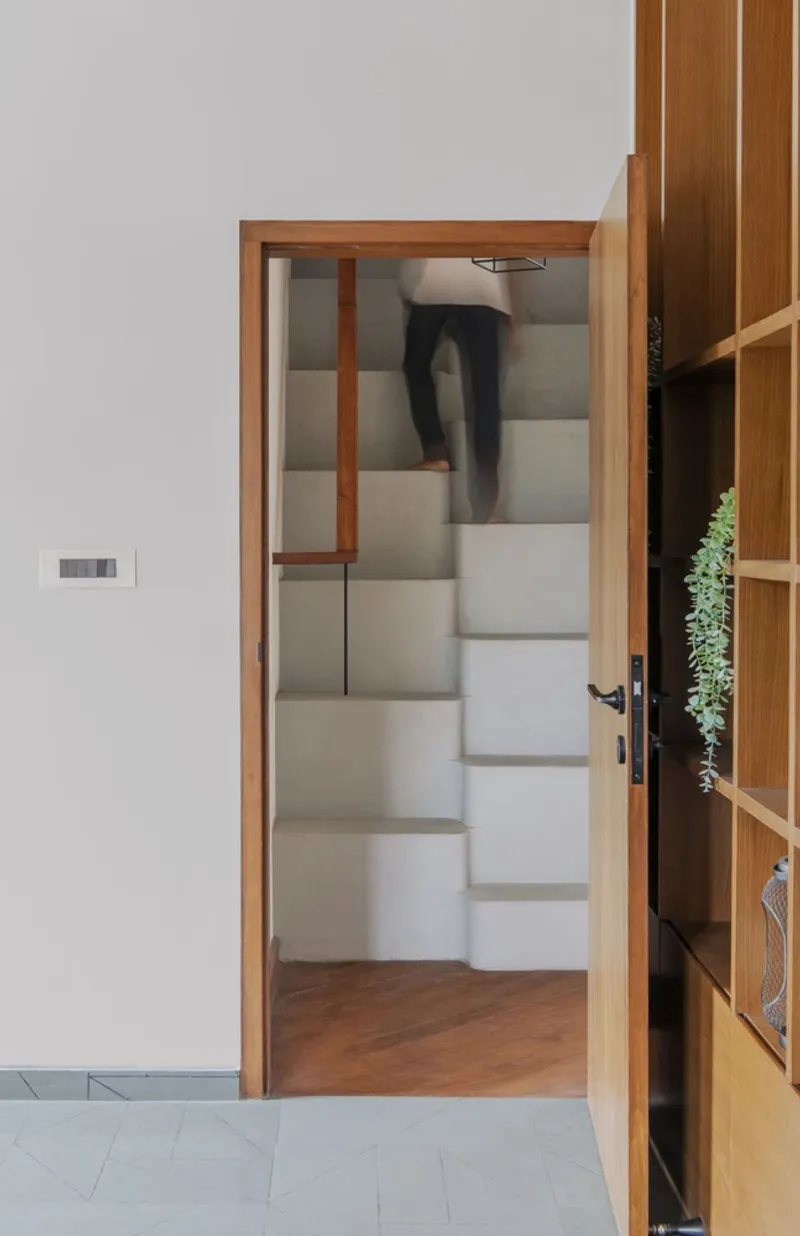
Elsewhere, a sitting area with cane-back chairs and a planked brick accent wall captures the material palette at its most understated. Timber-framed doorways open to concrete staircases, and a figure ascending the steps gives a sense of the proportions: generous head heights, wide treads, and a deliberate slowing of movement through the section.
Bedrooms Grounded in Brick and Terrazzo
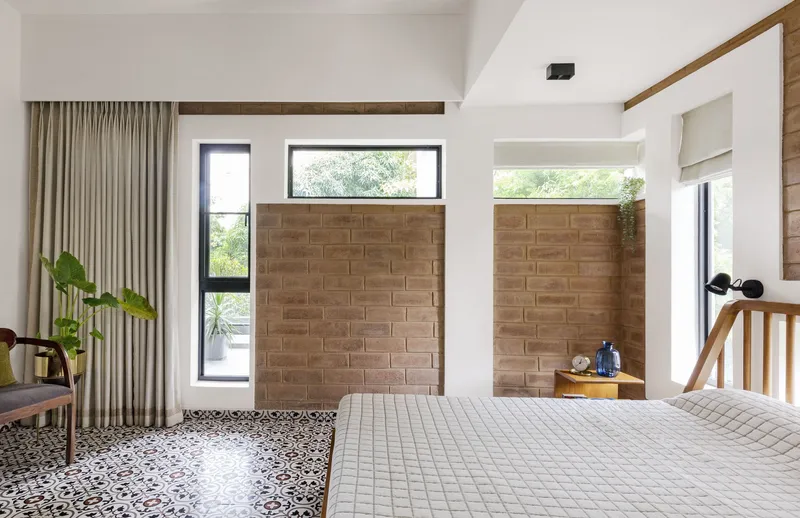
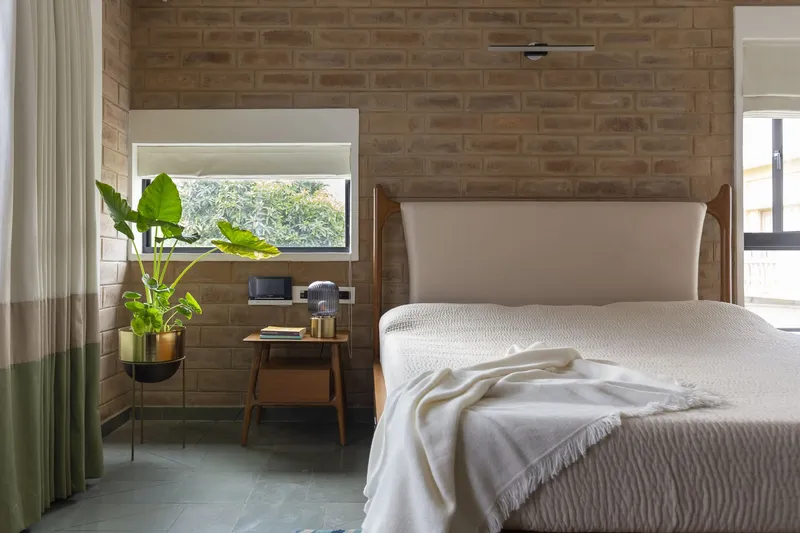
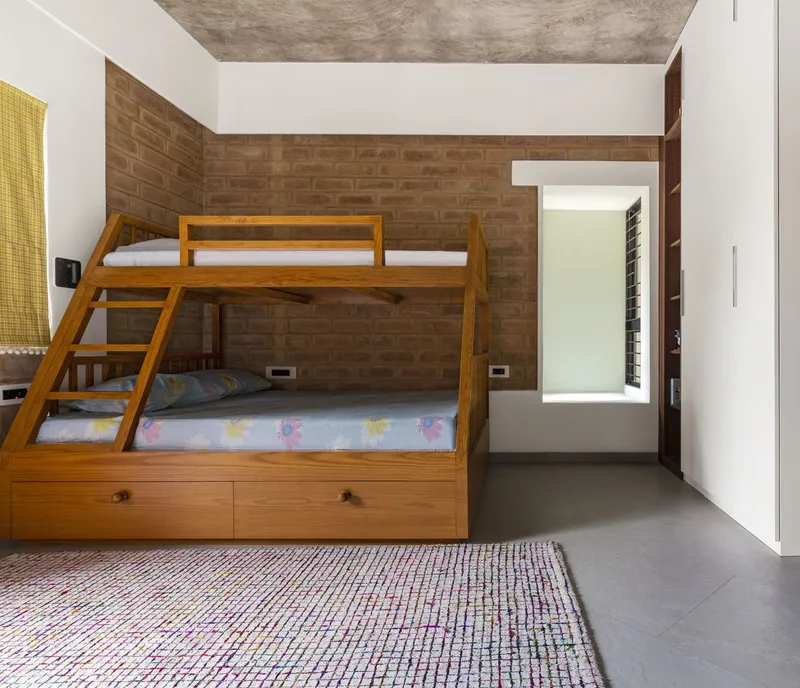
The bedrooms share a material language of exposed brick, patterned terrazzo, and polished concrete that keeps the palette warm without resorting to excessive finishes. In one room, a brick partition wall meets a terrazzo floor beneath clerestory windows that pull light across the ceiling. In another, an exposed brick wall backs an upholstered headboard, and a horizontal window frames a sliver of greenery. These are quiet rooms that rely on natural light and honest materials to create atmosphere.
A children's room features a timber bunk bed with integrated storage drawers set against exposed brick, with a polished concrete floor that can withstand the wear of daily life. The details here are practical and considered: storage is built in, surfaces are durable, and the room will age well as the children grow.
Before and After: The Evidence
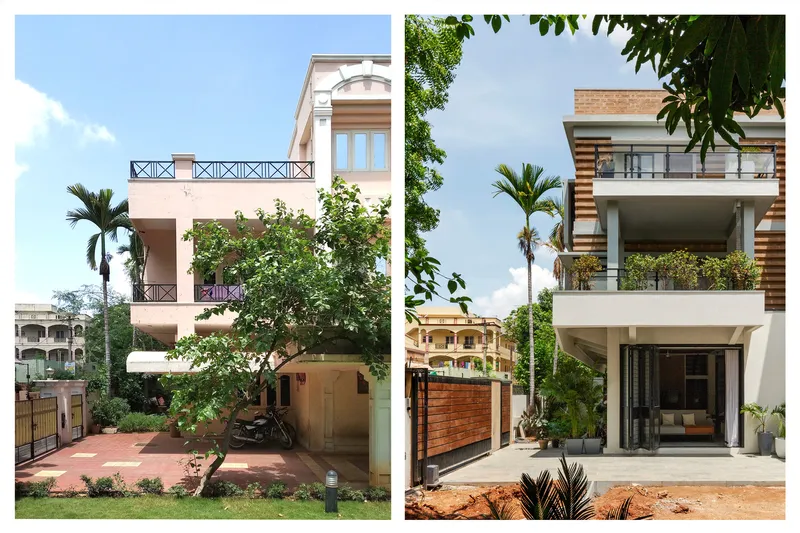
The before and after comparison is worth lingering on. The original facade was flat, plastered, and undifferentiated, offering no environmental mediation between street and interior. The renovated facade, by contrast, is an active threshold: timber cladding moderates solar gain, stacked balconies with planters introduce biology, and the articulated volumes create pockets of shade. Biome did not simply redecorate; they restructured the building's relationship to its climate.
Plans and Drawings
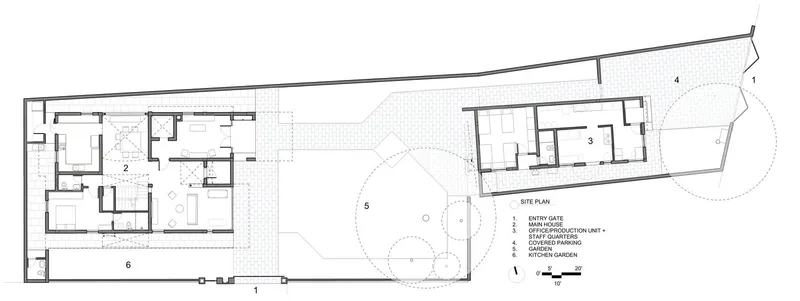
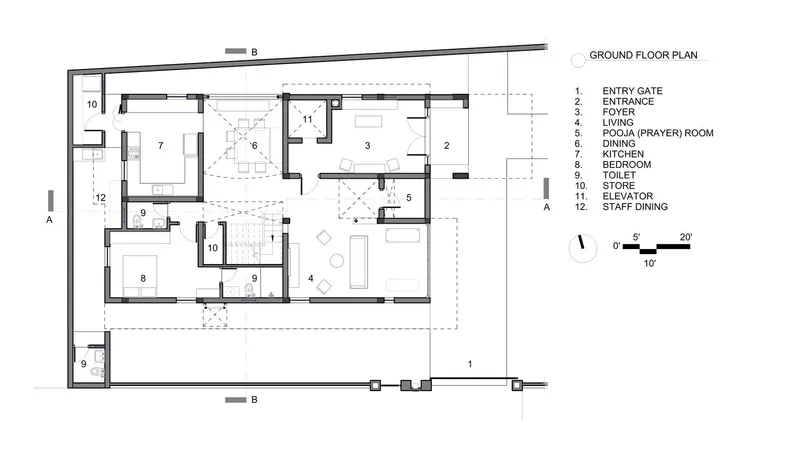
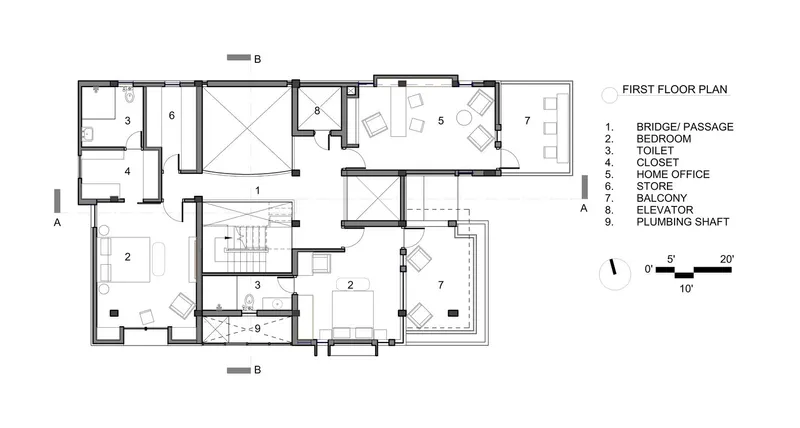
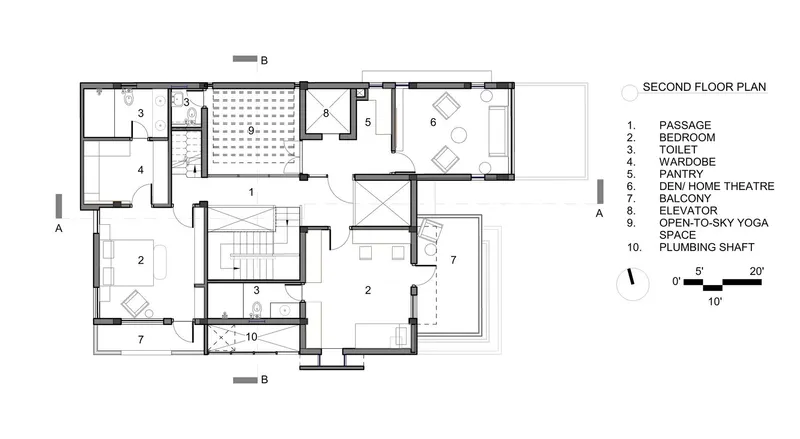
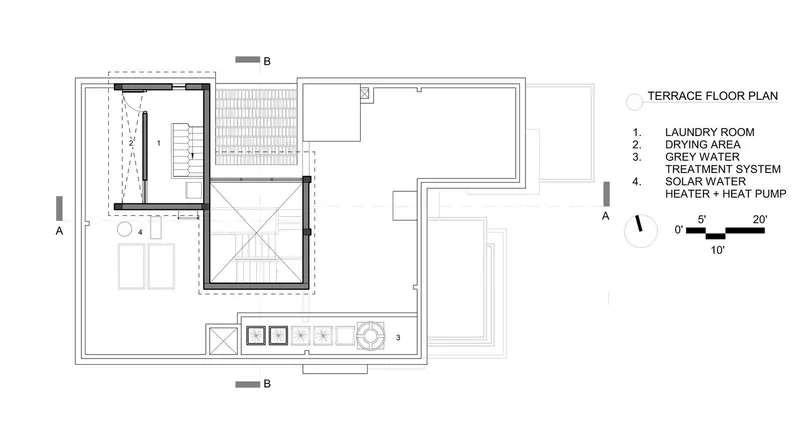
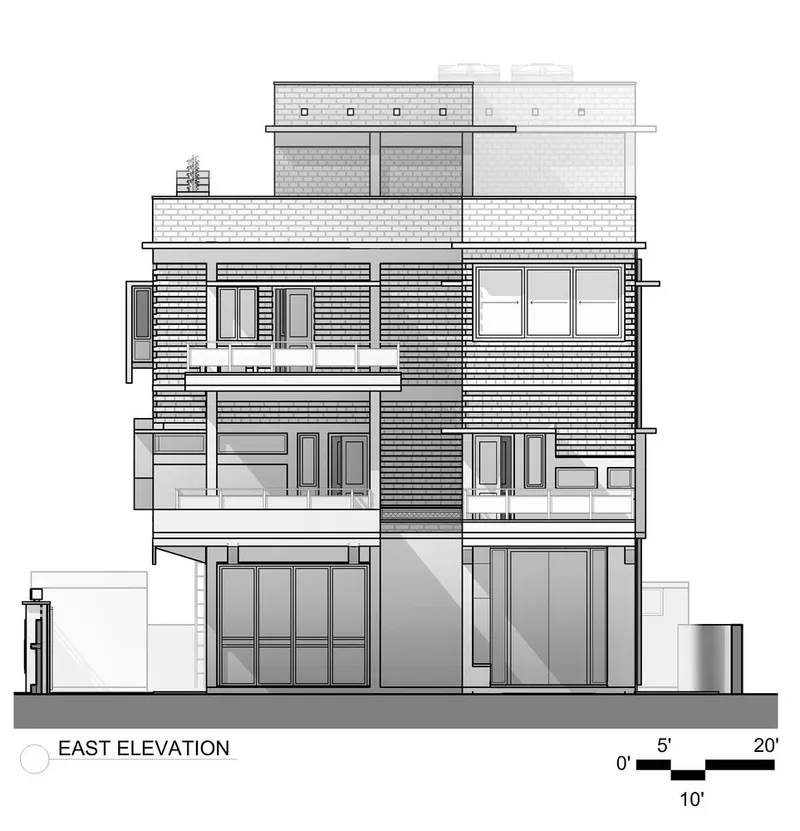
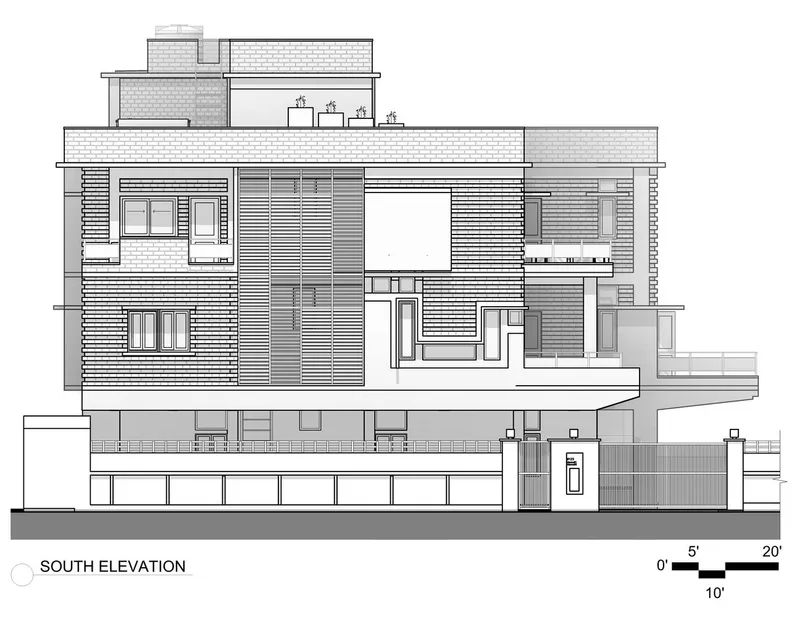
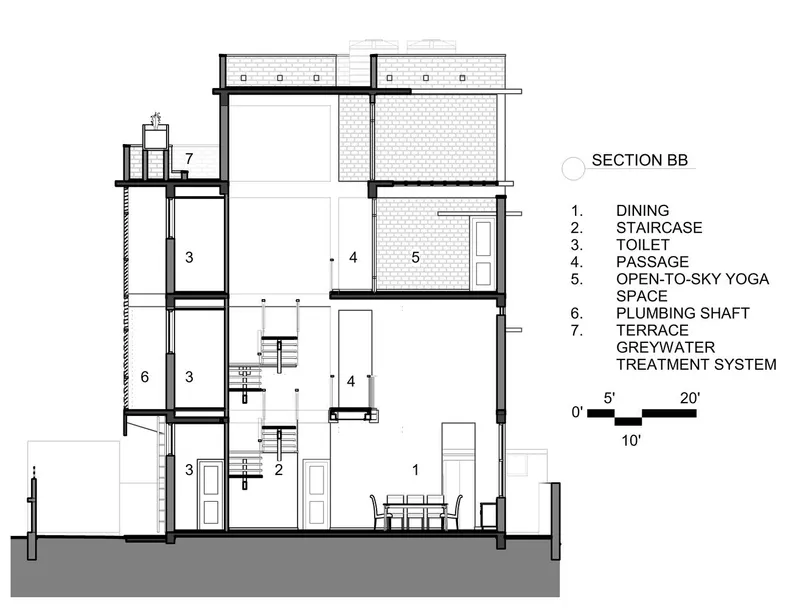
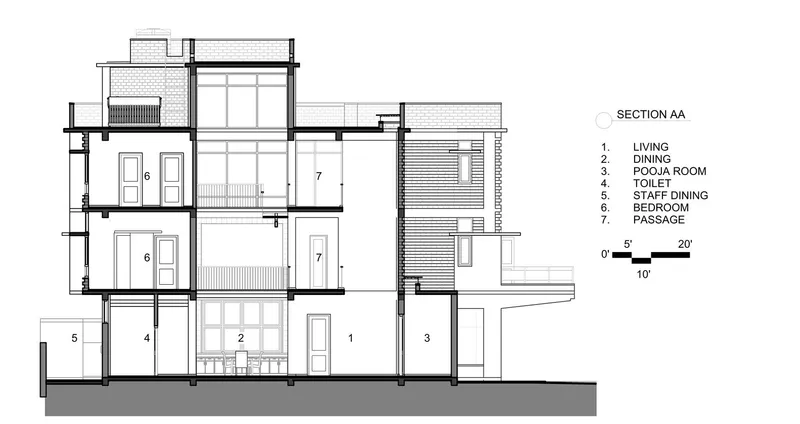

The site plan reveals the courtyard as a generous void between two built volumes, ringed by circular tree canopies that read as a small urban forest in plan. The ground floor organizes the entry sequence around this courtyard, placing living spaces where they can open onto it through glass doors. Upper floors distribute bedrooms around the central stair, with the second floor introducing a home theater and an open-to-sky yoga space that extends the courtyard logic upward. The terrace floor is given over to laundry, drying, and mechanical equipment, keeping service functions out of the inhabited levels.
The sections are particularly revealing. A cut through the staircase shows four levels interconnected by the open-to-sky void, confirming that the courtyard is not a single-storey gesture but a full-height spatial device. The east and south elevations document the layering of cladding textures and projecting terraces, while the axonometric drawing pulls everything apart to show the connecting pathway through the compound. These drawings make a convincing case that the project's sustainability credentials are structural, not cosmetic.
Why This Project Matters
Sustainable renovation in the Indian urban context often means solar panels and rainwater harvesting bolted onto an unchanged plan. Biome's approach is fundamentally different: they reorganized the section around a courtyard, designed the facade as an environmental filter, and used the staircase as a ventilation chimney. Every significant design decision has a climatic justification, yet the house never feels didactic or austere. It feels generous, lived-in, and full of light.
For architects working on renovation projects in dense, warm-climate cities, this house offers a clear lesson. You do not need to demolish and rebuild to achieve meaningful environmental performance. You need to identify the spatial moves that unlock passive strategies, invest in the right materials, and trust that a courtyard, a slatted skylight, and some well-placed brick can do more work than any mechanical system. Biome Environmental Solutions continues to prove that sustainability and spatial pleasure are not competing ambitions.
Shruthi and Sunith's House by Biome Environmental Solutions, Bangalore, India. Photography by Suryan // Dang.
About the Studio
Share Your Own Work on uni.xyz
If projects like this are the kind of work you want to make, uni.xyz is a place to publish your own, find collaborators, and enter design competitions.




Popular Articles
Popular articles from the community


Co-life: Sustainable Architecture for Age-Friendly Community Living
Co-life reimagines sustainable architecture for seniors through courtyards, rammed earth, shared gardens, and spaces designed for belonging.

Hill & Cross Opera: Sculptural Opera House Architecture Shaped by Tallinn’s Landscape and Identity
Hill & Cross Opera reimagines opera house architecture in Tallinn through its sculptural hill, civic plaza, glass wave and a luminous cross.

The Musturak Paradise: Senior Living Architecture for a Connected Future in Temara, Morocco
The Musturak Paradise reimagines senior living architecture in Temara via private homes, social spaces, culture, community, and shared care.

The Ocean Hive: Sustainable Architecture for a Self-Sufficient Civilization at Sea
The Ocean Hive imagines sustainable architecture at sea, where modular habitats, algae, wave power and ocean waste sustain a growing colony.


Similar Reads
You might also enjoy these articles


Hodi-Mandai Geram
Project Function: Preservation and revitalization of the Intangible heritage and socio-spatial identity of the Hodi by Housing, Cultural Memory Center, Sacred Grove, landscape, local tourism economy


Olio Towers: A Mid-Rise for Performers That Fuses Housing, Rehearsal, and Stage
Located blocks from Houston's Theater District, this modular tower stacks living units around a central performance atrium.

Oasis: Modular Green Housing Carved into Dhaka's Urban Fabric
A shortlisted Plugin Housing entry reclaims unauthorized settlements in Dhaka with stepped concrete volumes, green roofs, and ventilation-driven design.

Black Hole: A Floating Megastructure for the Post-Physical Era
Emiliano Mazzarotto envisions a spherical, self-scaling arena where e-sports, digital hotels, and holographic stadiums replace traditional public space.


Explore Pyht - Bio Architects Competitions
Discover active competitions in this discipline



Challenge to reimagine the Iron Throne


Photograph architecture without architects


Illustrate the lost glory of Angkor Wat - Render Challenge


Design challenge to reuse E-waste
Comments (0)
Please login or sign up to add comments
No comments yet. Be the first to comment!