
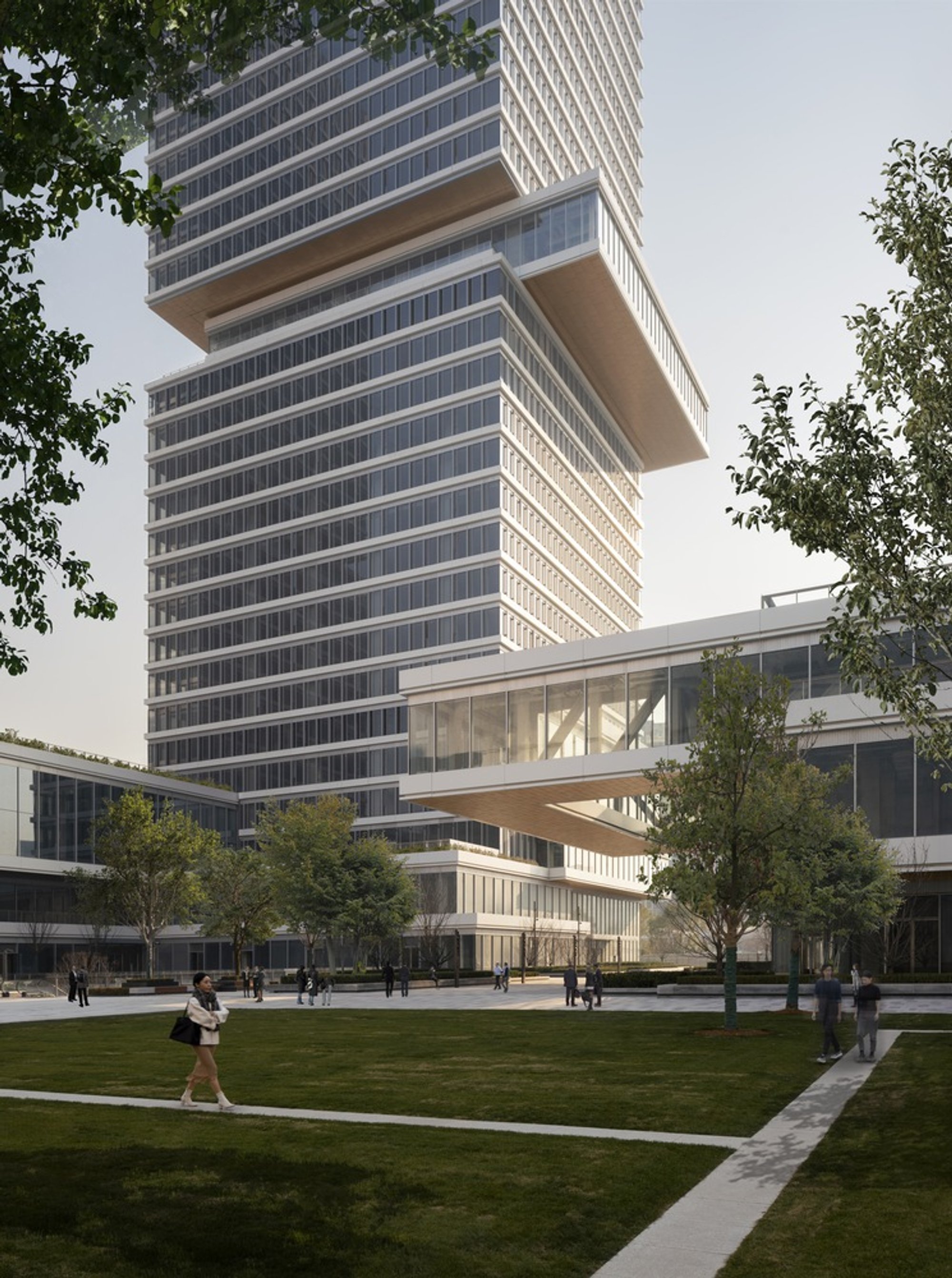
KPF Floats Cantilevered Sky Galleries Between Three Towers on a Revived Shanghai Riverfront
Huamu Lot 10 transforms a neglected stretch of Pudong waterfront into a 279,000 sqm civic precinct anchored by culture and green design.

Most mixed-use towers in Shanghai compete for attention at the top. Kohn Pedersen Fox flips that convention at Huamu Lot 10 by placing the project's most dramatic gesture at mid-height: cantilevered sky galleries that reach more than nine meters out from the tower faces, bridging three office volumes and a future museum across a central public plaza. The move is both structural bravado and urbanistic argument. Instead of crowning a single spire, the galleries stitch the towers together at a human-perceivable scale, creating a legible civic marker visible from the Huangpu River and Century Park without resorting to the usual supertall theatrics.
Completed in 2024 and totaling 279,000 square meters, the project sits on a previously neglected stretch of Pudong's Huamu Civic District, a site expected to draw over five million visitors per year. KPF's strategy repositions vehicular traffic to an outer loop, liberating the ground plane for a landscaped plaza with amphitheatre, water features, and large-scale art. The result is less a cluster of office buildings and more a piece of participatory urbanism: culture and commerce held together by a shared public realm.
Three Towers, One Skyline Gesture
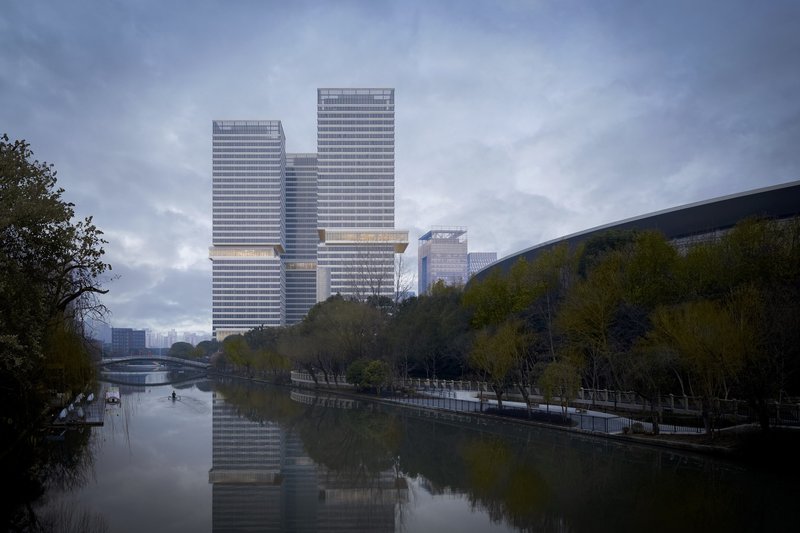
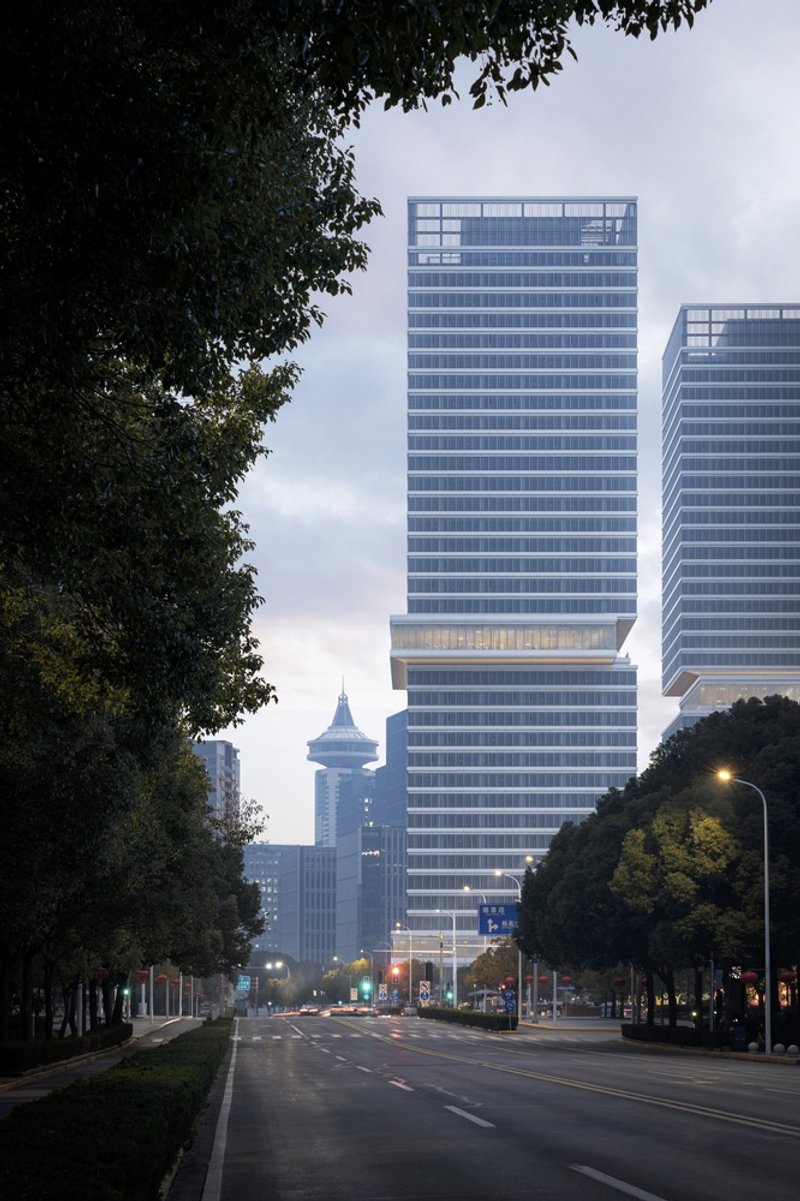
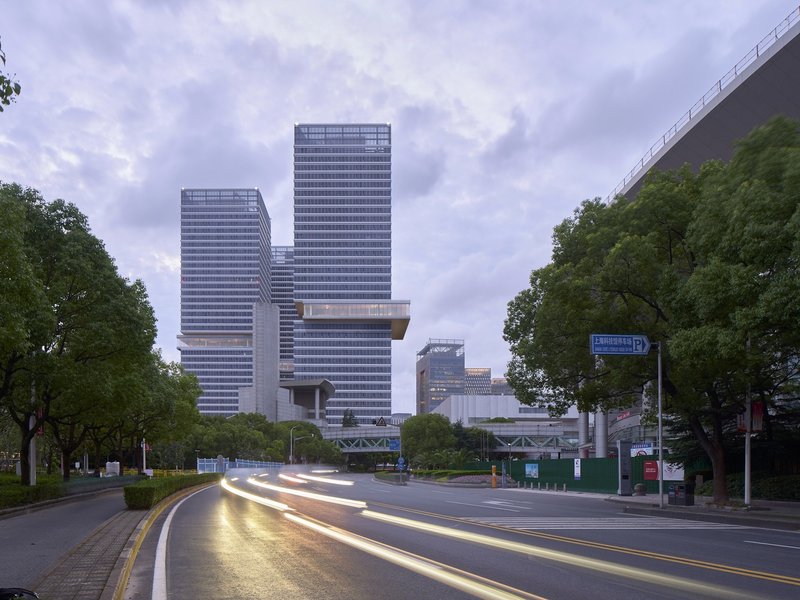
Seen from across the river or along the boulevard at dusk, the three towers read as a coordinated composition rather than isolated objects. Each volume is offset in plan and stacked with shifted floor plates, which creates the terraced geometry that defines the project's silhouette. The stepped forms are not decorative: they generate outdoor gardens at every setback, and each shift corresponds to a change in program or a structural transfer where the cantilevered galleries engage the tower cores.
KPF uses a restrained palette of white and silver metal fins, horizontal projections, and double-silver low-E glass with argon insulation to keep the facade legible at scale. The wider-than-standard 1.8-meter curtain wall panels reduce the number of joints and speed up construction, but they also produce a quieter grid that lets the massing do the talking. Low-reflectivity glass was a deliberate choice to avoid bouncing glare onto surrounding residential neighborhoods.
The Sky Galleries as Civic Architecture
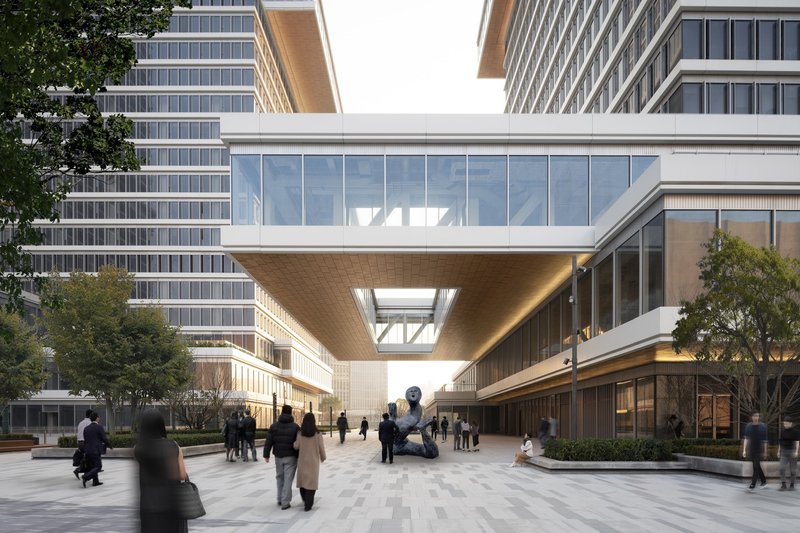
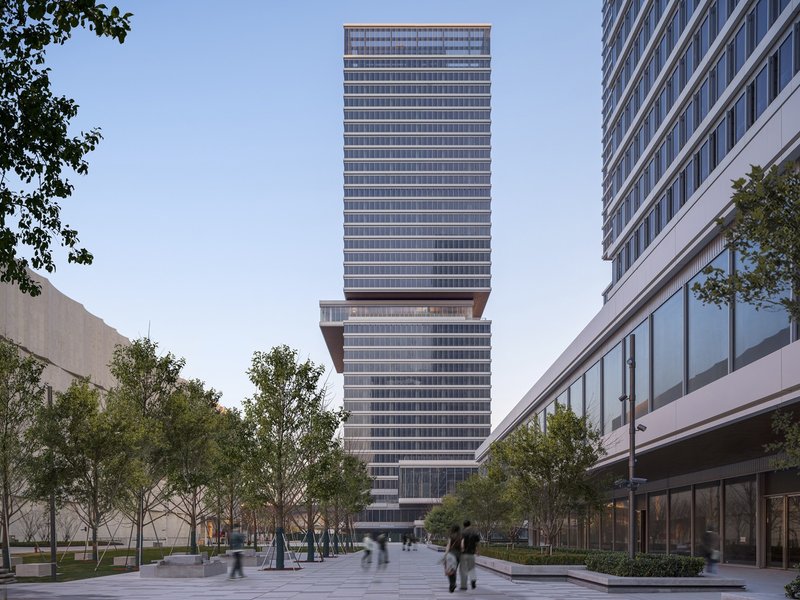
The cantilevered galleries are the conceptual core of Huamu Lot 10. Supported by steel trusses and a double-slab system, they hover above the plaza at a uniform datum, establishing visual continuity between the towers and the adjacent museum. Their undersides are clad in hammered titanized soffits with a copper-toned stainless steel base that catches ambient light and shifts in color through the day. At night, illumination turns them into lanterns visible from the waterfront.
Placing gallery-scale cultural program at the midpoint of the tower rather than atop it is a pointed rejection of the vanity crown. It prioritizes the pedestrian experience: visitors in the plaza look up and engage with the cantilevered volumes overhead, while occupants of the galleries look down onto public life. That reciprocal sightline is harder to achieve when your cultural amenity is 300 meters in the air.
Ground Plane and Podium Materiality
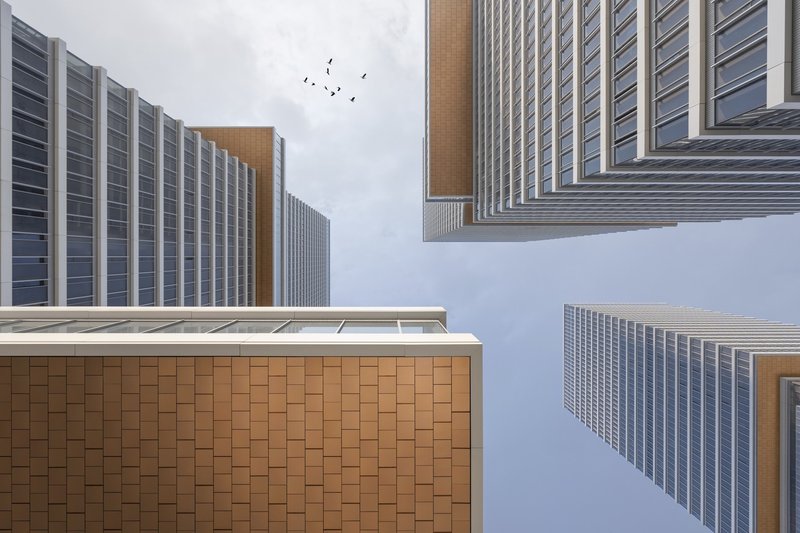
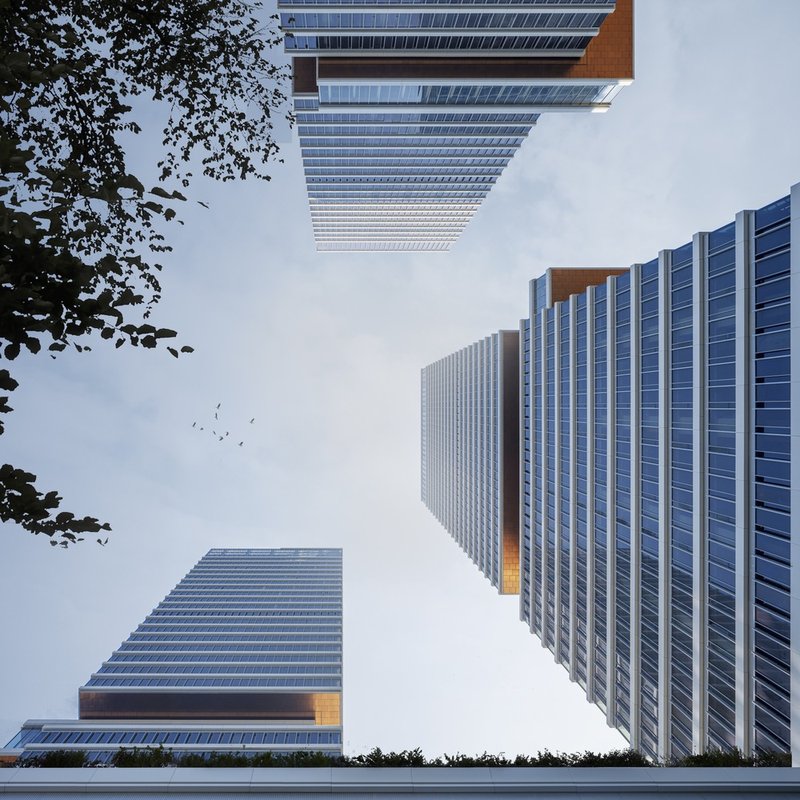
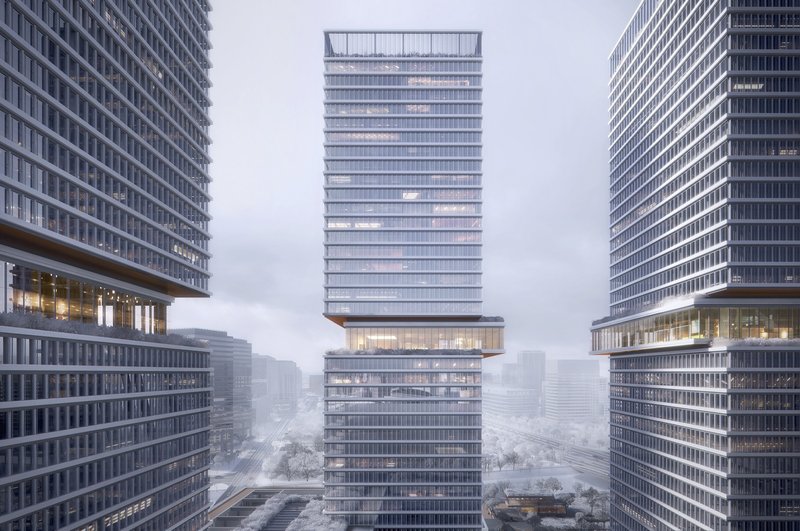
At street level the project shifts register. The podium base employs terracotta-toned cladding that grounds the glass towers in a warmer, tactile materiality. Looking up from the base, the transition between solid podium and transparent tower is handled cleanly: glass fin facades with corner modules fabricated as single pieces eliminate the typical corner mullion, maximizing transparency where the building meets the sky.
The worm's-eye perspective reveals how the offset volumes create pockets of sky between the towers, allowing daylight to reach the plaza even during Shanghai's notoriously hazy winters. The horizontal band overhangs that project from each facade are calibrated per orientation to reduce direct solar gain while preserving outward views. Vertical fins supplement the shading on facades that face east and west.
Lobby and Interior Experience
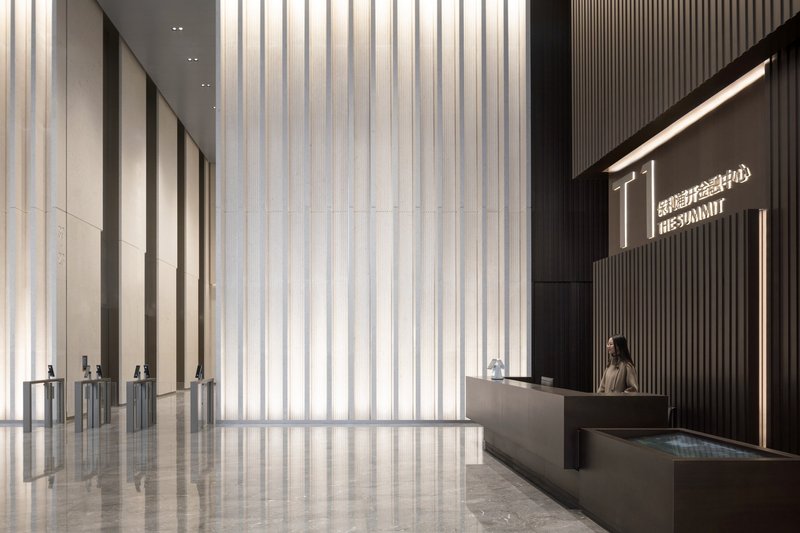
The 12-meter-high lobbies make a deliberate impression. Vertical light panels and a backlit reception desk establish an atmosphere that is corporate but not cold. Turnstile gates are pushed to the side, keeping the central sightline open from entry to courtyard. Full-height glass on every office floor continues the theme: operable windows on the narrower 0.6-meter module of each curtain wall panel give occupants direct access to fresh air, a wellness strategy that also reduces mechanical cooling loads.
Energy, Water, and Ecological Resilience
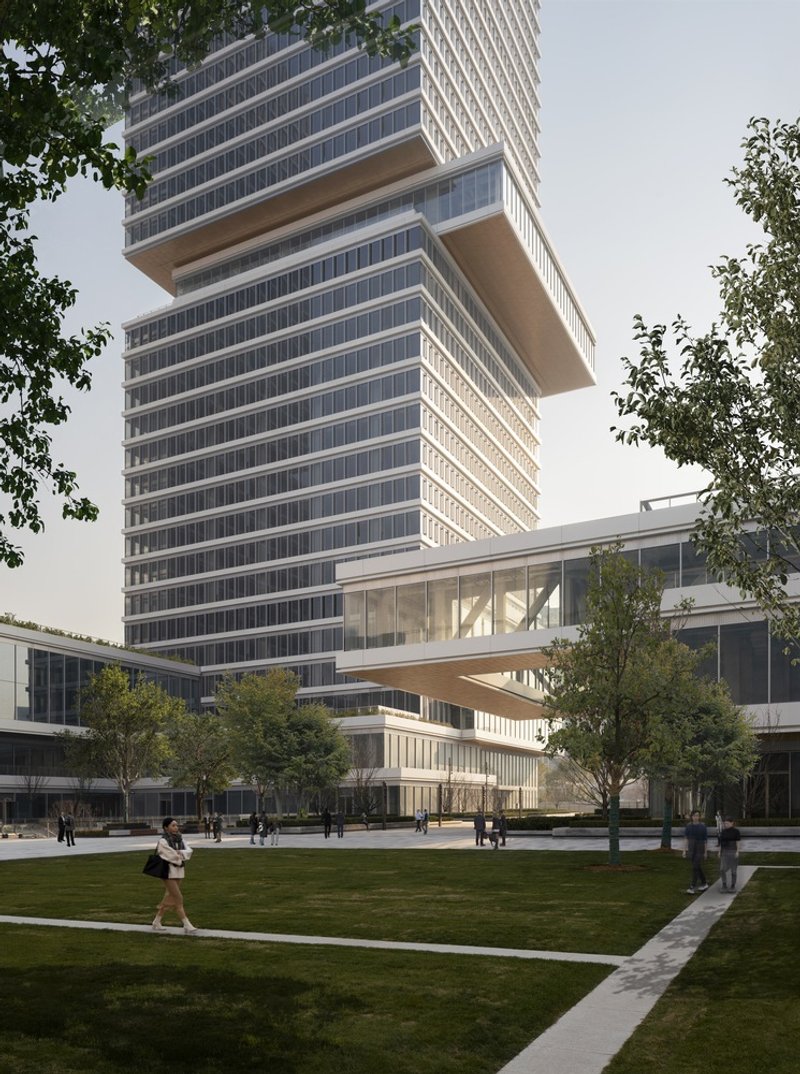
Sustainability at Huamu Lot 10 is systemic rather than cosmetic. A co-generation plant paired with absorption chillers captures waste heat to produce electricity, heating, and chilled water simultaneously. Stormwater is collected across the extensive roof gardens and used for landscape irrigation and tower cooling. The vegetated terraces do double duty: they insulate the slabs below and offset the urban heat island effect that plagues dense districts like Pudong.
The waterfront landscape strategy goes beyond aesthetics. Terraced planting with indigenous species is designed to absorb floodwater during storm surges, restoring ecological function to a riverbank that had been paved over and abandoned. Combined with insulation strategies, thermal breaks, and thermal energy modeling calibrated to China's 3-Star green building standard, the project makes a credible case that a quarter-million-square-meter commercial development can also be a net positive for its immediate ecology.
Plans and Drawings
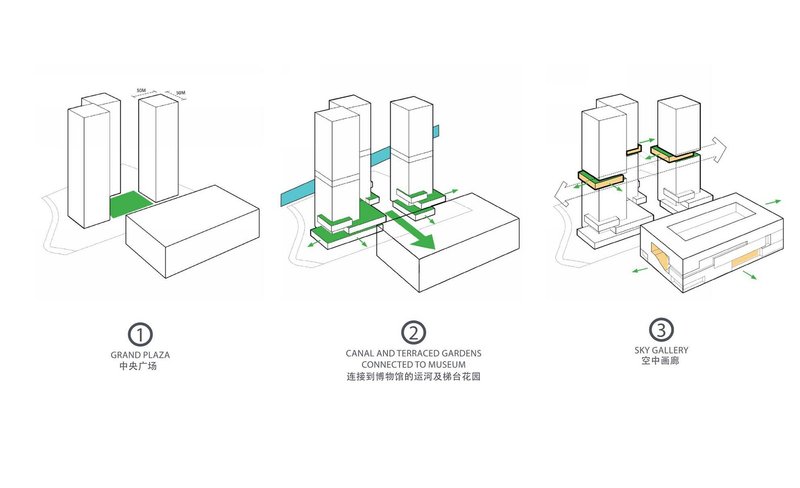
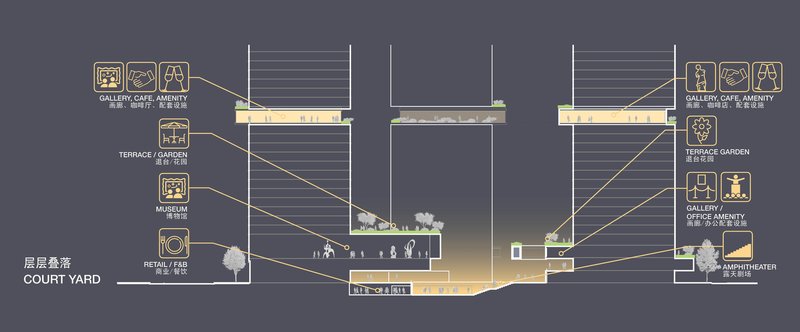
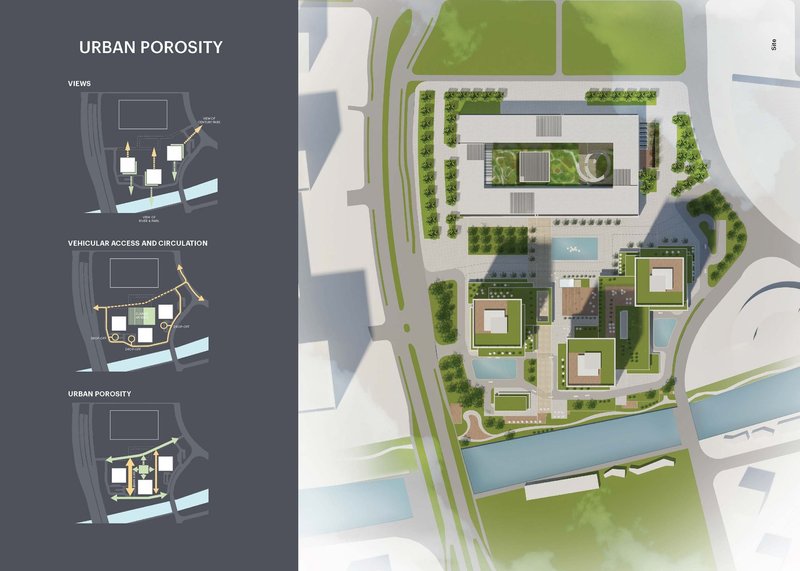
The axonometric diagram traces KPF's design logic in three phases: first the sunken plaza and amphitheatre, then the stepped garden terraces, and finally the cantilevered galleries that lock the composition together. The section through the courtyard makes the spatial ambition legible: museum volumes, terraced gardens, and sky galleries are layered to create a continuous public circuit from ground to mid-tower.
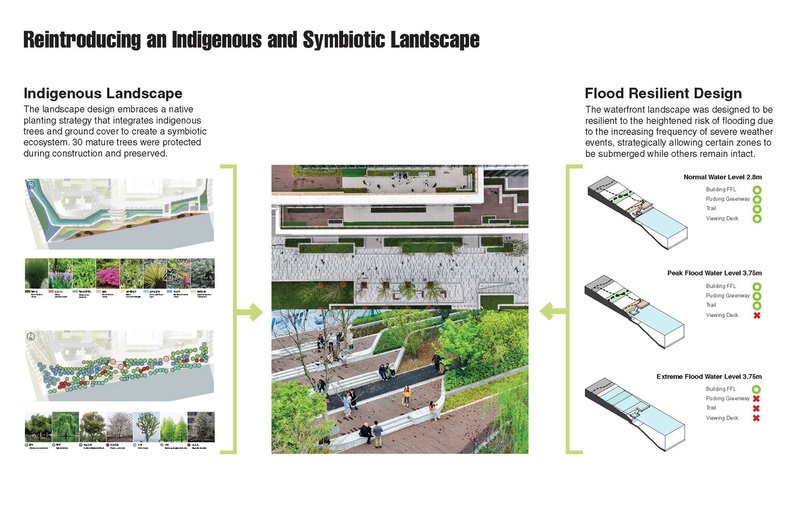
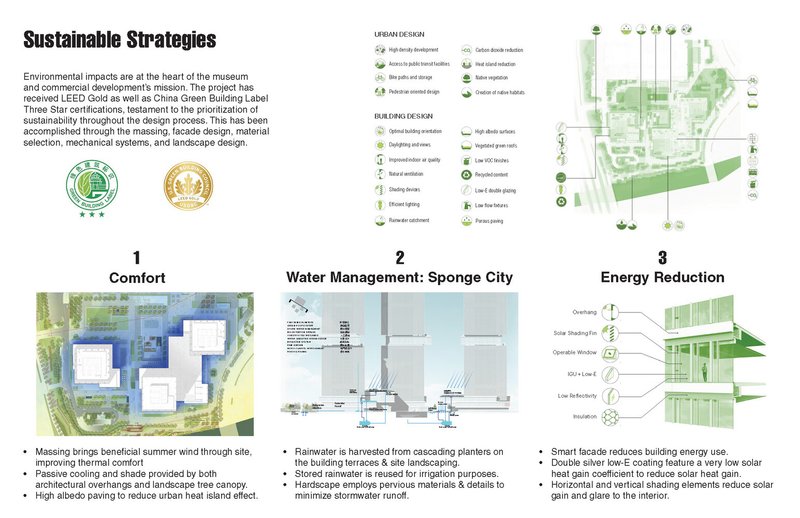
The landscape and sustainability diagrams reveal the engineering beneath the greenery. Indigenous planting zones are arranged by flood resilience, with terraced water levels designed to absorb variable storm loads. Energy diagrams illustrate the co-generation loop and rainwater collection cycles. These are not afterthoughts pinned to a conventional office park; they are integral to the project's form and site strategy.
Why This Project Matters
Huamu Lot 10 matters because it refuses the easy dichotomy between commercial efficiency and civic generosity. The cantilevered sky galleries are expensive and structurally demanding, but they create something a typical office campus cannot: a visual and programmatic link between towers, museum, and public space that reads as a single civic gesture rather than a collection of investment parcels. The decision to make culture visible at mid-height, not hidden in a basement or perched on a penthouse, is a design position with real consequences for how the district will be used.
For a city that has spent decades accumulating supertall icons, the project offers an alternative metric of ambition. Its success will be measured not by height but by the life of its ground plane: the five million annual visitors moving through the amphitheatre, the flood-resilient riverfront, and the gardens between the towers. If those spaces thrive, KPF will have proven that Shanghai's next chapter of urbanism can prioritize the pedestrian without sacrificing the skyline.
Huamu Lot 10 – The Summit by Kohn Pedersen Fox. Shanghai, China. 278,858 square meters. Completed 2024.
About the Studio
Share Your Own Work on uni.xyz
If projects like this are the kind of work you want to make, uni.xyz is a place to publish your own, find collaborators, and enter design competitions.




Popular Articles
Popular articles from the community

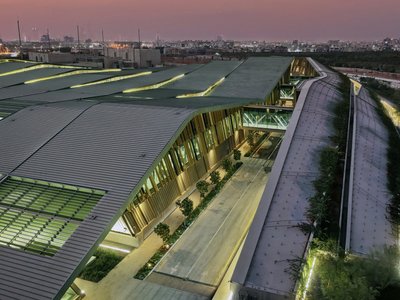
A Park Building That Wants to Be a Landscape
Omrania's Operations & Maintenance Building at King Salman Park dissolves industrial program into Riyadh's largest green infrastructure.
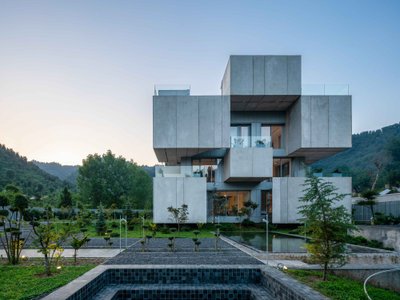
Bood Design Bureau Splits a Gilan Residence in Two to Let the Forest In
Double Side House negotiates privacy and openness through interlocking concrete volumes and planted courtyards in northern Iran's humid Caspian lowlands.
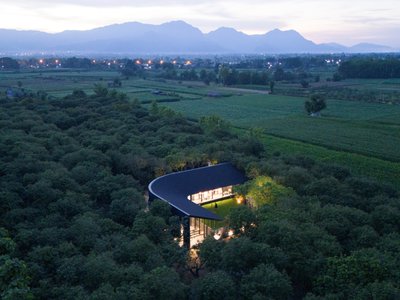
Cafe MADA: A Chiang Rai Pavilion in a Mango Orchard
BodinChapa Architects threaded a 254 m² black-roofed cafe through an existing mango orchard in Chiang Rai, Thailand, built around mature trees.
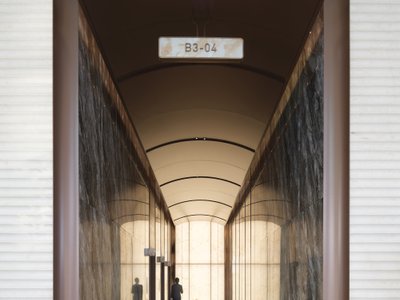
Guangzhou's Twin Towers Interiors Move Like Water
DuShe Architectural Design shapes the lobbies of a massive Guangzhou transit hub with undulating ceilings and deep geological materiality.


Similar Reads
You might also enjoy these articles

Filtering Space: A Gradual Spatial Experience
From urban intensity to spatial calm.


The Ken Roberts Memorial Delineation Competition (Krob)
As the most senior architectural drawing competition currently in operation anywhere in the world, it draws hundreds of entries each year, awarding the very best submissions in a series of medium-based categories.


Waterfront Redevelopment and Urban Revitalization in Mumbai: Forging a New Dawn for Darukhana
A transformative waterfront redevelopment project reimagining Darukhana’s shipbreaking heritage into an inclusive urban future.

OUT-OF-MAP: A Call for Postcards on Feminist Narratives of Public Space
Rhizoma Design and Research Lab invites artists, designers, architects, researchers, and students to reflect on how feminist perspectives can reshape public space. Selected works will be exhibited in Barcelona, October 2026. Submissions open until 15 April 2026.
Explore Architecture Competitions
Discover active competitions in this discipline




The International Standard for Design Portfolios


The Global Benchmark for Architecture Dissertation Awards


The Global Benchmark for Graduation Excellence


Challenge to reimagine the Iron Throne
Comments (0)
Please login or sign up to add comments
No comments yet. Be the first to comment!