
Sanjay Puri Architects Wraps a Three-Generation Jaipur Home in Climate-Responsive GFRC Screens
Zen Spaces Residence uses courtyards, perforated facades, and local materials to cool 27,000 square feet across four levels in Rajasthan's heat.


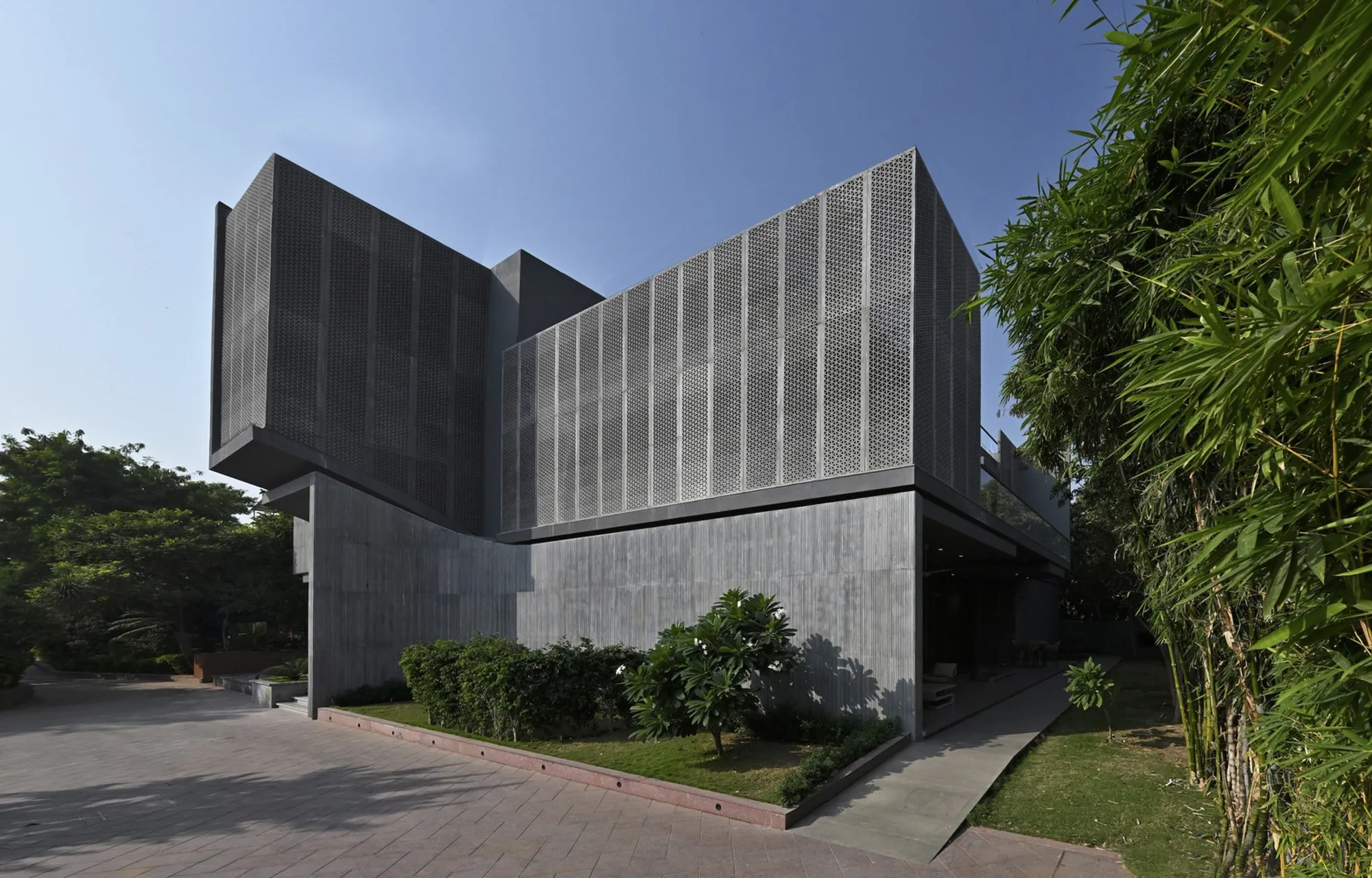
Jaipur spends eight months of the year above 35°C, and three of its roads border this corner plot. Those two facts shaped nearly every decision Sanjay Puri Architects made for the Zen Spaces Residence, a 27,000-square-foot house completed in 2023 for a multigenerational family. Rather than fortifying the building against its climate, the firm treated heat and sun as design inputs, wrapping east, west, and south elevations in GFRC (glass fiber reinforced concrete) screens that recall Rajasthan's traditional stone jali work while leaving the north facade open to cooler light. The result is a house that breathes, dims, and filters its environment instead of sealing it out.
What makes the project worth studying is its refusal to treat sustainability as a checklist bolted onto a form. The screens are simultaneously climate devices, privacy barriers, noise buffers from the arterial road, and the primary architectural expression. The courtyard is both a passive cooling engine and the social spine connecting four generations of rooms. Every element carries at least two jobs. In a profession that often separates performance from aesthetics, Zen Spaces collapses the distance between them.
Screens That Do the Work of Walls
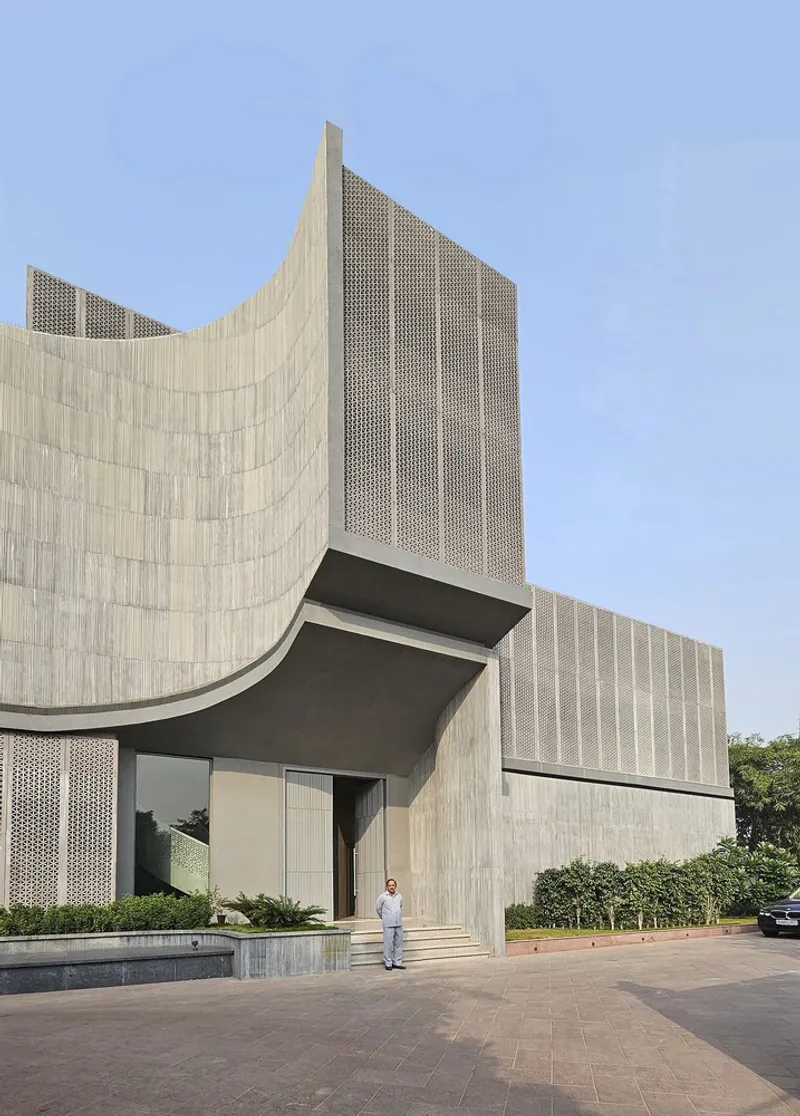
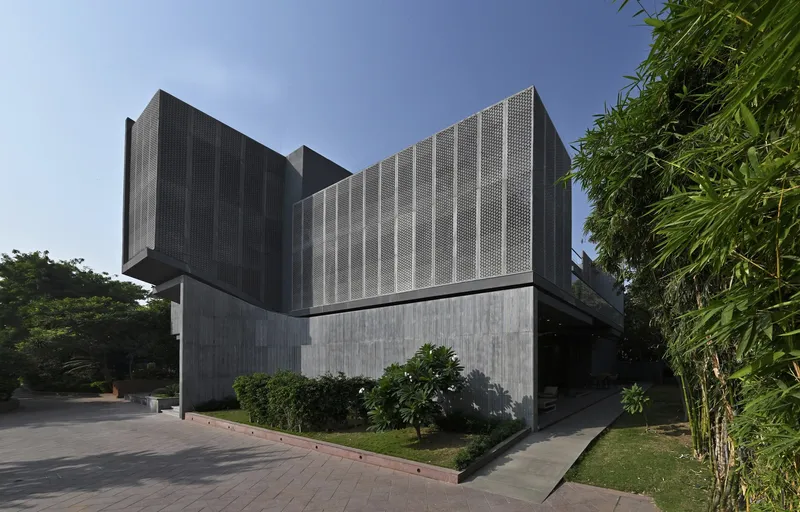
The GFRC screens are the most visible gesture, but their role goes beyond ornament. On the east, west, and south faces they intercept direct solar radiation during peak hours, cutting heat gain without blocking airflow. The screens also dampen traffic noise from the surrounding roads, a practical necessity on a corner site that could otherwise feel exposed. From the street, stacked concrete volumes alternate with perforated panels, creating a layered facade that shifts in depth and transparency depending on the angle of approach.
The reference to Jaipur's historic stone screens is deliberate but not nostalgic. Traditional jalis were tuned to the same climate problem: how to ventilate masonry buildings in an arid, high-temperature zone. Sanjay Puri's version updates the material (GFRC is lighter and more moldable than sandstone) while preserving the principle: let air through, keep heat out, and give inhabitants the ability to see without being fully seen.
The Courtyard as Cooling Engine
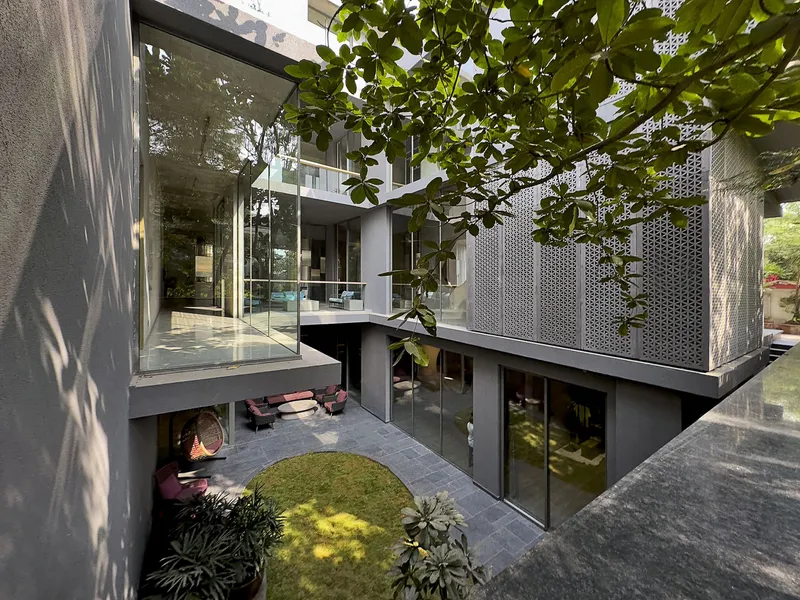
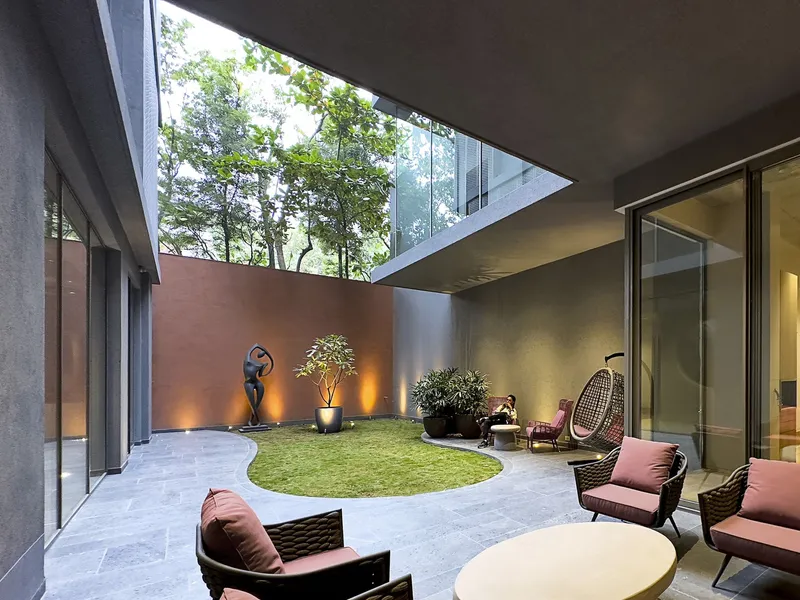
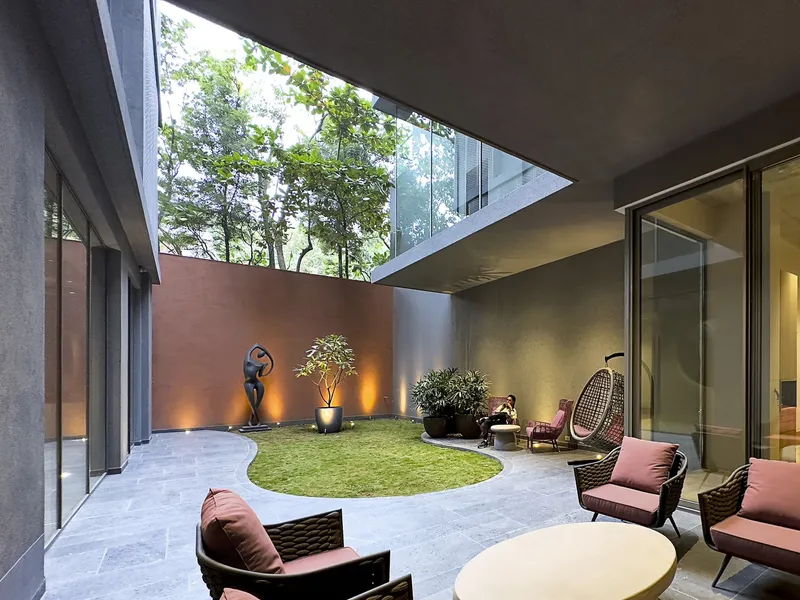
At the heart of the plan sits a sunken courtyard with a circular grass patch and retained trees. It functions as a light well, a ventilation shaft, and an organizing device for circulation. The house's spine skirts the courtyard on all four levels, so every corridor offers a glimpse of sky, greenery, and the shadows that shift across the concrete soffits throughout the day. The lower level, which houses a lounge, gym, and service areas, draws its only natural light from this sunken void.
Passive cooling here is not theoretical. Hot air rises out of the courtyard while cooler air is drawn through the perforated facades, creating a chimney effect that reduces dependence on mechanical systems. The decision to position the building on the extreme northern end of the plot preserved most of the existing garden and mature trees to the south, meaning the courtyard is not the only green space at work. The entire site acts as a heat sink.
Shadow as Interior Material
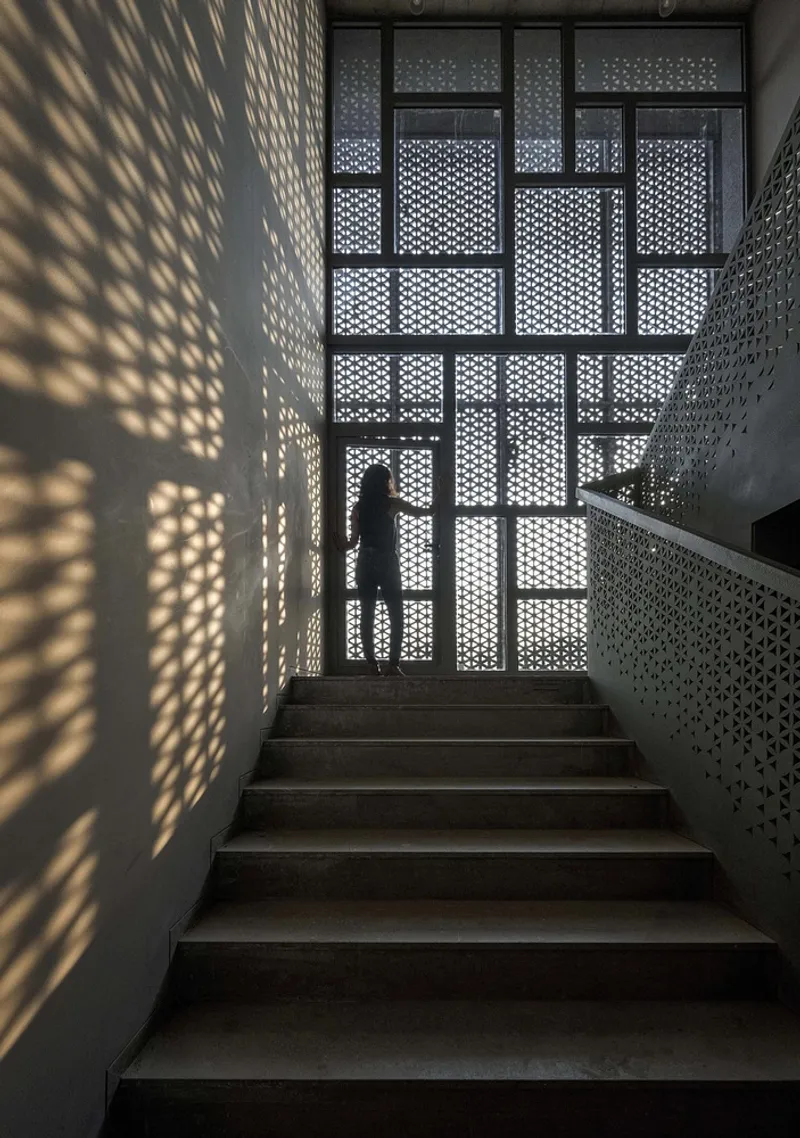
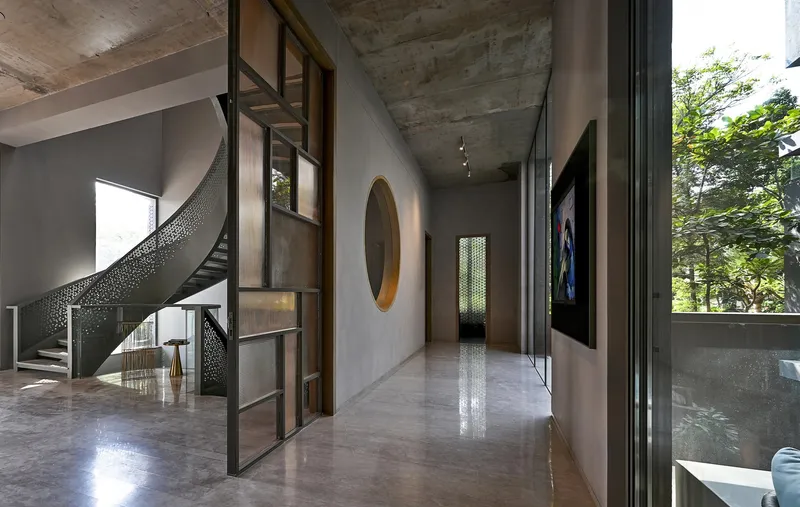
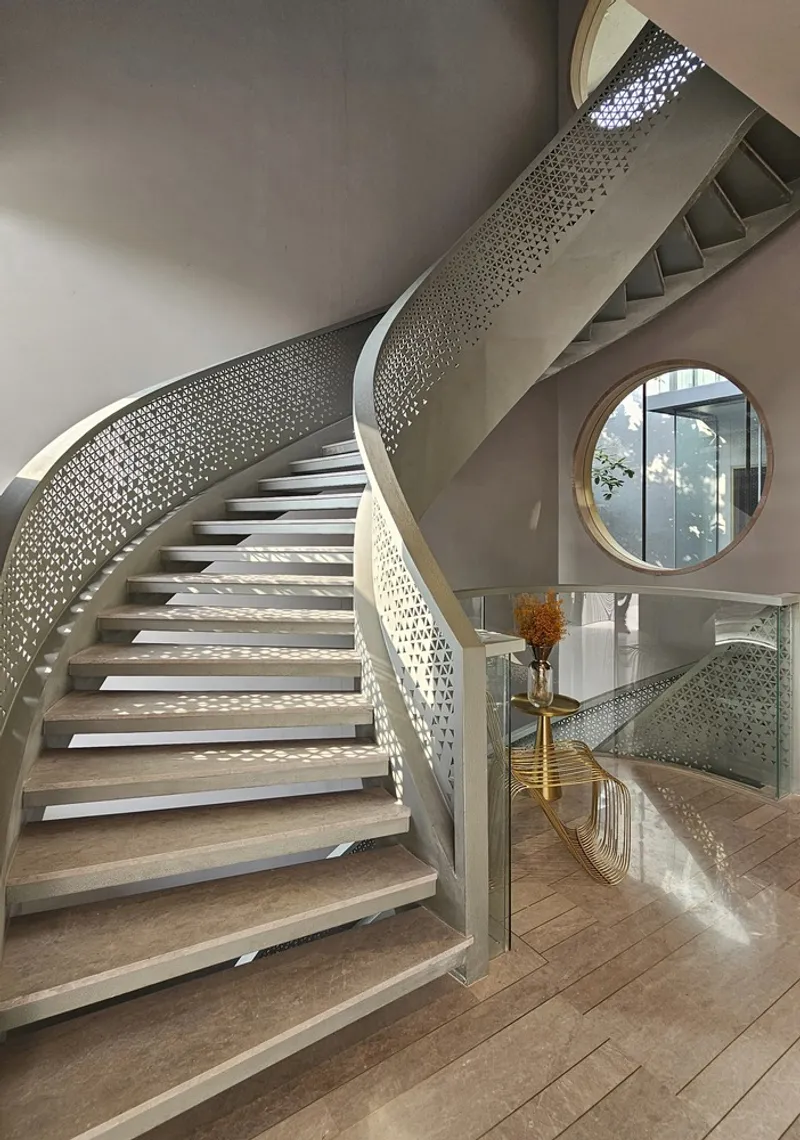
Inside, the perforated screens project geometric shadow patterns onto stairs, walls, and floors, turning circulation spaces into slowly changing light installations. The staircase enclosed by GFRC panels is perhaps the most dramatic example: as the sun moves, the pattern of diamonds and triangles slides across dark treads and lime plaster walls, marking time without a clock. It is an old trick, common in Islamic and Rajasthani architecture, but the precision of the GFRC perforations gives the effect an almost digital crispness.
The curved staircase with its perforated metal balustrade continues the theme vertically. Circular portals and wood-framed mirrors punctuate the gallery corridors, framing views back toward the courtyard and reinforcing a spatial rhythm that alternates between compression and release. The exposed concrete ceilings are left raw, providing a tonal counterweight to the lime plaster and ensuring that the interiors read as honest rather than decorated.
Living Between Decks
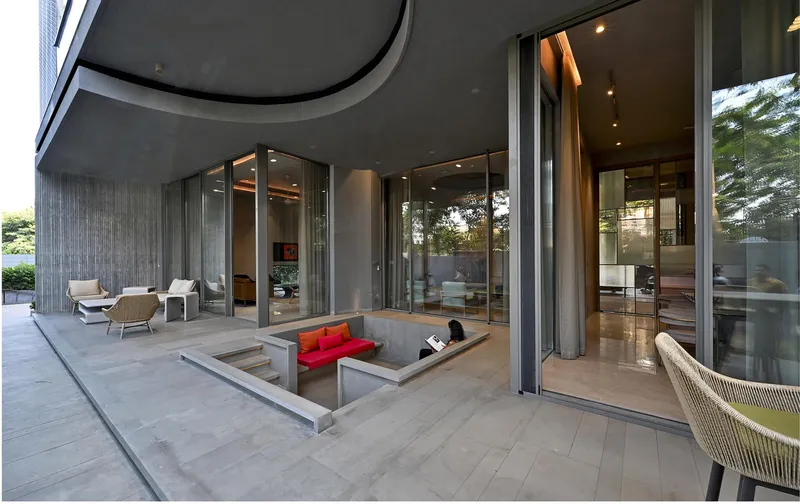
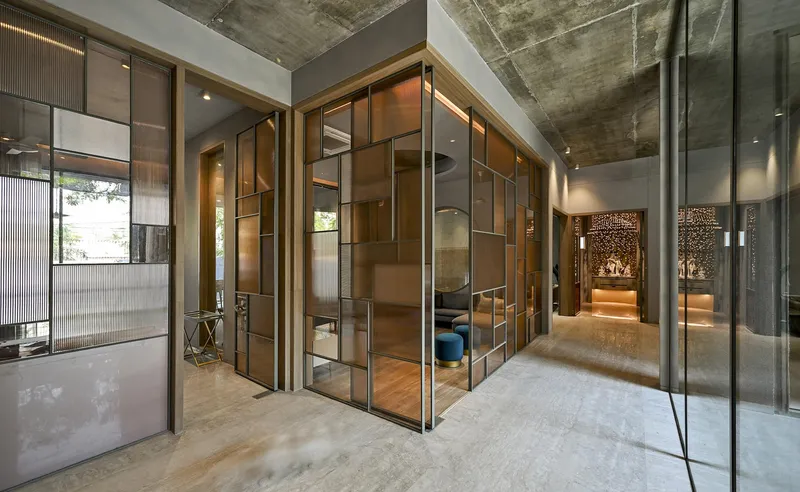
Every bedroom opens onto a private outdoor deck, balcony, or terrace, and the house distinguishes between seasonal use. A winter deck on the southern side catches low sun and faces the garden, while a linear summer deck on the northern end fronts the living and dining areas, staying shaded during the hottest months. The second floor's multipurpose room opens onto a large north-facing terrace, providing the family with a communal outdoor room that remains usable even when temperatures climb.
The sunken seating area at ground level, visible through glass walls that fold open to a covered terrace, represents the house at its most relaxed. At dusk the space dissolves the boundary between inside and out almost completely, fulfilling the stated ambition to blur the line between architecture and landscape. Bronze-framed glass doors at corridor junctions allow the house to be reconfigured for privacy or openness depending on who is home and what the weather demands.
Neutral Palette, Deliberate Accents
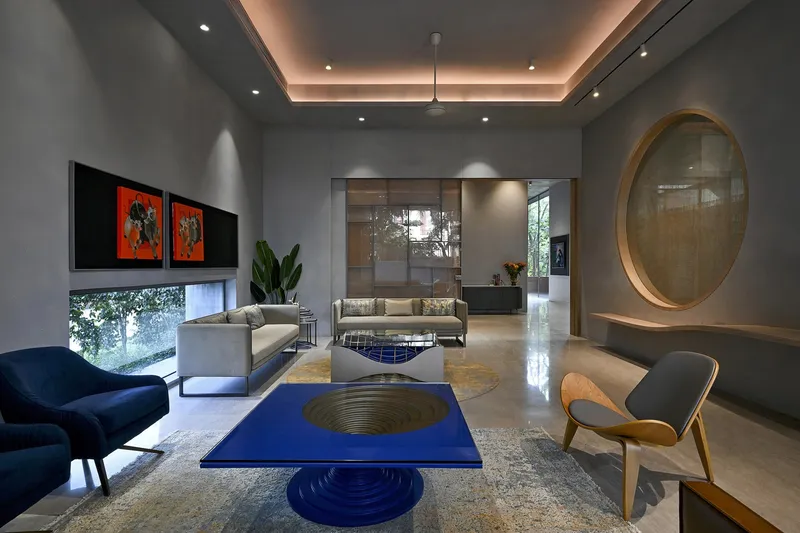
The interior palette stays within a tight range of greys, from exposed concrete ceilings to lime plaster walls to dark stone floors. Color appears only through art, furniture accents, and the green of courtyard vegetation visible from almost every room. A double-height living room with recessed cove lighting and a large circular mirror set into the wall demonstrates how the architects used geometry rather than material variety to create focal points. The restraint feels intentional rather than austere: in a building where light and shadow are the primary decorative elements, a busy palette would compete.
Over 80% of the furniture was custom-made on site by local carpenters using Indowuda, a rice-husk-based wood substitute. Combined with fly ash bricks, lime plaster, and materials sourced within a 100-kilometer radius, the project kept its supply chain short and its carbon footprint low. Solar water heating, rainwater harvesting, and water recycling round out the sustainability measures, but the real story is in the embedded carbon: local labor, local materials, and minimal transport.
Plans and Drawings
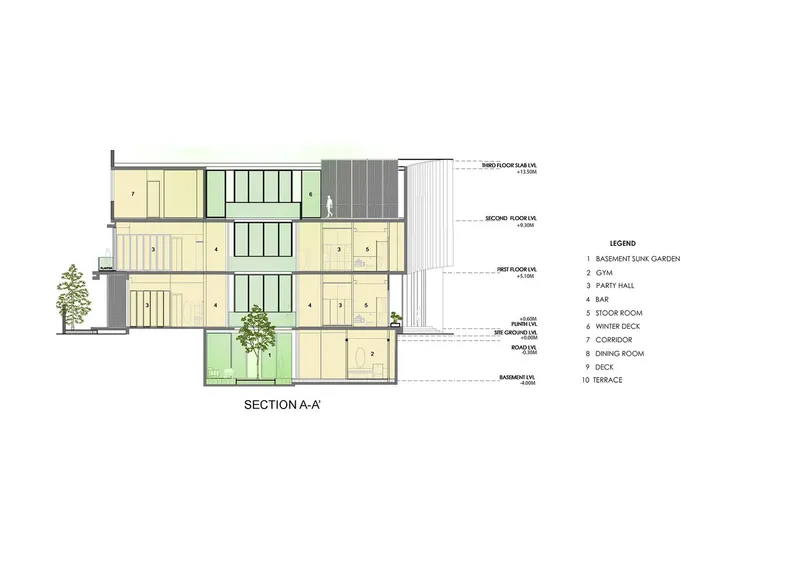
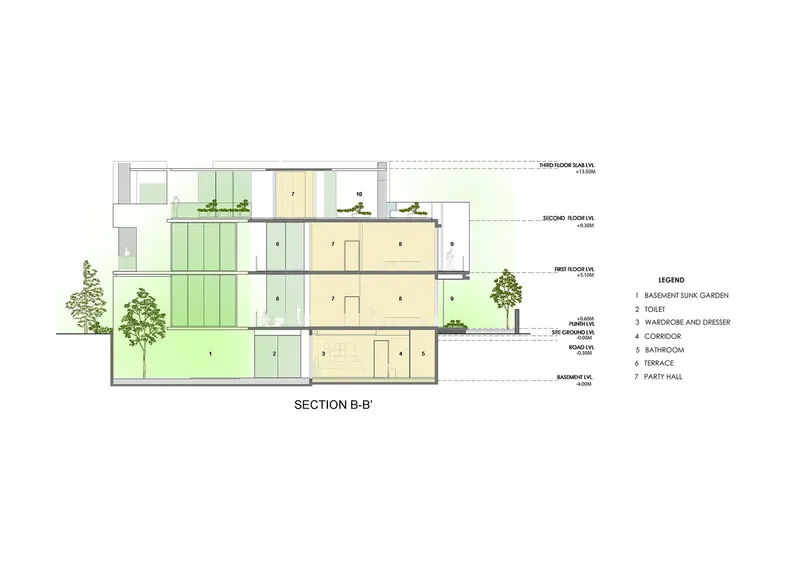
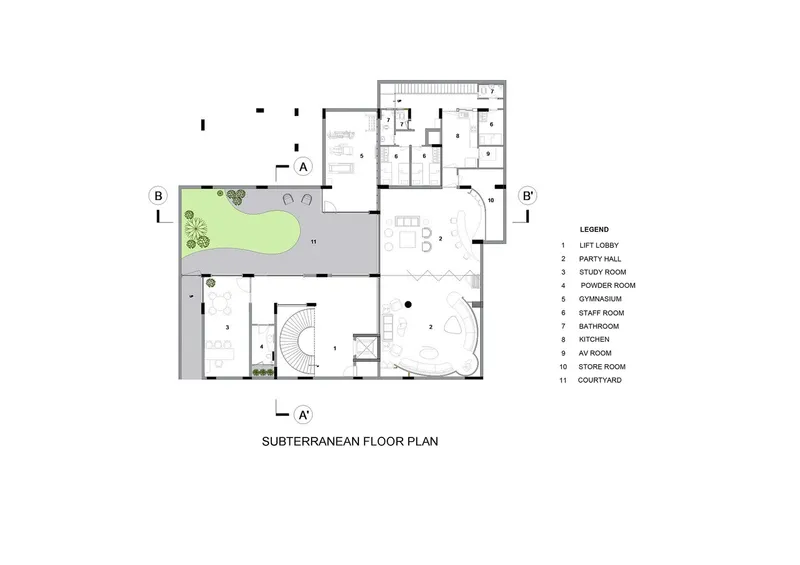
The sections reveal how the courtyard penetrates all four levels, bringing daylight down to the subterranean lounge and gym while allowing warm air to escape upward. The staggered floor plates create double-height moments at key social spaces, and the relationship between the sunken garden and the upper terraces becomes legible only in section. The subterranean floor plan shows the organic courtyard pool and curved staircase that connect the lower rooms, confirming that this level is not an afterthought but a fully resolved living space with its own landscape.
Why This Project Matters
Zen Spaces Residence matters because it demonstrates that climate-responsive design in extreme heat does not require exotic technology or imported systems. Everything here, the screens, the courtyard, the seasonal decks, the local materials, draws on Rajasthan's own building intelligence, updated with contemporary fabrication and spatial ambition. In a city where air conditioning is the default response to eight months of summer, a house that can stay cool through passive means while remaining spatially generous is a pointed argument for the relevance of regional knowledge.
It also offers a model for multigenerational living that avoids the usual trade-off between communal space and privacy. The courtyard gives the family a shared center of gravity; the private decks and separate bedroom wings give individuals room to withdraw. The circulation spine ties everything together without forcing interaction. For architects working on large domestic programs in hot climates, this project is worth a long, careful look.
Zen Spaces Residence by Sanjay Puri Architects (Lead Architect: Sanjay Puri; Associate Architects: Madhavi Belsare, Ishveen Bhasin). Jaipur, Rajasthan, India. 27,000 sq ft. Completed 2023. Photography by Dinesh Mehta.
About the Studio
Share Your Own Work on uni.xyz
If projects like this are the kind of work you want to make, uni.xyz is a place to publish your own, find collaborators, and enter design competitions.




Popular Articles
Popular articles from the community


Lunar Spiral: Space Architecture Shaped by the Mathematics of the Universe
Lunar Spiral reimagines space architecture through Fibonacci geometry, lunar regolith, levitating habitats, and self-sustaining Moon living.

Play: Fragments of Their World
Familiar architecture becomes modular playground design, creating safe spaces where displaced children can learn, connect, imagine and play.

Co-life: Sustainable Architecture for Age-Friendly Community Living
Co-life reimagines sustainable architecture for seniors through courtyards, rammed earth, shared gardens, and spaces designed for belonging.

The Earth Pod: 3D Printed Homes for Resilient Refugee Communities
The Earth Pod reimagines refugee housing through 3D printed homes made from clay, combining resilience, self-sufficiency, and rapid shelter.


Similar Reads
You might also enjoy these articles


Hodi-Mandai Geram
Project Function: Preservation and revitalization of the Intangible heritage and socio-spatial identity of the Hodi by Housing, Cultural Memory Center, Sacred Grove, landscape, local tourism economy


Olio Towers: A Mid-Rise for Performers That Fuses Housing, Rehearsal, and Stage
Located blocks from Houston's Theater District, this modular tower stacks living units around a central performance atrium.

Oasis: Modular Green Housing Carved into Dhaka's Urban Fabric
A shortlisted Plugin Housing entry reclaims unauthorized settlements in Dhaka with stepped concrete volumes, green roofs, and ventilation-driven design.

Black Hole: A Floating Megastructure for the Post-Physical Era
Emiliano Mazzarotto envisions a spherical, self-scaling arena where e-sports, digital hotels, and holographic stadiums replace traditional public space.

Explore Residential Building Competitions
Discover active competitions in this discipline


Challenge to design mud housing for contemporary communities


Challenge to reimagine the Iron Throne


Photograph architecture without architects


Illustrate the lost glory of Angkor Wat - Render Challenge
Comments (0)
Please login or sign up to add comments
No comments yet. Be the first to comment!