

Richter Architectes Builds a Timber Village School Around Double Courtyards in Mitry-Mory
A sawtooth-roofed nursery and leisure center in suburban Paris shelters children inside wood, hempcrete, and planted courtyards.


Twenty-four kilometers northeast of Paris, Mitry-Mory's newest quarter sits on a tight orthogonal grid of modest pavilion houses. It is not the kind of fabric that announces civic ambition. Yet Richter Architectes et Associés have placed something genuinely civic here: a single-story nursery school and community center that reads less like an institution than like a compact village folded around two tree-lined courtyards. The Nursery School and Elsa Triolet Center, completed in 2024, bundles eight classrooms, a leisure center, a lunchroom, and a multi-activity hall into a timber-framed complex whose sawtooth roofline rises and falls three times to signal its three programmatic entities.
What makes the project worth studying is not just its commitment to wood construction or its passive environmental strategies, though both are rigorous. It is the way the architects have used section, not plan, as the primary tool for shaping a child's experience of space. By eliminating false ceilings and letting the sawtooth roof structure remain fully exposed, every room becomes a lesson in scale, light direction, and sky. Classrooms look inward to courtyards; corridors frame alternating high and low views; and the central covered playground doubles as a social threshold between the nursery and the leisure center. The result is an architecture that takes early childhood seriously enough to give it real spatial complexity.
A Timber Envelope on a Suburban Grid
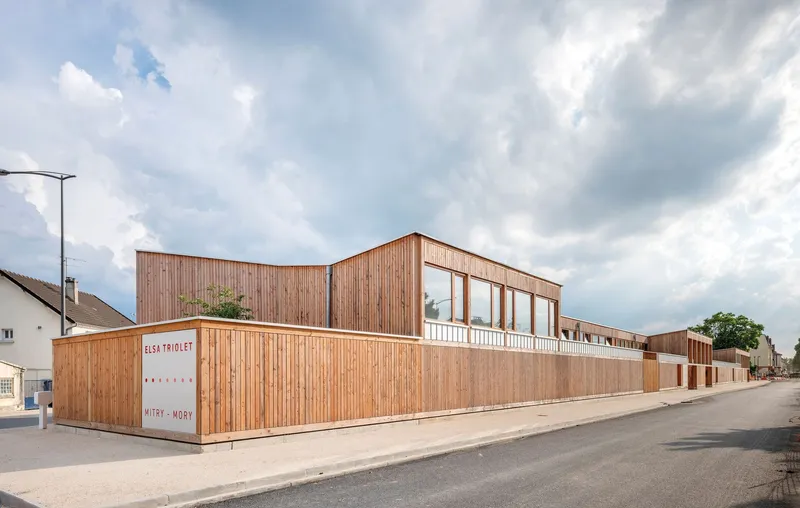
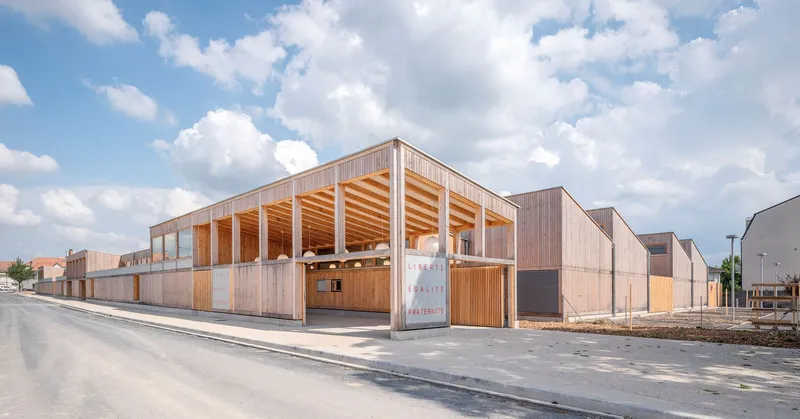

From the street, the building presents a restrained wall of vertical timber cladding punctuated by clerestory glazing. The wood is left to weather naturally, a deliberate counterpoint to the rendered facades and pitched roofs of the surrounding houses. Glulam members project beyond the roof edge at the corners, giving the structure an almost agricultural honesty. The facade strategy is protective rather than exhibitionist: it shields children from views and noise while letting daylight slide in from above.
The courtyard side tells a different story. Here, full-height glazing opens the classrooms directly to the planted interior landscapes. Young trees in gravel beds will, within a few years, form a canopy that transforms the light quality inside the rooms season by season. Richter's move to orient roofs parallel to the main street while turning classrooms perpendicular to the courtyard creates a terraced-house logic that gives each unit its own address within the larger ensemble.
Exposed Structure as Spatial Teacher


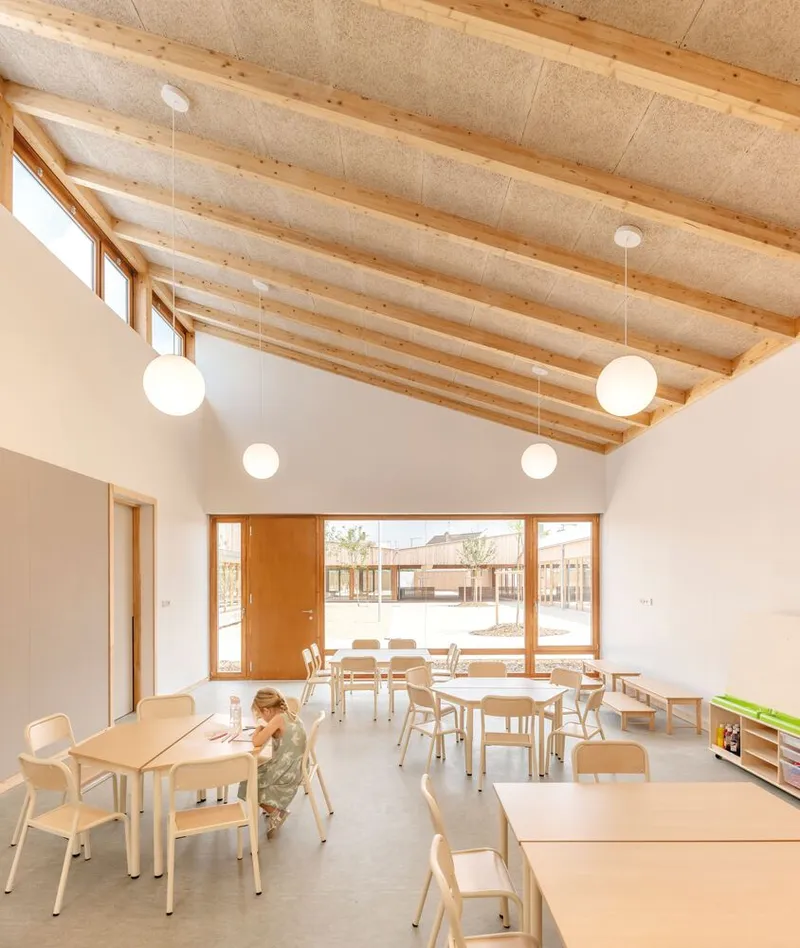
The decision to leave the timber trusses and hempcrete infill panels fully visible is not merely aesthetic. By distributing technical networks within the depth of the structure rather than hiding them behind suspended ceilings, the architects gain surprising ceiling heights that change as the sawtooth profile rises and dips. In the multi-activity hall, the full sectional drama is on display: glulam beams fan outward, hempcrete panels glow warm under angled afternoon light, and clerestory windows carve sharp bands of sky into the upper wall.
Classrooms benefit from a gentler version of the same strategy. Vaulted timber beam ceilings with globe pendant lights create an intimate, almost domestic scale for children, while the high side of the sawtooth pulls the eye upward. A mezzanine walkway in the double-height room hints at how the building can accommodate future programmatic shifts without structural modification.
Courtyards and the Life Between Rooms
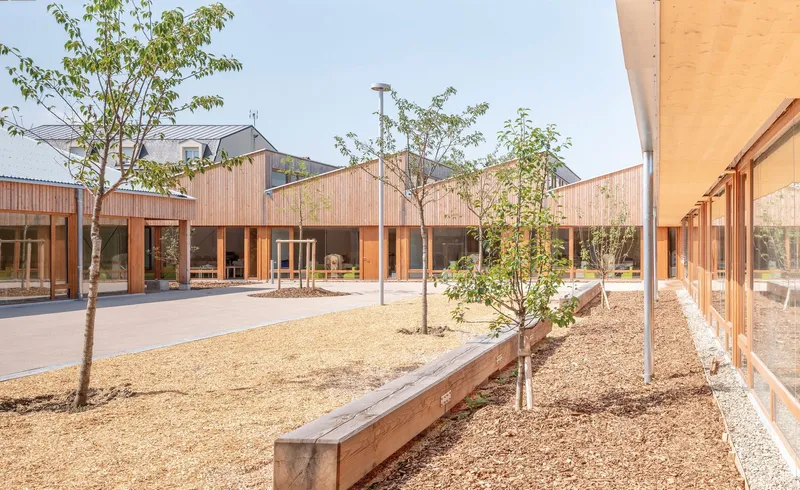
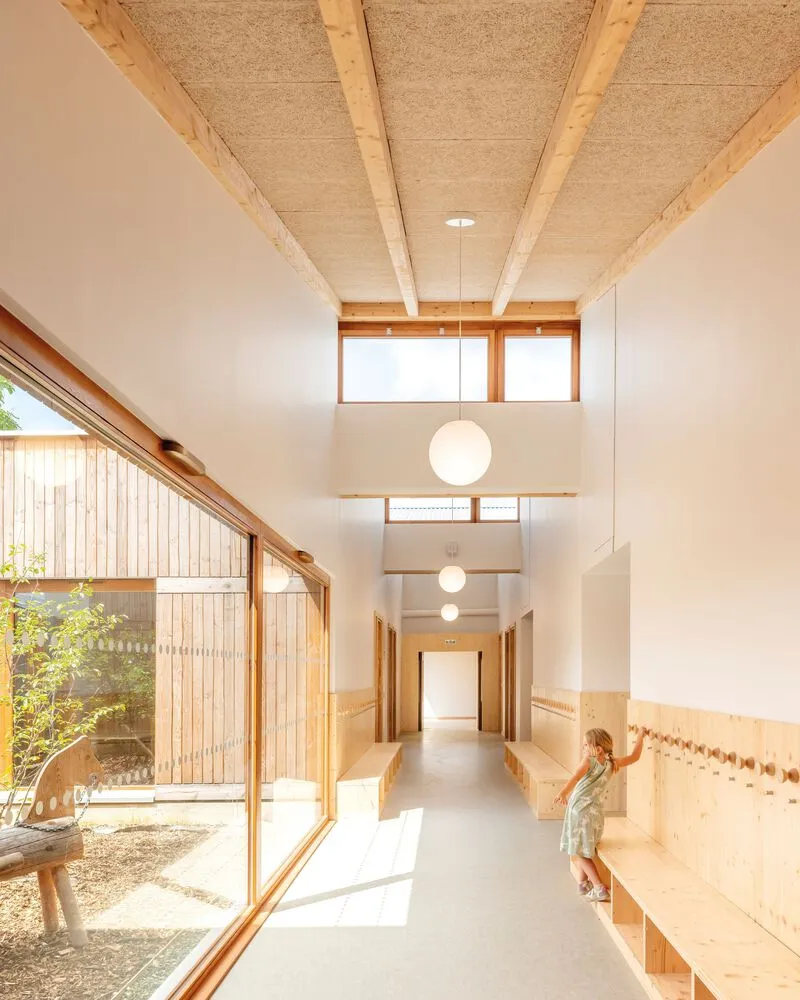
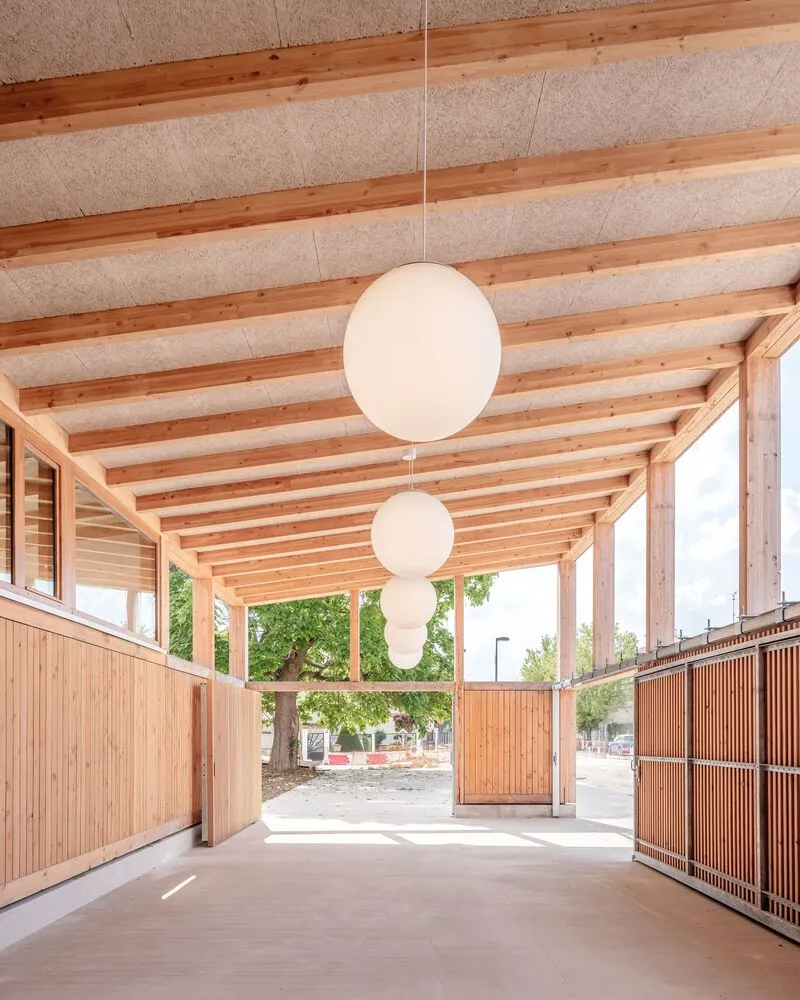
The double courtyard is the conceptual engine of the plan. One serves the nursery; the other anchors the leisure center. Between them, a covered playground and multi-activity room act as a shared hinge. Gravel planting beds, timber benches, and young deciduous trees compose a landscape (designed by Bruno Kubler) that is deliberately understated, inviting children to project their own narratives onto it rather than prescribing play.
Covered walkways with exposed rafters and hempcrete ceiling panels line the courtyard edges, forming a transitional zone that is neither fully inside nor fully outside. A child walking along this corridor, as captured in one photograph, moves through a rhythmic sequence of timber columns and framed garden views. The experience is sequential, almost cinematic, and it replaces the institutional double-loaded corridor with something far more generous.
Color, Detail, and Child-Scaled Moments

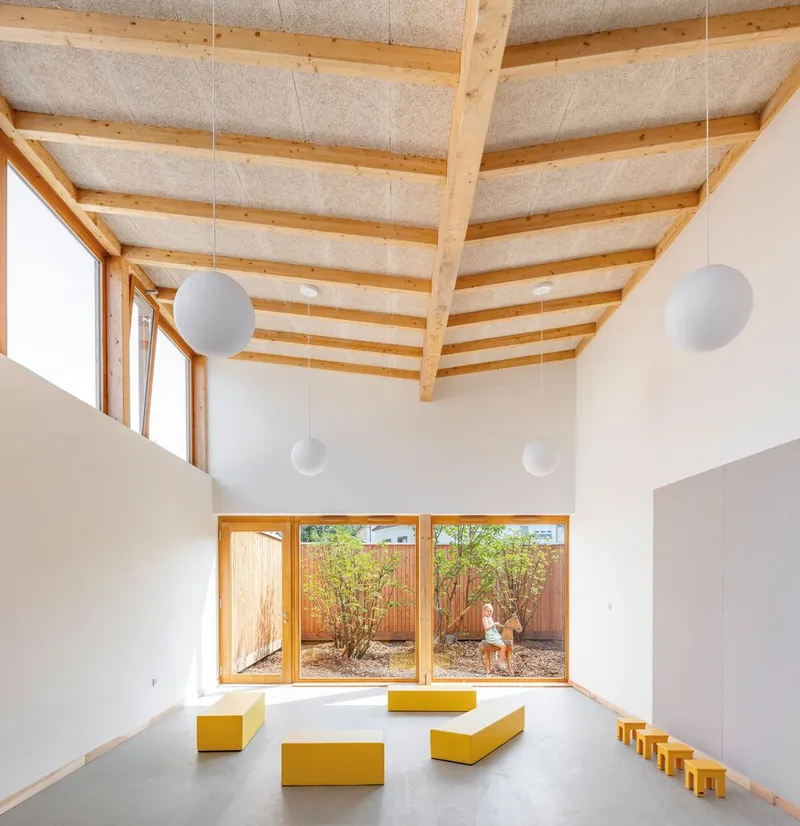

Richter deploys color sparingly but precisely. A red accent wall in one corridor anchors an otherwise neutral palette of timber and hempcrete. In the washroom, red tile wainscoting wraps child-height basins and partitions with a warmth that avoids the saccharine pastels so common in nursery design. Yellow foam seating blocks in a classroom overlooking the courtyard introduce a playful note without competing with the architecture.
These details matter because they demonstrate a commitment to the scale of the user. Pendant globe lights hang low enough to register as objects rather than fixtures. Windows are framed in timber at heights that prioritize a three-year-old's sightline over an adult's. The architecture does not merely accommodate children; it is calibrated to them.
Timber, Hempcrete, and a Material Ethic
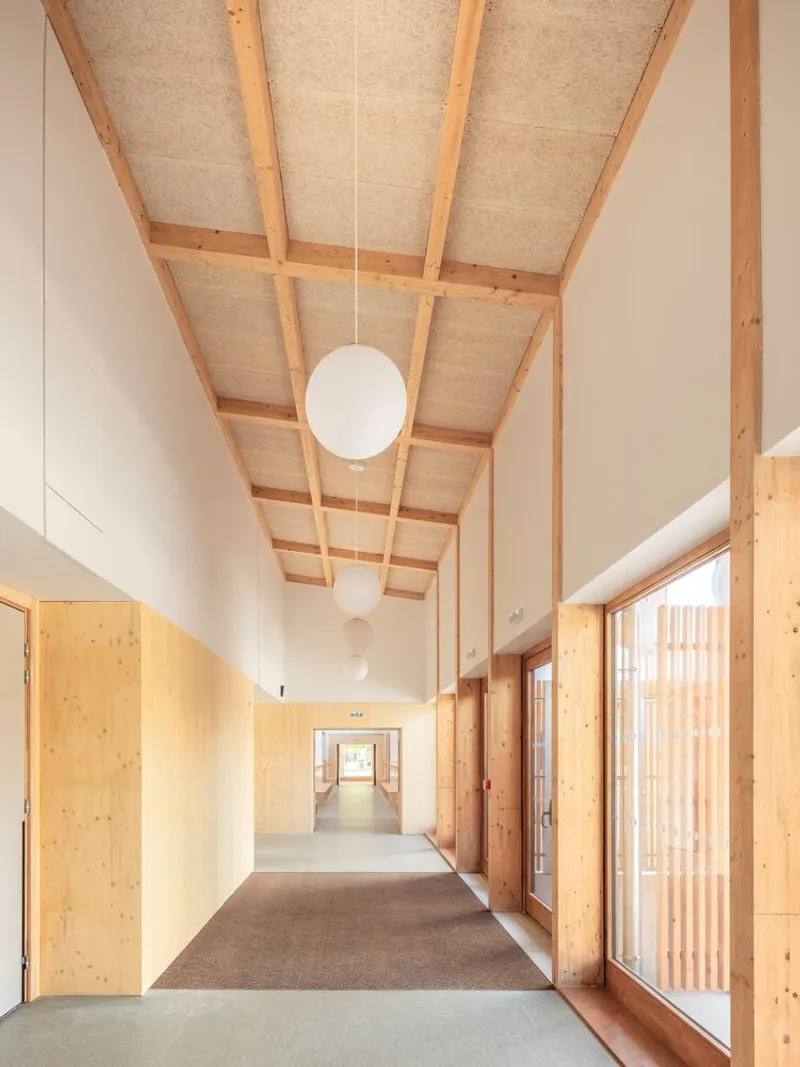
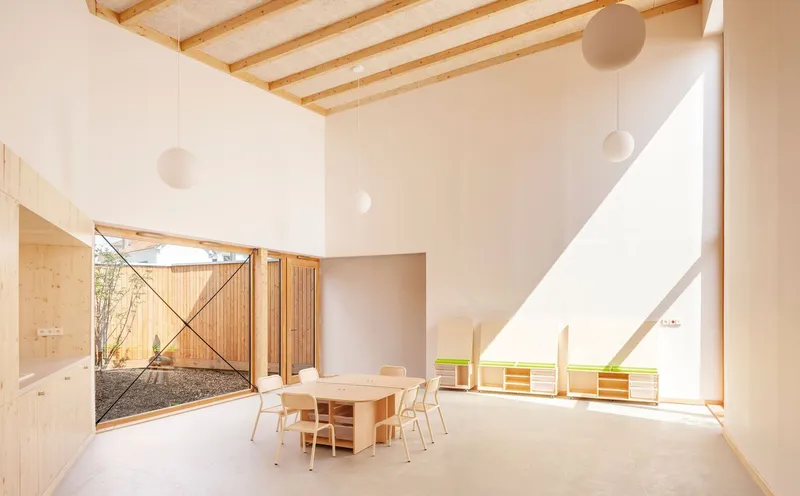
The material palette is tight: structural glulam timber, hempcrete infill panels, vertical timber cladding outside, and exposed wood surfaces inside. Hempcrete, a bio-based composite of hemp shiv and lime binder, contributes thermal mass and hygroscopic regulation without the embodied carbon of conventional insulation. Its matte, sandy surface reads as an honest complement to the warmer tones of the timber beams, and the two materials together eliminate the need for applied finishes across most interior surfaces.
In the double-height room where afternoon sunlight rakes across a timber table and chairs, the quality of light on wood is almost domestic. This is the payoff of an all-timber strategy: when every surface is real, light has something to work with. The architects' consultants at SIB études and Solares Bauen clearly pushed the structural and thermal engineering to allow this level of material exposure, and the acoustic treatment by Groupe Gamba ensures that exposed hard surfaces do not turn classrooms into echo chambers.
Plans and Drawings
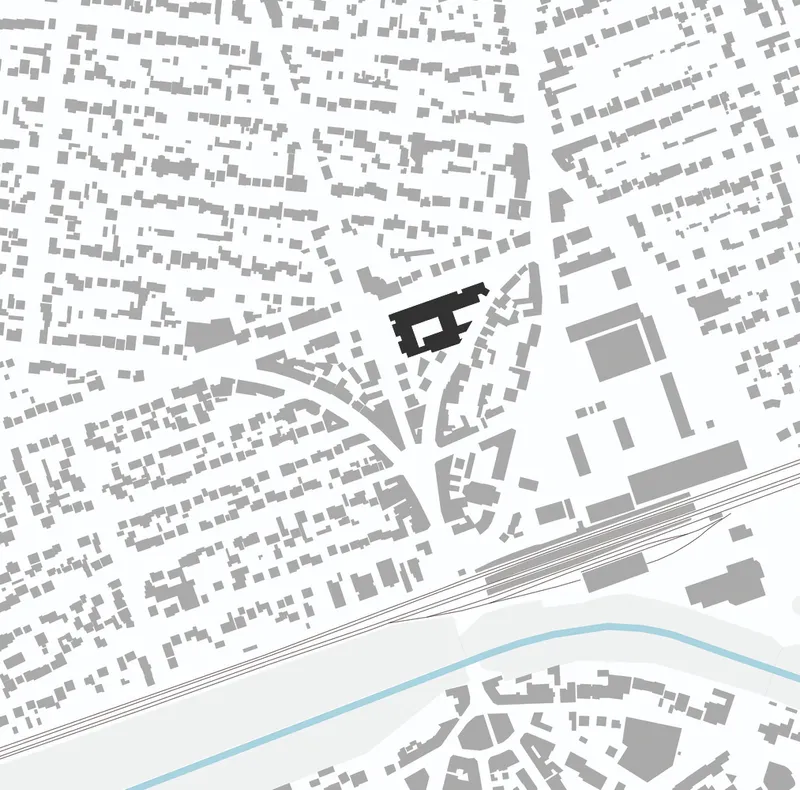
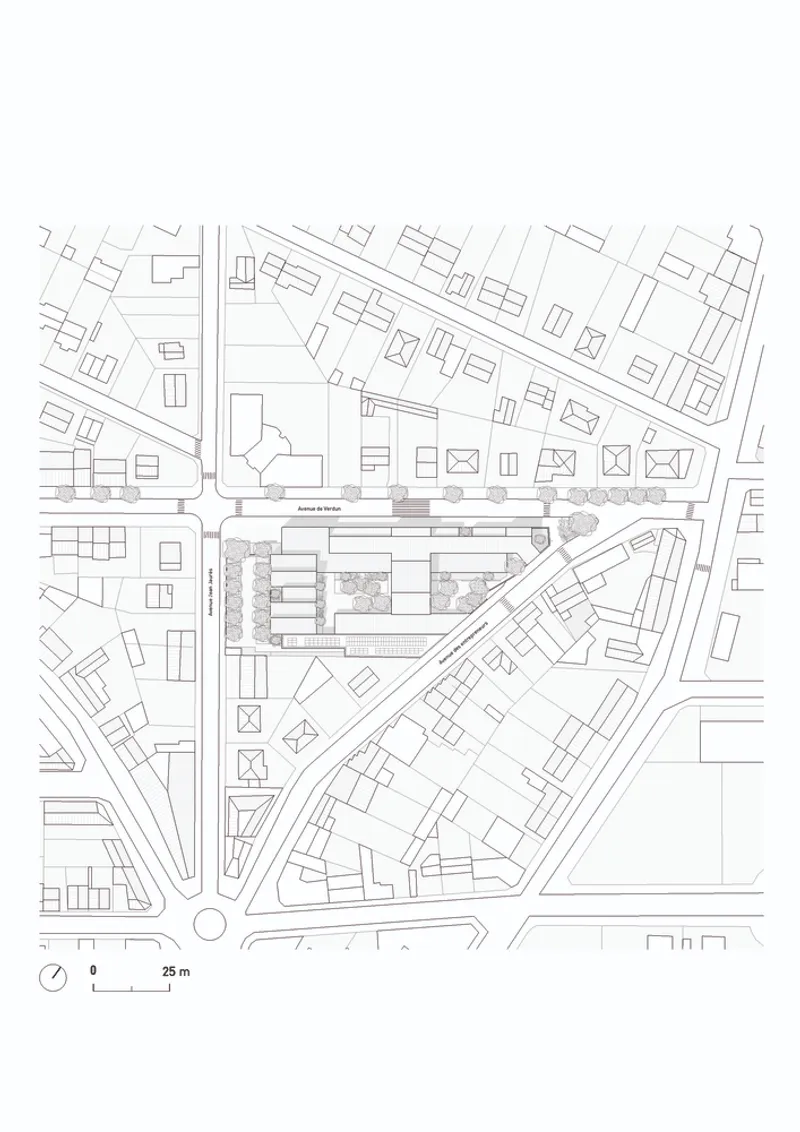
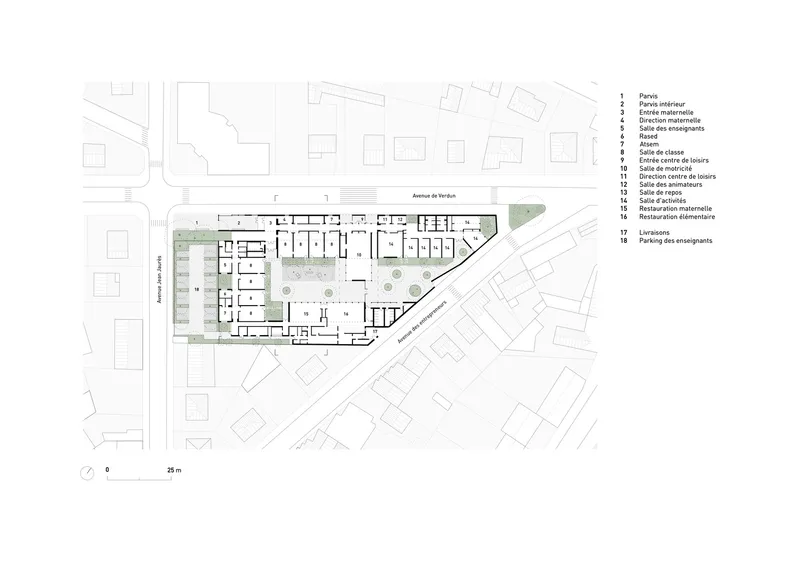
The site plans reveal how the building negotiates its corner condition on the urban grid, carving out a public square at the block's edge that serves as a sheltered forecourt and transitional threshold between city and school. The floor plan makes the terraced-house analogy explicit: classroom wings extend like fingers from a central spine, each one terminating at a courtyard or small garden. Every teaching space earns direct access to vegetation.
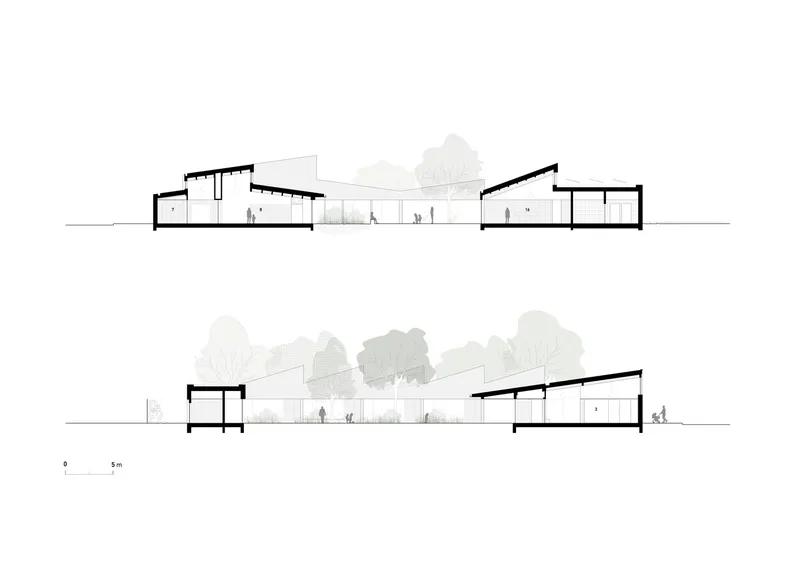
The section drawings are where the sawtooth strategy becomes fully legible. The roof profile descends as it approaches the courtyard, pulling the scale down to meet the children, then rises again at the clerestory to flood deeper spaces with light. Three distinct peaks mark the nursery, the multi-activity room, and the leisure center, giving each program its own volumetric identity while maintaining a unified roofline when seen from the street.
Why This Project Matters
School architecture in France often oscillates between two poles: the pragmatic box wrapped in colorful panels, and the signature gesture that prioritizes photogenic form over pedagogical function. The Nursery School and Elsa Triolet Center avoids both traps. Its spatial richness comes from structure, not ornament; its environmental performance comes from material choice and section design, not bolt-on technology. The building works because its architects understood that a three-year-old's experience of space is fundamentally sectional: floor to ceiling, window sill to sky.
There is also a broader lesson here about scale and civic responsibility. On a grid of modest suburban plots, Richter Architectes have inserted a public building that is simultaneously contextual and transformative. It does not tower over its neighbors or shout its presence. Instead, it creates a world within, organized around courtyards and light, built from timber and hempcrete, and calibrated to the smallest citizens of Mitry-Mory. That quiet ambition is harder to achieve than any formal pyrotechnics, and it is exactly what suburban communities deserve from their public architecture.
Nursery School and Elsa Triolet Center by Richter Architectes et Associés. Mitry-Mory, France. Completed 2024. Landscape by Bruno Kubler. Photographs by Luc Boegly.
About the Studio
Share Your Own Work on uni.xyz
If projects like this are the kind of work you want to make, uni.xyz is a place to publish your own, find collaborators, and enter design competitions.


Popular Articles
Popular articles from the community


Singing Woman: An Opera House That Performs Before the Curtain Rises
Ovidiu Cristian Pavel's conceptual opera house translates Estonia's choral identity into a sculpted waterfront landmark facing the Baltic Sea.

Cloaked Colonization: A Mobile Underwater Habitat That Moves Like a Fish
Micah Abaya's shortlisted EHC Pacific entry reimagines ocean settlement as a dispersed network of self-sustaining architectural organisms.

Faces of the Soviet Avant-Garde: Turning Moscow's Street Names into an Open-Air Museum
A network of sculptural installations across a Moscow residential district transforms forgotten architect names into spatial encounters with cultural memor

Extended Shell: Retrofitting Kolkata's Balconies as Living Urban Thresholds
A modular retrofit system recovers the social and environmental intelligence of Kolkata's historic verandas for contemporary Park Street residents.

Similar Reads
You might also enjoy these articles


Hodi-Mandai Geram
Project Function: Preservation and revitalization of the Intangible heritage and socio-spatial identity of the Hodi by Housing, Cultural Memory Center, Sacred Grove, landscape, local tourism economy


Olio Towers: A Mid-Rise for Performers That Fuses Housing, Rehearsal, and Stage
Located blocks from Houston's Theater District, this modular tower stacks living units around a central performance atrium.

Oasis: Modular Green Housing Carved into Dhaka's Urban Fabric
A shortlisted Plugin Housing entry reclaims unauthorized settlements in Dhaka with stepped concrete volumes, green roofs, and ventilation-driven design.

Black Hole: A Floating Megastructure for the Post-Physical Era
Emiliano Mazzarotto envisions a spherical, self-scaling arena where e-sports, digital hotels, and holographic stadiums replace traditional public space.

Explore Architecture Competitions
Discover active competitions in this discipline

Challenge to reimagine the Iron Throne

Photograph architecture without architects

Illustrate the lost glory of Angkor Wat - Render Challenge

Design challenge to reuse E-waste
Comments (0)
Please login or sign up to add comments
No comments yet. Be the first to comment!