

Madeiguincho Converts a Shipping Container into a Cork-Clad Tiny House in Portugal's Algarve
A 24-square-meter cargo container becomes a rooftop-terraced retreat among olive trees and grazing sheep in Lagos, Portugal.


A standard 20-foot shipping container is not a generous starting point for architecture. At six meters by two and a half, it offers roughly the interior volume of a transit van. Yet Portuguese studio Madeiguincho treats that constraint as a creative engine, wrapping, lining, and extending the steel box until it reads not as salvage but as a considered building. Set among olive trees on a sloping meadow in Lagos, the Cargo House is a short-term rental completed in 2024 that argues for reuse without apology.
What makes the project worth studying is not the container conceit itself, which has been explored to exhaustion elsewhere, but the specificity of the material strategy. Cork cladding on the exterior, poplar plywood on the interior, a patchwork stone and timber roof terrace, an arched corrugated metal door: every surface decision pulls the container away from its industrial origin and toward the vernacular textures of southern Portugal. The result is a 24-square-meter dwelling that feels rooted in its landscape rather than dropped onto it.
Cork, Steel, and the Algarve Landscape
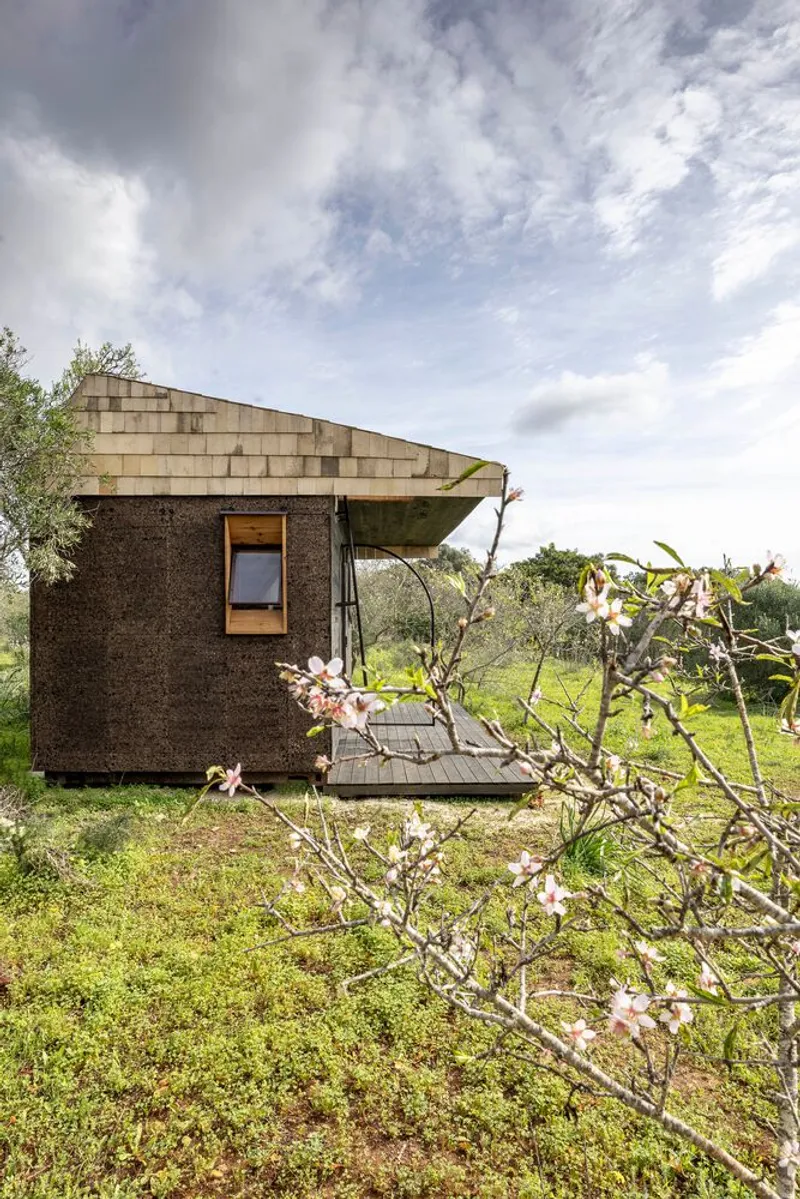
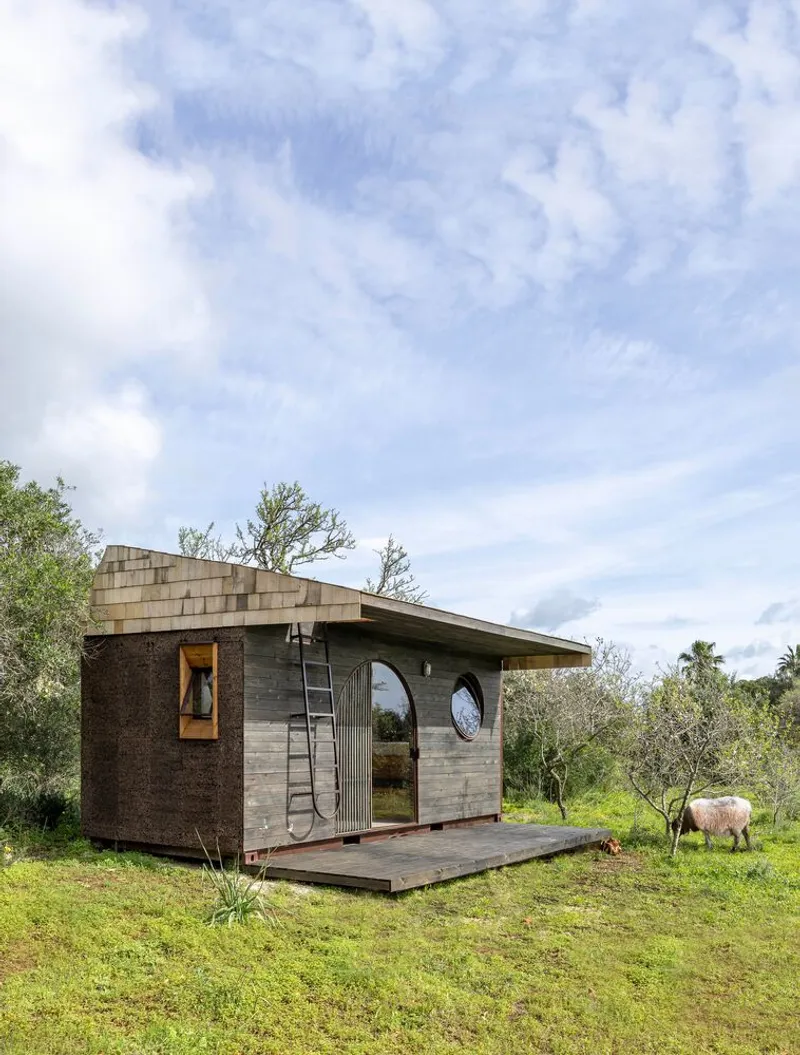
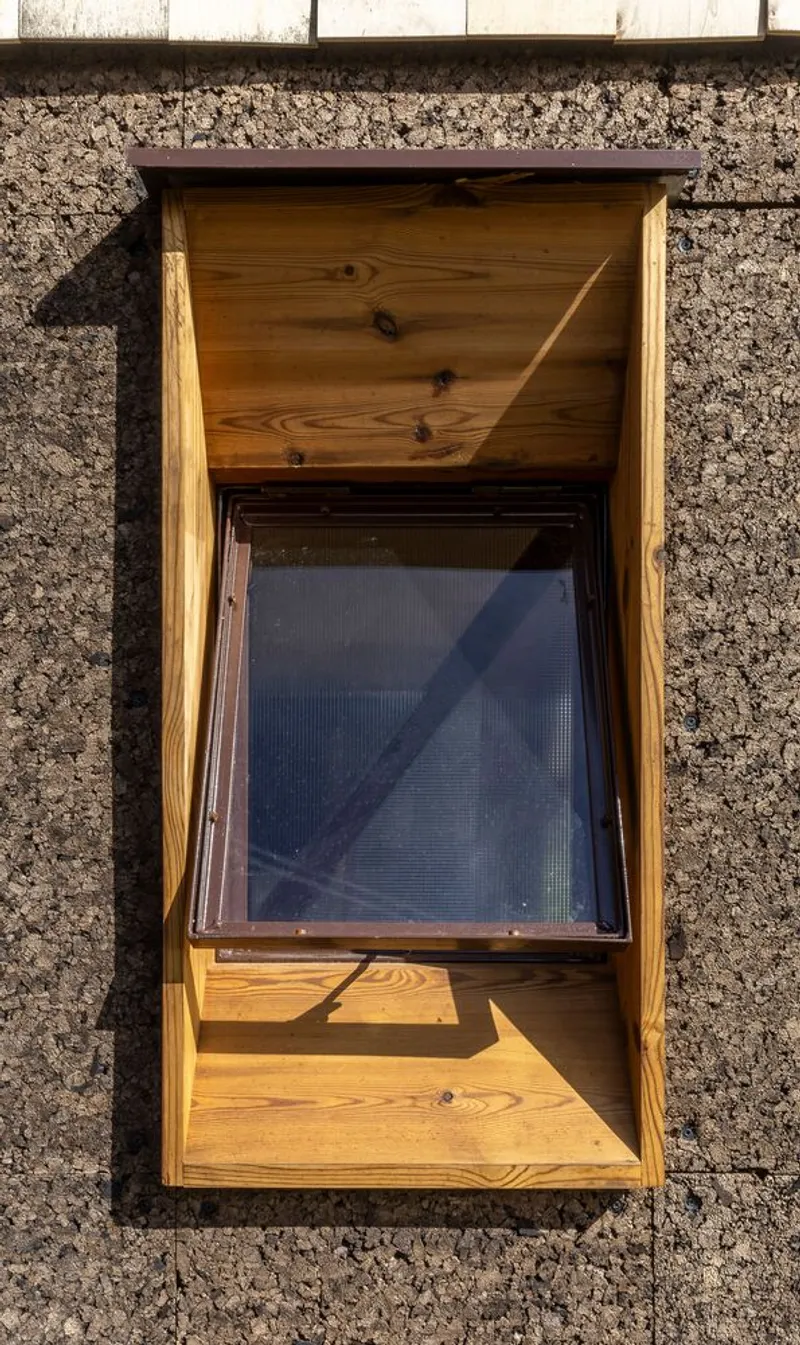
The container's original corrugated steel is almost entirely concealed behind a thick skin of cork panels. Cork is a regional material in the Algarve, harvested from the bark of Quercus suber without felling the tree, and its thermal mass helps buffer interior temperatures in a climate that swings between cool winters and searing summers. The rough, variegated surface of the cork gives the volume a geological quality, as if it were a boulder that settled into the meadow.
A cantilevered concrete roof plane extends beyond the cork walls on one side, sheltering the sleeping pod from direct sun and rain while framing the pastoral view. The overhang is generous enough to cast deep shade at midday but low enough to let morning and evening light penetrate. Between the cork, the concrete, and the surrounding spring blossoms, the building participates in the landscape rather than merely occupying it.
Thresholds: The Arched Door and Porthole Window
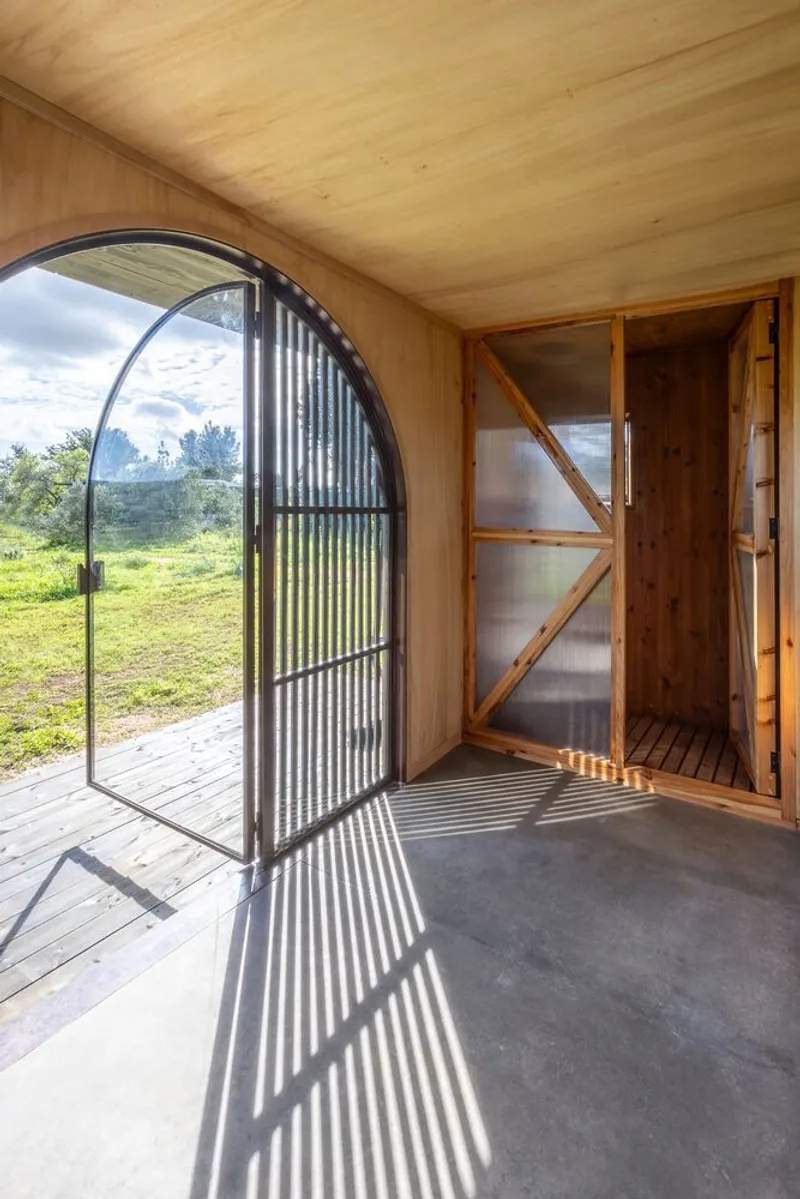
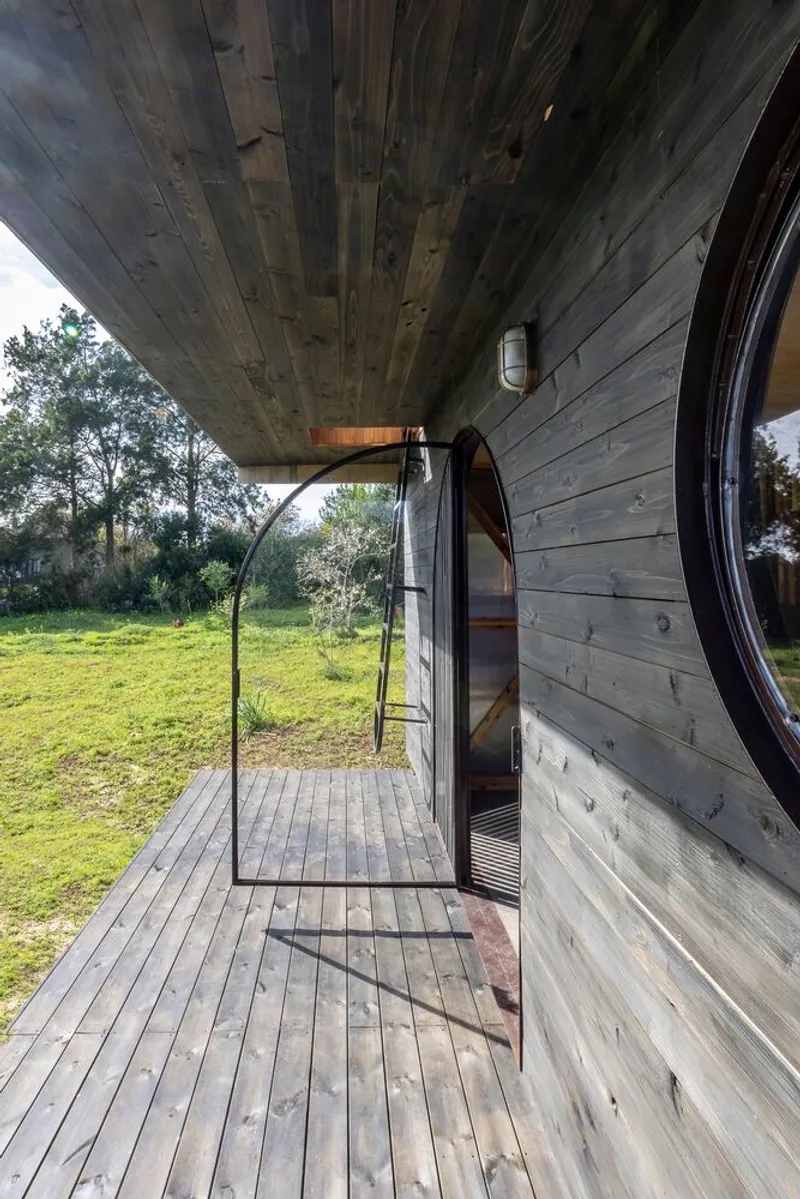
Madeiguincho introduces two unexpected openings to the container's utilitarian shell. The arched corrugated metal door at the front entry transforms the act of arriving. When swung open, it casts striped shadows across the concrete floor, turning a simple hinge into a light instrument. The proportions reference a chapel or cellar door more than a shipping dock, and the gesture immediately reframes the container as a dwelling.
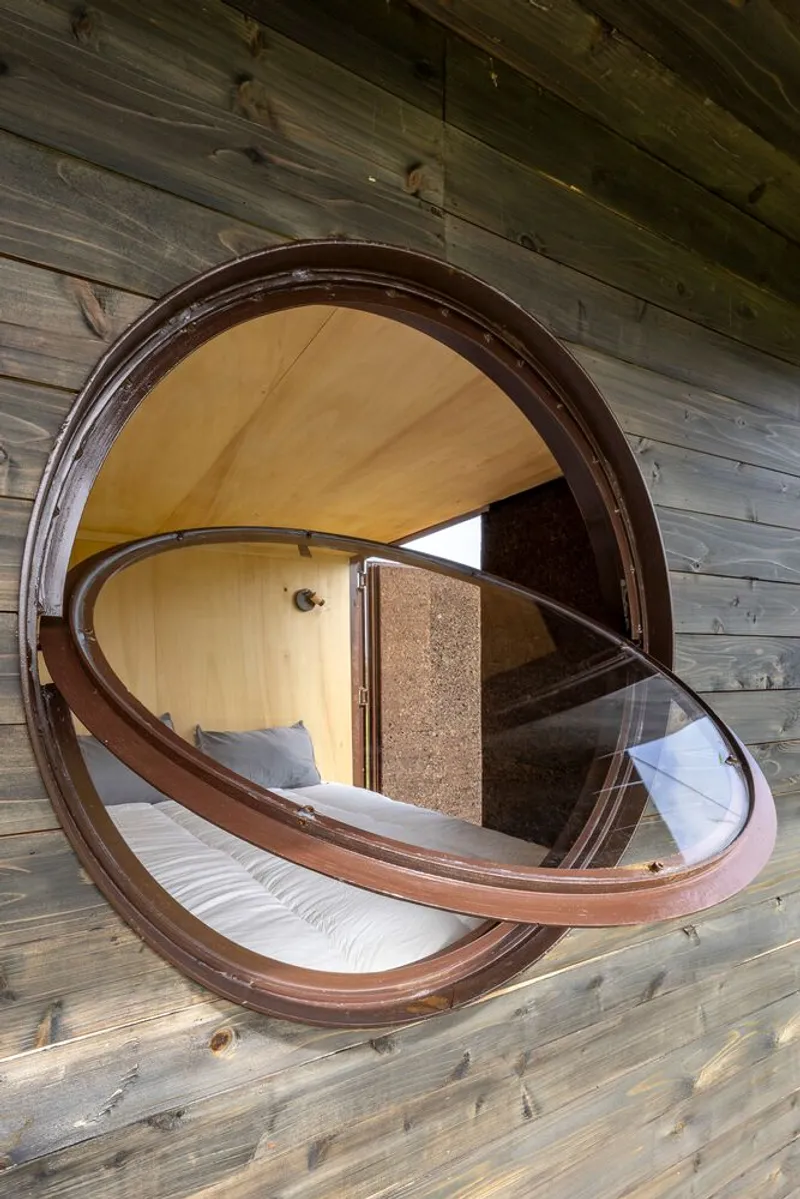
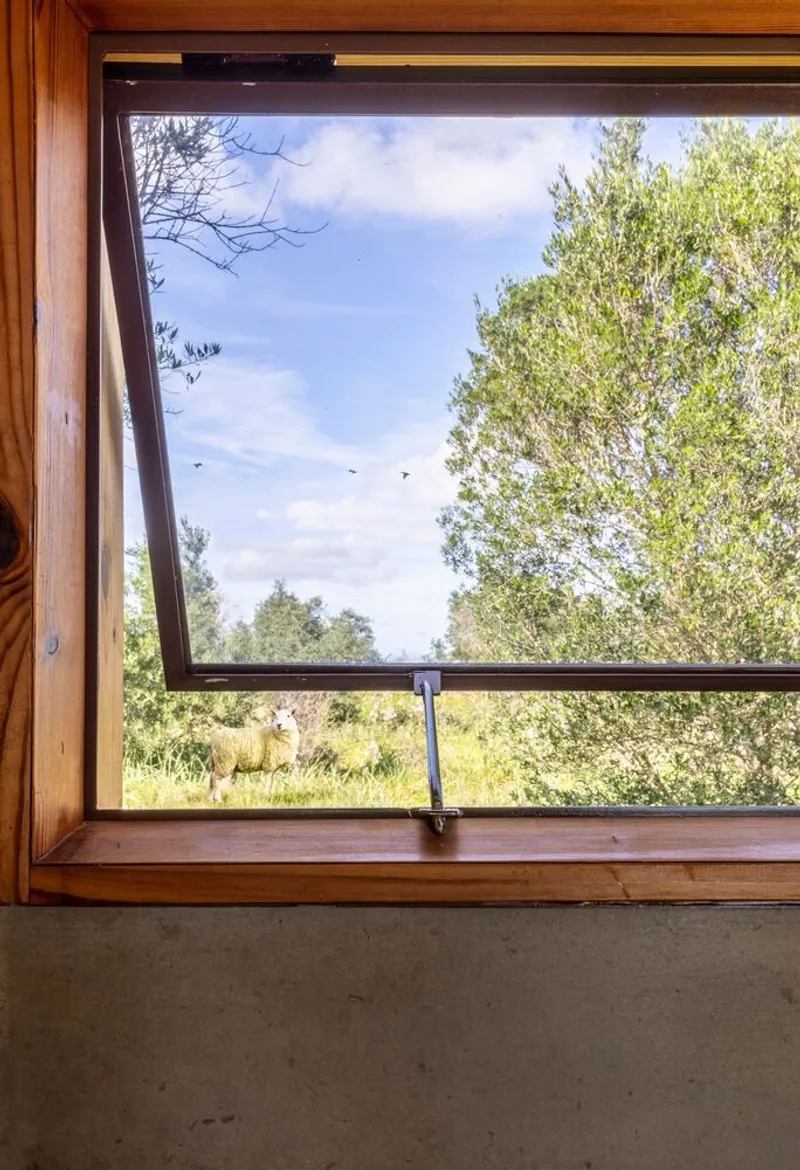
At the opposite end, a circular porthole window sits above the bed, framing the sky and treetops in a tight aperture. It pivots open for ventilation. The window is a deliberate contrast to the rectilinear logic of the container: a soft shape punched into a hard surface. Together, the arch and the circle give the Cargo House a visual identity that transcends the novelty of the container typology.
Interior: Plywood, Concrete, and Compact Planning
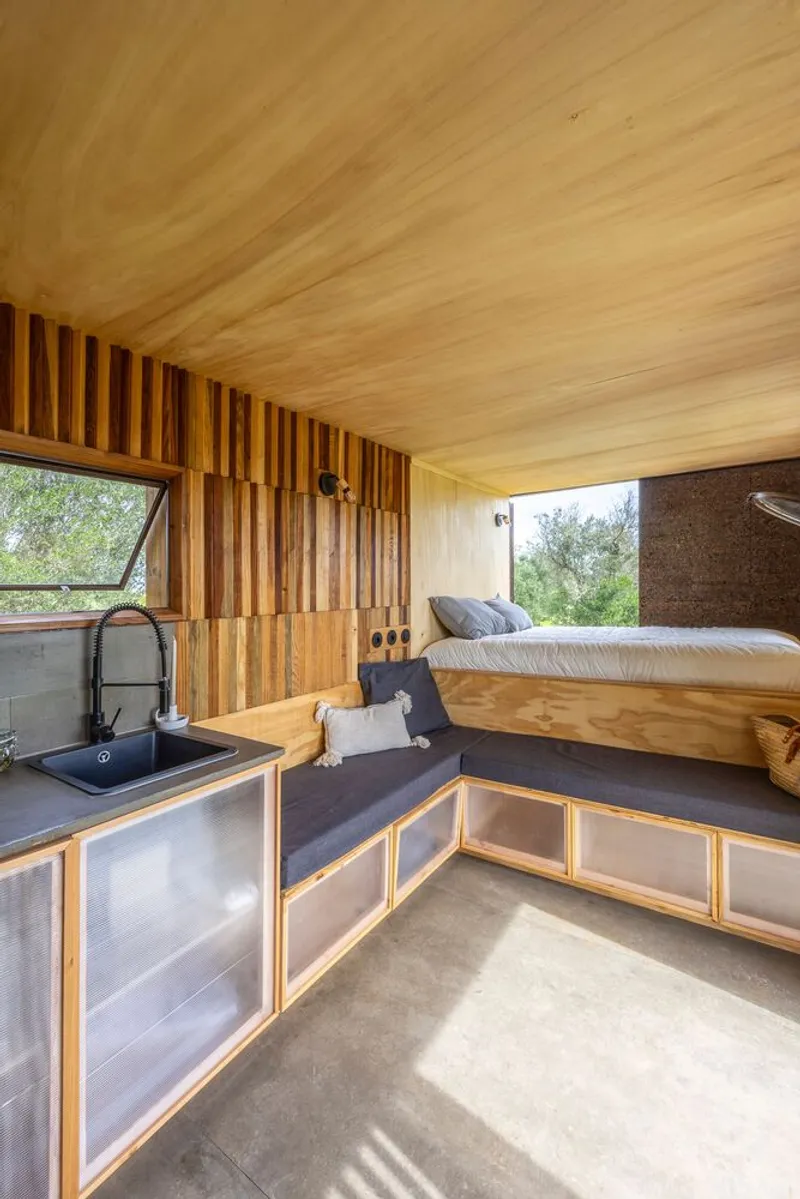
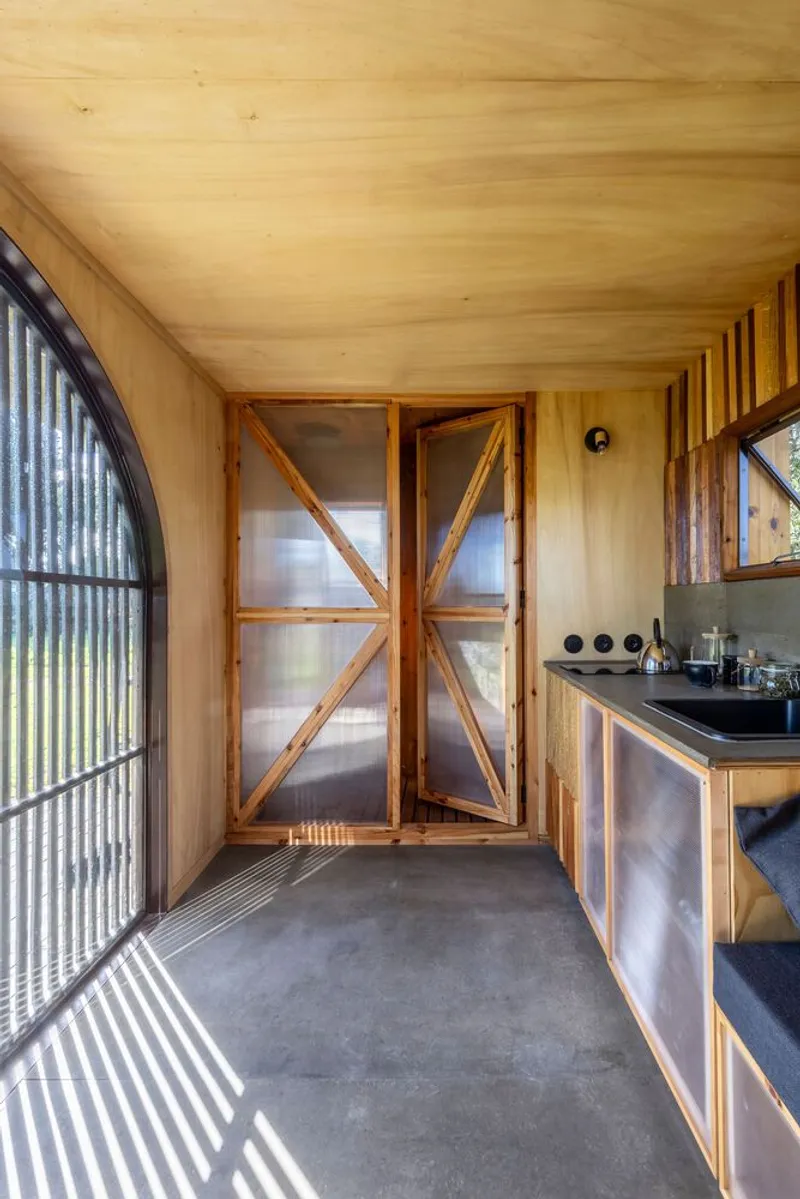
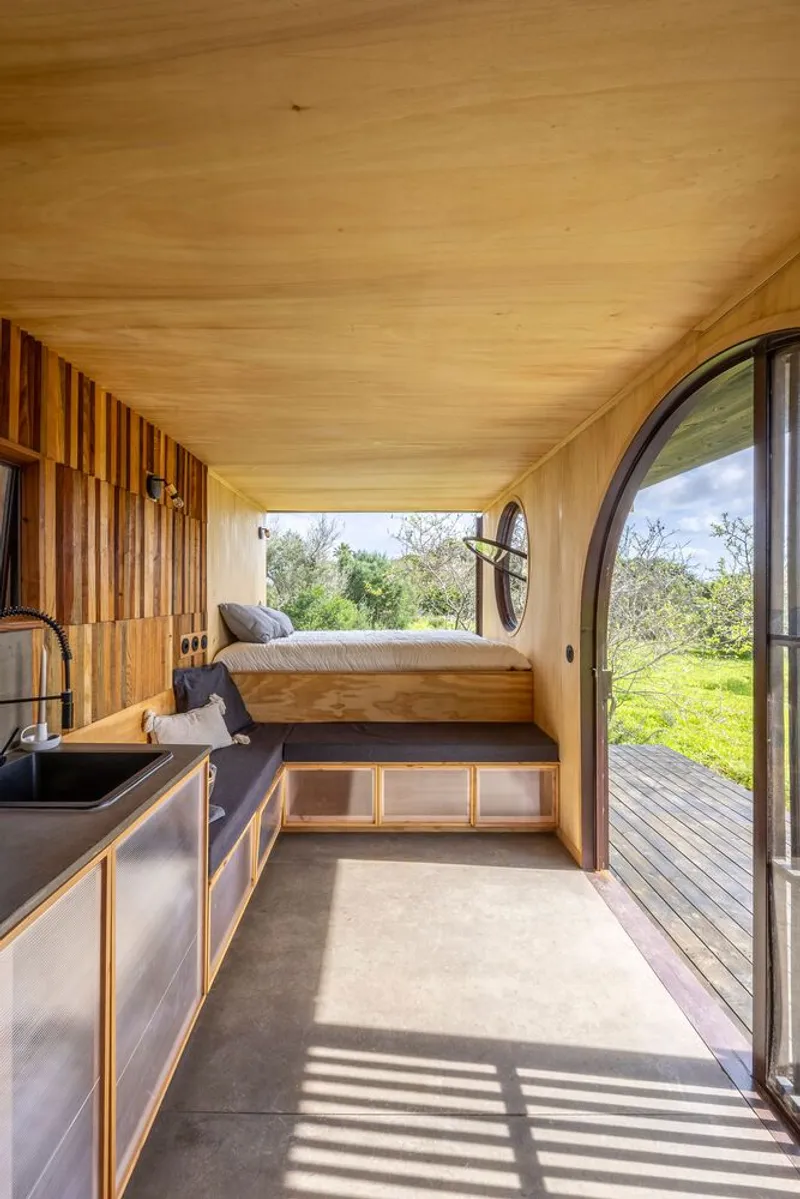
Inside, every surface is lined with poplar plywood panels that warm the space and hide the corrugated steel. The floor remains raw concrete, providing thermal mass and a practical surface that can handle tracked-in sand and water. The contrast between the pale wood overhead and the grey slab underfoot keeps the tiny interior from feeling precious.
The plan is linear and legible. An L-shaped kitchenette with induction hob, sink, fridge, and storage cabinets occupies the middle zone. Behind it, a translucent-walled bathroom admits light while maintaining privacy, with timber slats in the shower acting as a drainage floor. The sleeping platform is raised at one end, creating useful storage underneath and giving the bed a sense of enclosure. Diagonal-braced doors punctuate the corridor, reinforcing the handmade quality that distinguishes the project from off-the-shelf container conversions.
The Bed as Belvedere
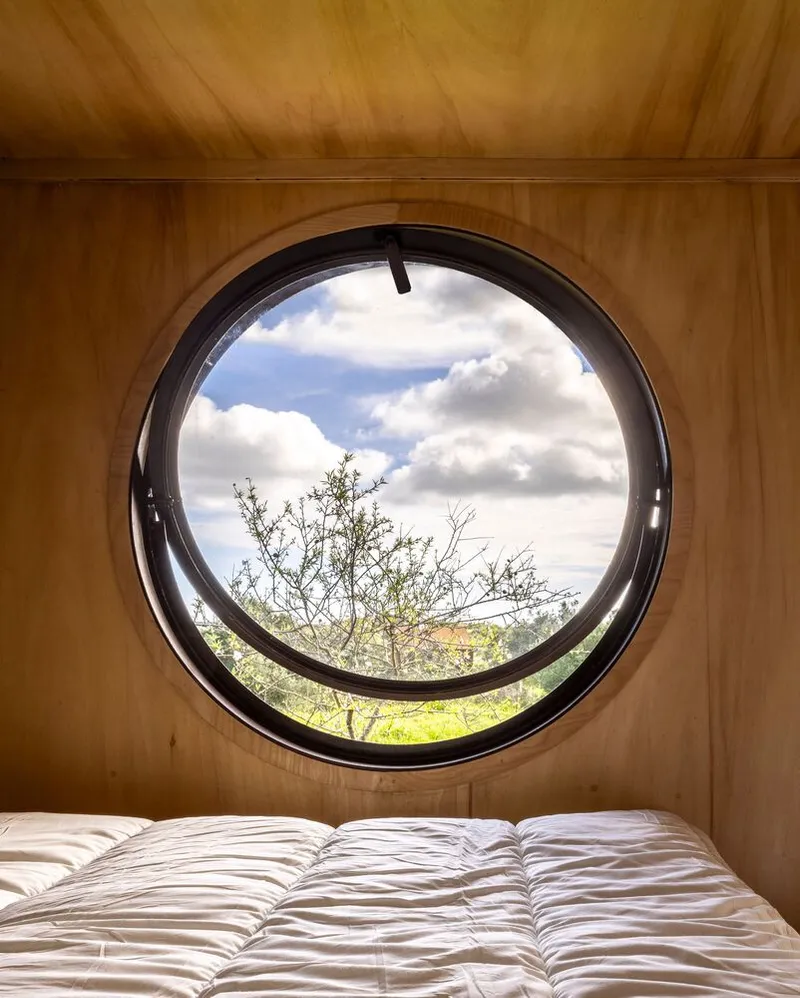
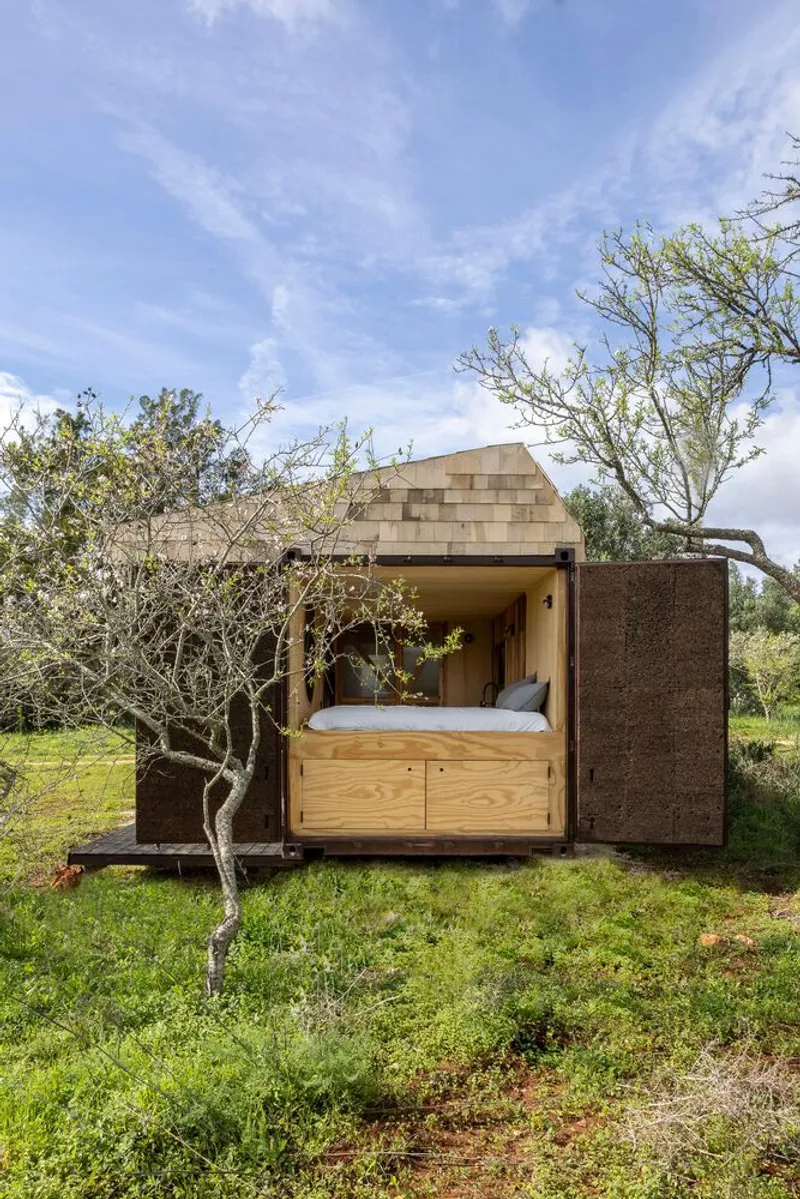
The raised sleeping platform is more than a storage trick. Positioned at the end of the container beneath the porthole, the bed becomes the most contemplative space in the house. Lying down, you see nothing but sky and foliage through the circular frame. The quilted bedding and timber surround create a cocoon, while the open side of the pod under the cantilevered roof dissolves the boundary between interior sleep and exterior landscape.
It is a spatial move borrowed from boat cabins and train sleepers: compress the volume, elevate the body, reward the eye. In a dwelling this small, the bed cannot be an afterthought. Here it is the climax of the plan.
Rooftop Terrace and Vertical Expansion
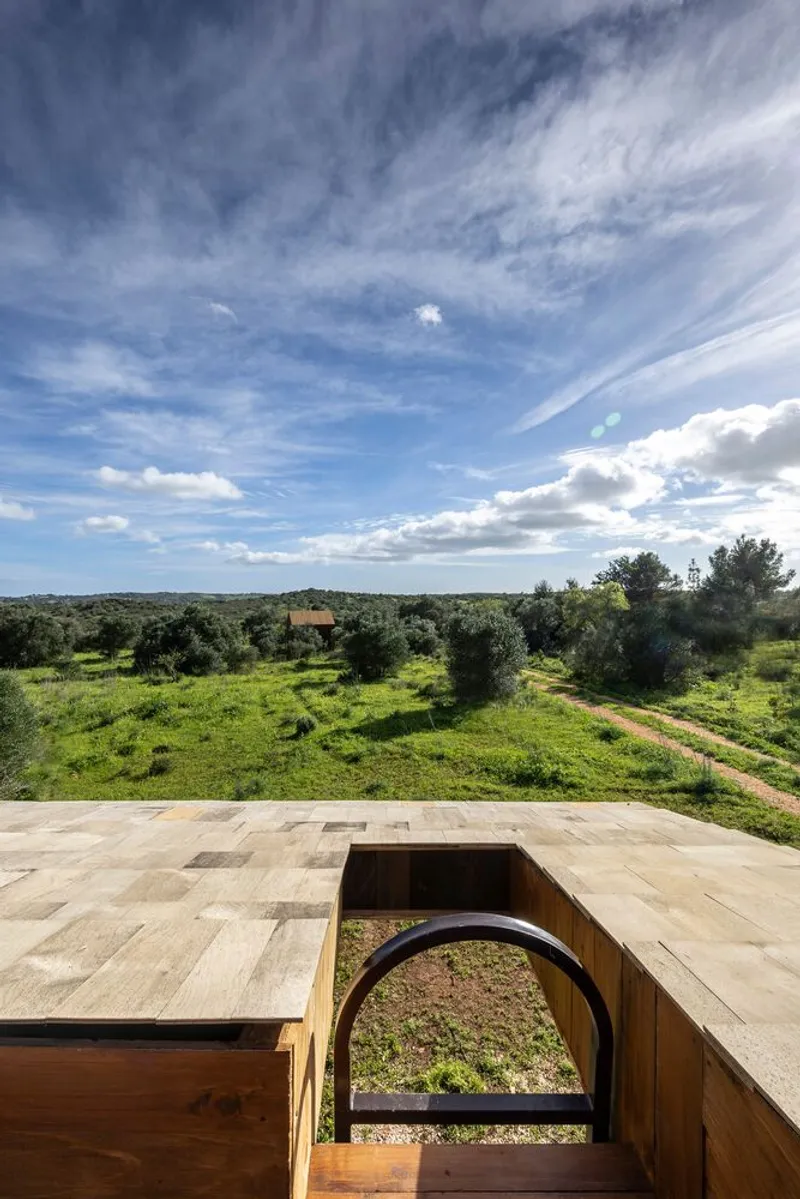
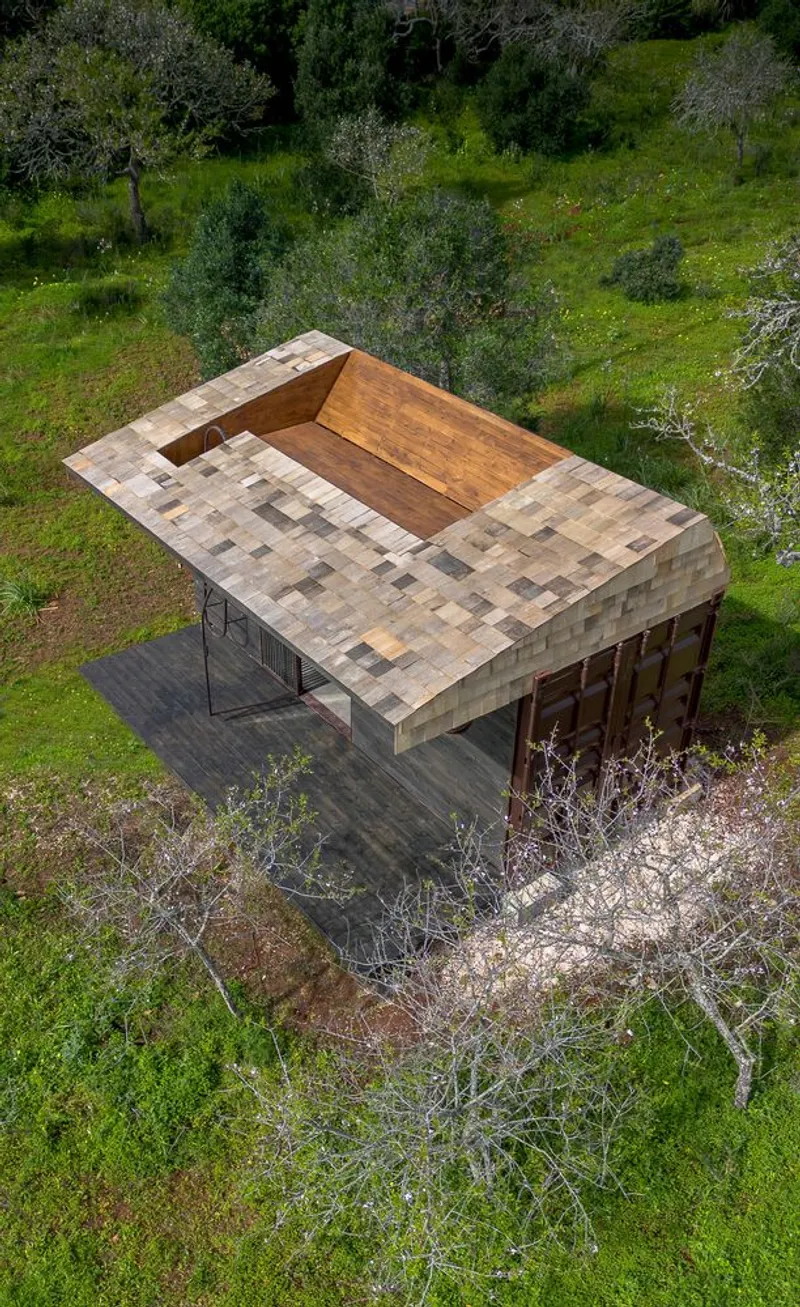
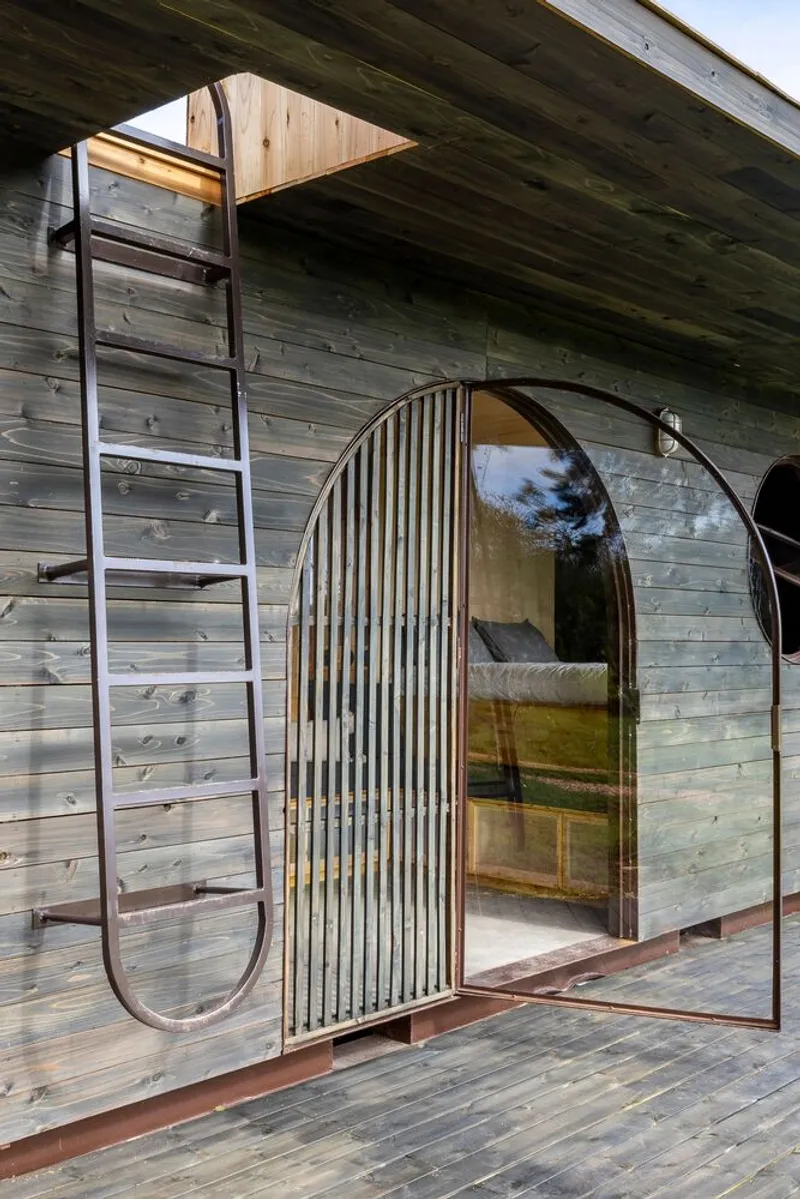
The roof doubles the usable outdoor area. A metal ladder bolted to the exterior wall leads through a hatch to a stone-tiled terrace that overlooks the olive grove. The arched opening at the terrace edge echoes the entry door below, creating a vertical rhythm between the two levels. From above, the patchwork of stone tiles and timber reads like a quilt draped over the container, softening the industrial geometry.
This is the most decisive departure from standard container architecture. Rather than accepting the box as a finished footprint, Madeiguincho stacks program vertically, treating the roof as a second room. For a short-term rental in a warm climate, the terrace is arguably the most valuable space in the entire project.
Slatted Screens and Controlled Transparency
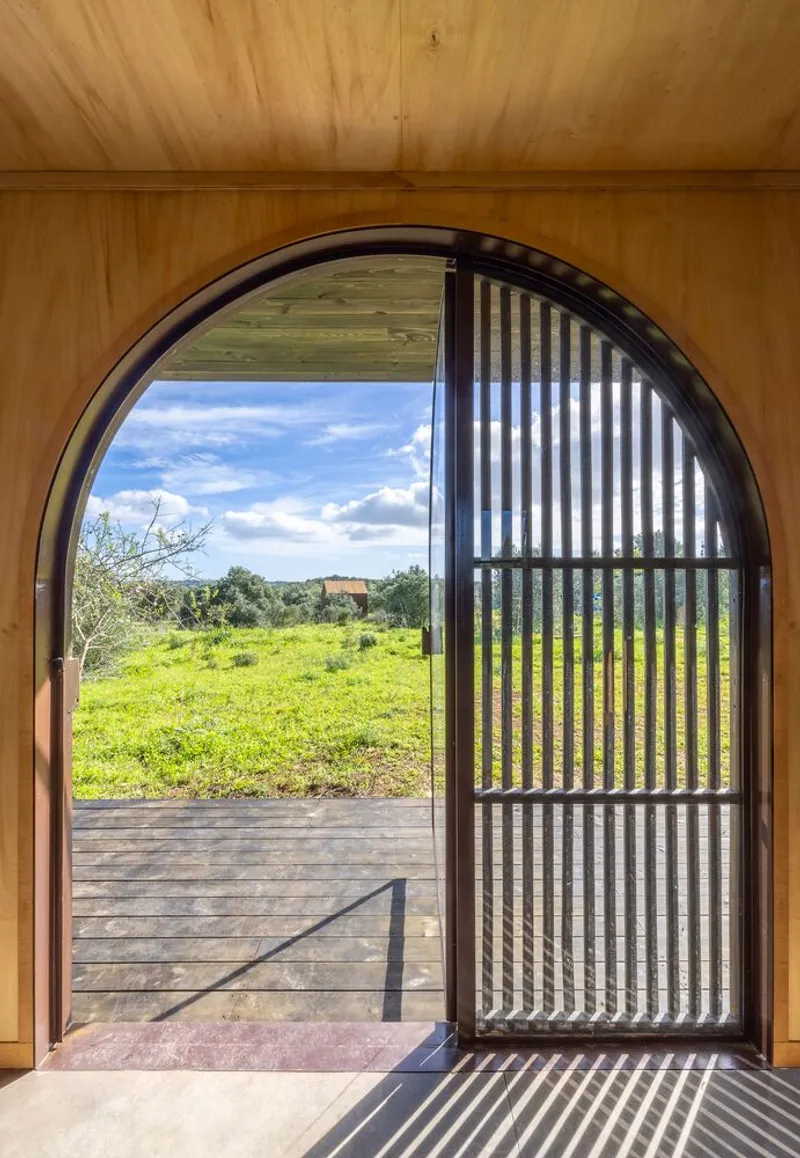
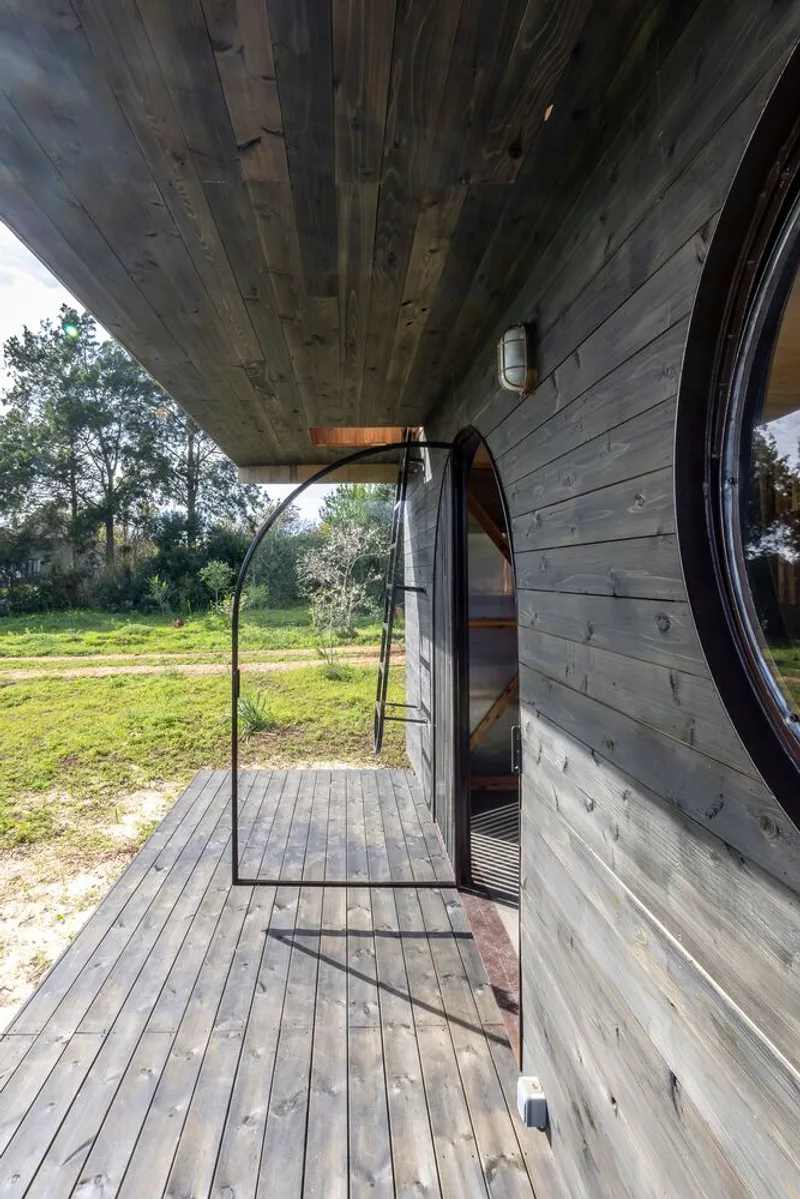
Throughout the Cargo House, timber slat screens mediate between inside and out. The double glass doors at the main opening are shaded by vertical wooden slats that filter afternoon sun, while the original rear cargo doors remain operable, swinging open to connect the interior directly with the field. The slatted screens appear again in the shower and at secondary openings, creating a consistent language of layered transparency.
The effect is atmospheric. Light enters in stripes, shadows shift through the day, and the boundary between shelter and garden becomes negotiable. It is a passive design strategy that happens to produce some of the most photogenic moments in the building.
Context: Sheep, Olives, and Gentle Occupation
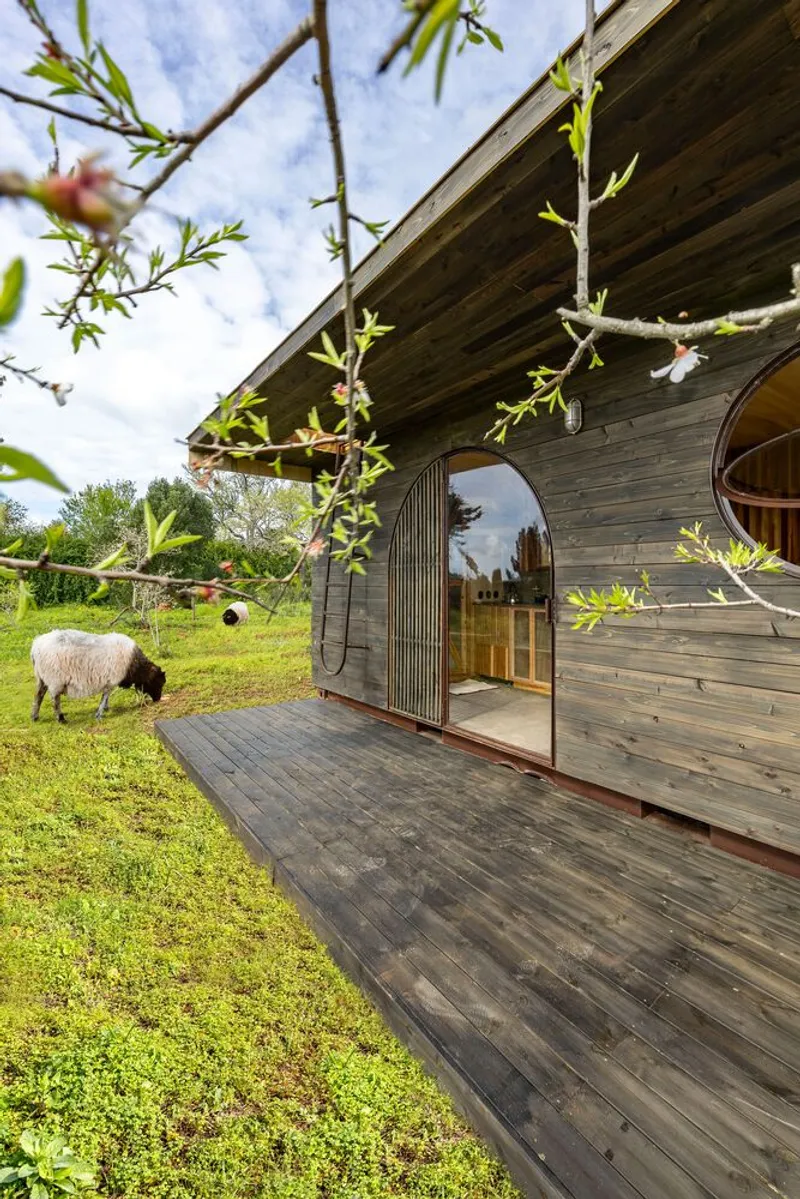
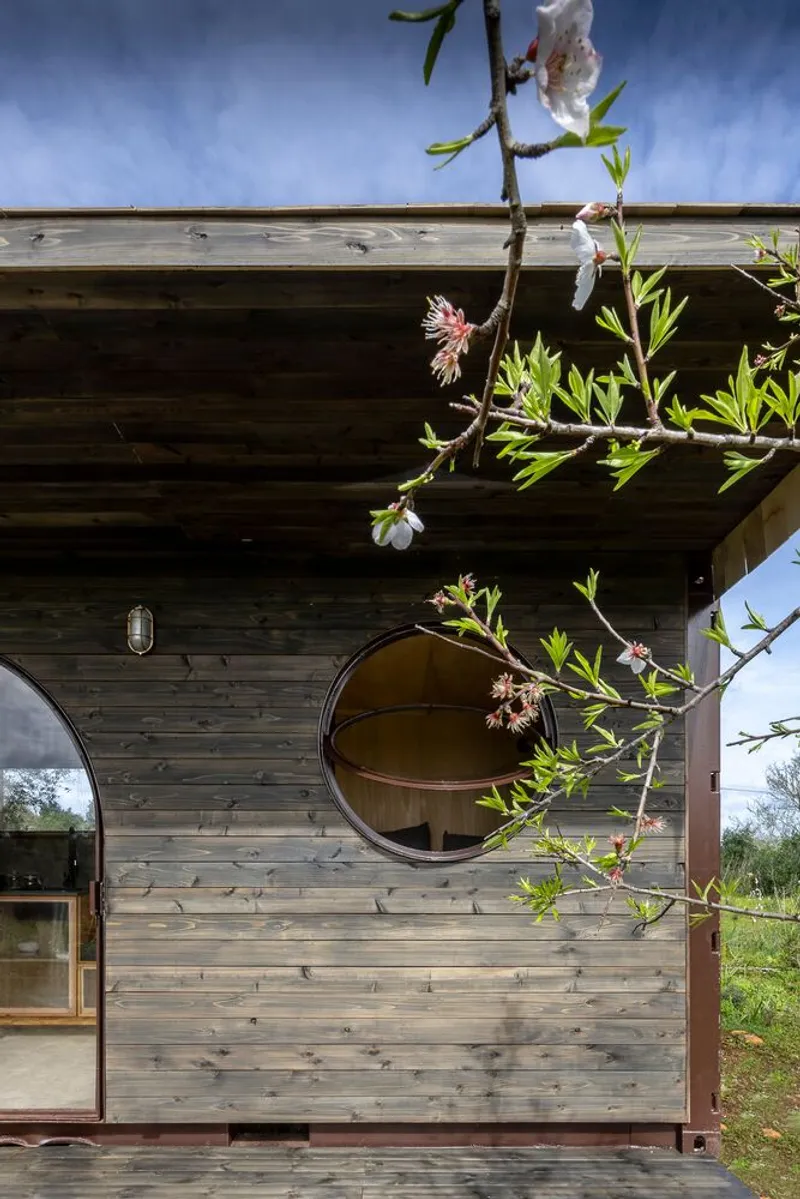
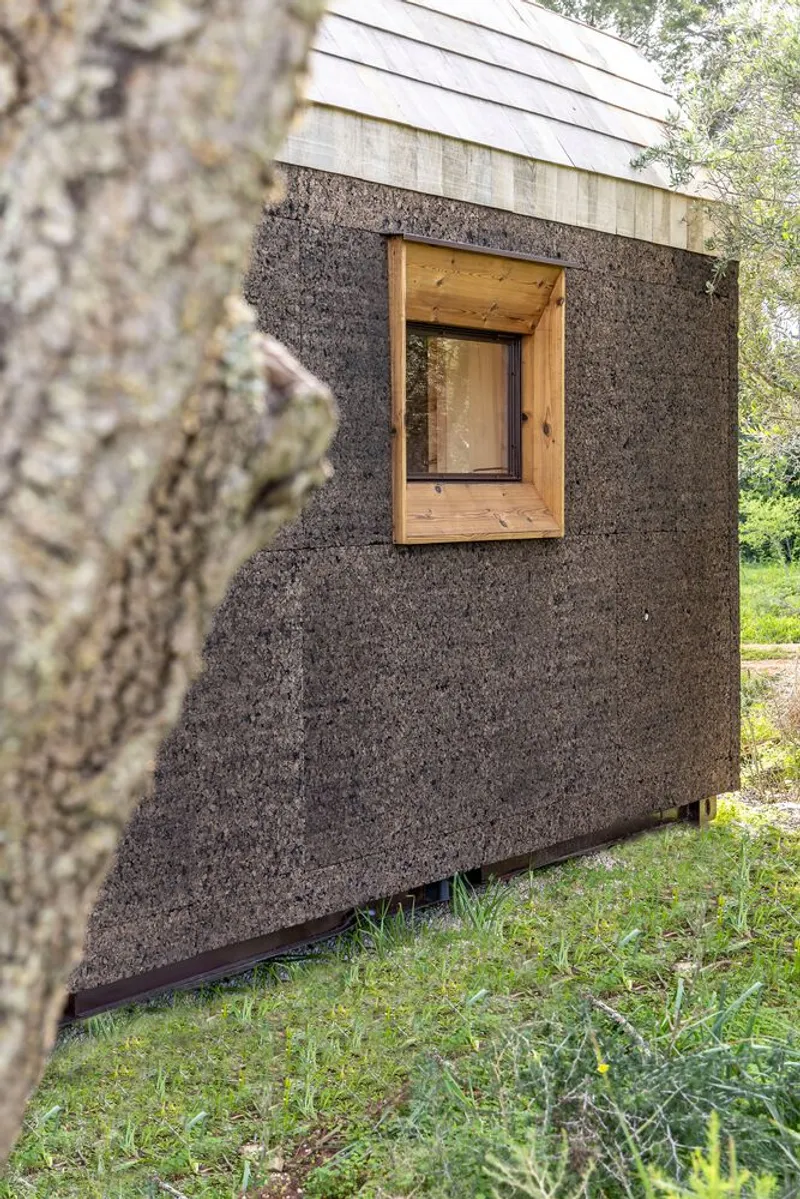
The siting is as careful as the construction. The container sits lightly on a grassy slope, surrounded by mature olive trees and, apparently, a small flock of sheep. There is no paved drive, no perimeter fence, no hard landscaping. The front porch timber deck serves as the only transition between architecture and pasture. The implication is that the building is a guest on the land, not its owner.
For a project designed as a short-term rental, this integration matters. The experience of waking up to sheep grazing outside an arched doorway is inseparable from the architecture. Madeiguincho understands that the container is only half the proposition. The other half is the landscape it opens onto.
Plans and Drawings
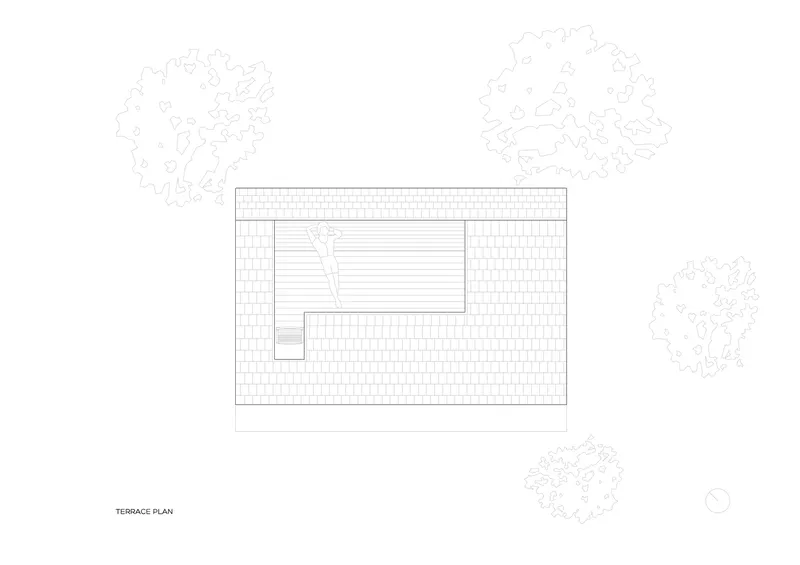
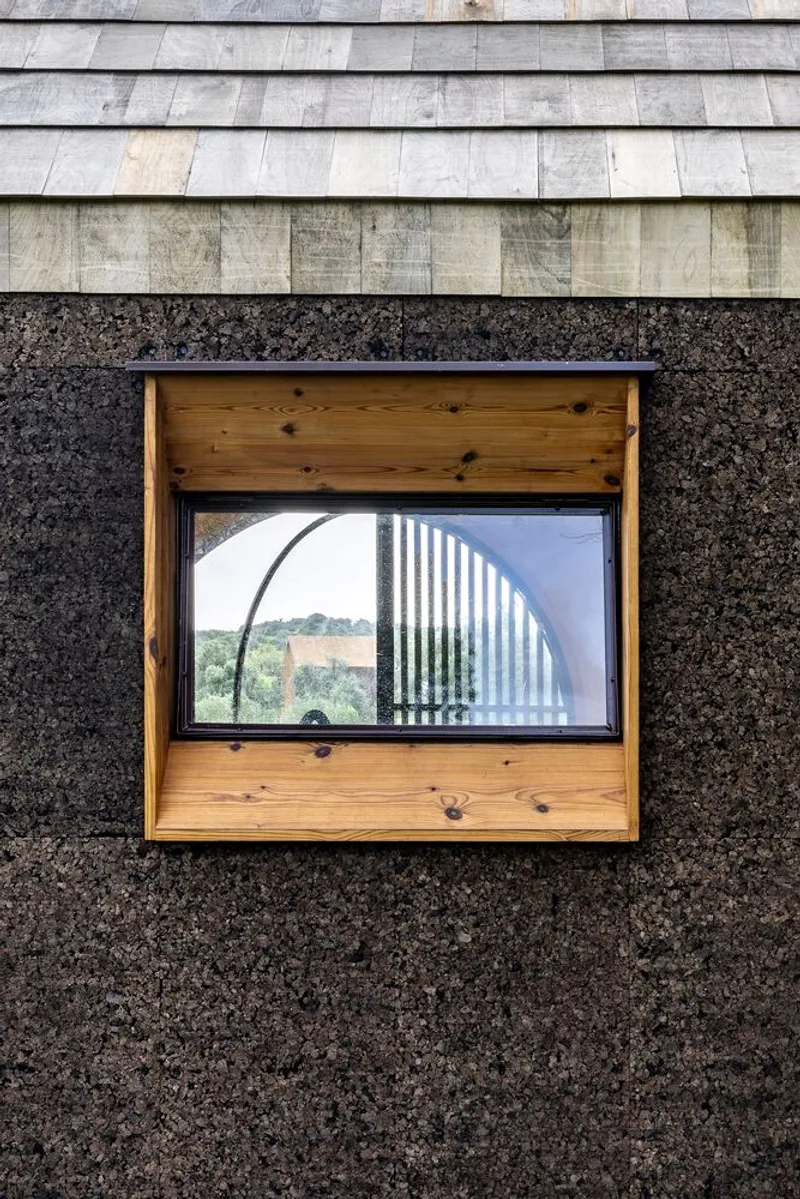
The terrace plan drawing reveals the simplicity of the organizational strategy: a rectangular deck wraps the service volume, with surrounding trees drawn as part of the composition rather than as incidental context. The plan confirms that the project was designed as much around the landscape as around the container.
Why This Project Matters
Container architecture has suffered from two persistent problems: fetishizing the found object while ignoring thermal performance, and treating the steel box as an end in itself rather than a structural starting point. The Cargo House avoids both traps. By burying the container beneath cork, plywood, and stone, Madeiguincho makes the industrial origin legible but not dominant. The insulation strategy, operable openings, and passive shading are not afterthoughts bolted onto a concept; they are the concept.
More broadly, the project demonstrates that sustainability and pleasure are not opposed. The Cargo House is small, it is made from salvaged steel and regionally sourced cork, and it consumes minimal land. It is also, by every measure, a beautiful place to spend a weekend in the Algarve. That combination of restraint and generosity is what separates a serious contribution to compact housing from a social media prop.
Cargo House by Madeiguincho. Lagos, Algarve, Portugal. 24 square meters. Completed 2024.
About the Studio
Madeiguincho
Official website of Madeiguincho, one of the studios behind this project.
madeiguincho.ptShare Your Own Work on uni.xyz
If projects like this are the kind of work you want to make, uni.xyz is a place to publish your own, find collaborators, and enter design competitions.


Popular Articles
Popular articles from the community


Manzana Morphosis: Stretching Barcelona's Grid into a Living Landscape for 2050
A radical reworking of the Eixample manzana turns density into a tool for generous public space, vertical ecology, and environmental performance.
Extended Shell: Retrofitting Kolkata's Balconies as Living Urban Thresholds
A modular retrofit system recovers the social and environmental intelligence of Kolkata's historic verandas for contemporary Park Street residents.

Opera on the Sea: Driftwood Logic Shapes a Timber Opera House on Estonia's Coast
Trevor Orgill's opera house translates the entangled drift of floating timber into a civic building where wood, water, and music converge.

Tsunami Convergenics: Turning Catastrophic Ocean Forces into Underwater Housing Infrastructure
A speculative underwater settlement off the coast of Onagawa, Japan, treats tsunamis and typhoons as energy sources rather than threats.

Similar Reads
You might also enjoy these articles


Hodi-Mandai Geram
Project Function: Preservation and revitalization of the Intangible heritage and socio-spatial identity of the Hodi by Housing, Cultural Memory Center, Sacred Grove, landscape, local tourism economy


Olio Towers: A Mid-Rise for Performers That Fuses Housing, Rehearsal, and Stage
Located blocks from Houston's Theater District, this modular tower stacks living units around a central performance atrium.

Oasis: Modular Green Housing Carved into Dhaka's Urban Fabric
A shortlisted Plugin Housing entry reclaims unauthorized settlements in Dhaka with stepped concrete volumes, green roofs, and ventilation-driven design.

Black Hole: A Floating Megastructure for the Post-Physical Era
Emiliano Mazzarotto envisions a spherical, self-scaling arena where e-sports, digital hotels, and holographic stadiums replace traditional public space.

Explore Container House Competitions
Discover active competitions in this discipline

Challenge to reimagine the Iron Throne

Photograph architecture without architects

Illustrate the lost glory of Angkor Wat - Render Challenge

Design challenge to reuse E-waste
Comments (0)
Please login or sign up to add comments
No comments yet. Be the first to comment!