
2by4-architects Buries a Net-Zero Vacation Home in the Dunes of Terschelling
On the Dutch island of Terschelling, a sand-colored villa half-embedded in the dune achieves zero-carbon living through biobased materials and passive stra


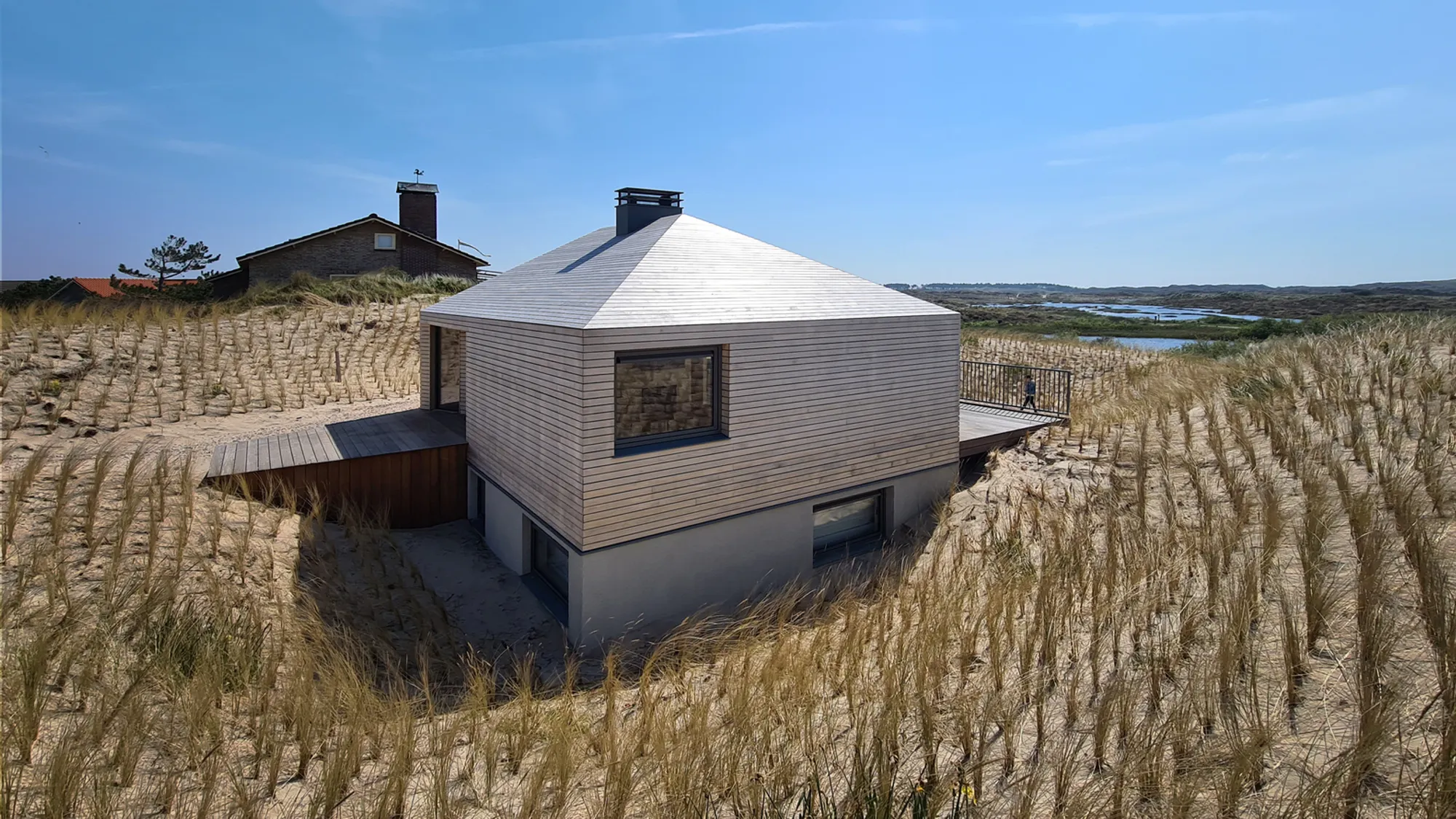
Terschelling is one of the Dutch Wadden Islands, a thin strip of sand and grass between the North Sea and the shallow tidal flats. Building here means negotiating fragile ecologies, strict regulations, and a landscape that shifts with every storm. For the Dune Villa West aan Zee, 2by4-architects took all of that as a starting point rather than a constraint, partially burying the 180 m² house in the dune itself and cladding it in biobased, sand-colored timber that will weather alongside its surroundings. The result, completed in 2024 after a six-year process, is a home that reads as geology from one side and pure transparency from the other.
What makes the project genuinely interesting is its operational metaphor. Lead architects Remko Remijnse, Matteo Carbone, and Agnese Argenti describe the guiding concept as the "hermit": an outwardly closed, almost reclusive shell that reveals spatial richness only once you step inside. The ground floor is intimate and partially subterranean, receiving subtle filtered light at dune level. The first floor, reached by a spiral route winding around a central wooden core, explodes into panoramic views, a huge folding wall, and a vaulted ceiling lit by a generous skylight. It is a convincing argument that sustainability and experiential generosity are the same ambition, not competing ones.
Hermit in the Sand
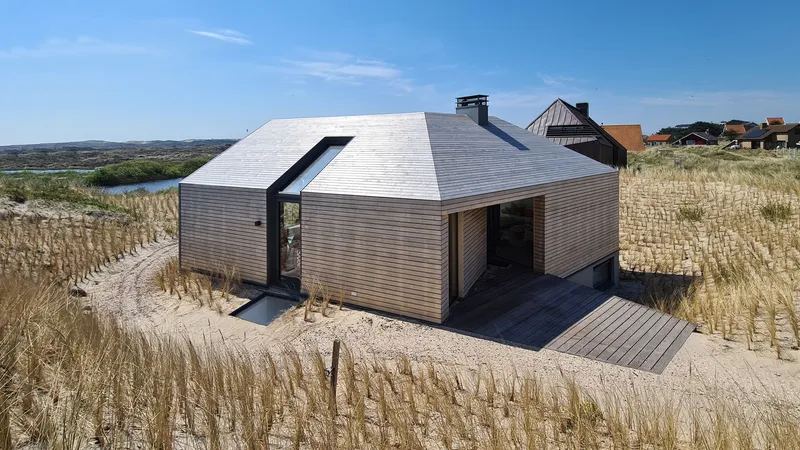
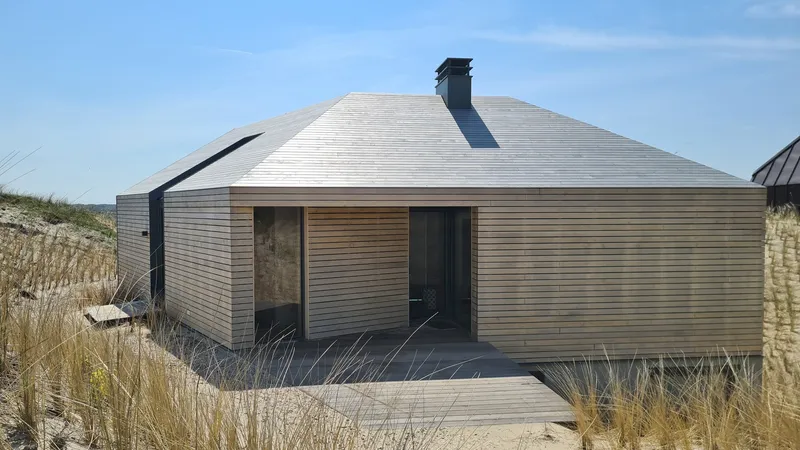
Seen from above or from the approach path, the villa barely registers as a building. Two angled volumes, one clad in horizontal timber and the other in grey panels, sit low among the dune grasses with a sloped metal roof that echoes the pitch of neighboring houses. The sand-colored facade is entirely biobased and selected to age naturally, meaning the structure will only become more embedded in its context over time. There is no heroic gesture here, just a careful calibration of mass, color, and profile to disappear into an unstable terrain.
The closed side of the villa presents few openings, reinforcing the hermit metaphor. Occasional punched windows at dune level allow just enough light to enter the ground-floor bedrooms without compromising privacy or the sense of being sheltered within the landscape. It is a deliberate withholding, one that makes the open side all the more effective when you finally encounter it.
The Open Side
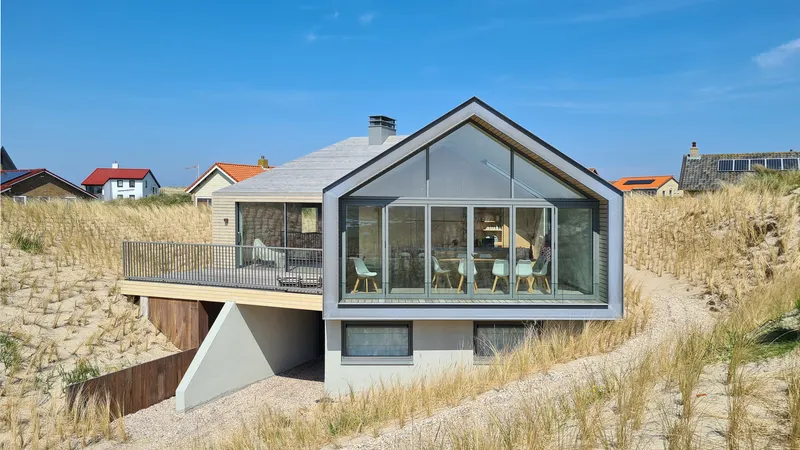
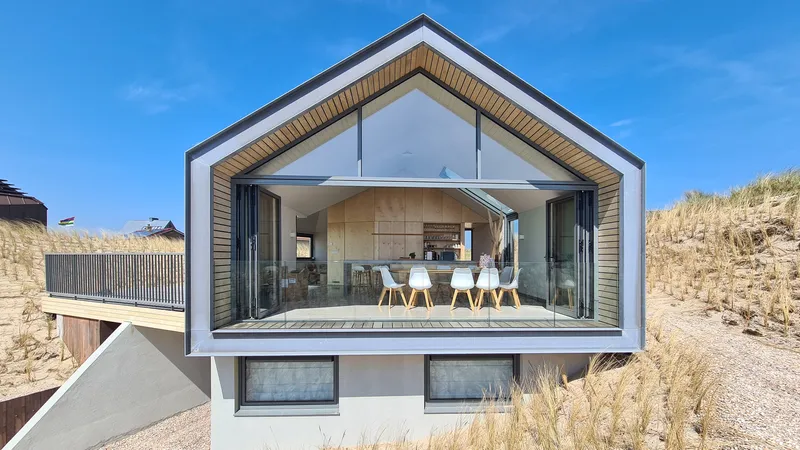
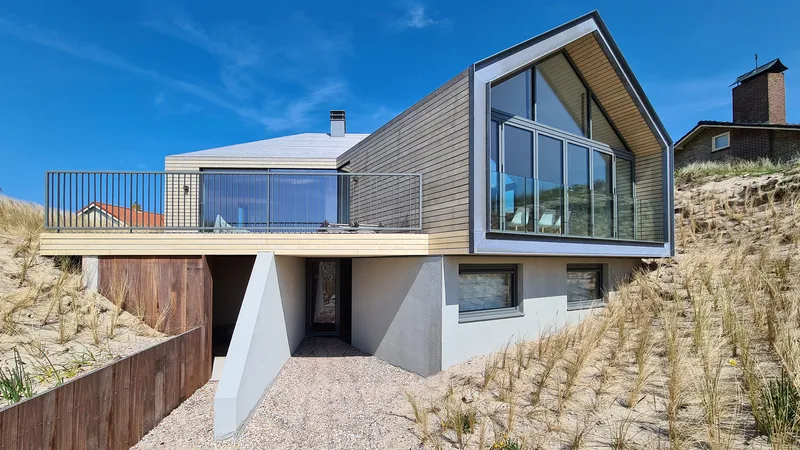
The opposite facade is almost entirely glass. A gabled end wall opens the first-floor living spaces directly onto a timber deck flanked by dune grasses, framing the coastal landscape as a single, cinematic composition. Each window and opening in the facade is positioned to function as what the architects call a "living painting," and the glazed gable delivers on that promise without reservation. The transition from sand and timber to full transparency is abrupt, and that contrast is the whole point.
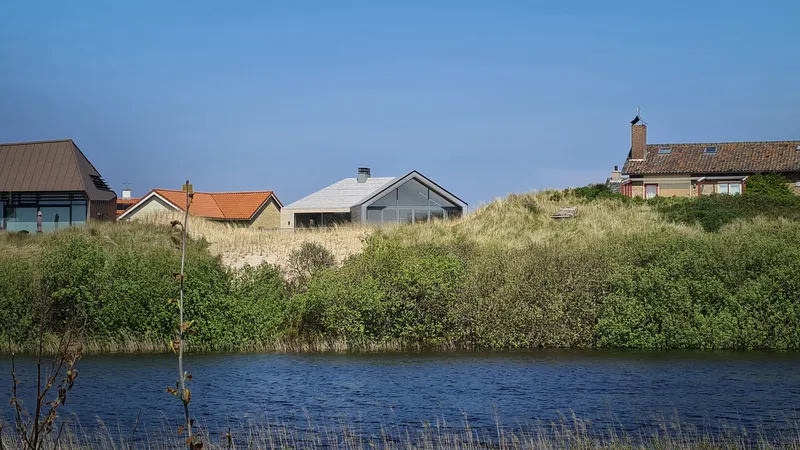
Between the neighboring houses and the dune vegetation, the villa occupies a tight site. The glazed gable and its deck feel less like a conventional terrace and more like a viewing platform that has been threaded into the gap, borrowing depth from the landscape beyond rather than relying on generous setbacks.
Interior Spiral and the Wooden Core
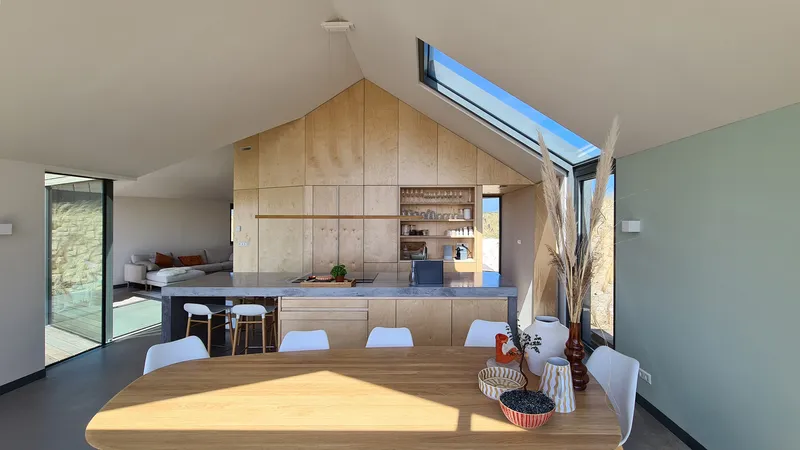
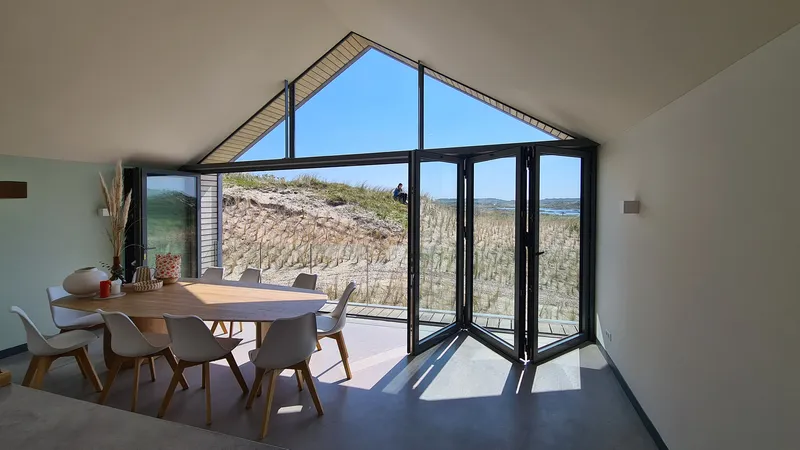
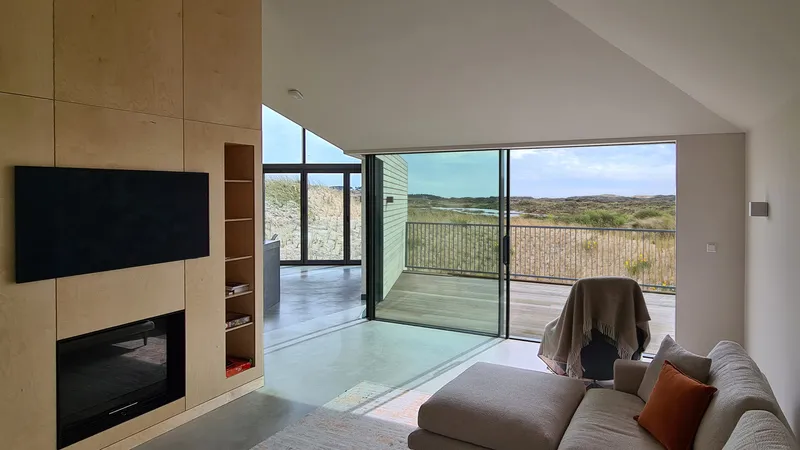
Inside, a central wooden core organizes both floors. Bathrooms, storage, and laundry are packed into this spine, freeing the perimeter for habitable space. Movement through the house follows a spiral route that begins at the entrance hall and revolves around the core, producing a continuous sequence of changing views and light conditions. It is a compact plan, just 180 m², that feels substantially larger because you are never standing still in the same atmosphere.
The first-floor kitchen and dining area benefit from a large skylight that cuts through the pitched ceiling, flooding the plywood cabinetry with daylight. When the huge folding wall of the dining room swings open, interior and exterior merge into a single continuous surface. The vaulted ceiling with its clerestory glazing amplifies the sense of loft on this upper level, a deliberate contrast to the low, cocooned character of the bedrooms below.
Material choices stay restrained throughout: plywood wall units, timber decking, exposed ceiling structure. The palette reads as warm but not precious, consistent with a vacation home that needs to absorb the salt air and sandy feet of island life without demanding constant maintenance.
Terraces at Every Level
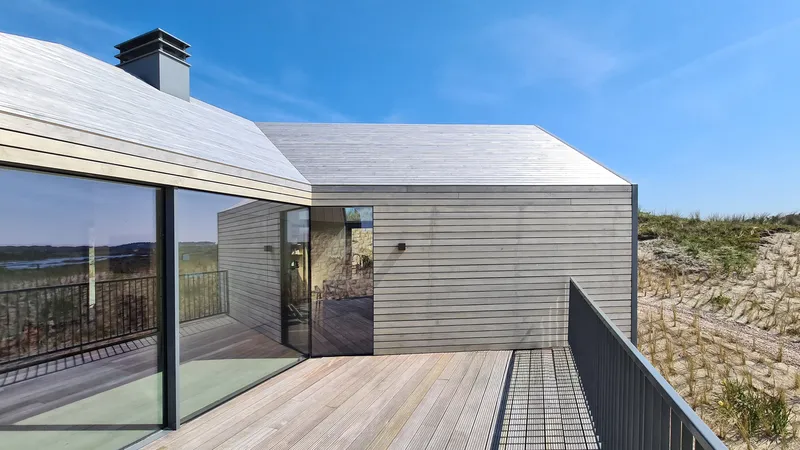
The landscape strategy, developed in collaboration with Staatsbosbeheer (the Dutch forestry commission), distributes terraces at different heights across the site. Each terrace creates its own microclimate and degree of privacy, from the sheltered ground-level patios embedded in the dune to the rooftop deck that connects the two volumes with metal grating and timber. The rooftop terrace in particular offers a vantage point that few neighboring houses share, turning the modest height of the villa into an asset.
At dusk, the gabled roof settles into the silhouette of the surrounding houses, its profile visible across the pond as a quiet addition to the village rather than an intrusion. The architects clearly understood that on an island of this scale, even a single building shapes the collective horizon.
Net-Zero Without Fanfare
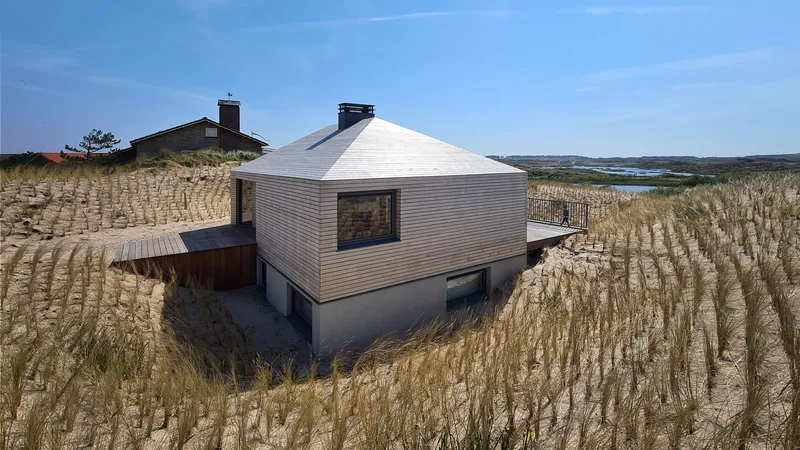
The villa achieves net-zero energy through a suite of passive and active measures: the ground floor's partial burial provides significant thermal mass and natural insulation; proper orientation maximizes solar gain in winter while limiting overheating in summer; and a heat pump handles the remaining heating load. Solar panels are installed not on the villa itself but on an adjacent existing dwelling owned by the same client, a pragmatic solution that keeps the new roof clean and the energy balance honest.
Equally significant is the decision to use local contractors and craftsmen from Terschelling throughout the construction process. Bouwbedrijf Bos served as general contractor, and Kooistra Interieurbouw handled the interior joinery. Keeping the supply chain on the island reduced transport emissions and embedded the project in the community it serves, an approach that is easy to advocate in theory but rarely followed through in practice.
Plans and Drawings
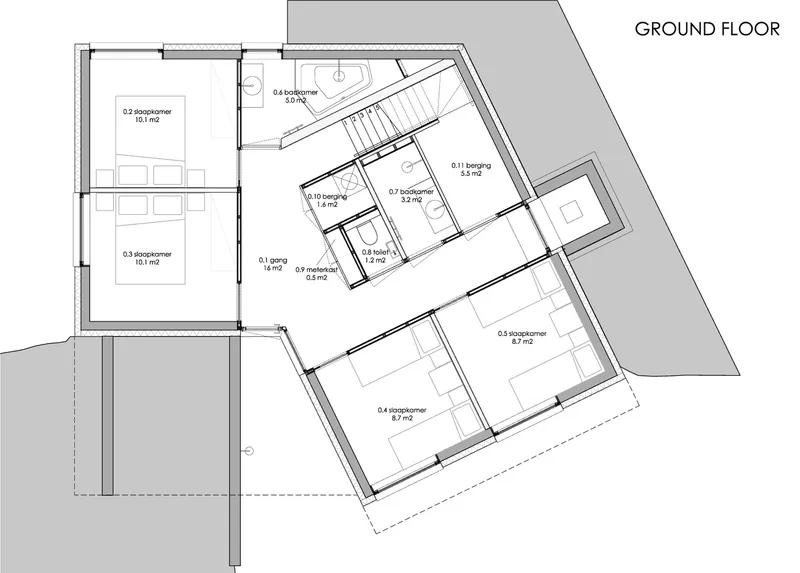
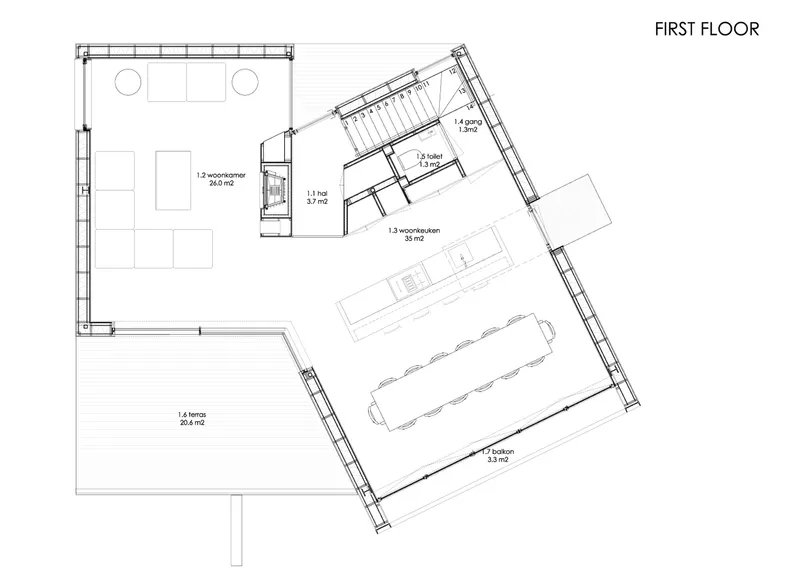
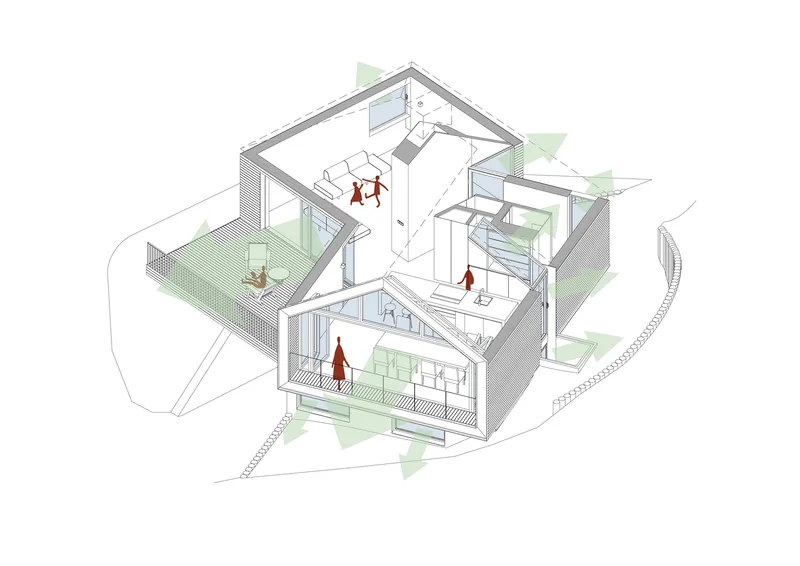
The floor plans reveal the angled geometry that allows both volumes to negotiate the sloping site while orienting their primary openings toward the best views. On the ground floor, bedrooms cluster around the central core with direct access to terraces embedded in the hillside. The first floor flips the emphasis, placing kitchen, dining, and living spaces around the same core but opening them to the full panorama. The axonometric cutaway makes the spiral circulation legible, showing how a single continuous route connects all levels and terraces without corridors or dead ends.
Why This Project Matters
Vacation homes on ecologically sensitive sites often fall into one of two traps: either they perform sustainability through conspicuous green technology while ignoring the landscape, or they fetishize rusticity while consuming energy with abandon. Dune Villa West aan Zee avoids both. Its net-zero performance is achieved through deeply architectural decisions (burial, orientation, massing) rather than bolt-on gadgetry, and its biobased facade will only improve with age. The hermit metaphor gives the design a conceptual backbone that translates into real spatial experience, not just a clever diagram.
More broadly, the project demonstrates that working within severe constraints, a fragile dune, an island supply chain, a modest footprint, can produce architecture that is richer and more surprising than a blank-check brief on open land. 2by4-architects took six years to get this right, and the patience shows. On a 180 m² budget, every move counts, and here none of them are wasted.
Dune Villa West aan Zee by 2by4-architects B.V. (lead architects: Remko Remijnse, Matteo Carbone, Agnese Argenti). Located in West aan Zee, Terschelling, the Netherlands. 180 m². Completed 2024.
About the Studio
Share Your Own Work on uni.xyz
If projects like this are the kind of work you want to make, uni.xyz is a place to publish your own, find collaborators, and enter design competitions.




Popular Articles
Popular articles from the community


Hill & Cross Opera: Sculptural Opera House Architecture Shaped by Tallinn’s Landscape and Identity
Hill & Cross Opera reimagines opera house architecture in Tallinn through its sculptural hill, civic plaza, glass wave and a luminous cross.

The Earth Pod: 3D Printed Homes for Resilient Refugee Communities
The Earth Pod reimagines refugee housing through 3D printed homes made from clay, combining resilience, self-sufficiency, and rapid shelter.

Co-Life: Senior Housing Design That Reconnects Older Adults With the City
Co-Life reimagines senior housing design through healing gardens, shared streets, workshops, and a sustainable community across generations.

Play: Fragments of Their World
Familiar architecture becomes modular playground design, creating safe spaces where displaced children can learn, connect, imagine and play.

Similar Reads
You might also enjoy these articles


Hodi-Mandai Geram
Project Function: Preservation and revitalization of the Intangible heritage and socio-spatial identity of the Hodi by Housing, Cultural Memory Center, Sacred Grove, landscape, local tourism economy


Olio Towers: A Mid-Rise for Performers That Fuses Housing, Rehearsal, and Stage
Located blocks from Houston's Theater District, this modular tower stacks living units around a central performance atrium.

Oasis: Modular Green Housing Carved into Dhaka's Urban Fabric
A shortlisted Plugin Housing entry reclaims unauthorized settlements in Dhaka with stepped concrete volumes, green roofs, and ventilation-driven design.

Black Hole: A Floating Megastructure for the Post-Physical Era
Emiliano Mazzarotto envisions a spherical, self-scaling arena where e-sports, digital hotels, and holographic stadiums replace traditional public space.


Explore Architecture Competitions
Discover active competitions in this discipline



Challenge to reimagine the Iron Throne


Photograph architecture without architects


Illustrate the lost glory of Angkor Wat - Render Challenge


Design challenge to reuse E-waste
Comments (0)
Please login or sign up to add comments
No comments yet. Be the first to comment!