
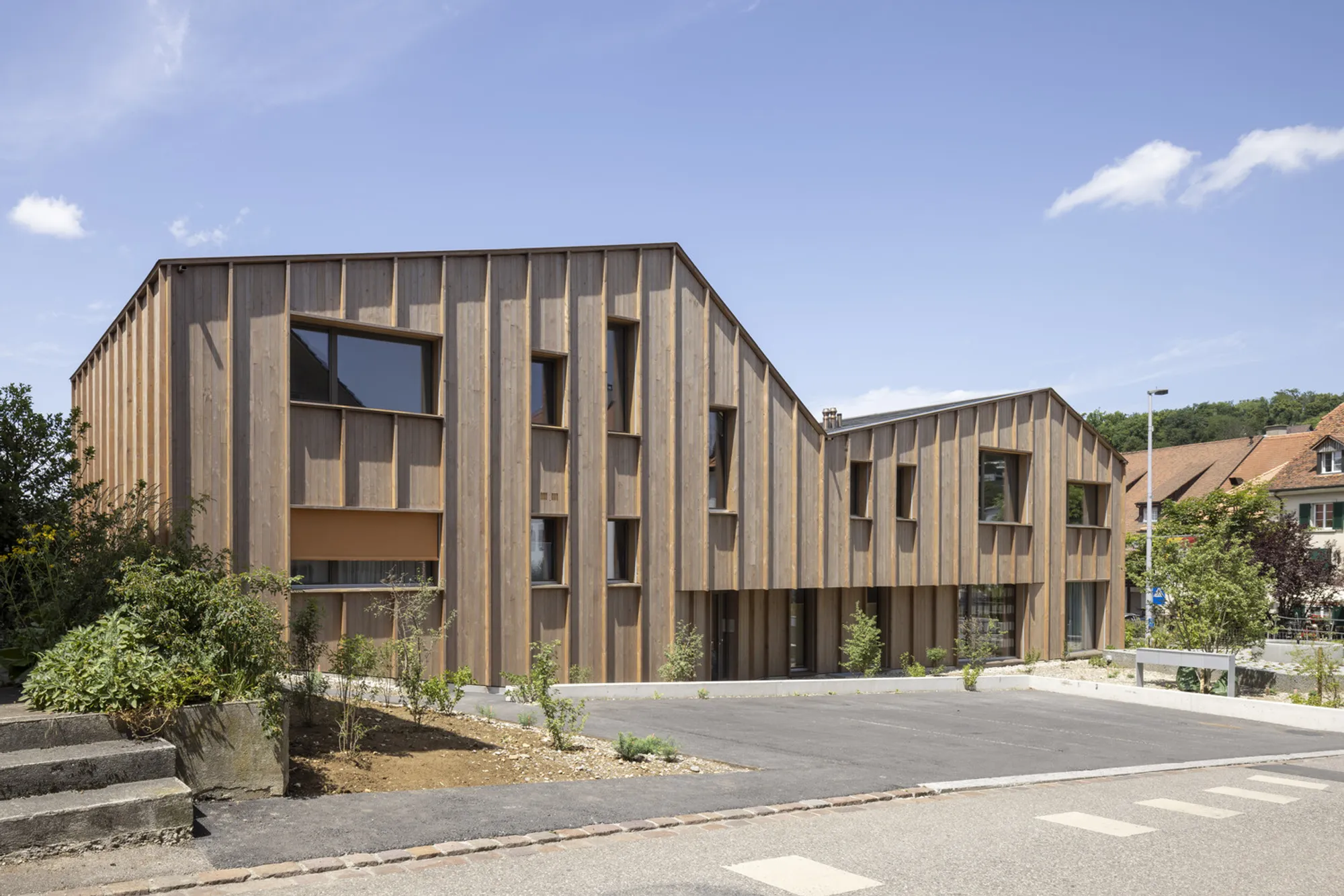
Beck Oser Architekten Replaces an Old Carpentry Workshop with Timber Housing in Elgg
Two gabled wooden volumes on a former workshop site in Switzerland honor craft heritage through material continuity and quiet formal invention.


A carpentry workshop is a charged site for any residential replacement project. When Beck Oser Architekten took on the former joinery yard in Elgg, Switzerland, the question was not whether wood should define the new buildings, but how literally the material memory of the place should register. Their answer, completed in 2021, is two gabled timber volumes that absorb the massing, ridge heights, and orientations of the structures they replace while pushing the language of the facade into something distinctly contemporary.
What makes the project genuinely interesting is the discipline involved. The architects resisted the temptation to reimagine the site from scratch. Instead, they kept the dimensional logic of the originals, including roof pitches and story counts, then expressed everything through prefabricated wooden construction, vertical slat screens, and angled wall planes that follow the terrain's natural slope. The result feels both inevitable and inventive: housing that belongs to its street without pretending to be old.
Two Volumes, One Courtyard
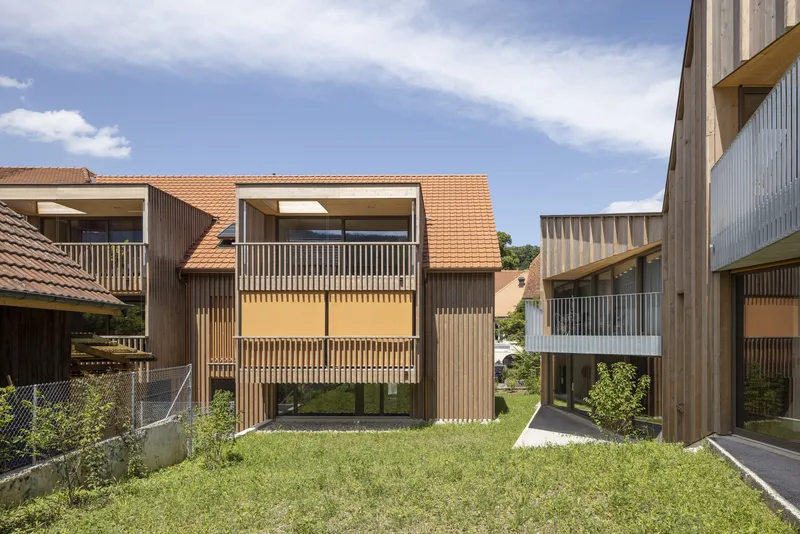
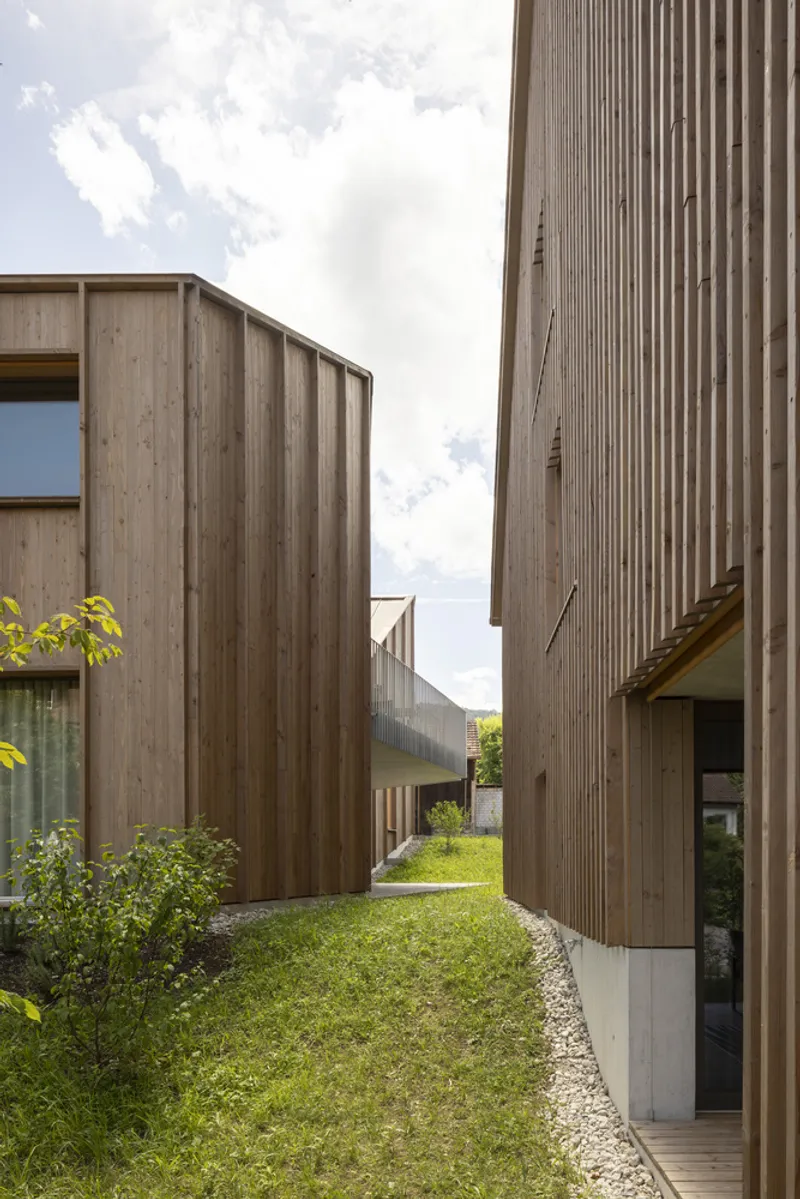
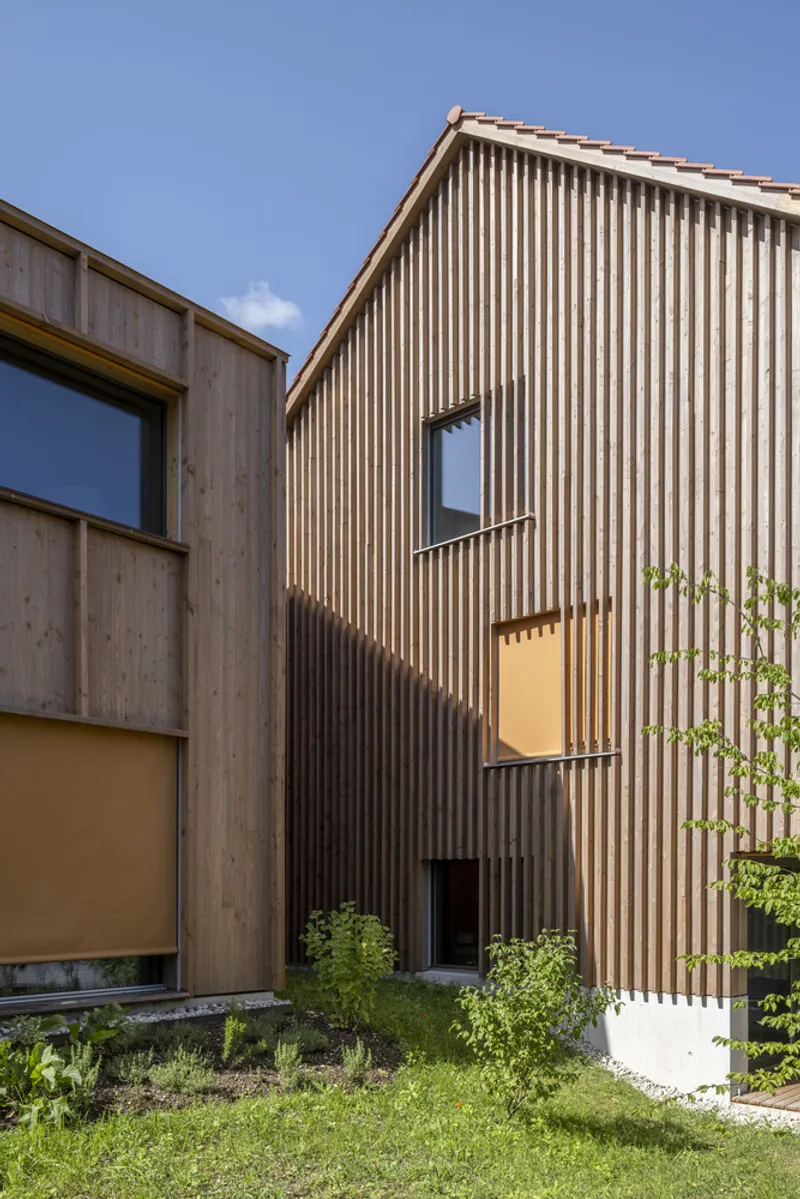
The scheme splits into a replacement building on Flühstrasse and a supplementary structure on Hutmattweg. By detaching the second volume and pulling it toward Hutmattweg, the architects open a shared backyard between the two buildings. Grass runs through the passage between them, connecting the street to a generous communal lawn. The move is simple on plan but effective in section: it gives every unit either courtyard or street presence, and it restores the kind of forecourt and yard sequence typical of the settlement pattern here.
Density is achieved without claustrophobia. The gap between the two gabled forms is just wide enough to feel like an invitation rather than a service lane, and the stepping of floor levels along the slope ensures that no single facade overwhelms its neighbor.
A Facade Built from Craft Memory
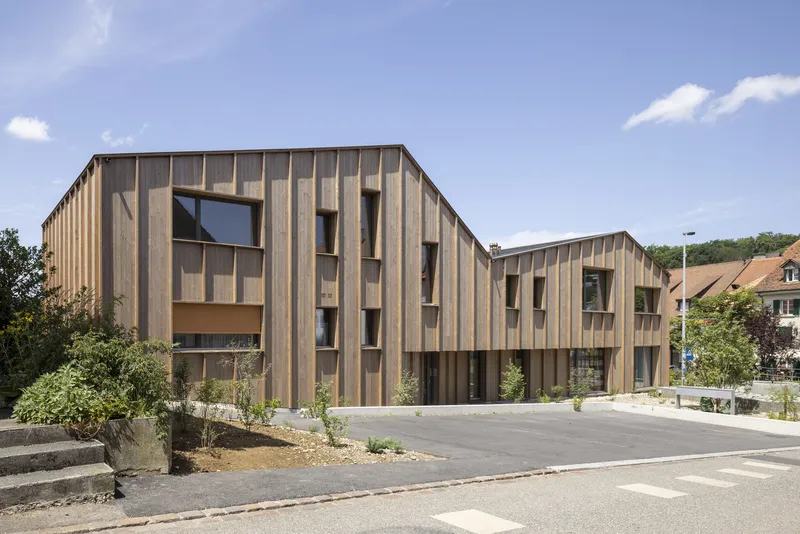
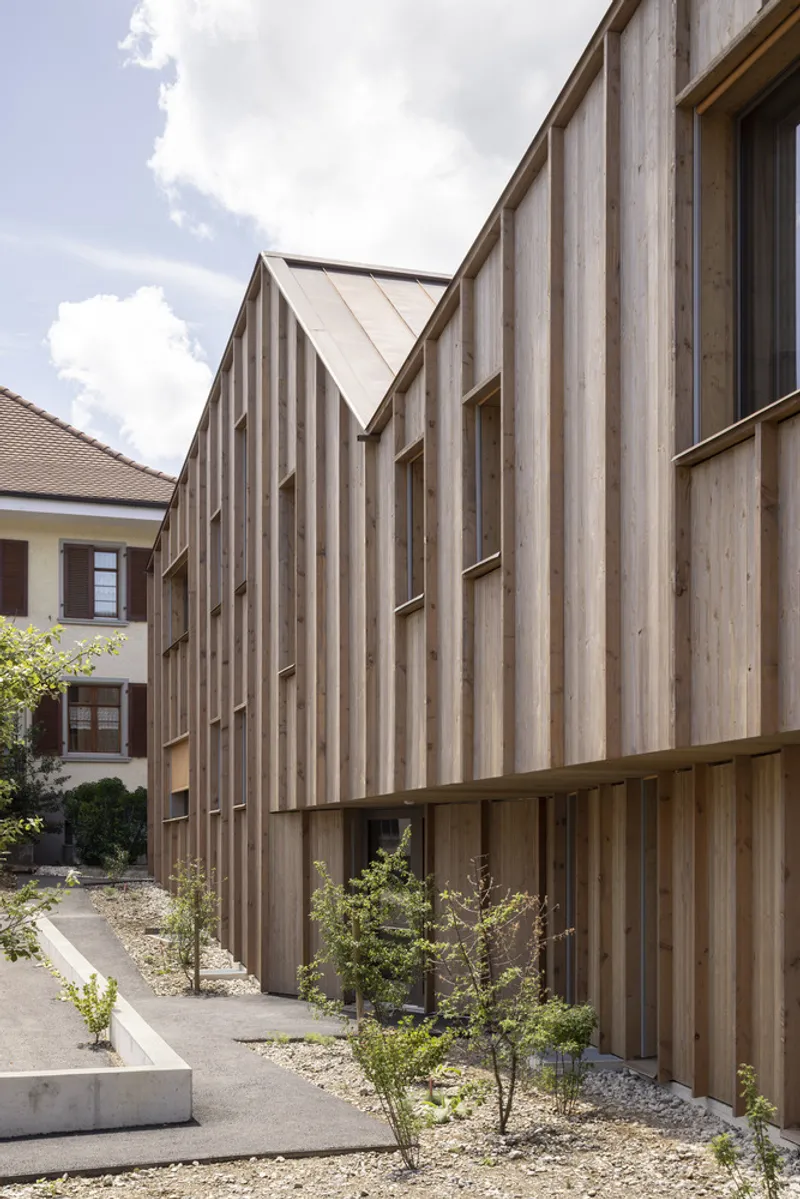
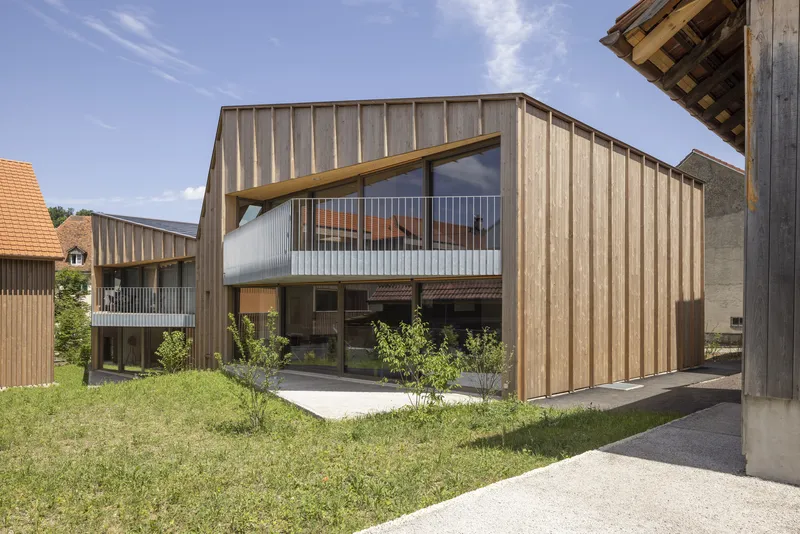
The vertical timber slat cladding is the project's most visible assertion. Tight, rhythmic, and uninterrupted from base to eave, it reads as a continuous screen pierced by asymmetrically punched openings. The slats reference the raw material economy of the former workshop without resorting to literal quotation. At the base, planted gravel beds introduce a soft buffer that keeps the timber off the ground and edges the building into its garden.
On the street side, the facade under an orange clay tile roof with dormer windows is more restrained, almost village-like. On the courtyard side, translucent balcony screens filter light while maintaining privacy. The asymmetry of the window placements is deliberate: it signals that the interior plan does not obey a strict grid, which becomes legible from outside. That honesty between plan and elevation is a small thing, but it lifts the project above the anonymous timber housing that proliferates across Switzerland.
Interior Sequences and Angled Walls
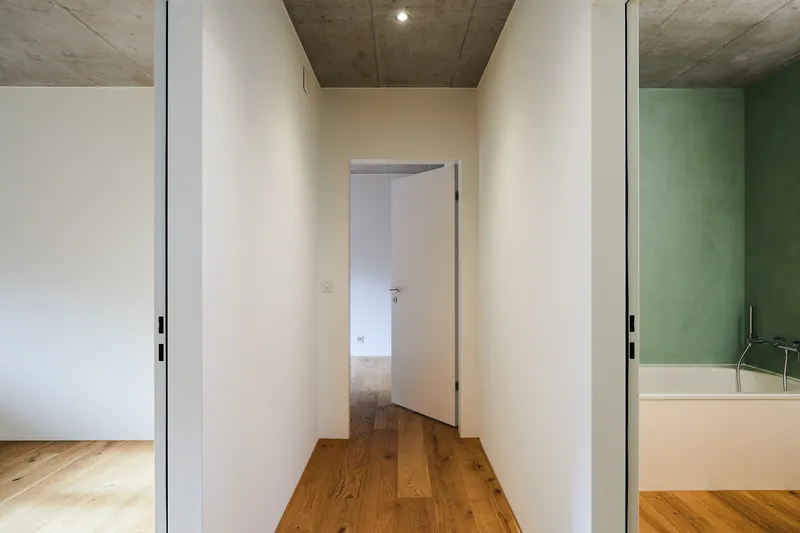
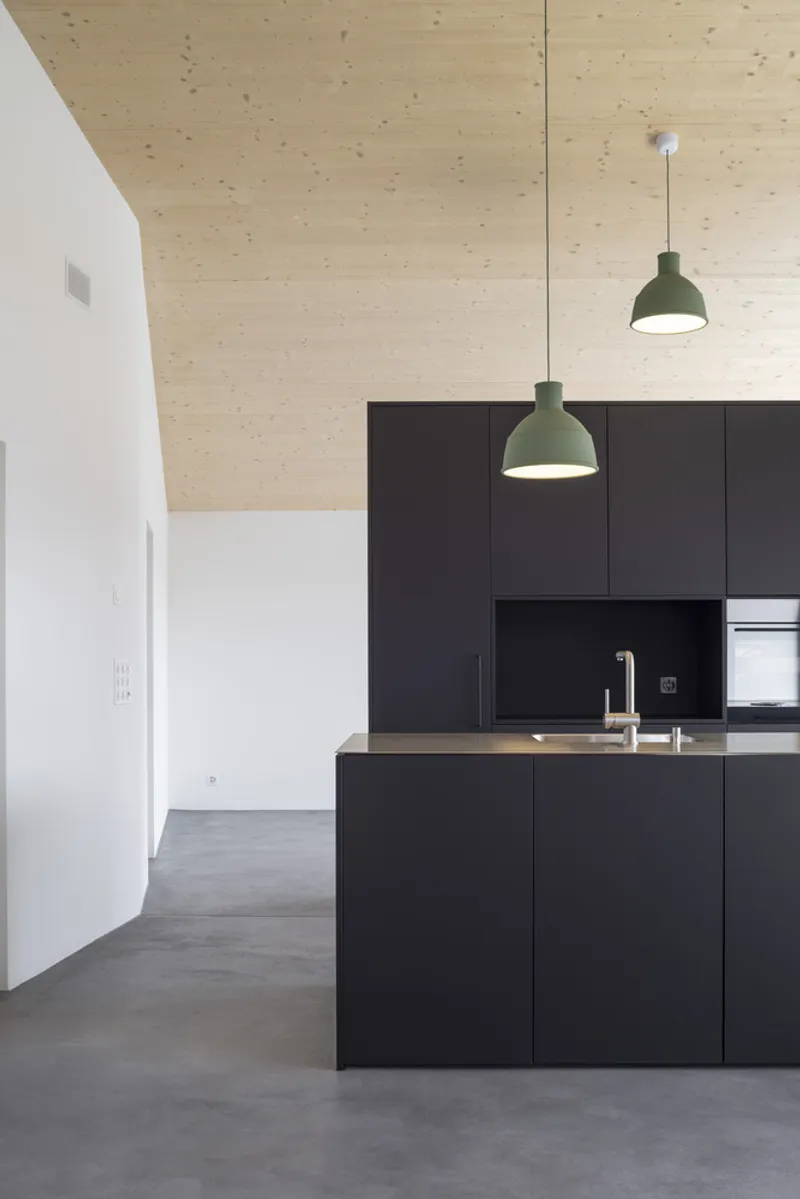
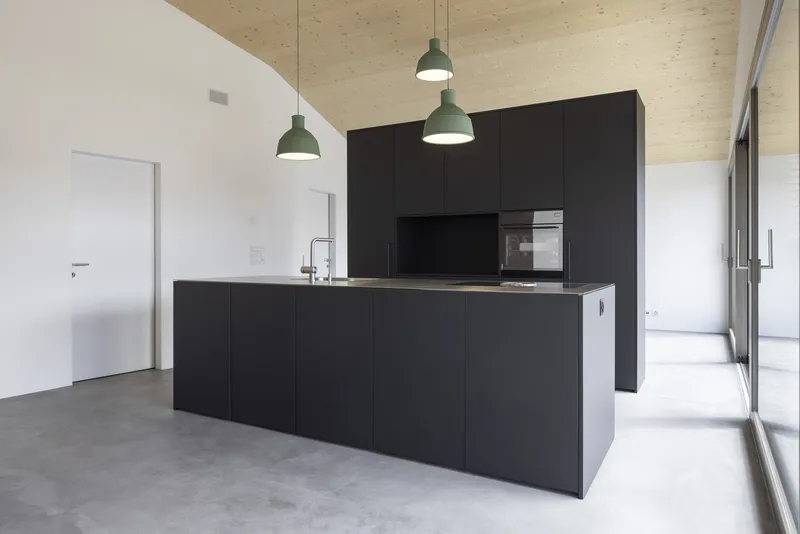
Inside, the apartments reveal the consequences of following the terrain. Walls angle subtly, creating room proportions that shift as you move through the plan. Hallways connect timber-ceilinged zones to concrete-ceilinged zones, marking the boundary between the solid lower structure and the prefabricated wood upper levels. Oak flooring warms the living spaces while polished concrete anchors the kitchens and circulation areas.
The kitchens deserve mention. Matte black cabinetry and islands sit under exposed timber ceilings lit by olive-toned pendant fixtures. Sliding glass doors open directly to garden level, so the kitchen doubles as a threshold between domestic interior and shared landscape. The palette is restrained: black, timber, concrete, white plaster. No material competes for attention, and the spatial variety produced by the angled walls does the expressive work that ornament might otherwise perform.
Concrete Core, Timber Shell
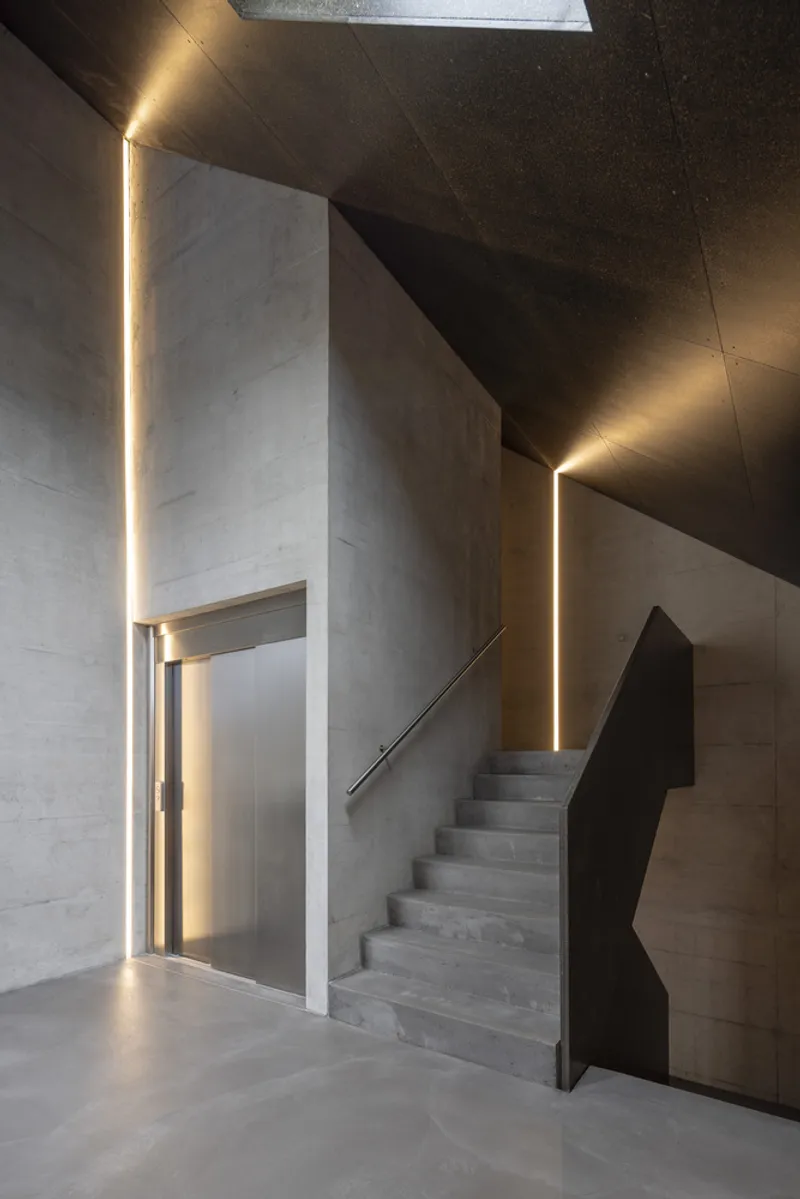
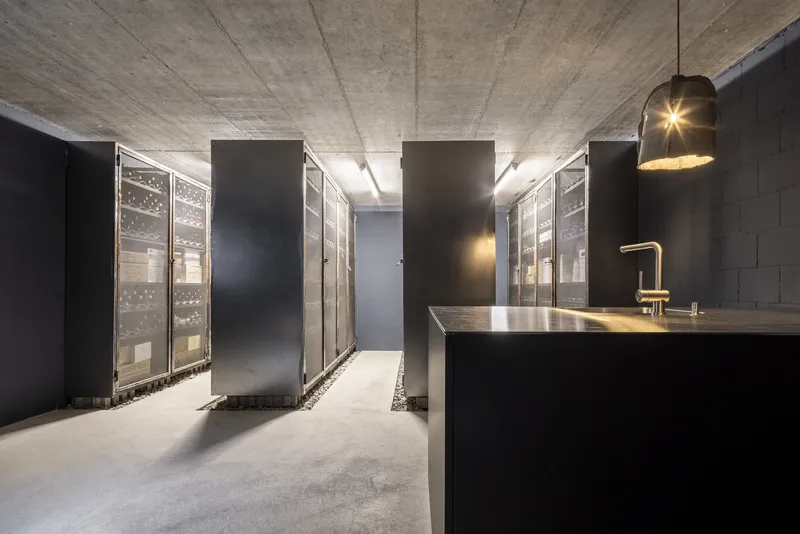
The hybrid construction strategy splits neatly. Solid concrete handles the lower floors and staircases, providing structural mass, fire resistance, and acoustic separation. The attics, facades, and roofs are prefabricated insulated timber elements assembled on site. A concrete staircase lit by vertical LED slots becomes the building's spine, pulling you upward through warm light. In the basement, the material logic inverts: exposed concrete ceilings and black metal partitions frame a wine cellar that feels almost industrial, a subtle echo of the site's working past.
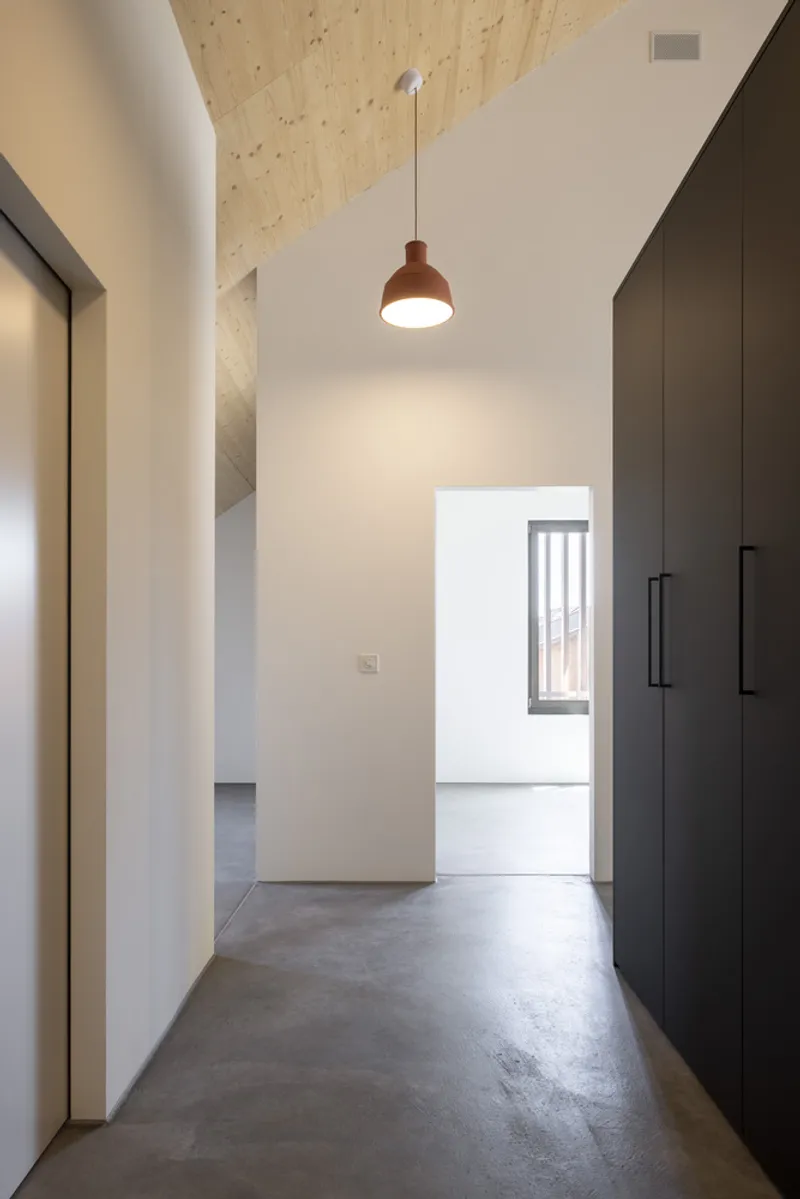
The narrow corridor on the upper level, with its plywood ceiling and red pendant light, demonstrates how even the tightest spaces receive careful material attention. Nothing is left as generic drywall. Every surface announces whether you are in the concrete zone or the timber zone, and the thresholds between the two are legible without being theatrical.
Energy Systems Worn Lightly
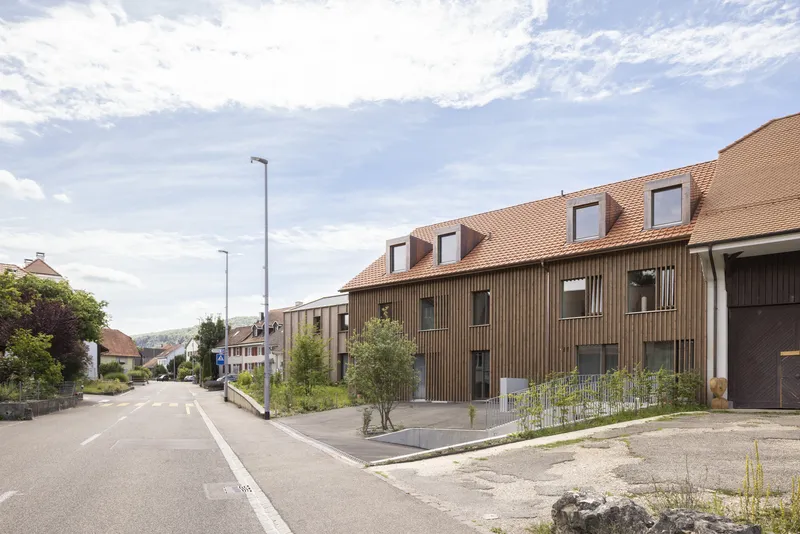
A central wood pellet heating system, residential ventilation with heat recovery, and photovoltaic panels on the south-facing roofs form the energy backbone. The panels are integrated so inconspicuously that they disappear beneath the orange clay tiles in most views. Ecological insulation materials throughout the timber envelope keep the energy balance tight without relying on conspicuous green technology.
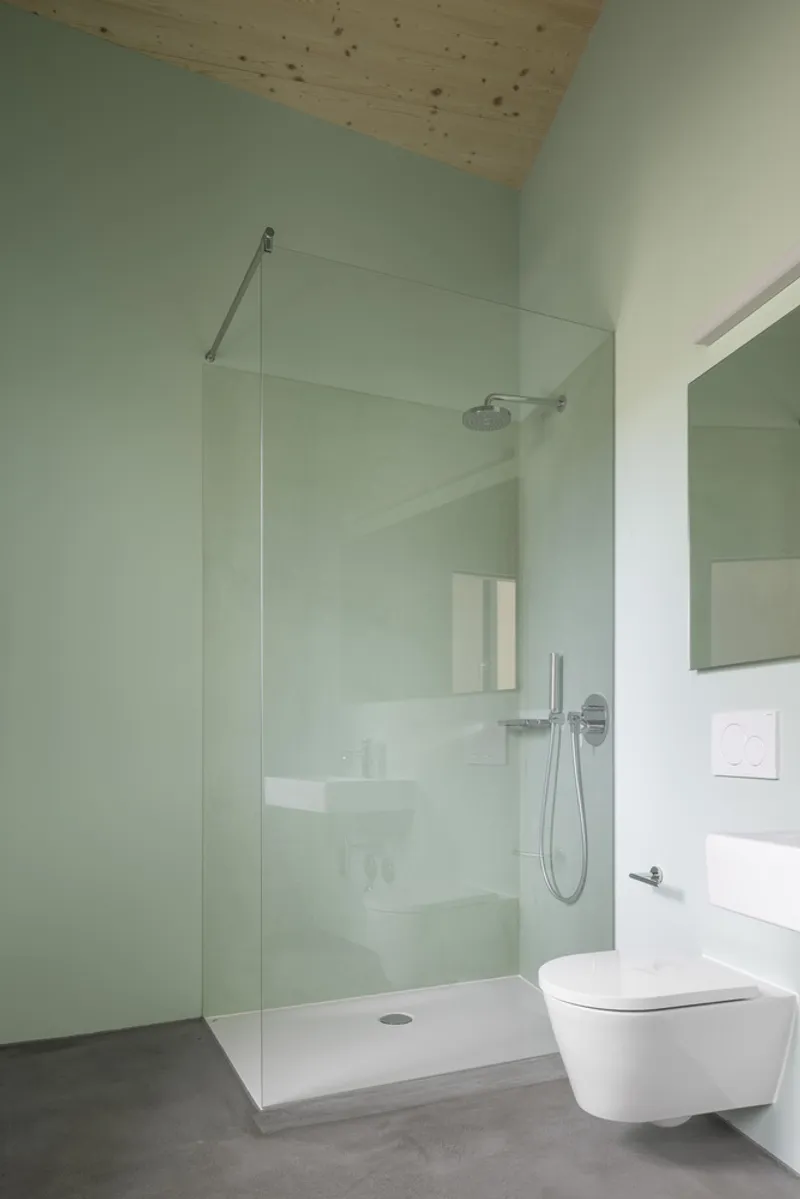
The bathroom interiors, with pale green tiled walls, glass partitions, and timber ceilings, show the same economy of means. Wall-hung fixtures and flush detailing keep maintenance simple. Sustainability here is not a marketing layer but a structural decision embedded in the choice to prefabricate in wood and heat with biomass.
Plans and Drawings
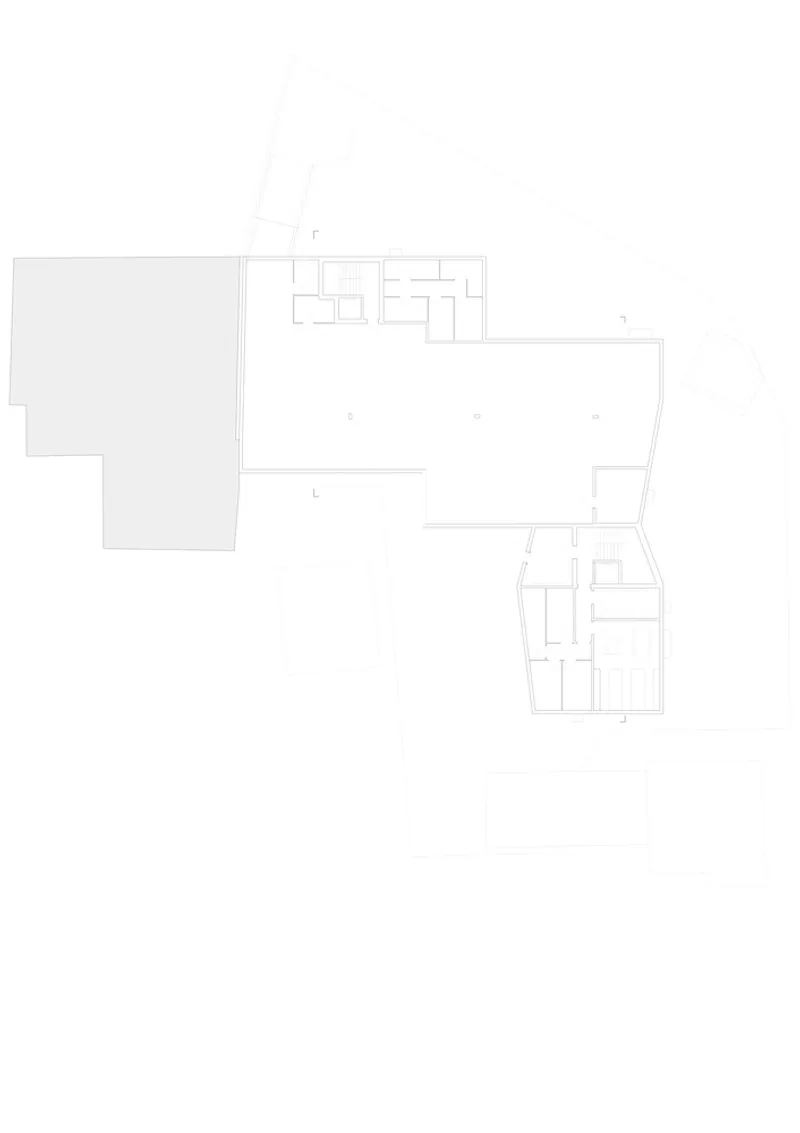
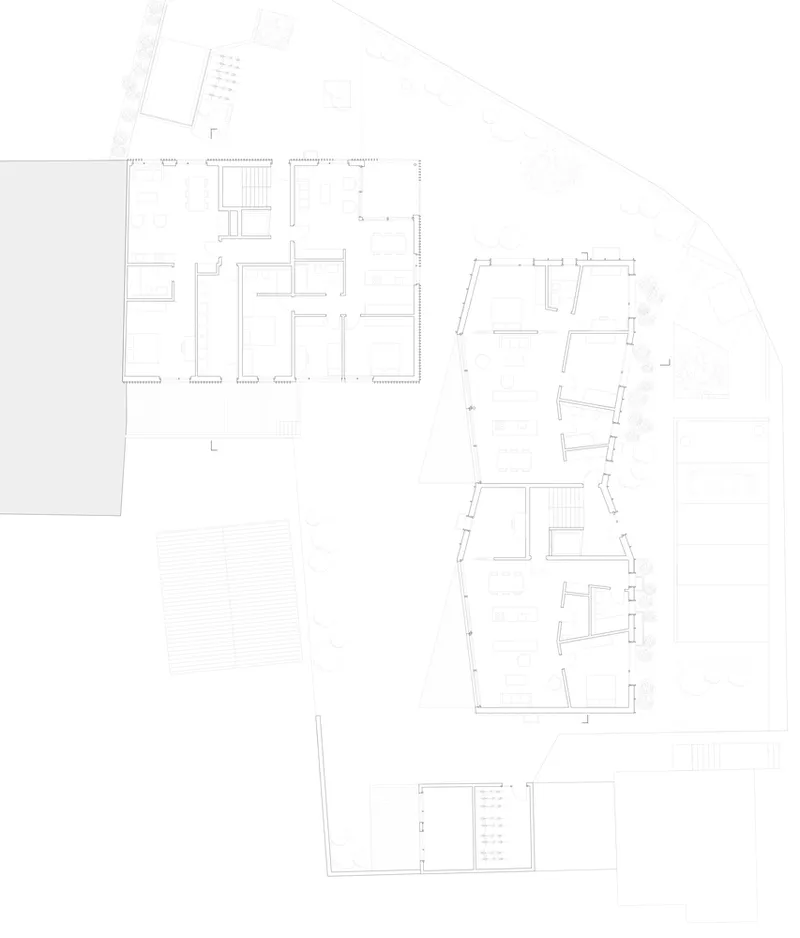
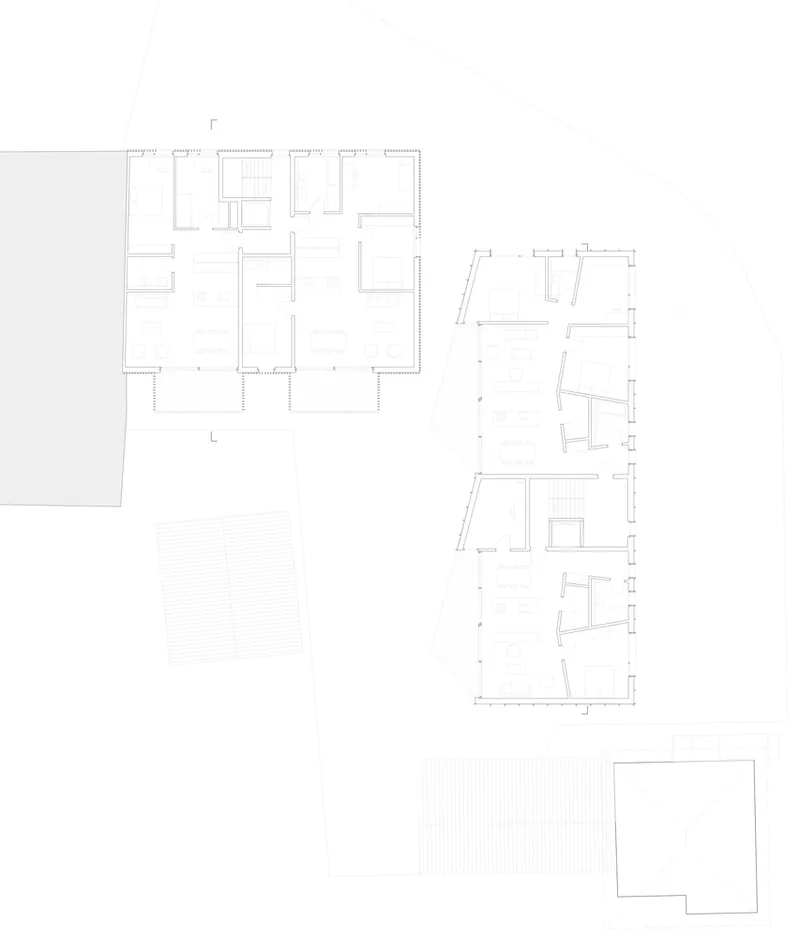
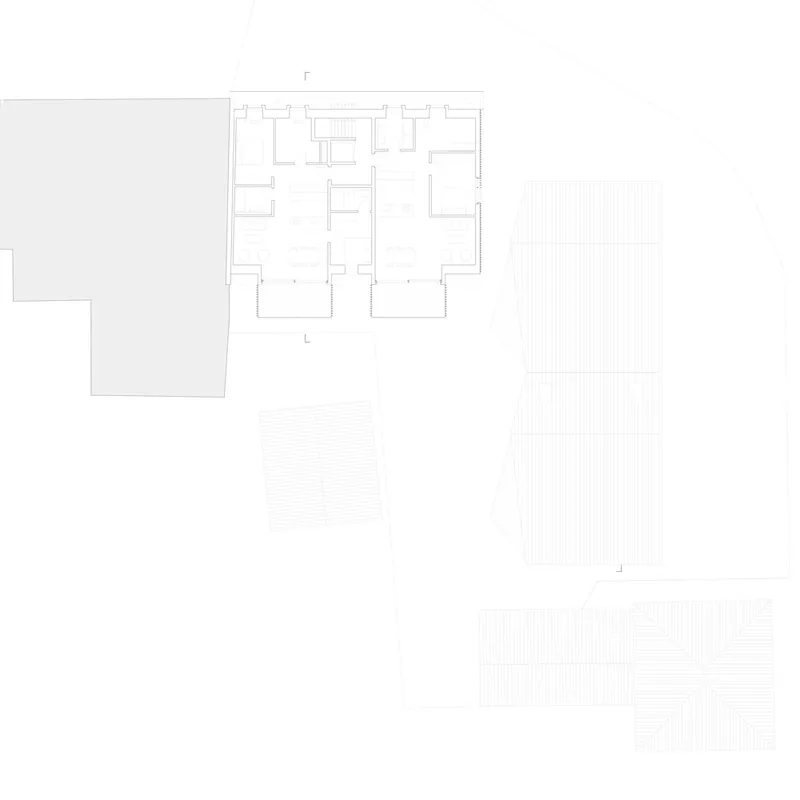
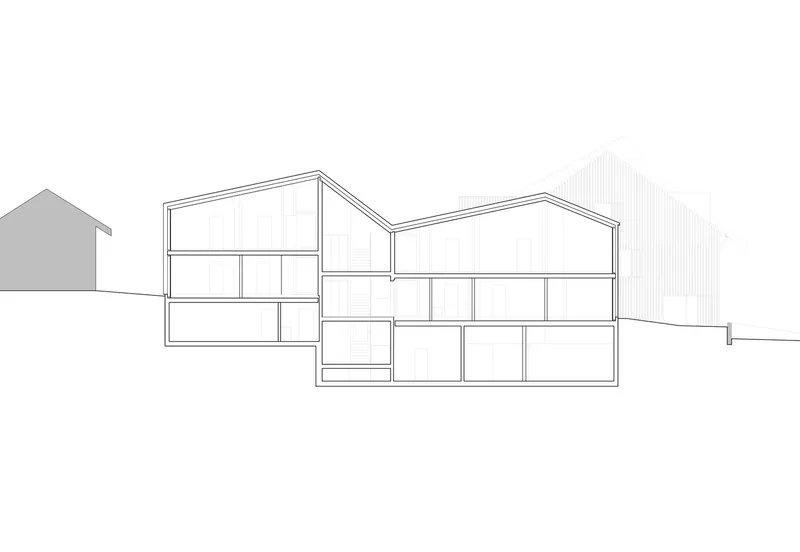
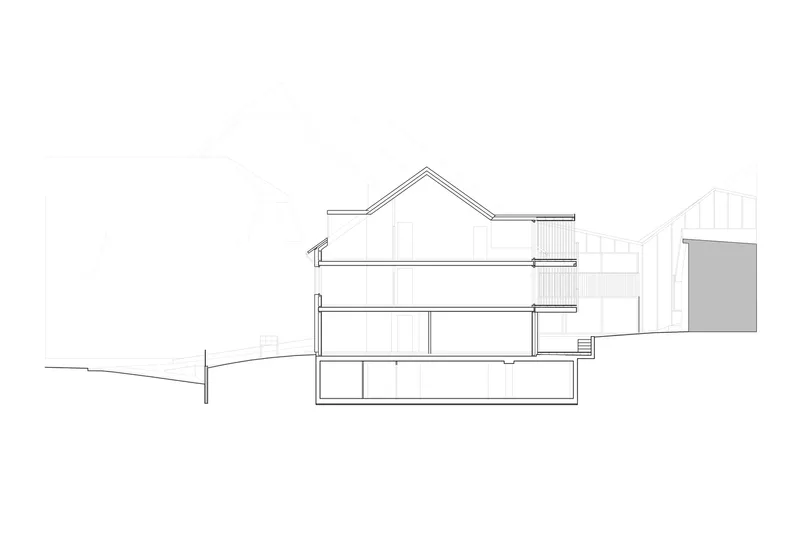
The site plan reveals the angular relationship between the two volumes, offset just enough to maximize yard space while holding the street edge. Floor plans show how the curved and rectangular wings accommodate multiple residential units per level, with terraces hatched along the south-facing edges. The sections are the most revealing documents: split-level volumes step down with the terrain, cantilevered decks extend living space outward, and the pitched roofs conceal generous attic rooms. Together, the drawings confirm that the project's apparent simplicity conceals a carefully calibrated geometric game played in three dimensions.
Why This Project Matters
Swiss timber housing is not rare. What is rare is a project that grounds its material choice in the specific history of its site and then follows that logic through every decision, from hybrid structure to facade rhythm to interior finish. Beck Oser Architekten do not use wood because it is fashionable; they use it because the land remembers a carpentry workshop, and the new buildings carry that memory forward in prefabricated panels rather than sentimental gesture.
The broader lesson is about replacement architecture as a design discipline. Keeping the massing, orientation, and proportional system of demolished buildings is a constraint that most firms would resent. Here it becomes a generative rule, producing facades that read as contemporary precisely because the underlying volume is familiar. In a country where heritage protection can freeze villages in amber, the Elgg project offers a more productive model: acknowledge what was there, then build something better with the same material.
Replacement Buildings Old Carpentry by Beck Oser Architekten, Elgg, Switzerland, 2021. Photography by Börje Müller.
About the Studio
Share Your Own Work on uni.xyz
If projects like this are the kind of work you want to make, uni.xyz is a place to publish your own, find collaborators, and enter design competitions.


Popular Articles
Popular articles from the community


The Earth Pod: 3D Printed Homes for Resilient Refugee Communities
The Earth Pod reimagines refugee housing through 3D printed homes made from clay, combining resilience, self-sufficiency, and rapid shelter.

The Musturak Paradise: Senior Living Architecture for a Connected Future in Temara, Morocco
The Musturak Paradise reimagines senior living architecture in Temara via private homes, social spaces, culture, community, and shared care.

Conexión: Biophilic Design Reimagines High-Rise Living in Hong Kong
Conexión reimagines high-rise living in Hong Kong through biophilic design, green facades, shared spaces, daylight, water and nature within.

Co-Life: Senior Housing Design That Reconnects Older Adults With the City
Co-Life reimagines senior housing design through healing gardens, shared streets, workshops, and a sustainable community across generations.


Similar Reads
You might also enjoy these articles


Hodi-Mandai Geram
Project Function: Preservation and revitalization of the Intangible heritage and socio-spatial identity of the Hodi by Housing, Cultural Memory Center, Sacred Grove, landscape, local tourism economy


Olio Towers: A Mid-Rise for Performers That Fuses Housing, Rehearsal, and Stage
Located blocks from Houston's Theater District, this modular tower stacks living units around a central performance atrium.

Oasis: Modular Green Housing Carved into Dhaka's Urban Fabric
A shortlisted Plugin Housing entry reclaims unauthorized settlements in Dhaka with stepped concrete volumes, green roofs, and ventilation-driven design.

Black Hole: A Floating Megastructure for the Post-Physical Era
Emiliano Mazzarotto envisions a spherical, self-scaling arena where e-sports, digital hotels, and holographic stadiums replace traditional public space.


Explore Wood Construction Competitions
Discover active competitions in this discipline



Challenge to reimagine the Iron Throne


Photograph architecture without architects


Illustrate the lost glory of Angkor Wat - Render Challenge


Design challenge to reuse E-waste
Comments (0)
Please login or sign up to add comments
No comments yet. Be the first to comment!