

MUUAN Builds a CLT Daycare in Oulu That Puts Children at Eye Level with the Forest
Five groups of children share a timber village of gabled volumes tucked among birch and pine trees in northern Finland.


Most daycare buildings are boxes dressed up with bright colors and rubber flooring, designed to be durable and little else. The Kaijonharju Daycare Center in Oulu takes the opposite position. Designed by Finnish studio MUUAN, the 1,180 square meter facility is a cluster of gabled timber volumes arranged around courtyards, built entirely from cross-laminated timber and detailed with the conviction that the materials surrounding a child from age one onward actually matter. Completed at the end of 2023, it sits in a forested residential district near the Linnanmaa campus, where a 1980s site plan provided the framework and MUUAN seized the opportunity to deviate from every neighboring structure.
What makes the project genuinely interesting is not just its low-carbon credentials, though those are substantial. It is the way the architects designed from a child's physical vantage point: low windows positioned for small bodies, cork floors chosen for bare feet under a no-shoes policy, and a spatial sequence that breaks the program into three color-coded entities so that orientation becomes intuitive for a four-year-old. The building was erected under weather protection all the way to the water roof and facade cladding, a construction protocol more common in Scandinavian apartment blocks than kindergartens. CLT prefabrication brought the project in ahead of schedule, and the result is a small-scale landmark along Kaijonharju's pedestrian routes, proof that public buildings for very young citizens can be taken as seriously as concert halls.
A Village of Gables in the Snow
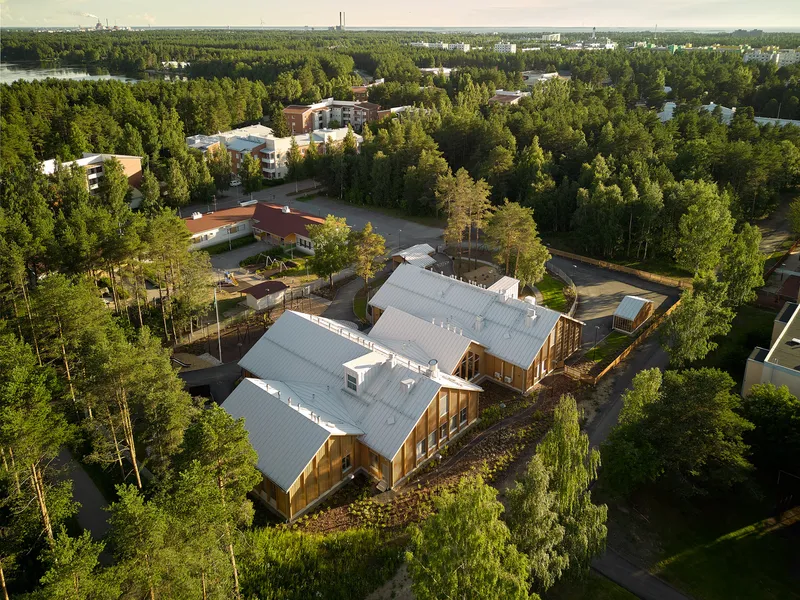
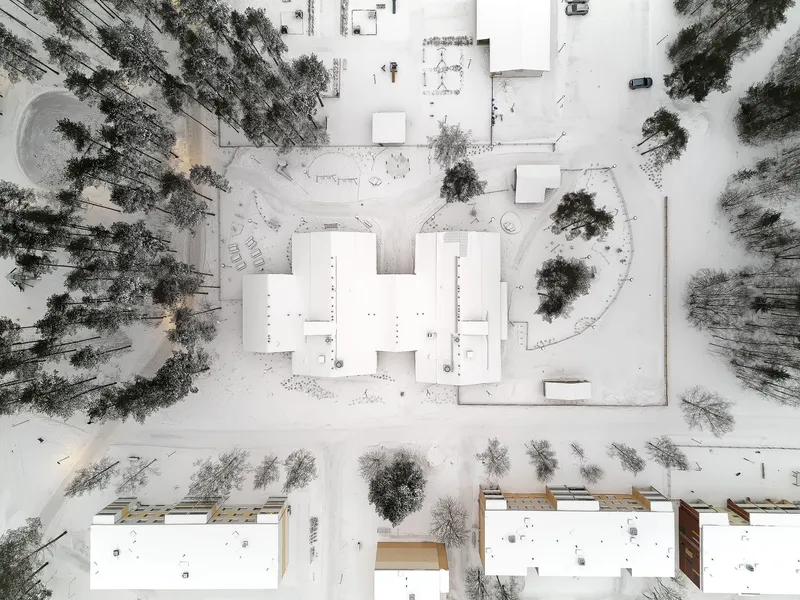
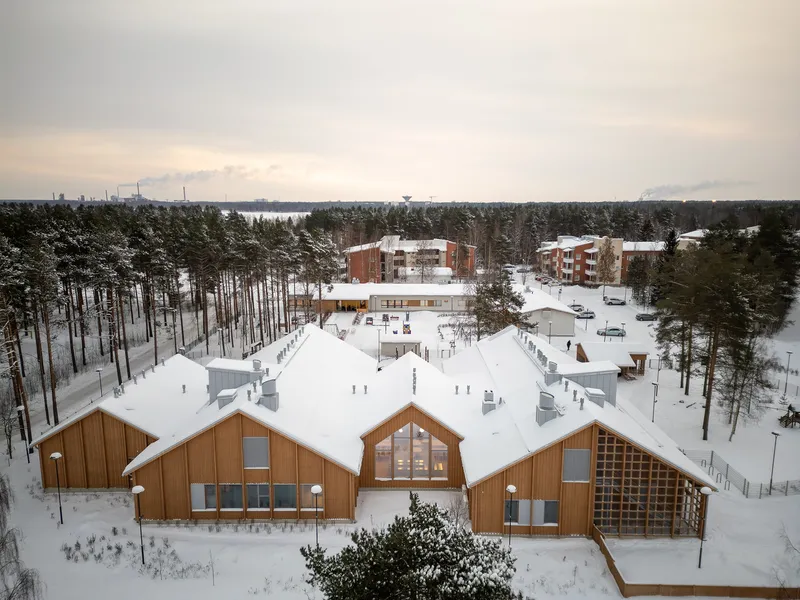
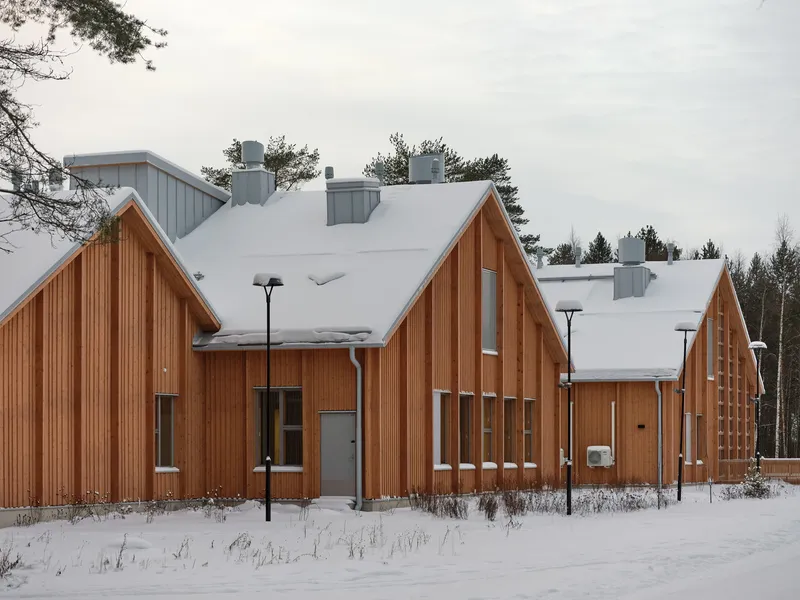
From the air, the daycare reads as a small settlement: four single-story gabled sections with standing-seam metal roofs, their footprints staggered to create sheltered outdoor spaces between them. The massing strategy is deliberately domestic in scale, avoiding the institutional bulk that daycare programs of this size often produce. Each volume holds its own identity while interlocking with its neighbors, so the building never presents a single monolithic face to the street.
The site strategy is inseparable from the architecture. Existing birch and pine trees were retained throughout the clearing, and the building's orientation was calibrated to northern light conditions and the paths children and parents walk daily. In winter, when snow buries everything up to the windowsills, the warm timber cladding and glowing interiors turn the complex into a lantern among the trees.
Timber Cladding and the Gable as Motif
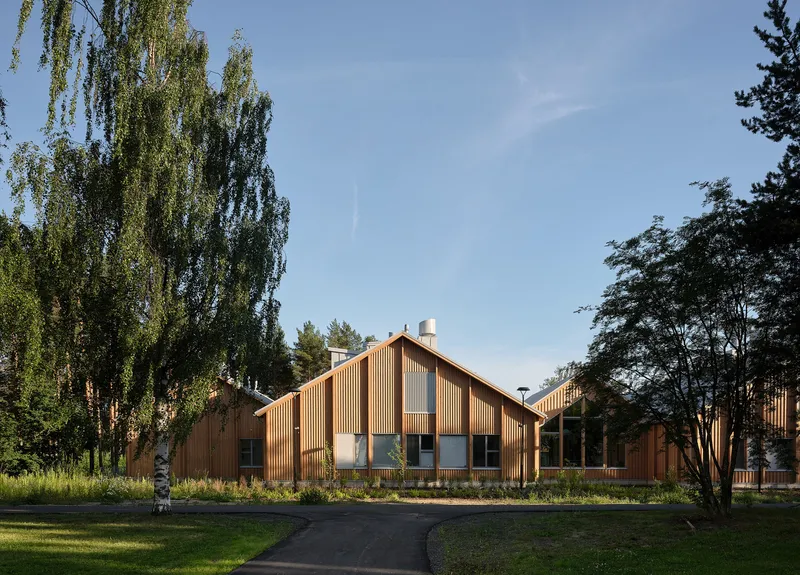

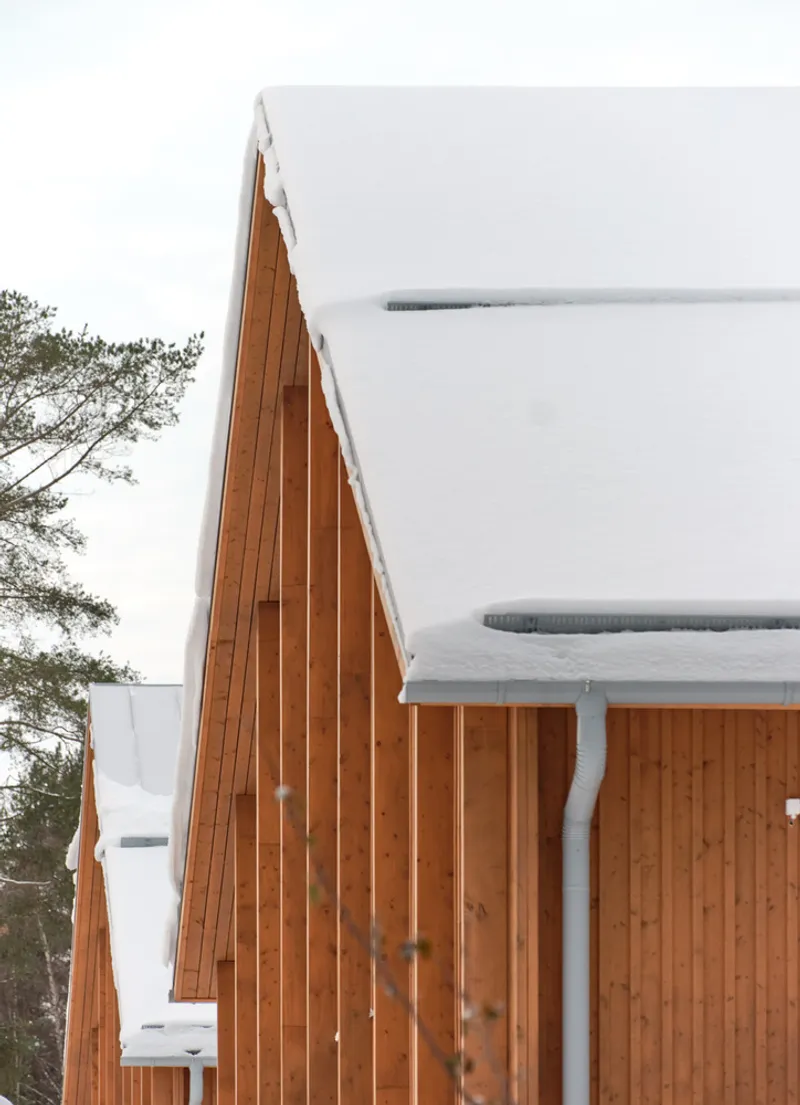
The facades are clad entirely in vertical timber boards, a choice that reinforces the building's kinship with Finnish vernacular construction while giving the walls a rhythmic texture that shifts with the light. The vertical grain draws the eye upward toward the pitched rooflines, and the slat density varies at certain openings to modulate transparency. At the gable ends, gridded translucent panels introduce a softer diffused light into the interiors, a move that transforms what could be a flat wall into a luminous surface at dusk.
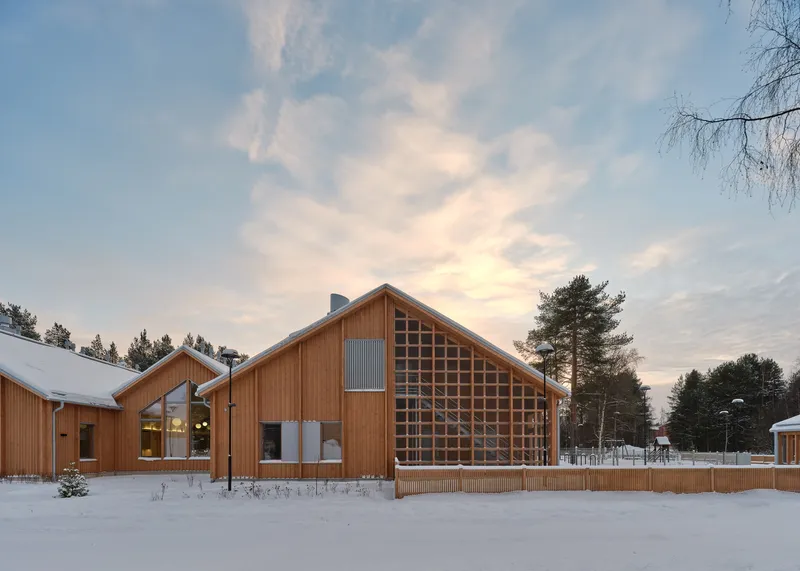


These translucent gables are the building's most expressive gesture. Seen through bare winter branches or dusted with snow, they glow with a quiet warmth that signals habitation without shouting. The pitched roof junctions accumulate snow in clean ridgelines, and the cladding weathers into the same tonal range as the surrounding bark. MUUAN understood that in a landscape this monochromatic for half the year, architecture communicates through silhouette and warmth as much as through form.
Arriving Through the Forest
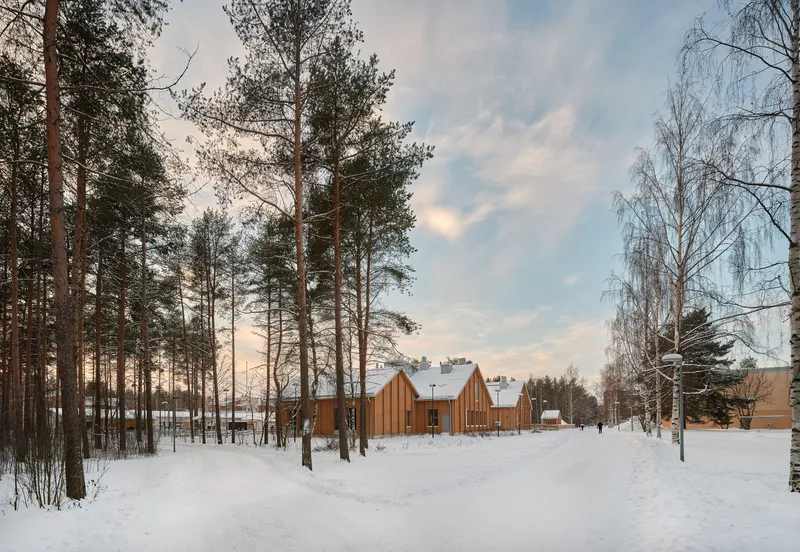
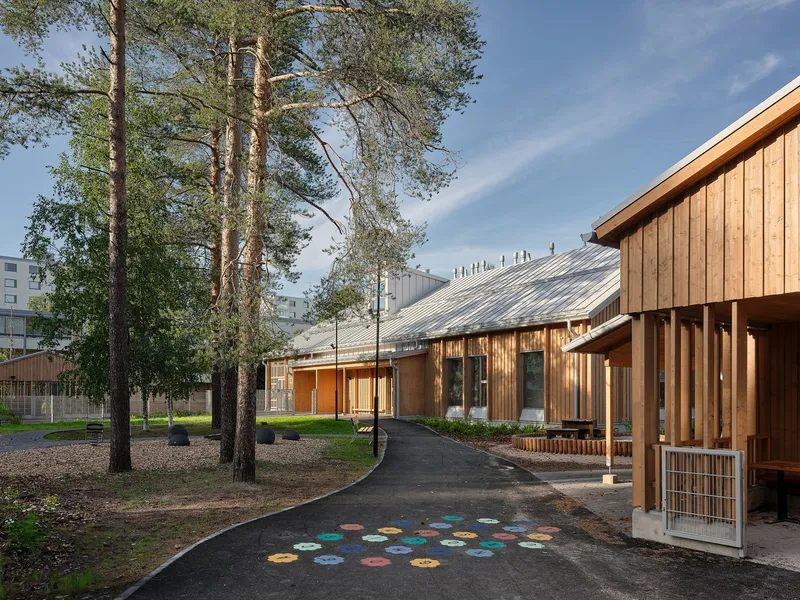
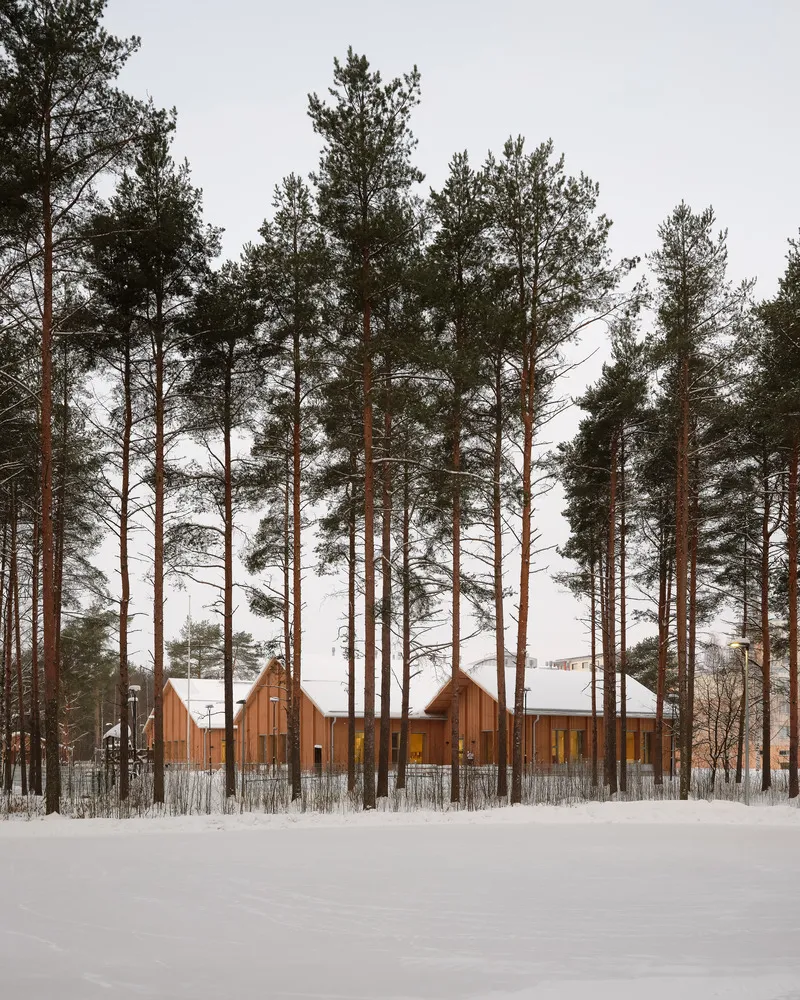
Approach matters in a building designed for small children. The paths leading to the daycare curve through stands of pine, with colorful circles painted on the asphalt to mark the way. It is a small detail, but it converts the daily commute into a game, establishing the building's values before anyone crosses the threshold. The architects analyzed surrounding circulation routes during the design phase, and the building's shape was deliberately calibrated to stand out along the neighborhood's light-traffic paths without dominating them.
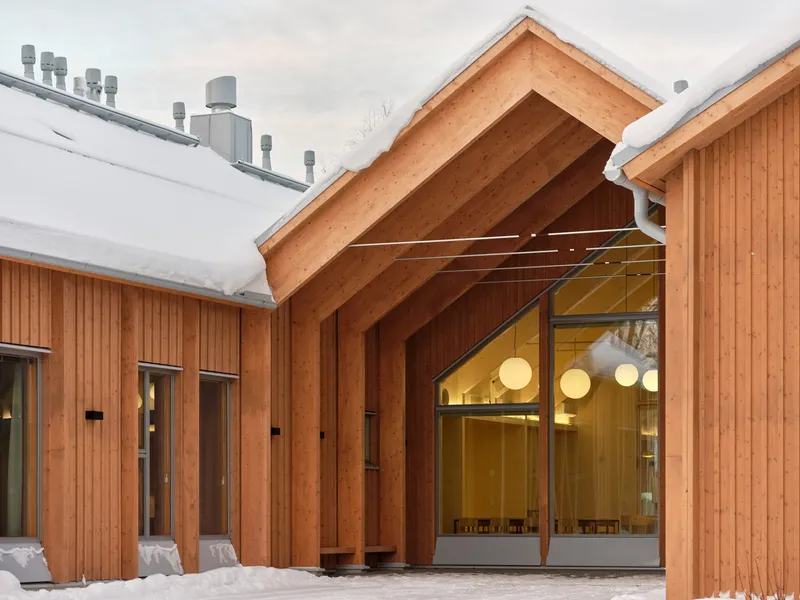
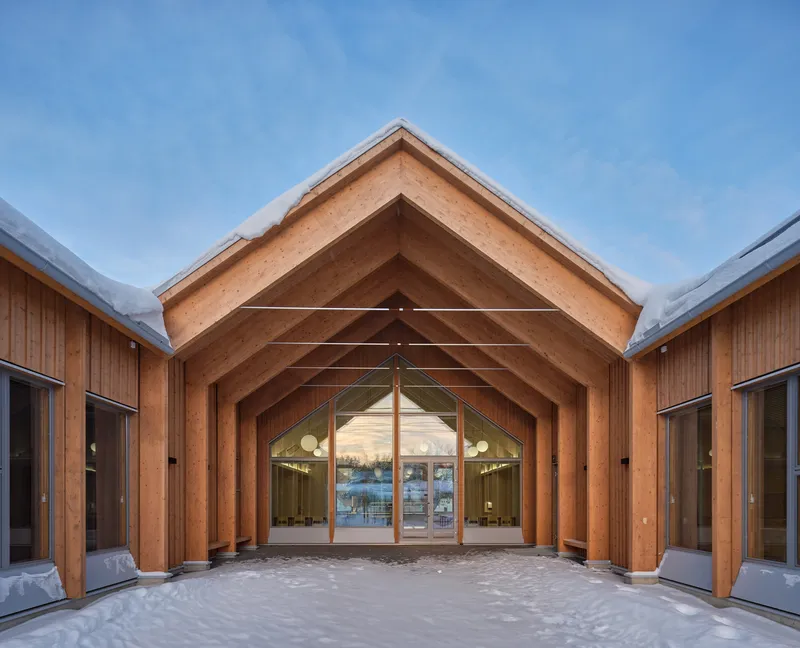
The entrances reinforce the domestic scale. Covered porches framed by laminated timber arches lead to glazed doors, creating a transitional zone between the cold exterior and the warm interior. The exposed rafter structure at the entry canopy gives arriving families a preview of the construction logic they will find inside. There is no grand foyer, no double-height lobby: just a sheltered threshold and a door at a child's proportion.
The Dining Hall as Heart
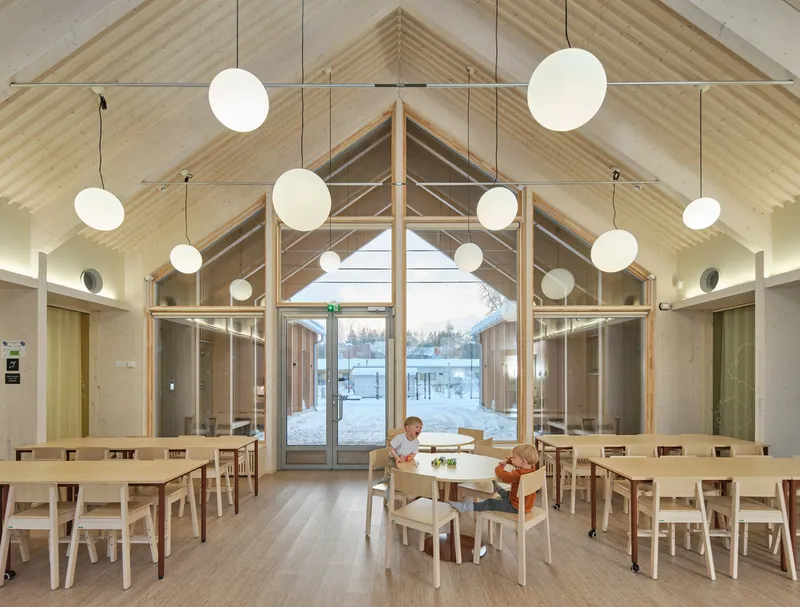
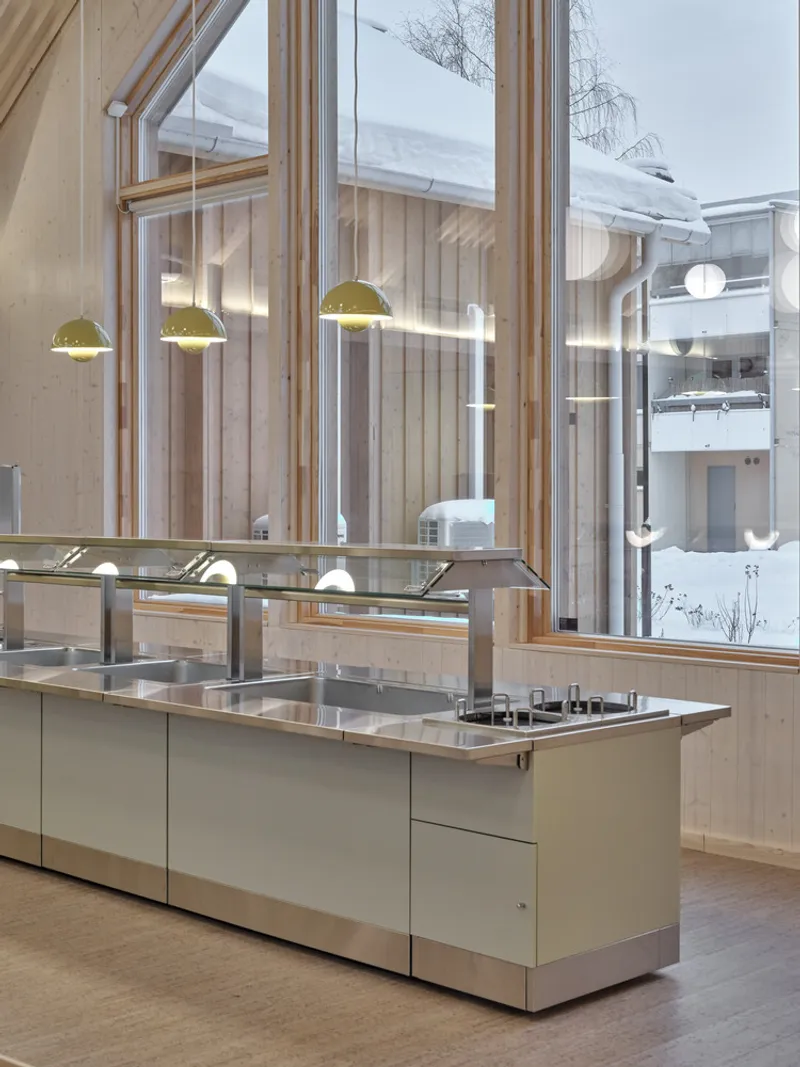

The central dining area is the social core of the building. Positioned beneath the tallest roof section, it benefits from expansive south-facing glass that floods the room with daylight and frames views of the courtyard and forest beyond. Exposed CLT rafters run the full span of the ceiling, their pale wood surface treated with a light log wax that lets the grain remain legible. Globe pendant lights hang at intervals, providing even illumination when the sun drops below the treeline at three in the afternoon.
Full-height windows in the kitchen area open onto the snow-covered courtyard, collapsing the boundary between meal preparation and outdoor life. Children eat at blonde wood tables scaled to their height, seated in chairs that let their feet touch the floor. The adjacency between kitchen, dining, and courtyard is the plan's strongest organizational move, binding the daily rhythms of eating, playing, and resting to a single legible sequence.
Interior Worlds Scaled to Small Bodies
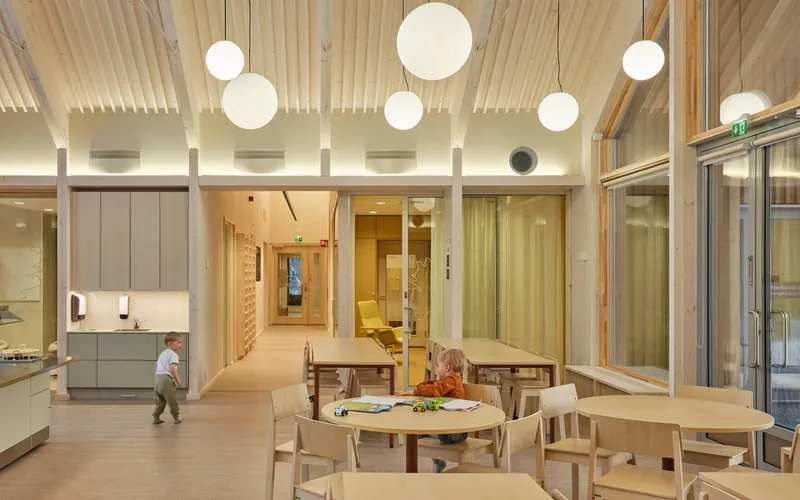
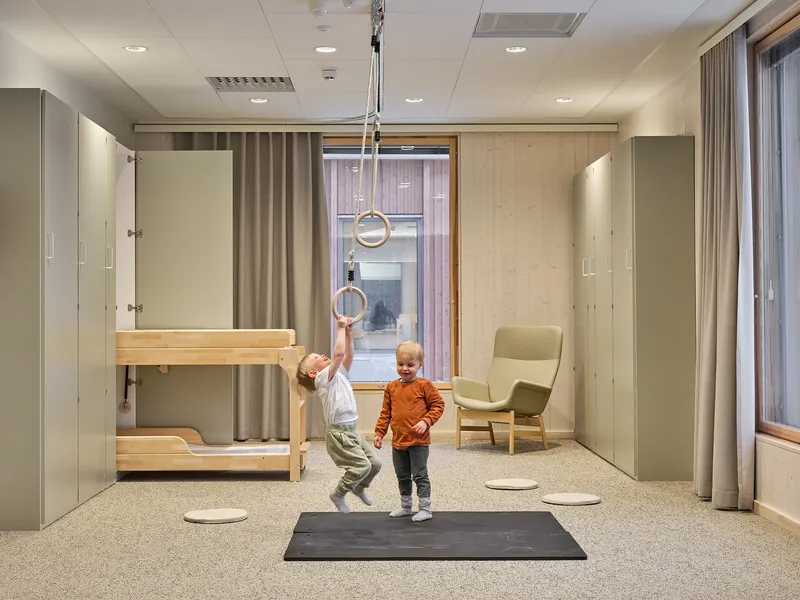
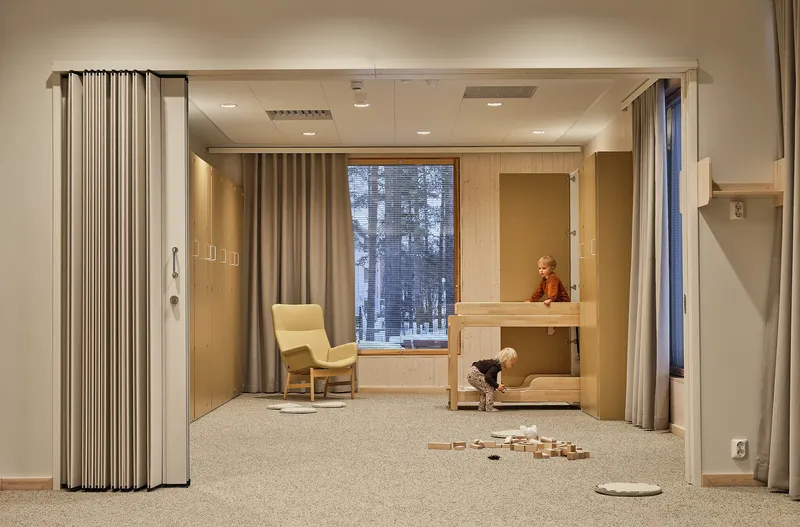
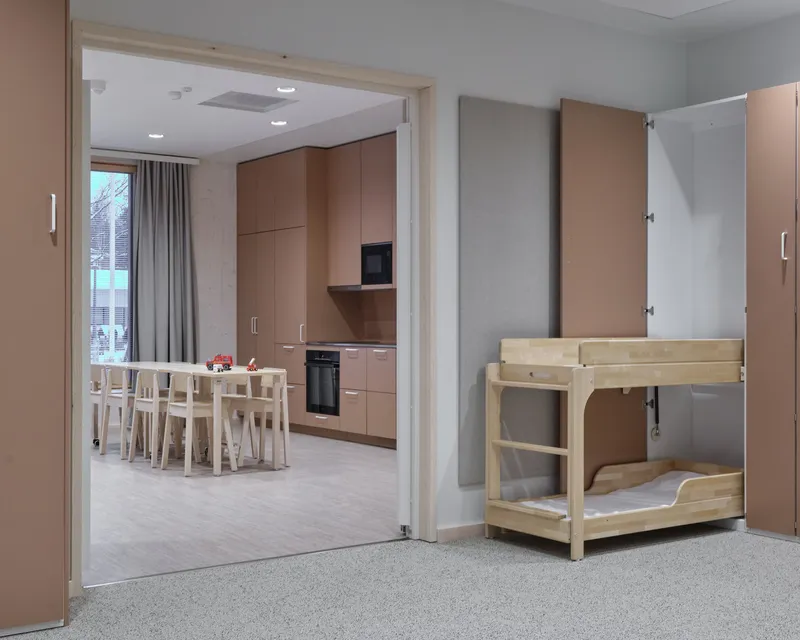
Each of the five children's groups occupies a suite of rooms differentiated by color and spatial character. Playrooms feature built-in timber bunk beds that double as climbing structures, with suspended gymnastics rings adding a vertical dimension to play. Folding fabric partitions allow caregivers to subdivide rooms for nap time without permanent walls, a flexible solution that acknowledges how quickly children's needs shift throughout a day. The CLT walls are left exposed wherever possible, their warmth and tactility serving as a constant sensory backdrop.
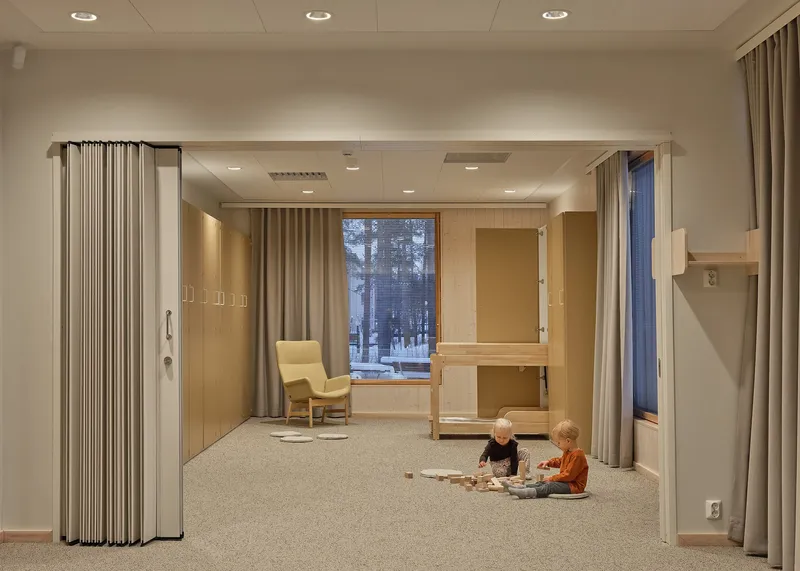
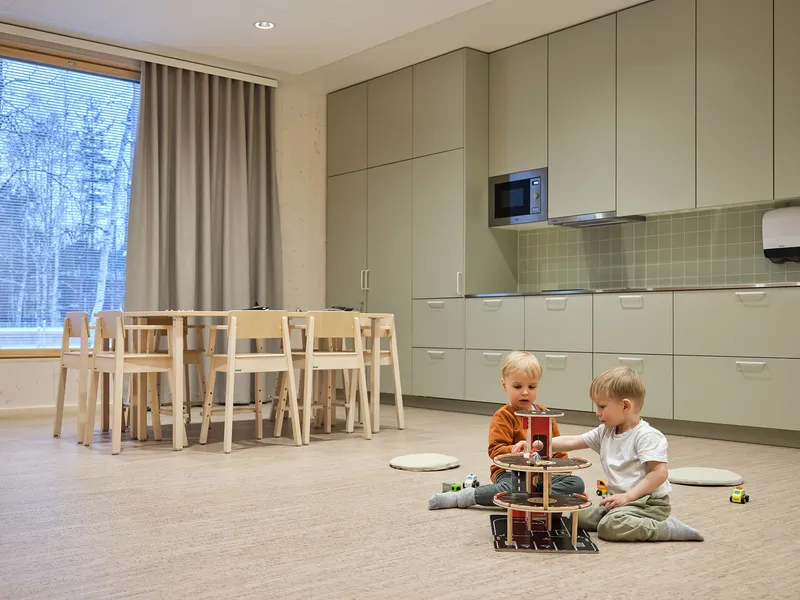
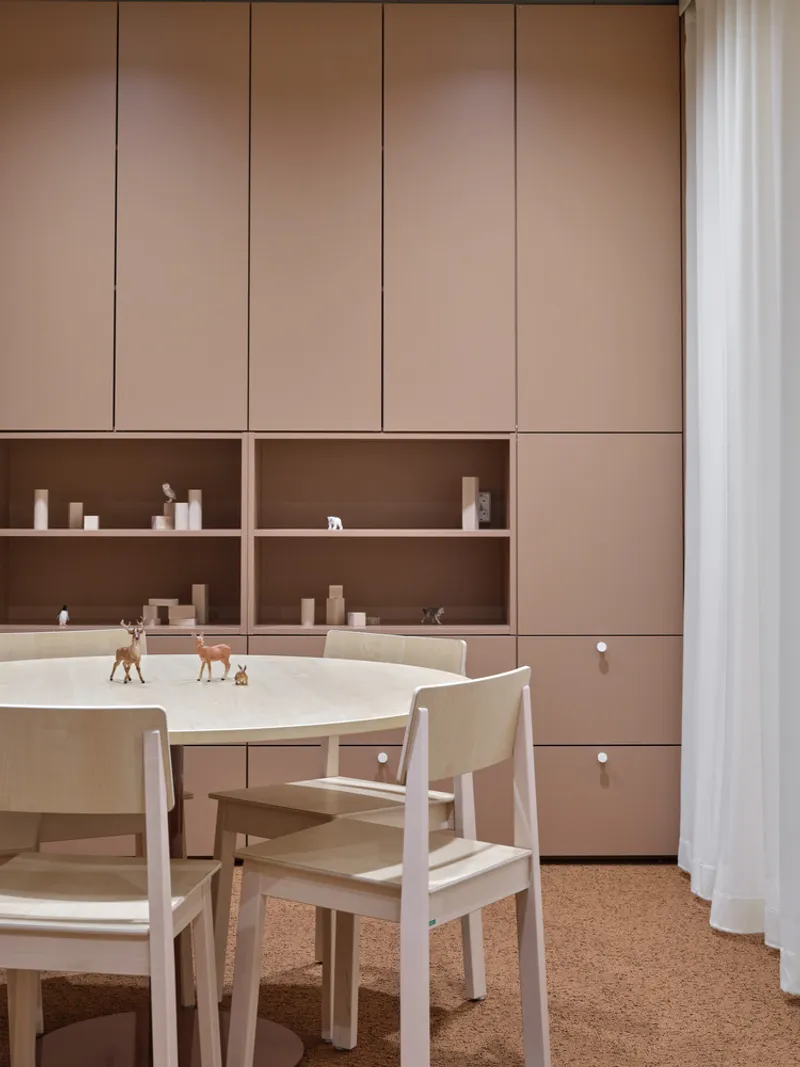
Cork floors in the nursery accommodate the no-shoes policy that guided MUUAN's material palette. Children play, crawl, and sleep on surfaces free from the chemical off-gassing that synthetic flooring produces. Textile carpet appears in rest areas and circulation zones, while laminate-coated chipboard forms the fixed furniture. The loose furniture mixes solid wood, metal, and upholstery fabric, each selected for durability and low emissions. Activity tables sit beneath open birch cabinetry, putting toys and tools within arm's reach for a three-year-old.
Color, Light, and the Finnish Landscape Palette
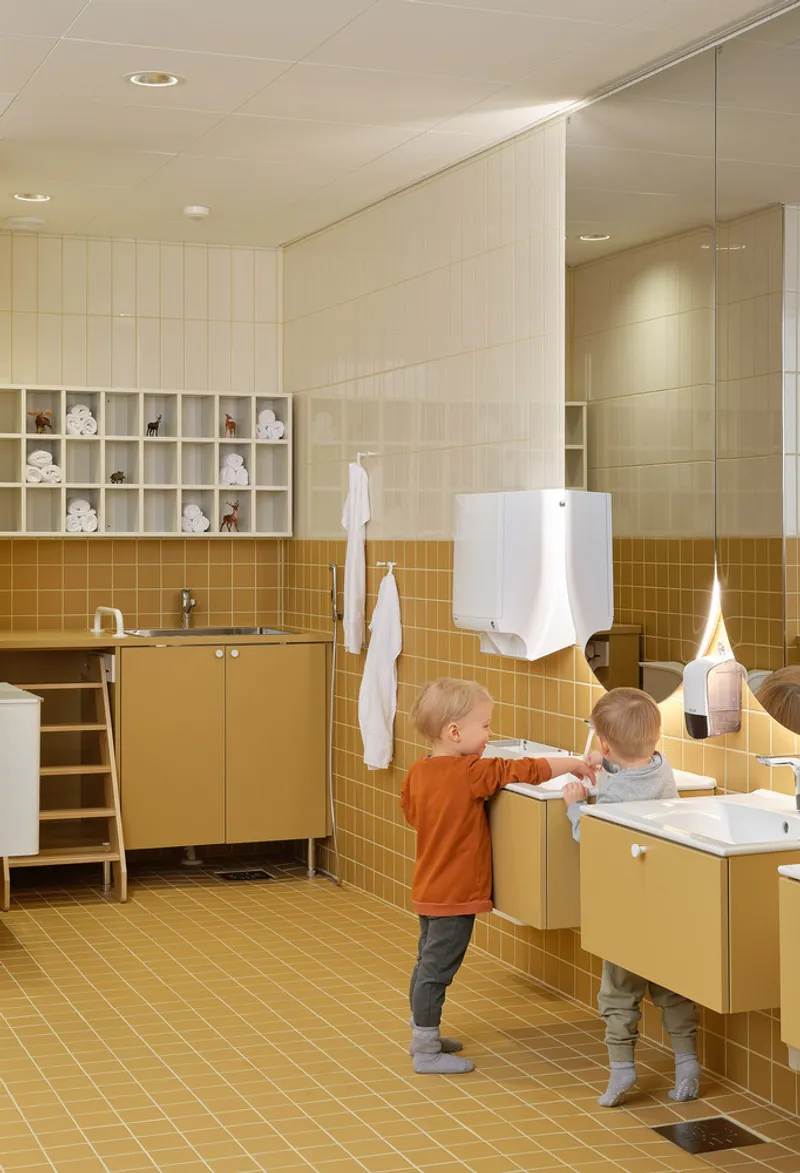
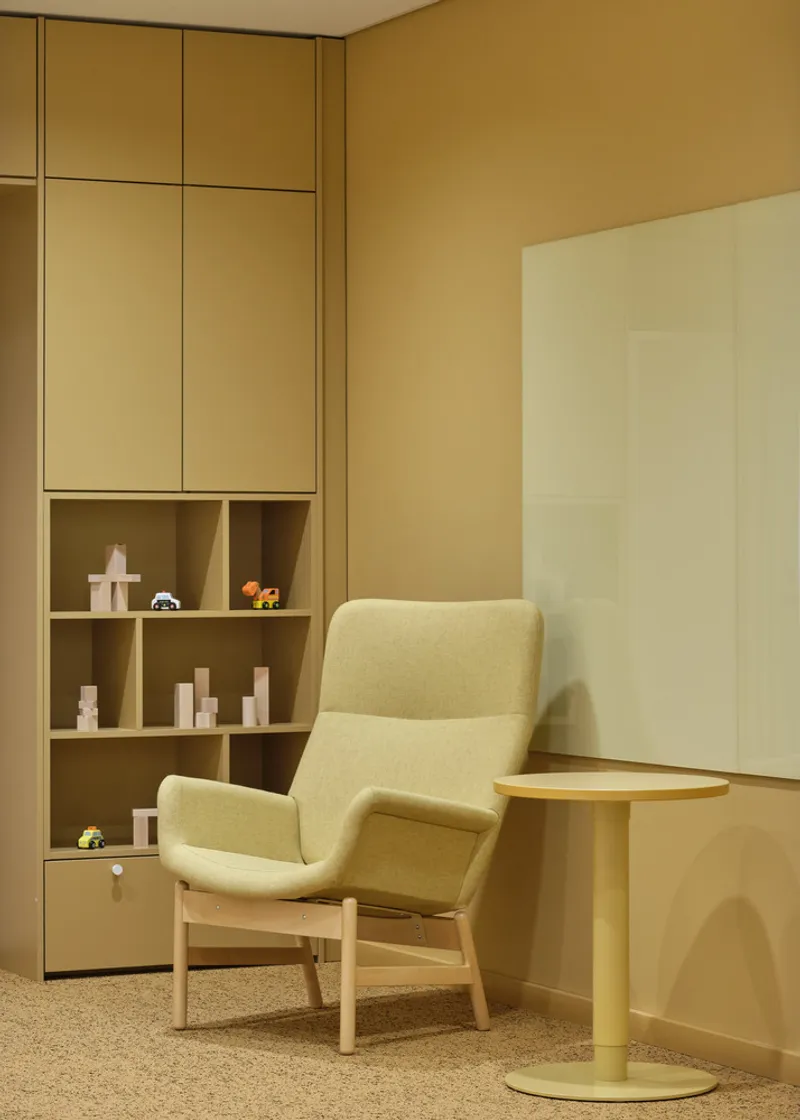
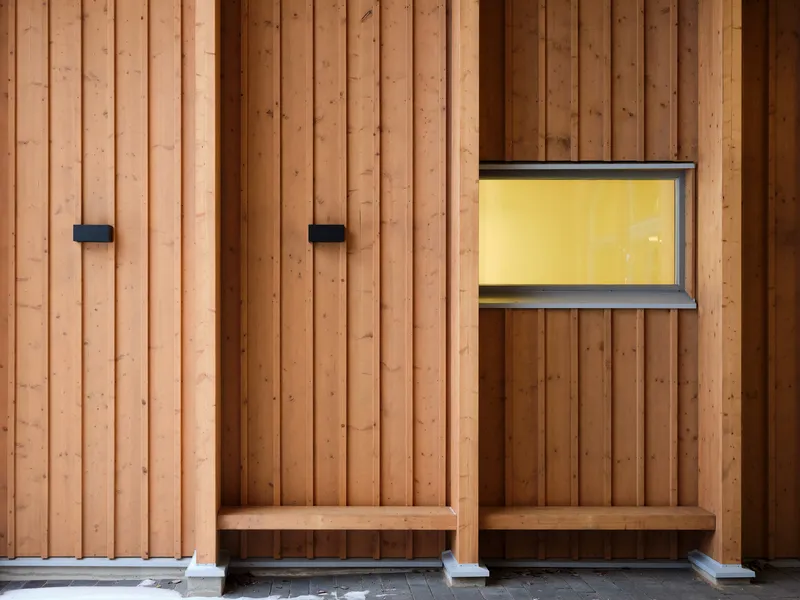
The color scheme avoids the saturated primaries that most kindergartens default to. Instead, MUUAN drew on the surrounding Finnish landscape: mustard yellow in the tiled bathrooms, pale green on upholstered seating, ochre and red clay accents on textiles. These colors reference lichen, birch bark, autumn moss, and clay soil, grounding the interiors in the same natural systems visible through every window. A horizontal window with a yellow curtain in one corridor catches low northern light and redistributes it as a warm glow across the timber wall.
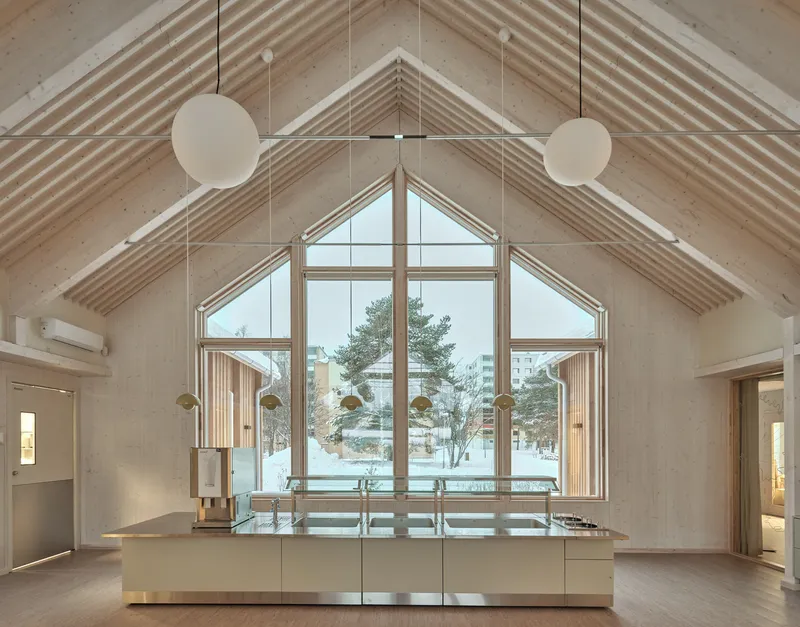
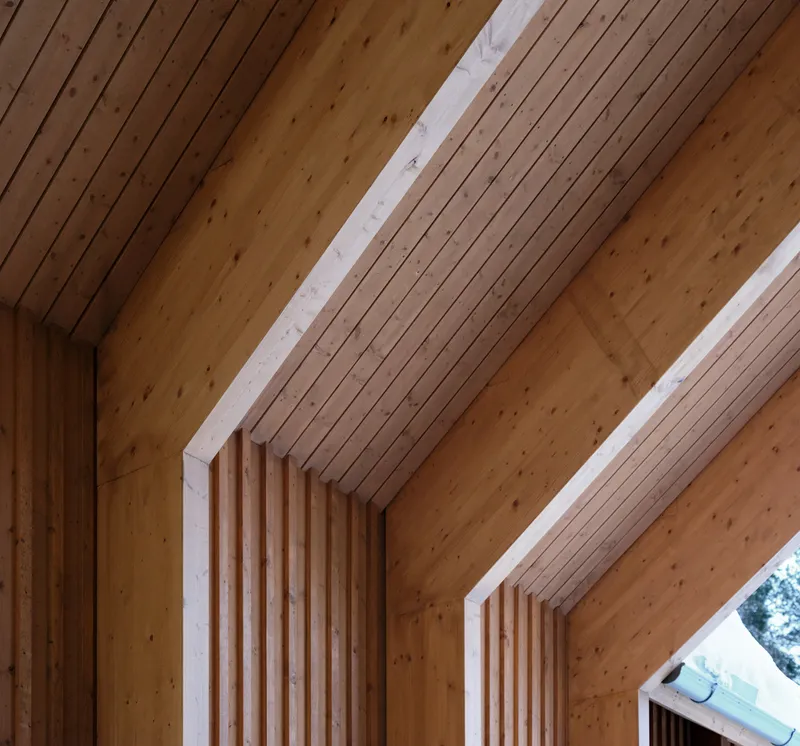
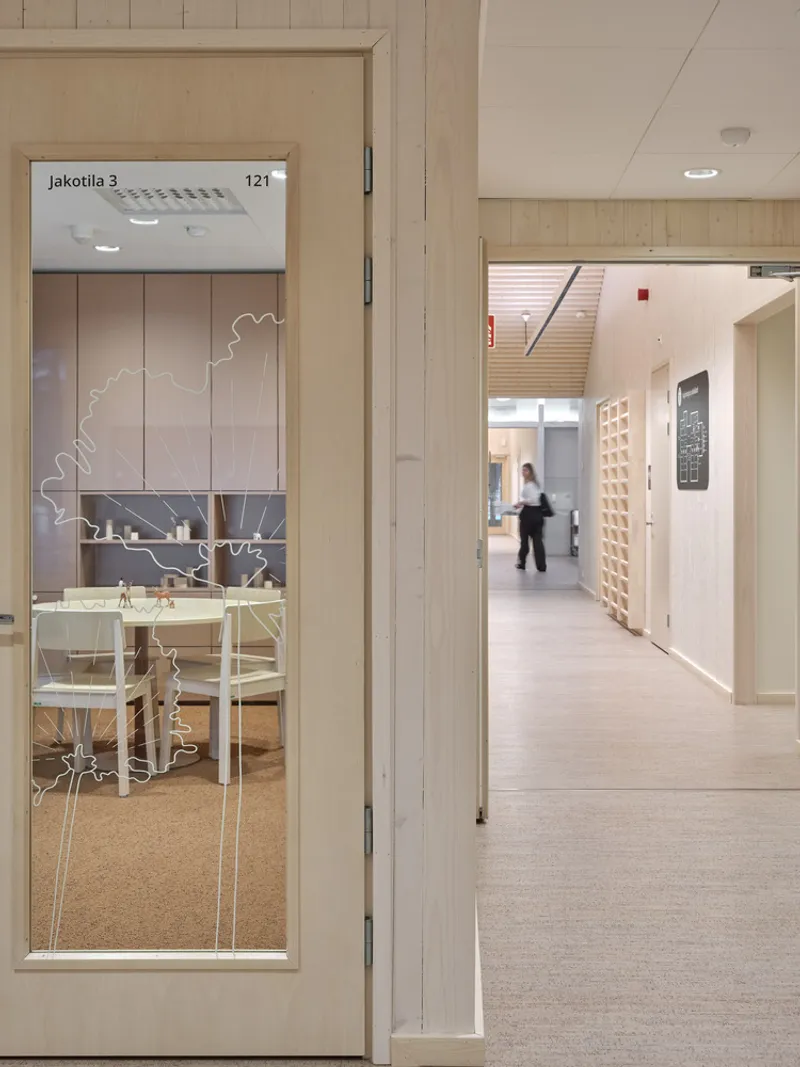
The vaulted plywood ceilings deserve particular attention. Exposed rafters create a rhythm overhead that gives even narrow corridors a sense of generosity, and recessed skylights between ribbed wood panels bring diffused light deep into the plan where windows alone cannot reach. At the gabled window walls, the timber structure frames a panoramic view of the snowy landscape, positioning nature as the most important piece of wall art in the building.
Thresholds, Storage, and the Details of Daily Life
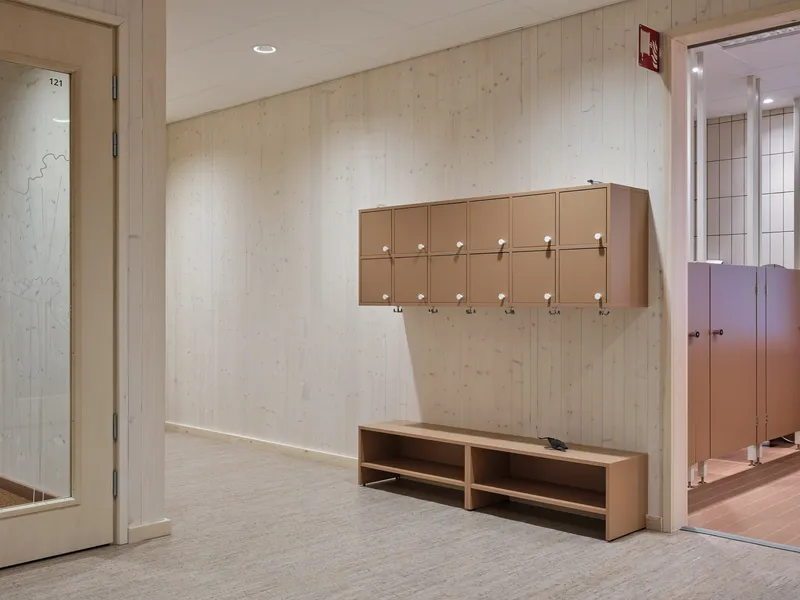
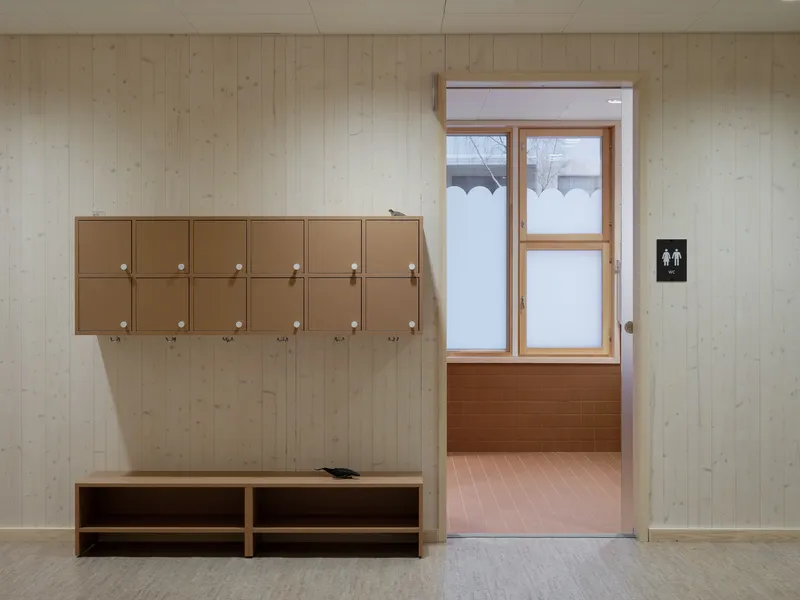
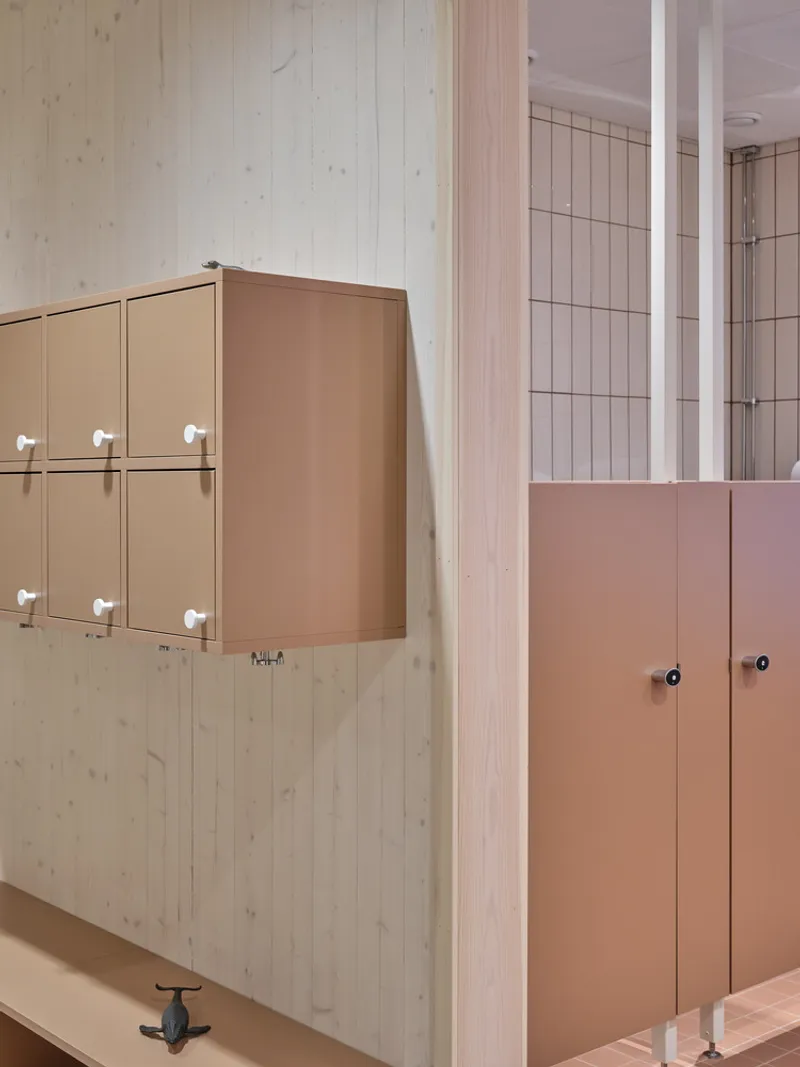
Finnish daycare life involves an extraordinary amount of gear: snowsuits, boots, hats, mittens, spare clothes, drying racks. MUUAN gave this prosaic reality proper architectural attention. Entryway mudrooms feature wall-mounted locker boxes and low benches against pale timber paneling, sized so children can manage their own coats and shoes independently. The vestibule opens directly to the snow-covered exterior, with enough floor area to absorb the slush and chaos of twenty toddlers arriving simultaneously on a February morning.
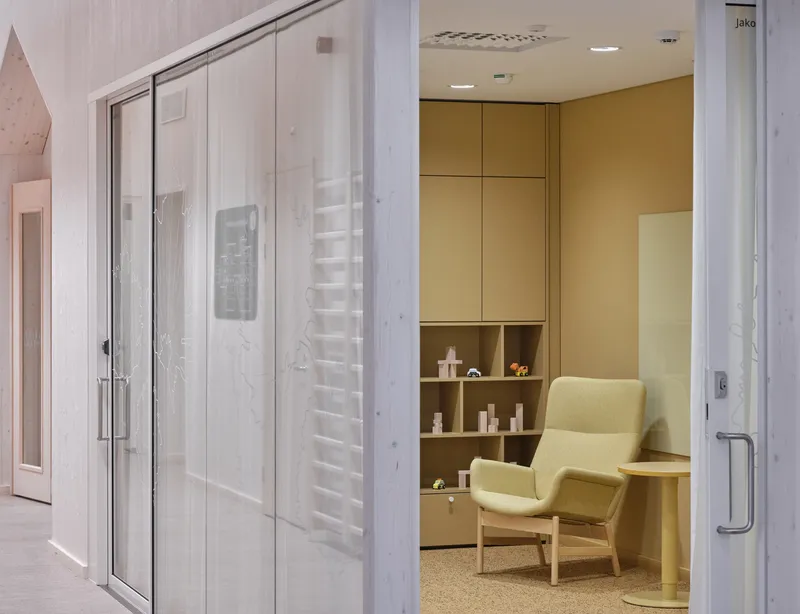
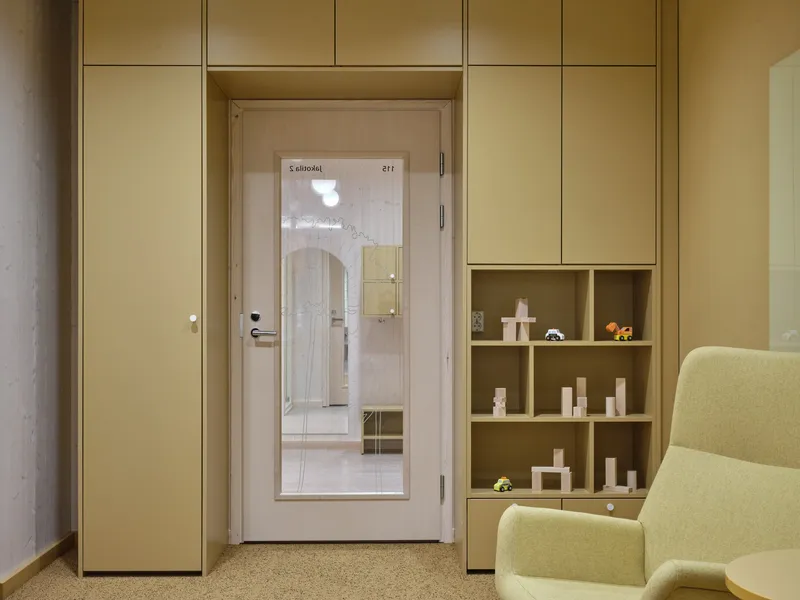
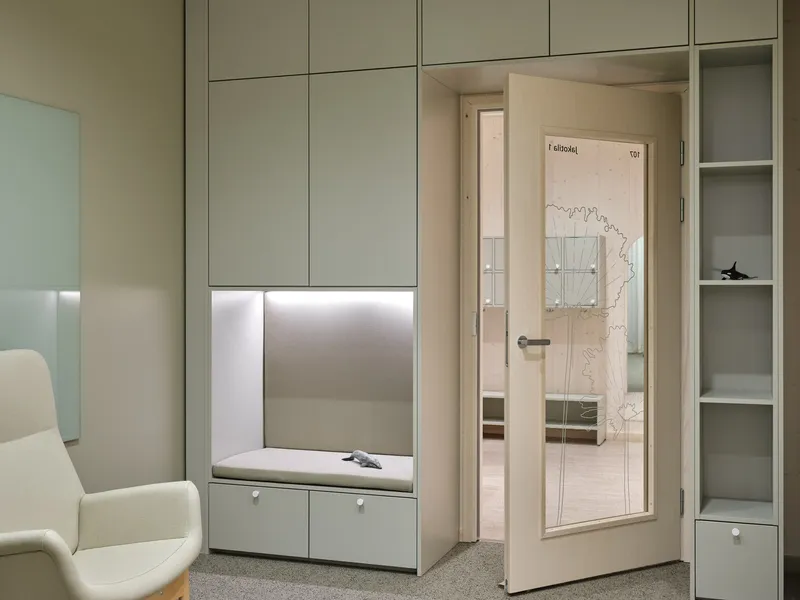
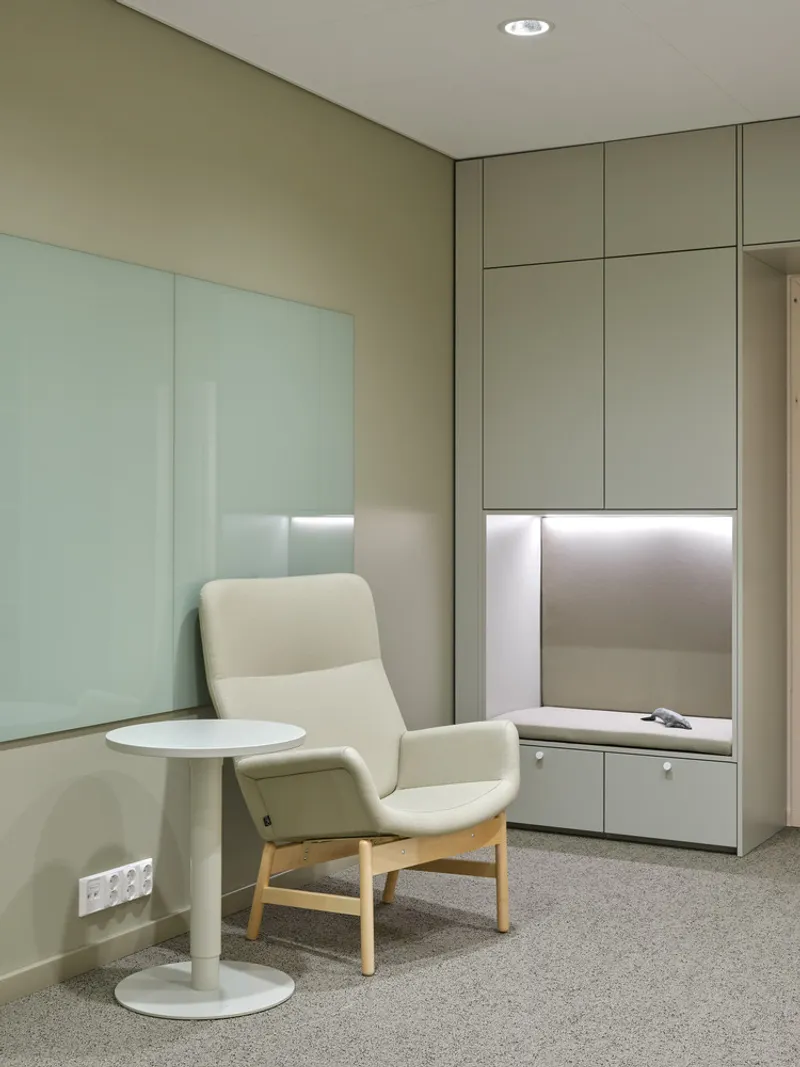
Consultation rooms behind glass sliding doors with translucent panels offer private space for parent meetings and staff work. Built-in birch plywood millwork integrates storage, display, and room divisions into a single system, reducing the need for freestanding furniture and keeping sight lines clear for supervision. A mirrored glass panel set within the millwork at one doorway expands the perceived depth of the corridor, a subtle trick that prevents the compact plan from feeling constrained.
Courtyards and Outdoor Life

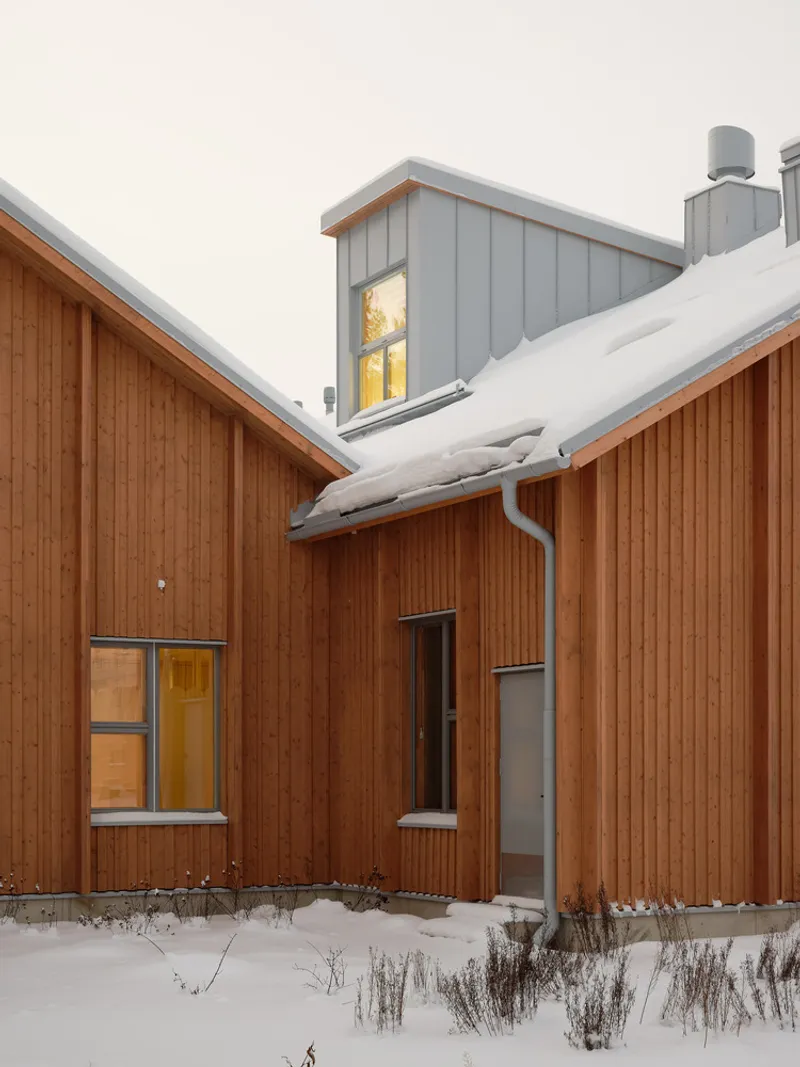
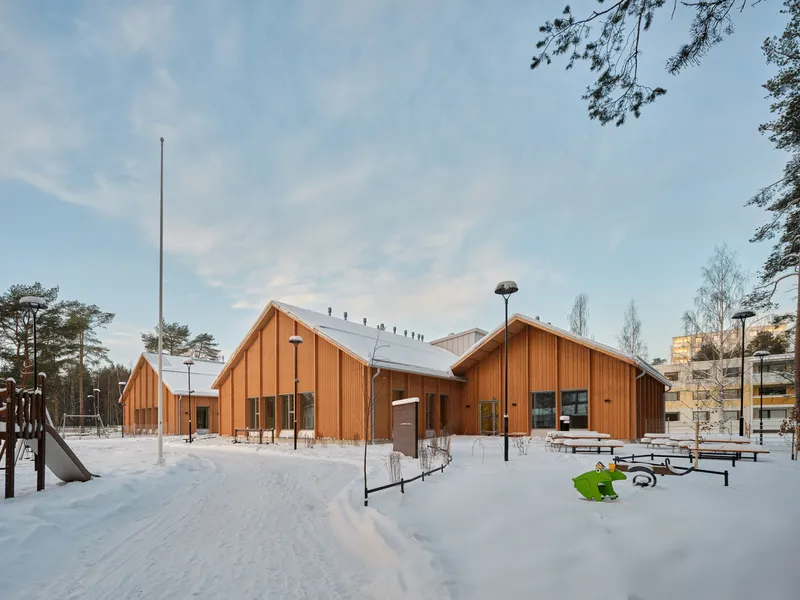
The sheltered courtyards between the gabled volumes are as deliberately composed as the interiors. Timber-clad facades wrap the outdoor spaces on three sides, creating wind-protected zones that remain usable even when temperatures drop well below freezing. At twilight, warm light spills through the glazing and casts long rectangles across the snow, turning the courtyard into an extension of the dining hall's atmosphere. Playground equipment occupies a snow-covered clearing at the building's edge, visible from interior windows so that supervision remains continuous.
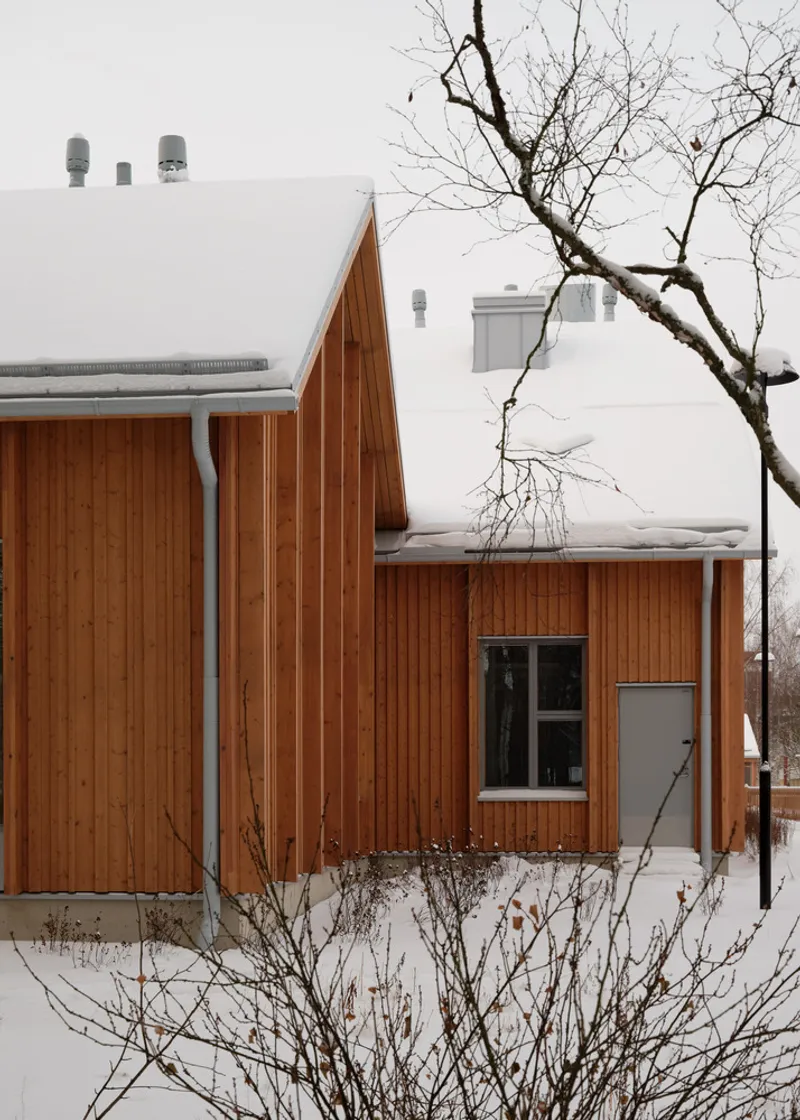
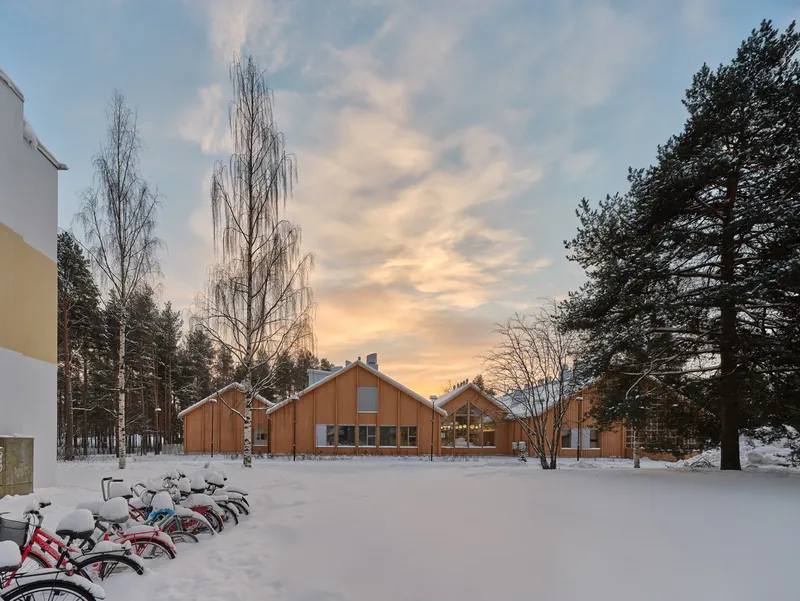
The view from across the open field, bicycles parked in the foreground and timber gables catching the last light of a winter sunset, captures what MUUAN achieved: a building that belongs to its neighborhood while insisting on a higher standard of craft and environmental performance than its context requires. It is neither precious nor austere. It simply takes children, wood, and the Finnish winter as the starting conditions for architecture.
Plans and Drawings
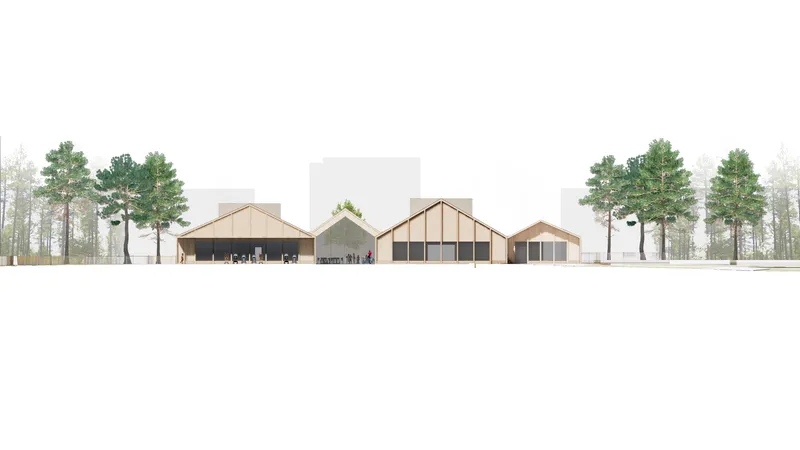
The elevation drawing reveals how the cluster of gabled volumes reads as a unified composition despite each section maintaining its own ridge height and footprint. Glazed openings are concentrated at gable ends and south-facing walls, while the north facades remain more solid, a practical response to heat loss that also produces the building's characteristic asymmetry between public and private faces.
Why This Project Matters
The Kaijonharju Daycare Center matters because it refuses the false choice between sustainability and spatial quality. Too many low-carbon buildings treat material selection as a checkbox exercise, wrapping engineered wood around conventional plans and calling it progress. MUUAN started from the other direction: a child's body, a child's sightline, a child's bare foot on a cork floor. The CLT structure follows from those decisions, not the other way around. The result is a building where the environmental argument and the experiential argument are the same argument.
As a pilot project for the city of Oulu, it will inform future public construction standards across northern Finland. The lessons are transferable: prefabricated CLT frames erected under weather protection, natural color palettes derived from site-specific landscapes, spatial sequences broken into identifiable clusters rather than continuous corridors. None of these moves require extraordinary budgets. They require architects who believe that the youngest citizens deserve buildings designed with the same rigor as any other civic program. MUUAN has delivered exactly that, and the profession should be paying attention.
Kaijonharju Daycare Center, designed by MUUAN. Oulu, Finland. 1,180 m². Completed 2023. Structural design by Laukka; landscape design by HELMA. Photography by Marc Goodwin | Archmospheres.
About the Studio
Share Your Own Work on uni.xyz
If projects like this are the kind of work you want to make, uni.xyz is a place to publish your own, find collaborators, and enter design competitions.


Popular Articles
Popular articles from the community


Riyadh For All: Intergenerational Urban Design for Active Aging in Rabat
Riyadh For All reimagines urban design in Rabat with intergenerational co-living, adaptive courtyards, and Moroccan cultural exchange today.

AL-JANNAH: Sustainable Architecture and Permaculture for Afghan Widows
AL-JANNAH uses sustainable architecture and permaculture to create resilient oasis of housing, learning, work and renewal for Afghan widows.
EW PARK: Sustainable Architecture Reimagines the Future of Urban Parking
EW PARK reimagines city parking as a modular wooden tower combining automation, solar energy, electric mobility, and adaptable urban design.

The Musturak Paradise: Senior Living Architecture for a Connected Future in Temara, Morocco
The Musturak Paradise reimagines senior living architecture in Temara via private homes, social spaces, culture, community, and shared care.


Similar Reads
You might also enjoy these articles

FAMM Arquitectura Organizes Ten Villas Around Courtyards and Jungle in Nosara, Costa Rica
El Molino pairs two elongated volumes with deep overhangs and timber louvers to build a compact coastal community five minutes from the beach.
Oscar Niemeyer's Ibirapuera Park Pavilions Define São Paulo's Cultural Identity in Concrete and Curve
A constellation of modernist volumes set within São Paulo's most important urban park, conceived for the city's 400th anniversary in 1954.
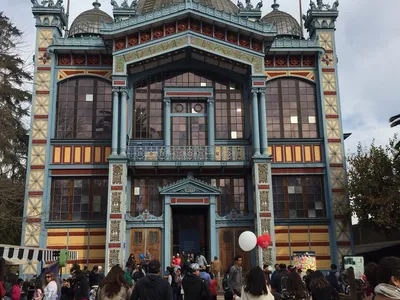
How Henri Picq's 1889 Paris Pavilion Traveled 11,000 Kilometers to Become Santiago's Artequín Museum
A prefabricated iron and glass pavilion built for the Paris Universal Exposition found a second life as a children's art museum in Chile.
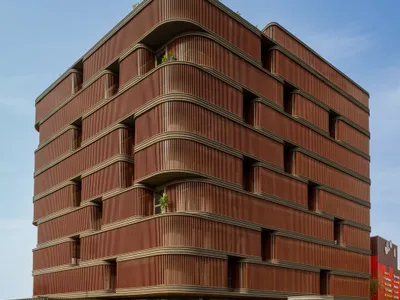
Sanjay Puri Architects Wraps a Jaipur Office Tower in Capsule-Shaped Green Buffers
A nine-level climate-responsive workplace near Jaipur Airport uses stacked planter terraces and aluminium screens to fight 40°C heat.


Explore Wood Construction Competitions
Discover active competitions in this discipline



Challenge to reimagine the Iron Throne


Photograph architecture without architects


Illustrate the lost glory of Angkor Wat - Render Challenge


Design challenge to reuse E-waste
Comments (0)
Please login or sign up to add comments
No comments yet. Be the first to comment!