
Pelletier de Fontenay Wraps a 1908 Quebec Stone House in Hemp and White Mineral Plaster
Sutton House unifies three construction eras into a single cohesive volume in Quebec's Eastern Townships through bio-sourced insulation and local stone.


Most renovation projects trade in the language of contrast: old against new, rough against smooth, dark against light. Pelletier de Fontenay refused that binary entirely at Sutton House, a 500 m² residence in Quebec's Eastern Townships that has been built, expanded, and rebuilt across three distinct construction periods starting in 1908. Rather than announcing each intervention, the architects developed a single material vocabulary, a white mineral skin made from lime and cement coatings, that wraps original stone, mid-century additions, and new extensions into one continuous reading. The result is a house that looks timeless rather than layered, unified rather than collaged.
What makes the project worth studying isn't the aesthetic trick alone. It is the passive climate strategy embedded in what might initially appear to be a straightforward plaster renovation. Heavy stone walls insulated from the inside with hemp, south-facing glazing calibrated for winter solar gain, radiant stone floors that store heat, restored fireplaces functioning as masonry heat sinks, and a high-efficiency heat recovery system all work together behind the calm white surfaces. Sutton House demonstrates that deep energy retrofits don't have to look like technology showcases. They can look like manor houses on a hillside.
Three Eras, One Skin
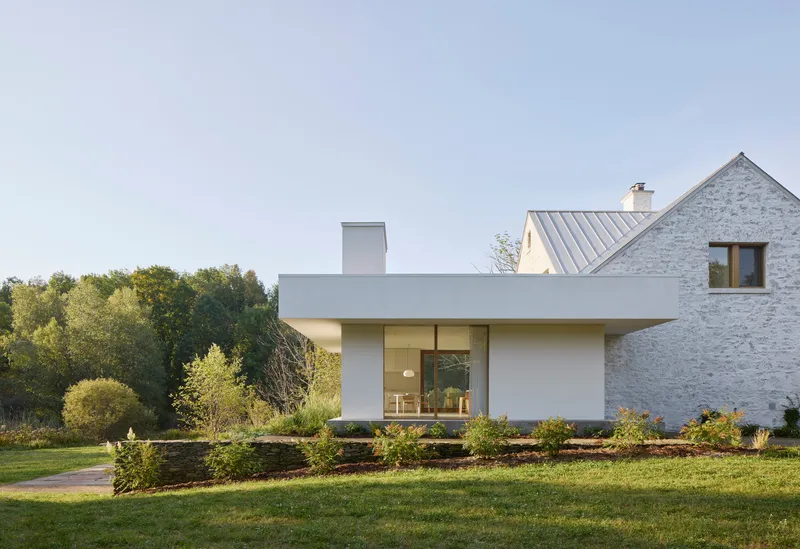
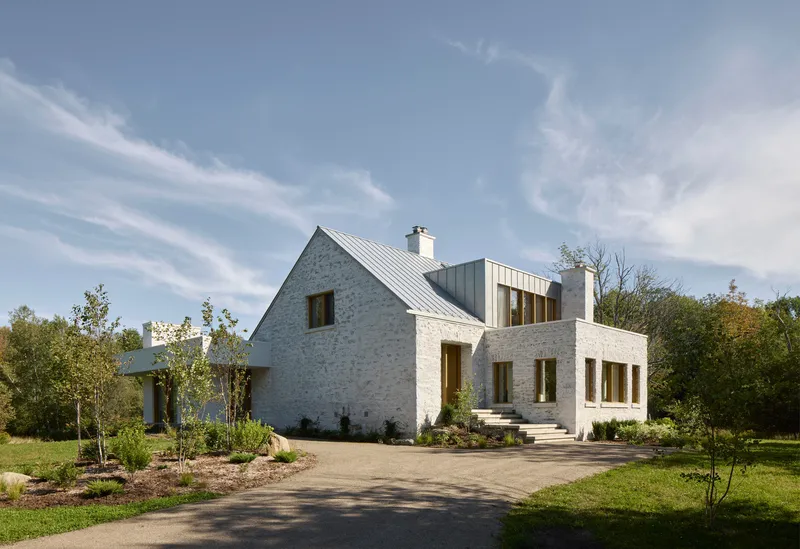
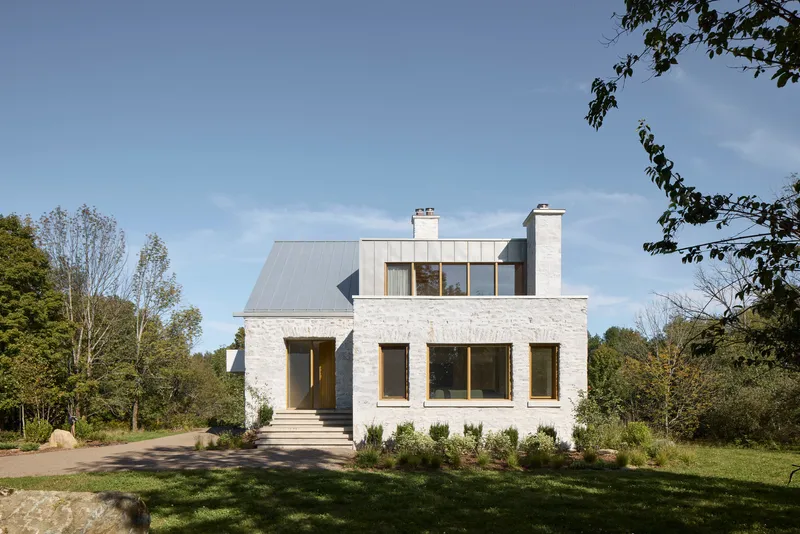
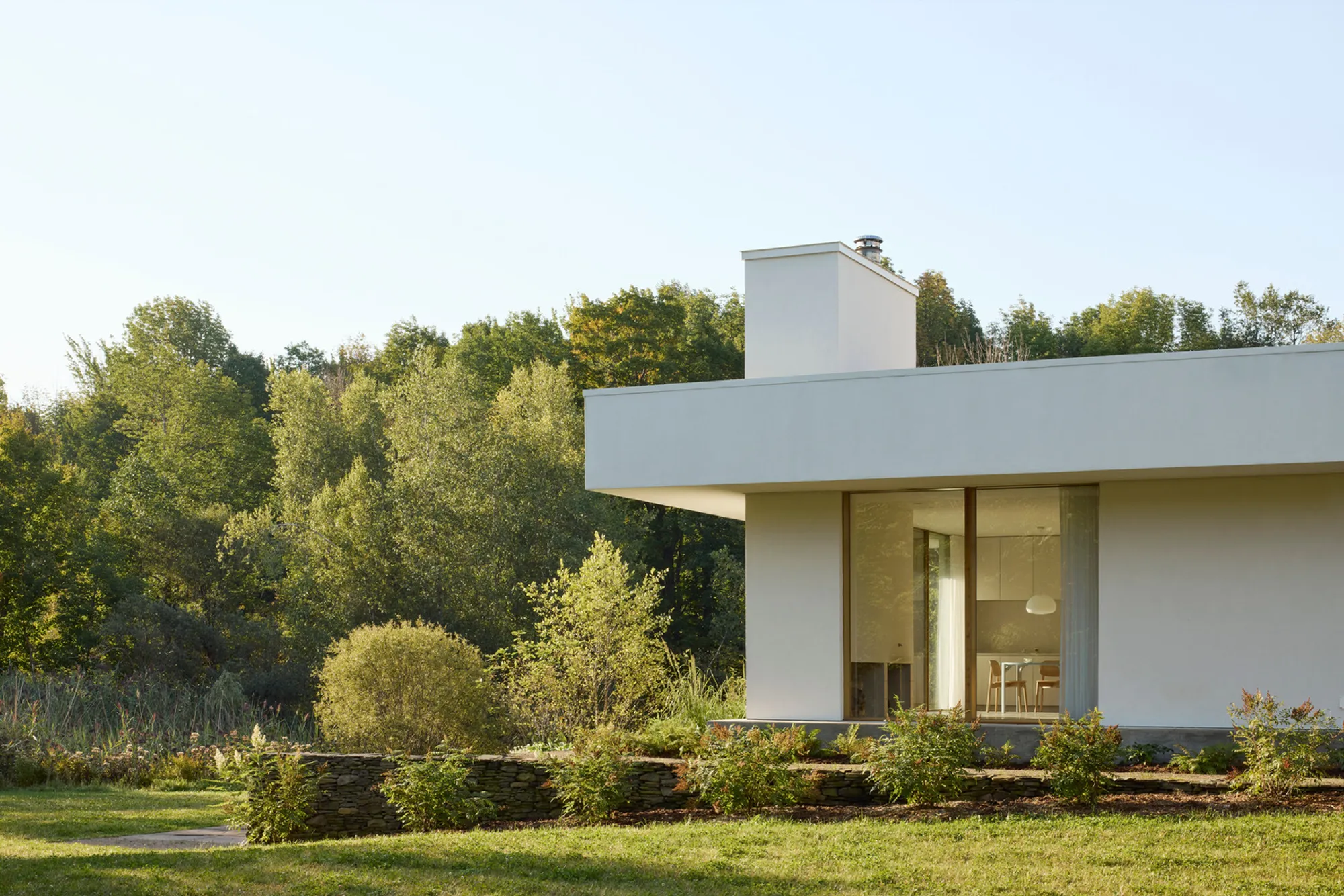
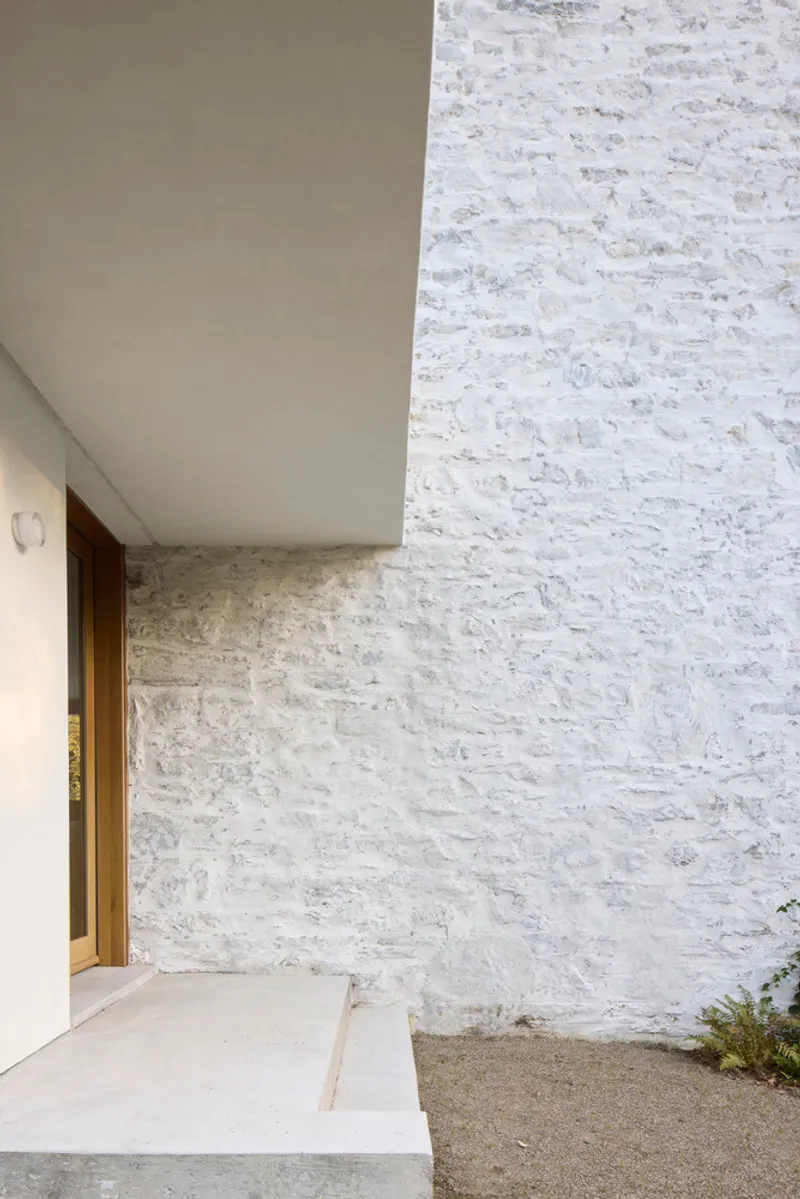
The original 1908 stone house had the proportions of a small manor, with oversized chimneys, thick walls, and a steep gable. A 1950s expansion added volume but muddled the architectural identity. Pelletier de Fontenay's new ground-floor extension, with its deep walls and cantilevered roof, echoes the original structure's heavy, grounded character while pushing the living spaces outward toward the landscape. Custom white cementitious coatings, developed with local artisans, cover every surface. The finish is mineral-based and breathable, allowing the façade to patina with the seasons: sharp white against summer foliage, near-invisible against Quebec snow.
The strategy is deliberately ambiguous. You know the gabled portion is older and the flat-roofed extension is new, but the shared material language makes it hard to say exactly where one ends and the other begins. That ambiguity is the point. The architects describe the approach as drawing on the original house's architectural language rather than contrasting or mimicking it.
Thresholds and Terraces
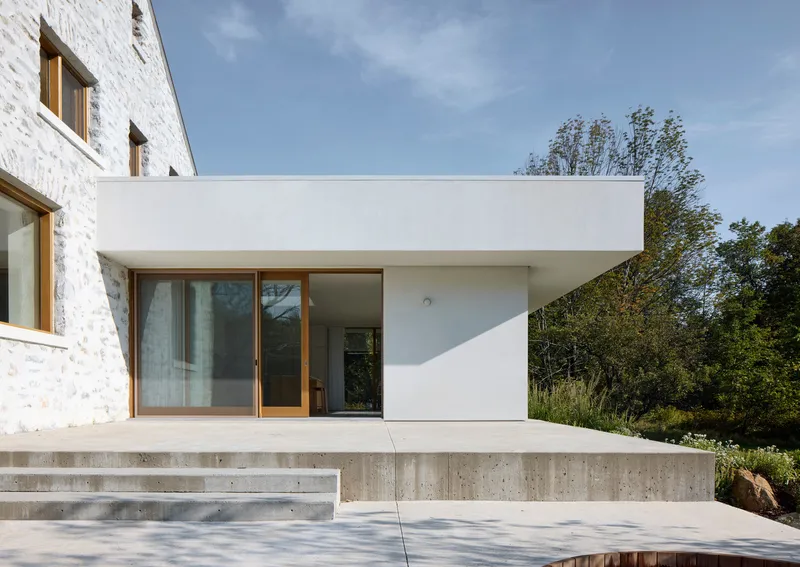
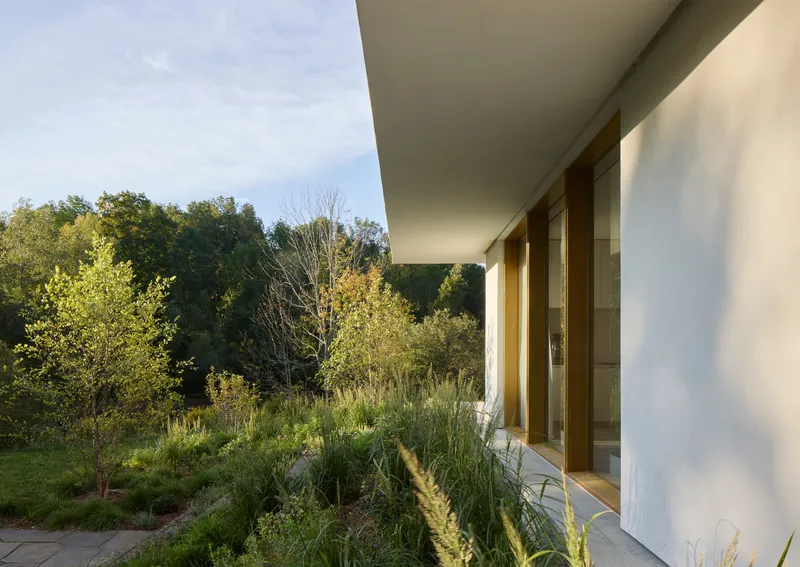
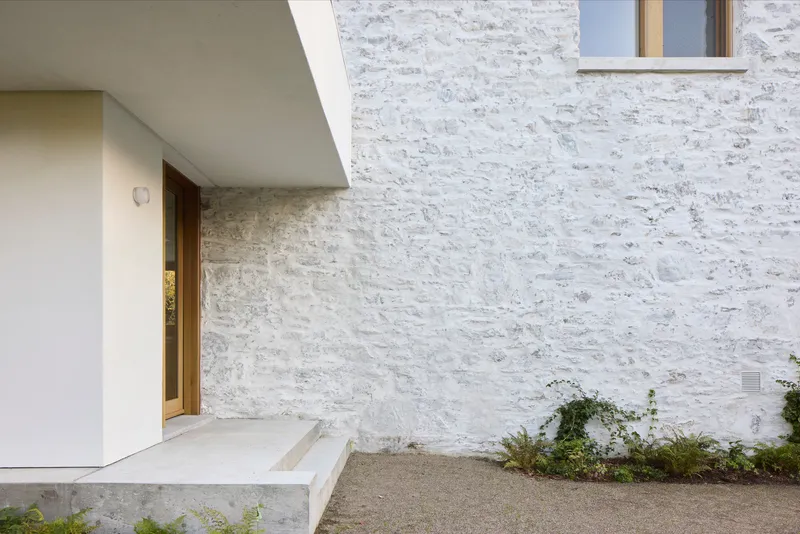
Sutton House refuses to end at its walls. The cantilevered roof creates a covered terrace that reads as an outdoor room, framing views of the planted meadow and distant tree line. Sliding glass doors dissolve the boundary between kitchen and garden, while a recessed timber entrance beneath a concrete canopy compresses the threshold experience before the interior opens up. The landscape design, by Friche Atelier, extends this logic: corten steel terraced planters, local flagstones, and fieldstones unearthed during excavation create a gentle berm that settles the house into its site rather than perching it above.
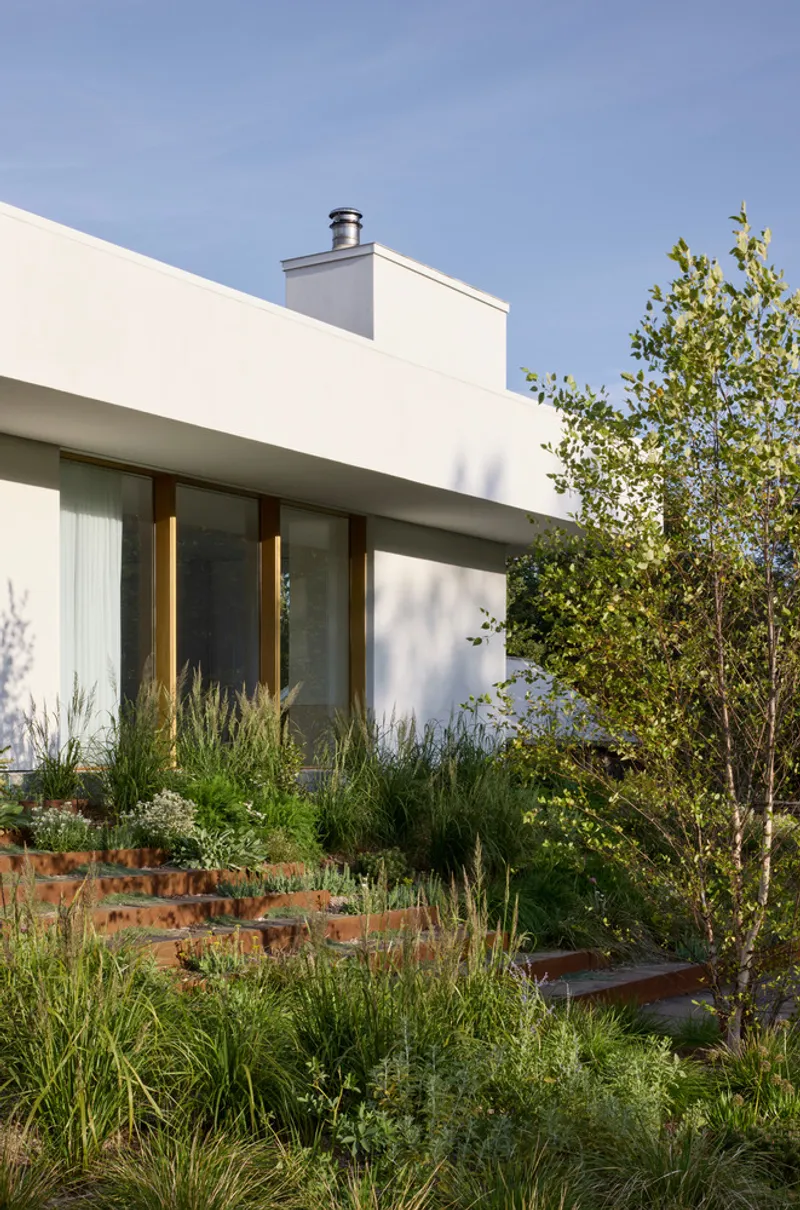
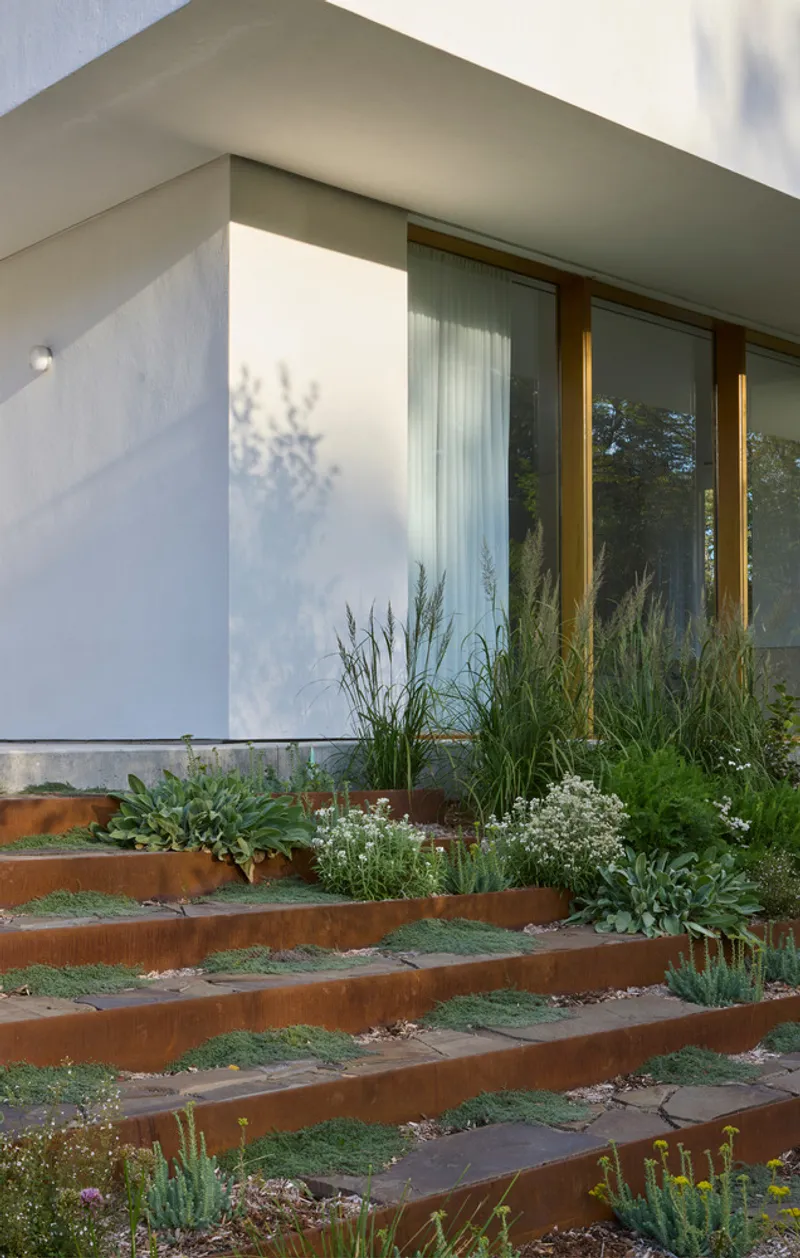
The berm strategy is pragmatic as much as aesthetic. By minimizing excavation depth, the architects reduced the amount of exposed exterior wall in the basement, limiting heat loss. The terraced landscape simultaneously manages drainage, creates planting beds, and establishes a gradient between the cultivated garden and the wilder meadow beyond.
Material Honesty from Kitchen to Corridor
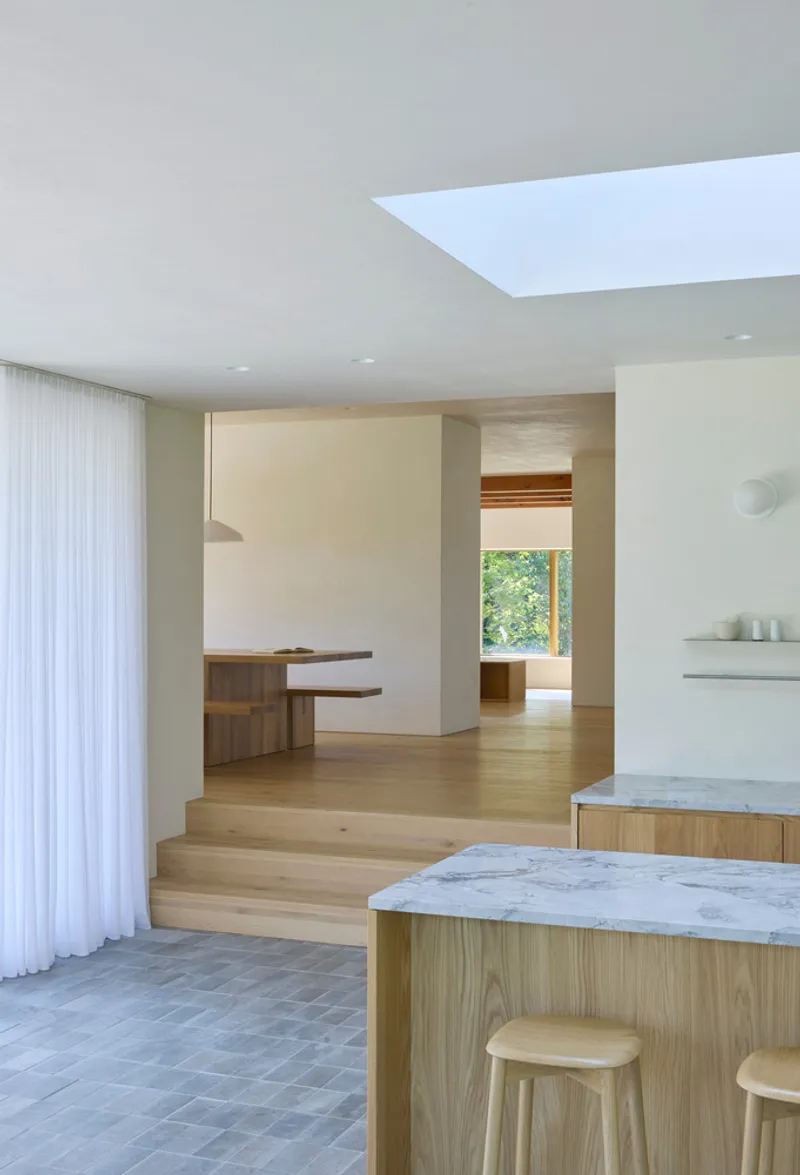
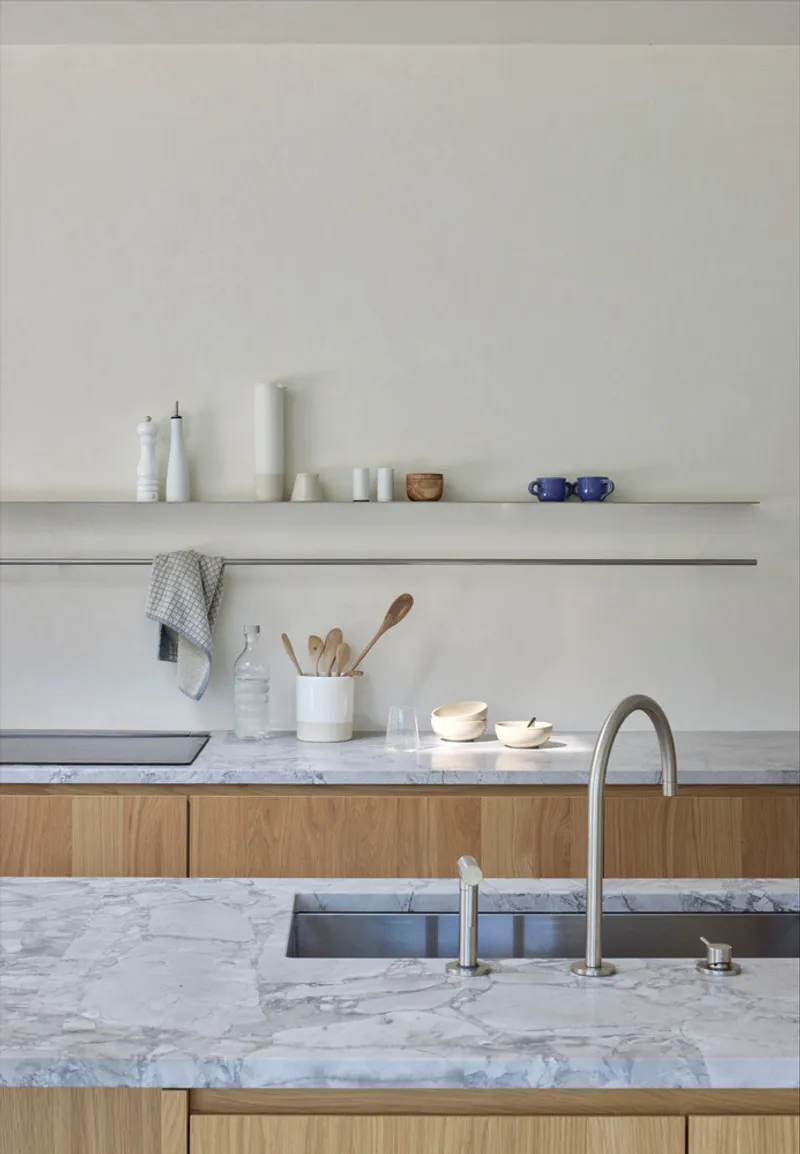
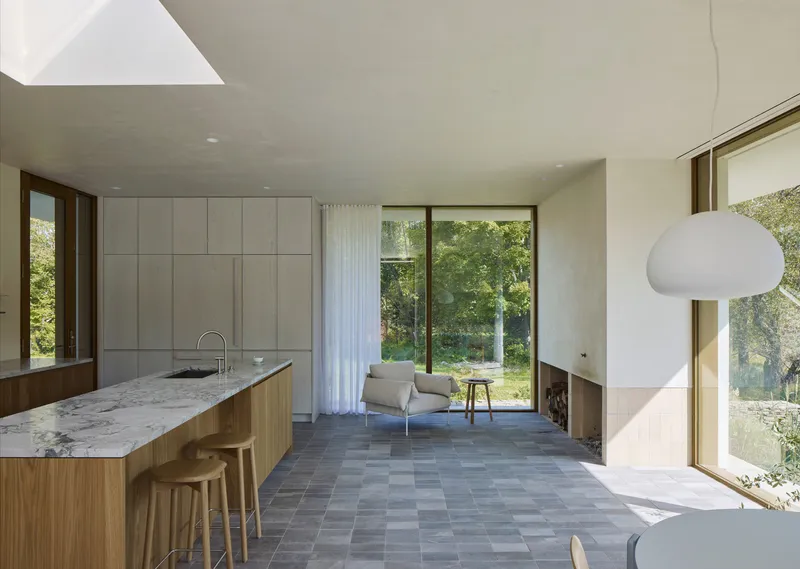
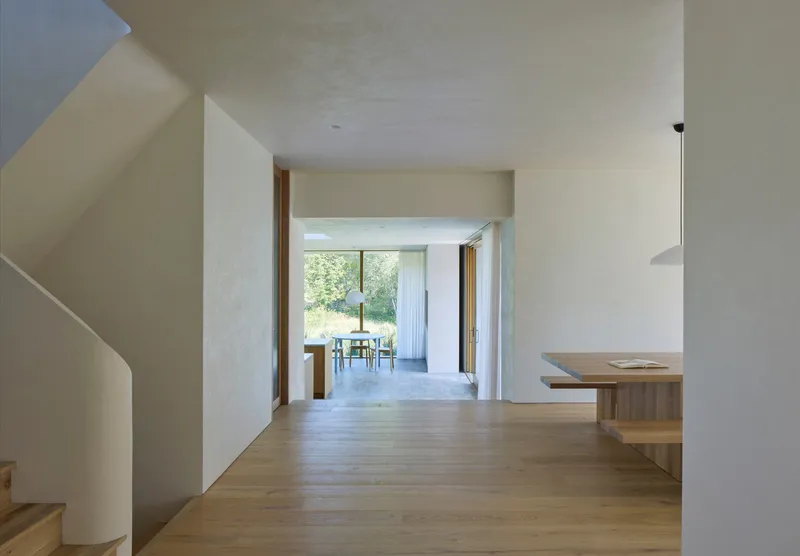
Inside, the palette is restrained but not austere. St-Marc limestone floors run throughout the ground level, chosen for their thermal mass as much as their appearance: they absorb solar energy through the south-facing glazing and release it slowly as temperatures drop. Marble-topped kitchen islands sit on oak veneer bases, and twin floating shelves keep the space open. A linear skylight above the kitchen counter pulls daylight deep into the plan, reducing reliance on artificial lighting during the day.
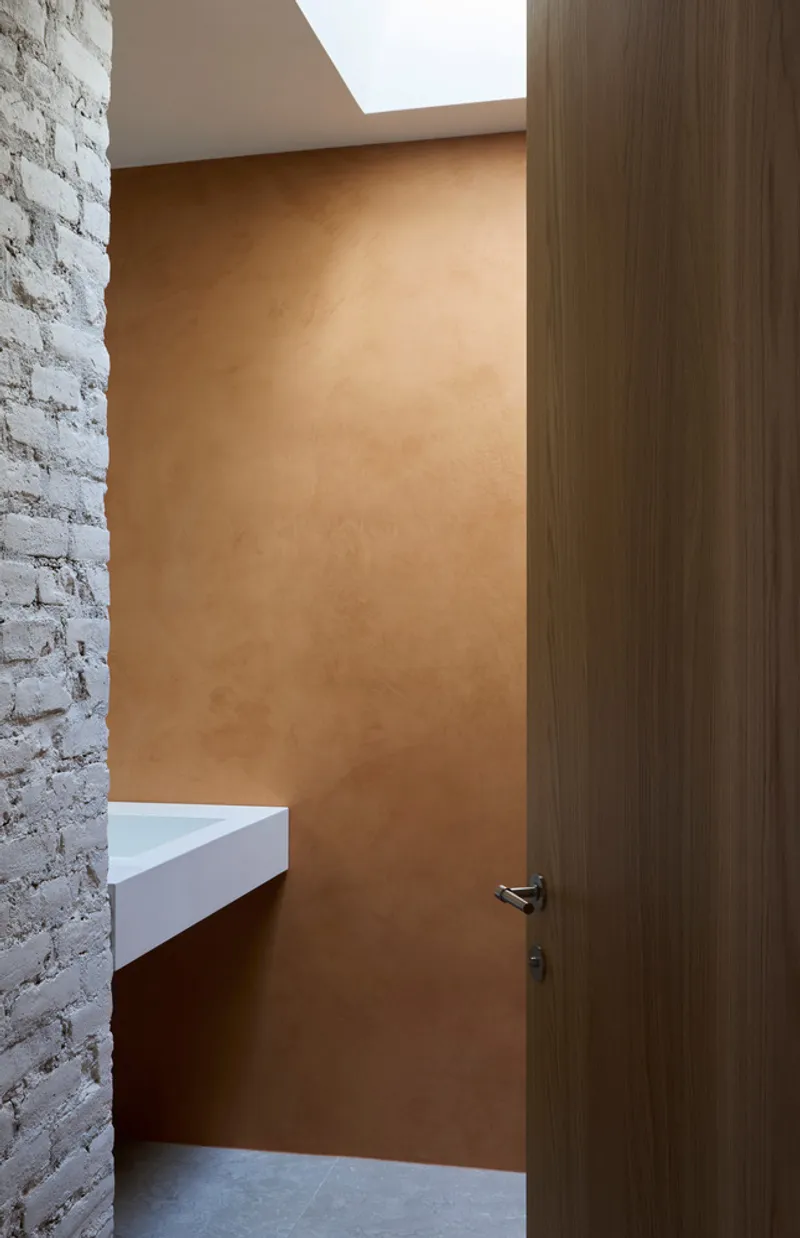
Natural lime plaster on the interior walls serves a double function. It maintains the monolithic appearance of the original stone construction (the hemp insulation is layered on the inside, hidden behind the plaster) while creating a vapor-permeable assembly that lets the old masonry breathe. The architects worked with local masons to restore the original fireplaces, integrating them as functional heat sinks whose masonry cores absorb and slowly radiate warmth.
Timber, Light, and Vertical Circulation
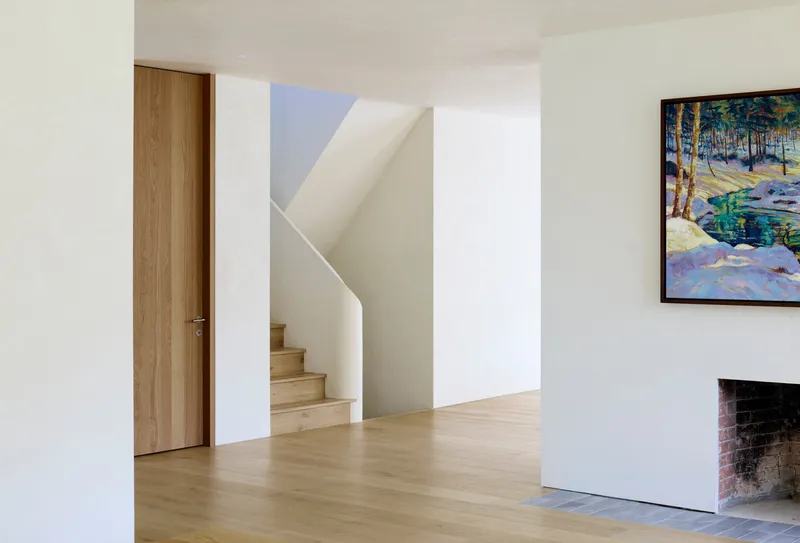
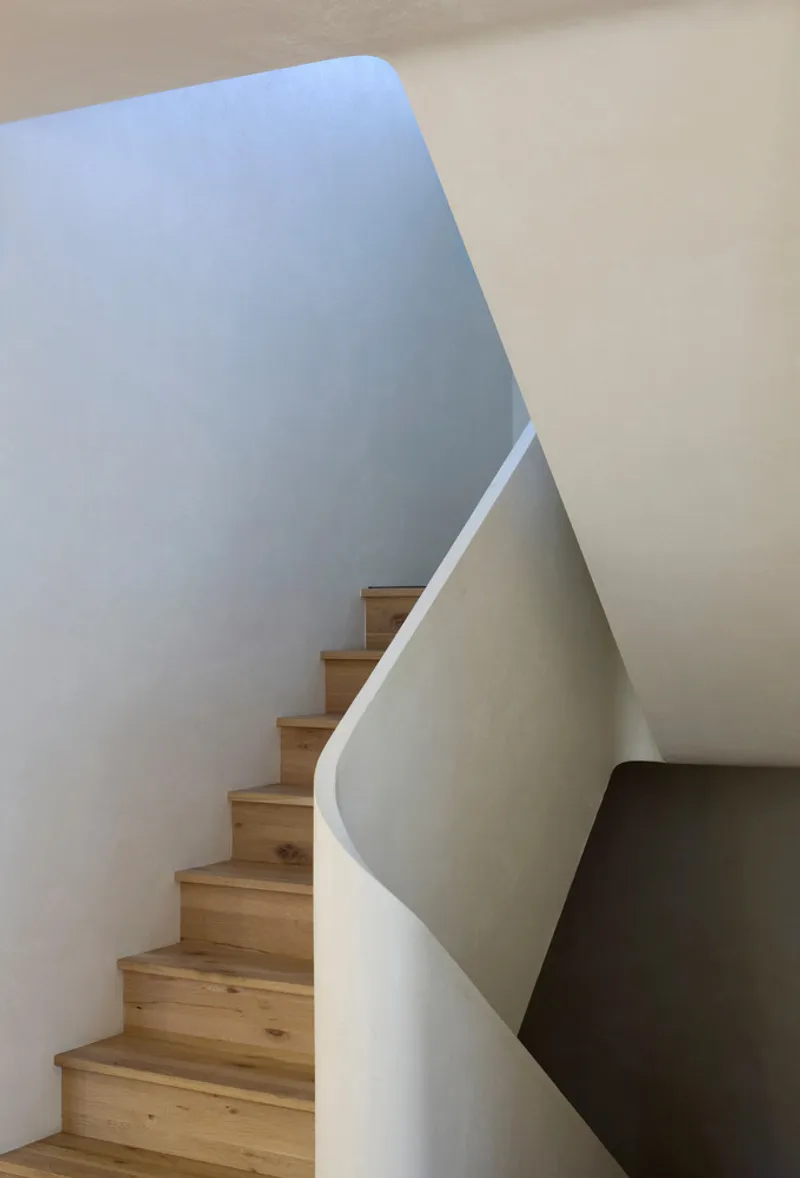
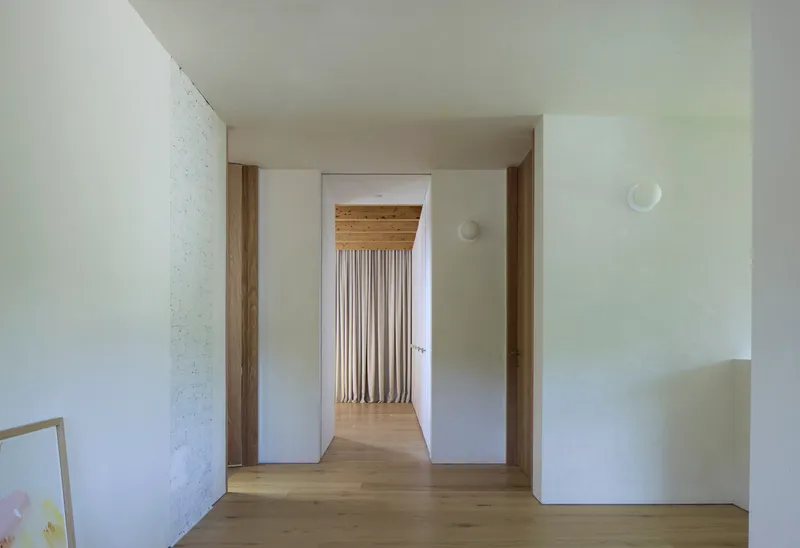
The staircase is the only moment where the architects allow a more expressive gesture. Ascending between curved white walls beneath a skylit opening that frames nothing but blue sky, it transforms vertical circulation into a moment of decompression. An angled opening beside an exposed brick fireplace on the ground floor hints at the stair's presence before you reach it, pulling you through the plan. Timber-framed doorways and oak flooring create a warm running thread through the otherwise mineral-dominant interiors.
Bedrooms as Pavilions
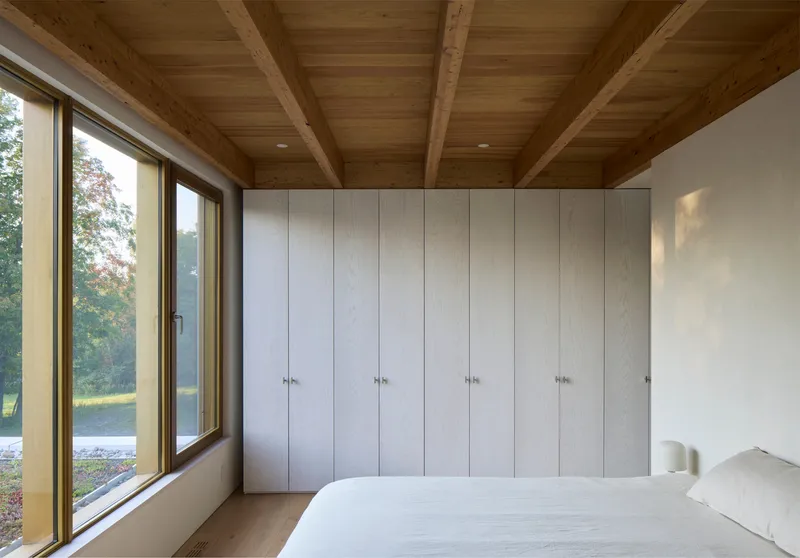
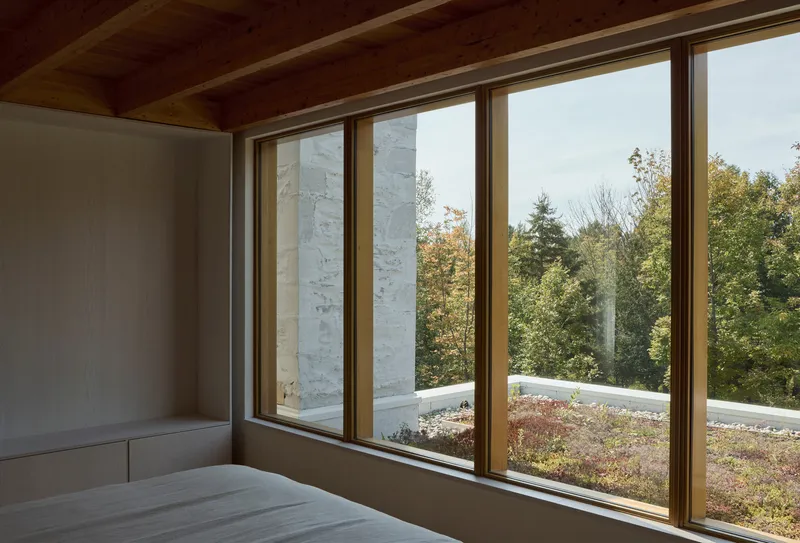
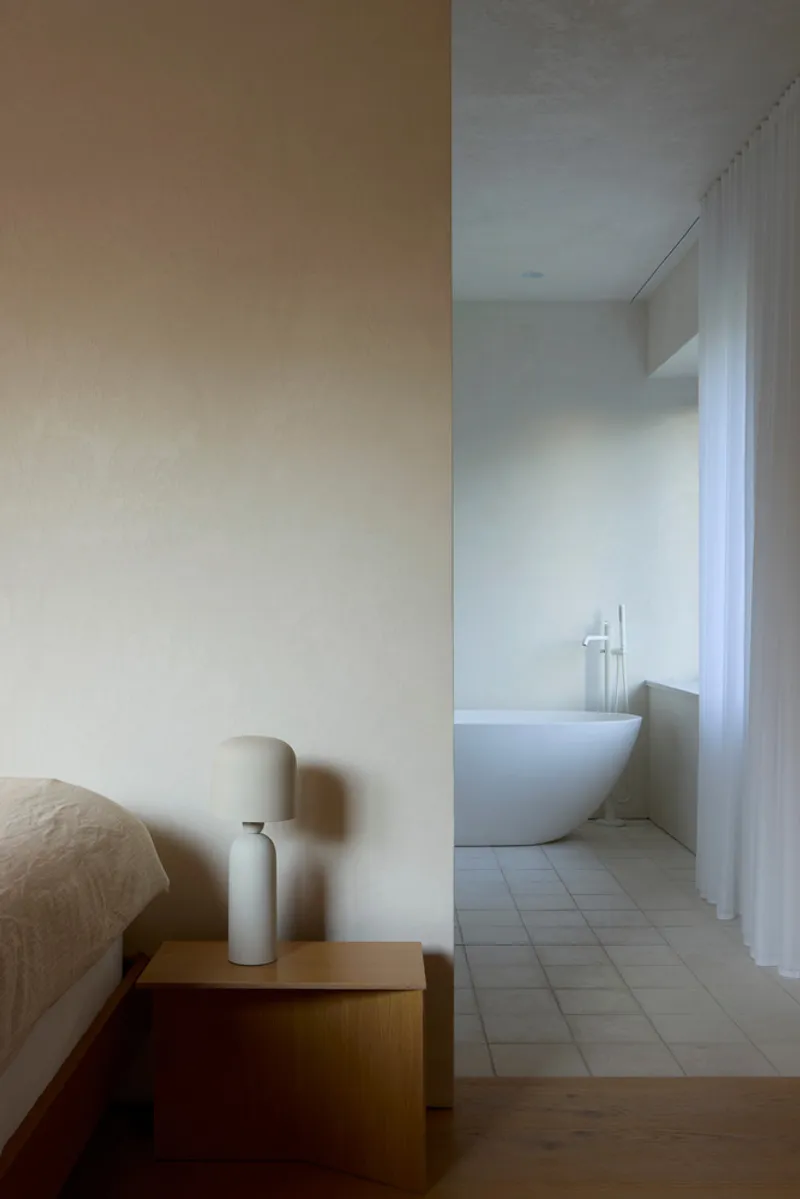
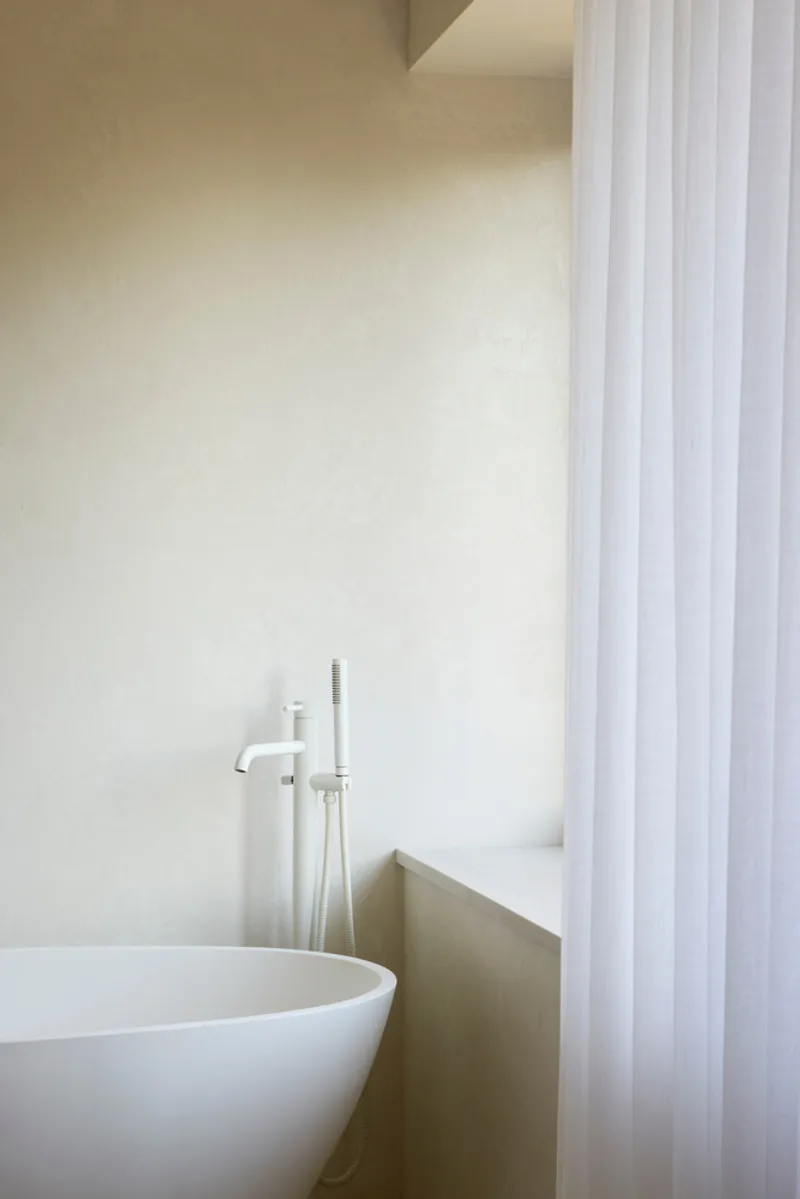
The upper-level bedrooms take full advantage of a fully glazed dormer and high-performance wood windows to create rooms that feel more like garden pavilions than attic retreats. Exposed timber ceiling joists run overhead, and light oak wardrobes line the walls. In one bedroom, a full-height window looks directly onto a planted roof and the woodland edge beyond, collapsing the distance between sleep and landscape. A doorway from the master bedroom opens to an ensuite where a freestanding bathtub sits beneath clerestory light, screened by a sheer curtain that diffuses the glow.
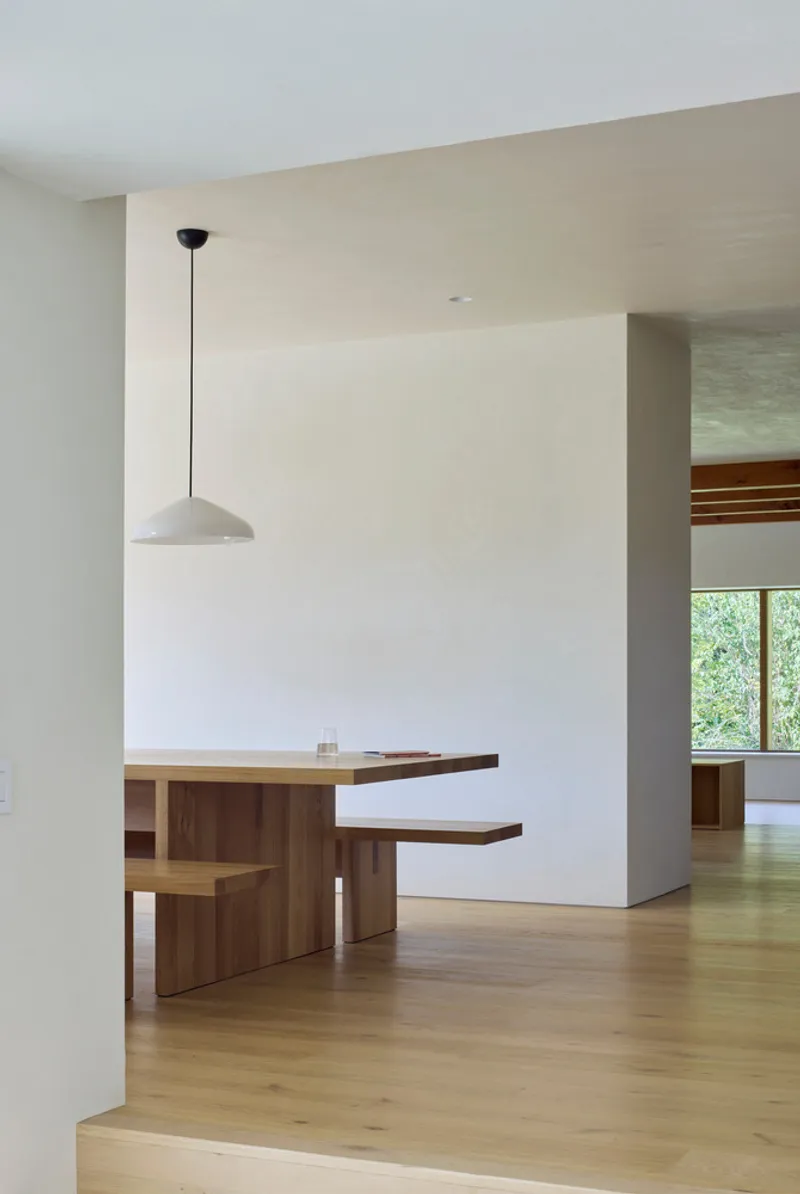
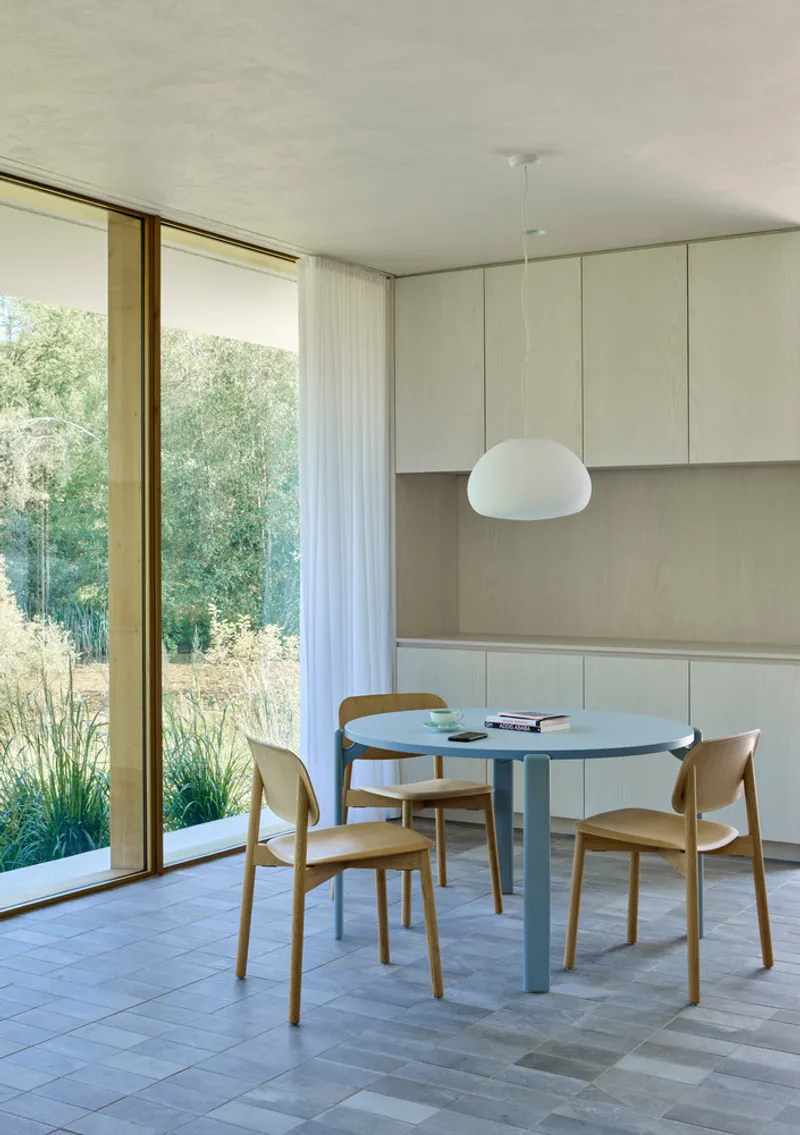
Throughout the upper level, the architects deploy color sparingly but with intent. Pale green cabinetry in a secondary dining area, an ochre plaster accent wall in a hallway, a blue round table catching light from floor-to-ceiling glazing: each instance reads as a considered intervention against the dominant white and timber backdrop. These are not decorating decisions. They are spatial markers that orient you within a house whose unified skin could otherwise make navigation disorienting.
Passive Strategy as Architecture
The passive climate strategy at Sutton House is not an add-on. It is inseparable from the architectural decisions. The stepped ground-floor configuration encourages stack-effect ventilation between levels. Deep stone walls and overhanging roofs reduce summer solar gain. South-facing windows, sized generously, harvest winter sunlight that the radiant limestone floors store and release. A high-efficiency heat recovery system captures warm air in winter and redistributes it, supplementing rather than replacing the passive systems.
Insulating with hemp from the inside was a consequential decision. It allowed the exterior stone walls to retain their monolithic, unclad appearance while achieving contemporary thermal performance. Hemp's breathability also means moisture can migrate through the wall assembly without condensation, a critical requirement for century-old masonry in a climate that swings between humid summers and brutal Quebec winters.
Plans and Drawings
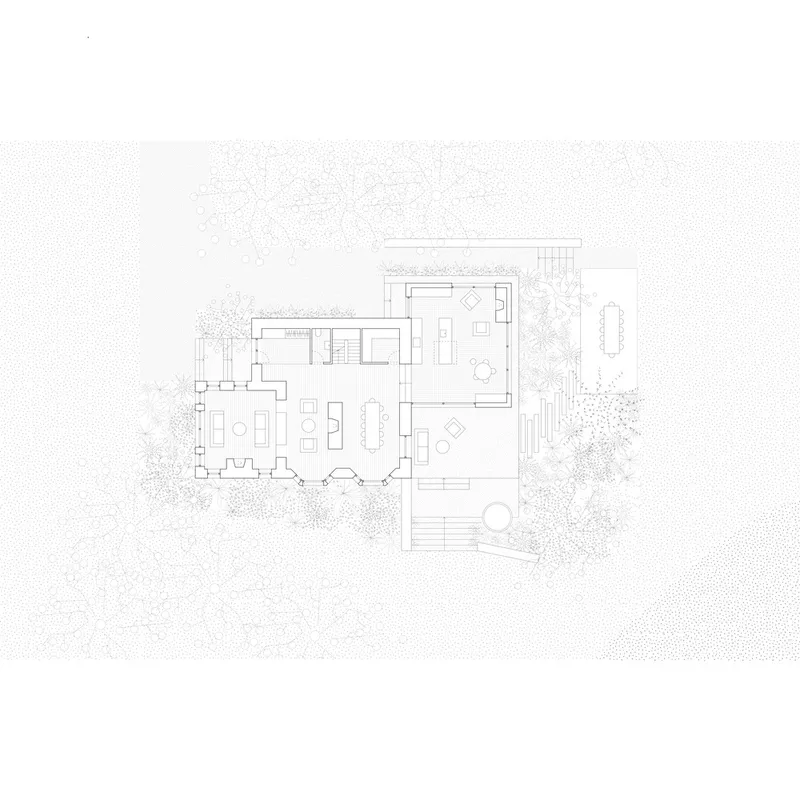
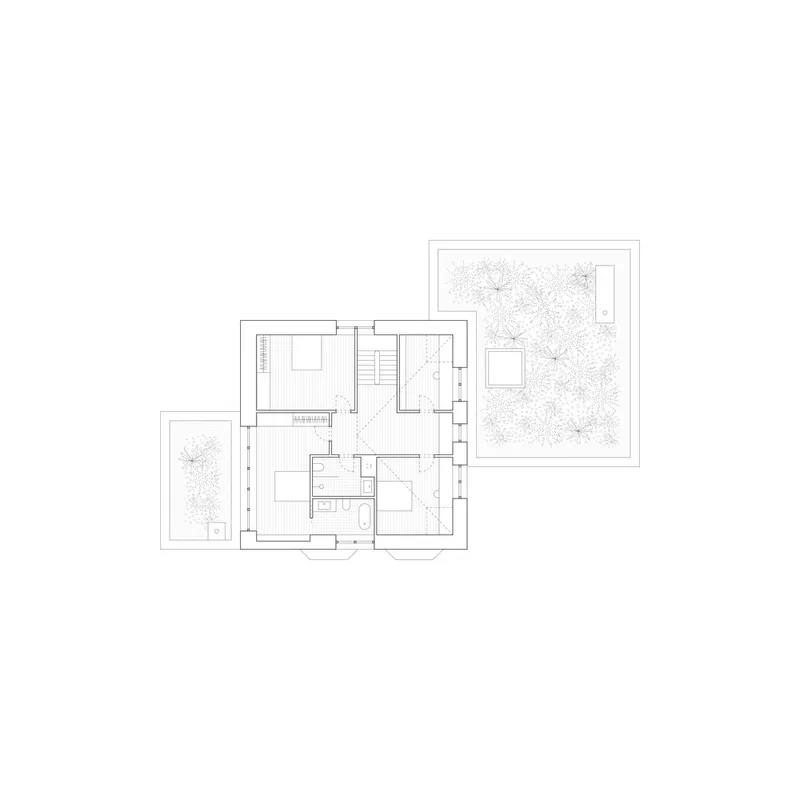
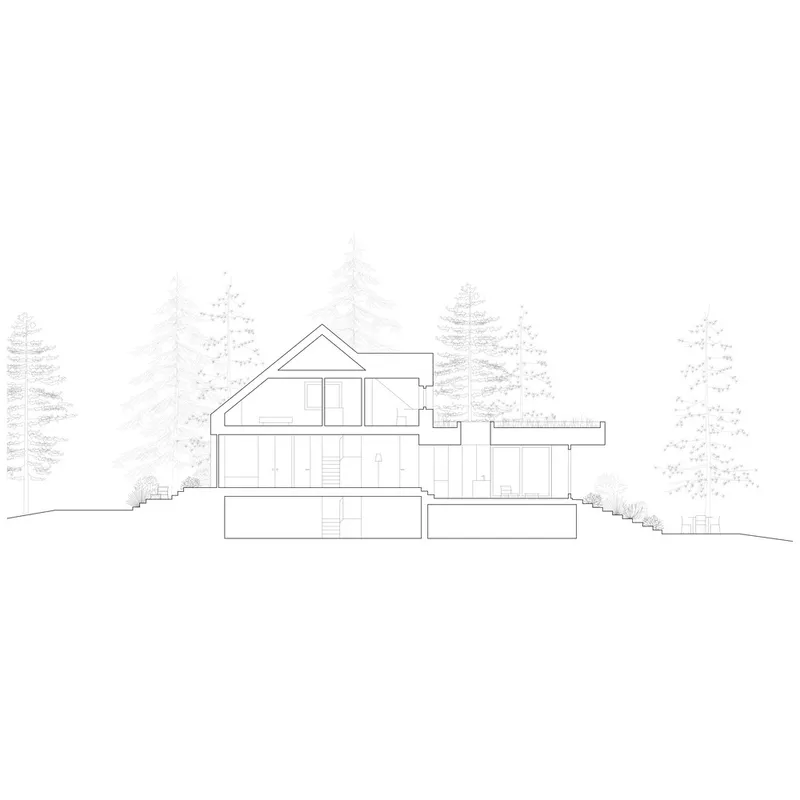
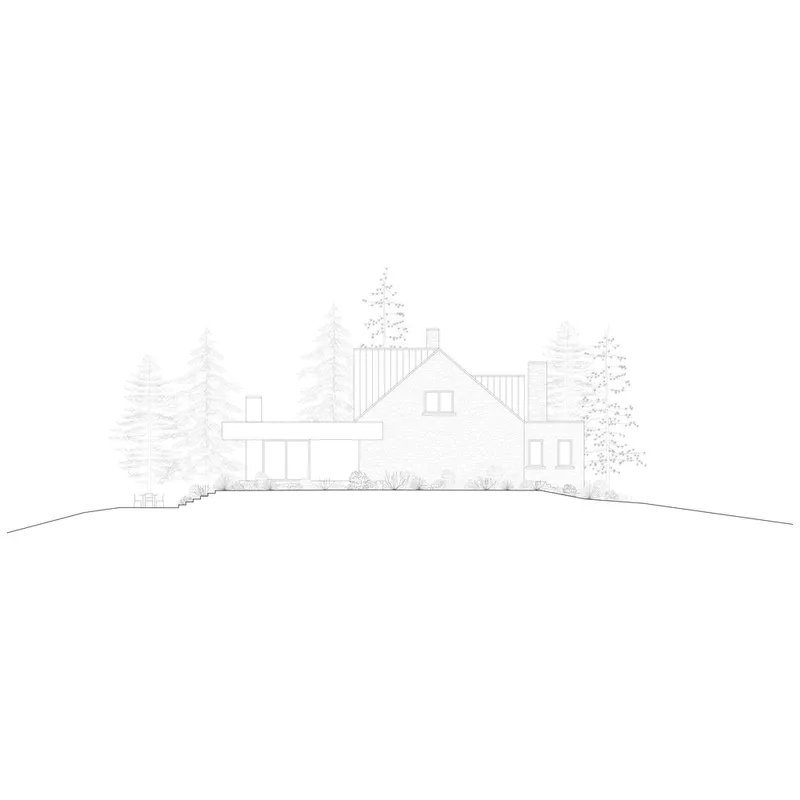
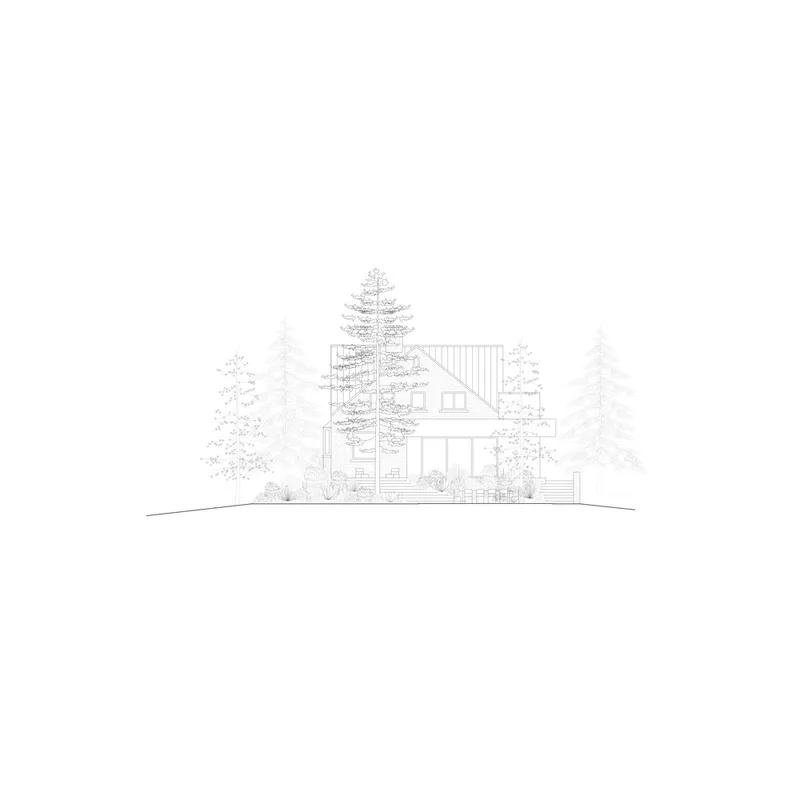
The ground-floor plan reveals how the three blocks of the new addition, containing storage and a fireplace, lock into the existing footprint while generating terraces on multiple sides. The upper-level plan shows bedrooms arranged around a planted courtyard, an unexpected move that brings daylight and ventilation into the center of the plan. The section drawing is perhaps most instructive: you can read the sunken basement, the stepped ground floor, the cantilevered roof, and the fully glazed dormer as a single continuous section that negotiates the slope of the site. The elevations confirm that the gabled volume and the new rectilinear extensions share a proportional discipline, with window openings and roof lines calibrated to read as variations on a theme rather than competing statements.
Why This Project Matters
Sutton House is a counterargument to the idea that sustainable renovation must look like sustainable renovation. There are no visible solar panels in these images, no exposed insulation details celebrating their own greenness, no didactic material samples on display. Instead, the project embeds its environmental performance within an architectural language that prioritizes coherence and material warmth. Hemp insulation, radiant stone floors, restored masonry heat sinks, and passive solar strategies all disappear into a house that simply feels right to inhabit.
More broadly, the project offers a model for how to handle buildings that have accumulated interventions over decades. Rather than privileging one era and treating others as damage, Pelletier de Fontenay treats the full timeline as raw material for a new whole. The white mineral coating is both a literal and conceptual unifier: it covers the seams, yes, but it also asserts that a building's identity can be defined by its present ambitions rather than its layered history. In a discipline that too often fetishizes either preservation or novelty, that is a genuinely useful position.
Sutton House by Pelletier de Fontenay. Eastern Townships, Quebec, Canada. 500 m². 2024. Landscape design by Friche Atelier. Photography by James Brittain.
About the Studio
Share Your Own Work on uni.xyz
If projects like this are the kind of work you want to make, uni.xyz is a place to publish your own, find collaborators, and enter design competitions.




Popular Articles
Popular articles from the community


Play: Fragments of Their World
Familiar architecture becomes modular playground design, creating safe spaces where displaced children can learn, connect, imagine and play.

The Ocean Hive: Sustainable Architecture for a Self-Sufficient Civilization at Sea
The Ocean Hive imagines sustainable architecture at sea, where modular habitats, algae, wave power and ocean waste sustain a growing colony.

Hill & Cross Opera: Sculptural Opera House Architecture Shaped by Tallinn’s Landscape and Identity
Hill & Cross Opera reimagines opera house architecture in Tallinn through its sculptural hill, civic plaza, glass wave and a luminous cross.

The Musturak Paradise: Senior Living Architecture for a Connected Future in Temara, Morocco
The Musturak Paradise reimagines senior living architecture in Temara via private homes, social spaces, culture, community, and shared care.

Similar Reads
You might also enjoy these articles


Hodi-Mandai Geram
Project Function: Preservation and revitalization of the Intangible heritage and socio-spatial identity of the Hodi by Housing, Cultural Memory Center, Sacred Grove, landscape, local tourism economy


Olio Towers: A Mid-Rise for Performers That Fuses Housing, Rehearsal, and Stage
Located blocks from Houston's Theater District, this modular tower stacks living units around a central performance atrium.

Oasis: Modular Green Housing Carved into Dhaka's Urban Fabric
A shortlisted Plugin Housing entry reclaims unauthorized settlements in Dhaka with stepped concrete volumes, green roofs, and ventilation-driven design.

Black Hole: A Floating Megastructure for the Post-Physical Era
Emiliano Mazzarotto envisions a spherical, self-scaling arena where e-sports, digital hotels, and holographic stadiums replace traditional public space.
Explore Architecture Competitions
Discover active competitions in this discipline



Challenge to reimagine the Iron Throne


Photograph architecture without architects


Illustrate the lost glory of Angkor Wat - Render Challenge


Design challenge to reuse E-waste
Comments (0)
Please login or sign up to add comments
No comments yet. Be the first to comment!