
InOrder Studio Lines a Taichung Riverbank with Pigpen Grates and River Stones to Sell Apartments
A sales center on the Han River embankment in Taichung turns humble agricultural and industrial materials into a quietly luminous pavilion.


Sales centers in Taiwan are a genre unto themselves. They are temporary structures built to sell a lifestyle that doesn't yet exist, and most of them default to marble lobbies and LED-lit model rooms. InOrder Studio, led by architect Chingju Chen, took the opposite approach for the Sweeten Sales Center Grand Urban in Taichung's East District. The pavilion sits along the embankment of the Han River, and every material decision points back to that location: stones pulled from the nearby riverbank, industrial metal trusses borrowed from local factory construction, and translucent green plastic grates of the kind used in pigpens across the Taiwanese countryside.
What makes the project genuinely interesting is its refusal to dress these materials up. The river stones are not polished into feature walls; they are laid in rough fieldstone courses. The plastic grates are not backlit and treated as art objects; they function as spatial dividers that happen to filter light in unexpected ways. The metal trusses are left white and exposed, doing structural work while also organizing the ceiling plane. The result is a building that earns its atmosphere through material honesty rather than theatrical staging, and that manages to feel both casual and precisely considered.
Turning Away from the City
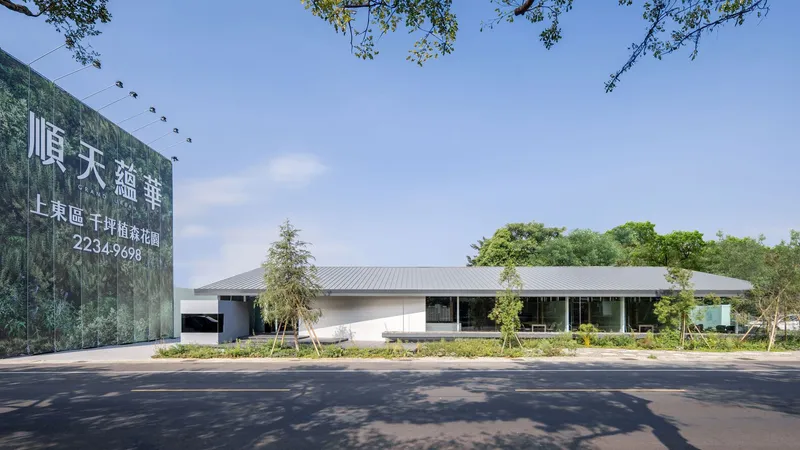
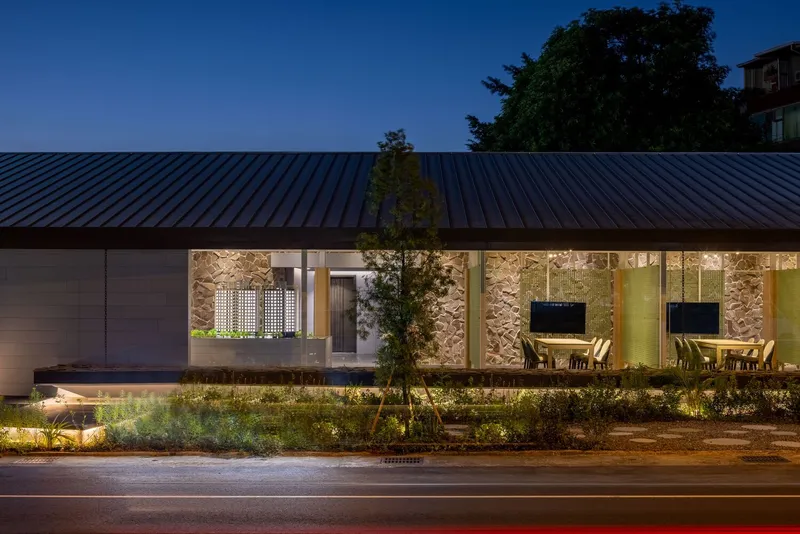
The building's most decisive gesture is its orientation. Rather than facing the street and competing with Taichung's urban density, the low-slung pavilion turns its back on the city and opens toward the Han River. From the street, what you see is a corrugated metal standing-seam roof, a rough stone wall, and a row of landscape beds under tree canopy. At dusk, the stone wall glows faintly from interior lighting, but the building never shouts. It reads as a wall, not a storefront.
This posture is deliberate and effective. It sets up the sequence that follows: you arrive expecting a commercial space and find something closer to a sheltered garden path. The architecture uses the river's presence as a psychological anchor, positioning calm and continuity against the transactional nature of property sales.
A Path of Stones
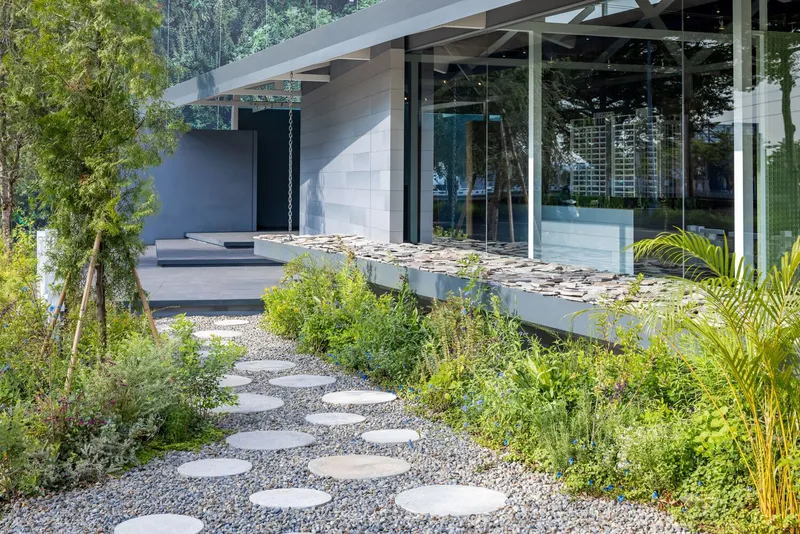
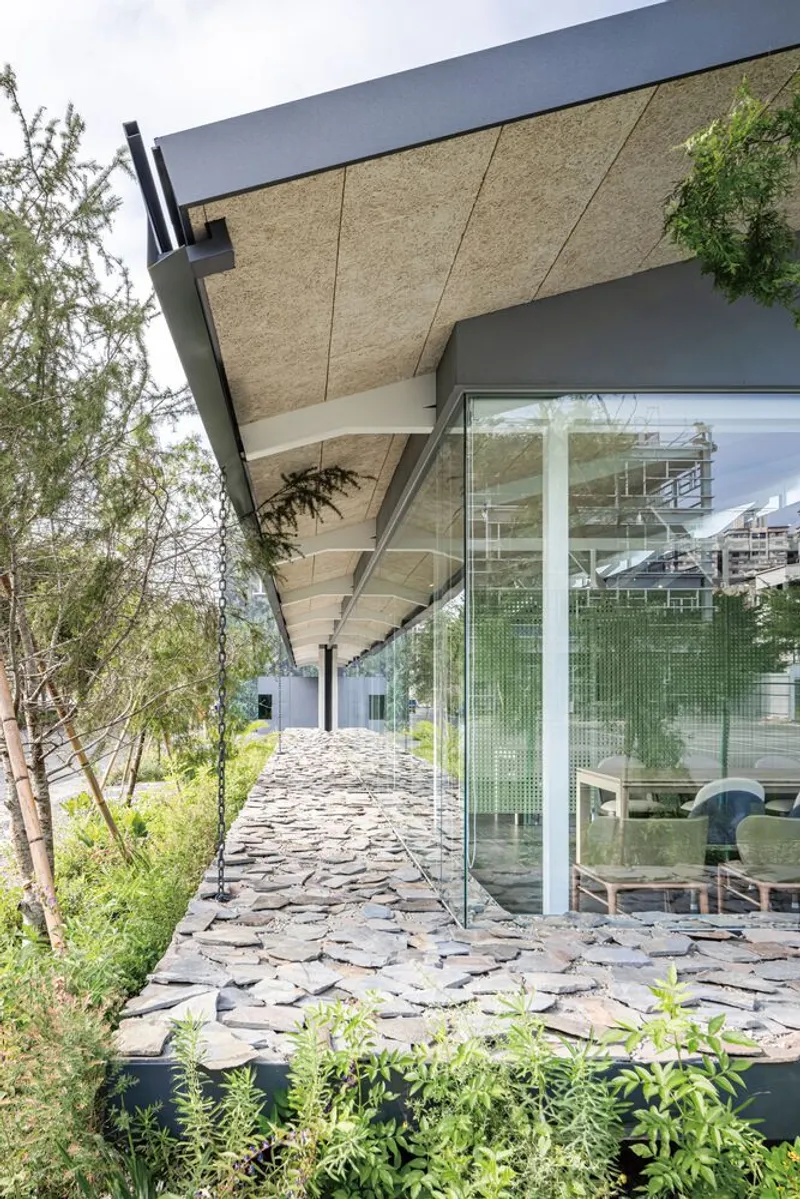
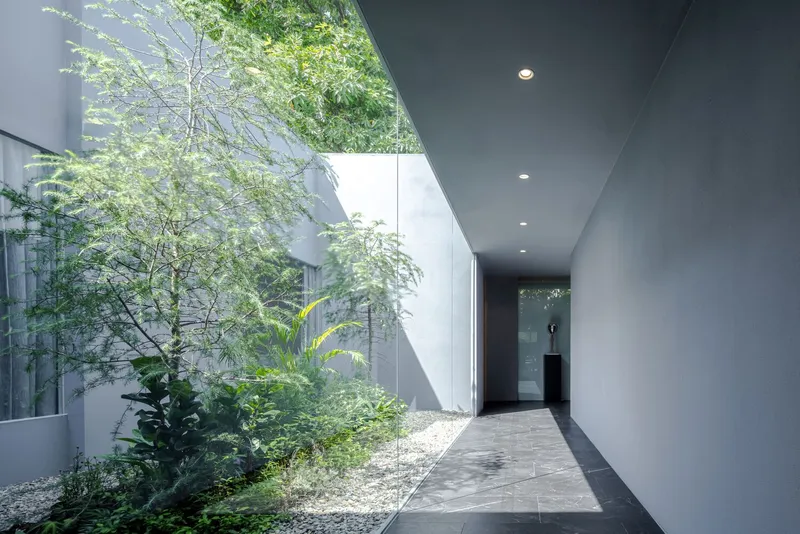
The arrival sequence is the project's strongest spatial move. Circular stepping stones set into gravel lead toward a glass-walled entrance flanked by a reflecting pool and planted palms. The threshold between exterior and interior is deliberately ambiguous. Stone pavers continue under covered walkways alongside planted courtyards, so the act of entering the building is extended into a slow, deliberate walk.
InOrder Studio uses this procession to collapse the distinction between landscape and architecture. The covered walkways feel like outdoor corridors, with planted beds visible through floor-to-ceiling glass on one side and a dark grey ceiling overhead. Stone slabs that begin in the front yard climb onto a raised platform and then continue inward to become wall cladding, creating a single material logic that runs from ground to enclosure.
Fieldstone and Timber Structure
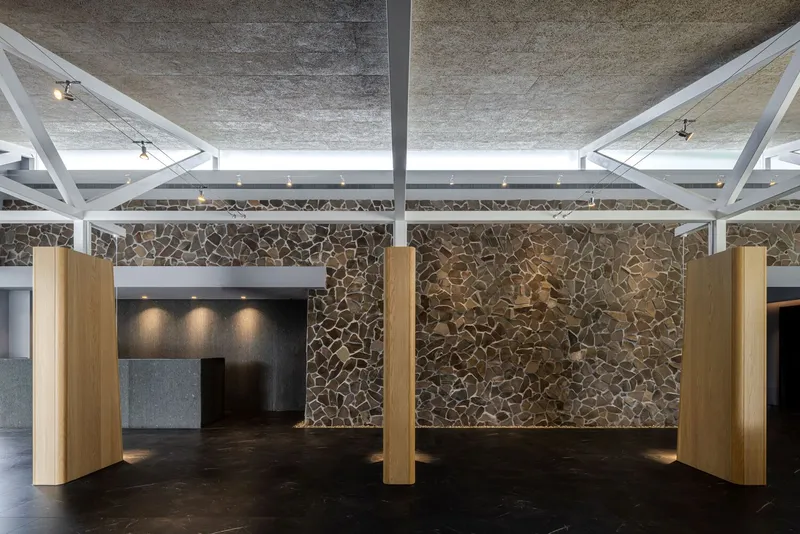
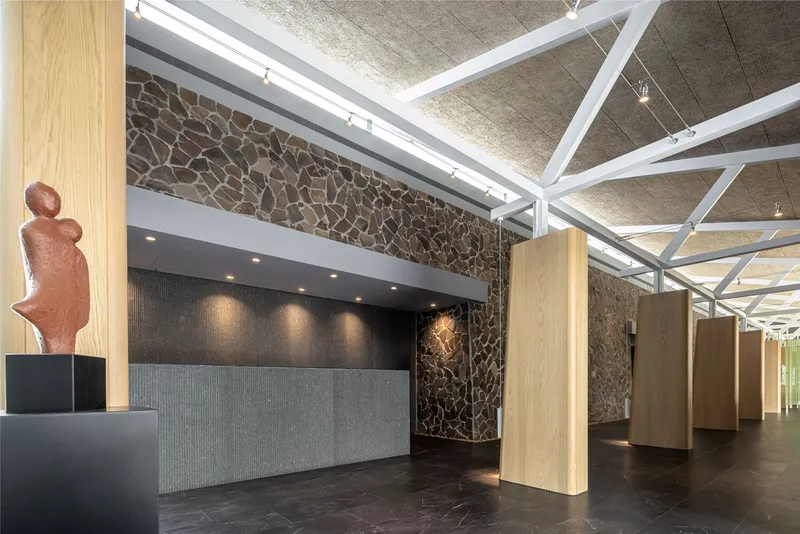
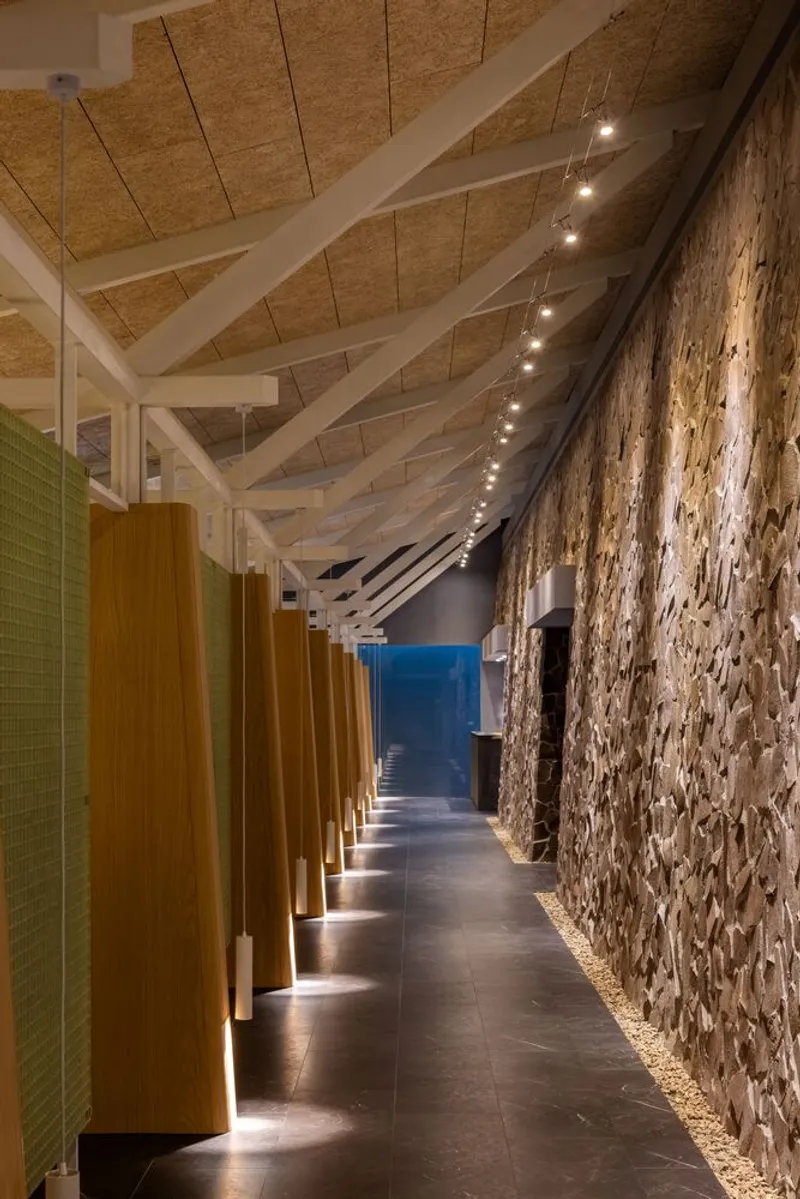
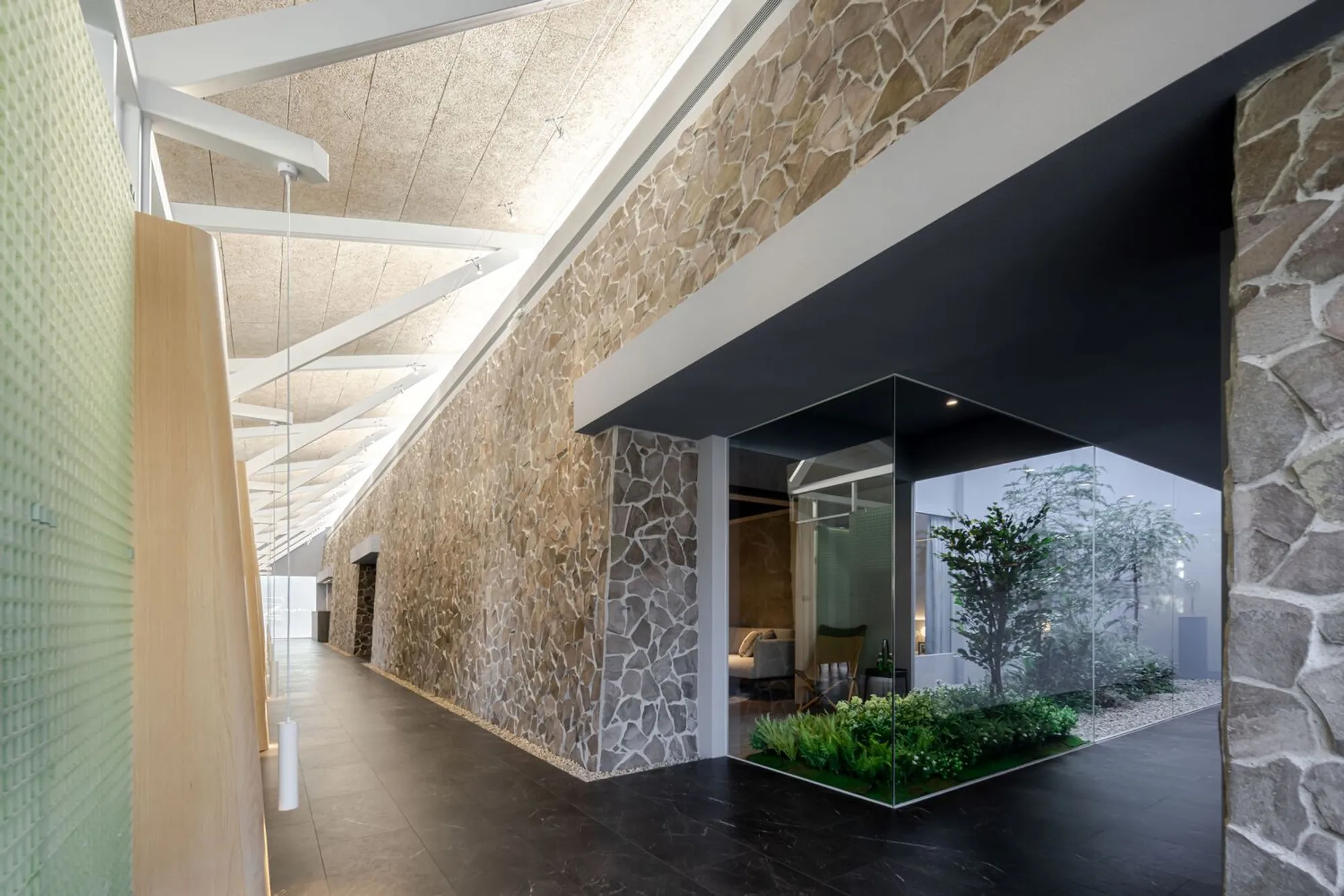
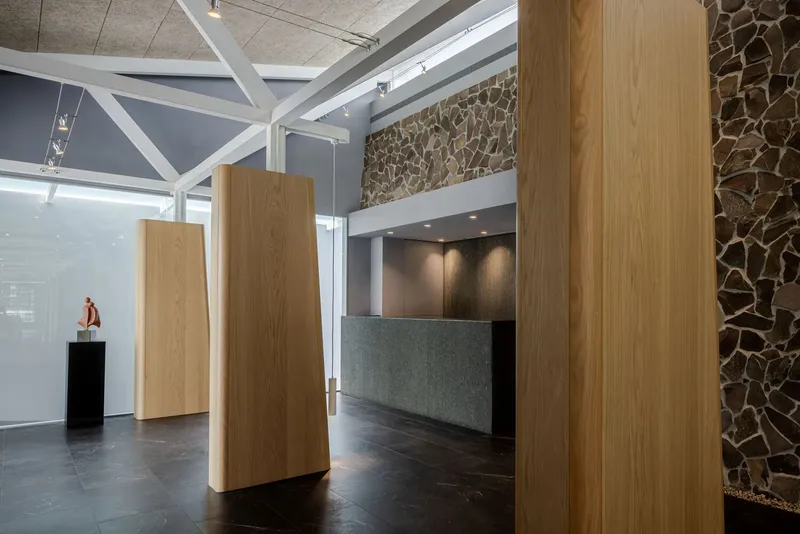
Inside the lobby, the fieldstone wall becomes the dominant surface, running in long horizontal bands that anchor the space. Cylindrical timber columns stand free of the walls, carrying the white-painted steel trusses above. The combination is straightforward but carefully proportioned: warm timber verticals, cool stone horizontals, and the geometric lattice of the trusses overhead. A terracotta sculpture sits on a plinth near the entry, the one decorative object in a space that otherwise lets materials speak for themselves.
The stone is worth lingering on. Sourced from the Han River's banks, it arrives with the color variation and irregular sizing of material that was never meant for cladding. InOrder Studio treats it as a found condition, stacking it in courses that reveal mortar joints and surface texture. Against the precise geometry of the trusses, the stone reads as geological rather than architectural, grounding the building in its specific site.
Green Grates as Light Filters
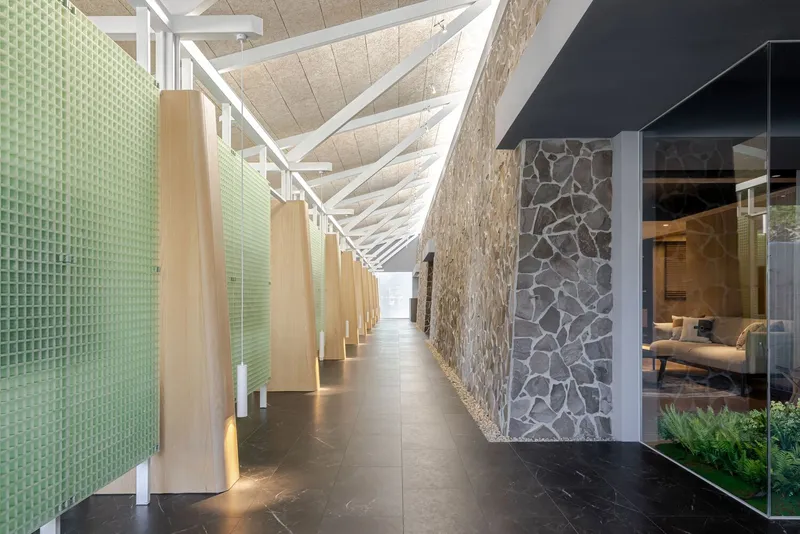
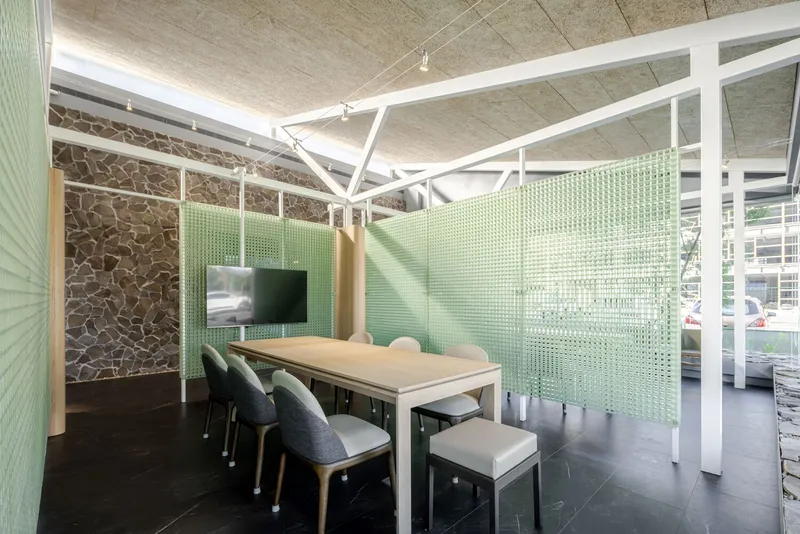
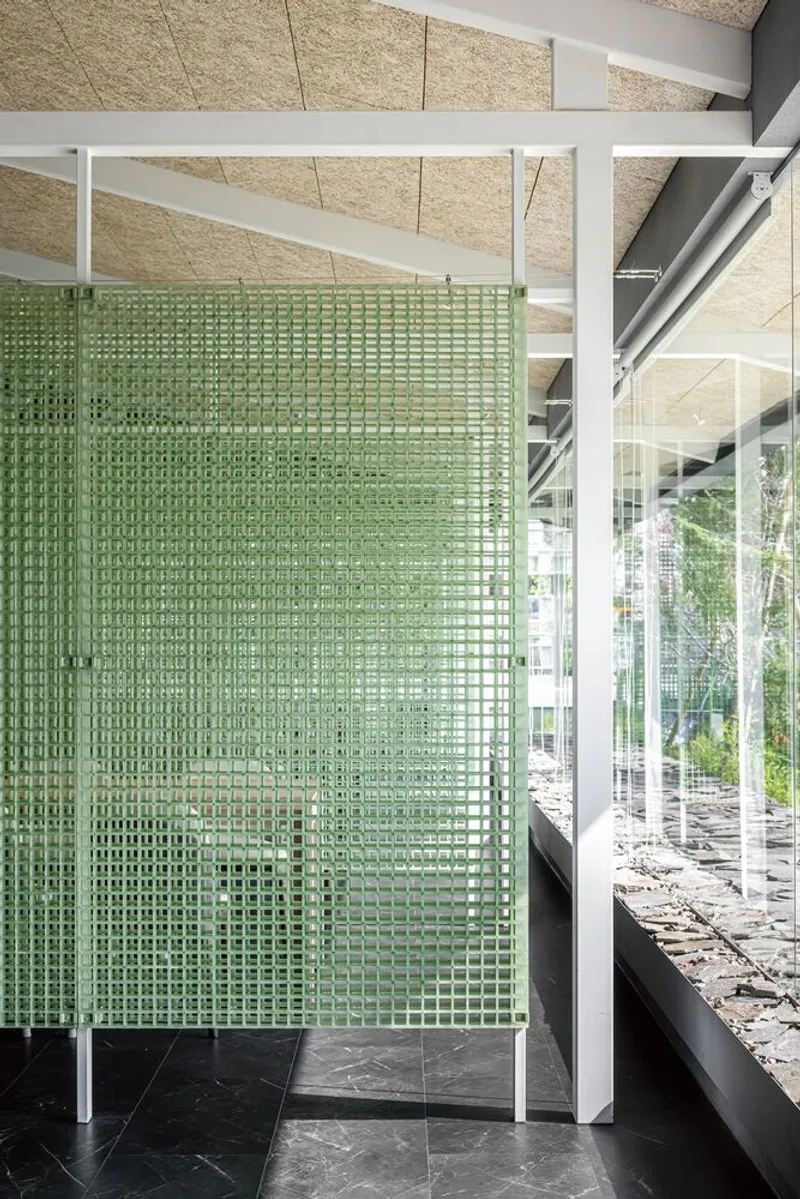
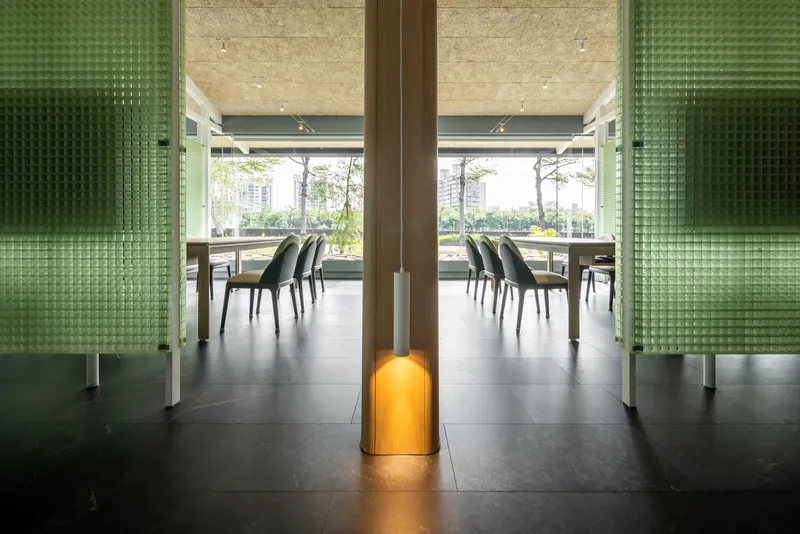
The translucent green glass block partitions (built from the same plastic grate material used in agricultural settings) are the project's most provocative detail. Framed in white steel, they divide meeting rooms and corridors while allowing diffused light to pass through. The material is thick enough to obscure figures on the other side but thin enough to register movement and color, creating a layered visual field that shifts with the angle of view.
In a meeting room, these screens wrap three sides of the space, filtering daylight into a green-tinged glow that softens the hard surfaces of the table and chairs. The white structural frame overhead reads as a second grid, perpendicular to the grates, and the particleboard ceiling panels add a third textural layer. The effect is dense without being heavy, and it demonstrates how a cheap, utilitarian material can produce spatial richness when deployed with care.
Interior Courtyards and Borrowed Landscape
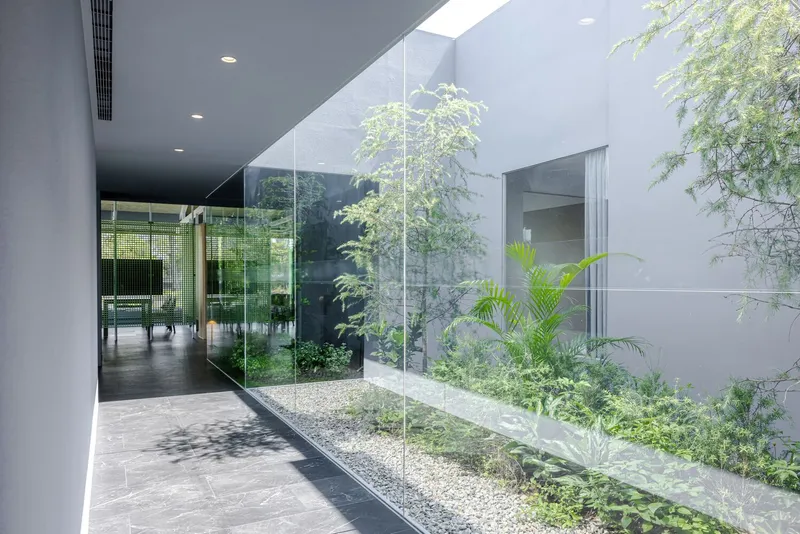
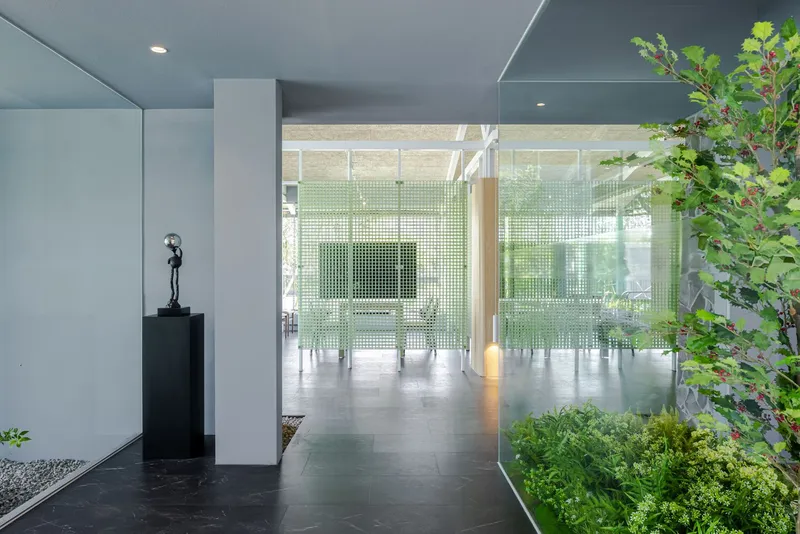
Planted courtyards are threaded through the floor plan, visible through glass walls from corridors, meeting rooms, and the dining area. These are not decorative atriums. They serve as light wells, privacy buffers, and orientation devices, always visible but never directly accessible from the sales floor. The planting is subtropical and unmanicured: palms, broad-leafed shrubs, and groundcover that will thicken over time.
The dining area is the clearest demonstration of how InOrder Studio uses these courtyards. Green glass block panels frame the view on two sides, with a timber column marking the foreground and the planted exterior filling the background. The layering, from grate to column to glass to garden, creates depth in a room that is not particularly large. It is a technique borrowed from traditional Chinese garden design, adapted here for a commercial program and executed with industrial materials.
Lighting as Atmosphere
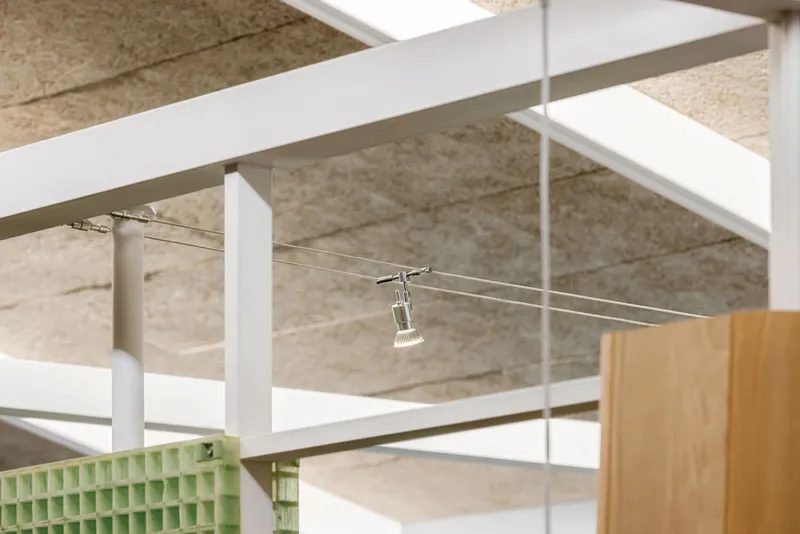
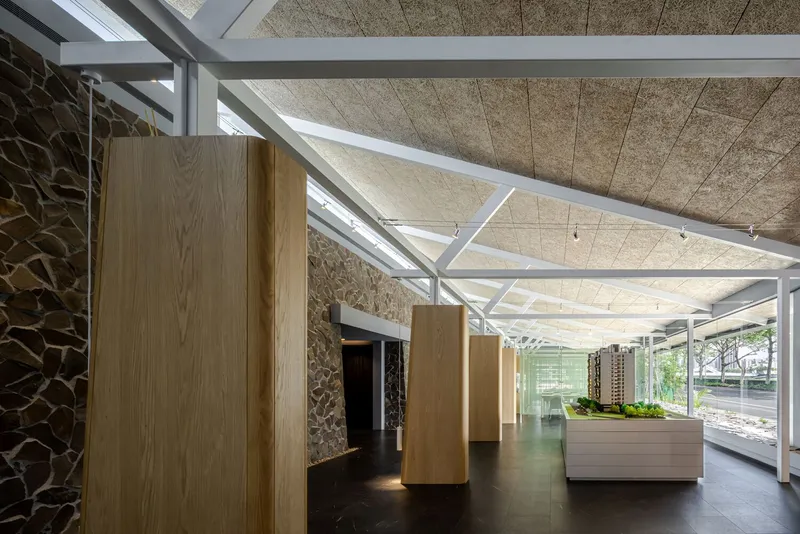
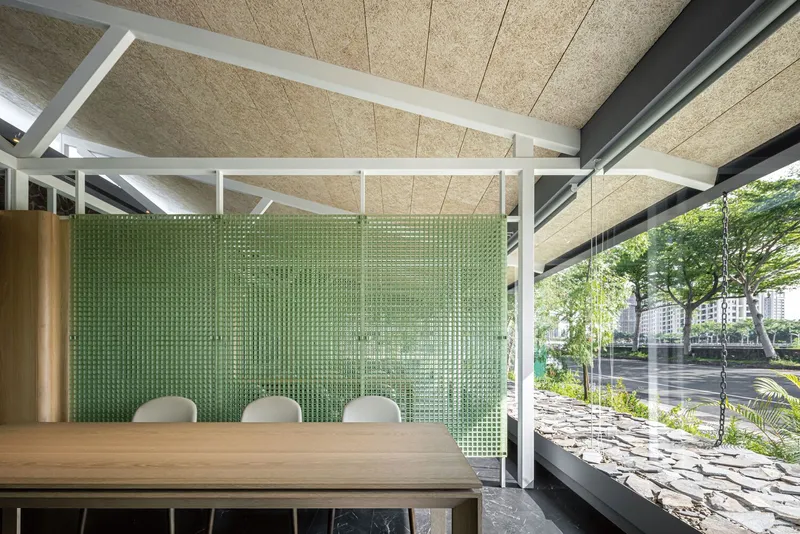
The cable lighting system, suspended from white steel beams beneath the textured particleboard ceiling, is restrained and intentional. Slender cables carry small point lights at regular intervals, creating a low, even wash that avoids the recessed-downlight monotony of most commercial interiors. The lights trace the structural grid, reinforcing the architecture rather than competing with it.
By day, the floor-to-ceiling glass facades pull enough natural light into the corridors and meeting rooms that the artificial lighting recedes. The green grate partitions modulate this daylight, casting soft patterns that shift with sun angle. The interplay between the two systems, cable lights and filtered daylight, gives the interior a temporal quality that most sales centers lack entirely. The space changes through the day, rewarding repeat visits in a way that aligns neatly with the slow process of buying a home.
A Model Unit, Quietly
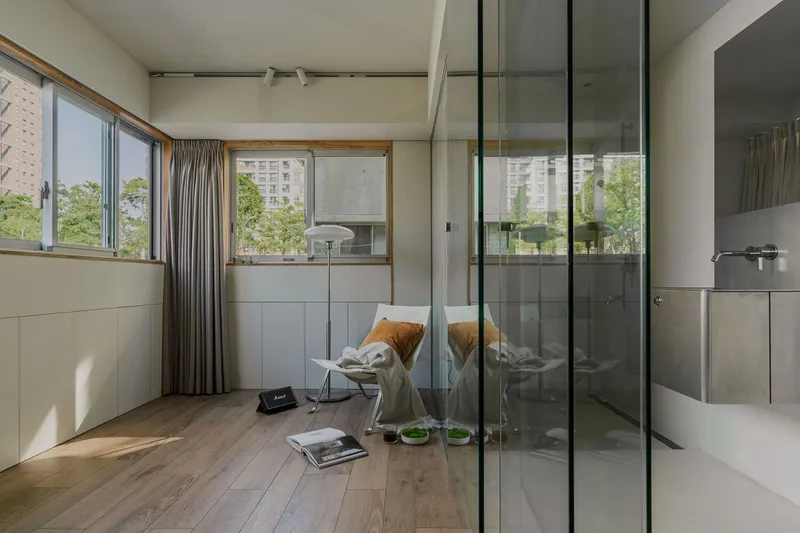
The model bedroom, with its glass-enclosed bathroom and timber flooring beneath a white coffered ceiling, is the most conventional room in the building. It has to be: its job is to project an aspirational domestic scene. But even here, InOrder Studio keeps the palette tight and the detailing clean. The coffered ceiling is a nod to domestic scale without descending into decorative trim, and the glass bathroom enclosure maintains the transparency theme that runs through the entire project.
The reception desk, clad in dark tile with a sculptural figure nearby, operates similarly. It signals "lobby" without resorting to the polished stone and brass fixtures that dominate the sales center genre. The timber columns continue through this space, maintaining the structural language of the rest of the building and preventing the reception area from feeling like a separate world.
Plans and Drawings
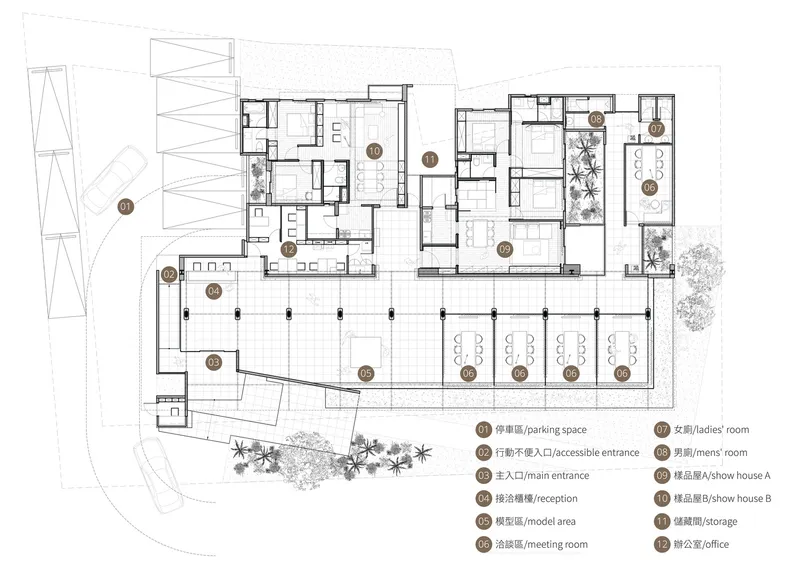
The floor plan reveals how the building organizes its commercial program around the planted courtyards. Meeting rooms and offices line the interior edge, with parking tucked to one side and landscape elements distributed throughout. The plan is essentially linear, stretched along the river embankment, which explains the corridor-driven circulation and the sequential unfolding of spaces from entry to sales floor to model unit. The landscape elements are not afterthoughts; they are load-bearing parts of the spatial strategy.
Why This Project Matters
The Sweeten Sales Center Grand Urban matters because it proves that a commercial typology widely dismissed as throwaway architecture can carry real ideas. InOrder Studio did not invent a new material system or a radical structural form. They took pigpen grates, river stones, and factory trusses and assembled them with enough precision and spatial intelligence to create a building that rewards attention. In a market where sales centers are designed to impress quickly and be demolished within a few years, this one is designed to accumulate meaning slowly.
The project also makes a quiet argument for locality. Every material is drawn from the immediate context, not as a sustainability checklist item but as a design methodology. The stones are from the river you can see from the window. The trusses are from the factories down the road. The grates are from the farms in the surrounding district. This specificity gives the building a rootedness that no imported marble or imported concept could achieve, and it suggests a model for how even the most temporary commercial architecture can engage meaningfully with its place.
Sweeten Sales Center Grand Urban, designed by InOrder Studio (lead architect: Chingju Chen). Located in Taichung's East District, Taiwan. Completed in 2024. Program: property sales center.
About the Studio
Share Your Own Work on uni.xyz
If projects like this are the kind of work you want to make, uni.xyz is a place to publish your own, find collaborators, and enter design competitions.




Popular Articles
Popular articles from the community


Lunar Spiral: Space Architecture Shaped by the Mathematics of the Universe
Lunar Spiral reimagines space architecture through Fibonacci geometry, lunar regolith, levitating habitats, and self-sustaining Moon living.

Hill & Cross Opera: Sculptural Opera House Architecture Shaped by Tallinn’s Landscape and Identity
Hill & Cross Opera reimagines opera house architecture in Tallinn through its sculptural hill, civic plaza, glass wave and a luminous cross.

Play: Fragments of Their World
Familiar architecture becomes modular playground design, creating safe spaces where displaced children can learn, connect, imagine and play.

Co-Life: Senior Housing Design That Reconnects Older Adults With the City
Co-Life reimagines senior housing design through healing gardens, shared streets, workshops, and a sustainable community across generations.


Similar Reads
You might also enjoy these articles


Hodi-Mandai Geram
Project Function: Preservation and revitalization of the Intangible heritage and socio-spatial identity of the Hodi by Housing, Cultural Memory Center, Sacred Grove, landscape, local tourism economy


Olio Towers: A Mid-Rise for Performers That Fuses Housing, Rehearsal, and Stage
Located blocks from Houston's Theater District, this modular tower stacks living units around a central performance atrium.

Oasis: Modular Green Housing Carved into Dhaka's Urban Fabric
A shortlisted Plugin Housing entry reclaims unauthorized settlements in Dhaka with stepped concrete volumes, green roofs, and ventilation-driven design.

Black Hole: A Floating Megastructure for the Post-Physical Era
Emiliano Mazzarotto envisions a spherical, self-scaling arena where e-sports, digital hotels, and holographic stadiums replace traditional public space.


Explore Architecture Competitions
Discover active competitions in this discipline



Challenge to reimagine the Iron Throne


Photograph architecture without architects


Illustrate the lost glory of Angkor Wat - Render Challenge


Design challenge to reuse E-waste
Comments (0)
Please login or sign up to add comments
No comments yet. Be the first to comment!