
Swing House Folds Timber and Concrete Into a Hillside
In São Carlos, Brazil, lb+mr architects dissolve the boundary between house and landscape with layered volumes, courtyards, and generous shadow.


Residential architecture in Brazil's interior cities often defaults to one of two modes: fortified walls hiding conventional floor plans, or glassy pavilions that ignore the heat. Swing House, designed by lb+mr partners Luciana Bernasconi and Mila Ricetti in São Carlos, São Paulo state, does neither. At 600 square meters, the house is substantial, yet it reads from the street as a collection of restrained volumes: a stone perimeter wall, a dark timber-clad box, planted grasses, and shade trees. The architecture absorbs rather than announces.
What makes the project genuinely interesting is its refusal to separate the act of living inside from the act of being outside. The house is organized around a central courtyard, with living pavilions that open on multiple sides through floor-to-ceiling glazing. Slatted pergolas filter equatorial light into striped patterns across floors and walls, turning shadow into a primary material. The sloping site is engaged rather than flattened, with board-formed concrete retaining walls that step down the terrain and create garden terraces at multiple levels. It is a house built around the idea that comfort in a subtropical climate comes not from sealing yourself in, but from controlling exposure.
A Layered Street Presence
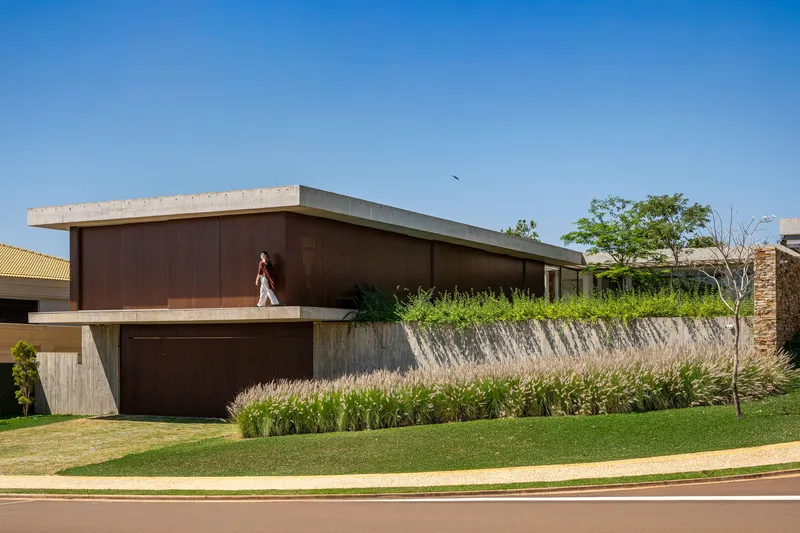
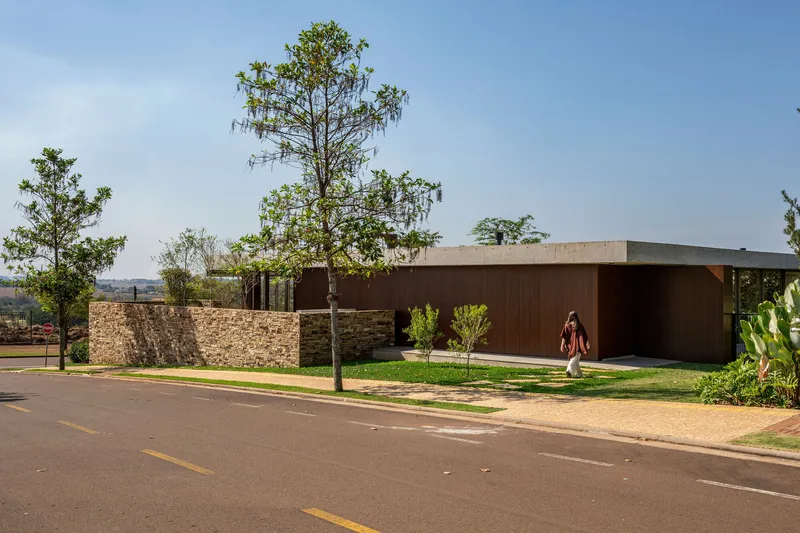
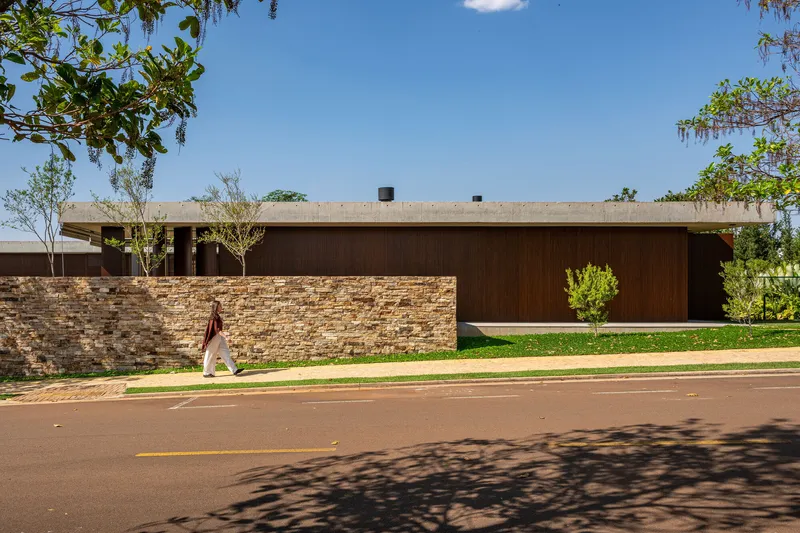
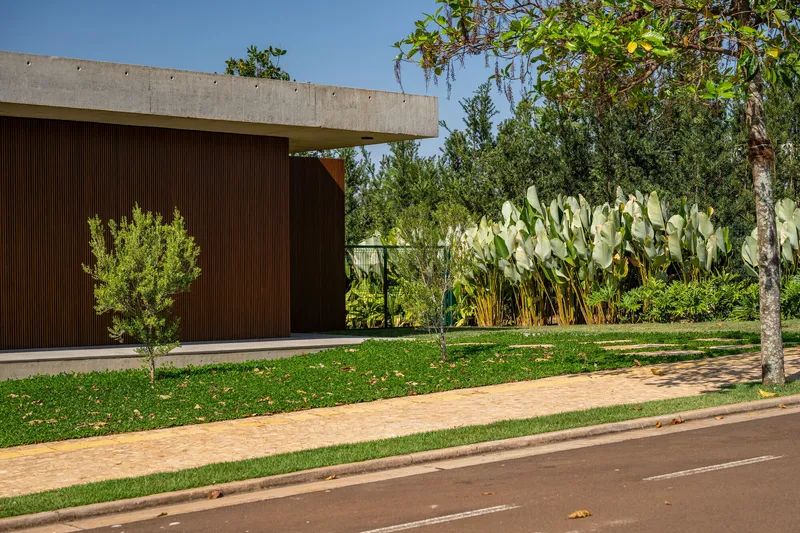
From the sidewalk, Swing House presents a composed sequence of textures. A dry-stacked stone wall establishes a boundary without aggression, while the dark timber-clad upper volume hovers above with a concrete soffit that shelters the planted zone below. The palette is deliberately muted: charcoal wood, grey stone, green grasses. There is no monumental entrance or showy cantilever. Privacy comes from layering rather than height.
The effect is that the house participates in the streetscape rather than withdrawing from it. A pedestrian walking past, as captured in the photographs, encounters a building that engages the ground plane with vegetation and low walls. The timber cladding reads as warm and tactile even from a distance, countering the institutional coldness that board-formed concrete can sometimes carry.
Green Roof and Planted Terraces
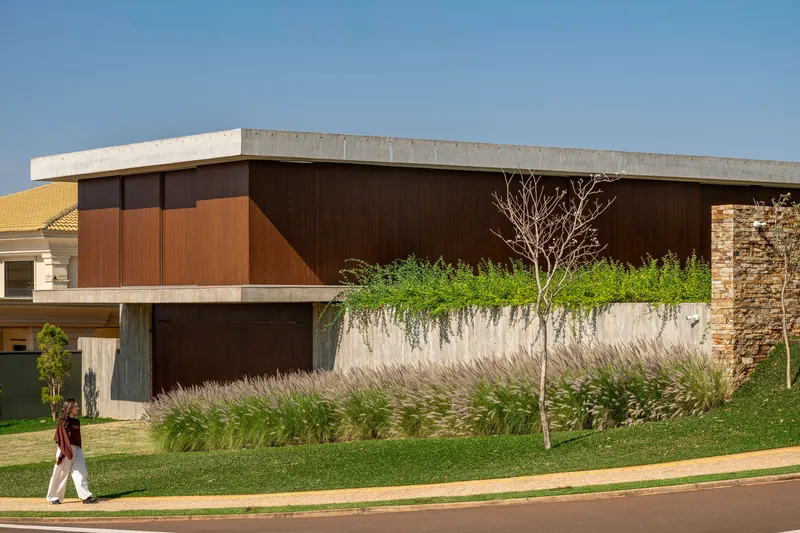
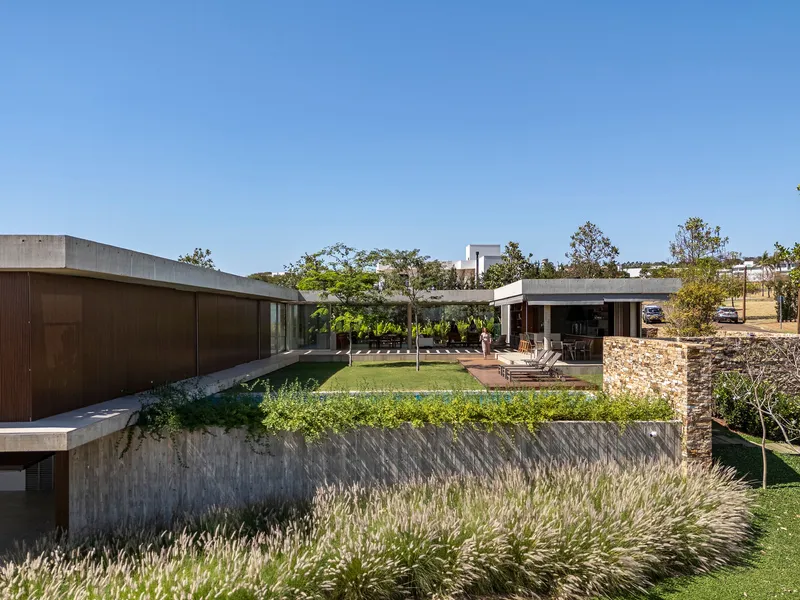
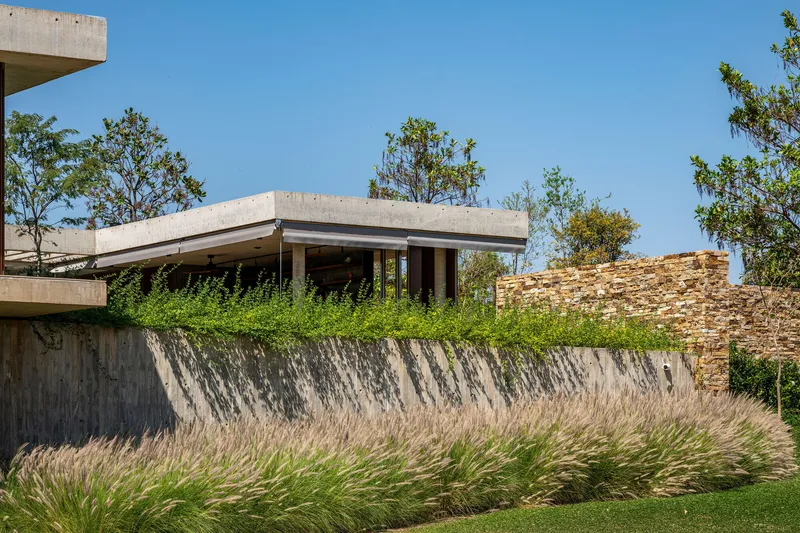
The upper level features a planted green roof terrace visible from the street, softening the building's profile and contributing to thermal performance. Below, board-formed concrete retaining walls hold back the sloped terrain and create horizontal planting beds filled with ornamental grasses and native species. These terraces are not decorative afterthoughts. They are structural landscape moves that mediate between the public edge and the private courtyard below.
The concrete itself deserves attention. Its board-formed texture gives it a directional grain that echoes the timber cladding elsewhere. There is a conscious effort throughout the project to make every hard surface feel crafted rather than simply poured or clad. When the afternoon light rakes across these walls, the horizontal lines of the formwork create their own subtle shadow play.
The Courtyard as Organizing Principle
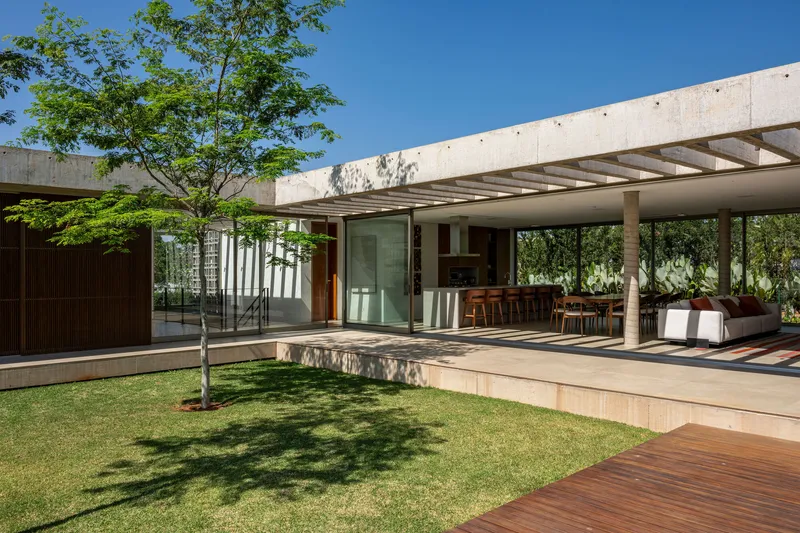
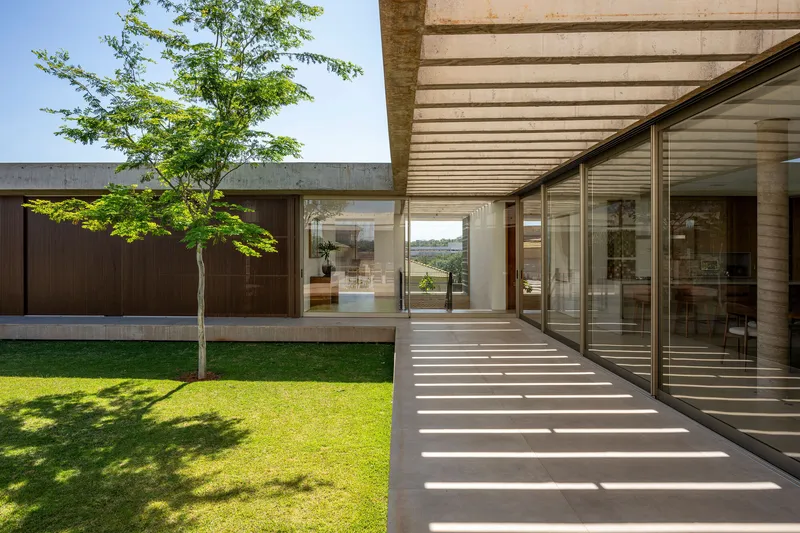
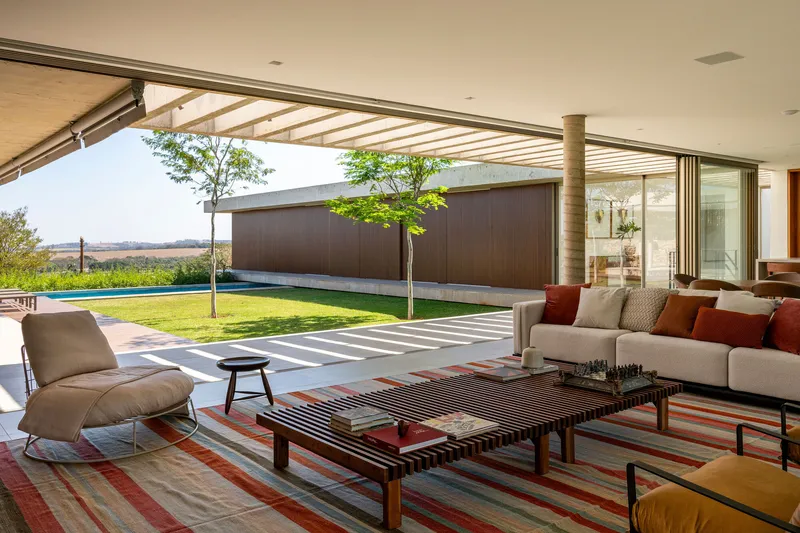
The central courtyard is the heart of the plan. A young tree anchored in the ground and framed by concrete beams overhead gives this space a quiet, almost monastic quality. Glass-walled rooms surround it on multiple sides, meaning that every major interior space borrows light, air, and views from this shared outdoor room. The courtyard makes the house legible from within: you always know where you are because you can always see the tree.
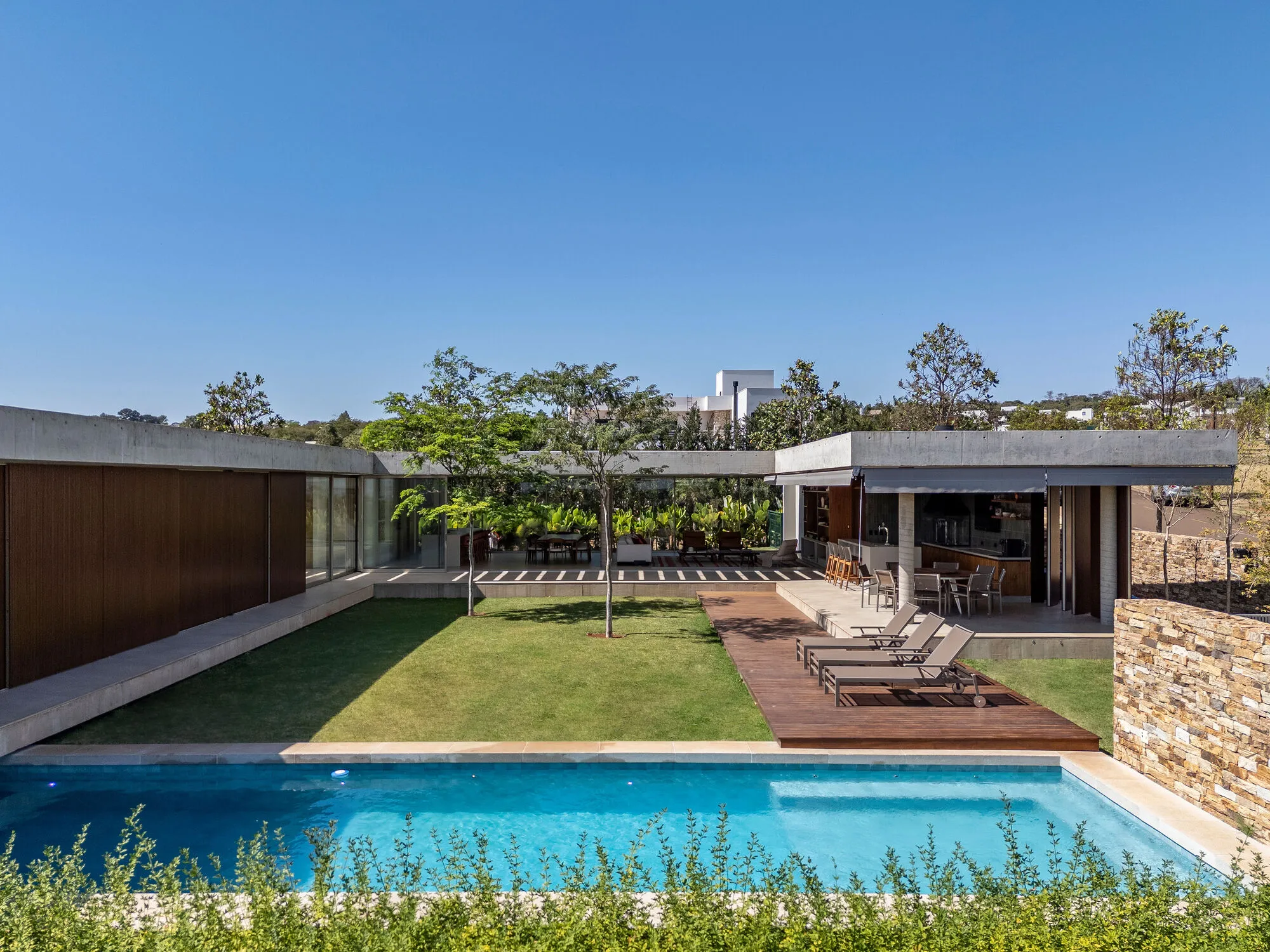
From the living room, the courtyard extends visually to the swimming pool and lawn beyond, creating a telescoping depth of field that makes 600 square meters feel substantially larger. The slatted canopy overhead filters direct sun while maintaining a sense of openness. It is a well-calibrated balance: covered enough to be usable year-round, open enough to feel genuinely outdoors.
Shadow as Material
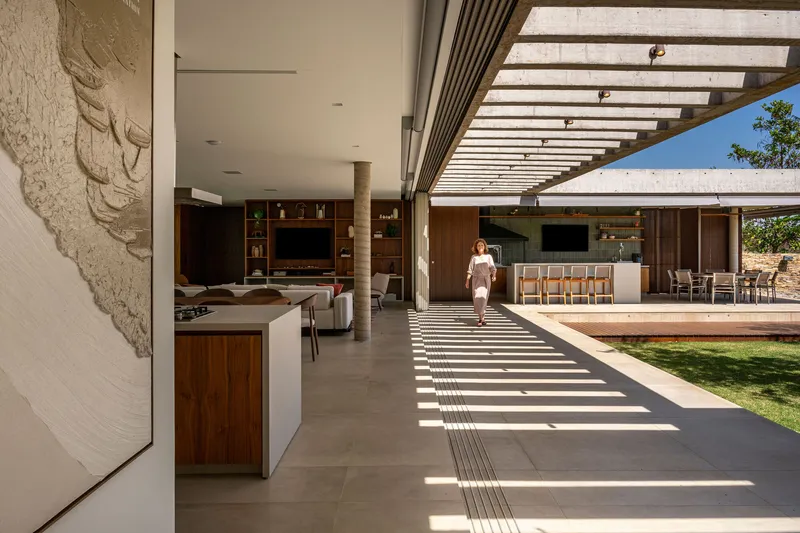
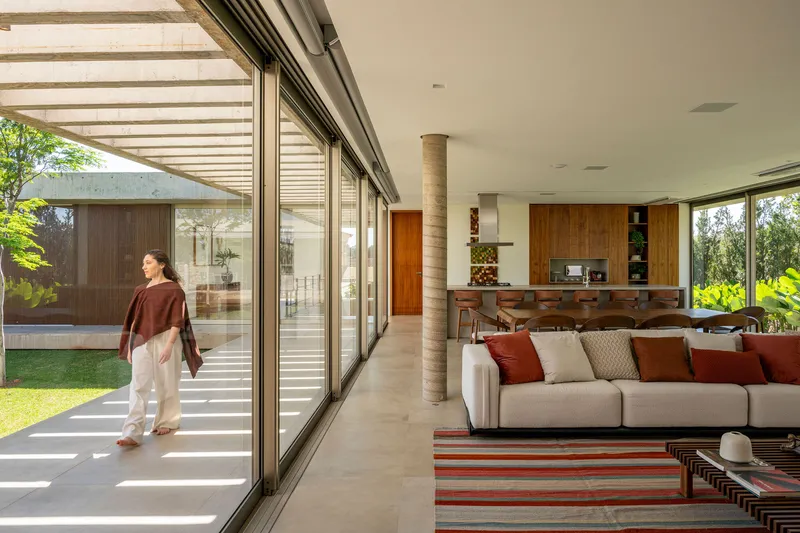
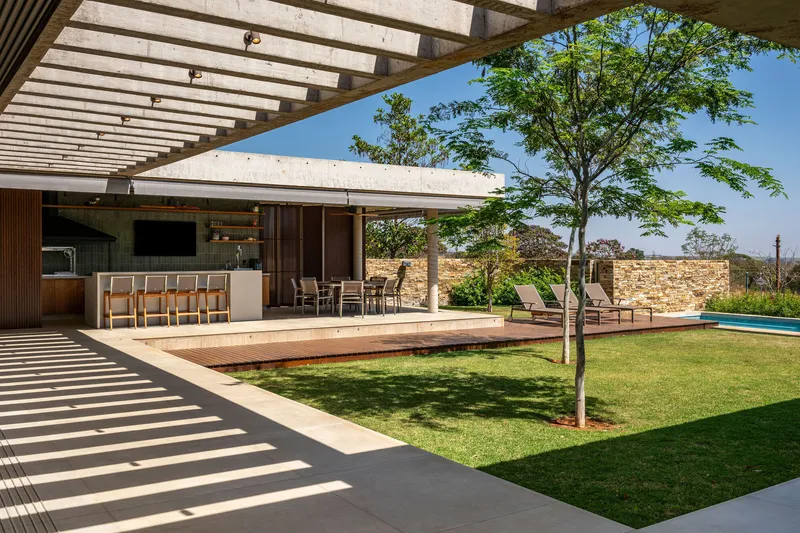
The slatted pergola structure that runs across the living pavilion is perhaps the project's most photogenic element, and for good reason. As the sun moves, timber and concrete slats cast rhythmic striped shadows across the polished floor, up the walls, and onto the figures moving through the space. The effect transforms the interior into a kind of sundial, marking time through shifting patterns of light and dark.
This is not merely aesthetic. In São Carlos, where temperatures regularly exceed 30°C, overhead shading is essential to making open-plan spaces livable without relying entirely on mechanical cooling. The pergola allows ventilation while blocking the worst of the direct sun. The concrete beams in the outdoor kitchen area perform the same role with heavier mass, absorbing heat during the day and radiating it slowly after sunset.
Living Spaces Open on All Sides
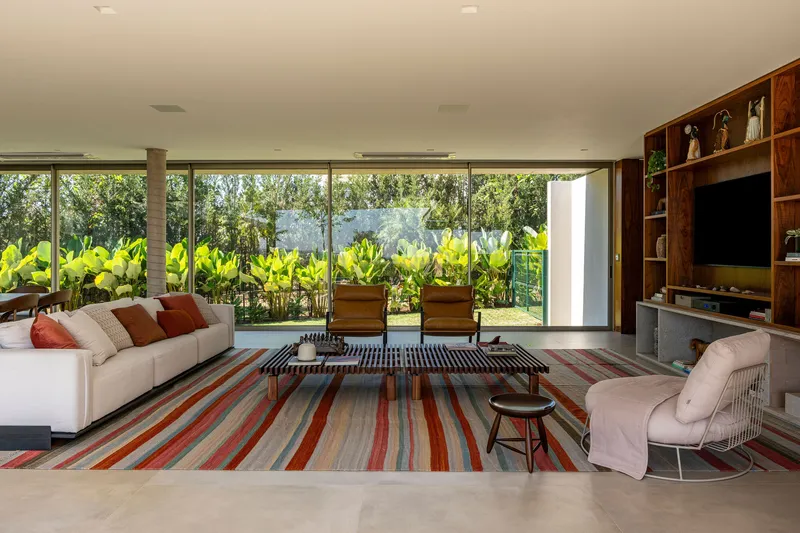
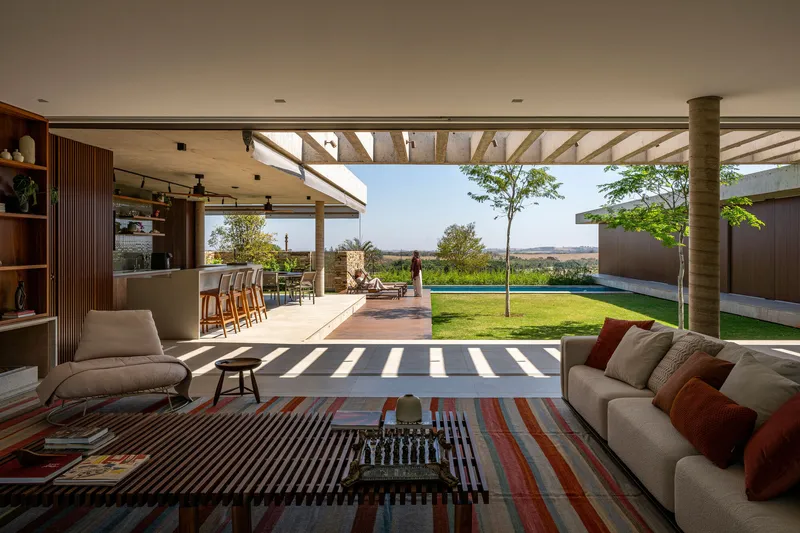
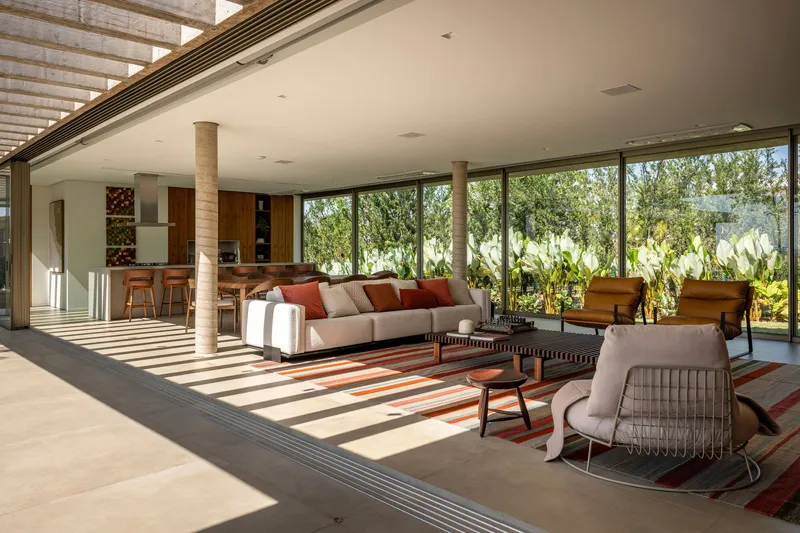
The main living room is defined not by walls but by the absence of them. Floor-to-ceiling glazing wraps the space on at least two sides, connecting to a terrace thick with banana plants on one edge and the lawn and distant landscape on the other. Structural concrete columns do the work that partition walls would normally handle, allowing the floor plate to remain continuous and uninterrupted.
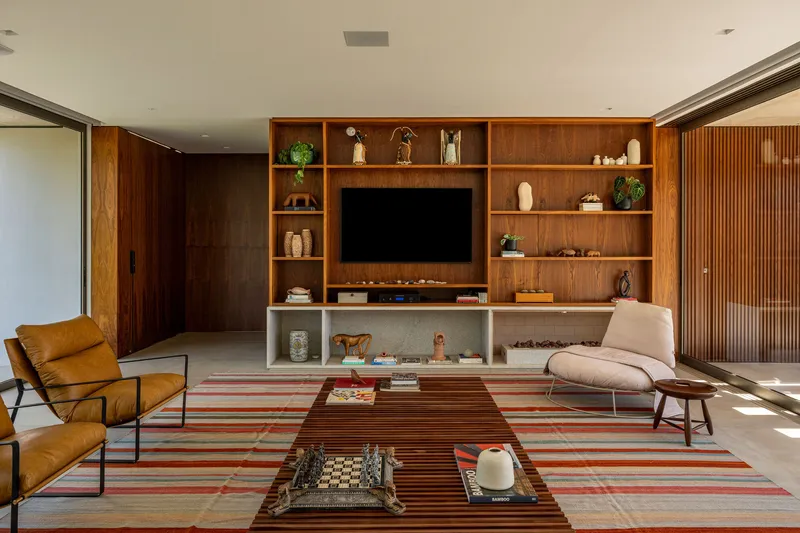
A striped area rug and a timber shelving unit around the television provide the only real spatial definition in the living zone. The architects trust the architecture itself, the column grid, the ceiling height, the relationship to the outdoors, to do the work of making the room feel like a room. It is a confidence that pays off: the space feels generous without being empty.
Kitchen, Dining, and the Indoor-Outdoor Meal
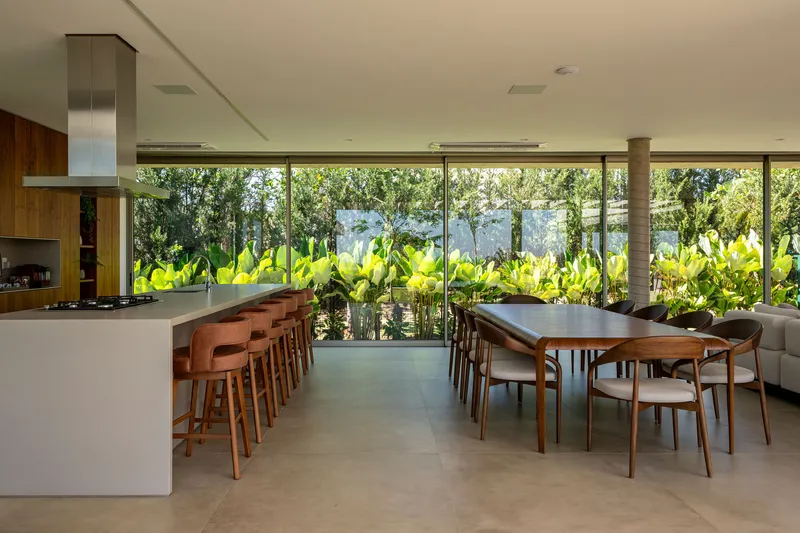
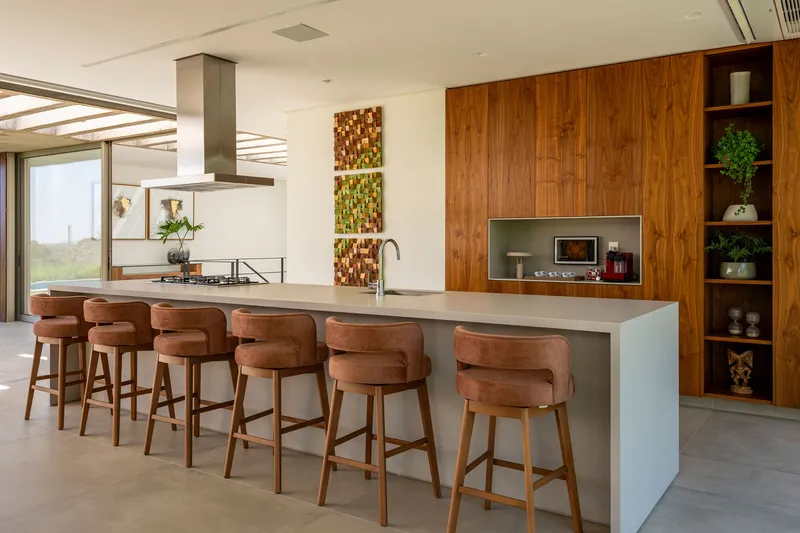
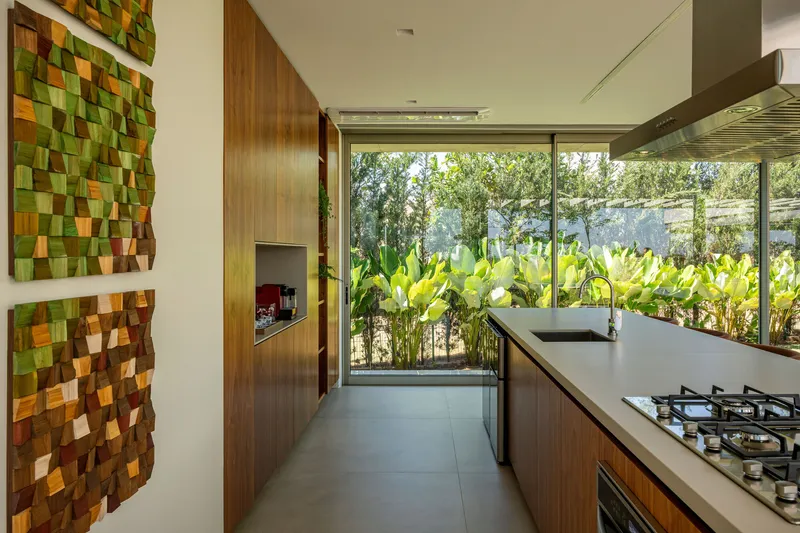
The kitchen occupies a privileged position in the plan, flanked by glass walls that look directly onto planted beds of large-leafed tropical vegetation. A long island with leather-upholstered stools faces a timber-clad wall of integrated appliances, keeping the cooking zone clean and minimal. The galley layout behind features textured tile walls and glass doors that swing open to the garden, allowing the smell of jasmine to compete with whatever is on the stove.
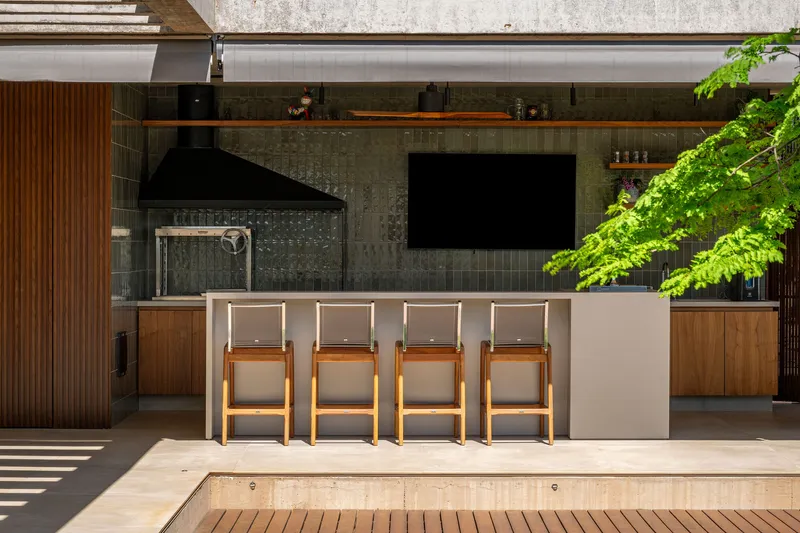
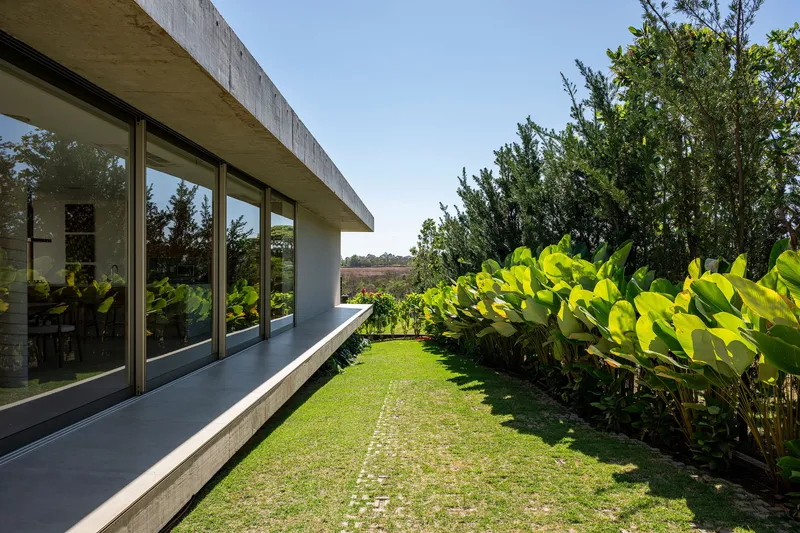
The outdoor kitchen extends this hospitality to the courtyard side, with bar seating beneath a concrete soffit and an overhanging tree that provides natural shade. Dark tile backsplash and a grill setup suggest this is not a token barbecue corner but a fully equipped second kitchen. In a culture where weekend gatherings routinely move between inside and outside, this doubling of kitchen functions is practical architecture rather than luxury.
Pool and Lawn as Living Rooms
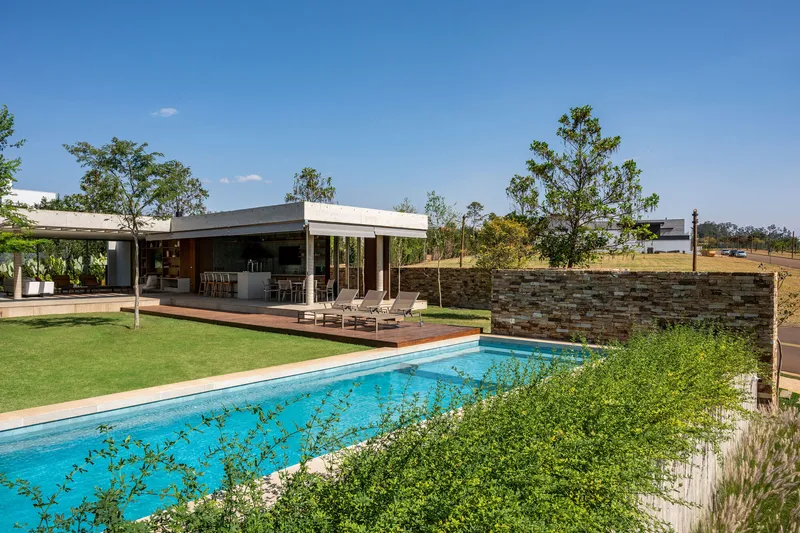
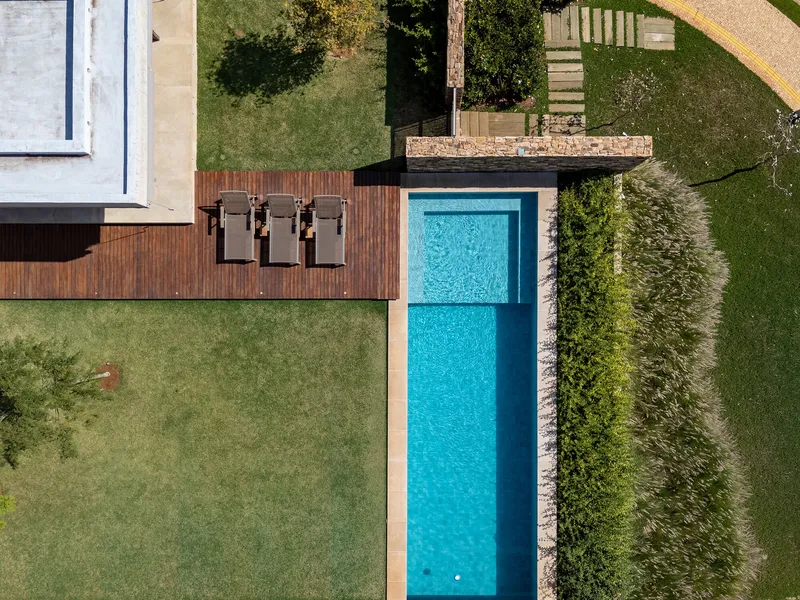
The lap pool sits along one edge of the courtyard, bordered by timber decking and a stone wall that provides privacy from adjacent properties. Three lounge chairs on the green lawn complete the scene, captured from above in an aerial photograph that reveals the careful proportioning of hard and soft surfaces. The pool is long enough to swim in seriously, not just a decorative rectangle, which suggests the architects were designing for use rather than for the drone shot.
The stone wall bounding the pool zone carries the same material language as the street-facing perimeter wall, tying the private rear of the house back to its public face. It is a small detail that speaks to a larger discipline: every material appears in at least two locations, creating coherence without monotony.
Plans and Drawings
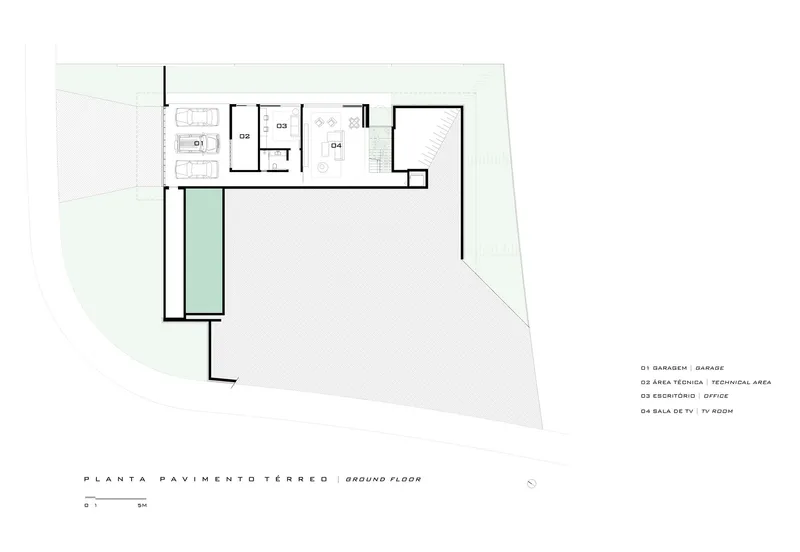
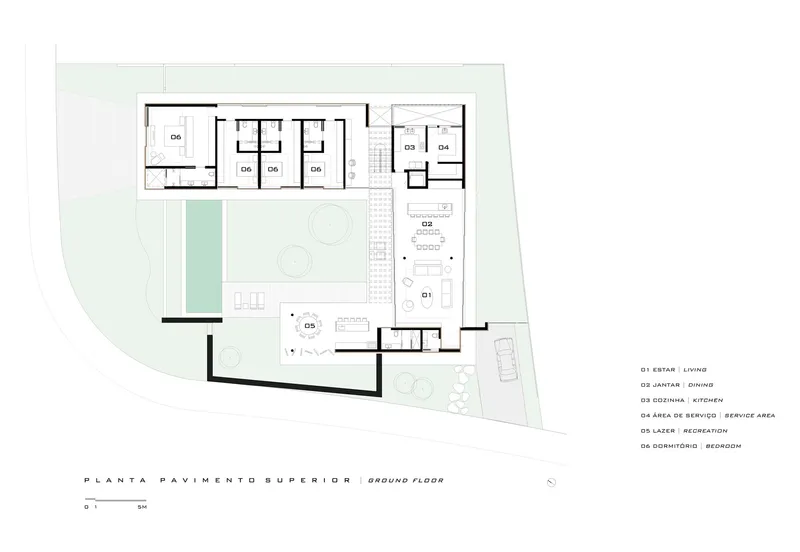
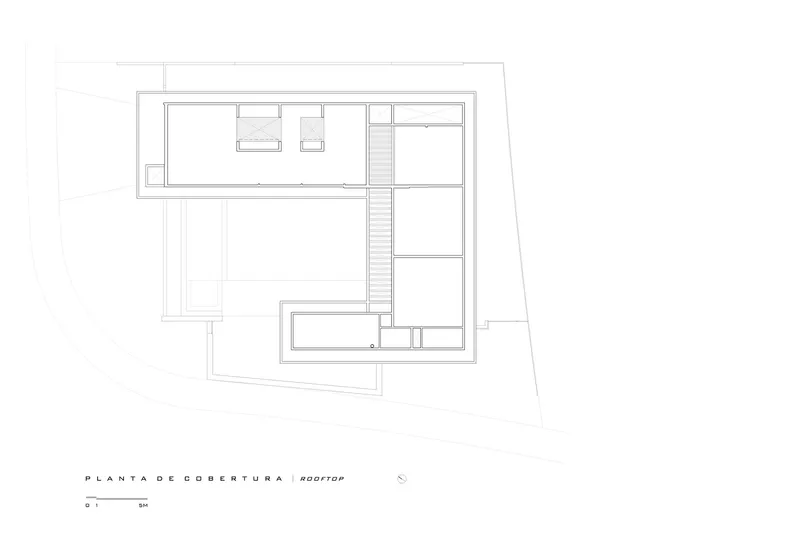
The ground floor plans reveal the courtyard's central role clearly. The western edge accommodates the garage, technical service areas, and the pool, while the primary living, dining, kitchen, and bedroom spaces wrap around the central open-air void on the remaining three sides. The rooftop plan shows minimal intervention: stair access and two skylight openings that presumably feed light to interior corridors below.
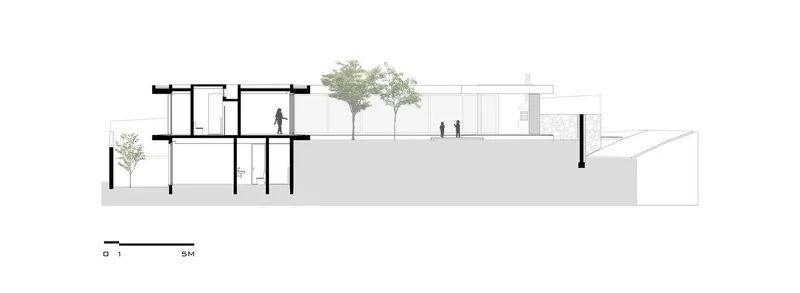
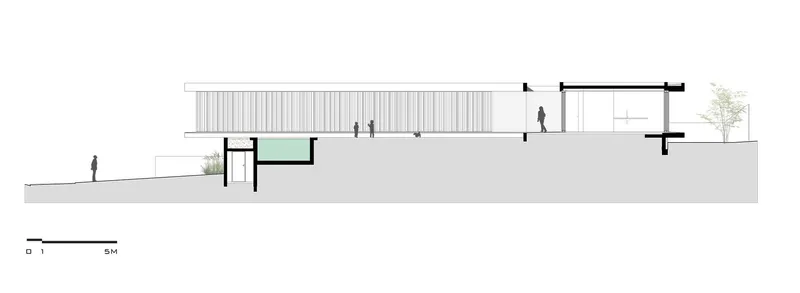
The section drawings are the most instructive. They show how the two-story volume steps down the sloped site, with the upper timber-clad box cantilevering slightly over the lower stone and glass base. The slatted screen facade, the pool's relationship to the garden plane, and the terraced landscape are all legible in cross-section. The architects have used the slope to their advantage, tucking service spaces into the grade change and reserving the upper levels for the spaces that benefit most from views and ventilation.
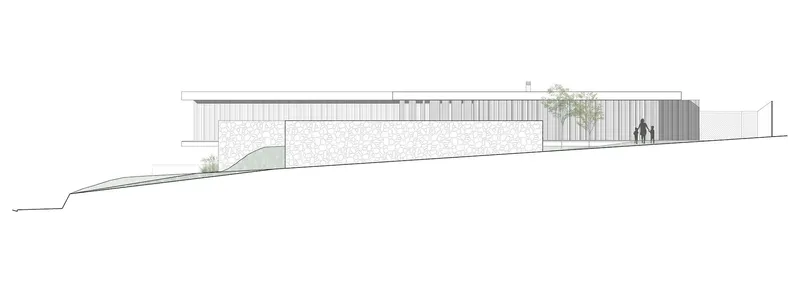
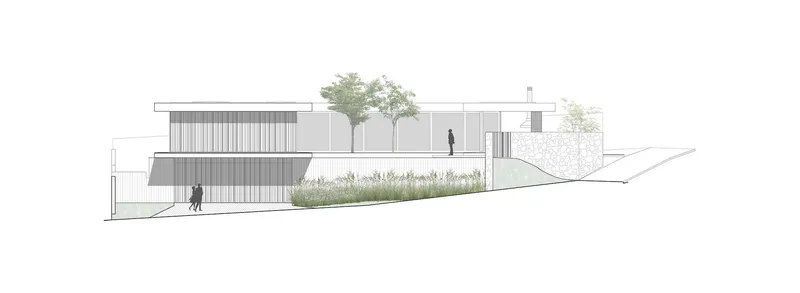
The elevations confirm the horizontal emphasis of the composition. Vertical slat cladding on the upper volume provides texture and rhythm, while terraced garden beds soften the base. Figures placed in the drawings give a sense of the building's modest scale: despite its generous area, the house never rises more than two stories, keeping it in proportion with the residential neighborhood around it.
Why This Project Matters
Swing House matters because it demonstrates that climate-responsive design in tropical Brazil does not have to look like a research project or a vernacular pastiche. Bernasconi and Ricetti have produced a house that is contemporary in its spatial ambition, rigorous in its material palette, and genuinely tuned to the way people live in São Carlos. The courtyard plan, the slatted shading systems, and the layered landscape are all proven strategies, but they are deployed here with a precision and restraint that elevates them beyond formula.
The project also reminds us that the boundary between architecture and landscape is a design decision, not a given. By stepping the house into the terrain, wrapping rooms around an outdoor void, and treating vegetation as a building material on par with concrete and timber, lb+mr has produced a residence where inside and outside are not opposites but collaborators. In a discipline that too often treats landscape as garnish, that commitment is worth celebrating.
Swing House by lb+mr (Luciana Bernasconi, Mila Ricetti), São Carlos, Brazil. 600 m², completed 2025. Photography by Favaro Jr.
About the Studio
Share Your Own Work on uni.xyz
If projects like this are the kind of work you want to make, uni.xyz is a place to publish your own, find collaborators, and enter design competitions.




Popular Articles
Popular articles from the community


Hill & Cross Opera: Sculptural Opera House Architecture Shaped by Tallinn’s Landscape and Identity
Hill & Cross Opera reimagines opera house architecture in Tallinn through its sculptural hill, civic plaza, glass wave and a luminous cross.

The Earth Pod: 3D Printed Homes for Resilient Refugee Communities
The Earth Pod reimagines refugee housing through 3D printed homes made from clay, combining resilience, self-sufficiency, and rapid shelter.

Play: Fragments of Their World
Familiar architecture becomes modular playground design, creating safe spaces where displaced children can learn, connect, imagine and play.

The Musturak Paradise: Senior Living Architecture for a Connected Future in Temara, Morocco
The Musturak Paradise reimagines senior living architecture in Temara via private homes, social spaces, culture, community, and shared care.


Similar Reads
You might also enjoy these articles

Bao Huynh Watercolor Atelier: A Serene Art Retreat in Hội An
Bao Huynh Watercolor Atelier in Hội An blends multifunctional art spaces, sustainable design, local materials, and family-friendly living in a serene environment.

Atelier Macri Concept Store Interior Design by CASE-REAL
Atelier Macri store features a "ko" counter, walnut wood details, cork displays, blending retail, gallery, and seamless customer experiences.

Manuel Vargas Izquierdo Stadium and High-Performance Sports Center: Architectural Excellence in Jalpa de Méndez
The Manuel Vargas Izquierdo Stadium blends sustainable design, inclusive sports facilities, and cultural-inspired architecture, revitalizing Jalpa de Méndez’s public spaces.

KAKR Buluh Awar Hall: Revitalizing Community and Ecology Through Bamboo Architecture
Community built bamboo hall revitalizes Buluh Awar village, empowering youth, restoring ecology, celebrating vernacular craftsmanship through sustainable architecture and culture.




Comments (0)
Please login or sign up to add comments
No comments yet. Be the first to comment!