
XStudio Stacks a Watchtower Home on a 9x4 Meter Plot in Gran Canaria's Volcanic Summit
T House in Tejeda climbs three levels on a sliver of land, framing views of Roque Bentayga and Roque Nublo through calibrated openings.


Tejeda sits inside a volcanic caldera near the summit of Gran Canaria, a place where geology is the dominant architectural fact. Roque Bentayga and Roque Nublo, the island's two great basalt monoliths, preside over a sparse fabric of small buildings scattered across steep terrain. Strict municipal regulations aim to keep new construction sympathetic to this rural character, but the rules often produce bland, generic results. XStudio, led by architects Leticia Romero Hernández and Ancor Suárez Suárez, took the opposite tack with T House: accept every constraint and turn each one into a design decision.
The plot measures just 9 by 4 meters, drops 2.5 meters from one edge to the other, and sits at the junction of a regional road and a pedestrian passage. There is no yard, no setback to play with, no room for sprawl. XStudio responded by stacking the entire program vertically and treating the house as a contemporary watchtower: hermetic toward the street, permeable toward the landscape, with every opening calibrated to frame a specific piece of the volcanic panorama. The result is a 112 square meter residence that is compact in footprint and expansive in experience.
A White Volume in the Caldera
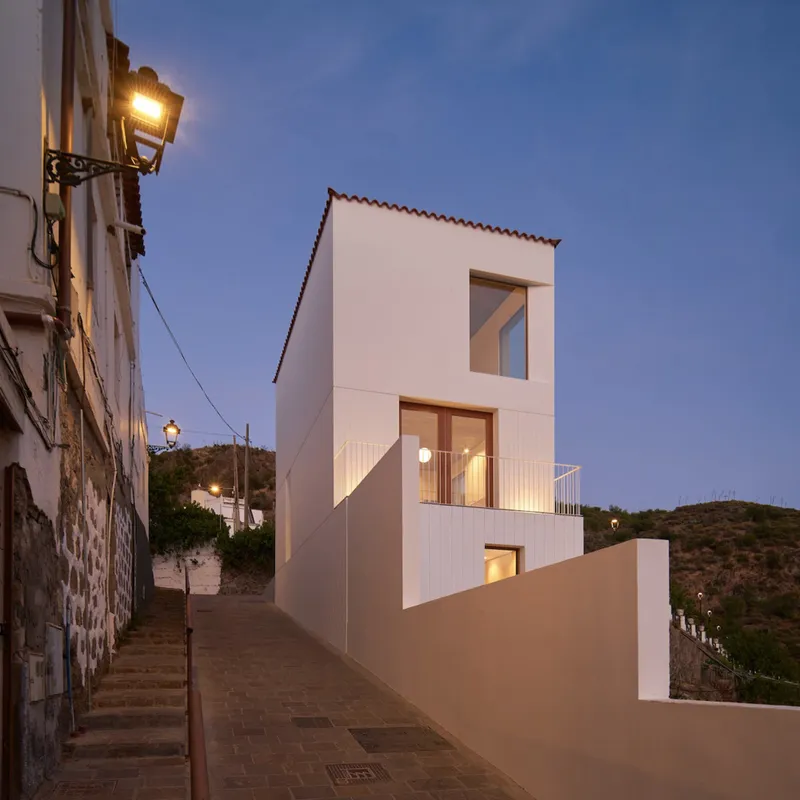
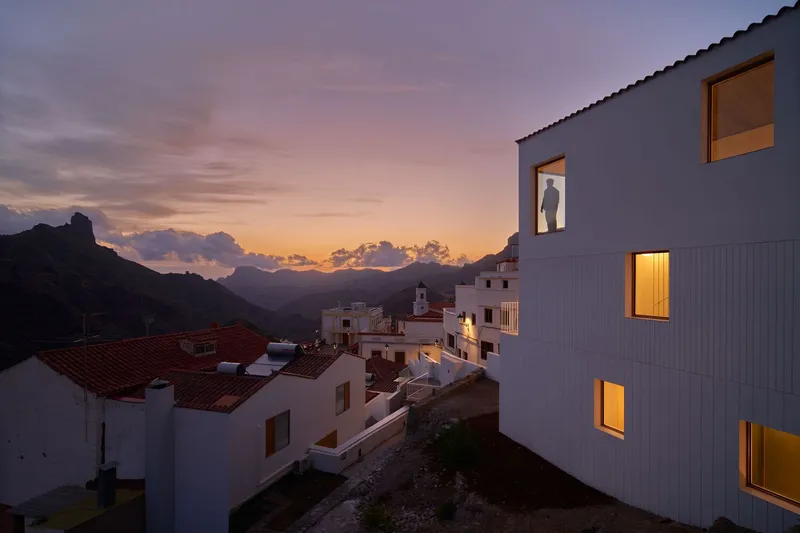
Seen from the narrow hillside street at dusk, T House reads as a simple white cube wedged into the slope. Its corrugated plaster surface, hand-striated in horizontal bands at the base and smooth above, gives the facade a subtle grain that catches low light and anchors the volume to the ground. The proportions are deliberately archetypal: a compact vertical mass that could be a village granary or a signal tower, scaled to fit the existing fabric without mimicking it.
At night the strategy becomes legible. Lit windows punch through the white skin at different scales but identical proportions, a direct response to zoning rules that prescribe uniform openings. XStudio manipulated size rather than shape, so the fenestration reads as a composed rhythm rather than a regulatory checklist. The street facades remain largely closed, directing attention and daylight toward the west and south, where the volcanic peaks sit.
Three Levels Connected by a Fissure
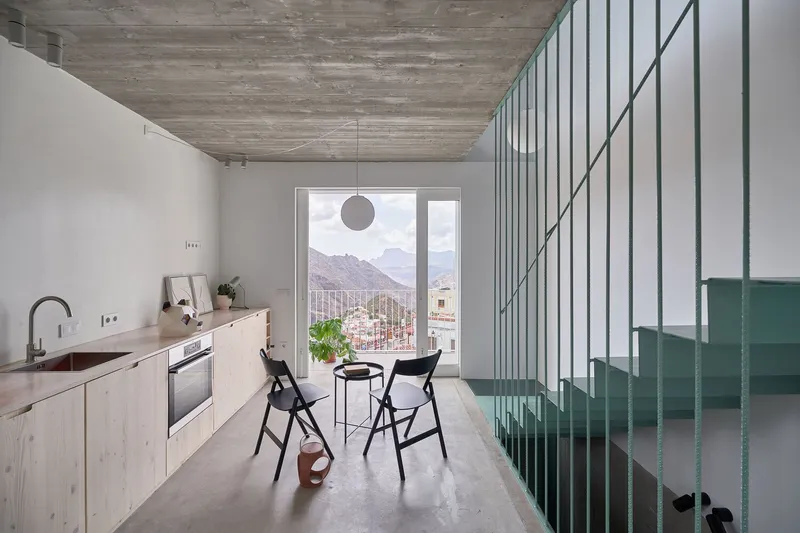
The spatial logic is straightforward and disciplined. A semi-basement holds the private bedrooms, taking advantage of the grade change to sit partially below street level. The intermediate floor, entered at road height, contains the kitchen and dining area, which spills onto a small terrace. The living room occupies the top floor, positioned to claim the widest and most commanding views. Each level relates to the landscape differently: the bedrooms are sheltered and introverted, the kitchen opens onto a middle-ground panorama, the living room floats above the roofline of the village.
Binding these three stories together is what XStudio calls a longitudinal fissure: a central stairwell slot that runs the full height of the house. The stair changes character as it rises, shifting from heavy exposed concrete at the base to lighter, more open construction at the top. That gradient reinforces the sensation of climbing from earth to sky, which is the whole point of living on the rim of a volcanic caldera.
Framing the Rocks
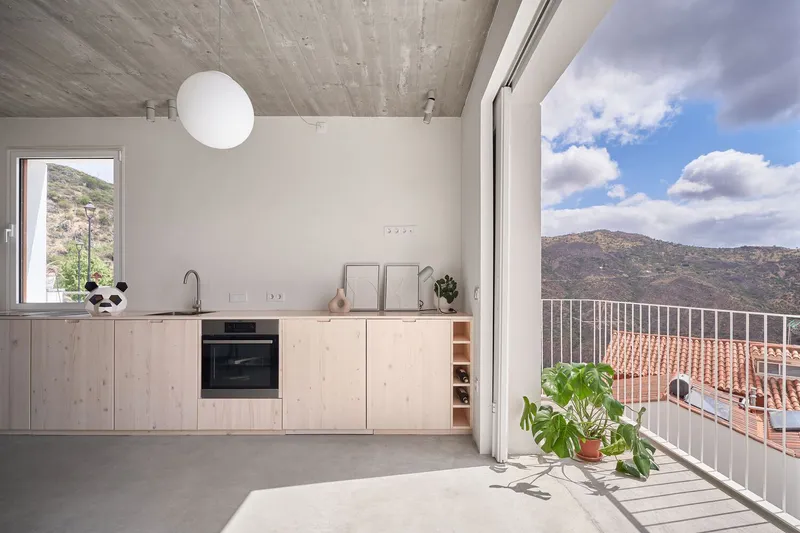
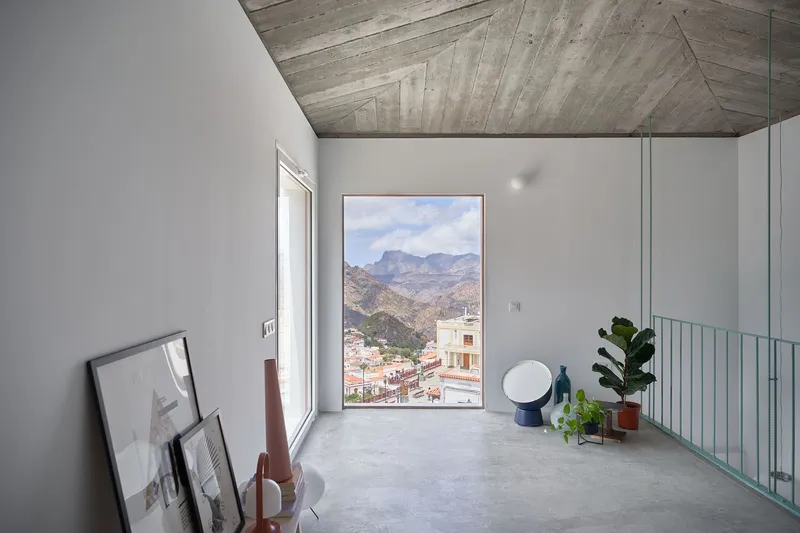
The tall windows on the west and south facades do serious compositional work. Each one isolates a specific portion of the terrain: the craggy profile of a peak, the layered rooftops of the village below, the distant ridge dissolving into haze. Because the proportions are uniform while the scales vary, the openings function like a series of lenses set to different focal lengths. A green steel balustrade runs along the balcony edge, its color pulled from the scrub vegetation on the slopes outside.
Standing at the kitchen level, you look past a potted plant and a thin metal railing directly into the mountainous terrain. The framing is tight enough to feel cinematic but generous enough to let the sky in. It is a controlled relationship with a landscape that could easily overwhelm a building this small.
Concrete and Pine in Dialogue
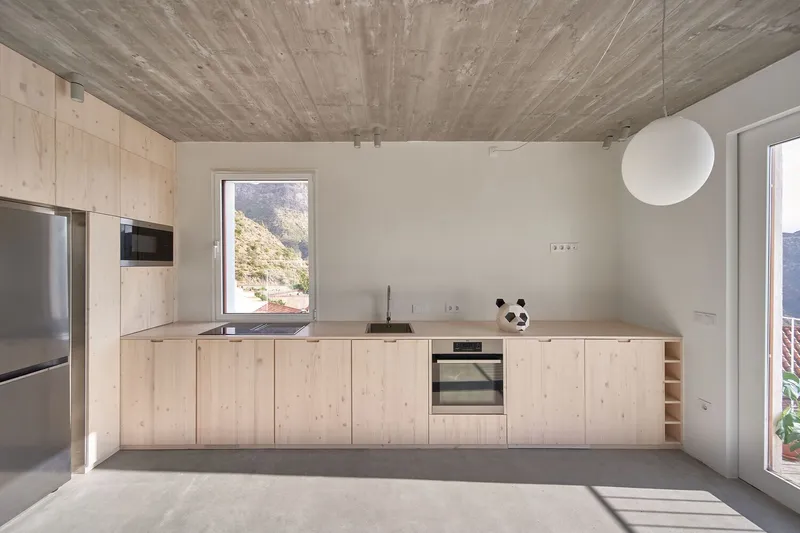
The interior palette is deliberately limited: polished concrete floors, board-formed concrete ceilings, and pale pine for cabinetry, paneling, and furniture. The pine formwork used to cast the slabs leaves its grain imprinted on the ceiling surface, so the two dominant materials literally touch each other during construction and then separate into distinct registers of warmth and weight. The kitchen cabinetry picks up the same wood tone, creating continuity across storage, structure, and finish.
Accents of green steel, visible in the balustrade and occasional hardware, tie back to the landscape palette without becoming decorative. White walls amplify daylight in rooms that could easily feel constricted given the narrow floor plates. The restraint pays off: each surface reads clearly, and the transitions between concrete, wood, and plaster feel honest rather than curated.
The Watchtower at Sunset
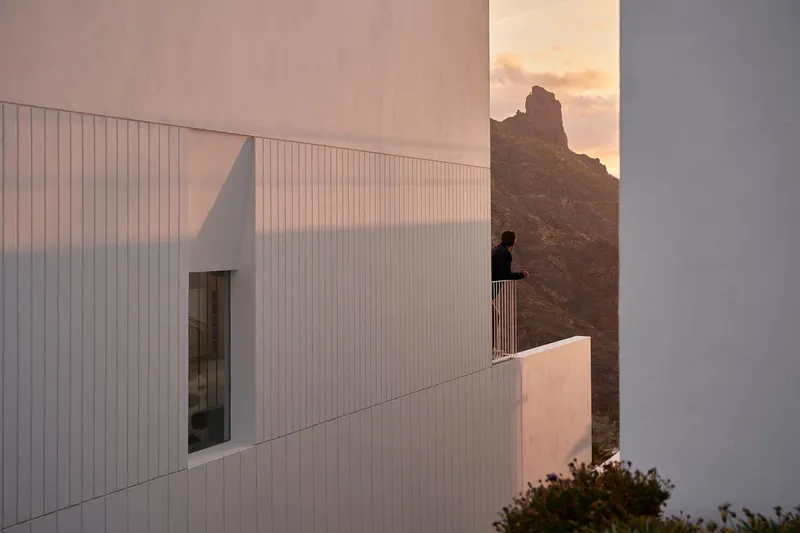
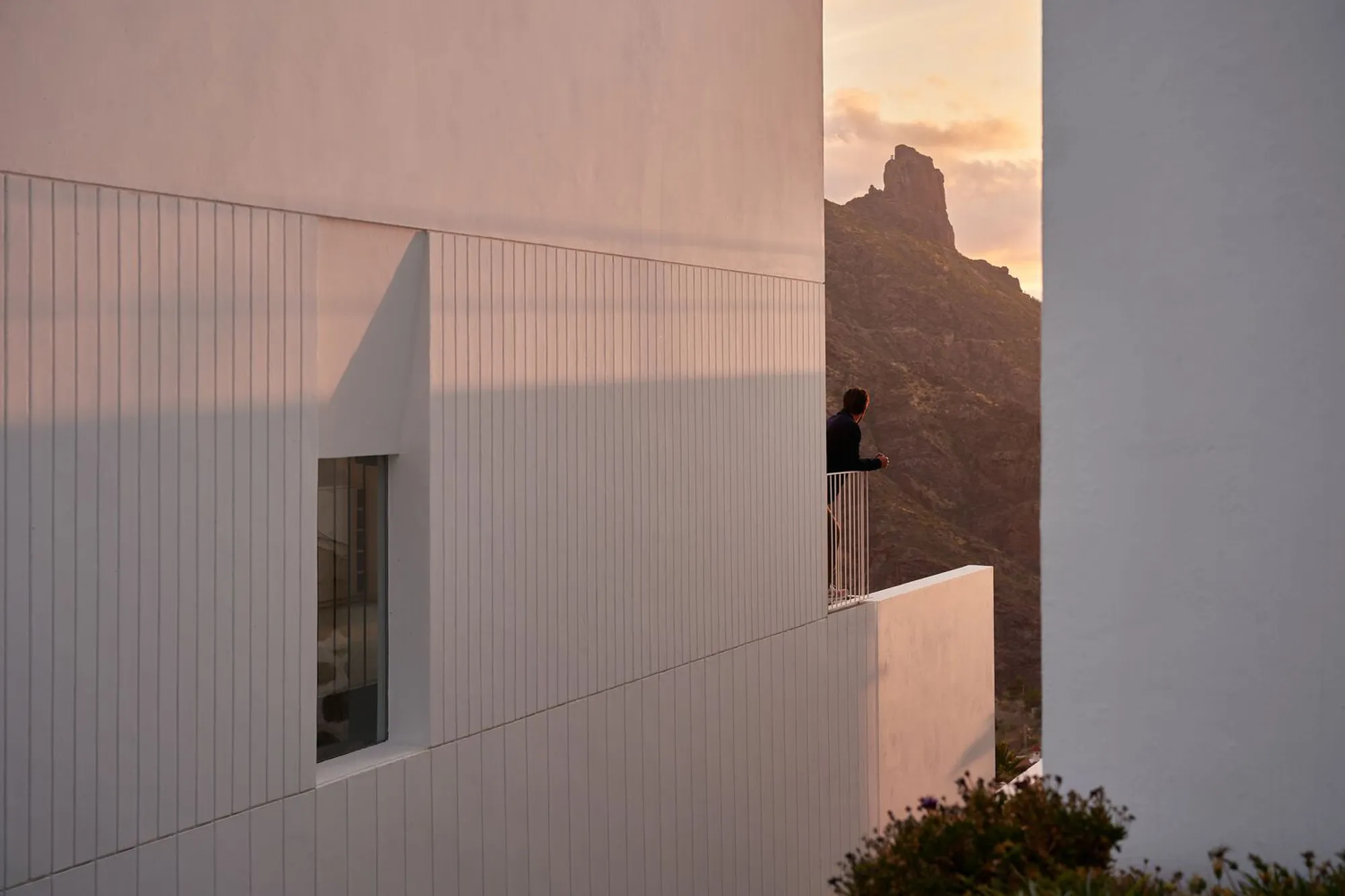
The most compelling image of T House may be the silhouette shot: a figure standing on the balcony at sunset with Roque Nublo rising behind. In that frame, the house is neither heroic nor humble. It is simply positioned correctly, doing the one thing a building in this landscape must do: get you high enough to see. The corrugated facade catches the last warm light while the balcony projects just far enough to feel like a promontory.
That image also reveals the house's proportional success. Despite occupying every centimeter of a tiny plot, it does not look crammed. The vertical massing, the horizontal plaster banding, and the restrained color palette allow it to sit among its neighbors without friction. It reads as a building that belongs to Tejeda's tradition of small, dense construction while being unmistakably contemporary.
Why This Project Matters
T House is a case study in productive constraint. A 36 square meter footprint, a 2.5 meter grade change, and strict preservation regulations could have produced something timid. Instead, XStudio treated each limitation as a design brief: the tiny plot demanded vertical organization, the slope enabled a split-level section with distinct spatial characters, and the fenestration rules became a compositional framework rather than a burden. The result is a house that feels larger than its numbers, quieter than its ambition, and more specific to its place than most buildings several times its size.
For architects working in heritage-sensitive contexts, the lesson here is about attitude. Regulations written to prevent harm do not have to prevent quality. Leticia Romero Hernández and Ancor Suárez Suárez demonstrate that accepting the rules of a place, its geology, its building code, its material culture, is not a compromise. It is the starting point for architecture that is genuinely rooted rather than merely compliant.
T House by XStudio (Leticia Romero Hernández and Ancor Suárez Suárez), Tejeda, Gran Canaria, Spain. 112 m². Completed 2023.
About the Studio
Share Your Own Work on uni.xyz
If projects like this are the kind of work you want to make, uni.xyz is a place to publish your own, find collaborators, and enter design competitions.




Popular Articles
Popular articles from the community


Conexión: Biophilic Design Reimagines High-Rise Living in Hong Kong
Conexión reimagines high-rise living in Hong Kong through biophilic design, green facades, shared spaces, daylight, water and nature within.

Lunar Spiral: Space Architecture Shaped by the Mathematics of the Universe
Lunar Spiral reimagines space architecture through Fibonacci geometry, lunar regolith, levitating habitats, and self-sustaining Moon living.

The Ocean Hive: Sustainable Architecture for a Self-Sufficient Civilization at Sea
The Ocean Hive imagines sustainable architecture at sea, where modular habitats, algae, wave power and ocean waste sustain a growing colony.

Co-life: Sustainable Architecture for Age-Friendly Community Living
Co-life reimagines sustainable architecture for seniors through courtyards, rammed earth, shared gardens, and spaces designed for belonging.


Similar Reads
You might also enjoy these articles


Hodi-Mandai Geram
Project Function: Preservation and revitalization of the Intangible heritage and socio-spatial identity of the Hodi by Housing, Cultural Memory Center, Sacred Grove, landscape, local tourism economy


Olio Towers: A Mid-Rise for Performers That Fuses Housing, Rehearsal, and Stage
Located blocks from Houston's Theater District, this modular tower stacks living units around a central performance atrium.

Oasis: Modular Green Housing Carved into Dhaka's Urban Fabric
A shortlisted Plugin Housing entry reclaims unauthorized settlements in Dhaka with stepped concrete volumes, green roofs, and ventilation-driven design.

Black Hole: A Floating Megastructure for the Post-Physical Era
Emiliano Mazzarotto envisions a spherical, self-scaling arena where e-sports, digital hotels, and holographic stadiums replace traditional public space.


Explore 2X1 Architects Competitions
Discover active competitions in this discipline



Challenge to reimagine the Iron Throne


Photograph architecture without architects


Illustrate the lost glory of Angkor Wat - Render Challenge


Design challenge to reuse E-waste
Comments (0)
Please login or sign up to add comments
No comments yet. Be the first to comment!