

USeR: Reclaiming Privately Owned Public Spaces Through Play, Refuge and Beacon
Lightweight tactical interventions turn dormant plazas in New York, Tokyo and Copenhagen into places to linger, shelter and find your way.


Cities are full of public space that nobody uses. Privately Owned Public Spaces, or P.O.P.S., were traded to developers for extra floor area. Thousands of them now meet the letter of zoning law and fail its spirit. They are legally open, but their edges are blank and their purpose is unclear, so people walk past them. USeR, short for Urban Space Reclamation, treats these voids as unclaimed potential rather than planning failures. Its answer is not demolition or a capital project. It proposes a kit of light, flexible and interactive insertions that make dead plazas worth stopping in.
The project is by Austin Crowley, Kevin King and Merrit Morcos. It is built on the logic of tactical urbanism: small moves, deployed quickly, that change how a place behaves. The team organises the intervention around three experiential pillars, Play, Refuge and Beacon. They then test the framework in three very different cities: the dense commercial fabric of New York, a historic tram corridor in Tokyo's Setagaya, and a heritage core and mobility hub in Copenhagen.
A Lit Ground Plane That Asks You to Stop

The opening rendering shows the framework at its smallest scale. A glowing yellow paved pad sits below a green-roofed wall. Pedestrians pass along its edge while a woman reads on a bench nearby. It is a modest scene, and that restraint is the point. The Play pillar describes interactive ground surfaces, dynamic floor grids and flexible platforms that invite children, commuters and passers-by to engage rather than cut through. Here the illuminated pad marks a zone of possible activity without dictating what it should be.
The rendering also brings the other two pillars into one frame. The bench offers a moment of pause, which is the premise of Refuge. The glowing surface works as a small Beacon, a visual signal that this corner belongs to the public. The three-part framework reads less like a programme brief and more like a set of dials. Each site can turn them up or down depending on what it lacks.
Mapping the Voids, Then Sheltering Inside Them


The aerial plan, drawn in grey and cyan, shows the method behind the kit. Glowing blue circles mark intervention points along a diagonal road. They read as a distributed network rather than one showpiece plaza. This is where tactical urbanism earns its keep: many small activations along a corridor can shift the character of a district more effectively than a single large project. The drawing places the leftover spaces within the movement patterns of the street blocks around them.
The street-corner rendering moves the Refuge idea into weather. A glass-fronted pavilion stands beside a tall building while pedestrians with umbrellas cross in the rain. The designers describe transparent programmatic pods and climate-responsive installations that give warmth in winter, mist cooling in summer and visual security all year. Transparency matters here. A shelter that hides its occupants becomes another dead zone, while a glazed one keeps eyes on the street. In Tokyo's Setagaya corridor, the team applies this logic to underused edges along historic tram lines. There, storage spaces become gathering pods with smart signage, local information systems and environmental conditioning.
Canopies as Landmarks at the Mobility Hub
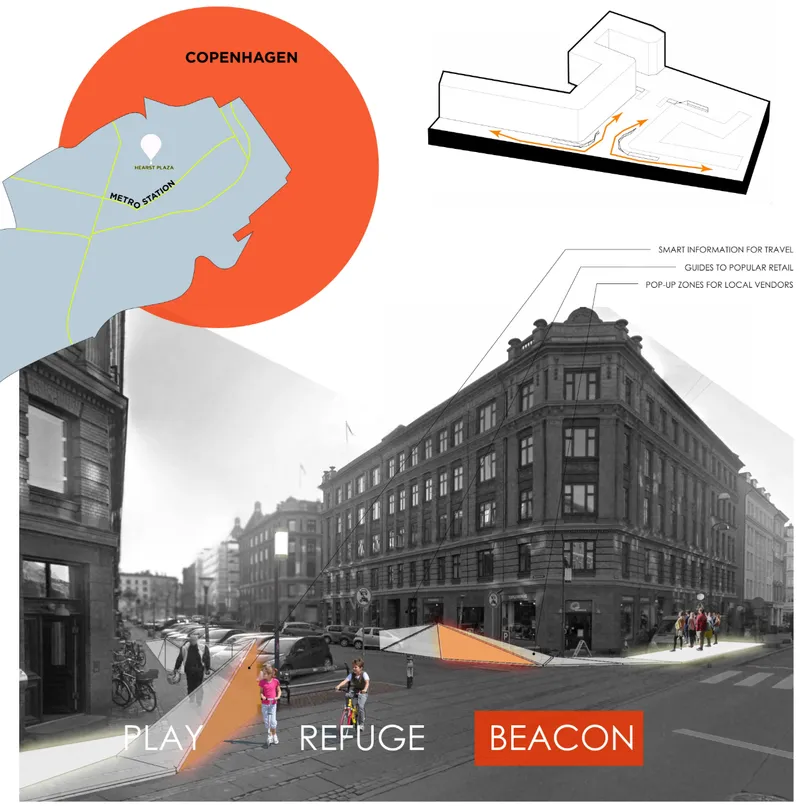
The final collage pairs a corner building, fitted with orange angular canopies and passed by cyclists, with a site map and an isometric circulation diagram. It is the clearest expression of the Beacon pillar. The canopies are bold enough to read from a distance and anchor a corner that would otherwise go unnoticed. The team's Copenhagen proposal targets heritage-rich but passively used spaces near metro stations. It combines pop-up retail zones, guided digital wayfinding and landmark canopy structures to strengthen pedestrian engagement and local economic participation.
Setting the collage beside the circulation diagram shows the canopy is more than a graphic gesture. It sits where routes converge, so orientation and identity overlap. The same approach drives the New York scenario, where interactive media walls and programmable lighting turn commercial P.O.P.S. into social hubs for spontaneous performance and daily gathering, while also making circulation clearer and the spaces safer. The vocabulary changes from city to city, but the move stays the same: make the space visible, then give people a reason to stay.
Why This Project Matters
USeR addresses a real and widespread condition. Privately Owned Public Spaces are a product of policy, not design ambition, and many cities have inherited a large stock of them that underperforms. The project neither condemns the incentive model nor proposes rebuilding these sites. It argues that the gap between legally public and socially public can be closed with lightweight means. Lighting, shelter, interactive surfaces and signage are cheap compared with reconstruction and fast to deploy, so the strategy is realistic as well as appealing.
Its strongest quality is portability. Play, Refuge and Beacon are not a style to stamp onto every site. They are a diagnostic framework that adapts to a Manhattan plaza, a Setagaya tram edge or a Copenhagen metro forecourt. There is a fair question about how digital layers such as media walls and smart signage will age, and who maintains them. Even so, the core proposition stands: dormant urban space is often one well-placed intervention away from becoming a place people choose to be.
View the Full Project
About the Designers
Designers: Austin Crowley, Kevin King, Merrit Morcos
Enter a Design Competition on uni.xyz
uni.xyz runs architecture and design competitions year-round that reward proposals with spatial conviction and real site intelligence.
Project credits: USeR by Austin Crowley, Kevin King, Merrit Morcos.


Popular Articles
Popular articles from the community


U.GA Architects Wraps an Oval Rooftop Pool in Curved Board-Formed Concrete on Busan's Jeollidan-gil
In Busan's Jeonpo-dong, a 454 m² mixed-use block stacks a neighborhood facility, guest rooms and an oval rooftop pool inside spiraling concrete walls.

LT2A and OPEN Architectes Thread a Brick and Glass High School Through a Wooded Belgian Campus
In Braine-l'Alleud, a 3,000 m² wing for Collège Cardinal Mercier pairs pale brick with a glazed colonnade, deferring to a small chapel and a dense wood.

Architekt Andreas Gruber Scatters 23 Dark Timber Chalets Across a South Tyrolean Forest Edge
In Molini di Tures, Amonti Chalets breaks a resort into a hamlet of gabled timber houses, with parking, storage and services pushed into the slope.

longwave studio Reorganizes a 112 m² Tainan Apartment Around the Daily Routines of a Family and Two Cats
In Tainan, Taiwan, birch plywood, rust-red furniture and a freestanding plaster wall link arrival, storage, work and family life in one apartment.

Similar Reads
You might also enjoy these articles
Healing Façade: A Modular Chapel System That Restores Ethiopia's Sacred Forests
Winner of the Eco-Chapel competition, this circular timber façade collects water from air to rebuild soil and reforest degraded Ethiopian landscapes.
Kaffeebühnen: Where Coffee Shop Architecture Becomes a Civic Stage in Vienna
A linear sequence of timber boxes, transparent shells, and open yards turns the Viennese café tradition into a public performance space.
Eco Chapel: A Modular Forest Pavilion That Grows Like the Landscape It Protects
Hexagonal timber modules weave through existing trees, turning a chapel into a living system for prayer, education, and reforestation.


Urban Forest: A Vertical Ecosystem for 5,000 Workers in Singapore's Changi Business Park
Radially stacked pods and layered green decks turn a 7-acre plot into 47 acres of ecological workspace projected for 2040.

Explore Prototyping Competitions
Discover active competitions in this discipline

Design challenge to equip cities with modern furniture

Packaging challenge - Design meets sustainability
Comments (0)
Please login or sign up to add comments
No comments yet. Be the first to comment!