
Tale of a legend
Memorial for Sher-e-Bangla A.K.. Fazlul Huq.

About Sher-e-Bangla Abul Kasem Fazlul Huq
Sher-e-Bangla Abul Kasem Fazlul Huq was a towering Bengali leader who fought relentlessly for the civil rights and welfare of the people of East Bengal during both the British and Pakistan eras. Sher means “Tiger,” and Sher-e-Bangla translates as “Tiger of Bengal.” He is remembered as the Royal Bengal Tiger of Indian subcontinental politics. His remarkable contributions—ranging from agrarian reforms and the abolition of the zamindari system to his central role in the Lahore Resolution—made him a statesman whose vision extended beyond politics to the very fabric of society. The historic Lahore Resolution, which he placed in 1940, is considered the first formal vision that ultimately led to the creation of an independent Bangladesh.
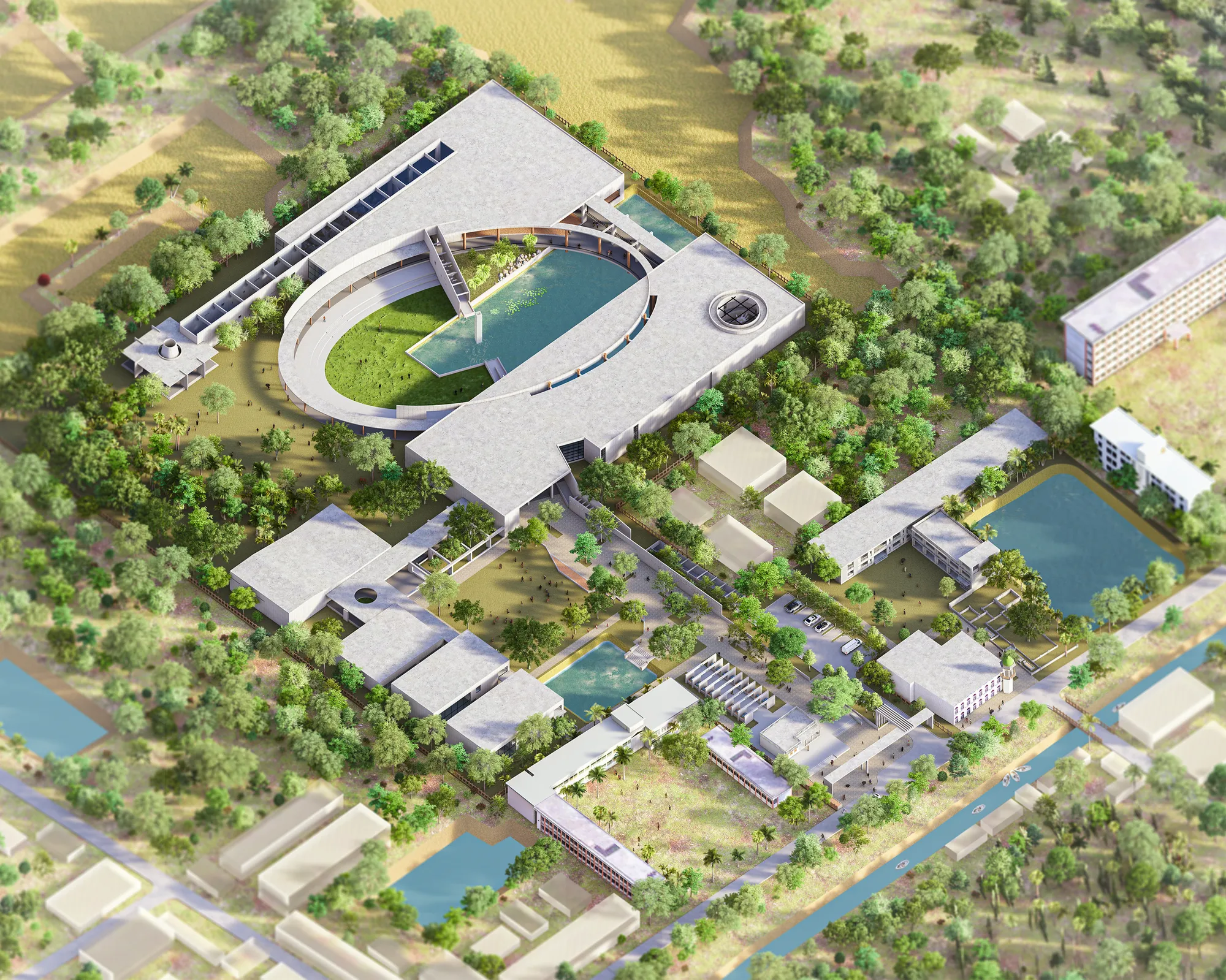
In response to his legacy, a proposal has been made to establish a new memorial museum dedicated to Sher-e-Bangla A.K. Fazlul Huq. The vision is to create not just a museum, but a living memorial—an environment that reflects his ideals while inspiring new generations.
The project focuses on three core aspects: preservation, education, and inspiration. The ancestral bungalow, family graveyard, and ponds on the site will be conserved as heritage elements, ensuring the continuity of memory and place. Exhibition galleries will narrate his political journey and personal life, while open plazas and gathering spaces will provide opportunities for collective remembrance, cultural programs, and civic interaction.
Barishal’s unique landscape of rivers, canals, and ponds forms the natural backdrop of the project. This water-based identity is woven into the design through preserved waterbodies, traditional ghats, and green open spaces—ensuring both ecological sustainability and cultural authenticity. For students and young visitors, the memorial will serve as a platform for learning, nurturing leadership, and cultivating civic responsibility, echoing the values Sher-e-Bangla championed throughout his life.
Thus, the proposed memorial is envisioned not merely as a monument of remembrance, but as a dynamic civic and cultural space—where history, heritage, and education converge—keeping alive the enduring spirit of Sher-e-Bangla A.K. Fazlul Huq for future generations..
Design Brief
The memorial is designed over the existing pond, ensuring the biodiversity of the site remains unharmed. Its bold, square form is softened into an elliptical shape, symbolizing Sher-e-Bangla’s dynamic yet adaptable character. This form creates an inner courtyard that offers privacy to the museum while inviting nature inside—echoing how Sher-e-Bangla blended seamlessly with the people of Bengal.
The galleries are divided into three main phases of his life: British era, Pakistan period, and the vision of Independent Bangladesh. Sub-galleries within these phases narrate key moments. The early galleries highlight his struggle for farmers’ rights, represented by the ox and plow. The Lahore Resolution is expressed through a sculpture of a hand breaking chains from water, reaching toward light—a metaphor for freedom.
The Pakistan period galleries explore his political contributions, while the final spaces reflect his vision of an independent Bangladesh. Though he passed away in 1962, his ideals continue. A white crane sculpture above symbolizes his eternal journey. The Liberation War gallery uses stone and a narrow, light-filled path to depict hardship and sacrifice, leading to the Freedom Gallery. Here, an eternal flame stands in an open, wall-less space—reminding visitors that freedom, like fire, is powerful, precious, and must be used wisely.
Necessity of this Memorial
This project is more than an architectural proposal—it is a cultural and historical responsibility. It seeks to preserve the legacy of one of Bengal’s most influential leaders while reinterpreting his ideals for future generations.
The design is deeply rooted in context. Barishal’s geography—shaped by rivers, canals, and ponds—defines the project’s form and spatial character. The memorial is built over an existing pond to preserve biodiversity, while traditional ghats and open courtyards weave nature and culture into the architectural experience. This sensitivity ensures that the project remains both environmentally responsive and socially meaningful.
Symbolism lies at the heart of the design. Each gallery narrates a chapter of Sher-e-Bangla’s life: from his fight for farmers’ rights to the Lahore Resolution, the Pakistan era, and his vision for an independent Bangladesh. Sculptural elements—the ox and plow, the breaking of chains, the white crane, and the eternal flame—transform the museum into a journey of memory, struggle, and hope.
Importantly, the project is not just a static monument but a living civic space. It is designed to inspire leadership, engage communities, and educate future generations about justice, equality, and freedom—the values Sher-e-Bangla stood for. By balancing heritage conservation, ecological awareness, and architectural storytelling, this project embodies the spirit of socially conscious design.
Conclusion
The Sher-e-Bangla A.K. Fazlul Huq Memorial is conceived not as a static monument, but as a living ground of memory and becoming. Architecture here transforms legacy into experience—where form, void, water, and landscape together narrate strength, struggle, loss, and liberation.
The bold geometry reflects the firmness of his character, while the dynamic curves express movement and political vitality. The spatial journey culminates in the “Great Void,” marking the profound silence his passing left in the nation’s history. From there, the path narrows through the Liberation War Gallery toward Victory—symbolizing sacrifice, resilience, and the inevitable march toward freedom.
At its heart lies an open civic realm—free, accessible, and woven into the neighborhood of Chakhar. This public space redefines the memorial as a platform for dialogue, learning, and self-growth. Here, remembrance is not confined to observation; it becomes participation. It invites each visitor to discover within themselves the courage, integrity, and leadership that defined Sher-e-Bangla.
Ultimately, the project aspires to be more than a tribute. It is a democratic landscape of continuity—where history inspires action, and memory nurtures future leaders.




Popular Articles
Popular articles from the community


Co-life: Sustainable Architecture for Age-Friendly Community Living
Co-life reimagines sustainable architecture for seniors through courtyards, rammed earth, shared gardens, and spaces designed for belonging.

Conexión: Biophilic Design Reimagines High-Rise Living in Hong Kong
Conexión reimagines high-rise living in Hong Kong through biophilic design, green facades, shared spaces, daylight, water and nature within.

Co-Life: Senior Housing Design That Reconnects Older Adults With the City
Co-Life reimagines senior housing design through healing gardens, shared streets, workshops, and a sustainable community across generations.

The Ocean Hive: Sustainable Architecture for a Self-Sufficient Civilization at Sea
The Ocean Hive imagines sustainable architecture at sea, where modular habitats, algae, wave power and ocean waste sustain a growing colony.

Similar Reads
You might also enjoy these articles

The Rhythm of Seasons
A Farmers' Market Connecting Nature and the City

More Than a Building-Designing a Living System
More Than a Building-Designing a Living System
Base Beyond
DESERT COMPOUND ARID: TOURISM OF ABSENCE AND ABUNDANCE


Comments (0)
Please login or sign up to add comments
No comments yet. Be the first to comment!