
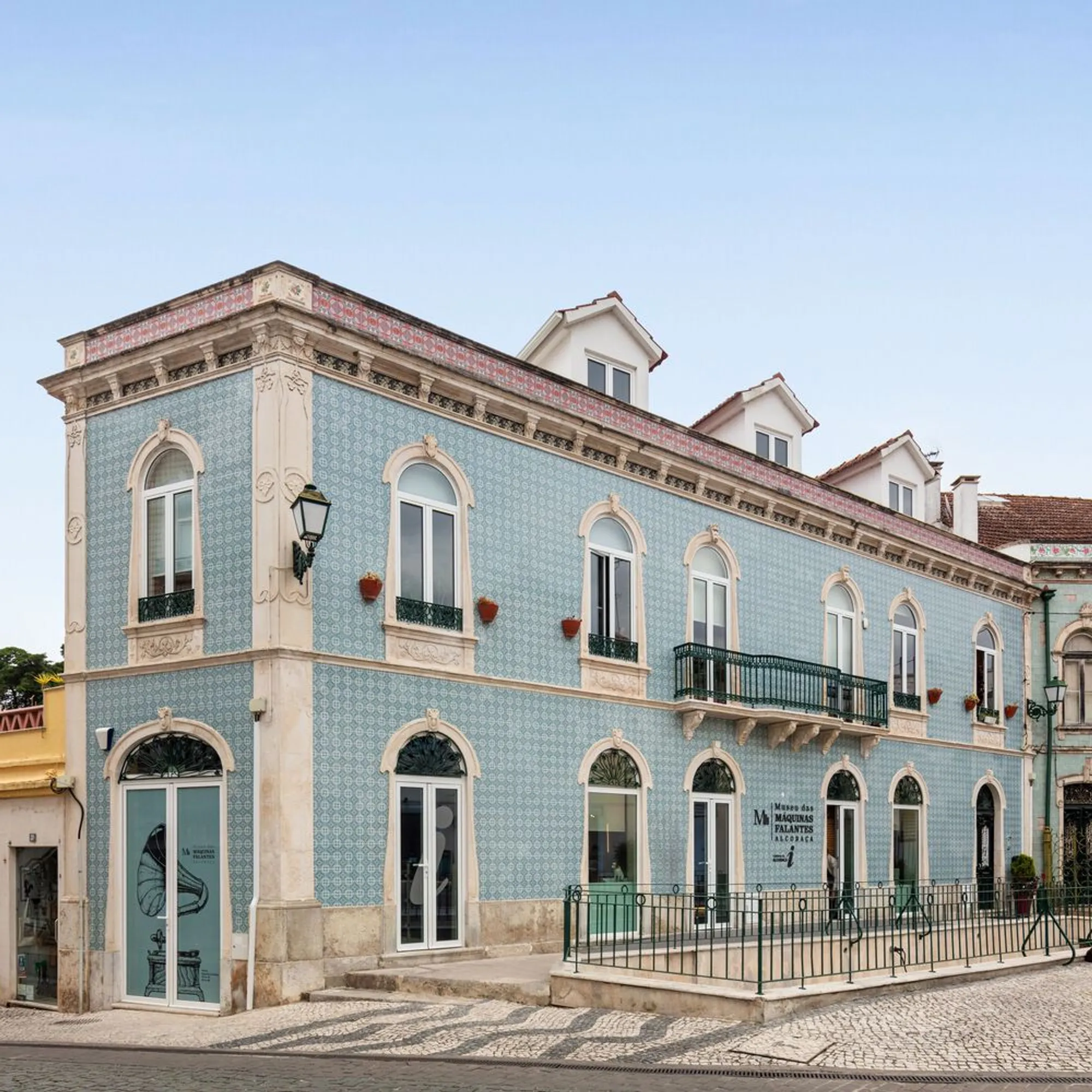
Talking Machines Museum by UMA Collective
Curved, soundwave-inspired interiors transform a former commercial space into an immersive museum celebrating sound technology beside Alcobaça Monastery in Portugal.


The Talking Machines Museum (Museu das Máquinas Falantes), designed by UMA Collective, introduces a contemporary cultural landmark in Alcobaça, Portugal, carefully positioned beside the historic Alcobaça Monastery. Initiated in 2017 and inaugurated on 25 April 2024, the project transforms a former commercial interior into an immersive museum dedicated to the history of sound, telecommunications, and broadcasting.
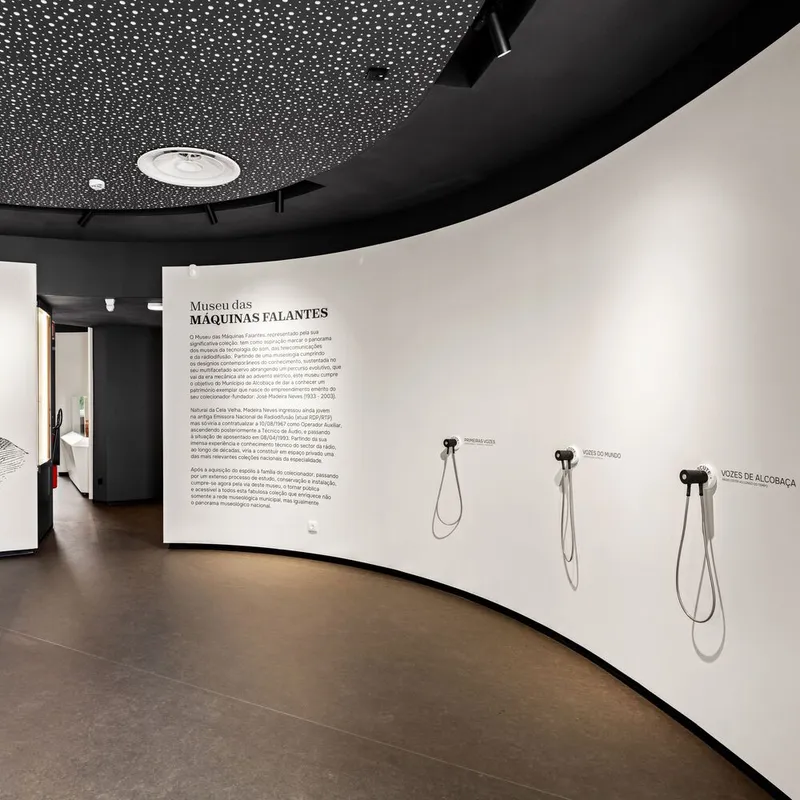
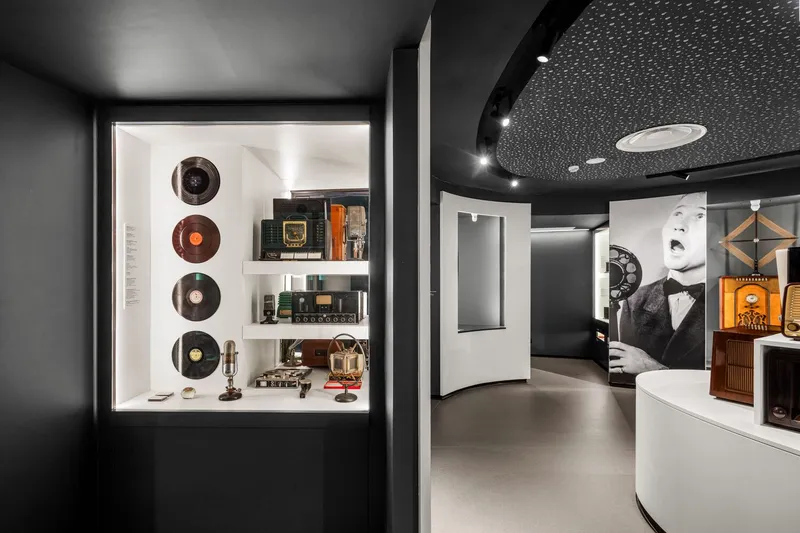
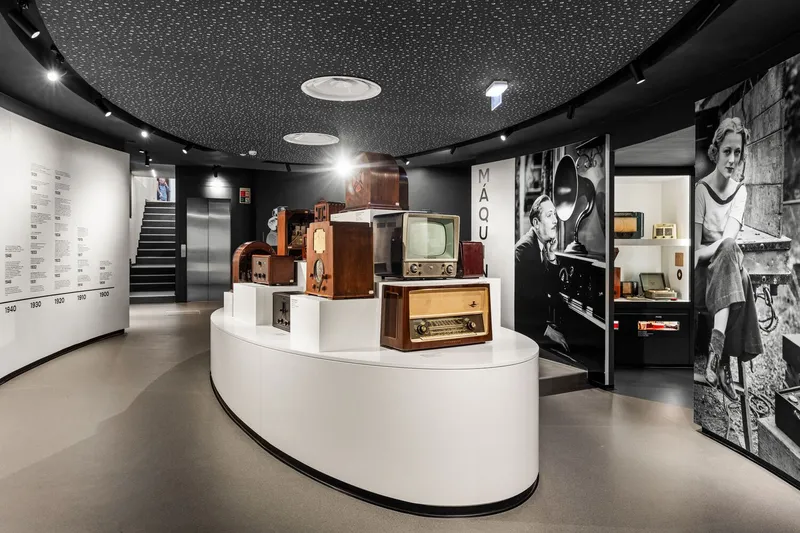
Housing a remarkable collection of over 5,000 sound-related objects, originally assembled by José Madeira Neves and later acquired by the Municipality of Alcobaça, the museum bridges technological heritage with spatial experimentation. The project demonstrates how adaptive reuse and interior architecture can support both curatorial clarity and sensory engagement.
Urban Context and Spatial Organization
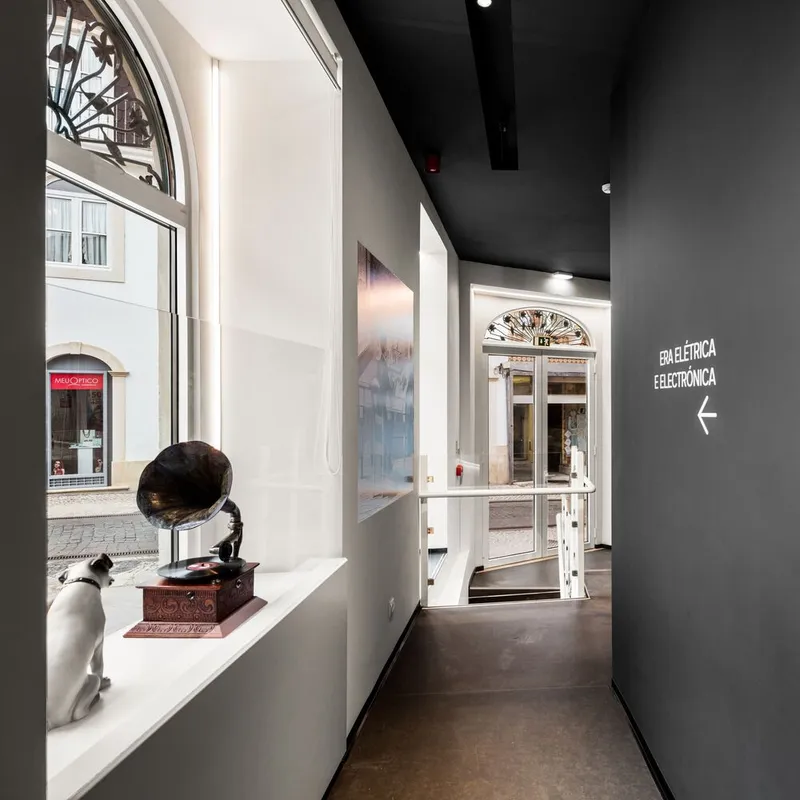
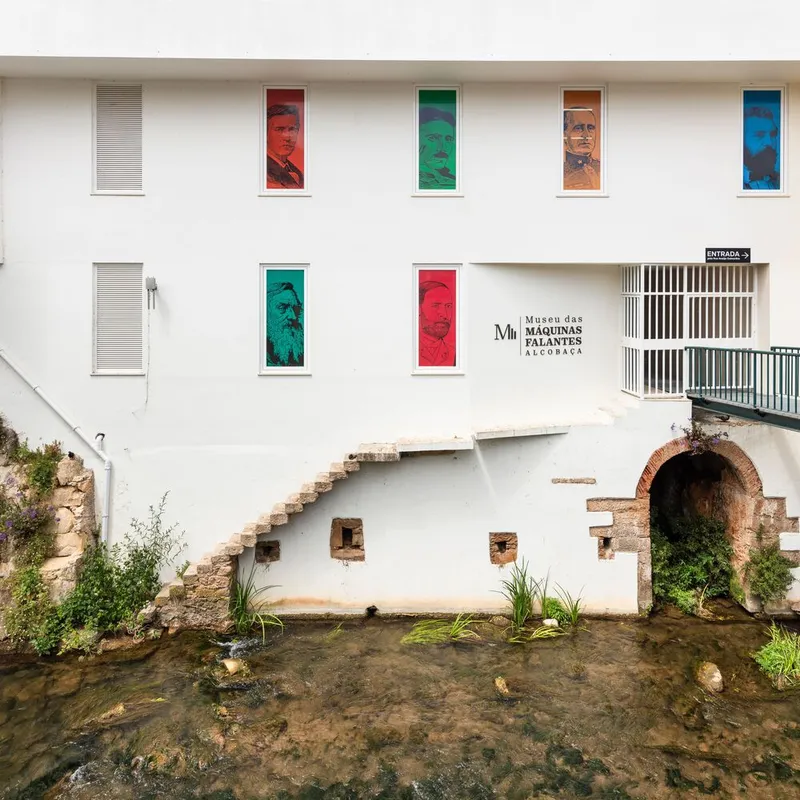
The museum occupies a strategic location adjacent to the monastery complex and unfolds across two floors, with the lower level connecting directly to a pedestrian bridge over the Alcoa River. This physical connection reinforces the museum’s role as an urban hinge between historic fabric, landscape, and contemporary cultural life.
With a total area of approximately 420 square meters, of which 330 square meters are dedicated to exhibition spaces, the project required a highly efficient spatial strategy. The reception area also integrates the Alcobaça Tourist Office, positioning the museum as both a cultural destination and a point of civic orientation.
Interior Redesign and Architectural Challenges
The intervention involved a complete interior redesign of a previously fragmented commercial space characterized by an irregular plan, a dense structural grid of columns, and limited usable surface relative to the scale of the collection. Rather than resisting these constraints, UMA Collective responded with a strong conceptual framework that transforms limitation into spatial identity.
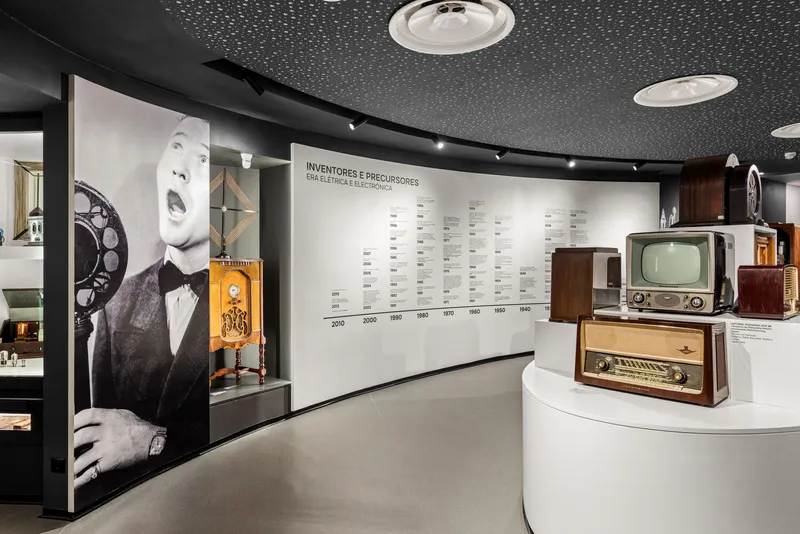
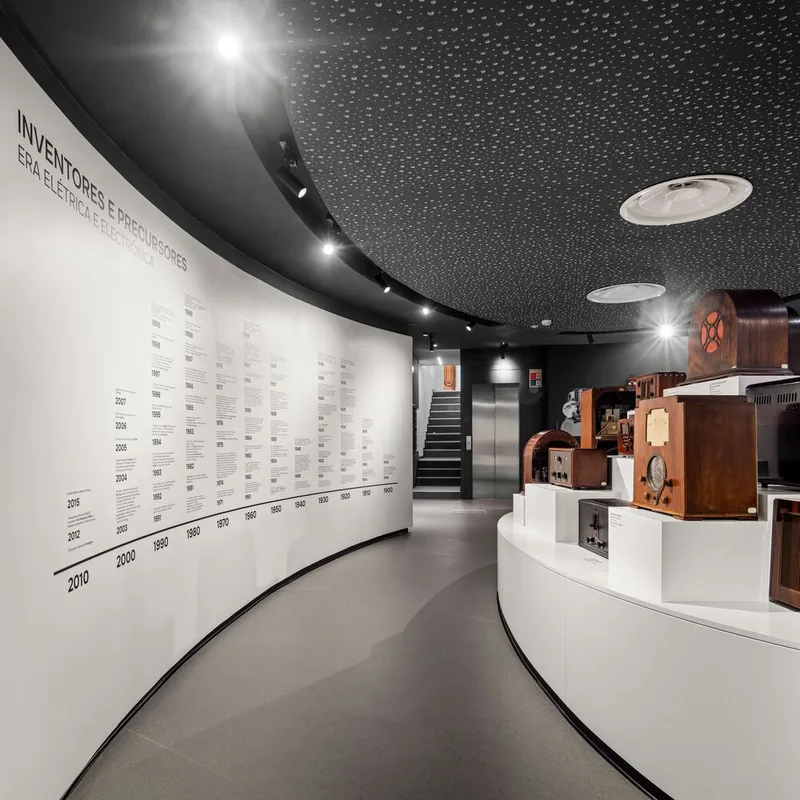
The architectural concept draws direct inspiration from the visual representation of sound waves, translating acoustic phenomena into spatial geometry. Curved forms organize circulation, define exhibition zones, and establish a clear hierarchy while softening the rigidity of the existing structure.
Curved Geometries and Exhibition Experience
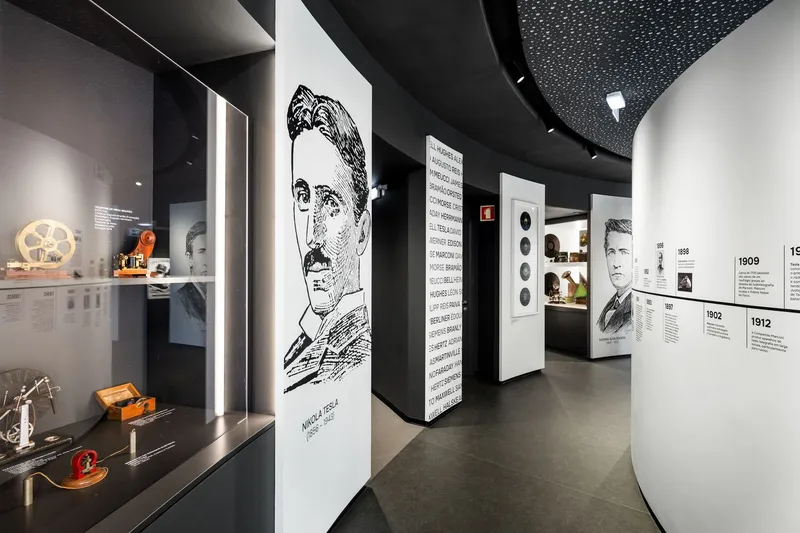
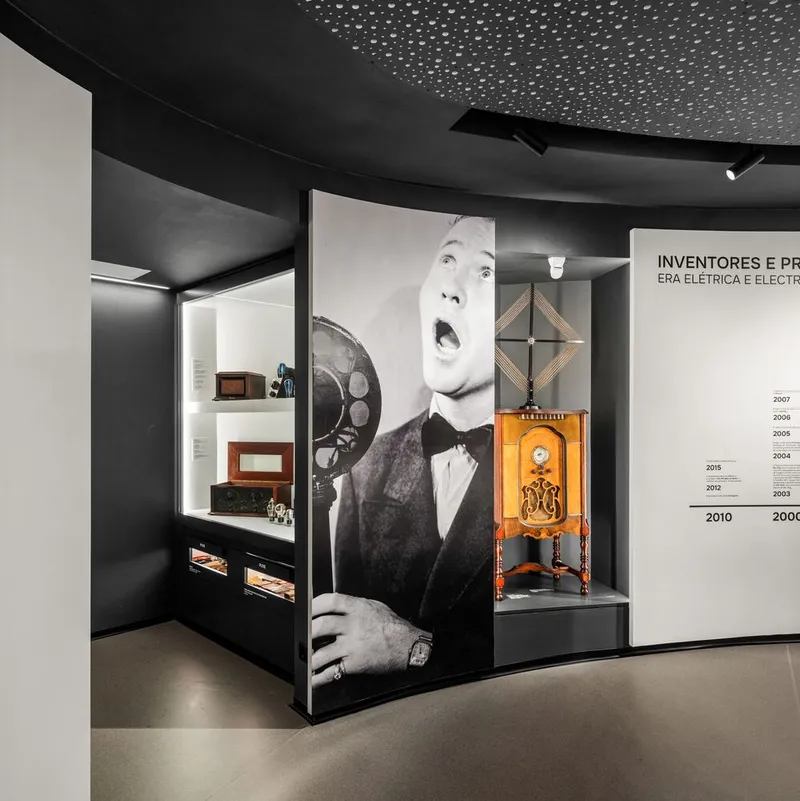
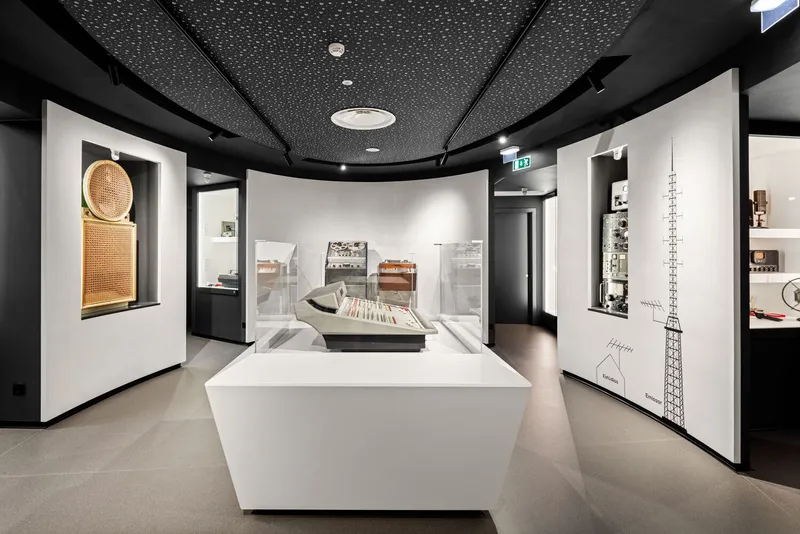
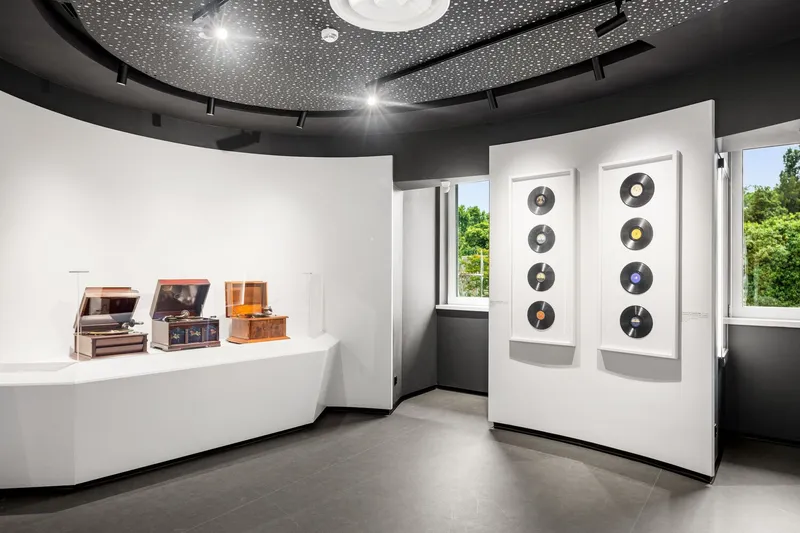
At the heart of the museum are four elliptical chambers, articulated by smooth, white, curved surfaces. These chambers function as open exhibition rooms and support the majority of the museum’s graphic and interpretive content. Their geometry introduces a sense of continuity and flow, guiding visitors intuitively through the narrative of sound technologies.
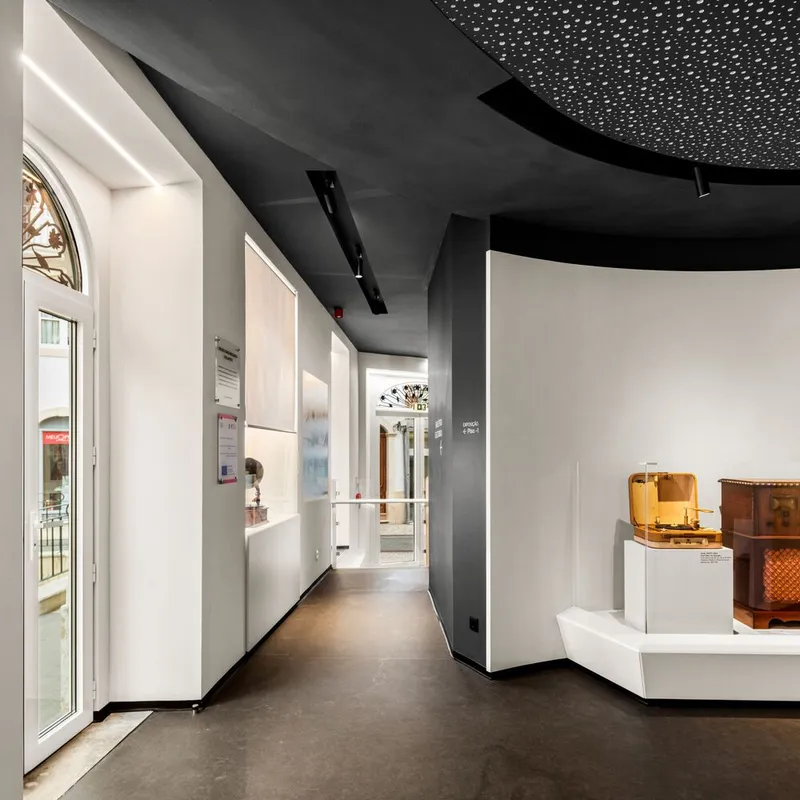
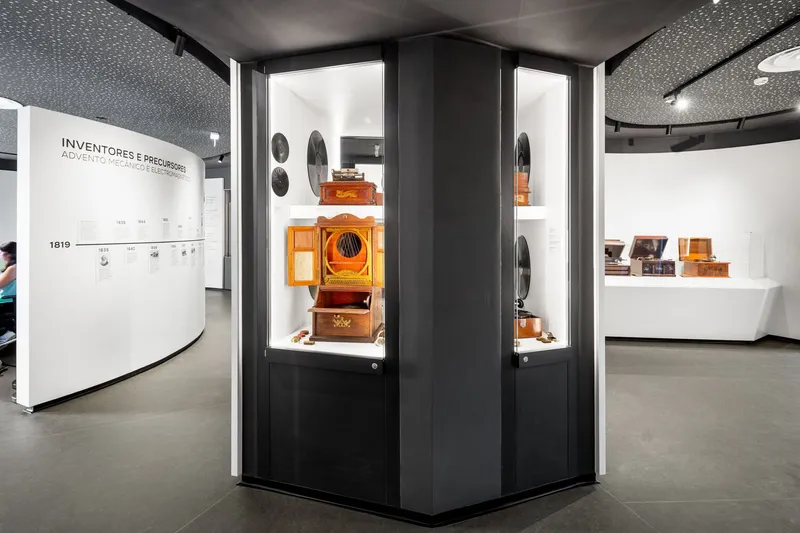
Between these chambers, a series of exhibition antechambers create moments of compression and pause. These transitional spaces feature niches, glass display cases, lower ceiling heights, and finely tuned acoustic treatments, reinforcing intimacy and focus.
The interior palette is deliberately restrained. Neutral and predominantly dark tones form a subdued background, allowing the morphological and chromatic diversity of the exhibited objects to stand out. This contrast enhances legibility while reinforcing the museum’s immersive atmosphere.
Materiality, Acoustics, and Lighting
Acoustic performance is central to the project. The ceilings incorporate acoustic panels, while curved plasterboard partitions help modulate sound and reduce reverberation. Recessed lighting integrated into the ceilings provides controlled illumination, avoiding visual noise and ensuring consistent exhibition conditions.
Custom-designed exhibition furniture, primarily crafted from lacquered wood, was developed specifically for the collection. Designed in close collaboration with curator Alberto Guerreiro, the furniture reflects a long and precise design process, balancing conservation requirements, ergonomics, and visual coherence.
Architecture as a Medium for Sound Heritage
Rather than acting as a neutral container, the Talking Machines Museum uses interior architecture as an interpretive tool. Curvature, acoustics, light, and materiality work together to translate the invisible nature of sound into a tangible spatial experience. The result is a museum that not only displays objects but also embodies the logic of sound itself.
All photographs are works of João Morgado



Popular Articles
Popular articles from the community


Lunar Spiral: Space Architecture Shaped by the Mathematics of the Universe
Lunar Spiral reimagines space architecture through Fibonacci geometry, lunar regolith, levitating habitats, and self-sustaining Moon living.

The Musturak Paradise: Senior Living Architecture for a Connected Future in Temara, Morocco
The Musturak Paradise reimagines senior living architecture in Temara via private homes, social spaces, culture, community, and shared care.

Riyadh For All: Intergenerational Urban Design for Active Aging in Rabat
Riyadh For All reimagines urban design in Rabat with intergenerational co-living, adaptive courtyards, and Moroccan cultural exchange today.

Co-life: Sustainable Architecture for Age-Friendly Community Living
Co-life reimagines sustainable architecture for seniors through courtyards, rammed earth, shared gardens, and spaces designed for belonging.


Similar Reads
You might also enjoy these articles


Hodi-Mandai Geram
Project Function: Preservation and revitalization of the Intangible heritage and socio-spatial identity of the Hodi by Housing, Cultural Memory Center, Sacred Grove, landscape, local tourism economy


Olio Towers: A Mid-Rise for Performers That Fuses Housing, Rehearsal, and Stage
Located blocks from Houston's Theater District, this modular tower stacks living units around a central performance atrium.

Oasis: Modular Green Housing Carved into Dhaka's Urban Fabric
A shortlisted Plugin Housing entry reclaims unauthorized settlements in Dhaka with stepped concrete volumes, green roofs, and ventilation-driven design.

Black Hole: A Floating Megastructure for the Post-Physical Era
Emiliano Mazzarotto envisions a spherical, self-scaling arena where e-sports, digital hotels, and holographic stadiums replace traditional public space.


Explore Cultural Architecture Competitions
Discover active competitions in this discipline



Challenge to reimagine the Iron Throne


Photograph architecture without architects


Illustrate the lost glory of Angkor Wat - Render Challenge


Bring back Drive In's
Comments (0)
Please login or sign up to add comments
No comments yet. Be the first to comment!