
Tanim-Bale: A Five-Level Seedling House Rooted in Metro Manila's Dense Urban Fabric
Vertical farming, passive cooling, and multi-generational living converge in a narrow timber tower that grows food and family life alike.


A seedling pushes through a crack in concrete. That image, both literal and metaphorical, drives Tanim-Bale, a five-level residential tower designed for a working-class family in Pasay City, Metro Manila. The name fuses two Filipino words: Tanim (to plant) and Bale (house). The building takes that fusion seriously, weaving hydroponic vertical gardens, louvered facades, and passive ventilation into a structure narrow enough to fit the dense urban grain of one of Southeast Asia's most pressurized cities. It is not a house that merely shelters. It produces food, circulates air without mechanical systems, and stacks five generations of domestic life into a compact vertical section.
The project is the work of Janine Hung, who situates it in Pasay City, a district defined by high population density, migrant labor, commercial activity, and a chronic shortage of affordable housing close to essential services like markets, schools, and transport hubs. Rather than proposing large-scale redevelopment, Tanim-Bale argues that small, community-based housing projects can collectively shift the trajectory of an entire neighborhood. The design is calibrated for the tropical climate and for a specific fictional household, the Santos family, whose daily routines and aspirations inform every spatial decision.
A Timber Tower Among Concrete Neighbors

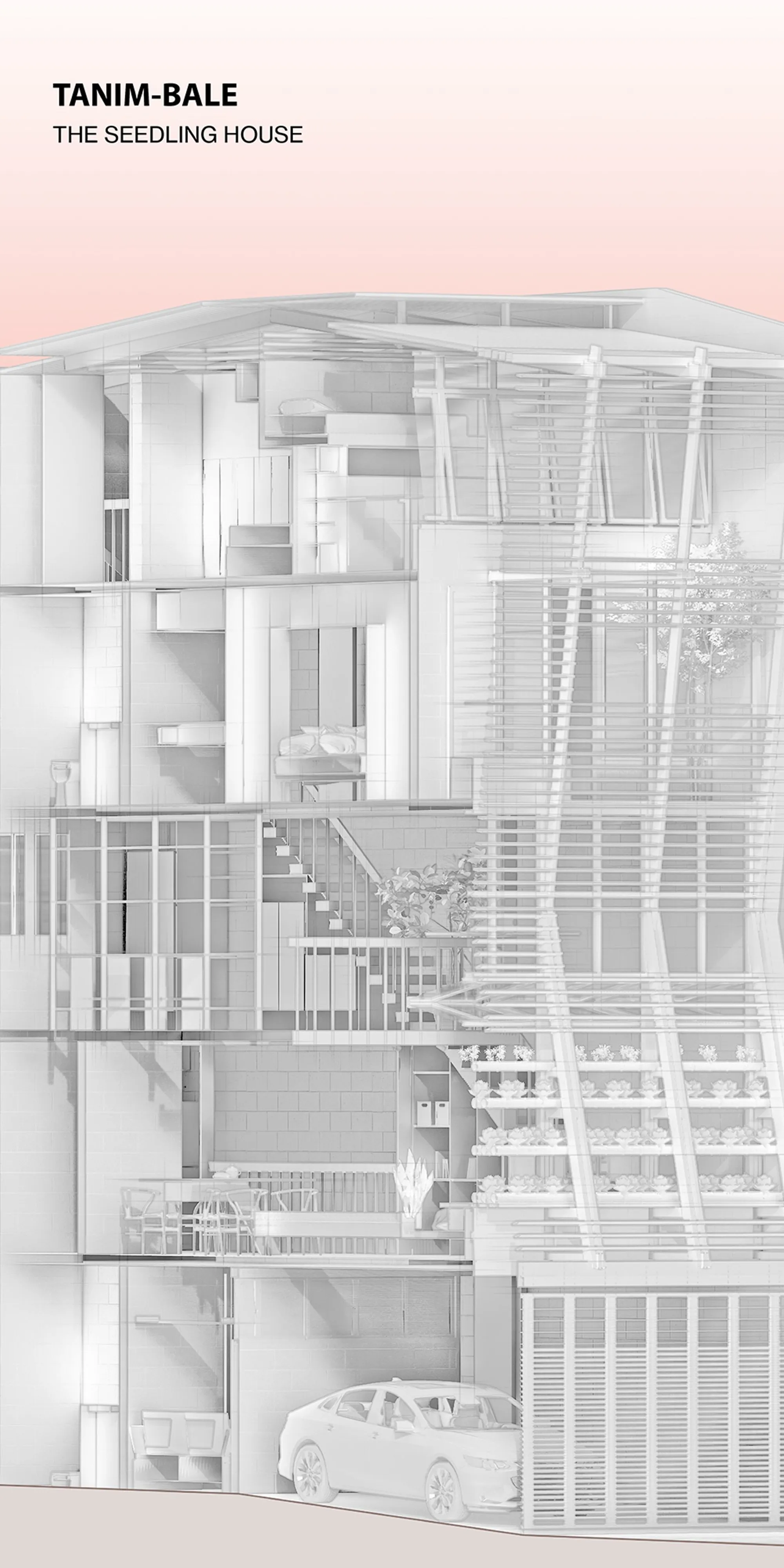
Seen at dusk, Tanim-Bale glows warmly against its weathered concrete surroundings. Timber louvers wrap the facade, filtering light and air while providing sun-shading suited to Manila's tropical latitude. Planters at multiple levels interrupt the building's vertical mass, signaling the integration of greenery into the structural logic rather than treating it as ornament. The overhanging roof extends beyond the building envelope, offering weather protection against monsoon rains. In a streetscape dominated by flat, impermeable surfaces, the tower reads as an organism: porous, breathing, and rooted.
Stacking Five Floors of Multi-Generational Life

The exploded axonometric and floor plans reveal how precisely each of the five levels is programmed. The ground floor handles utility functions and a convertible guest room. The second floor centers on dining and living areas designed to encourage family interaction. A third-floor recreational zone doubles as a homeschooling classroom. The fourth floor houses the master bedroom and private retreats, while the fifth accommodates children's rooms outfitted with space-saving, foldable furniture. Shared spaces benefit from high ceilings that promote airflow and reduce trapped heat; bedrooms are compact by contrast, optimized through retractable elements.
The vertical stacking is not arbitrary. Lightwells and airwells thread through the section, enabling natural ventilation from ground to roof. Clerestory windows at upper levels pull daylight deep into the plan. The section reads as a chimney of sorts: warm air rises and exits through louvered roof openings, drawing cooler air through lower apertures. These passive cooling strategies eliminate or drastically reduce the need for air conditioning, a significant cost and energy burden for low-income families in the tropics.
Growing Food on a Timber Wall

The interior view of the hydroponic garden wall is perhaps the project's most compelling image. Rows of seedlings sit in timber-framed channels beneath a louvered skylight that controls both light intensity and ventilation. The system allows residents to grow organic produce within the house itself, reducing dependence on expensive market food and improving dietary health. For the Santos family narrative, this space belongs to Efren, the retired grandfather and former farmer who tends the garden as both livelihood and purpose. Air purification, heat gain reduction, and mental well-being are secondary benefits that the greenery delivers without any additional infrastructure.
The hydroponic wall also works architecturally. It functions as a thermal buffer, absorbing solar radiation before it reaches interior living spaces. The evapotranspiration from plants contributes to passive cooling. And visually, it softens the boundary between inside and outside, reinforcing the seedling metaphor at the scale of a room rather than a facade.
Designing for People, Not Just Performance Metrics
What elevates Tanim-Bale beyond a sustainability exercise is its attention to lived experience. The Santos family is fictional, but their roles are sharply drawn: Carmela, the grandmother, crafts household goods; Alejandro and Cassandra balance work and childcare; Anika and Eggy learn and play in spaces designed to be safe and stimulating. Each floor responds to a specific domestic rhythm. The recreational third floor, for instance, acknowledges that in dense urban contexts where outdoor space is scarce, the house itself must provide room for play, study, and decompression. The convertible ground-floor layout anticipates visitors and shifting household needs over time, a nod to the fluidity of Filipino multi-generational living.
Why This Project Matters
Tanim-Bale does not propose a scalable housing block or a government policy framework. Its ambition is more precise and, in some ways, more radical: it argues that a single narrow tower, designed with care for climate, food production, and family structure, can seed regeneration in a neighborhood. Multiply that logic across a district like Pasay City, and you begin to see how incremental, human-scaled interventions could reshape Metro Manila's housing landscape without demolishing what already exists.
Janine Hung's contribution is to ground that argument in specifics: five floors, louvered timber, hydroponic channels, a grandfather's garden, a child's foldable desk. The project merges traditional Filipino spatial values with contemporary passive design strategies and delivers a proposition that feels both urgent and achievable. As Asian megacities continue to densify, Tanim-Bale offers a quiet counter-narrative to the tower-and-podium default, one seedling at a time.
View the Full Project
About the Designers
Designer: Janine Hung
Enter a Design Competition on uni.xyz
uni.xyz runs architecture and design competitions year-round that reward proposals with spatial conviction and real site intelligence.
Project credits: Tanim-Bale by Janine Hung.




Popular Articles
Popular articles from the community


EW PARK: Sustainable Architecture Reimagines the Future of Urban Parking
EW PARK reimagines city parking as a modular wooden tower combining automation, solar energy, electric mobility, and adaptable urban design.

Riyadh For All: Intergenerational Urban Design for Active Aging in Rabat
Riyadh For All reimagines urban design in Rabat with intergenerational co-living, adaptive courtyards, and Moroccan cultural exchange today.

The Ocean Hive: Sustainable Architecture for a Self-Sufficient Civilization at Sea
The Ocean Hive imagines sustainable architecture at sea, where modular habitats, algae, wave power and ocean waste sustain a growing colony.

Co-Life: Senior Housing Design That Reconnects Older Adults With the City
Co-Life reimagines senior housing design through healing gardens, shared streets, workshops, and a sustainable community across generations.


Similar Reads
You might also enjoy these articles

Bao Huynh Watercolor Atelier: A Serene Art Retreat in Hội An
Bao Huynh Watercolor Atelier in Hội An blends multifunctional art spaces, sustainable design, local materials, and family-friendly living in a serene environment.

Atelier Macri Concept Store Interior Design by CASE-REAL
Atelier Macri store features a "ko" counter, walnut wood details, cork displays, blending retail, gallery, and seamless customer experiences.

Manuel Vargas Izquierdo Stadium and High-Performance Sports Center: Architectural Excellence in Jalpa de Méndez
The Manuel Vargas Izquierdo Stadium blends sustainable design, inclusive sports facilities, and cultural-inspired architecture, revitalizing Jalpa de Méndez’s public spaces.

KAKR Buluh Awar Hall: Revitalizing Community and Ecology Through Bamboo Architecture
Community built bamboo hall revitalizes Buluh Awar village, empowering youth, restoring ecology, celebrating vernacular craftsmanship through sustainable architecture and culture.

Explore Housing Competitions
Discover active competitions in this discipline



Challenge to reimagine the Iron Throne


Photograph architecture without architects


Illustrate the lost glory of Angkor Wat - Render Challenge


Design challenge to reuse E-waste
Comments (0)
Please login or sign up to add comments
No comments yet. Be the first to comment!