
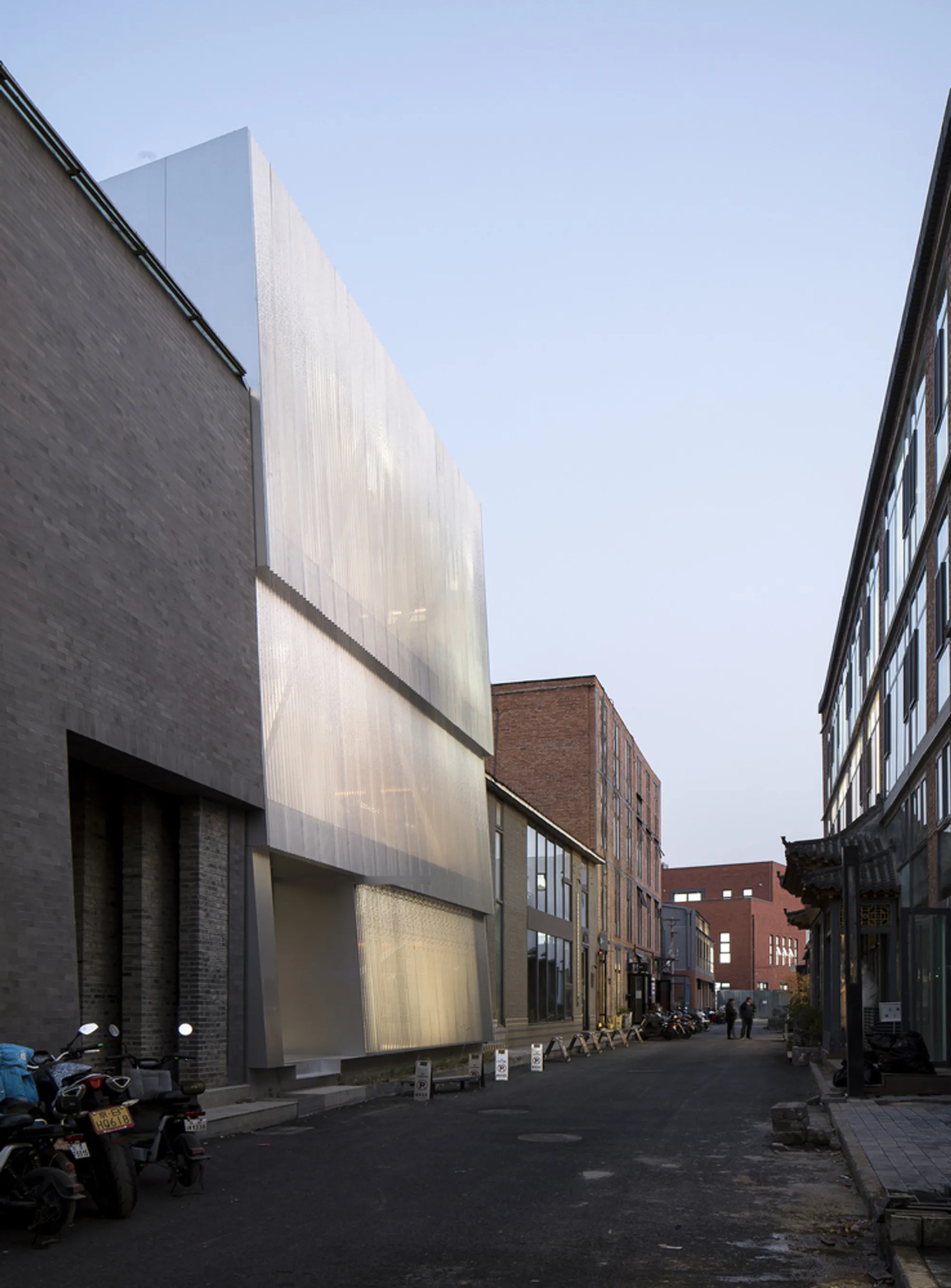
TAOA Wraps Its Own Beijing Studio in Corrugated Metal to Reimagine a 798 Art District Workshop
A three-story office renovation in Beijing's 798 Art District trades industrial brick for ribbed metal and translucent light wells.


Designing your own office is the most dangerous brief an architect can accept. Every material choice, every proportion, every threshold becomes a public declaration of values. TAOA took that risk inside Beijing's 798 Art District, converting an existing workshop structure into a three-story studio that doubles as exhibition space, meeting hub, and quiet retreat. The result is a building that manages to be both demonstrative and restrained, a calling card that never quite tips into showmanship.
What makes the project worth studying is not the corrugated metal skin on its own, though that move is bold enough in a neighborhood defined by Soviet-era red brick. It is the relationship between opacity and translucency, between the tight urban grain of the surrounding lanes and the generous vertical voids carved through the interior. TAOA treats light as a structural material here. Translucent polycarbonate panels, skylights, glass bridges, and interior courtyards conspire to flood narrow floor plates with daylight while keeping the street facade almost fortress-like. The tension between those two conditions is the engine of the whole design.
A Metal Shell Among Red Brick
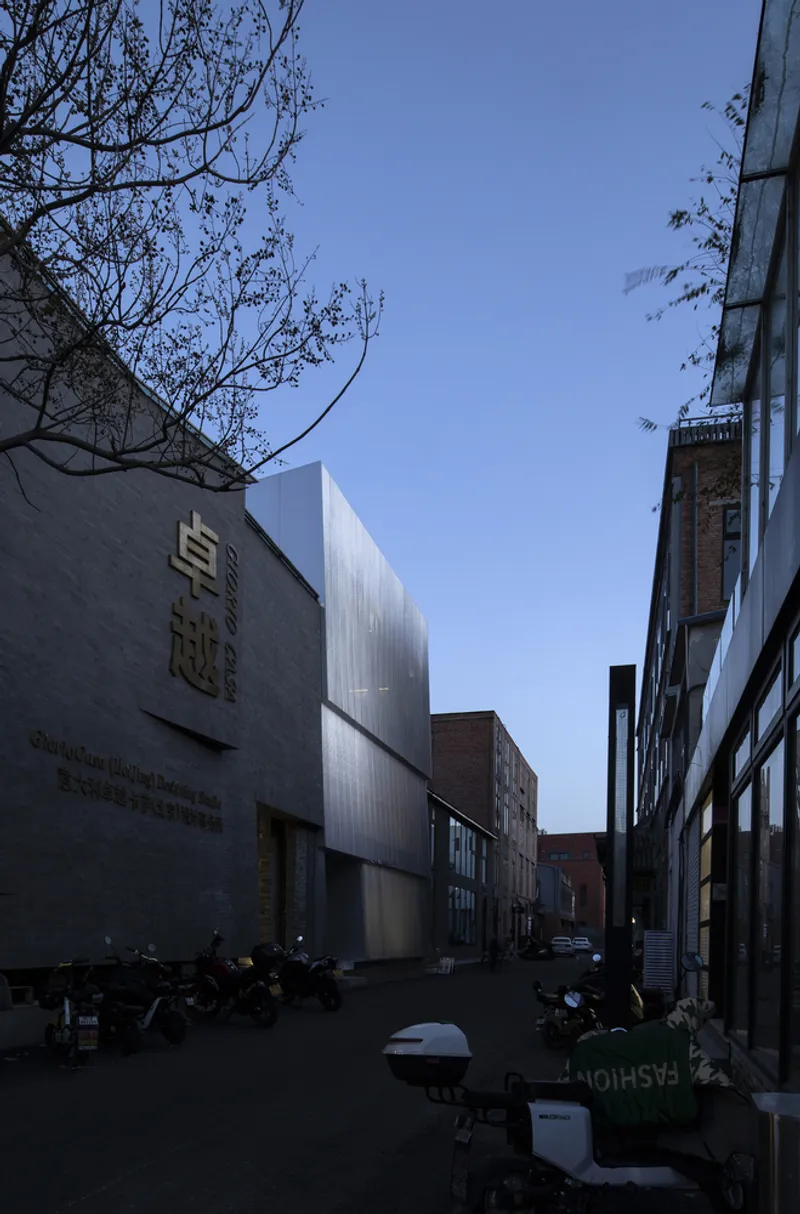
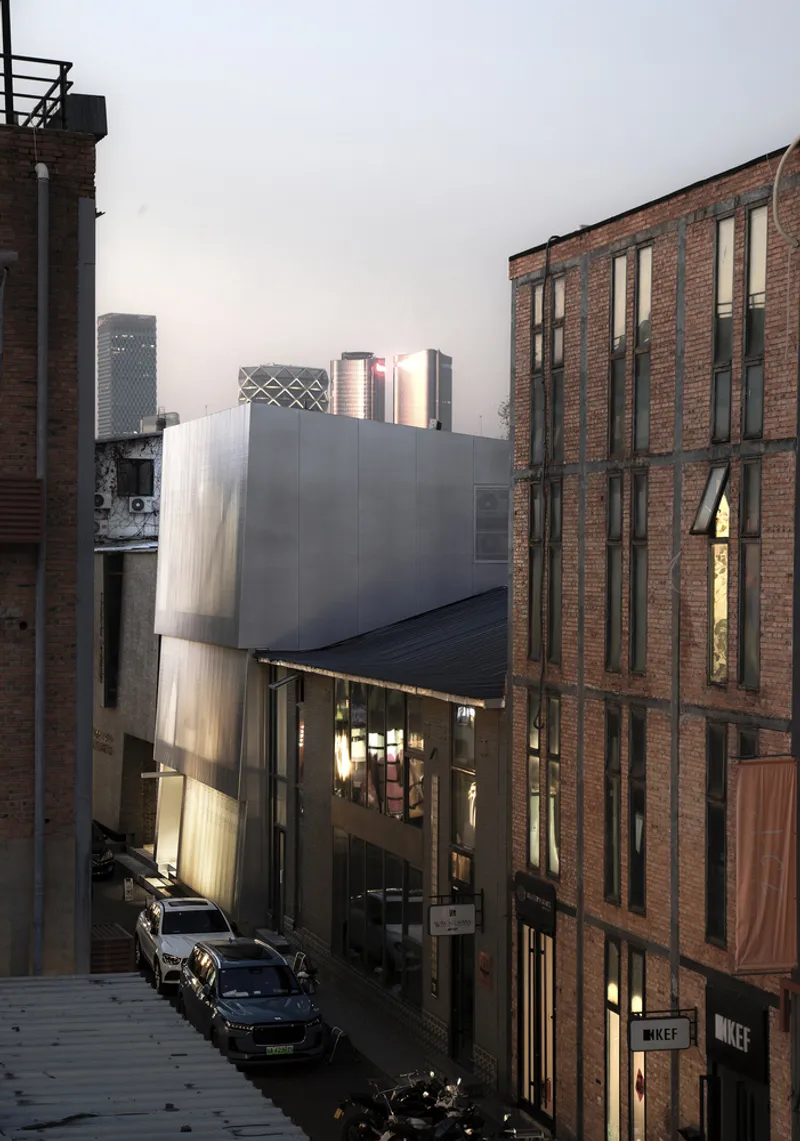
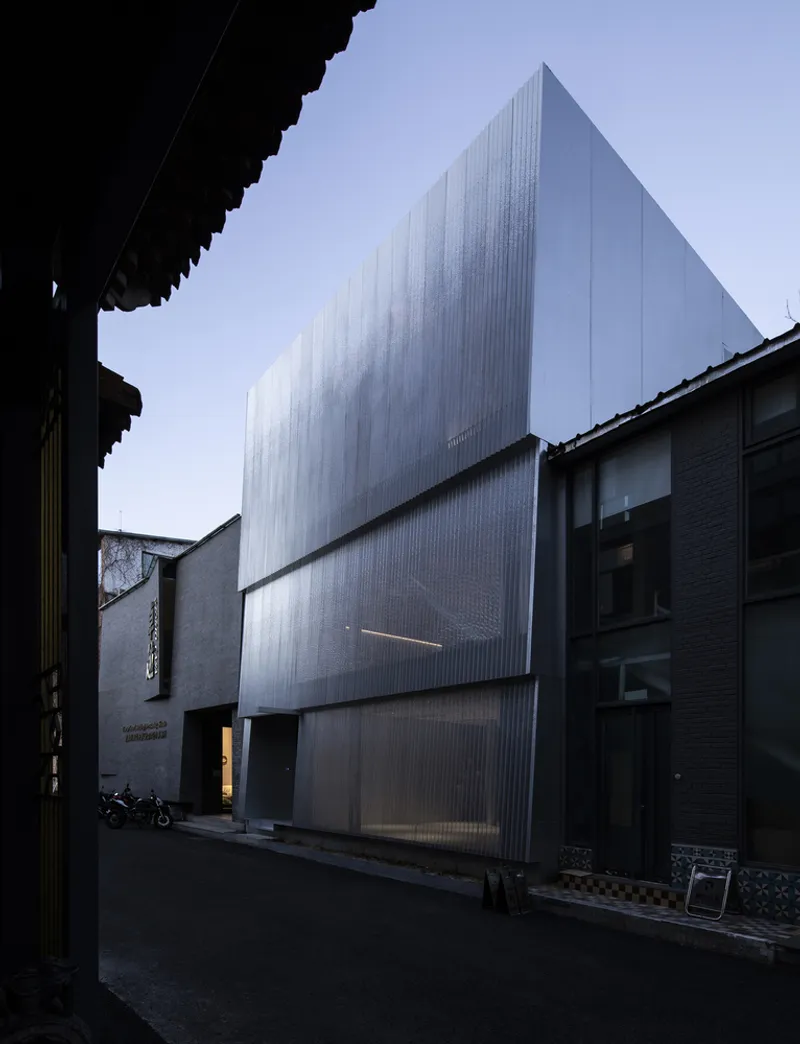
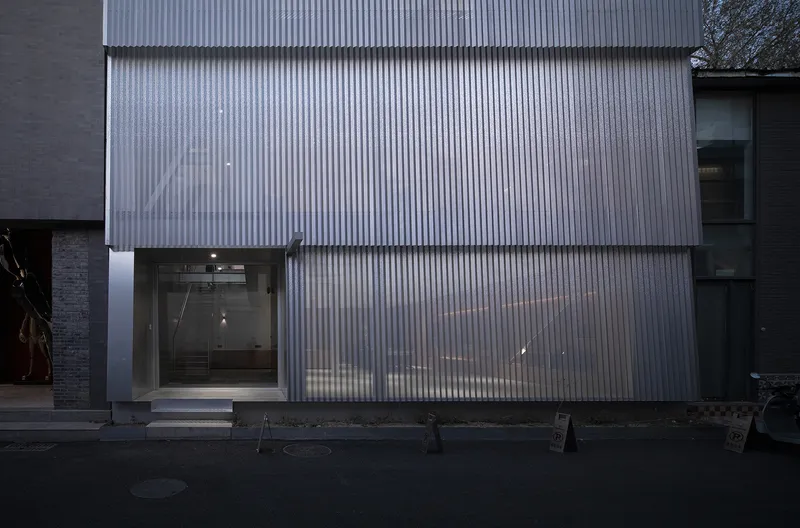
The 798 Art District is a landscape of repurposed factory halls and galleries nestled between low brick walls and narrow alleys. TAOA's studio announces itself through material contrast: vertical ribbed metal cladding that catches light in fine parallel lines, creating a surface that shifts from matte grey to silver depending on the time of day and the angle of approach. Wedged between neighboring brick buildings, the corrugated volume reads as an insertion rather than an imposition, its curves and staggered massing deferring to the tight geometry of the lane.
From the alley, the building's lit interior glows through translucent panels at dusk, turning the facade into a lantern. It is a generous gesture toward the public realm in a district where most galleries present opaque walls to the street. The decision to let the interior life of the studio be partially visible aligns with the neighborhood's culture of openness, even as the ribbed metal screens provide necessary privacy for the office functions within.
Facade as Filter
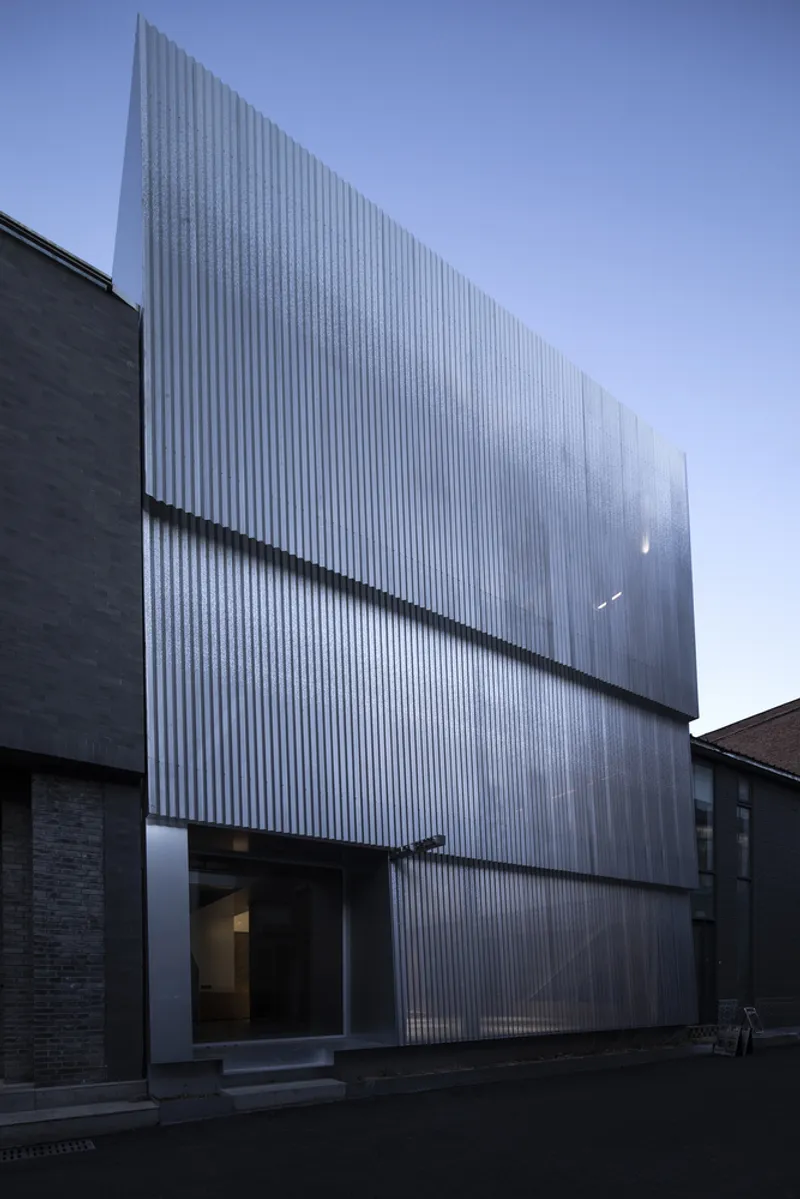
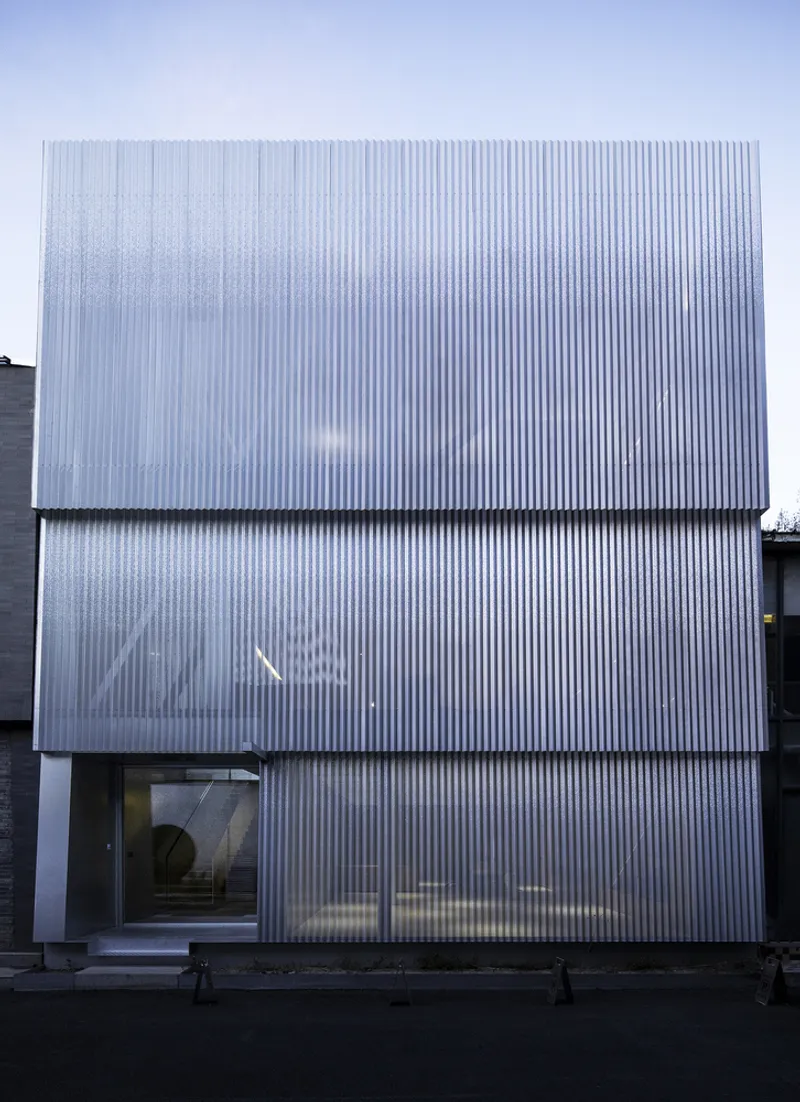
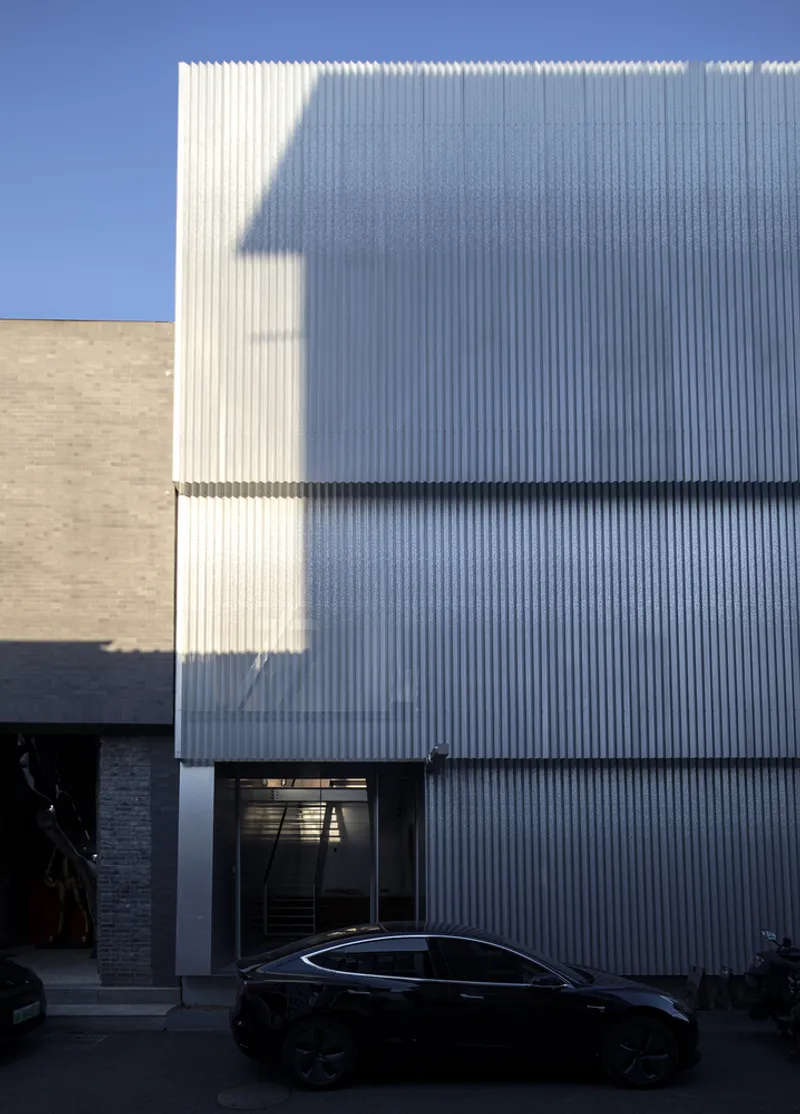
Viewed head-on, the facade reveals its compositional logic. Horizontal recessed joints break the vertical cladding into registers, each corresponding to a different floor level. A single slot window at street level punches through the metal surface, offering a carefully framed glimpse of interior activity without surrendering the wall's solidity. The proportioning is deliberate: the building wants to be read as a singular sculptural object, not as a stack of floors.
Under a clear sky, the staggered volumes cast crisp shadows on themselves, creating depth without ornament. TAOA lets the material do the work. The corrugation is both structural ribbing and surface texture, eliminating the need for applied detail. It is a strategy that keeps the construction legible and the budget honest.
Translucency and the Dusk Effect
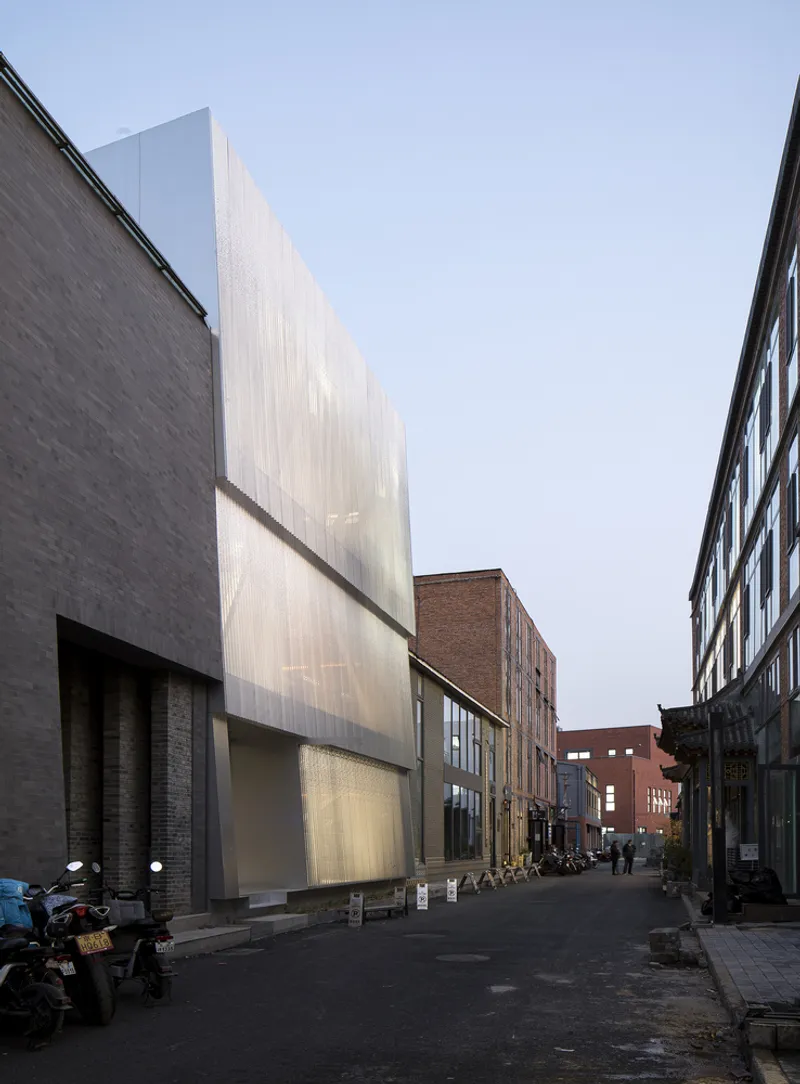
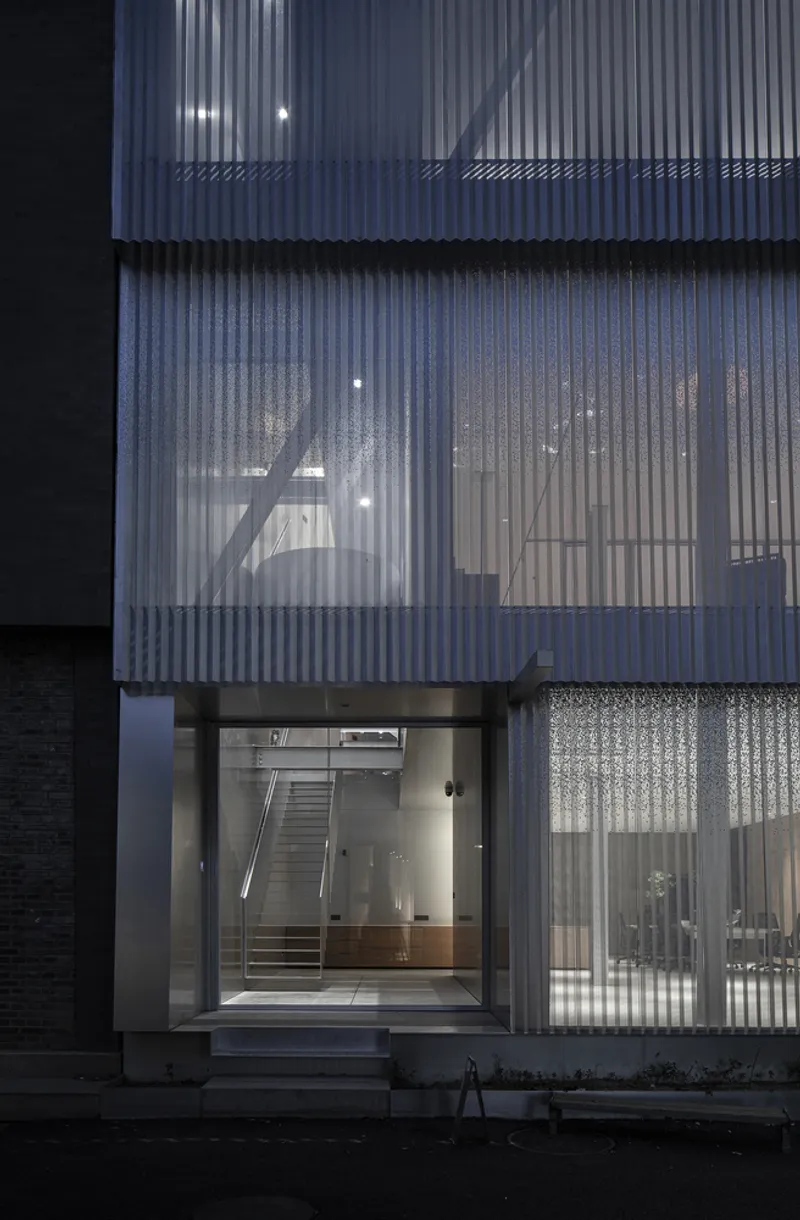
At dusk, the building undergoes a quiet transformation. The translucent corrugated walls glow with warm interior light, revealing the steel staircase and floor plates as silhouettes. Pedestrians passing along the narrow street experience the studio as an inhabited light box. The effect is not accidental: the translucent panels are concentrated on specific wall segments to control which interior elements become visible and which remain hidden.
The recessed entrance at ground level, flanked by glazed openings, draws the eye inward. A pivoting glass door acts as the threshold between the compressed alley and the generous double-height volume beyond. The transition from the low, tight streetscape to the vertical interior space is one of the building's strongest spatial experiences.
Vertical Circulation as Spatial Event
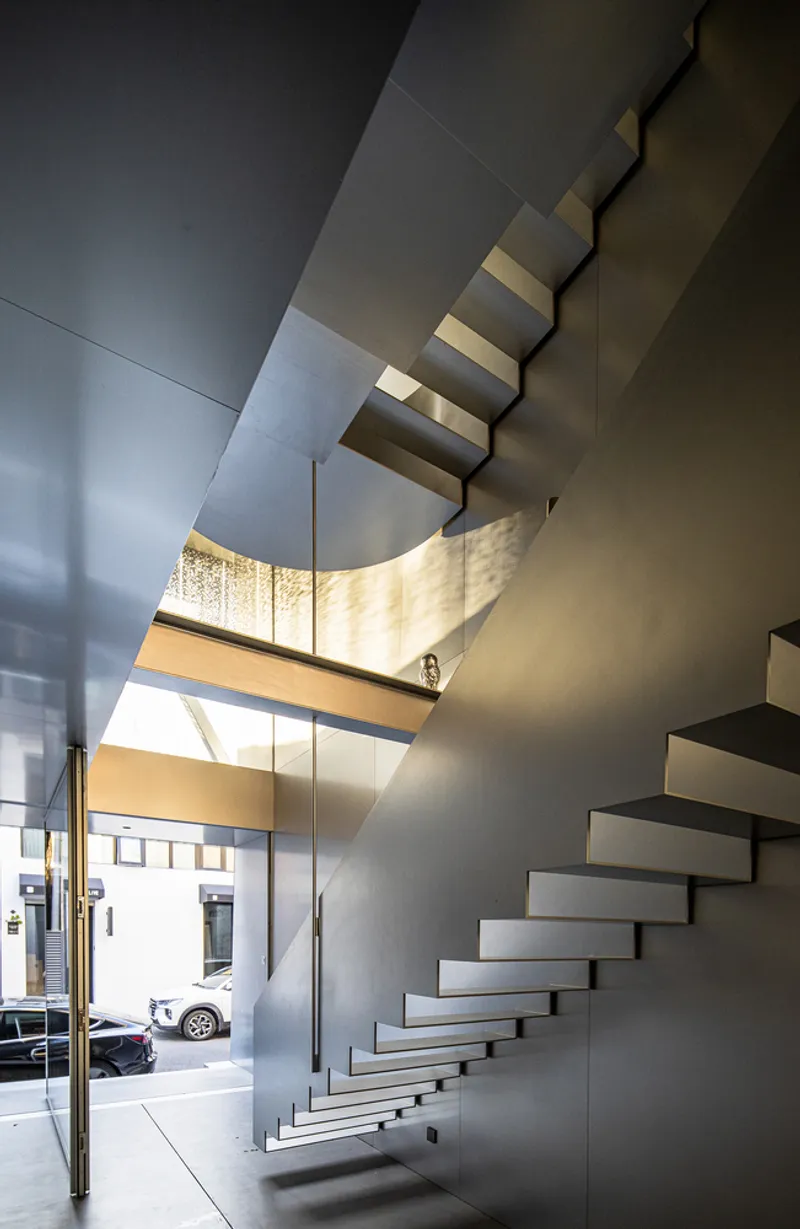
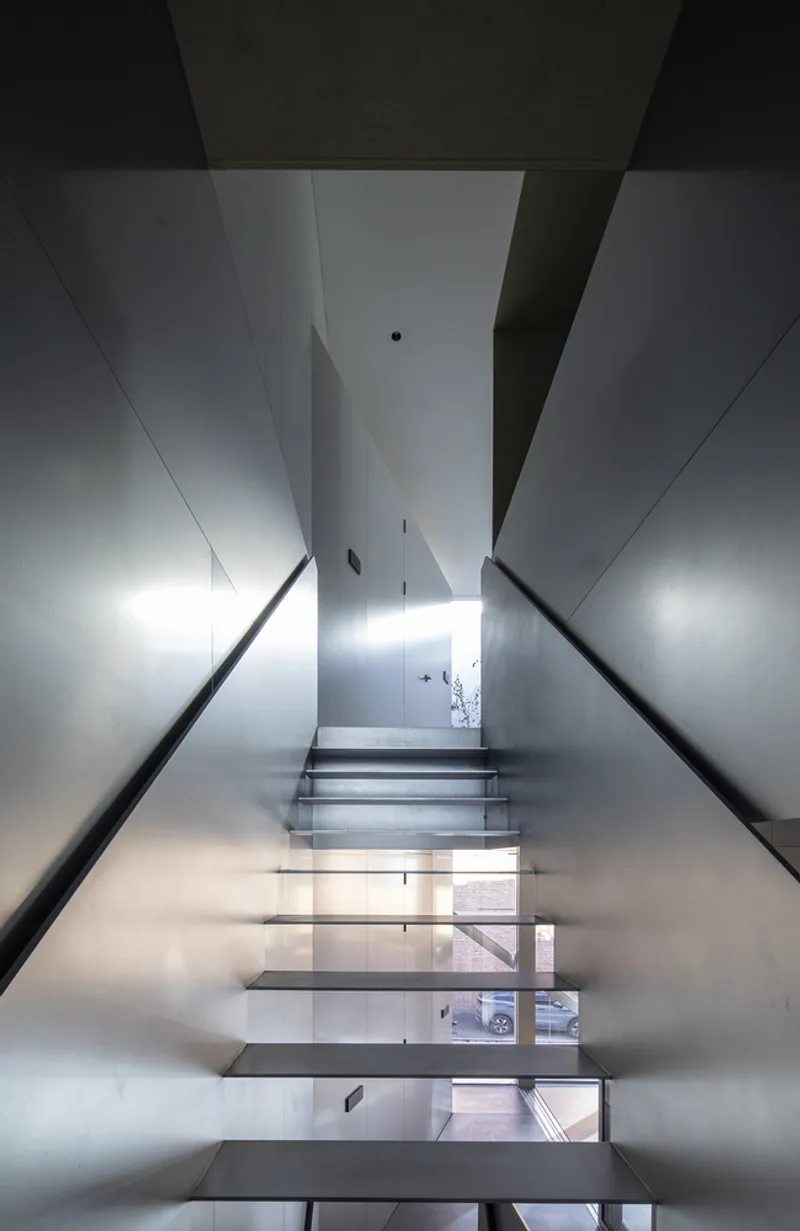
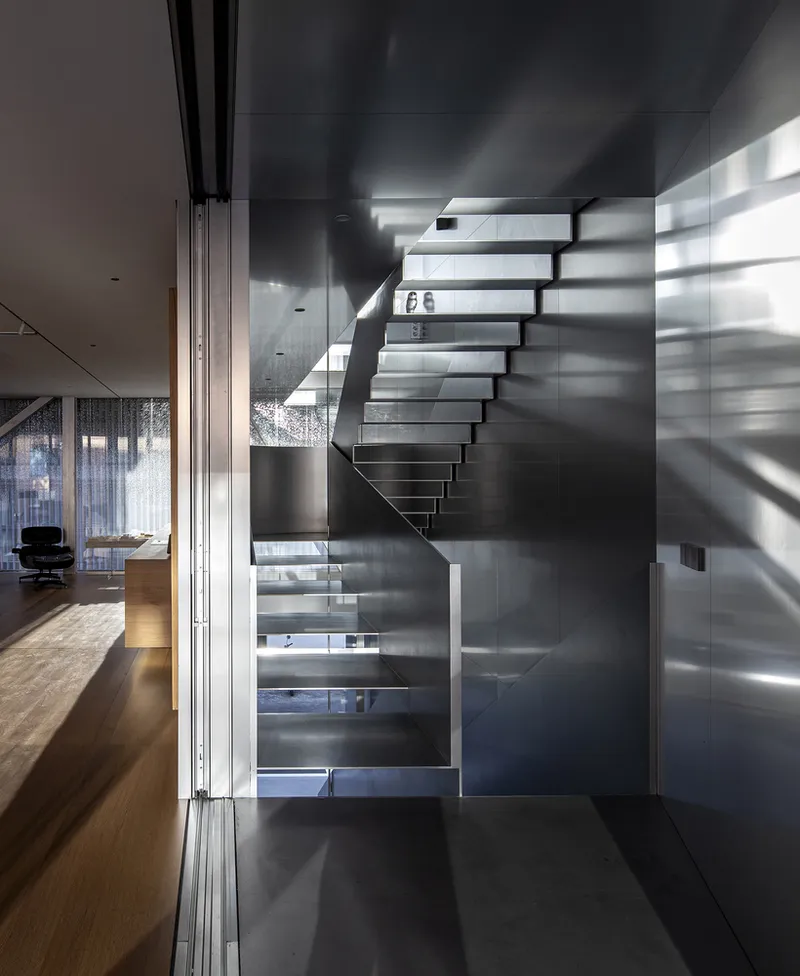
The staircase is the building's spine. A cantilevered steel structure with open treads and glass guardrails, it rises through a narrow white-walled shaft from the entrance hall to the upper floors. A skylight crowns the shaft, pulling daylight down through the full height of the building. The stair is not tucked away; it is on display the moment you walk in, framed by the pivoting glass entrance door.
Open treads allow light and sightlines to pass through each flight, preventing the narrow shaft from feeling claustrophobic. Striped shadows from the stair treads pattern the grey walls, adding visual rhythm to what could have been a purely functional element. The stair connects three levels but also connects the skylight to the ground floor, acting as a light conduit.
Working Interiors and Display Spaces
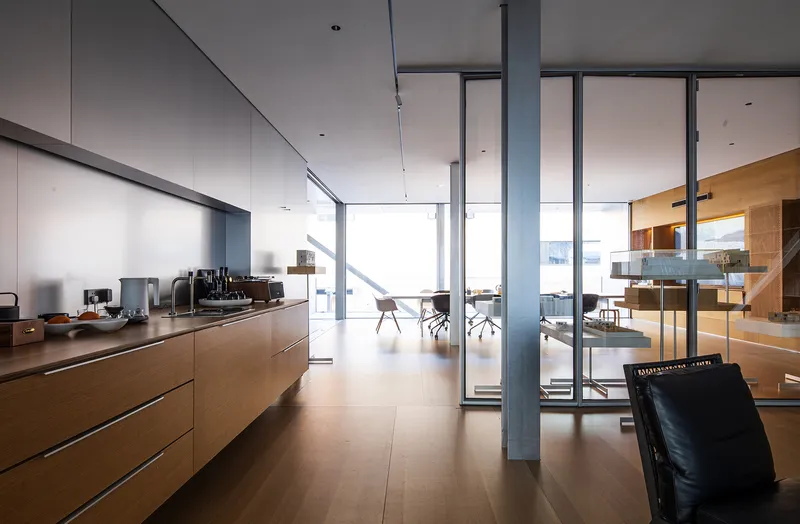
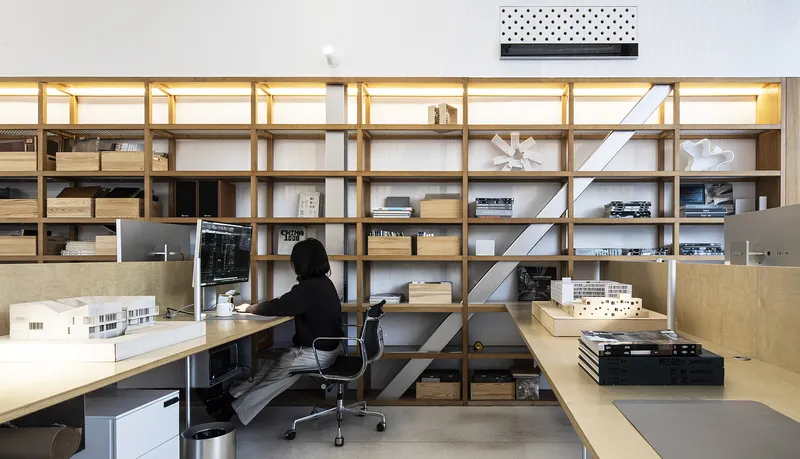
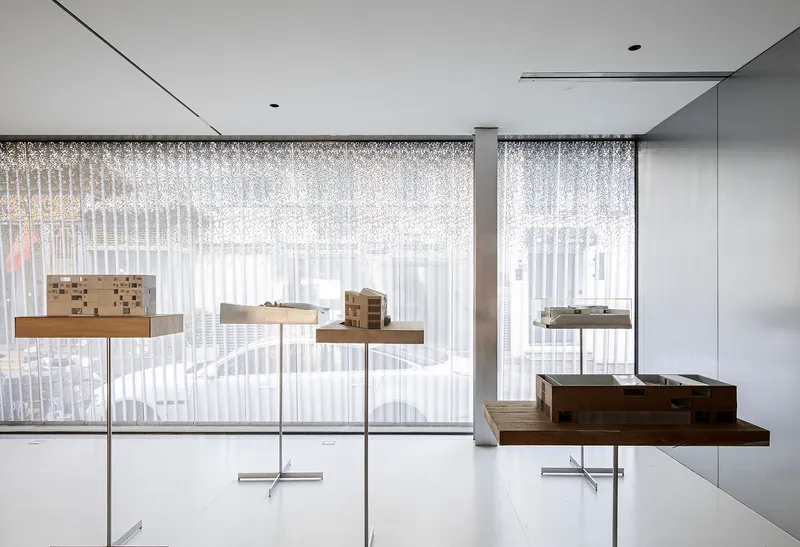
The office floors are organized around a clear principle: wood cabinetry and warm surfaces define the working zones, while white walls and sheer curtains define the display areas. Floor-to-ceiling glazing between rooms maintains visual connection across the floor plate, letting the eye travel from a desk through a partition to a workspace beyond. It is a studio designed to be seen working, where architectural models on pedestals and shelves are part of the daily environment rather than objects locked in a vitrine.
The integration of display into the working environment is pointed. Suspended model platforms, pedestal stands behind sheer curtains, and illuminated shelving walls all suggest that for TAOA, the act of making and the act of presenting are not separate events. The studio is the gallery, and the gallery is the studio. Light wood finishes and linear lighting keep the palette restrained, letting the models and drawings serve as the primary visual content.
Courtyards, Alcoves, and Filtered Daylight
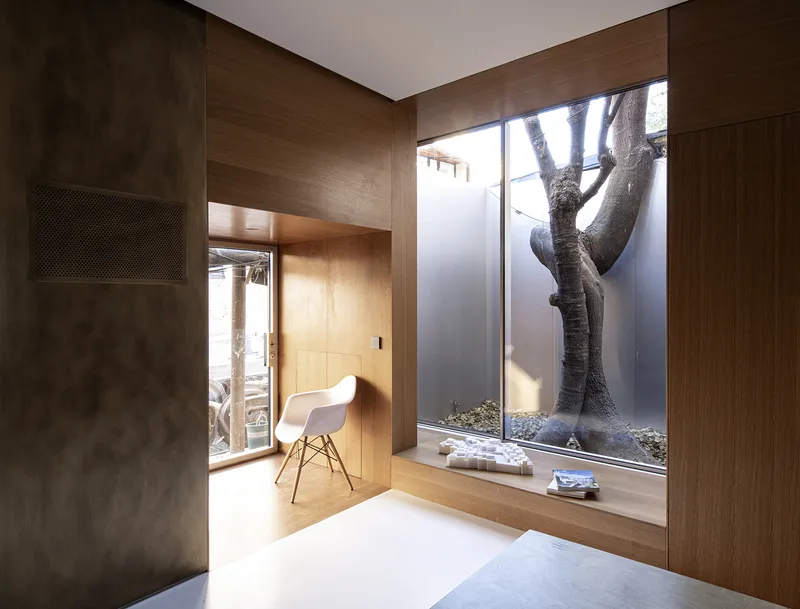
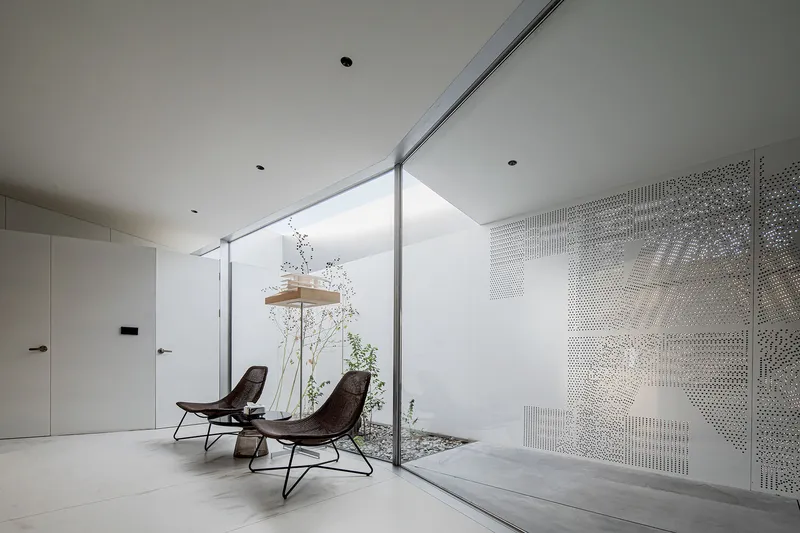
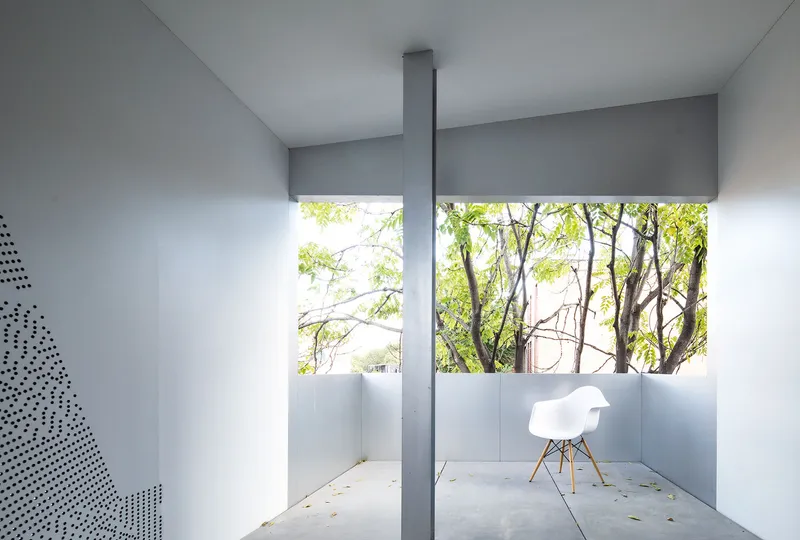
On a tight urban site, courtyards are a luxury. TAOA carves them in anyway. A timber-lined alcove with a glazed courtyard window frames a mature tree trunk against a white wall, offering a moment of contemplation within the building's working program. An interior courtyard with a planted bed and perforated white metal screen filters daylight into adjacent rooms. An upper-level terrace, enclosed by half-height walls with trees visible beyond, provides a semi-outdoor break space with a single chair that suggests solitary thought.
These pockets of green and sky are not decorative. They regulate the building's relationship with daylight, introduce cross-ventilation opportunities on a narrow site, and offer the kind of spatial release that dense urban interiors desperately need. The perforated metal screens mediate between the planted beds and the occupied rooms, softening direct sun while maintaining a visual link to the outdoors.
Double Heights and Glass Bridges
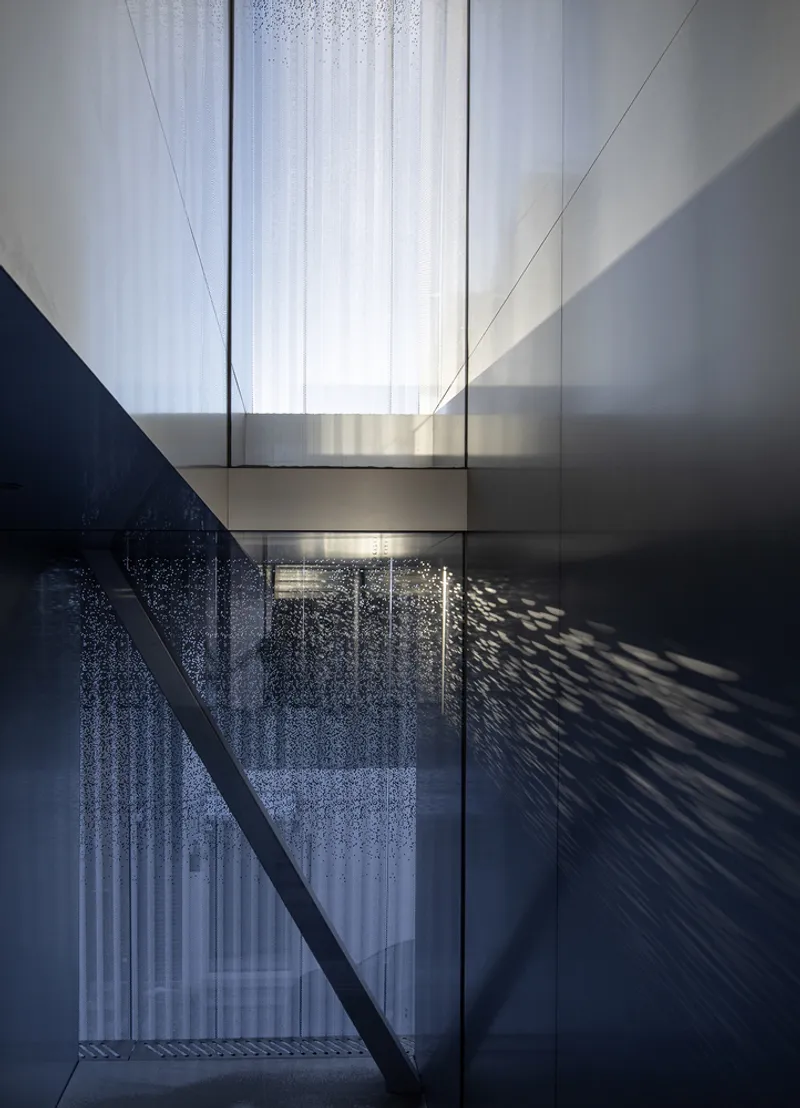
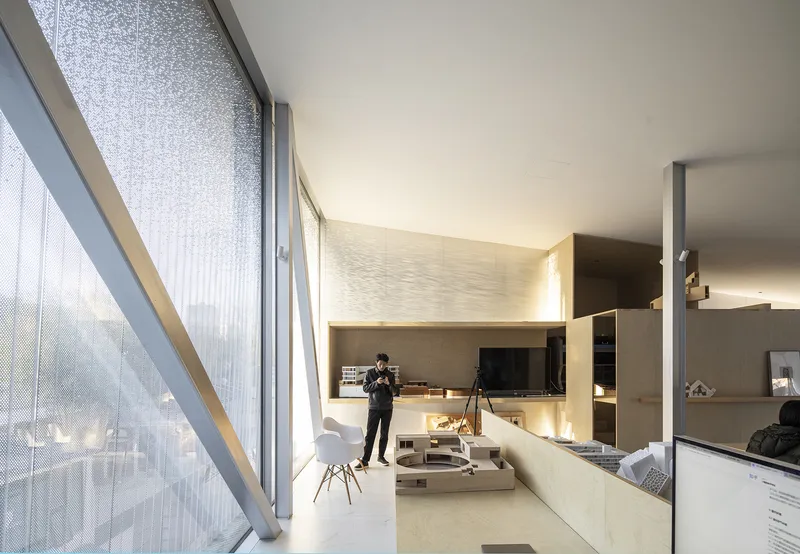
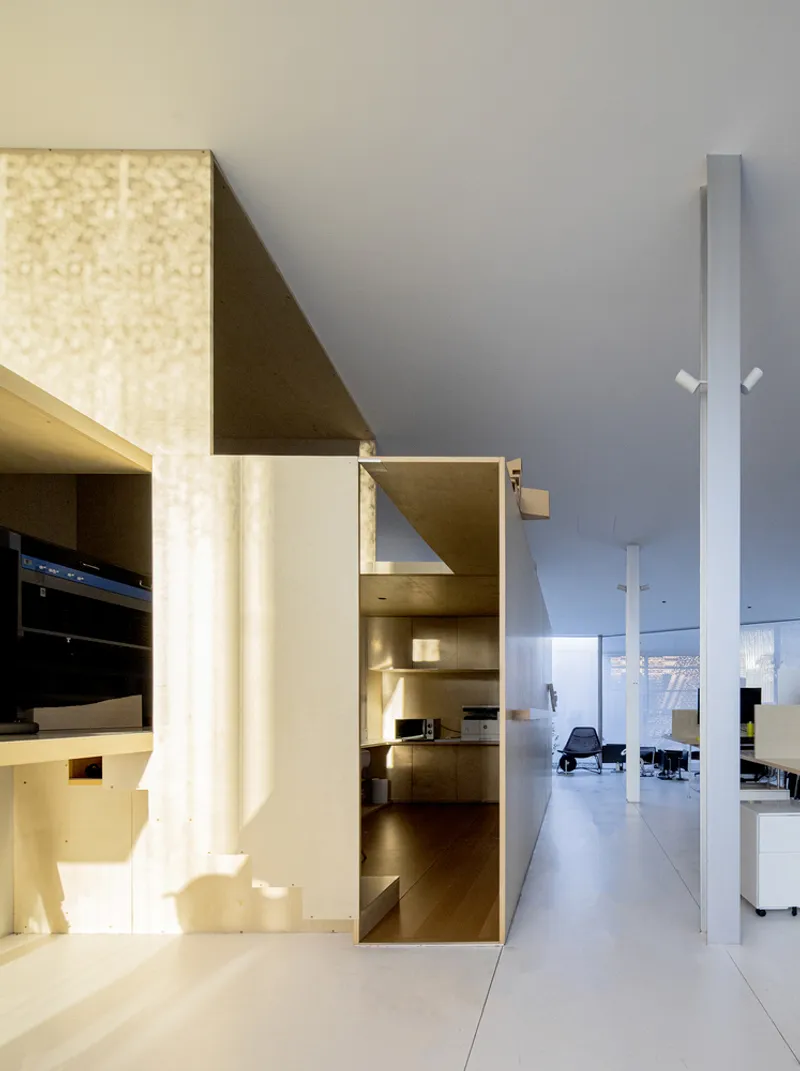
The section reveals TAOA's ambition. Double-height voids punctuate the floor plates, allowing white curtains to billow in front of glass bridges and perforated metal screens. The curtains are both pragmatic, controlling glare, and atmospheric, softening the industrial materials into something domestic. A glass bridge at the upper level connects two halves of the plan while maintaining the openness of the void below.
An angular plywood-clad passage opens to a white gallery space with columns beyond, hinting at the building's former life as a workshop. The contrast between the raw plywood and the pristine white gallery wall is a signature move: materials are not blended into a single palette but juxtaposed to create a sequence of spatial moods. You move from warm to cool, from compressed to expansive, in the span of a few steps.
Plans and Drawings
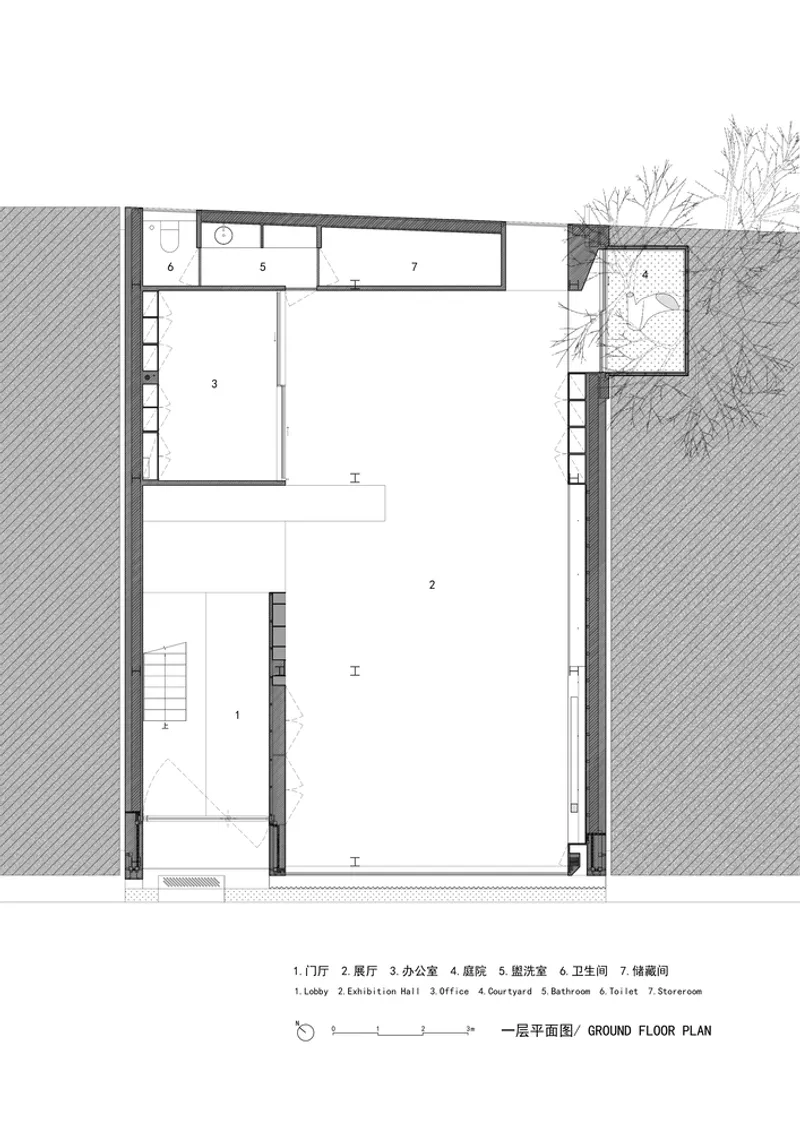
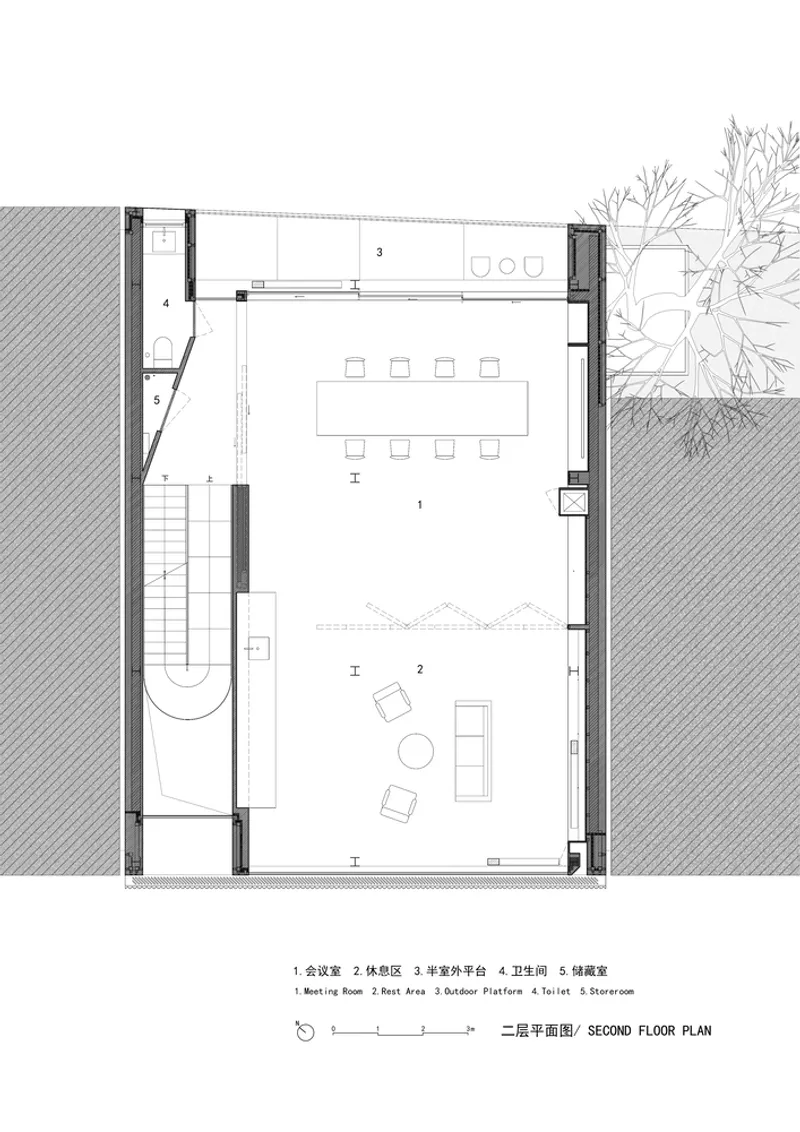
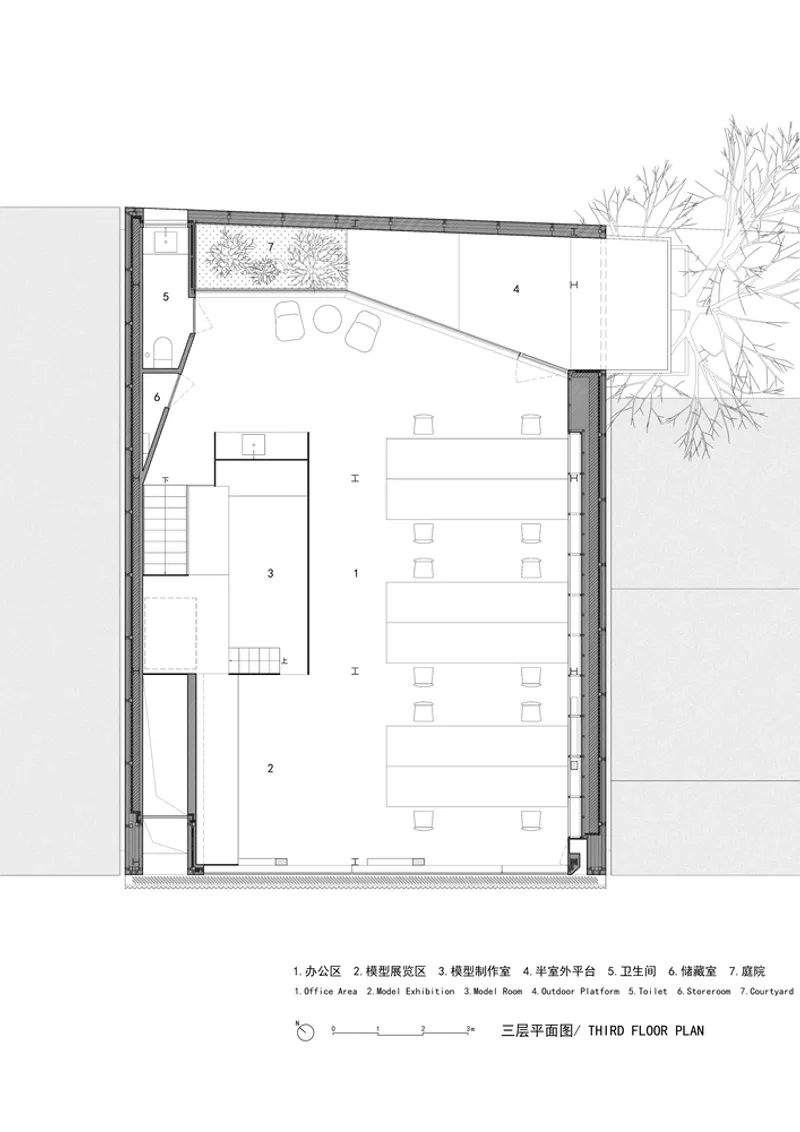
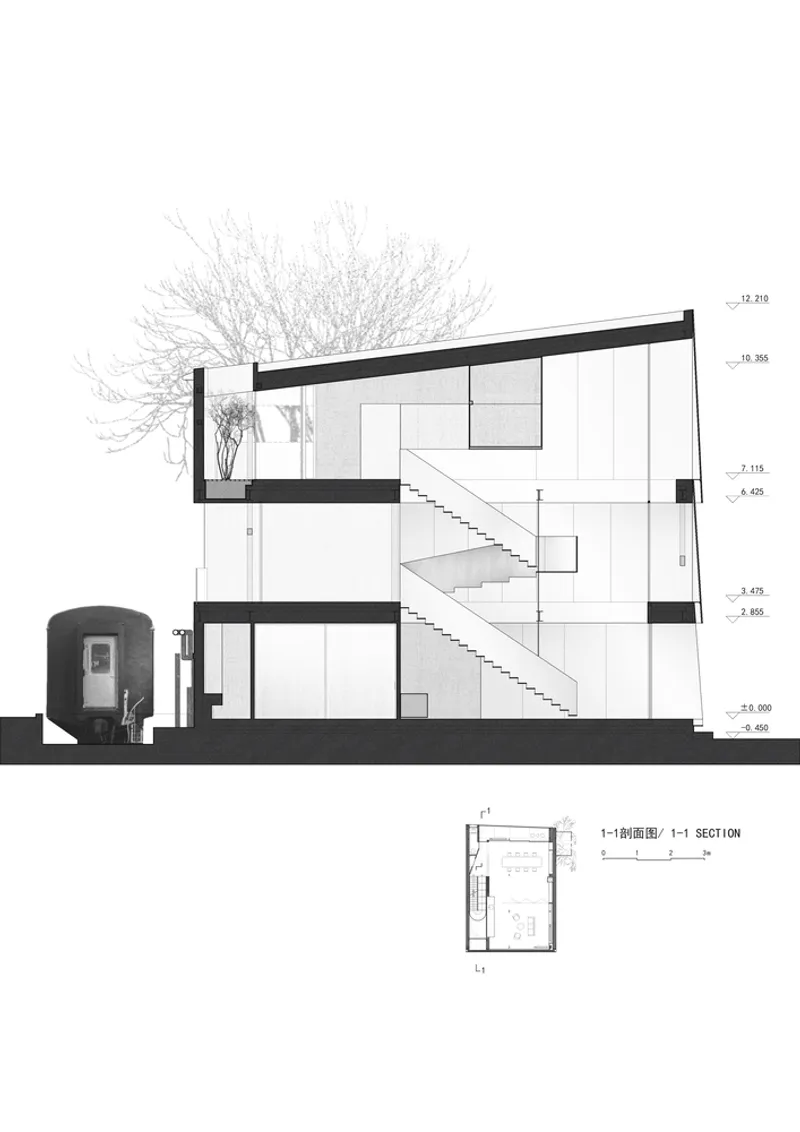
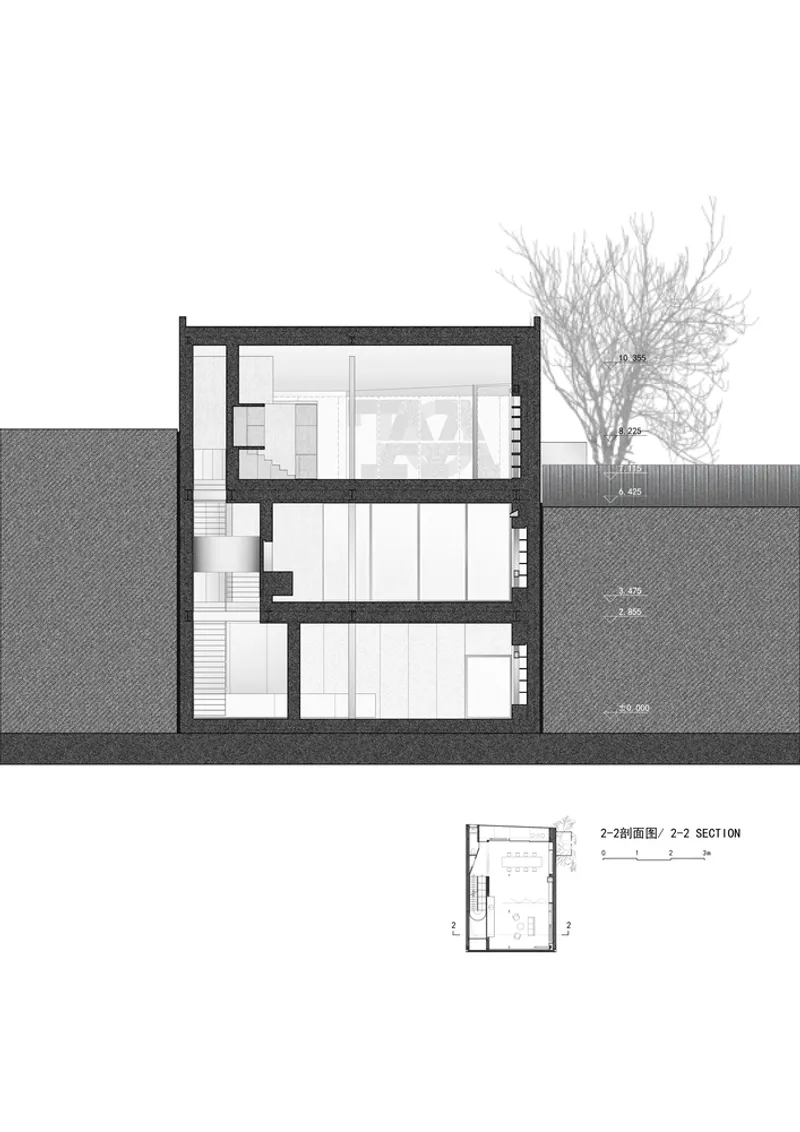
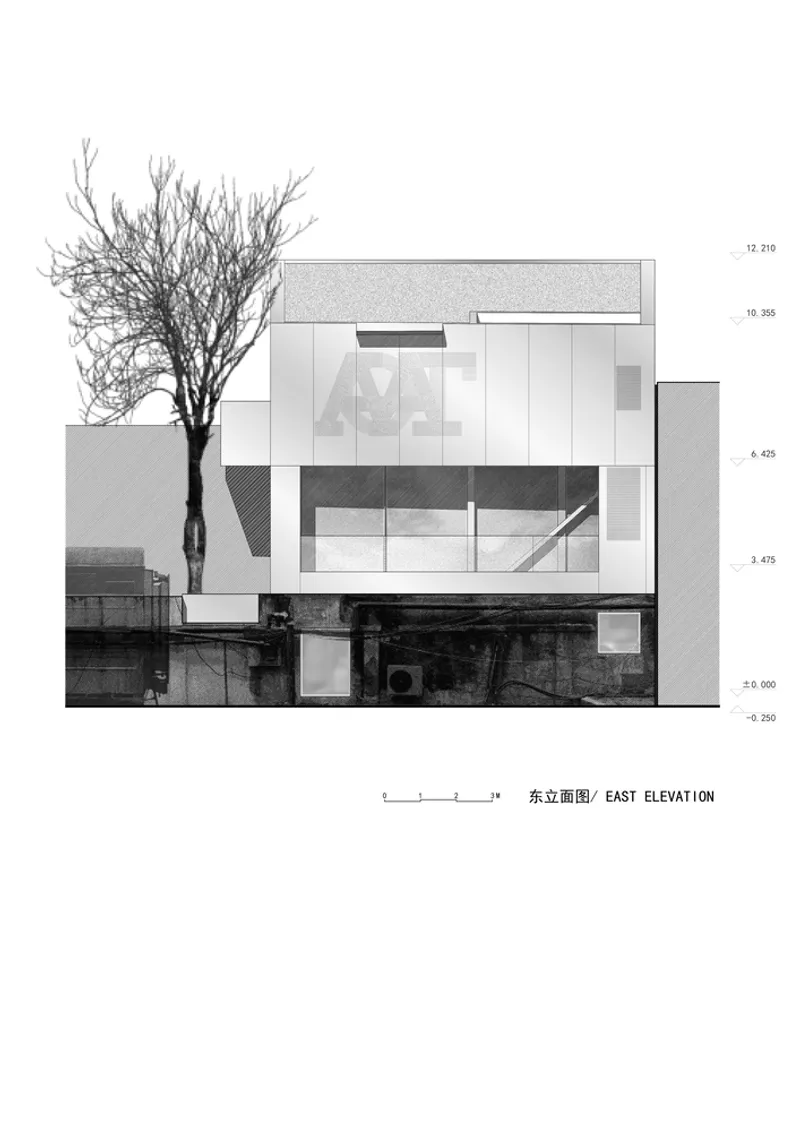
The floor plans confirm what the photographs suggest: the building is organized around a central circulation core with rooms radiating toward perimeter courtyards and glazed walls. The ground floor pairs a lobby and exhibition hall with office spaces and an exterior courtyard planted with trees. The second floor houses a meeting room, rest area, and outdoor platform. The third floor continues the pattern with an office area, model exhibition room, and rooftop courtyard with furniture.
The sections are the most revealing drawings. A central staircase threads through all three levels, and double-height spaces open up at strategic points to prevent the narrow floor plates from feeling cellular. The rooftop tree canopy visible in section is a real detail, not a rendering flourish: mature trees at the building's crown soften its profile against the 798 skyline and provide shade for the upper terrace. The east elevation drawing shows the composition of large glazed openings against the corrugated surface, confirming that the facade's apparent simplicity is the result of careful calibration rather than indifference.
Why This Project Matters
Architects' own offices tend to fall into one of two traps: either overdesigned showcases that prioritize image over function, or deliberately modest spaces meant to signal humility. TAOA's 798 studio sidesteps both. It is a building that takes its urban context seriously, responding to the narrow lanes and brick textures of the art district with a material language that is contemporary but not aggressive. The corrugated metal cladding, the translucent panels, and the carved courtyards are all calibrated to the specific conditions of this site, not imported from a generic palette.
More broadly, the project demonstrates that renovation in a historically significant district does not require mimicry. The building is unapologetically new in its materiality while being deeply contextual in its massing, its relationship to the street, and its treatment of light. For a practice working in one of Beijing's most architecturally scrutinized neighborhoods, that balance is a statement of intent. The studio is both a workplace and an argument: that contemporary architecture can be a good neighbor without pretending to be something it is not.
TAOA 798 Studio by TAOA, Beijing, China.
About the Studio
Share Your Own Work on uni.xyz
If projects like this are the kind of work you want to make, uni.xyz is a place to publish your own, find collaborators, and enter design competitions.



Popular Articles
Popular articles from the community


The Musturak Paradise: Senior Living Architecture for a Connected Future in Temara, Morocco
The Musturak Paradise reimagines senior living architecture in Temara via private homes, social spaces, culture, community, and shared care.

The Earth Pod: 3D Printed Homes for Resilient Refugee Communities
The Earth Pod reimagines refugee housing through 3D printed homes made from clay, combining resilience, self-sufficiency, and rapid shelter.

The Ocean Hive: Sustainable Architecture for a Self-Sufficient Civilization at Sea
The Ocean Hive imagines sustainable architecture at sea, where modular habitats, algae, wave power and ocean waste sustain a growing colony.

Play: Fragments of Their World
Familiar architecture becomes modular playground design, creating safe spaces where displaced children can learn, connect, imagine and play.

Similar Reads
You might also enjoy these articles


Hodi-Mandai Geram
Project Function: Preservation and revitalization of the Intangible heritage and socio-spatial identity of the Hodi by Housing, Cultural Memory Center, Sacred Grove, landscape, local tourism economy


Olio Towers: A Mid-Rise for Performers That Fuses Housing, Rehearsal, and Stage
Located blocks from Houston's Theater District, this modular tower stacks living units around a central performance atrium.

Oasis: Modular Green Housing Carved into Dhaka's Urban Fabric
A shortlisted Plugin Housing entry reclaims unauthorized settlements in Dhaka with stepped concrete volumes, green roofs, and ventilation-driven design.

Black Hole: A Floating Megastructure for the Post-Physical Era
Emiliano Mazzarotto envisions a spherical, self-scaling arena where e-sports, digital hotels, and holographic stadiums replace traditional public space.


Explore Aotu Architecture Office Competitions
Discover active competitions in this discipline



Challenge to reimagine the Iron Throne


Photograph architecture without architects


Illustrate the lost glory of Angkor Wat - Render Challenge


Design challenge to reuse E-waste
Comments (0)
Please login or sign up to add comments
No comments yet. Be the first to comment!