
Tatsuro Sasaki Architects Scatters a Village of Timber Cabins Across a Japanese Satoyama Hillside
Satoyama Terrace in Futtsu, Japan channels water, wind, and centuries of rural tradition into a 648 m² hospitality retreat.


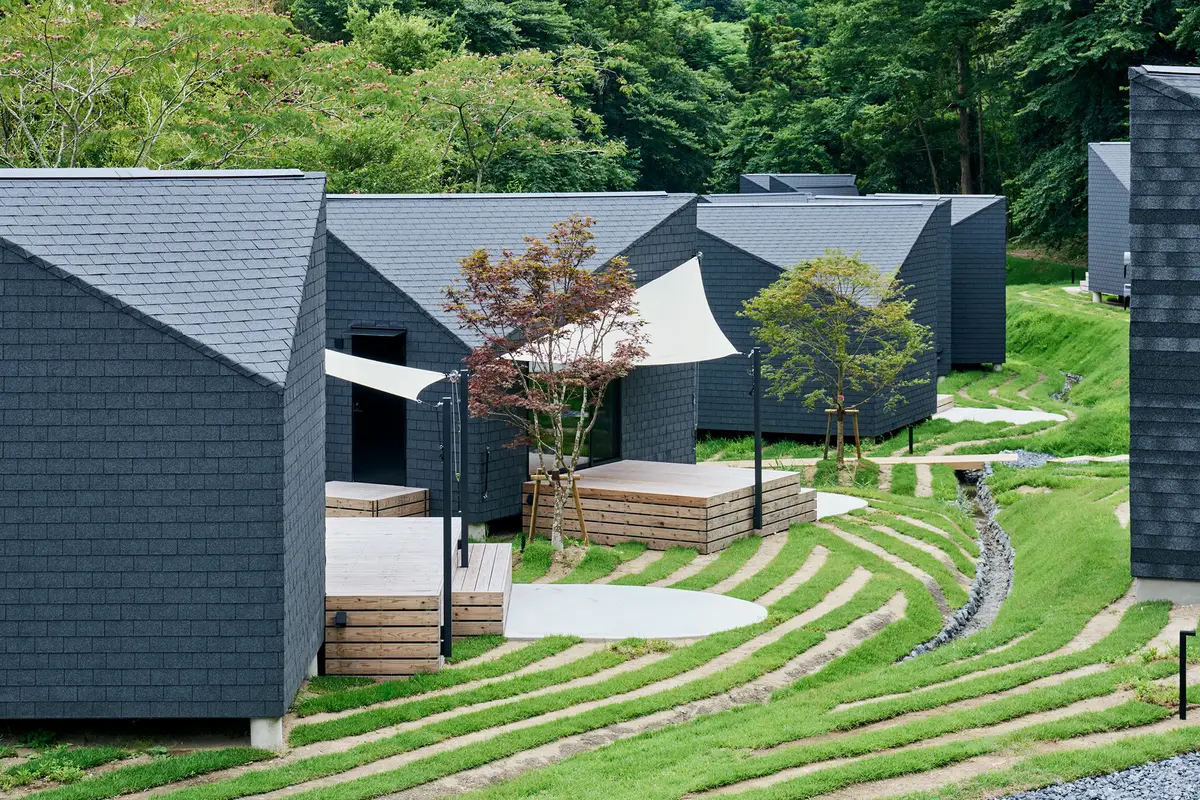
The satoyama is not wilderness. It is a specific kind of Japanese landscape, shaped over centuries by the negotiation between agriculture, forestry, and natural systems. Springs feed streams, forests shelter paddies, and human presence is folded into an ecological continuum rather than imposed on top of it. In the inland hills of Futtsu, Chiba Prefecture, that continuum still holds. Tatsuro Sasaki Architects has placed a small hospitality project directly into this fabric, not as a resort that consumes the landscape but as a cluster of dark-shingled cabins that reads, from the air, like a hamlet that has always been there.
Satoyama Terrace, completed in 2025, is interesting for one reason above all others: it treats the site's hydrology and airflow not as constraints to manage but as the primary design generators. The main building's large column-free roof lifts to invite breezes that descend from the surrounding mountains, and the cabins themselves are arranged to guide that airflow through the compound. Water from local springs feeds sauna features and cold baths. Streams and ponds have been revitalized rather than engineered from scratch. The result is a 648 m² project where climate strategy, landscape restoration, and hospitality programming are the same conversation.
A Village, Not a Hotel
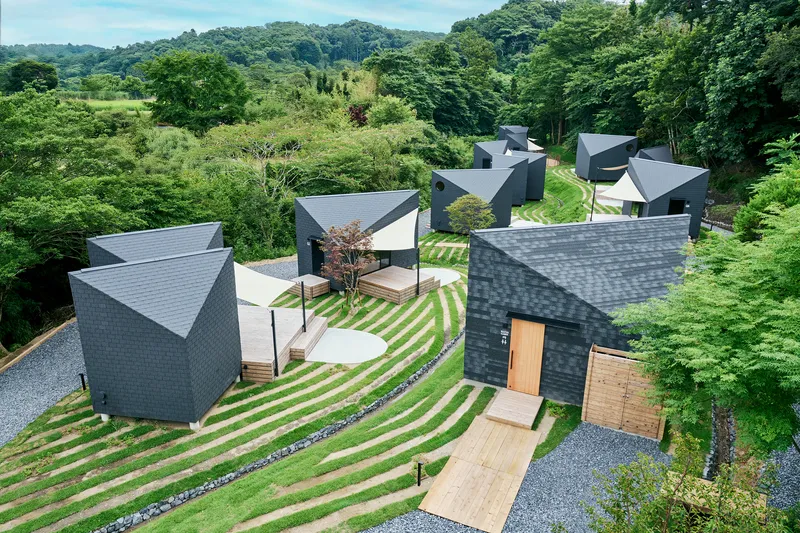
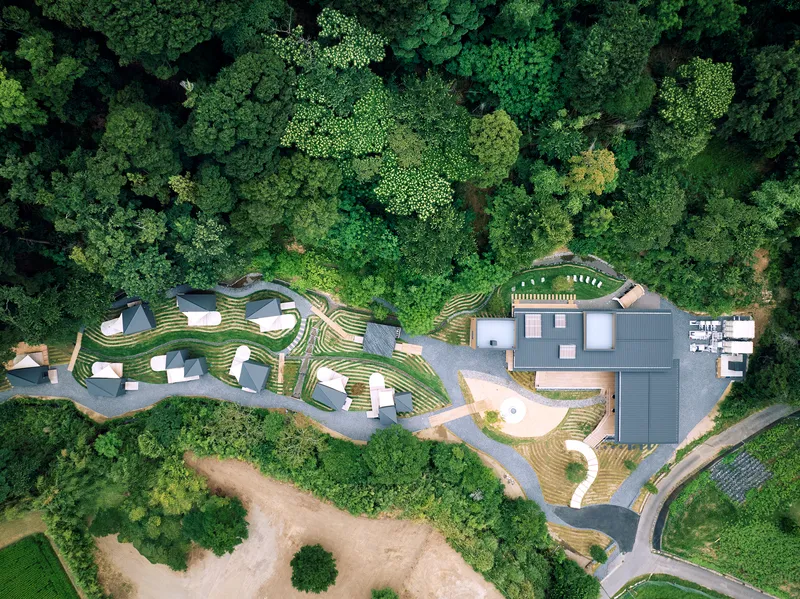
Seen from above, the compound's logic is immediately clear. Dark gable-roofed volumes are scattered across a sloped site in a pattern that recalls a rural settlement more than a planned resort. Striped grass terraces, mowed in alternating bands, cascade between the buildings, and concrete stepping paths link pavilions without paving over the hillside. The terracing is a practical move for drainage and slope stabilization, but it also reinforces the satoyama reading: these are cultivated contours, not wild ones.
The dispersal strategy does real work. Each cabin operates with a degree of autonomy, containing its own dining area and accommodating four guests. Privacy is achieved through distance and topography rather than through walls or fences. From the forest canopy above, the slate roofs almost disappear into the landscape, their dark surfaces blending with shadow and soil.
Shingled Skins and Gabled Forms
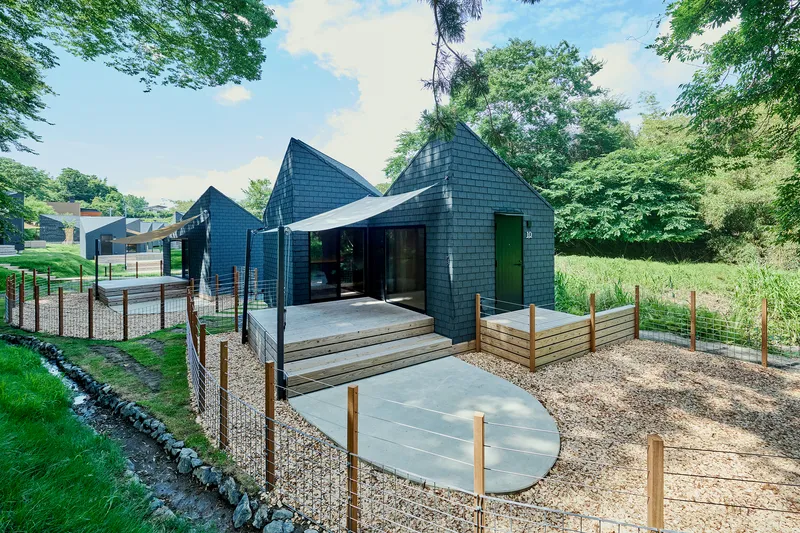
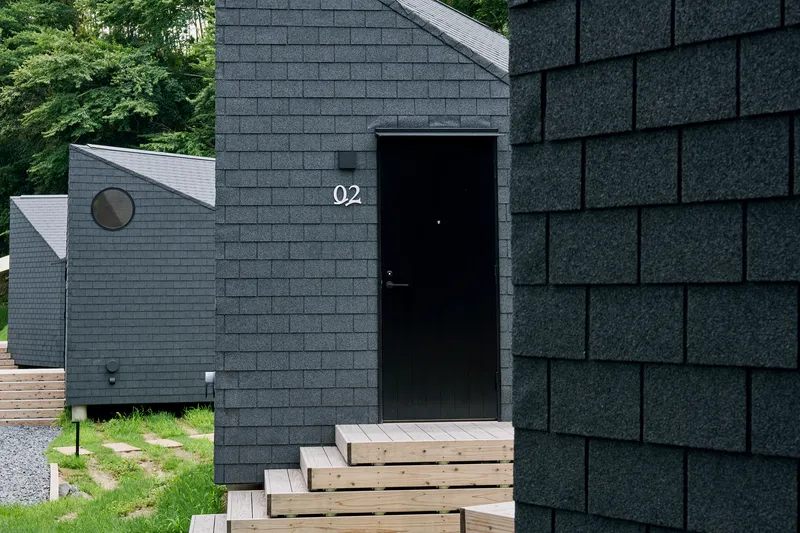
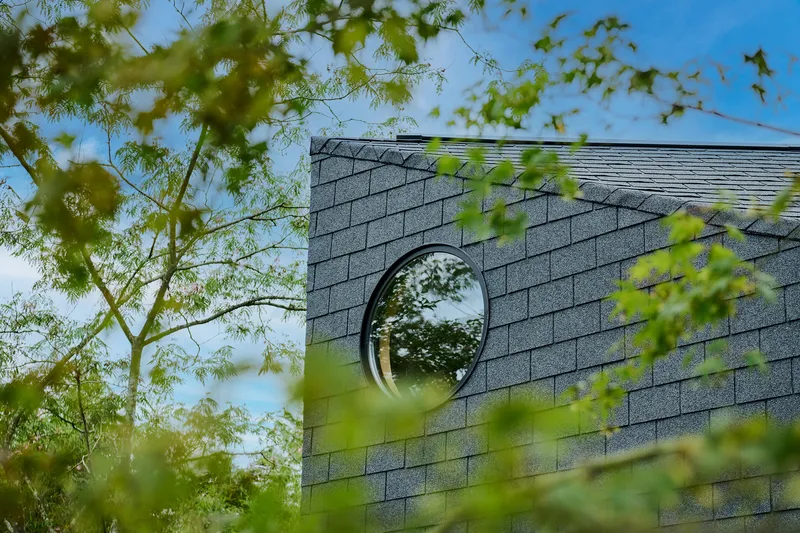
The cabins take their formal cue from Mt. Nokogiri, the sawtooth mountain visible in the regional landscape, translating that profile into a series of steeply pitched gable roofs clad in dark grey shingles. The shingle skin wraps continuously from wall to roof, erasing the distinction between cladding and roofing and giving each volume a monolithic, almost mineral quality. Against the green of the surrounding forest, the effect is stark but not hostile.
Detail moments punctuate the dark surfaces. Circular windows appear in the shingled walls, framing foliage like viewfinders. Timber steps and decks emerge at thresholds, and gravel courts with planted birch trees create intermediate zones between interior and landscape. The material vocabulary is deliberately restrained: dark shingle, raw timber, concrete, and gravel. Nothing competes with the forest.
Timber Structure as Spatial Identity
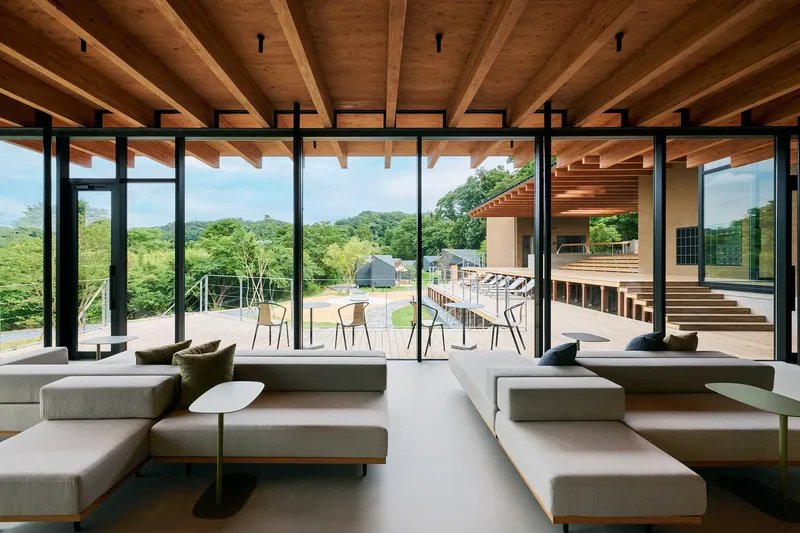
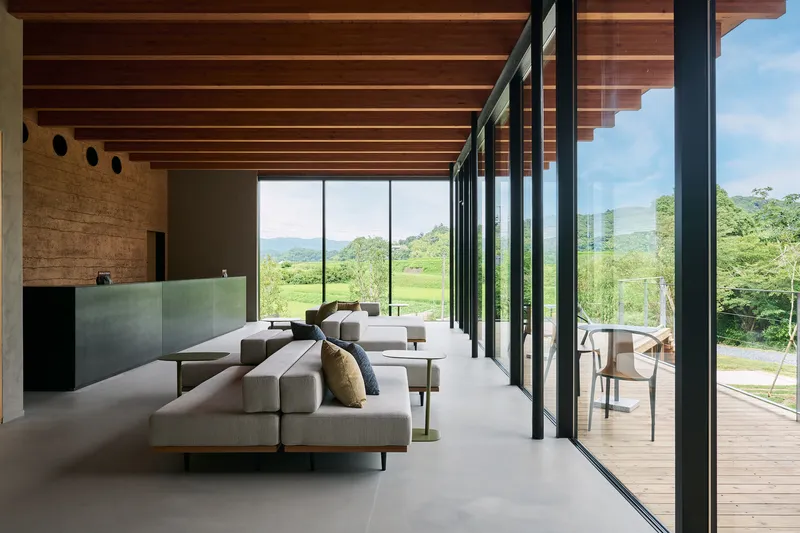
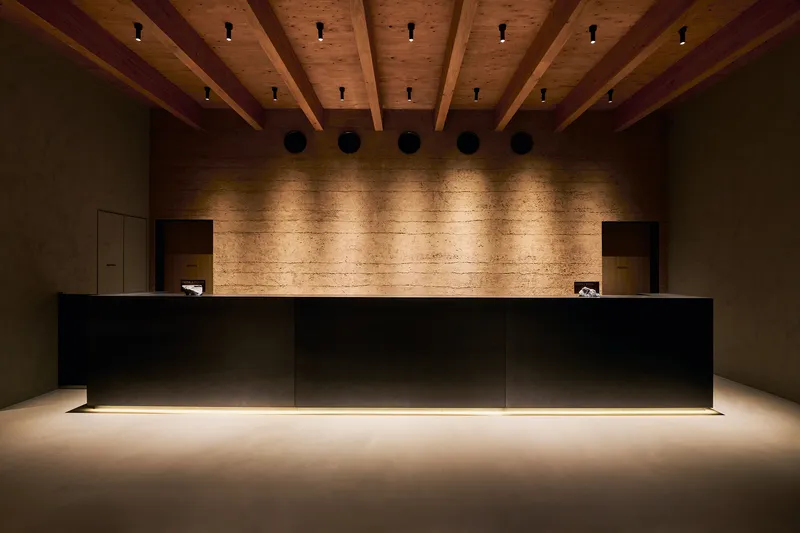
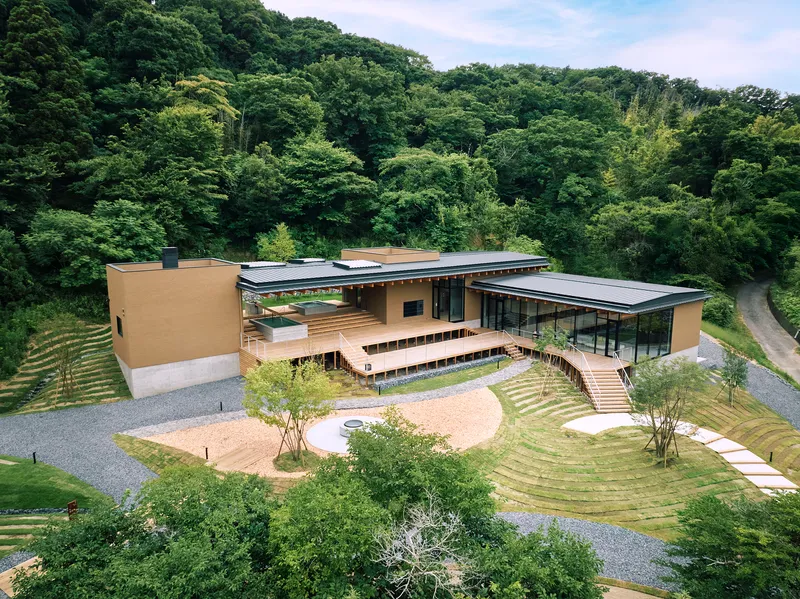
Inside the main building, the structural ambition becomes legible. A large column-free roof spans over an elevated deck, its exposed timber beams creating a rhythmic ceiling plane that frames the terraced grounds through floor-to-ceiling glass. The beam spacing is close enough to register as texture, not just structure, and the warm tone of the wood pulls the interiors toward the landscape outside.
Reception and lounge spaces share this language. A floating black reception desk sits beneath the beam grid with underlit base, a moment of graphic precision against the organic warmth of the timber. Steel columns appear sparingly where spans demand them, paired in the living areas with rammed earth walls featuring circular openings. The earth walls are a quiet gesture toward the ground itself, bringing the site's geology into the room.
Sleeping Lofts and Compact Cabins
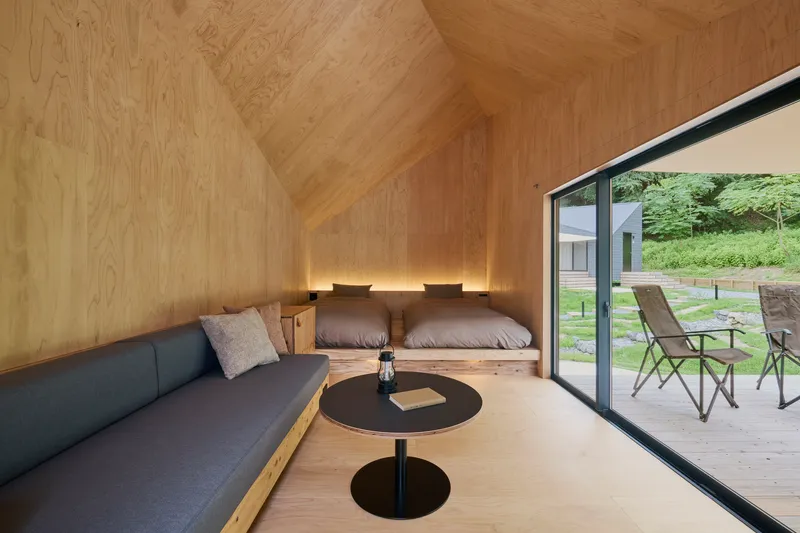
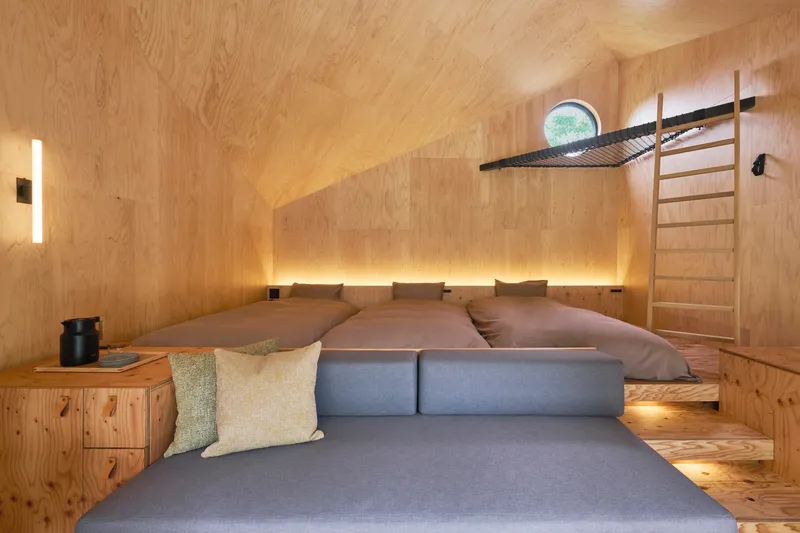
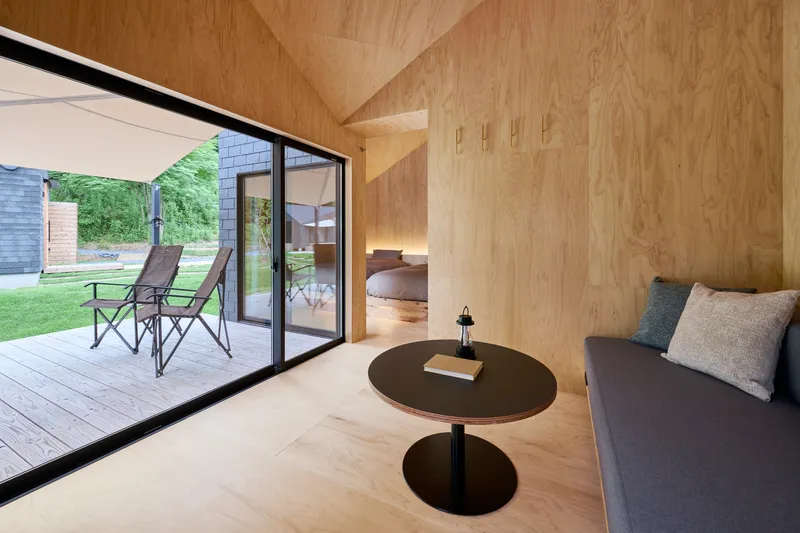
The guest cabins are tight. Plywood-lined interiors with vaulted ceilings make the most of the gable profile, with built-in platform beds tucked beneath the ridge. Strip lighting runs beneath the bed platforms, casting a warm glow that emphasizes the geometry of the room without over-illuminating it. Sliding glass doors open directly onto timber decks, collapsing the threshold between sleeping and landscape.
Corner glazing in some units opens views to the lawn and adjacent volumes, reinforcing the village quality of the arrangement. You are always aware of the other cabins, but they are framed as neighbors, not obstacles. The compact scale is deliberate: these rooms are for sleeping and waking, not for retreating from the site. The terraces, saunas, and shared spaces do the heavier programmatic lifting.
Water as Material
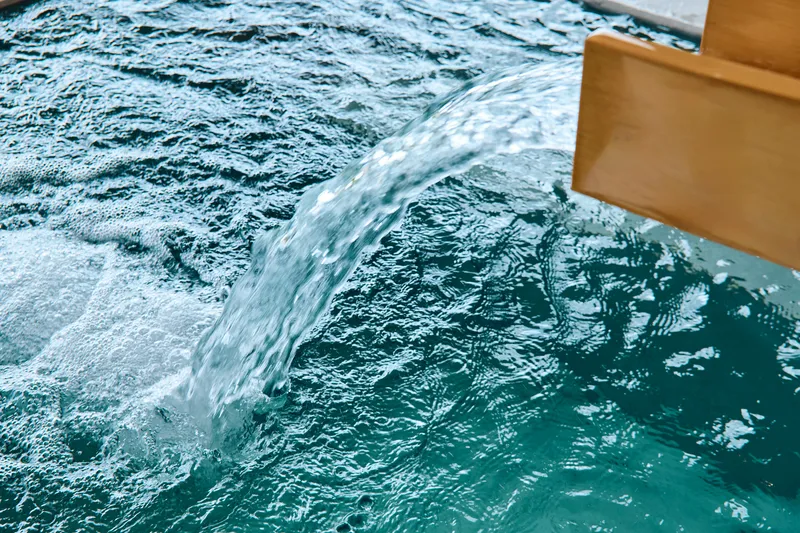
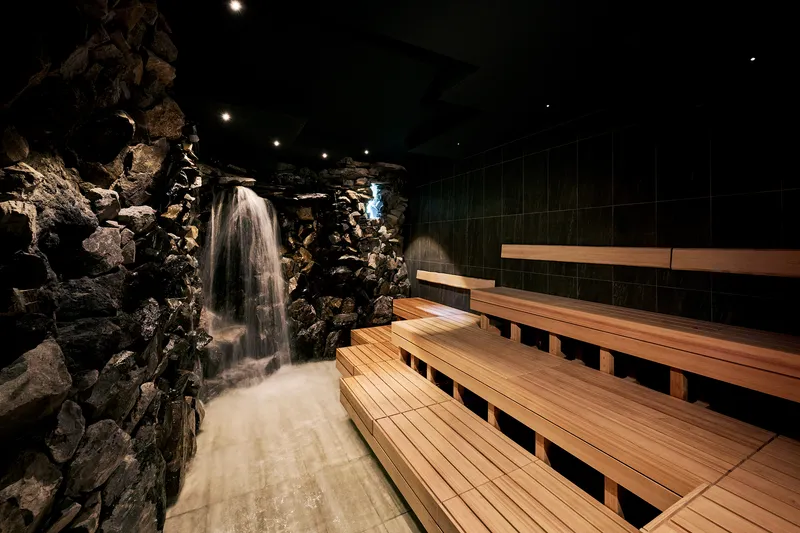

Water runs through this project literally and conceptually. A timber spout delivers natural spring water into a steaming turquoise hot spring pool, its surface catching light in rippled patterns. The sauna rooms feature rock waterfalls illuminated at night, inspired by the nearby Meisui Taki no Fudōson spring. Even in close-up detail, water flowing over dark basalt rocks becomes an object of attention rather than infrastructure.
The hydrological strategy extends beyond the wellness program. Existing waterways have been revitalized to restore the natural flow of water and wind along the site's existing contours, and ongoing workshops involve expanding streams and ponds and tending the surrounding mountains. The project frames itself as a participant in the satoyama cycle of care, not merely a consumer of its scenery.
Terraces and Canopies
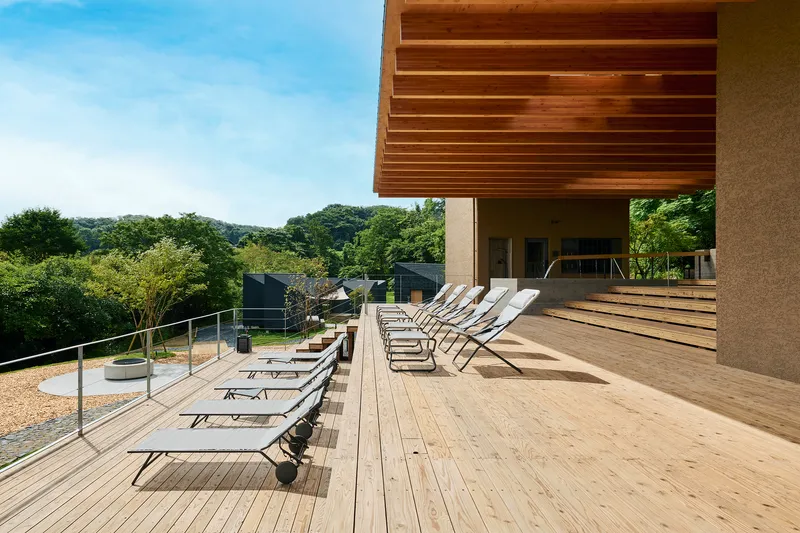
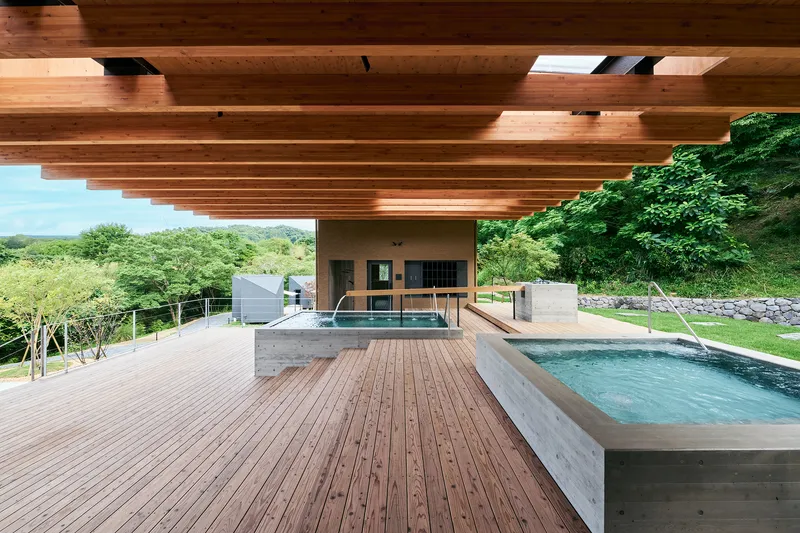
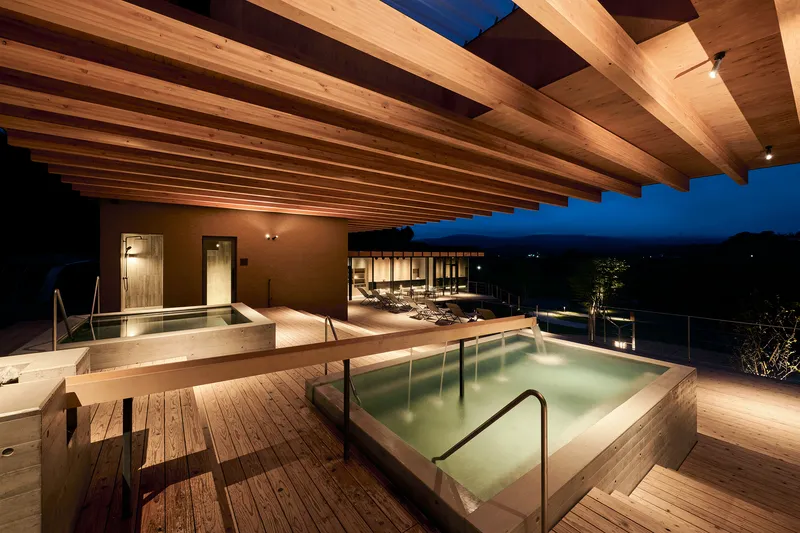
The outdoor spaces are as carefully designed as the interiors. Timber deck terraces with canvas lounge chairs sit beneath slatted wood canopies, their horizontal lines framing views of the forested hills beyond. Concrete spa pools on rooftop terraces catch the last light at dusk, their still surfaces reflecting the exposed beam canopy overhead. These are spaces engineered for breeze: the elevated decks and open canopies channel the mountain airflow that Sasaki identified as the site's defining climatic feature.
The layering of shade is worth noting. Canvas canopies, timber slat roofs, and tree canopy all overlap at different heights, creating a gradient of light and shelter that shifts throughout the day. It is passive comfort design executed with real spatial sophistication, avoiding the false choice between full exposure and sealed enclosure.
Dusk and Atmosphere
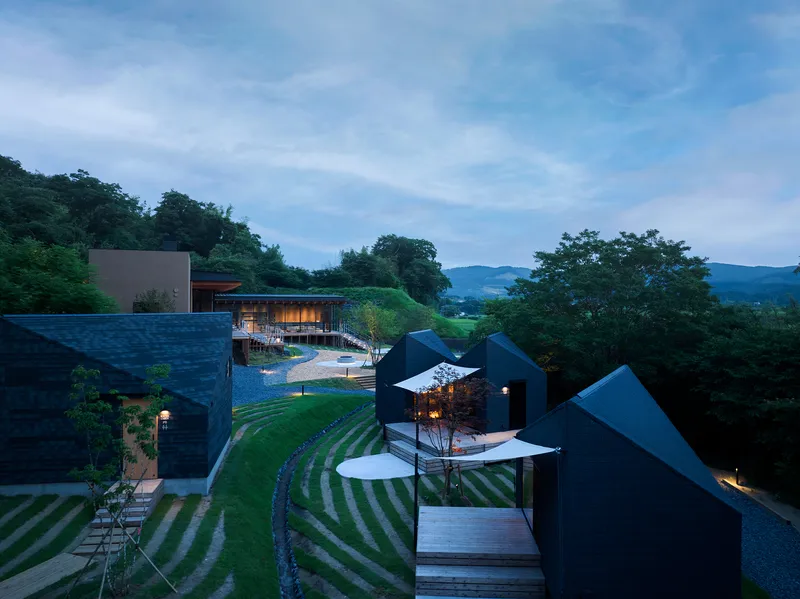
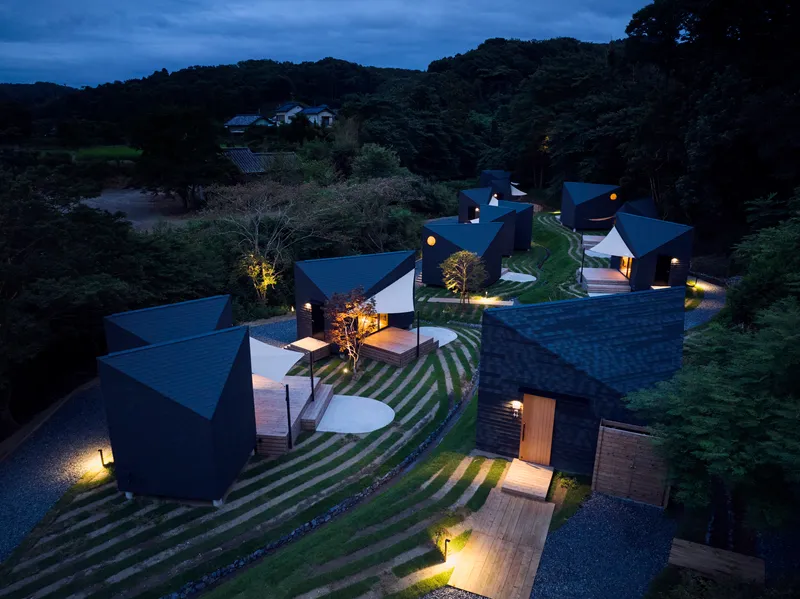
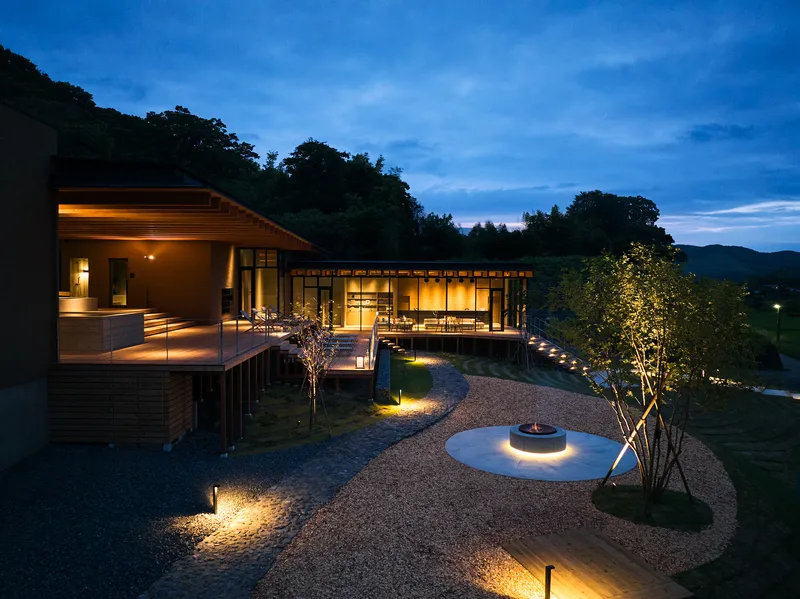
At dusk, the compound transforms. The dark cabins, nearly invisible against the hillside during the day, begin to glow from within, their scattered arrangement reading like a constellation across the sloped landscape. The glazed pavilion with its timber deck and uplighting becomes a lantern against the blue evening sky. The night views confirm the village metaphor: this is a settlement with its own rhythms, not a building with amenities.
Plans and Drawings
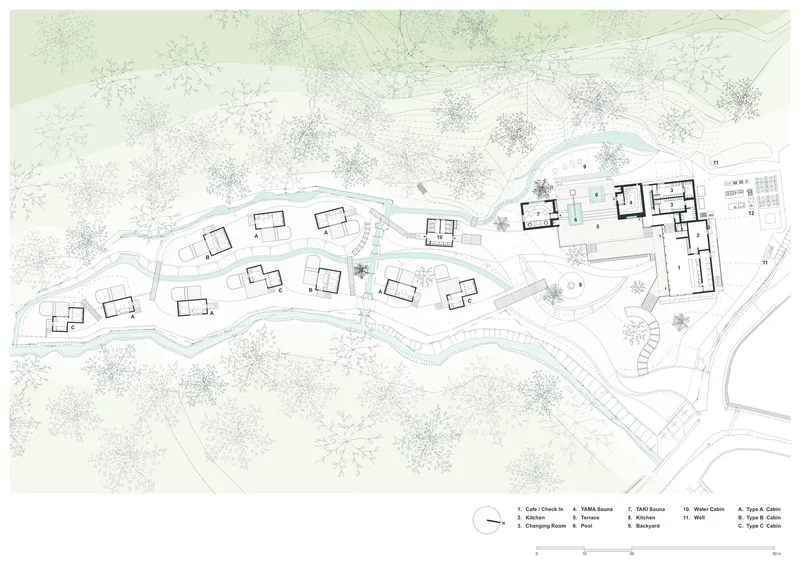
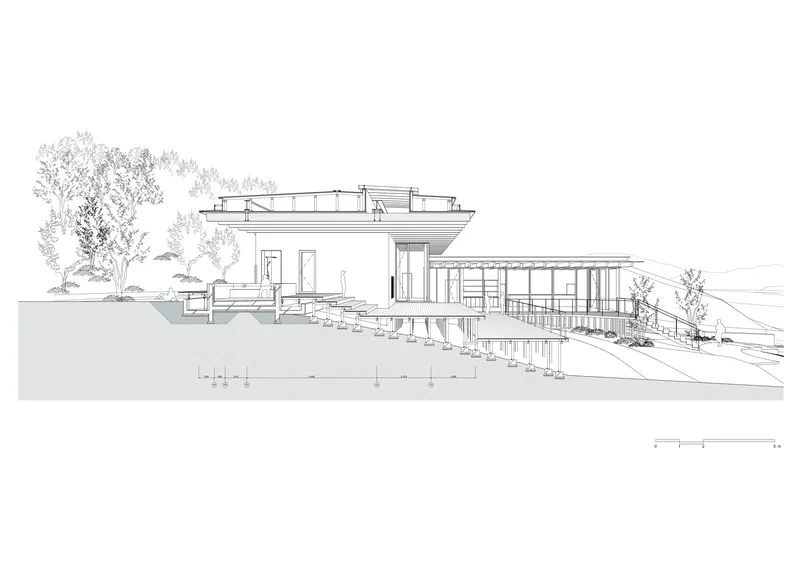
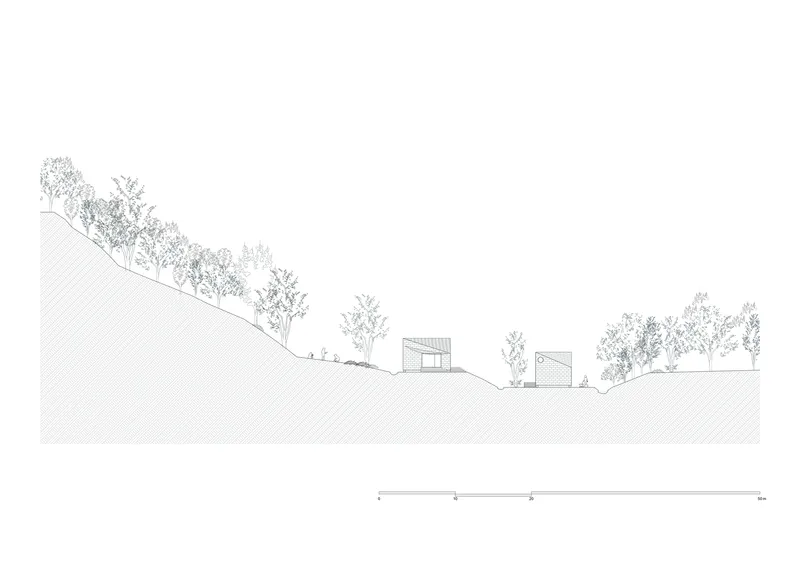
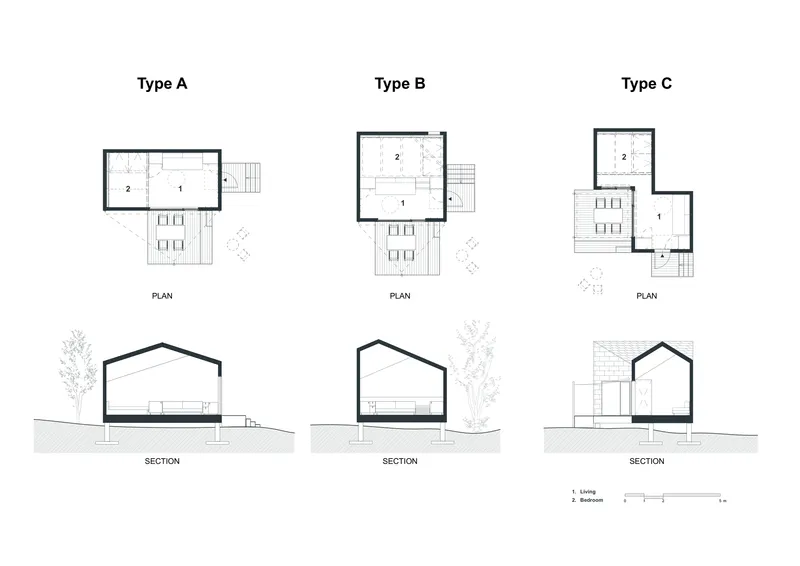
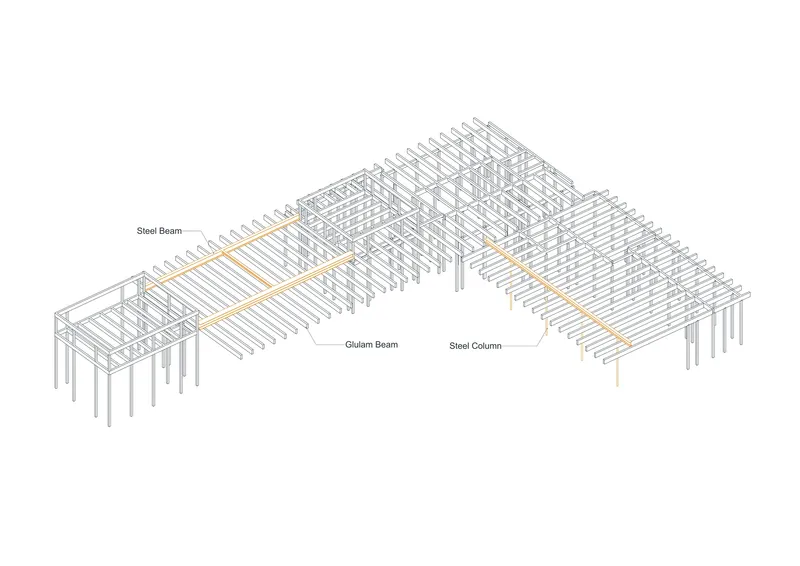
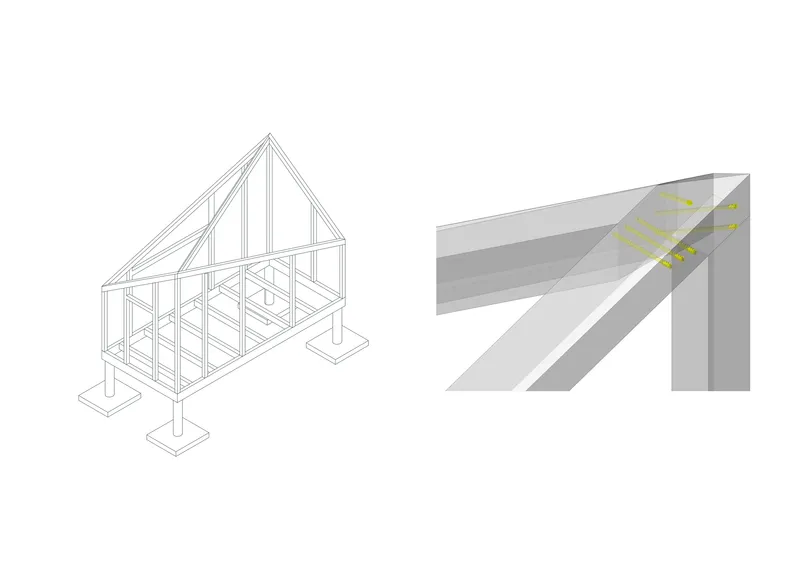
The site plan reveals the full extent of the landscape strategy. Cabin footprints are arrayed along a winding stream, their positions following the terraced contours rather than a grid. Section drawings show how the multi-level structures negotiate the sloping terrain with exterior stairs and careful foundation placement. The axonometric details of the structural system expose a hybrid approach: steel beams paired with glulam beams and columns supporting roof joists, with foundation piers lifting the buildings off the ground to minimize site disturbance.
Plan and section comparisons of three dwelling types confirm the modular logic. Each type shares the gabled roof and outdoor deck, but internal arrangements vary to suit different orientations and slope conditions. The structural axonometric is particularly instructive, showing how the ridge connection and pier foundations allow each cabin to sit lightly on the hillside, touching the earth at discrete points rather than carving a platform.
Why This Project Matters
Hospitality architecture in Japan has long oscillated between two poles: the ryokan tradition of deep cultural embeddedness and the resort model of imported luxury. Satoyama Terrace proposes a third path, one that borrows the settlement pattern and ecological sensitivity of rural tradition while delivering a contemporary spatial experience. The project does not romanticize the satoyama. It instrumentalizes its logic, using hydrology and airflow as literal design tools and committing to ongoing landscape stewardship through community workshops and ecosystem restoration.
What Tatsuro Sasaki has built here is not a building in a landscape. It is a landscape that includes buildings. The distinction matters. When the cabins are scattered to channel wind, when waterways are restored to feed both pools and ecosystems, when the structural system is designed to minimize ground contact, architecture becomes one variable among many. That willingness to share authorship with the site is the project's most radical and most quietly delivered proposition.
Satoyama Terrace by Tatsuro Sasaki Architects, Futtsu, Japan. 648 m², completed 2025. Landscape design by PLAT design. Photography by Junpei Kato.
About the Studio
Share Your Own Work on uni.xyz
If projects like this are the kind of work you want to make, uni.xyz is a place to publish your own, find collaborators, and enter design competitions.


Popular Articles
Popular articles from the community


Play: Fragments of Their World
Familiar architecture becomes modular playground design, creating safe spaces where displaced children can learn, connect, imagine and play.

The Musturak Paradise: Senior Living Architecture for a Connected Future in Temara, Morocco
The Musturak Paradise reimagines senior living architecture in Temara via private homes, social spaces, culture, community, and shared care.

Co-Life: Senior Housing Design That Reconnects Older Adults With the City
Co-Life reimagines senior housing design through healing gardens, shared streets, workshops, and a sustainable community across generations.

Little Red Riding Hood: Architectural Design as a Journey Through Fear, Light, and Storytelling
Little Red Riding Hood reimagines the fairy tale through architectural design shaped by fear, light, scale, memory, uncertainty, and choice.

Similar Reads
You might also enjoy these articles

Bao Huynh Watercolor Atelier: A Serene Art Retreat in Hội An
Bao Huynh Watercolor Atelier in Hội An blends multifunctional art spaces, sustainable design, local materials, and family-friendly living in a serene environment.

Atelier Macri Concept Store Interior Design by CASE-REAL
Atelier Macri store features a "ko" counter, walnut wood details, cork displays, blending retail, gallery, and seamless customer experiences.

Manuel Vargas Izquierdo Stadium and High-Performance Sports Center: Architectural Excellence in Jalpa de Méndez
The Manuel Vargas Izquierdo Stadium blends sustainable design, inclusive sports facilities, and cultural-inspired architecture, revitalizing Jalpa de Méndez’s public spaces.
KAKR Buluh Awar Hall: Revitalizing Community and Ecology Through Bamboo Architecture
Community built bamboo hall revitalizes Buluh Awar village, empowering youth, restoring ecology, celebrating vernacular craftsmanship through sustainable architecture and culture.


Comments (0)
Please login or sign up to add comments
No comments yet. Be the first to comment!