
td-Atelier and ENDO SHOJIRO DESIGN Revive a Meiji-Era Folk House in Northern Kyoto
A 150-square-meter renovation in Iwakura reactivates a traditional minka typology through restrained modern insertions and material honesty.


Traditional Japanese folk houses, or minka, are notoriously difficult to renovate well. Their timber frames carry centuries of structural logic, their earthen floors encode regional building customs, and their spatial sequences resist casual modernization. In Iwakura, a quiet district at the northern edge of Kyoto City, td-Atelier and ENDO SHOJIRO DESIGN have taken on exactly this challenge, renovating a 150-square-meter farmhouse presumed to date from the late Edo to Meiji period. The building conforms to the so-called "Iwakura-type minka," a local typology characterized by a linear earthen-floored passage, the doma, running north to south with rooms arranged alongside it.
What makes this renovation worth studying is its refusal to choose a side. Architects Masaharu Tada and Shojiro Endo neither freeze the house in amber nor gut it for Instagram. Instead, they thread precise, white-walled insertions through the existing timber skeleton, producing a layered interior where you constantly read two eras at once. The original blackened beams and columns remain exposed, and the new volumes sit beneath them like careful tenants. After decades of ad hoc alterations dating to the 1970s, the house finally has a coherent spatial strategy again.
Street Presence and the Threshold Sequence
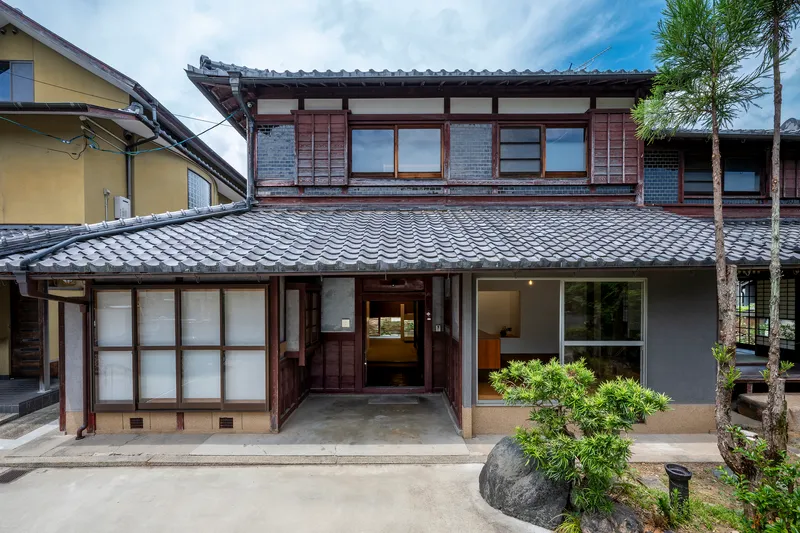
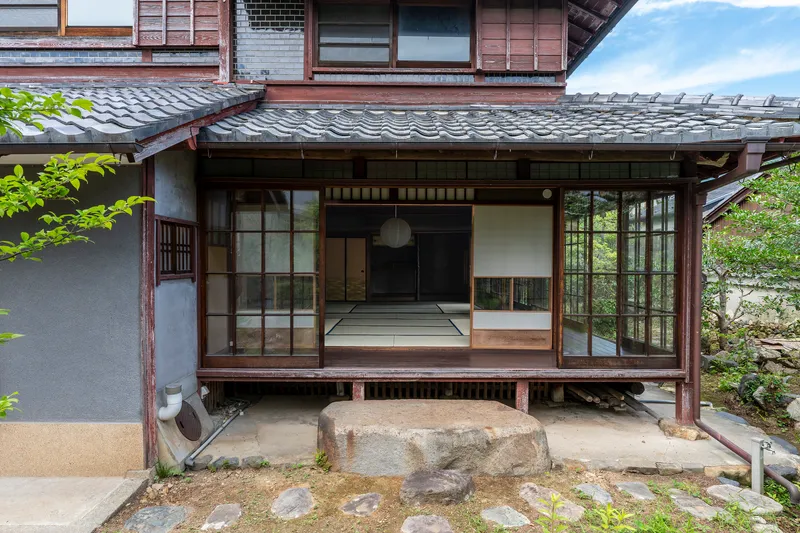
From the street, the house reads as unmistakably vernacular: a traditional tiled roof, timber-framed sliding screens, and a planted courtyard buffer between public and private life. The architects appear to have left this face largely intact, preserving the low-profile modesty that defines residential Iwakura. A sliding glass assembly opens onto a raised timber veranda, collapsing the boundary between garden and room in a way that feels inherited rather than designed.
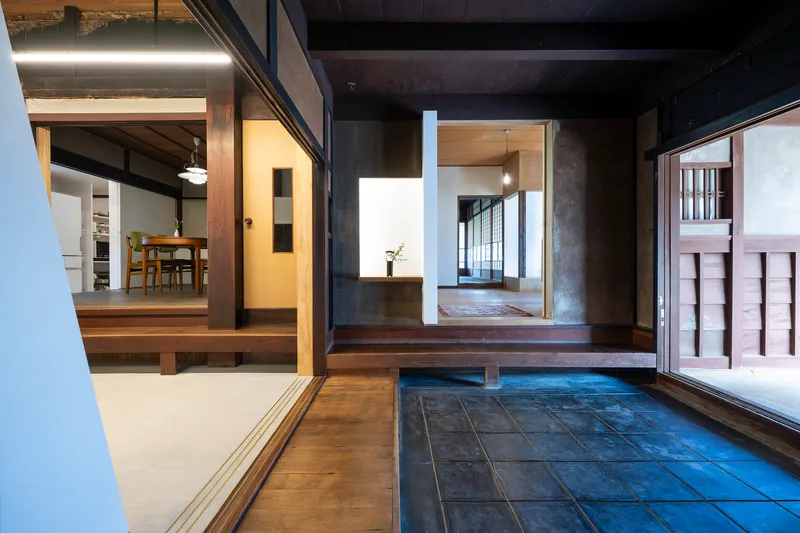
The entrance itself sets up a material conversation that runs through the entire house. Dark stone tile meets the timber frame in a vestibule that funnels light inward, drawing you past sliding doors toward the illuminated rooms beyond. The compression of this threshold, its darkness, its low ceiling, is deliberate. It makes the double-height spaces inside feel earned.
The Doma Passage as Organizing Spine
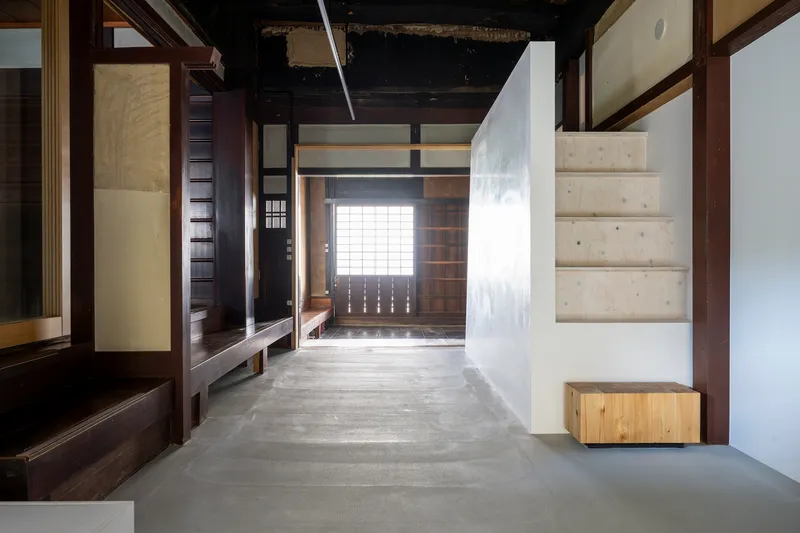
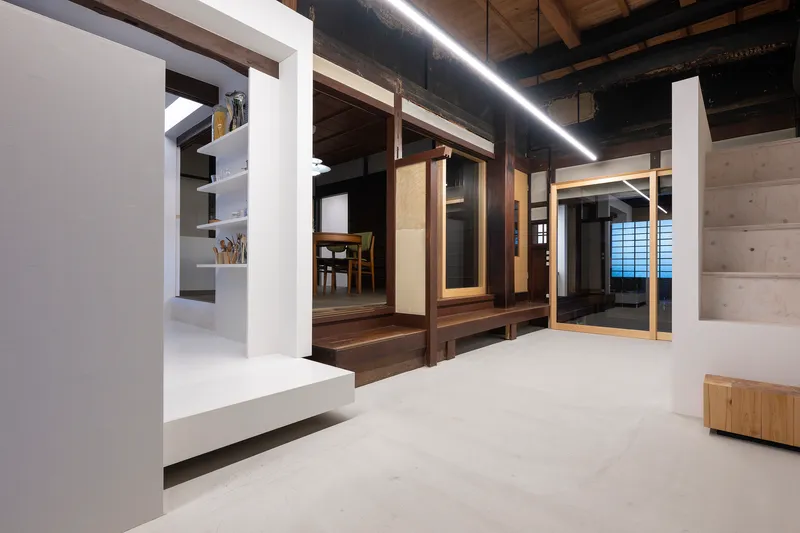
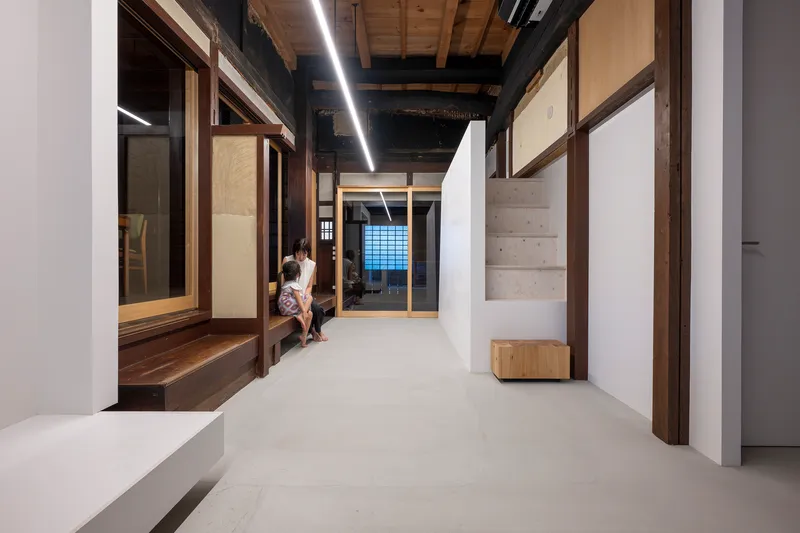
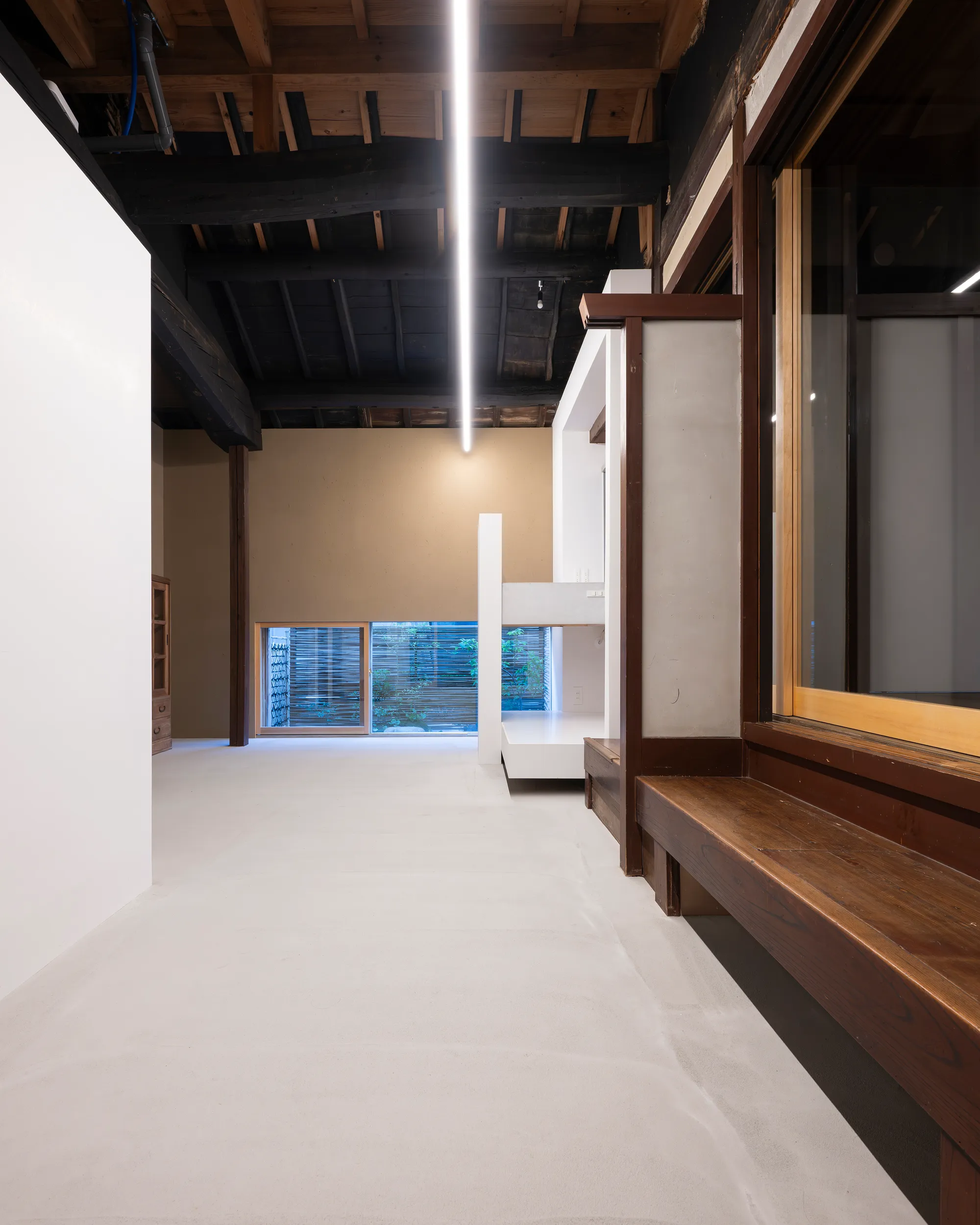
The doma, the earthen-floored passage that runs the length of the house, is the core spatial idea of the Iwakura minka type, and the renovation treats it accordingly. A concrete floor now replaces the original compacted earth (a practical concession), but the passage retains its proportional dominance. Exposed timber structure overhead remains dark and weighty, while new white plastered volumes stand alongside it like inserted furniture rather than rebuilt walls.
A continuous linear ceiling fixture runs through the hallway, providing even light without disrupting the rhythm of the beams. Two figures sit on a timber bench in one shot, and the image tells you everything about the scale: this is not a corridor but a room in itself, wide enough for dwelling, narrow enough to pull you through the house. The alternation between dark structure and white surface along its length keeps the eye moving.
A White Volume Under a Black Roof
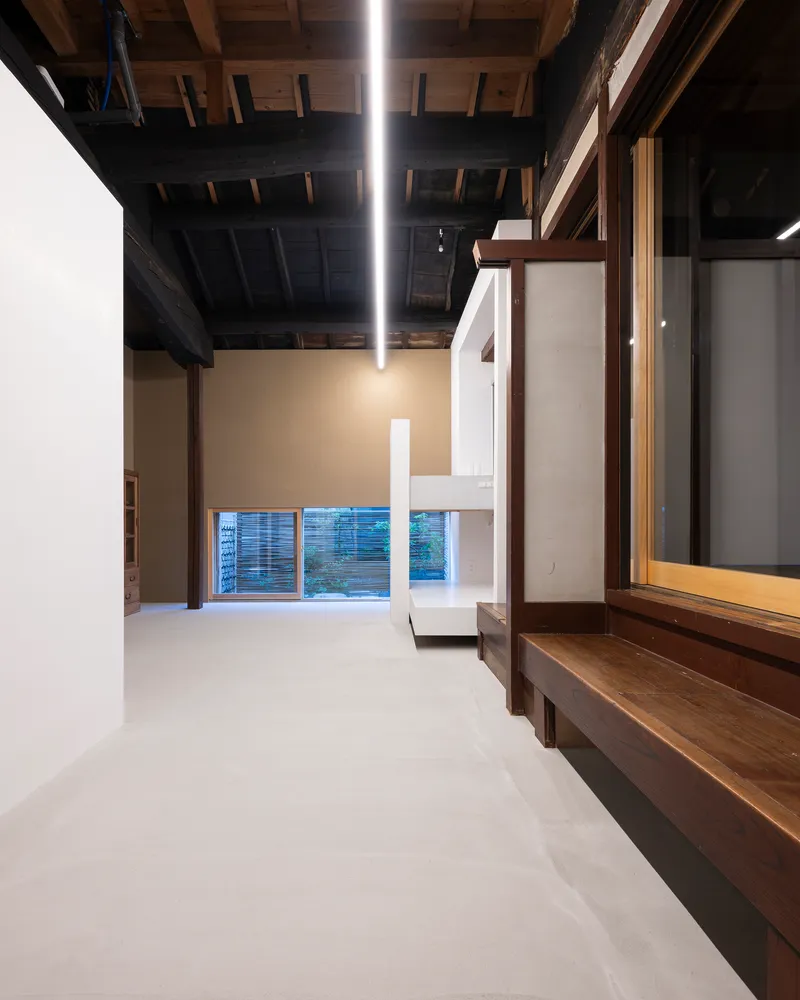
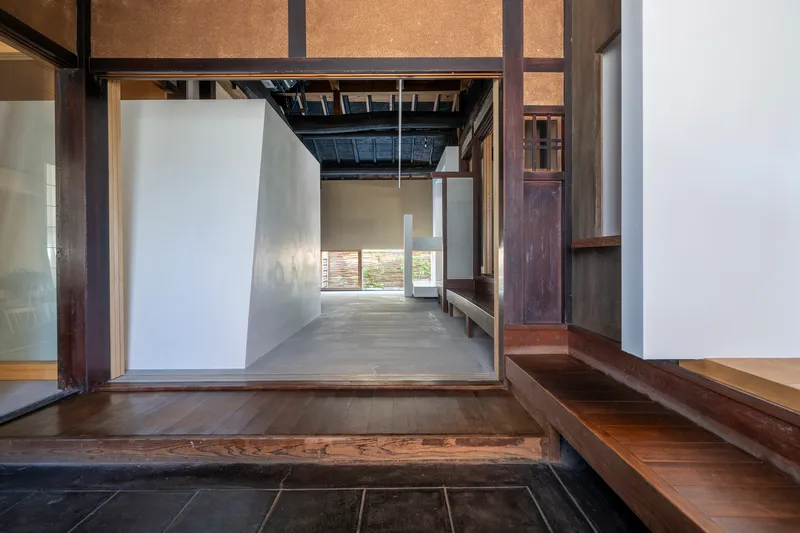
The most striking interior moment is a double-height space where a white mezzanine platform has been inserted beneath the blackened timber roof structure. This is the renovation's signature move: a clean, abstract box floating inside a weathered frame. Linear lighting traces the joint where new meets old, making the seam legible rather than hiding it. The effect is architectural honesty pushed to its visual limit.
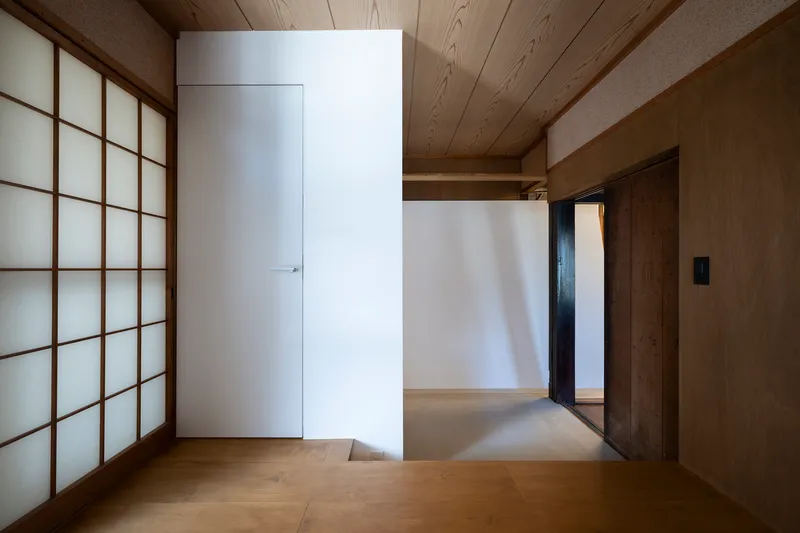
Elsewhere, translucent shoji screens define interior thresholds alongside the new white partition volumes, creating a gradient of opacity that the original house would have relied on. The view from a raised timber floor across a dark stone entry threshold to a polished concrete room beyond compresses three material eras into a single sightline. It is a controlled collision, and it works because none of the layers pretend to be something they are not.
Living Rooms: Tatami, Shoji, and Continuity
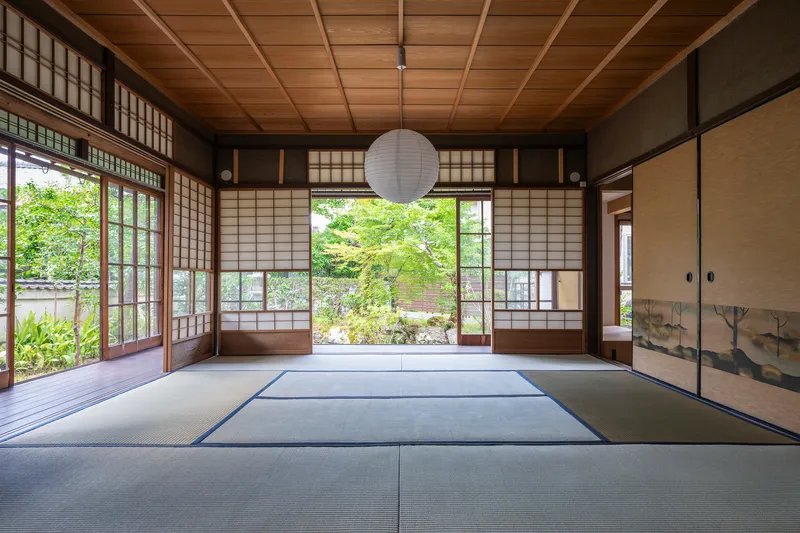
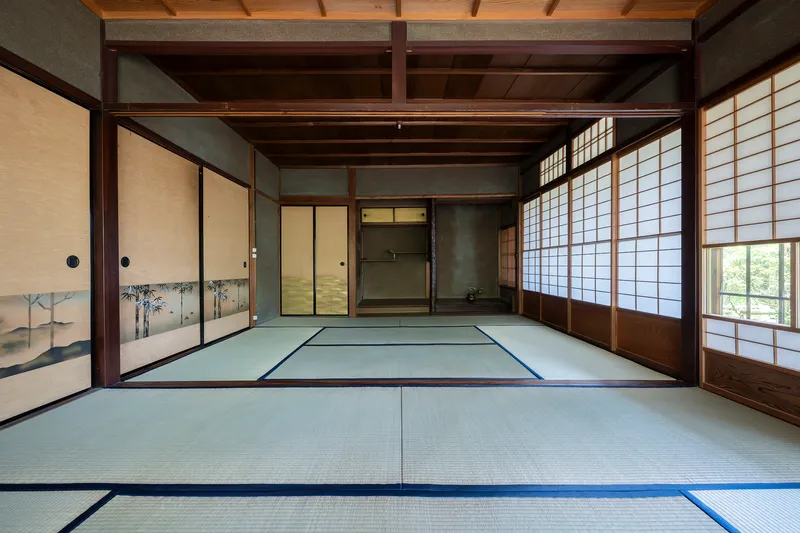
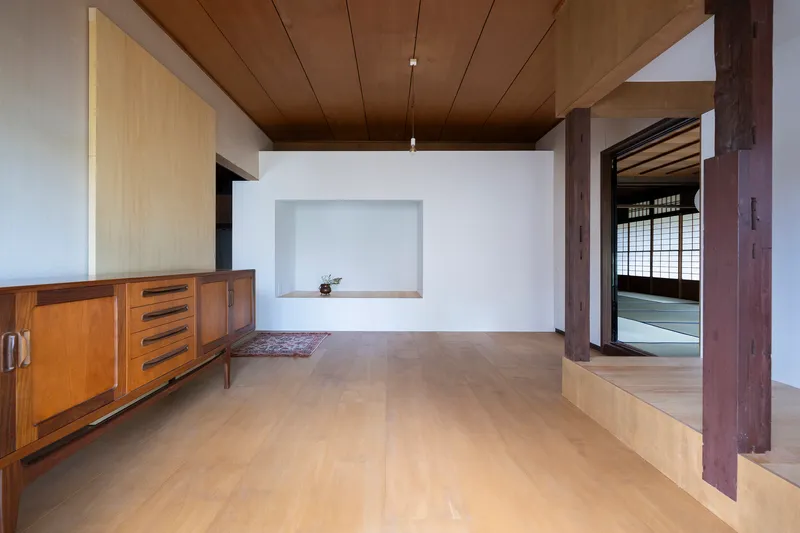
The tatami rooms are where the renovation is most conservative, and rightly so. A coffered timber ceiling, sliding shoji screens facing a garden courtyard, painted fusuma doors framing adjacent spaces: these rooms function almost exactly as they would have a century ago. The architects understood that certain spatial rituals do not need updating. They need maintenance.
A wall niche in one room suggests a tokonoma alcove, the traditional display recess, preserved as a grounding element against the more assertive interventions elsewhere. The adjacent doorway to the tatami space is deliberately modest, a timber frame and nothing more. The restraint here gives the bolder moves in the doma and the double-height space permission to be bold.
Kitchen and Dining: Where Eras Overlap
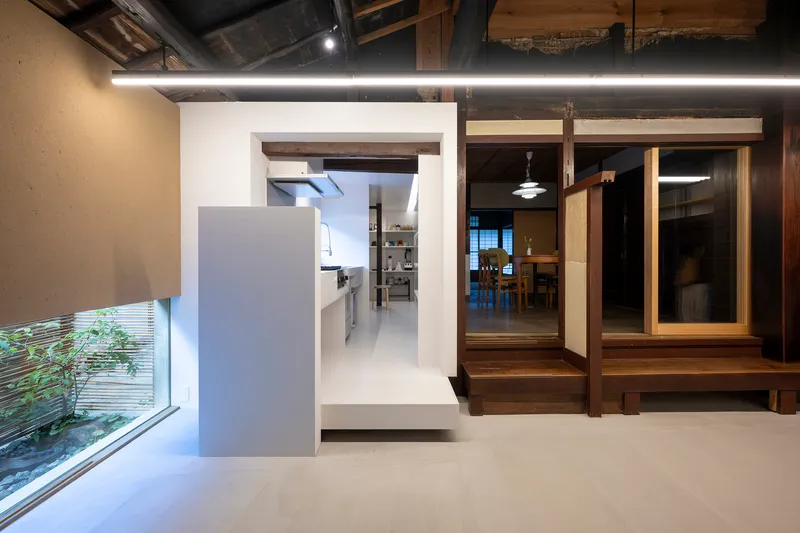
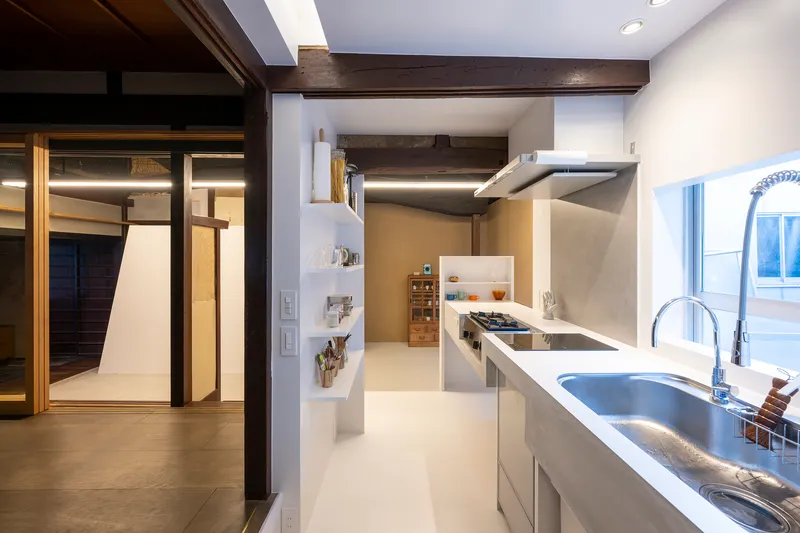
The kitchen is where the renovation's domestic ambitions become most legible. White countertops and contemporary fixtures sit beneath exposed timber beams, and an open doorway frames an illuminated corridor beyond. It is a functional modern kitchen that happens to exist inside a Meiji-era skeleton. The raised dining platform, visible at dusk through the timber framing, adds a level change that separates cooking from eating without walls.
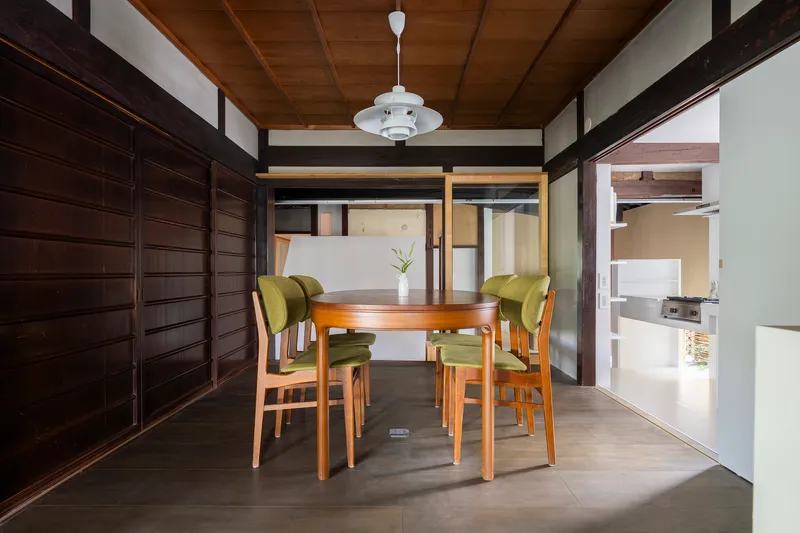
At the dining table, green upholstered chairs and dark wood sliding panels create an atmosphere closer to a considered apartment than a rural farmhouse. The pendant light over the table, the material palette, the careful framing: these choices signal that the house is not a museum piece but an occupied home for contemporary life. The manufacturers list (Panasonic, Toto, Sanei, toolbox) confirms the pragmatic side of the equation.
The Interior Courtyard as Mediator
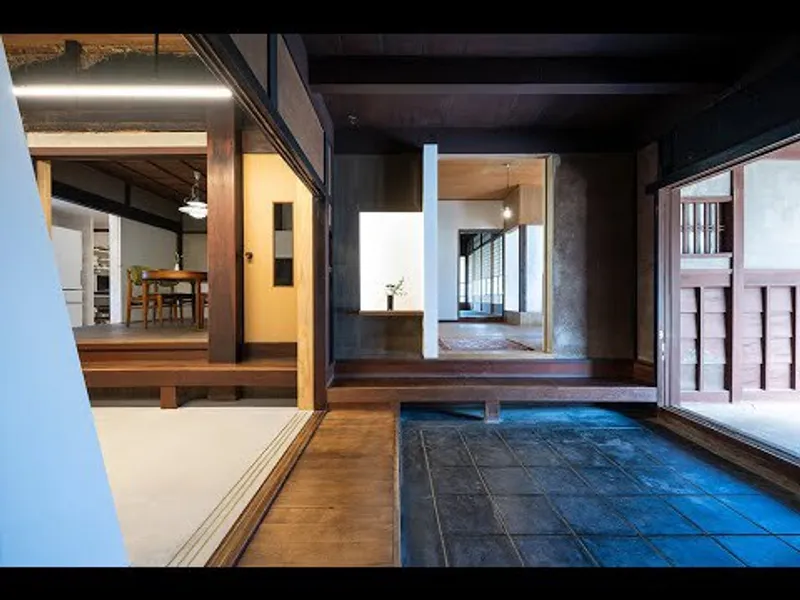
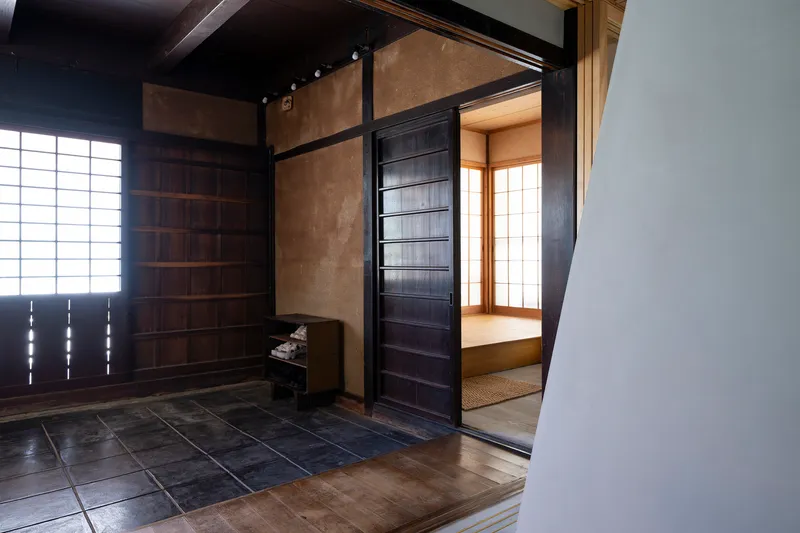
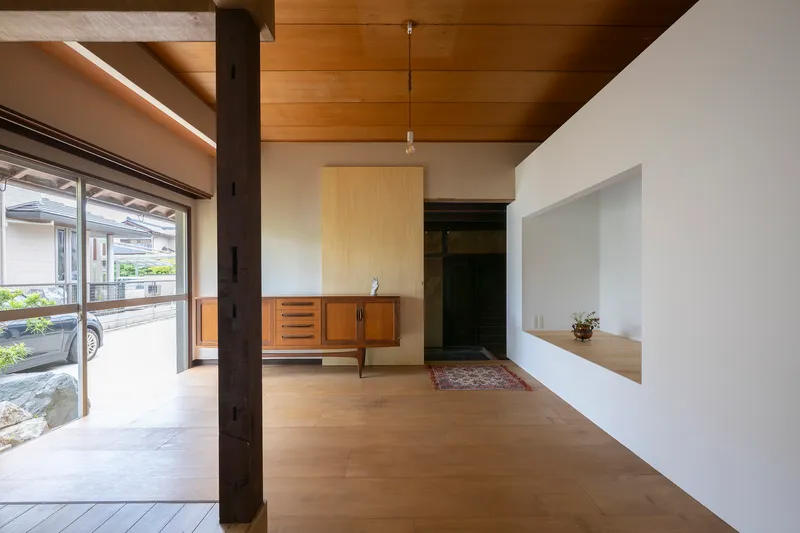
An interior courtyard with dark tile flooring sits surrounded by timber-framed rooms with raised wood platforms, acting as a light well and environmental buffer. In the minka tradition, the courtyard is not ornamental; it regulates airflow, admits daylight to deep plan rooms, and provides visual relief. Here it also stages the contrast between the grounded, mineral courtyard floor and the elevated, warm timber of the surrounding rooms.
The entry room, with its vintage credenza beneath a pendant light and sliding glass doors, hints at the owners' sensibility: collected, not curated. It is a room that invites inhabitation rather than documentation, which is perhaps the most difficult quality for a renovation of this type to achieve.
Plans and Drawings
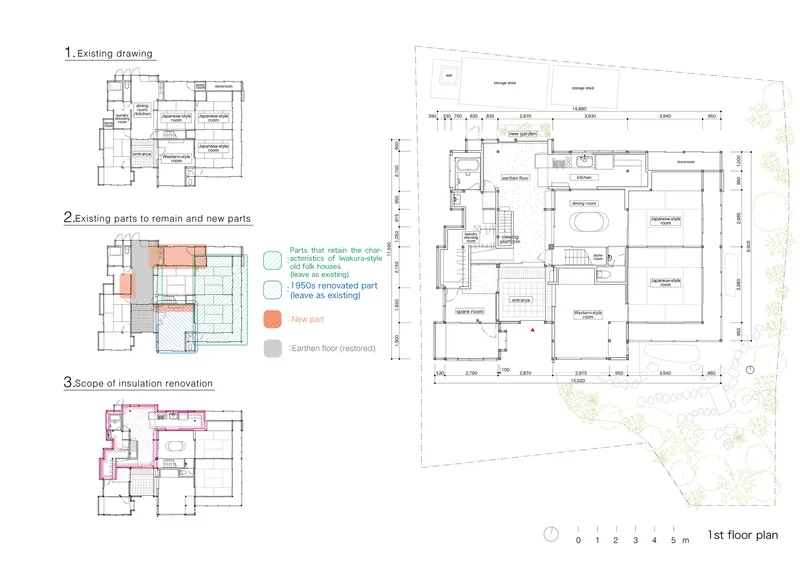
The floor plan reveals the linear organization that defines the Iwakura minka type: the doma passage running as a spine with rooms arrayed to either side. Color annotations distinguish the renovation scope from the existing structure, making the logic of intervention visible. What becomes clear in plan is how little new footprint the architects added. The transformation is almost entirely interior, a reorganization of volumes within a given envelope.
Why This Project Matters
Japan's stock of traditional minka is dwindling. Many are demolished; others are relocated to open-air museums and stripped of context. The projects that survive in place tend either toward over-preservation, where the house becomes a relic no one can comfortably live in, or over-renovation, where the timber frame is reduced to a decorative prop. td-Atelier and ENDO SHOJIRO DESIGN navigate a third path in Iwakura, one that acknowledges the building's typological identity while inserting a genuinely modern domestic program.
The key lesson here is legibility. Every new element, the white volumes, the concrete floors, the linear lighting, reads as new. Every old element, the blackened beams, the tatami rooms, the courtyard, reads as old. Neither is subordinated to the other. The result is a house that carries its full history without being burdened by it, and that offers a model for how regional building traditions can be sustained without being embalmed.
Old Folk House in Iwakura, by td-Atelier and ENDO SHOJIRO DESIGN. Iwakura, Kyoto, Japan. 150 m². Completed 2025. Photography by Kohei Matsumura.
About the Studio
Share Your Own Work on uni.xyz
If projects like this are the kind of work you want to make, uni.xyz is a place to publish your own, find collaborators, and enter design competitions.



Popular Articles
Popular articles from the community


Play: Fragments of Their World
Familiar architecture becomes modular playground design, creating safe spaces where displaced children can learn, connect, imagine and play.

The Musturak Paradise: Senior Living Architecture for a Connected Future in Temara, Morocco
The Musturak Paradise reimagines senior living architecture in Temara via private homes, social spaces, culture, community, and shared care.

The Earth Pod: 3D Printed Homes for Resilient Refugee Communities
The Earth Pod reimagines refugee housing through 3D printed homes made from clay, combining resilience, self-sufficiency, and rapid shelter.

Riyadh For All: Intergenerational Urban Design for Active Aging in Rabat
Riyadh For All reimagines urban design in Rabat with intergenerational co-living, adaptive courtyards, and Moroccan cultural exchange today.


Similar Reads
You might also enjoy these articles

Bao Huynh Watercolor Atelier: A Serene Art Retreat in Hội An
Bao Huynh Watercolor Atelier in Hội An blends multifunctional art spaces, sustainable design, local materials, and family-friendly living in a serene environment.

Atelier Macri Concept Store Interior Design by CASE-REAL
Atelier Macri store features a "ko" counter, walnut wood details, cork displays, blending retail, gallery, and seamless customer experiences.

Manuel Vargas Izquierdo Stadium and High-Performance Sports Center: Architectural Excellence in Jalpa de Méndez
The Manuel Vargas Izquierdo Stadium blends sustainable design, inclusive sports facilities, and cultural-inspired architecture, revitalizing Jalpa de Méndez’s public spaces.

KAKR Buluh Awar Hall: Revitalizing Community and Ecology Through Bamboo Architecture
Community built bamboo hall revitalizes Buluh Awar village, empowering youth, restoring ecology, celebrating vernacular craftsmanship through sustainable architecture and culture.

Explore Urban Design Competitions
Discover active competitions in this discipline


Challenge to design luxury tourism on rails


VR headsets Storefront design competition

Designing a staircase for a client
Comments (0)
Please login or sign up to add comments
No comments yet. Be the first to comment!