
Teitakusubako and Yusuke Igarashi Architects Dissolve a House into the Forest Edge in Zushi
A 215 m² residence on a generous Tokyo-suburban plot uses stone, timber, and fragmented volumes to blur the line between dwelling and woodland.


Zushi sits about an hour south of central Tokyo, where the density of the capital's commuter belt begins to loosen and thick pockets of protected forest push back against subdivision. It is exactly the kind of site that tempts architects toward a single dramatic gesture: a long glass pavilion, perhaps, or a concrete box punched with a few heroic openings. Teitakusubako, led by Naoki Hayasaka, and Yusuke Igarashi Architects chose the opposite path. Their House at the Urban-Nature Threshold breaks a 215 m² program across a 1,000 m² plot into a constellation of low-slung volumes, stone walls, and garden episodes that refuse to declare where the house ends and the landscape begins.
What makes the project genuinely interesting is the rigor of that refusal. Rather than treating indoor and outdoor as two conditions linked by a sliding door, the architects build a continuous field of thresholds: covered terraces, courtyard gardens, stone corridors open to the sky, clerestory slots that pull the treetops into rooms. The house doesn't frame nature as a view. It occupies the same stratum as the forest canopy around it, and the structural language of rough fieldstone and exposed timber makes that cohabitation legible at every scale.
Arriving Through Stone and Green
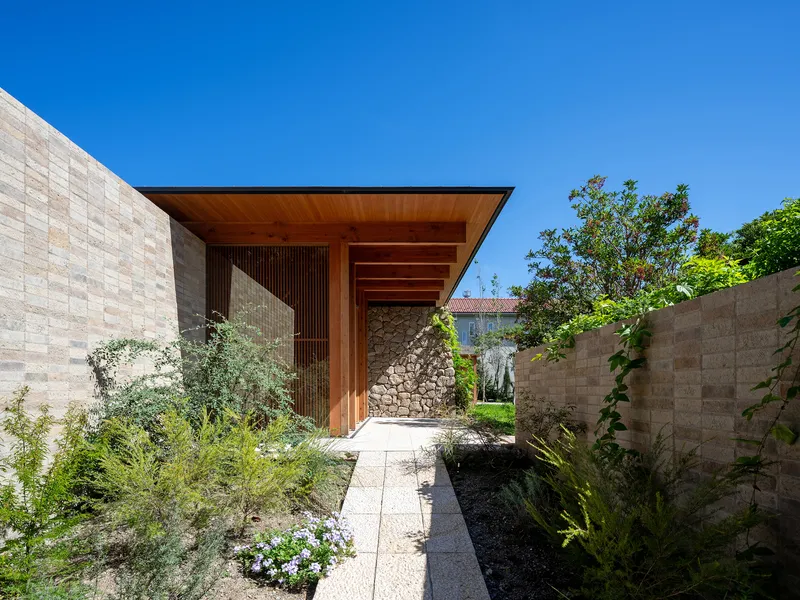
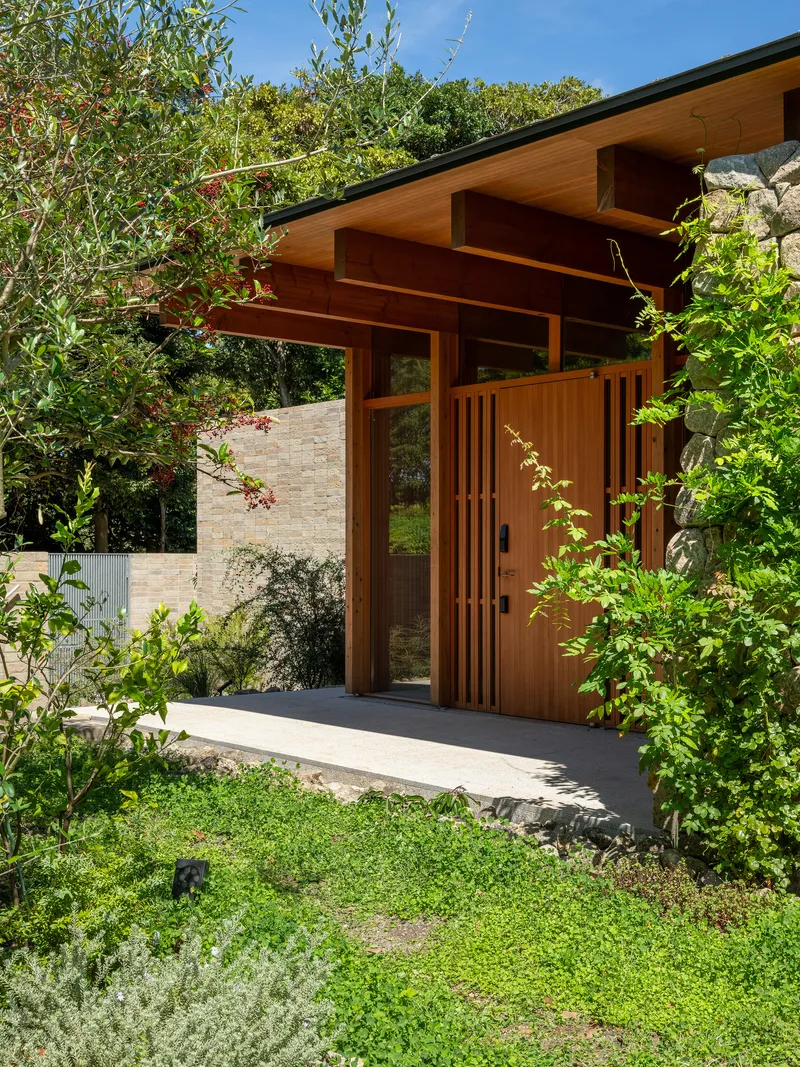
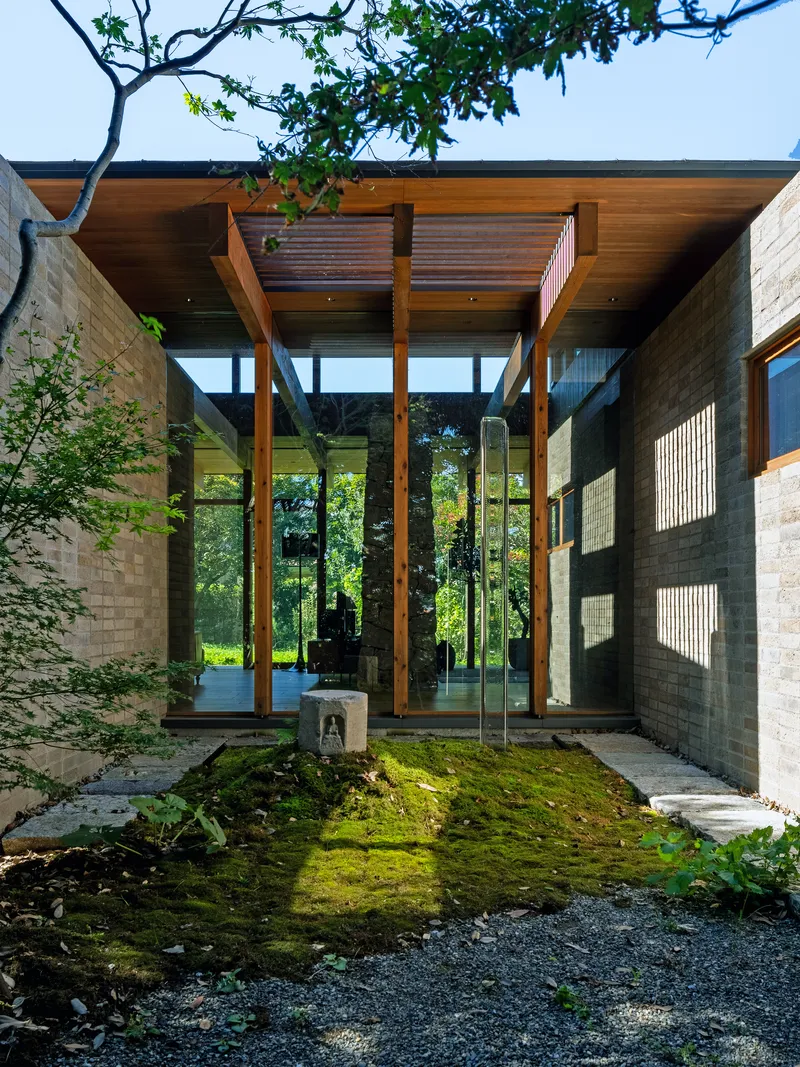
The approach sequence is deliberately slow. Planted beds push up between stone block walls, compressing the visitor into a narrow passage before releasing them at a timber entry pavilion screened by vertical slats and a moss garden. The slatted canopy filters light in a way that belongs neither fully inside nor fully outside, establishing the threshold logic that the rest of the house will elaborate. Stone pavers and stepping stones replace any conventional driveway or path, making every step a negotiation with the garden.
It is a move borrowed from traditional Japanese residential design, the roji or garden path that prepares the mind before entering a tea room, but scaled up and stripped of ceremony. The rough-cut stone and dense vegetation do the psychological work without needing a ceremonial gate.
Stone Walls as Geological Furniture
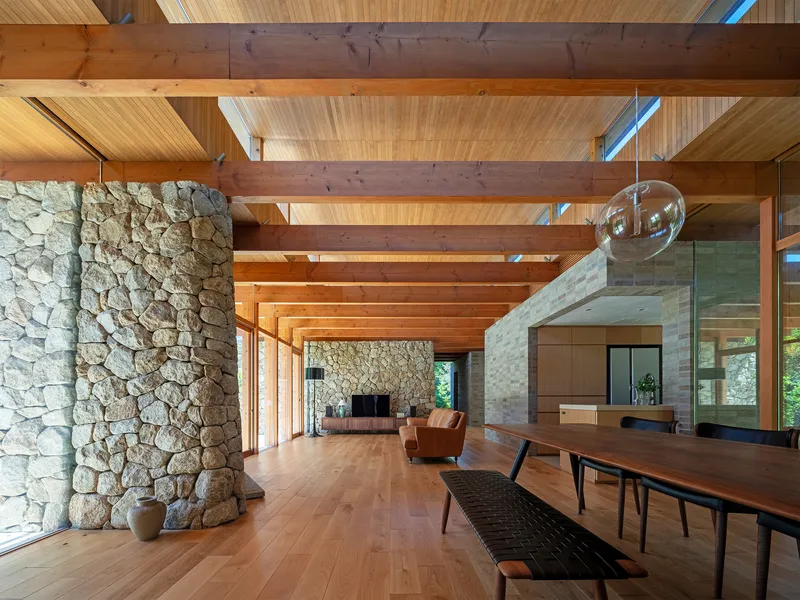
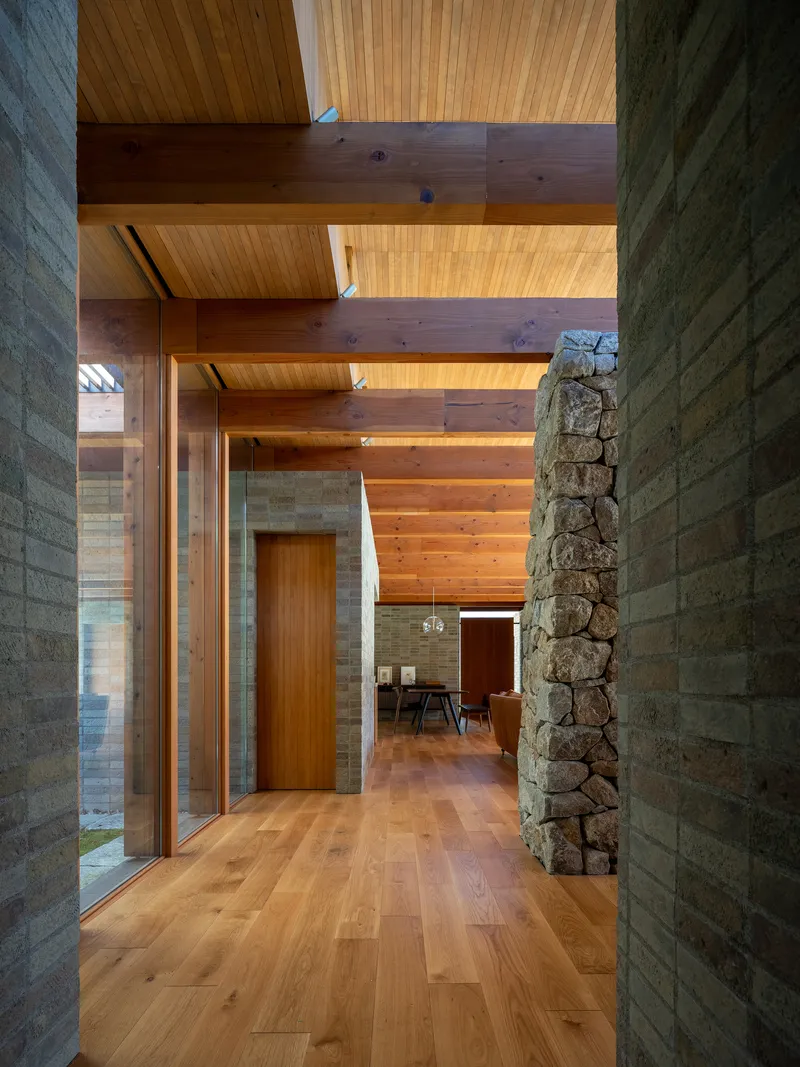
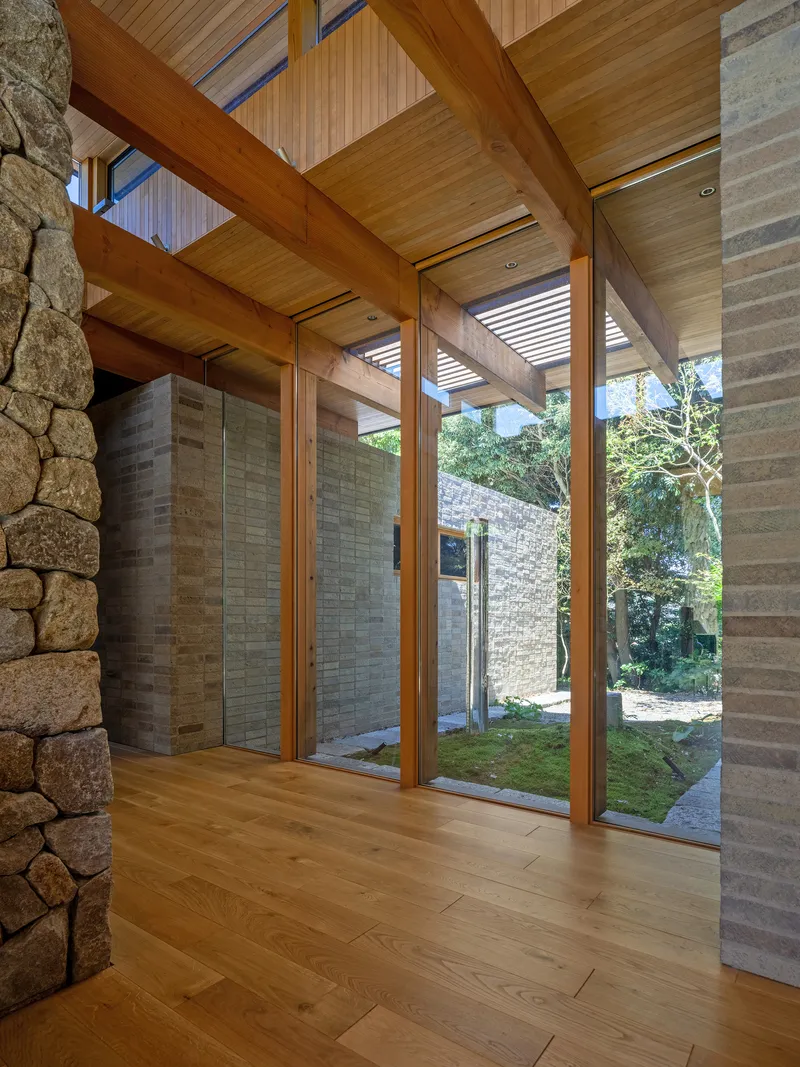
Inside, fieldstone columns and masonry walls do far more than hold up the roof. They act as room dividers, spatial markers, and textural anchors that keep the interiors grounded against floor-to-ceiling glazing. A rough stone column in the central corridor reads almost as an archaeological relic around which the timber structure was built, while concrete block walls in the hallways shift the palette just enough to signal a change of program.
The combination of fieldstone and concrete block is unorthodox. Most residential projects commit to one masonry language for consistency. Here the two coexist because they represent different degrees of refinement along the same material spectrum: quarry to factory, forest to suburb. It is a quiet argument made entirely through walls.
Living Under Timber and Light
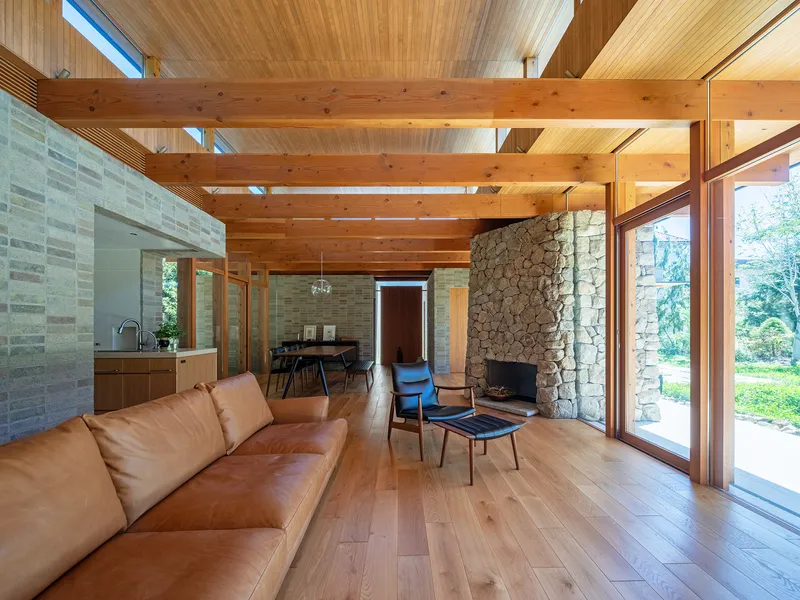
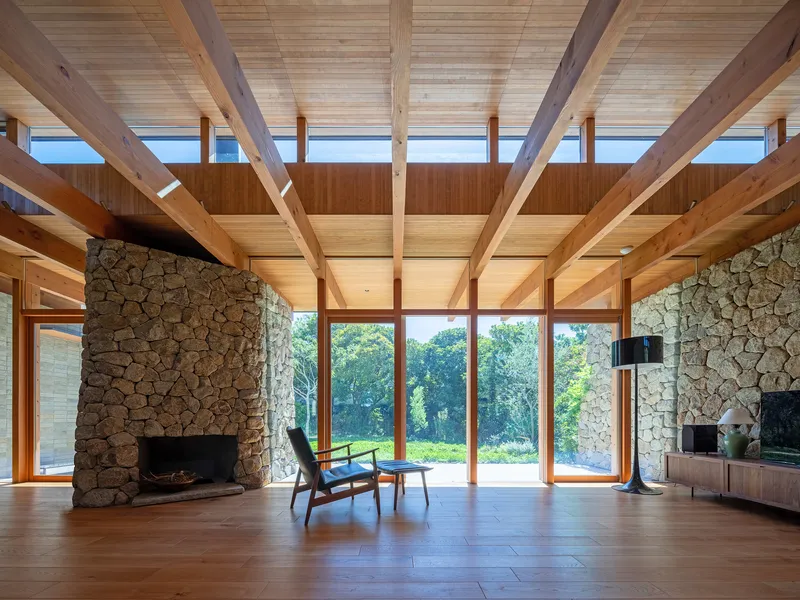
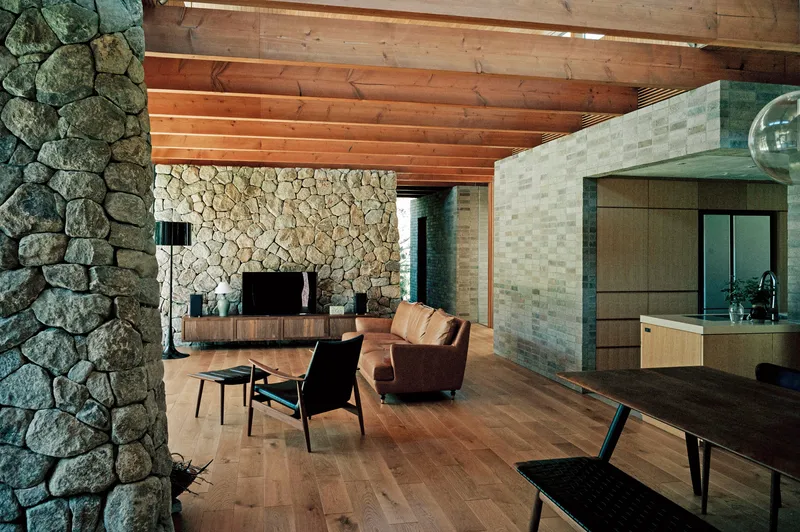
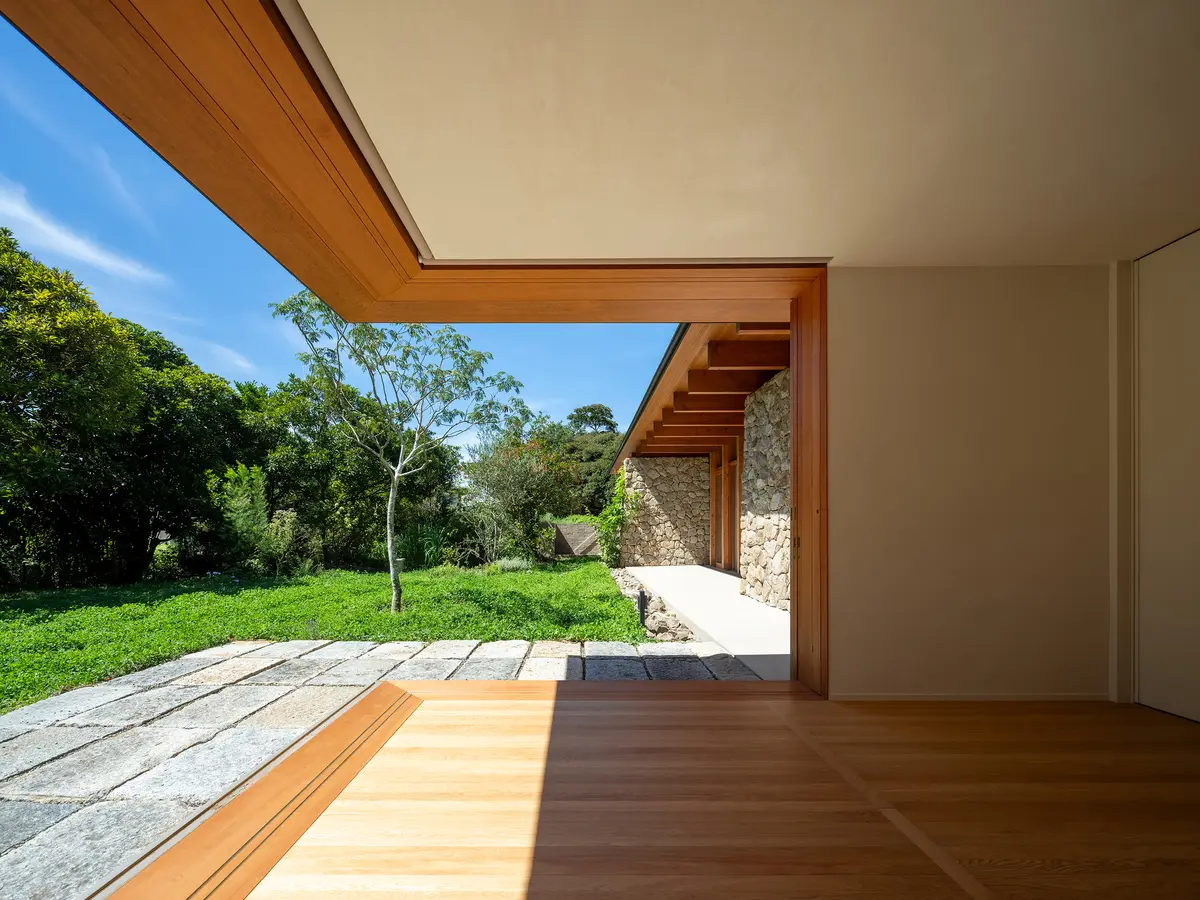
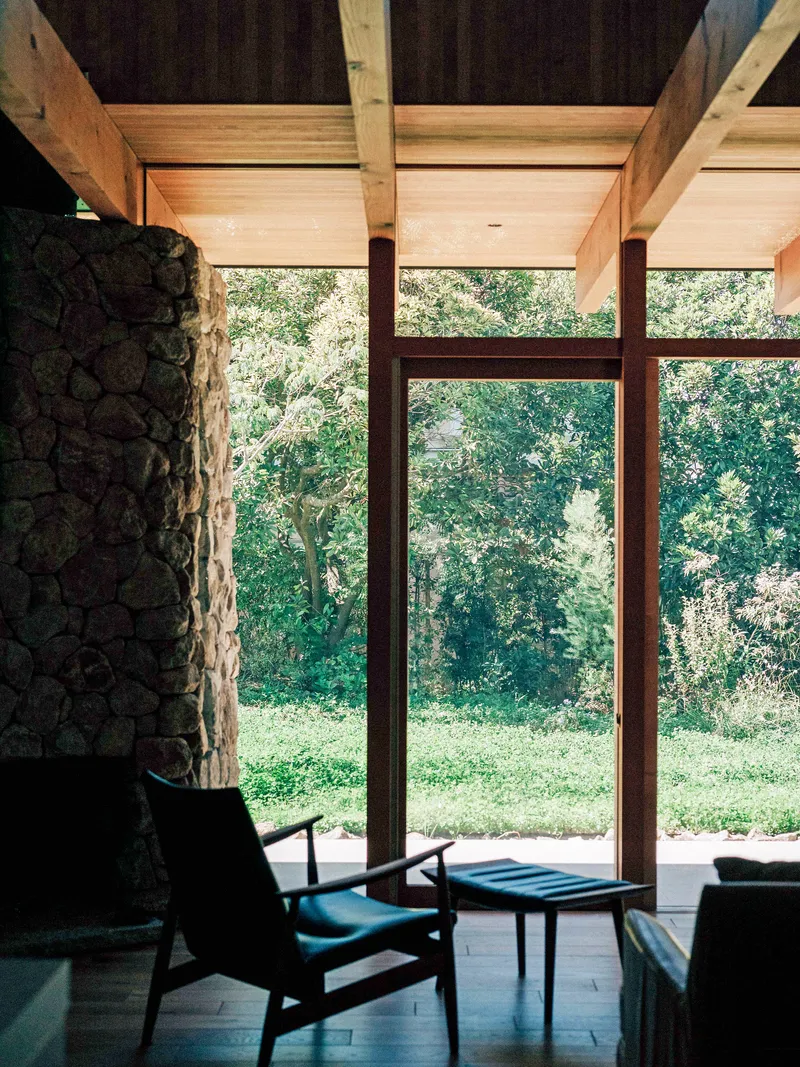
The main living room is the project's centrepiece, and it earns that status through restraint rather than spectacle. Exposed timber beams span overhead in a rhythmic grid, their honey tones warmed by the stone fireplace wall that anchors one end. Full-height glazing on the garden side dissolves the room's boundary into the lawn, while the fireplace wall pulls attention inward. At dusk the room glows against the darkening forest, a lantern that confirms human occupation without shouting about it.
Clerestory windows introduce a second layer of daylight above the main openings, washing the timber ceiling with a soft, indirect glow that changes character through the day. The effect keeps the ceiling plane alive and visible even when direct sun is elsewhere on the site.
Dining, Kitchen, and the Intimate Scale
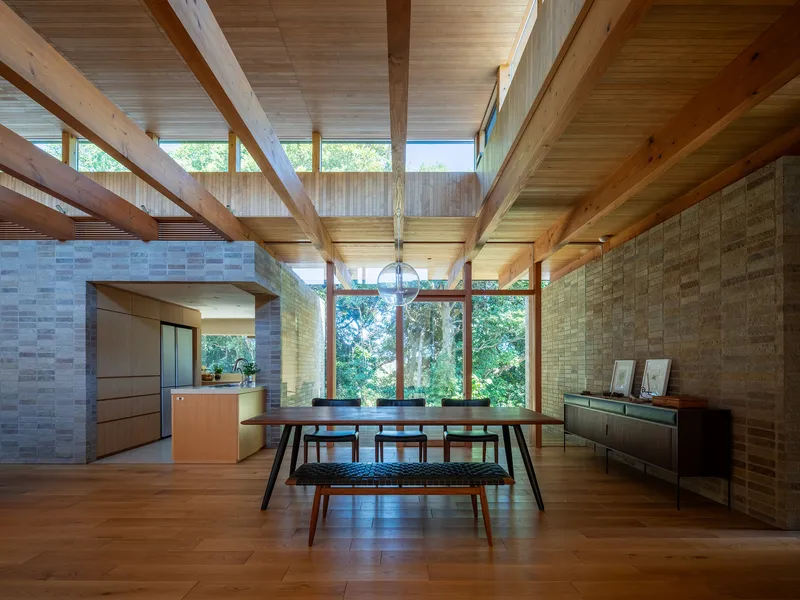
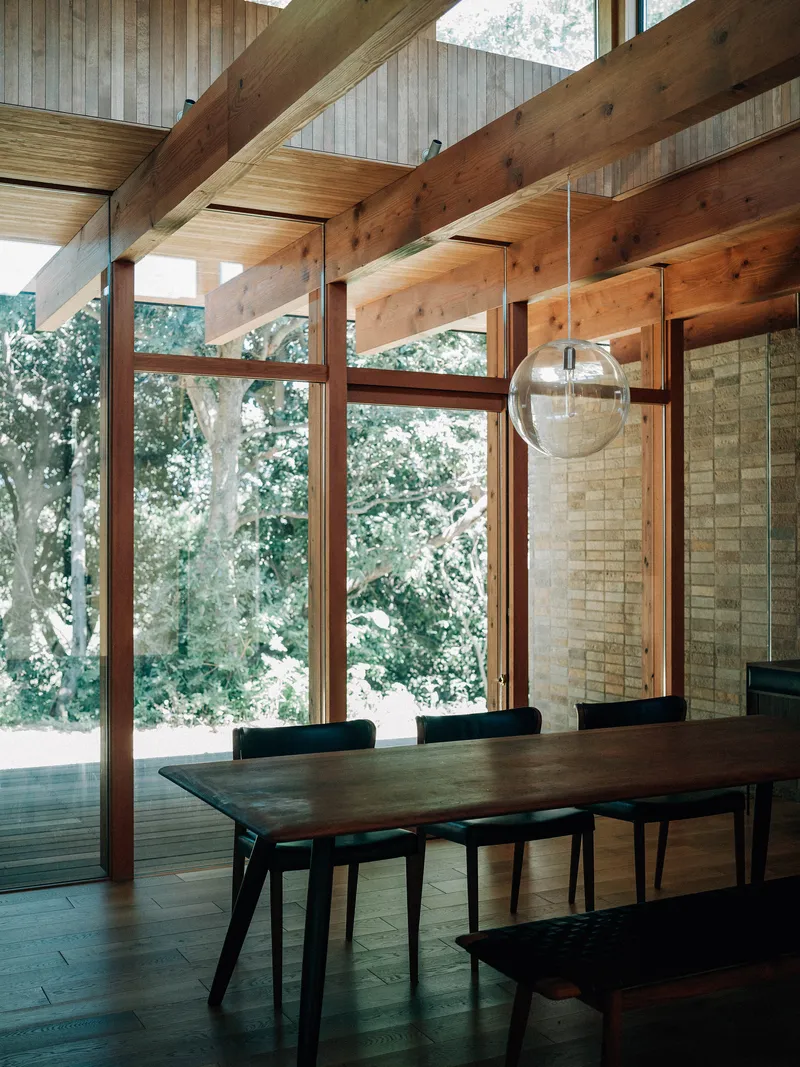
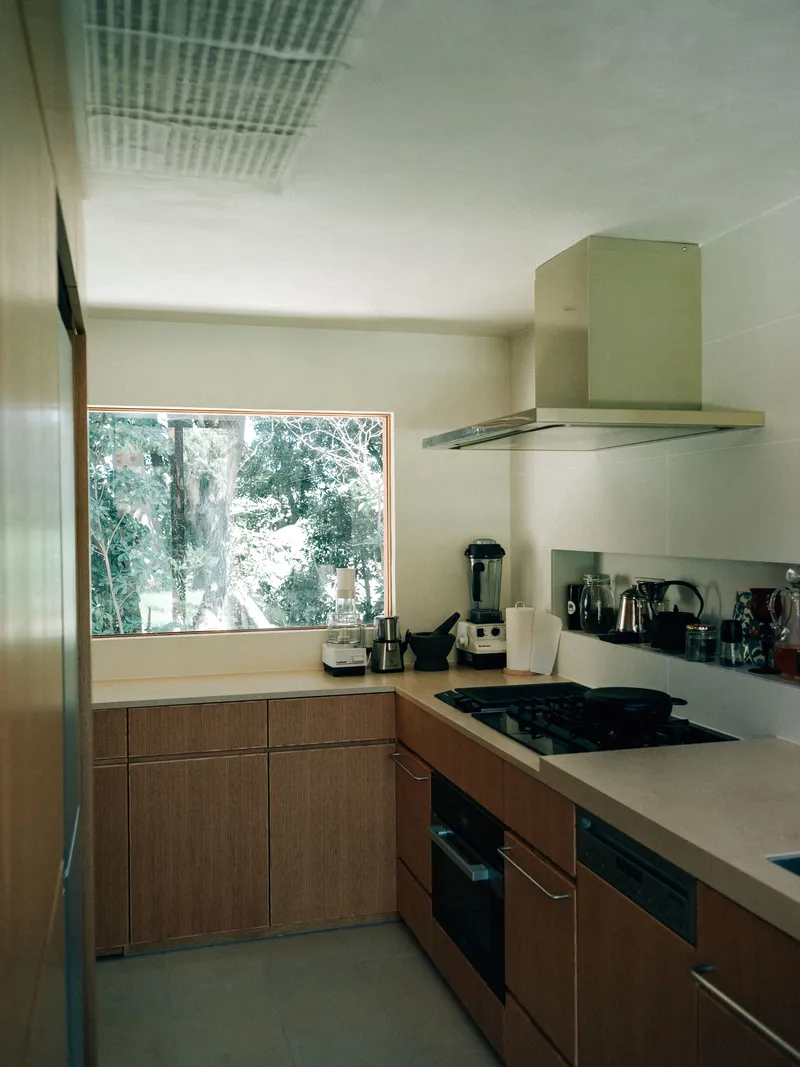
Where the living room is expansive, the dining area and kitchen compress space to a domestic intimacy. A glass pendant hangs low over the table, pulling the scale down, while the timber ceiling structure above remains exposed to maintain continuity with the larger volumes. The kitchen is compact and carefully detailed with timber cabinetry, a skylight overhead, and a window that frames the trees like a still life.
These rooms feel like clearings within the house, pockets of focused activity carved out from the flowing sequence of thresholds. The architects resist the open-plan instinct to merge everything. Each space has a ceiling height, a light source, and a material boundary that belongs to it alone.
Corridors as Spatial Instruments
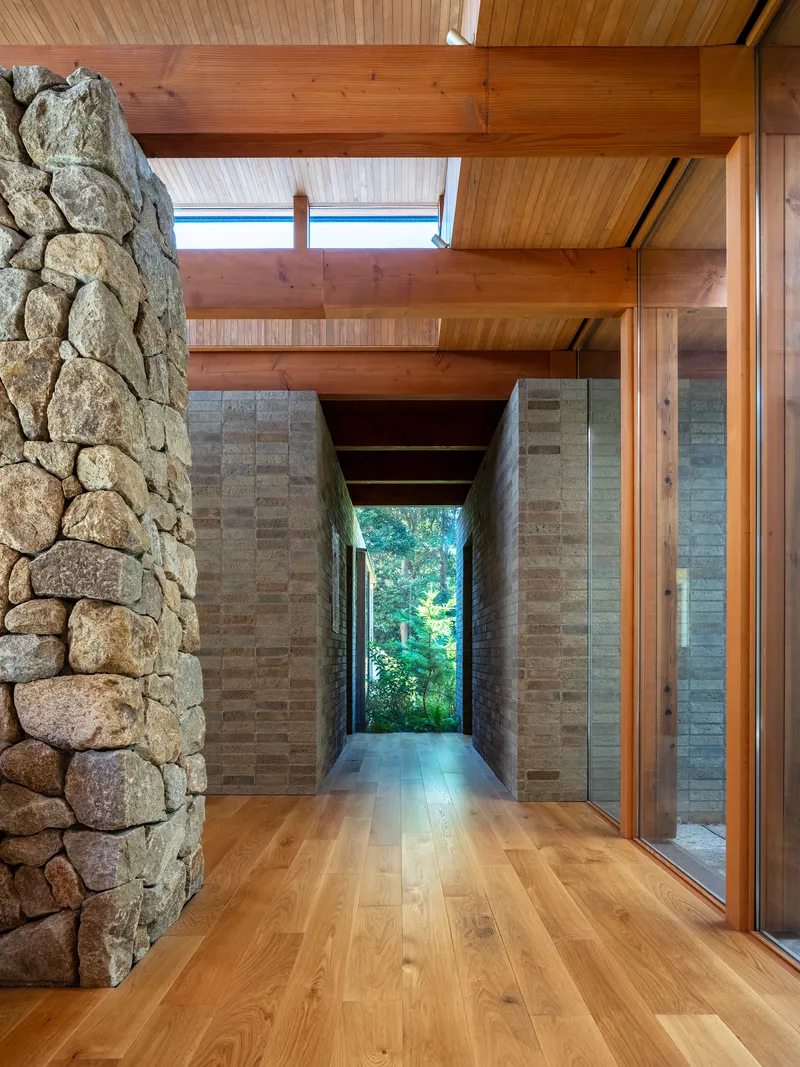
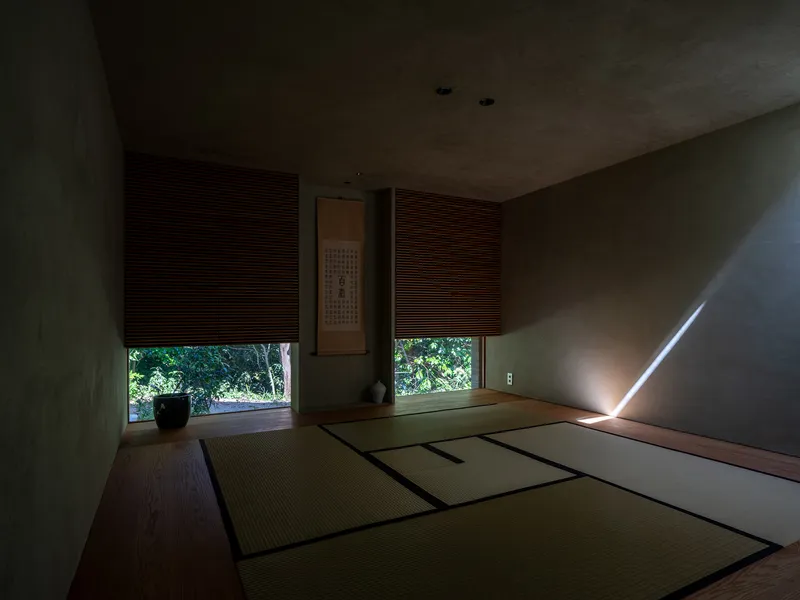
The corridors in this house are not leftover space. Layered masonry walls frame distant window views into deep telescopic compositions, turning a walk from bedroom to living room into a sequence of compressed and released sightlines. A tatami room at one end receives only a thin shaft of daylight through lowered bamboo shades, the quietest moment in the house.
That tatami room is worth pausing on. It is the one space where the architects close down every connection to the landscape and let interior silence take over. In a house so committed to porosity, this deliberate withdrawal reads as a counterpoint, not a contradiction. It proves the architects understand that the threshold between city and nature is also the threshold between stimulation and rest.
Bathing Between Indoors and Out
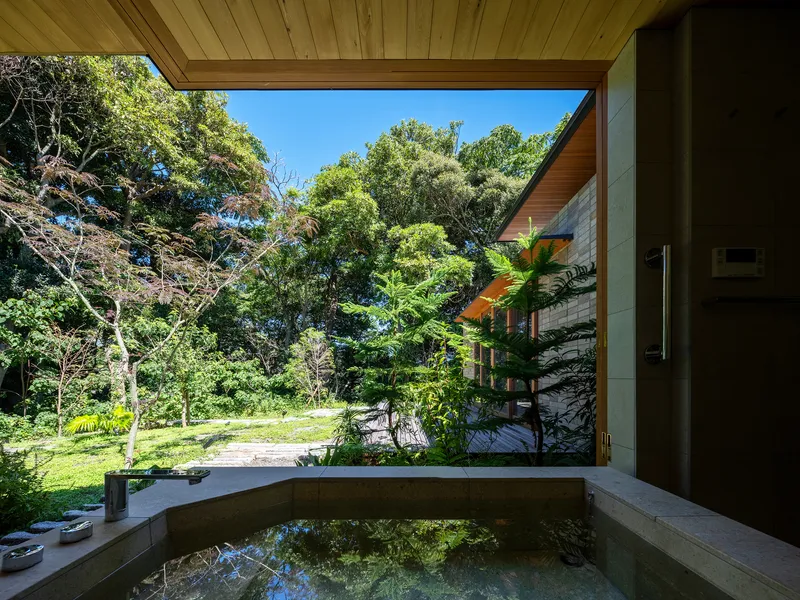
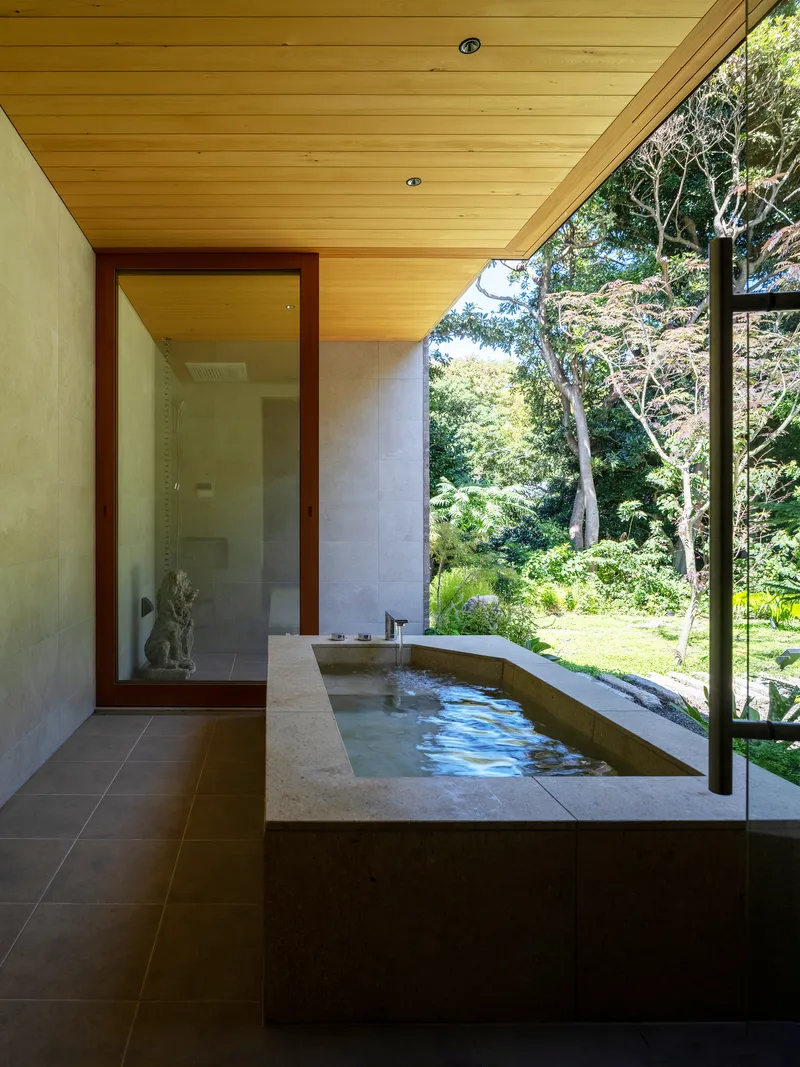
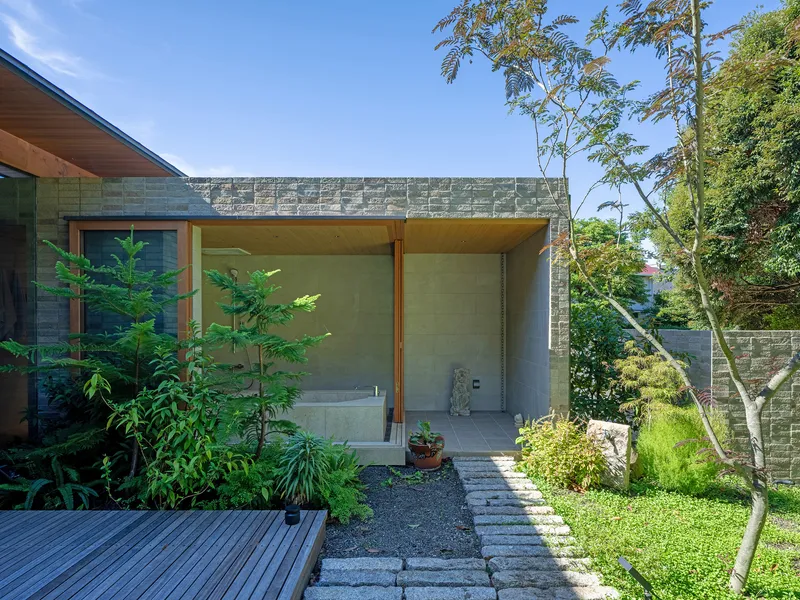
The bathing areas are where the threshold concept reaches its most sensory conclusion. A concrete soaking tub sits on a covered terrace open to the lawn and forest. A second sunken tub occupies a glazed room that feels only marginally more enclosed. Both arrangements treat bathing as a landscape event, aligning with the Japanese tradition of the outdoor bath while embedding it within the house's architectural language of stone, timber, and concrete.
A covered outdoor area with a concrete block wall, timber ceiling, and garden stepping stones offers a third bathing condition, fully sheltered but entirely open to the air. Three degrees of enclosure for a single domestic ritual. It is the kind of programmatic generosity that only a 1,000 m² site and a committed design team can sustain.
Roof and Canopy
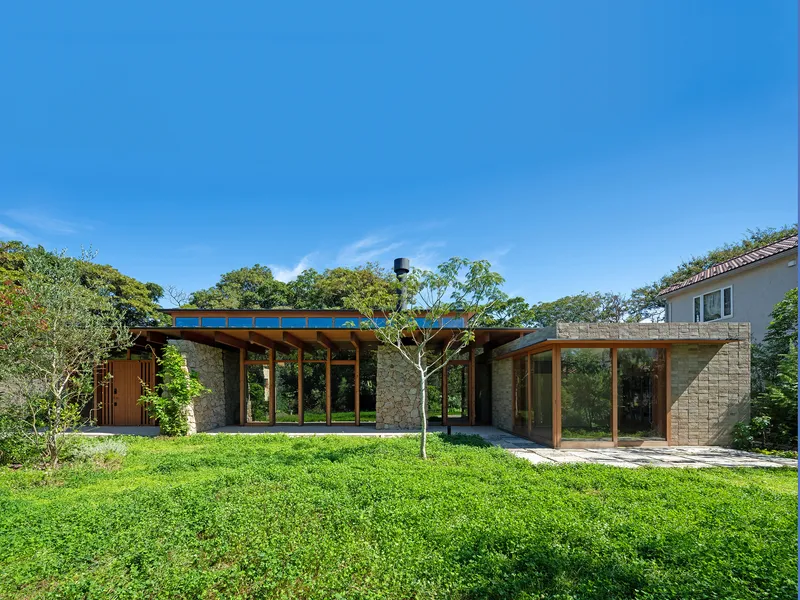
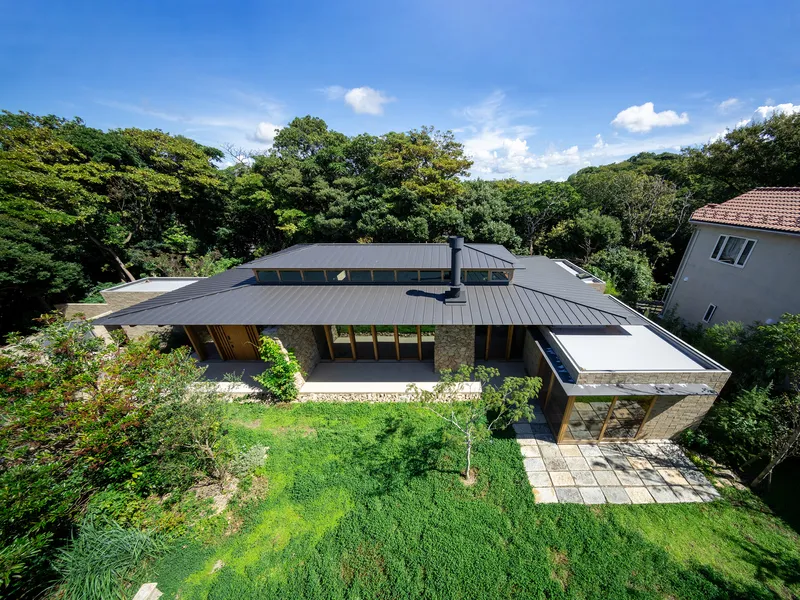
From the garden, the house reads as a series of stone walls and timber-framed glass panels sheltering under a flat, almost invisible roof. An aerial view confirms the strategy: several angled metal roof volumes sit low among the trees, their dark surfaces merging with the surrounding forest canopy. The building's footprint meanders across the site rather than claiming it, leaving large areas of lawn and planting intact.
That muted roof profile is essential. A pitched roof or a bold cantilever would have imposed a singular reading on the project. By keeping the roof planes thin and multiple, the architects ensure that the stone walls, timber beams, and garden episodes remain the dominant spatial experience.
Plans and Drawings
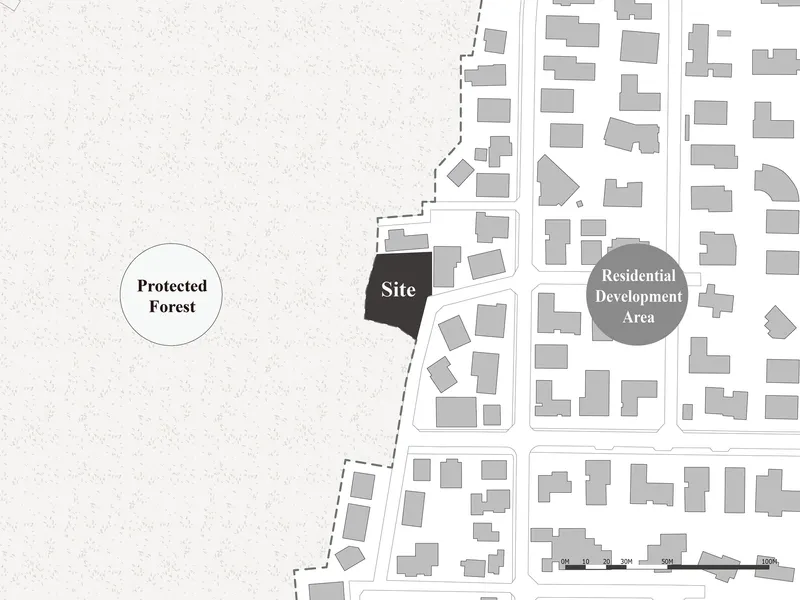
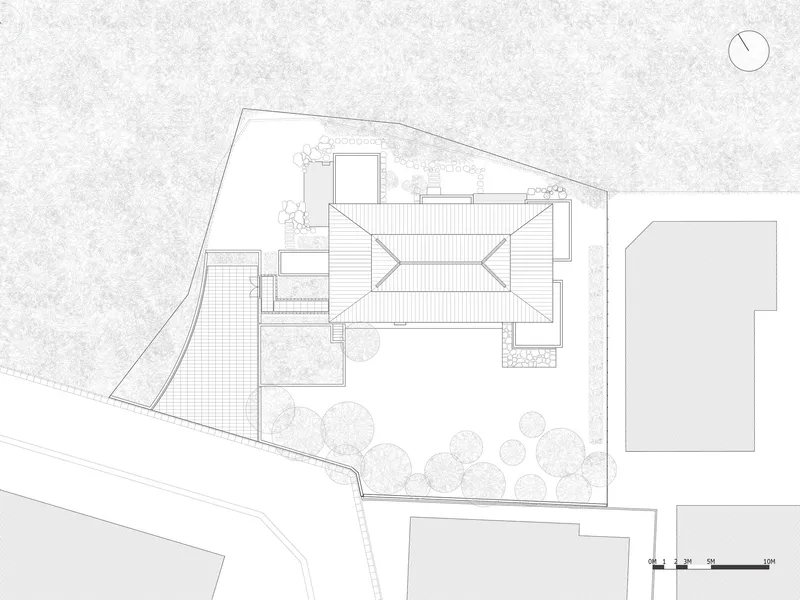
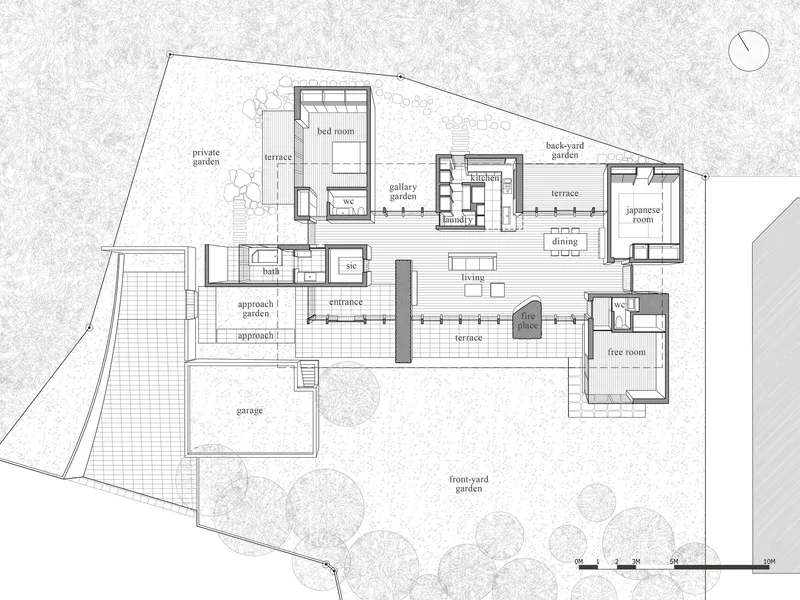
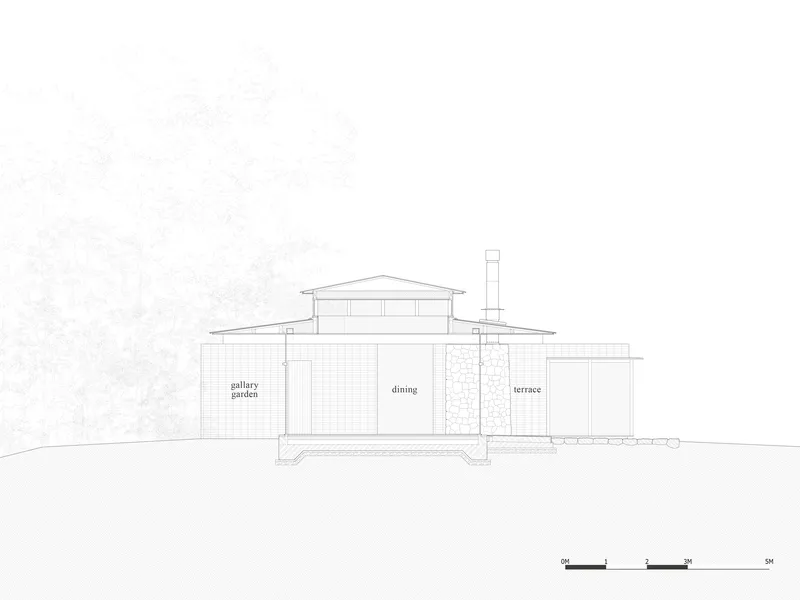
The site plan makes the project's context immediately legible: the building sits between a band of protected forest and a zone of residential development. The floor plan reveals rooms radiating from a central entrance and terrace, more like a village than a single house. A section drawing shows how a gabled upper volume rises above a lower level containing a gallery garden, dining area, and terrace, confirming that the section is as varied as the plan.
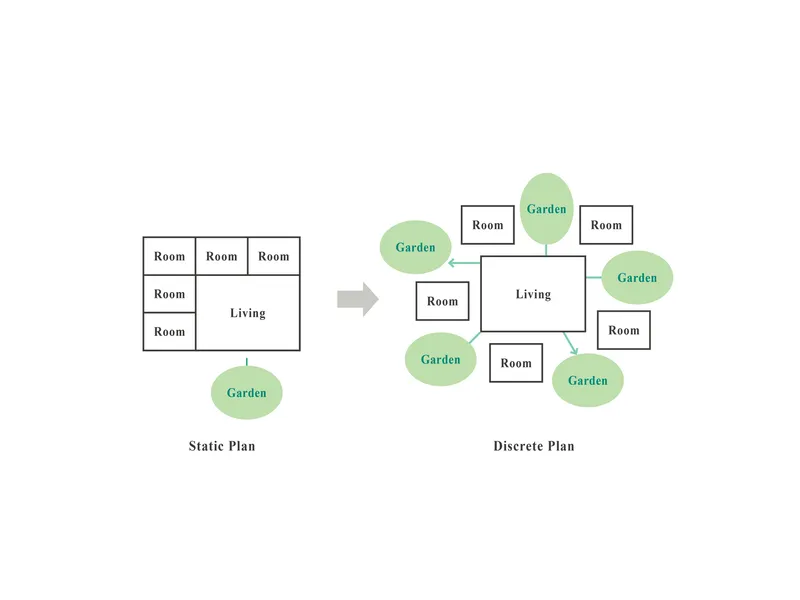
The conceptual diagram is perhaps the most telling drawing. It contrasts a conventional plan, rooms grouped around a central living space, with the architects' "discrete plan" in which garden nodes interrupt and separate each room. This is the project's thesis in graphic form: the garden is not outside the house, it is the connective tissue that makes the house work.
Why This Project Matters
Residential projects on generous suburban sites often default to one of two clichés: the hermetic box that ignores its context, or the glass pavilion that performs transparency without genuine spatial engagement with the ground. House at the Urban-Nature Threshold does neither. By fragmenting the program into distinct volumes linked by gardens, stone corridors, and covered terraces, Teitakusubako and Yusuke Igarashi Architects produce a domestic environment where moving through the house and moving through the landscape are the same activity.
The project also offers a quiet corrective to the idea that threshold conditions require expensive or technologically complex building systems. Here the threshold is constructed with the oldest materials available: stone, timber, glass, and plants, deployed with enough discipline and spatial imagination that they produce an architecture of real nuance. It is a house that respects the forest it borders by adopting the forest's own logic of clearings, edges, and filtered light.
House at the Urban-Nature Threshold by Teitakusubako and Yusuke Igarashi Architects. Zushi, Japan. 215 m². Completed 2023. Photography by Kentaro Nemoto and Kazumasa Harada.
About the Studio
Share Your Own Work on uni.xyz
If projects like this are the kind of work you want to make, uni.xyz is a place to publish your own, find collaborators, and enter design competitions.


Popular Articles
Popular articles from the community


David Ortega Stacks a Two-Story Mexico City Penthouse Around a Steel Stair and a Pergola-Shaded Roof Terrace
In Colonia Roma, a 300 m² penthouse uses oak joinery, a planted steel stair and a slatted roof pergola to make a new-build apartment feel like a house.

Cube Design Draws an Ecological Corridor Between Two Shenzhen Hills with the Nankai Building
Beside Shenzhen's container docks, the Nankai Building pairs stacked balconies with a climbing green screen to connect two hillsides across its height.

GROUP A Strips a 1969 Rotterdam Harbor Headquarters to Its Frame and Wraps It in Timber Louvers
In Rotterdam's M4H harbor district, Ferro Offices reuses a 1969 frame, adds one timber storey and reaches BREEAM-NL Outstanding.

Architekt Andreas Gruber Scatters 23 Dark Timber Chalets Across a South Tyrolean Forest Edge
In Molini di Tures, Amonti Chalets breaks a resort into a hamlet of gabled timber houses, with parking, storage and services pushed into the slope.

Similar Reads
You might also enjoy these articles


LAVA Architecten Gives Vocational Education a Sawtooth-Roofed Face on a Mechelen School Campus
In Mechelen, Belgium, a 2,053 m² STEM school on a 6×6 m grid turns workshops and classrooms into rooms that can be rearranged as teaching changes.

KEMA Studio Turns a Derelict Marvila Attic into a 60 m² Lighthouse Apartment Above Lisbon
In Lisbon's Marvila district, a rebuilt roof, four skylights and two plywood volumes turn an unlivable attic into a bright home facing the Tagus.

Pixel Gardens: One Repeated Module Stacked Into a Terraced Social Housing Tower for Famagusta
Salem Bader's shortlisted housing tower builds a vertical neighbourhood from one repeated module, offsetting units to carve terraces, light and air.

Bao Huynh Watercolor Atelier: A Serene Art Retreat in Hội An
Bao Huynh Watercolor Atelier in Hội An blends multifunctional art spaces, sustainable design, local materials, and family-friendly living in a serene environment.

Explore Urban Ecosystem Competitions
Discover active competitions in this discipline

Challenge to design a portable theatre

Challenge to design a portable music platform

Challenge to design an open learning module for the elderly

Challenge to design mud housing for contemporary communities
Comments (0)
Please login or sign up to add comments
No comments yet. Be the first to comment!