

Temporary Habitat: Reimagining a Border Bridge as a Respite Center for Asylum Seekers
A modular humanitarian architecture proposal transforms the Eagle Pass–Piedras Negras International Bridge into a living, layered community.


What if a border crossing could be more than a line of exclusion? Temporary Habitat takes the Eagle Pass–Piedras Negras International Bridge between the United States and Mexico and layers onto it an entire micro-community: housing, healthcare, education, worship, and solar infrastructure, all organized within a modular structural system that grows and adapts to the shifting demographics of asylum seekers. The bridge stops being a geopolitical threshold and starts functioning as what the designer calls a "bridge of destiny," a protected corridor where displaced individuals can live, recover, and navigate migration processes with dignity intact.
Designed by Jerry He, the project was recognized as an Editor's Choice entry in the No Man's Land competition. It responds directly to the humanitarian burden building at border zones worldwide, proposing architecture that treats asylum seekers not as transient statistics but as individuals and families in need of protection, stability, and human connection. The result is a proposal that is equal parts infrastructural strategy and social manifesto.
A Layered Structure Built onto Existing Infrastructure
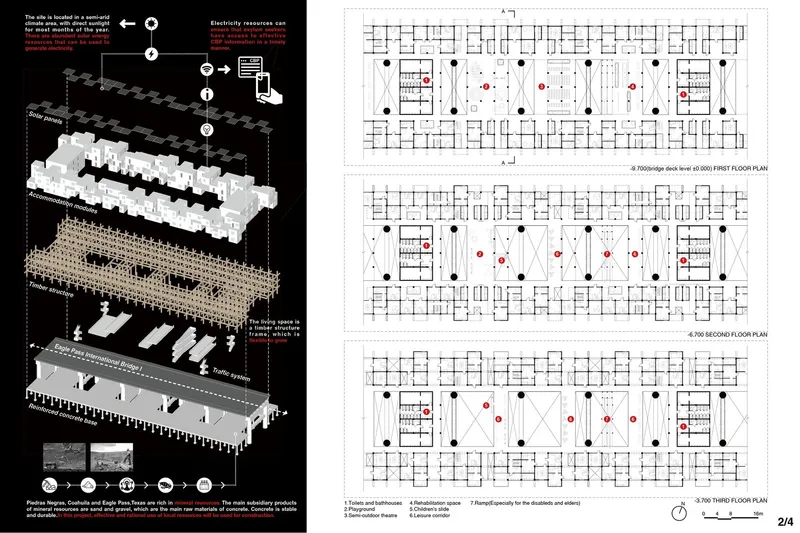
The exploded axonometric and floor plans reveal how the design attaches itself to the bridge as a multi-level inhabitable extension. Rather than interrupting the bridge's mobility or undermining its structural logic, the architecture nests within and above it, using the existing infrastructure as both foundation and circulatory spine. The restriction of building on the bridge becomes the project's defining strength: structural continuity, accessibility from both nations, and an undeniable symbolic charge.
The layered organization separates programmatic zones vertically, stacking living units above shared amenities and service corridors. Registration and information centers, medical care facilities, adult training areas, retail, canteen spaces, and areas for worship are all embedded within this system. Solar energy infrastructure sits at the top, contributing to the self-sustaining ambitions of the micro-community. The drawing makes clear that this is not emergency shelter; it is a resilient, community-based settlement with the organizational depth of a small neighborhood.
Interior Life Along Mezzanines and Sunlit Corridors

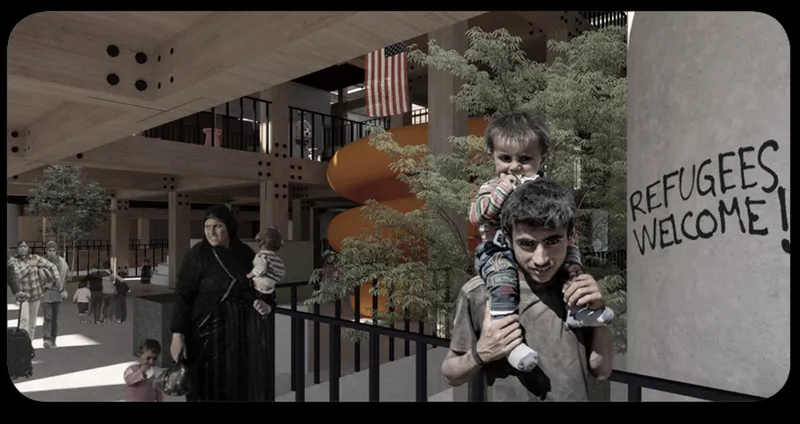
Two interior views expose the human scale of the project. In the first, a woman carries a child along a railed mezzanine where banners hang and sunlight filters through openings in the structure. The atmosphere is calm, almost domestic: a far cry from the tent camps and processing centers that typically define border infrastructure. In the second, children and adults gather beneath concrete overhangs in a central courtyard where planted trees introduce greenery and shade. These are not residual spaces; they are deliberately designed communal zones meant to encourage interaction and collective care.
The spatial quality here matters enormously. The design acknowledges that asylum seekers often arrive after prolonged periods of instability and trauma. Psychological security is not a byproduct of good architecture; it is a primary design objective. Shared corridors, playgrounds, communication spaces, and areas for rest and exercise all appear as programmatic elements in the proposal, and these renderings show what those intentions look like when inhabited: people moving, resting, caring for children, and simply existing in a space that respects their presence.
Sectional Logic and Modular Adaptability

The building section, annotated with red circulation nodes, reveals the multi-story structure in profile. Internal pathways connect vertically through the complex, linking housing levels with shared services below. The section demonstrates how the architecture creates a protected corridor shielding users from harsh weather while maintaining clear interior circulation. What could have been a claustrophobic condition, building on a bridge, reads instead as a compact but well-ventilated vertical neighborhood.
The modular housing system is configured for a range of household types: single children separated from family, single adults, elders or disabled individuals, couples, and families of three, four, or six. These units can be flexibly combined and reorganized as demographic ratios shift, allowing the habitat to evolve over time without requiring wholesale reconstruction. The modular logic ensures efficiency in construction while preserving customization at the scale of daily life, a balance that most emergency housing fails to achieve.
A Canteen, a Clinic, a School: Programming Dignity

The composite drawing assembles canteen plans, sectional views, and rendered interior vignettes with occupants and spatial annotations. It is the most informationally dense sheet in the set and arguably the most important, because it demonstrates that Temporary Habitat operates as a respite center, not merely a shelter. The canteen, medical facilities, skill-building areas, storage, retail, and spaces of worship are all mapped out with precision. Renewable energy systems, including solar infrastructure, support the ambition for a self-sustaining micro-community where residents can access food, healthcare, and legal information without leaving the bridge.
Programming at this level of detail signals a design philosophy grounded in humanitarian architecture, where the building is a social instrument first and a formal object second. The inclusion of adult training and skill-building areas is particularly notable: it positions asylum seekers not as passive recipients of aid but as people capable of self-reliance and growth during their transition period. Architecture here becomes a framework for agency.
Why This Project Matters
Temporary Habitat confronts a question that most architecture competitions pose abstractly but rarely answer with this level of programmatic commitment: what does humane border infrastructure actually look like? Jerry He's response is specific, layered, and unapologetic in its insistence that asylum seekers deserve more than tents and chain-link. The bridge site is not a conceit; it is a real location where real people wait in limbo, and the proposal treats that reality with the seriousness it demands.
What makes the project compelling beyond its humanitarian agenda is the clarity of its architectural thinking. Modular units respond to actual household typologies. Programmatic zones are distributed with spatial logic rather than piled into a single floor plate. The bridge's structural capacity is leveraged, not ignored. In a design landscape saturated with poetic gestures toward displacement, Temporary Habitat stands out because it proposes something buildable, inhabitable, and grounded in the lived experience of the people it claims to serve.
View the Full Project
About the Designers
Designer: Jerry He
Enter a Design Competition on uni.xyz
uni.xyz runs architecture and design competitions year-round that reward proposals with spatial conviction and real site intelligence.
Project credits: Temporary Habitat by Jerry He No Man's Land (uni.xyz).


Popular Articles
Popular articles from the community


Temporary Home for Dogs: A Reversed Zoo Rethinks Animal Shelter Architecture
In Bucharest, a sinuous corridor and freed landscape flip the logic of containment, designing a shelter that works to make itself unnecessary.
Cloaked Colonization: A Mobile Underwater Habitat That Moves Like a Fish
Micah Abaya's shortlisted EHC Pacific entry reimagines ocean settlement as a dispersed network of self-sustaining architectural organisms.

Opera on the Sea: Driftwood Logic Shapes a Timber Opera House on Estonia's Coast
Trevor Orgill's opera house translates the entangled drift of floating timber into a civic building where wood, water, and music converge.

Extended Shell: Retrofitting Kolkata's Balconies as Living Urban Thresholds
A modular retrofit system recovers the social and environmental intelligence of Kolkata's historic verandas for contemporary Park Street residents.

Similar Reads
You might also enjoy these articles
Yenisei Monitoring Center: A Sun-and-Moon Sphere Anchors a Research Campus on Siberia's Great River
In Krasnoyarsk, shifting square blocks, a glazed central sphere and descending window rhythms turn river science into a public spectacle on the Yenisei.
Andretta Artist's Village: A Node-Based Masterplan That Lets the Hills Write the Plan
A cultural landscape strategy for Palampur's artist colony threads studios, residences and stages along a porous spine shaped by the Dhauladhar terrain.
Street Children Rehabilitation Center: A Brick Campus That Eases Children From Street to Safety
A low-rise courtyard campus where learning streets, uthans and shaded verandahs stage a gradual passage from street into protective, family-scale life.
The NEON Culture: A Field of Pavilions Built for the 24-Hour City
Smaran Alva spreads galleries, stages, clubs and markets across a varied site, treating light, sound and ramped movement as the real building materials.

Explore Temporary Dwelling Competitions
Discover active competitions in this discipline

Challenge to reimagine the Iron Throne

Photograph architecture without architects

Illustrate the lost glory of Angkor Wat - Render Challenge

Design challenge to reuse E-waste
Comments (0)
Please login or sign up to add comments
No comments yet. Be the first to comment!