
Tésa architetture Converts an Abandoned Emilian Barn into a Staggered-Level Home
Casa NP in Carpi, Italy, preserves the vaulted shell of a century-old agricultural building while inserting a deliberately abstract domestic interior.


South of Carpi, along the road that runs toward Modena, a yellow-plastered barn sits at the edge of cultivated fields. It belonged to an agricultural company founded at the turn of the last century, and for decades it simply waited, abandoned but structurally sound. Tésa architetture spent four years turning it into Casa NP, a 140 m² residence completed at the beginning of 2026. The project is a case study in restraint: the original shell, its vaulted ceilings, and its heavy timber trusses remain intact while a new domestic life fills the interior.
What makes Casa NP worth examining is not the conversion itself, which is a common enough ambition in the Po Valley, but the specificity of the strategy. The barn belongs to the Reggiano-Modenese typology, where living quarters and working spaces (stables, hay storage) shared a single roof, connected and separated by a central portico. Rather than flattening that duality, Tésa architetture uses staggered floor levels to break the original void into domestic proportions while keeping the volume legible as a single, tall space. The materials do the same work: a continuous resin floor and white plaster walls act as an abstract contemporary layer that, by contrast, amplifies everything the old building already had.
A Farmstead in Its Landscape
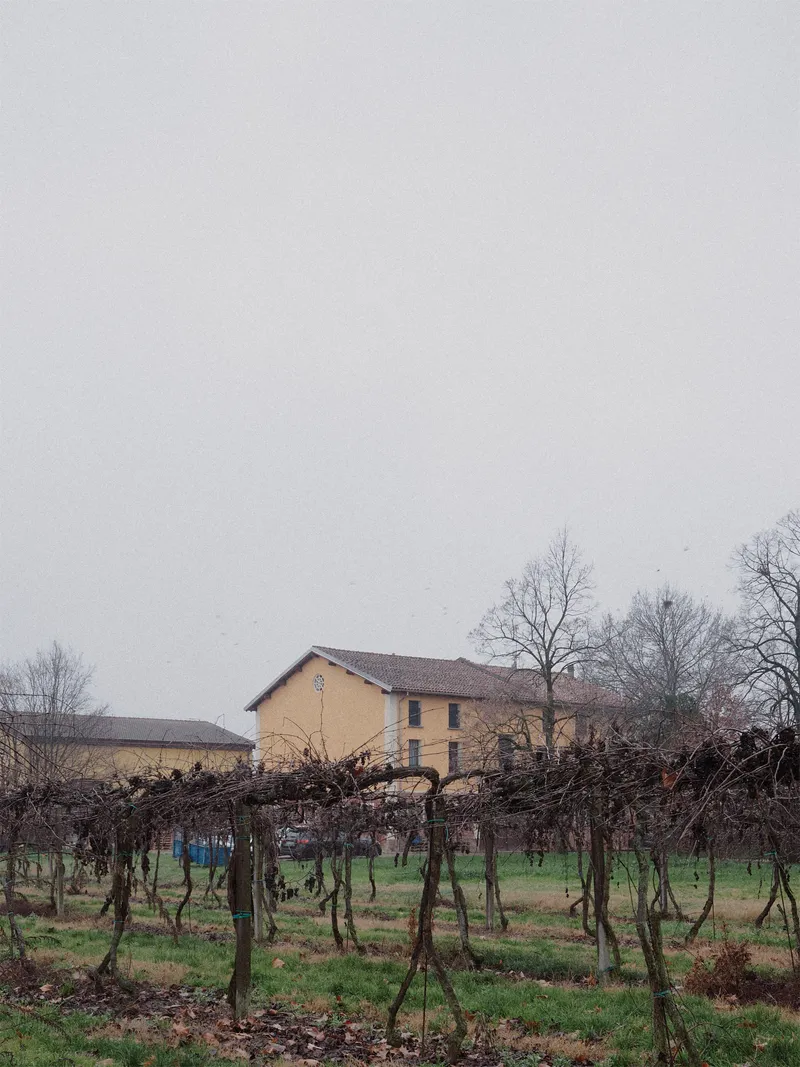
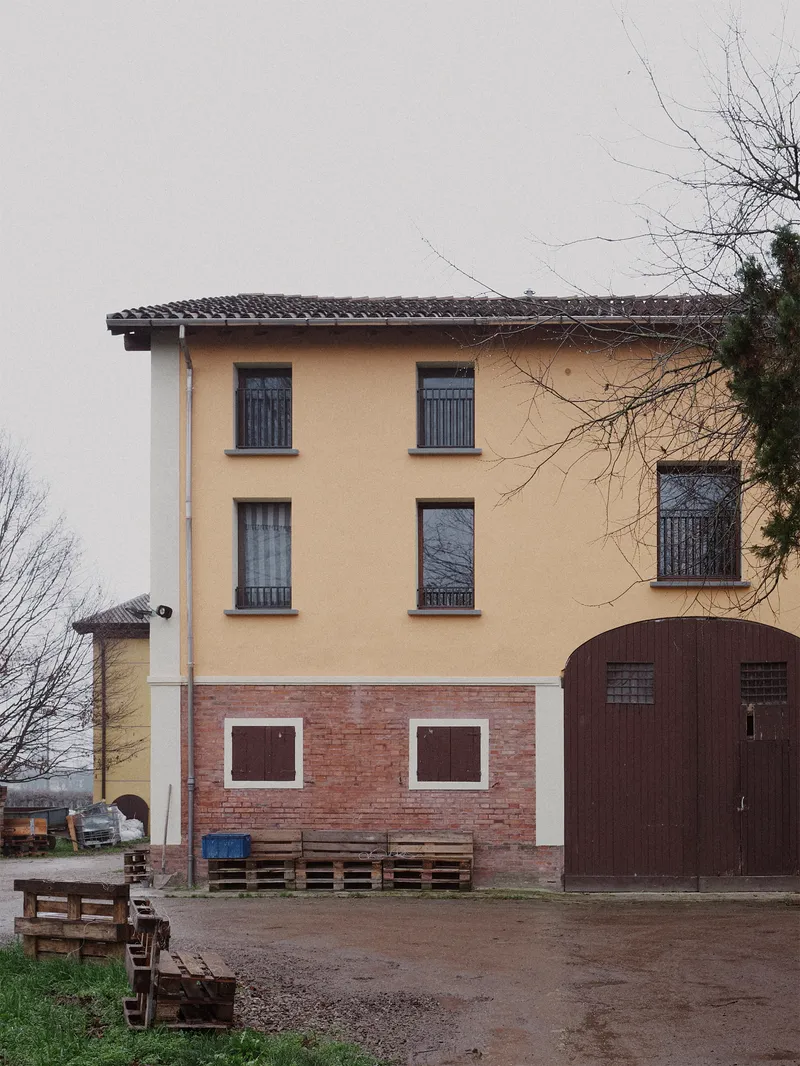
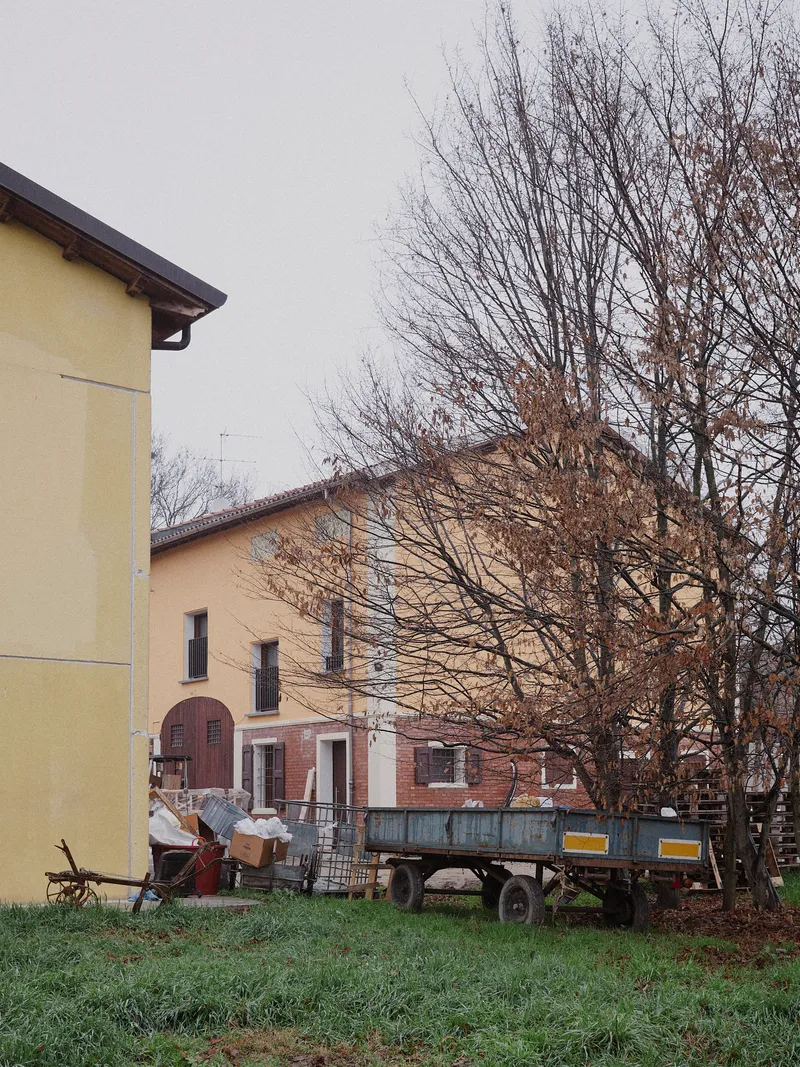
Approached from the southwest, Casa NP reads as a cluster of ochre-rendered volumes set against flat agricultural land. Bare winter trees line the road, and a dormant vineyard stretches toward the building. The facade retains its original proportions: a yellow plaster upper story sitting on a red brick base, scaled for a barn rather than a house. There is no attempt to signal the domestic conversion from the outside. The entrance appears almost incidental.
That discretion is a conscious choice. The building is completely surrounded by its own land, and the relationship between interior and landscape is managed from the inside out. The original barn opening, preserved in its original position, now frames a living room view over the fields. You understand the conversion only once you step through the door.
The Central Void and Its Staircase
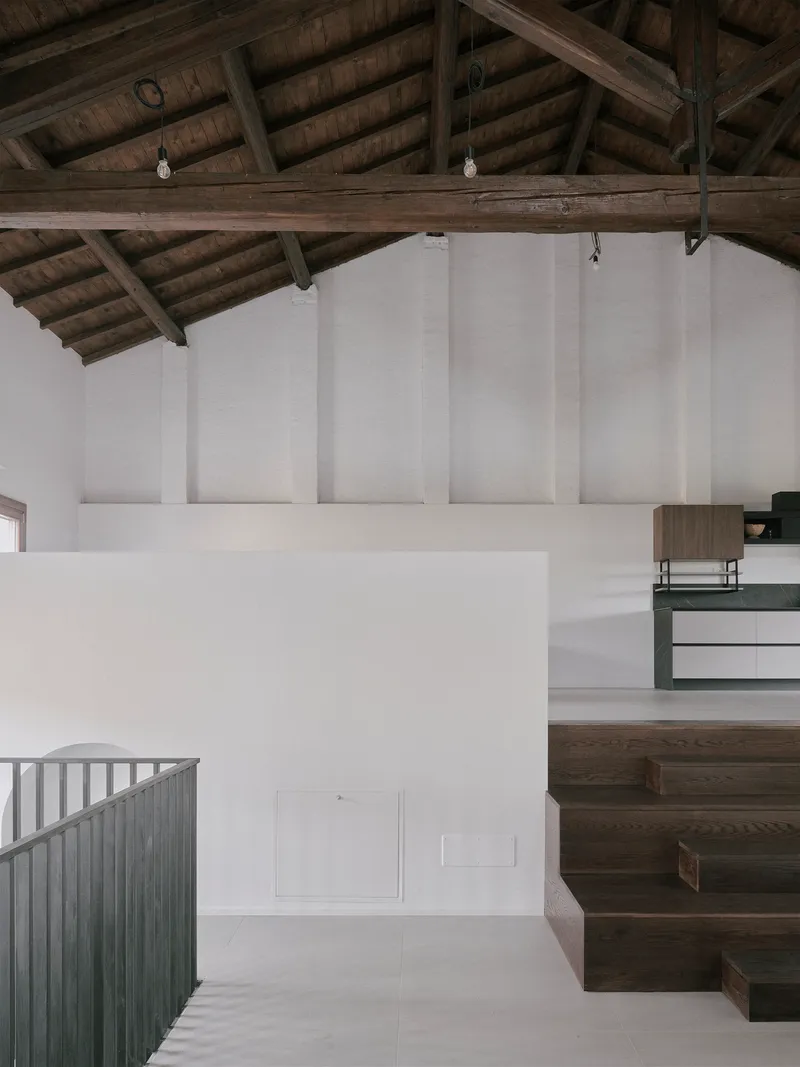
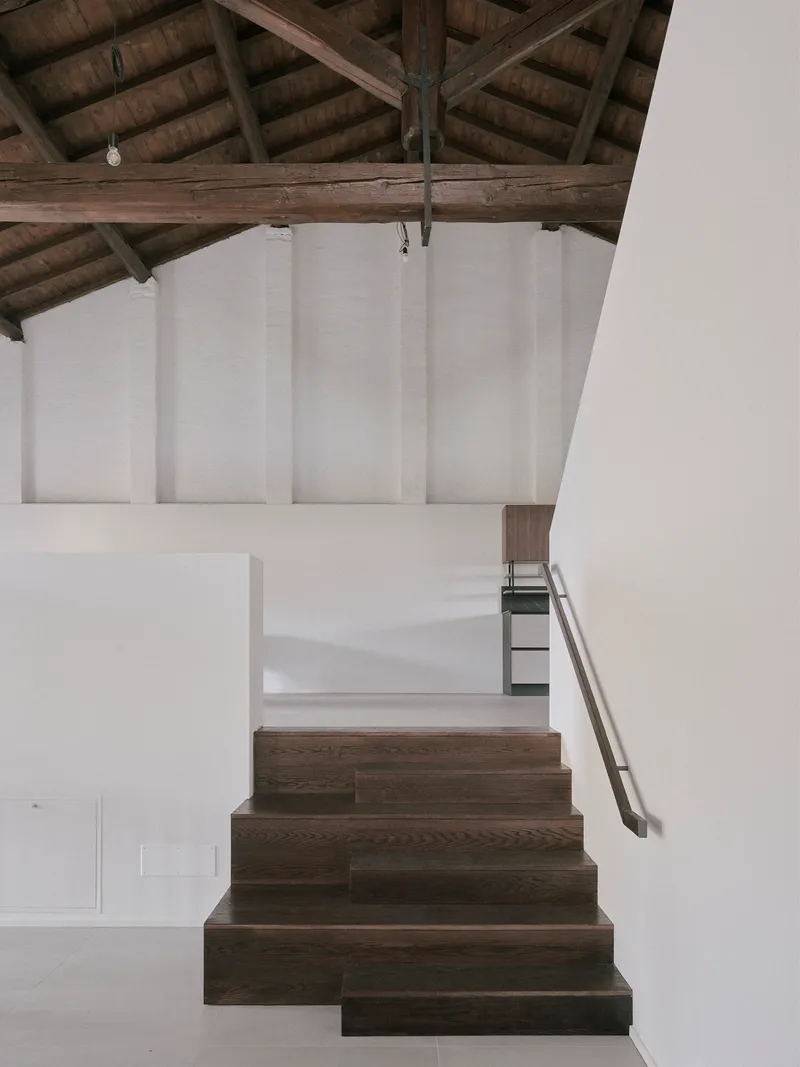
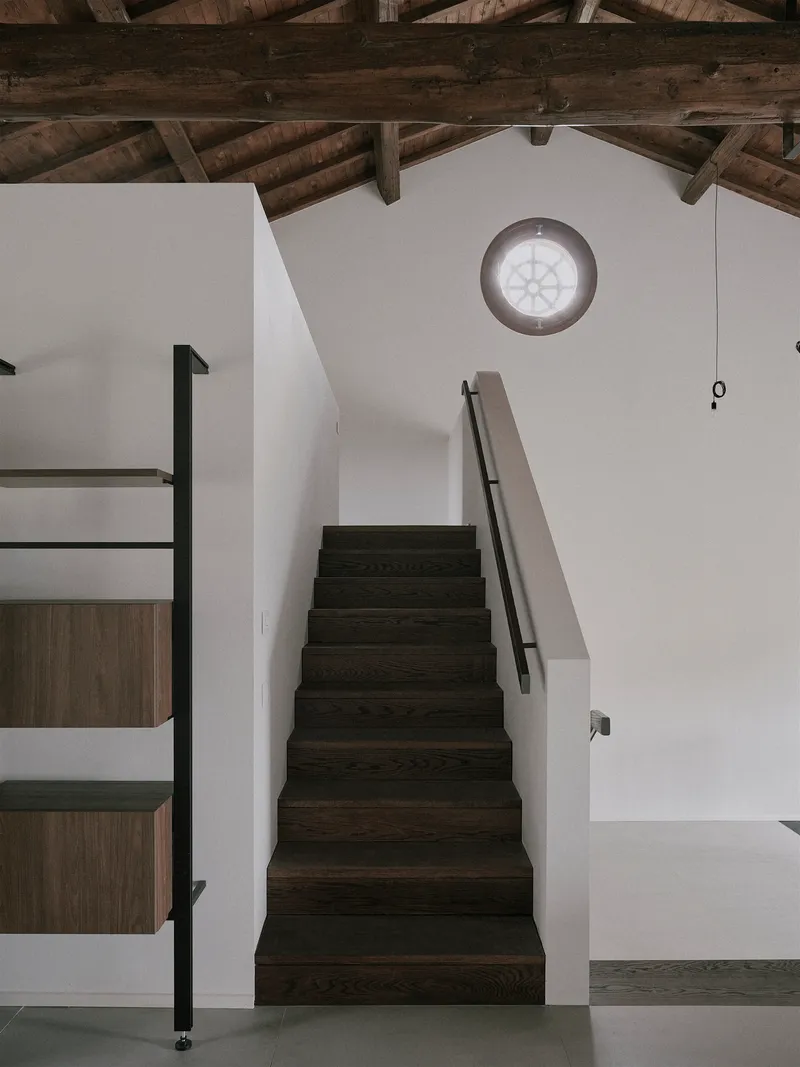
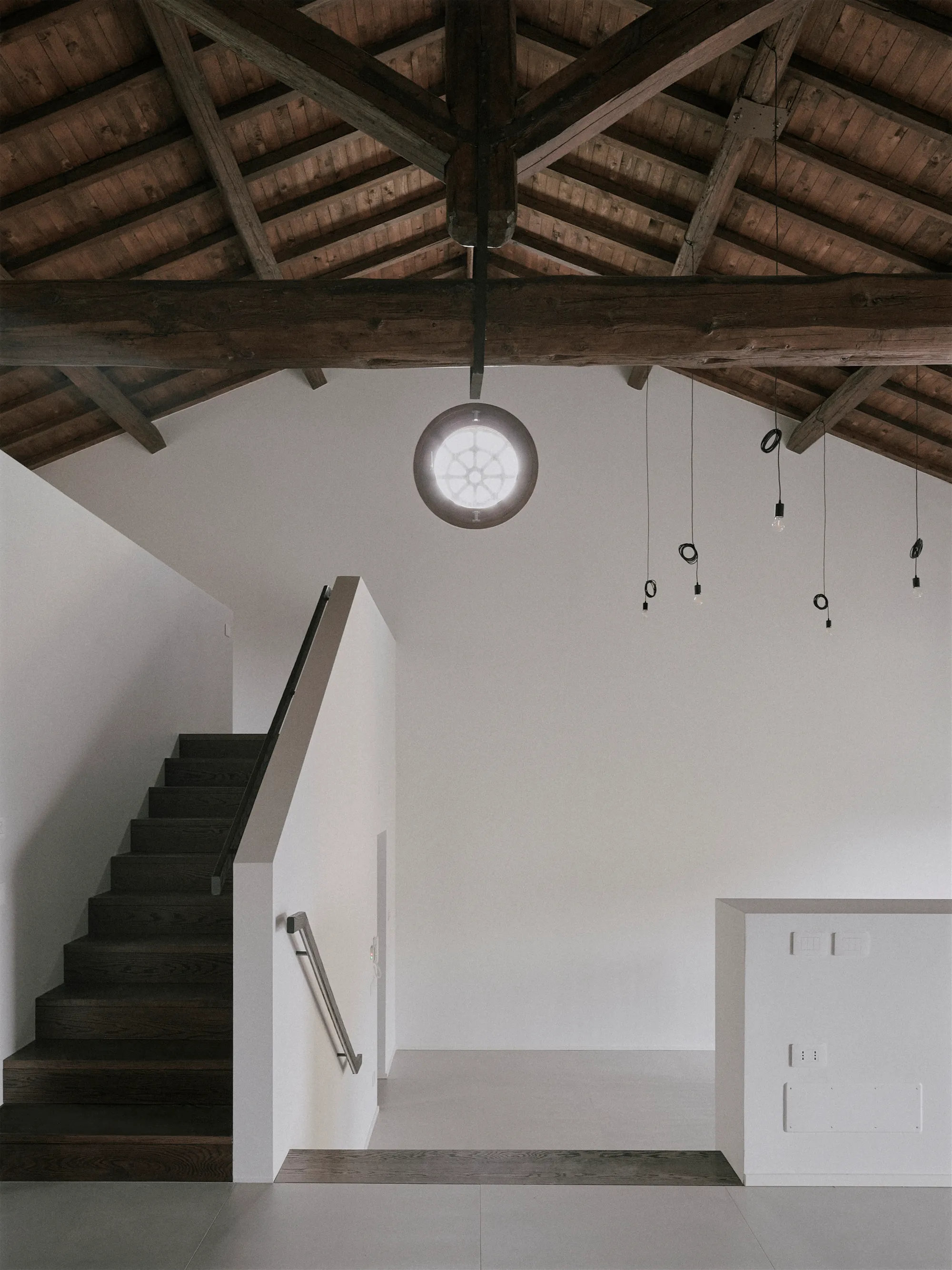
The double-height interior is organized around a dark timber staircase that rises through the center of the building, tracing the line where the old portico once divided working and living zones. The staircase does more than circulate; it structures perception. Standing at its base, you look up through exposed roof trusses and a spherical pendant light. The timber treads are open, so sight lines pass through them, keeping the volume continuous even as the stairs create layered levels.
The material palette is deliberately narrow: wood, concrete, iron. Dark oak for the stair, metal for the handrails and balusters, white plaster for the walls. There is no competing gesture. Each new element reads as an insertion into the existing structure rather than a replacement of it.
Staggered Levels Domesticate the Barn
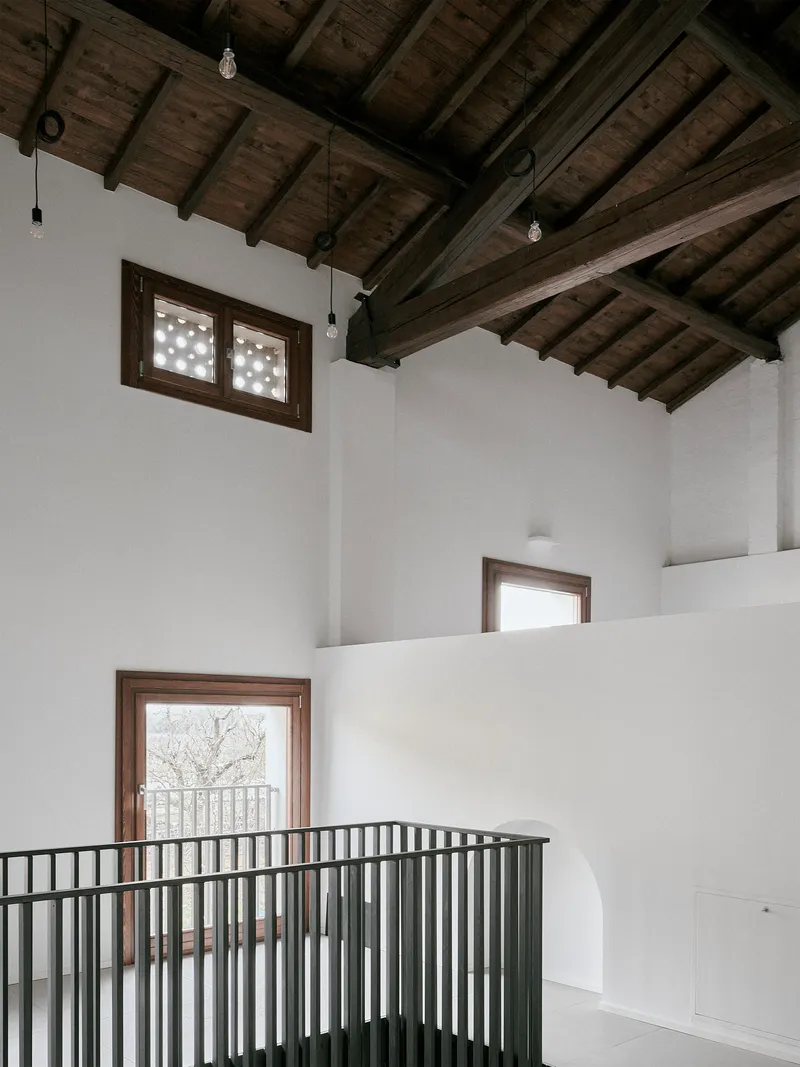
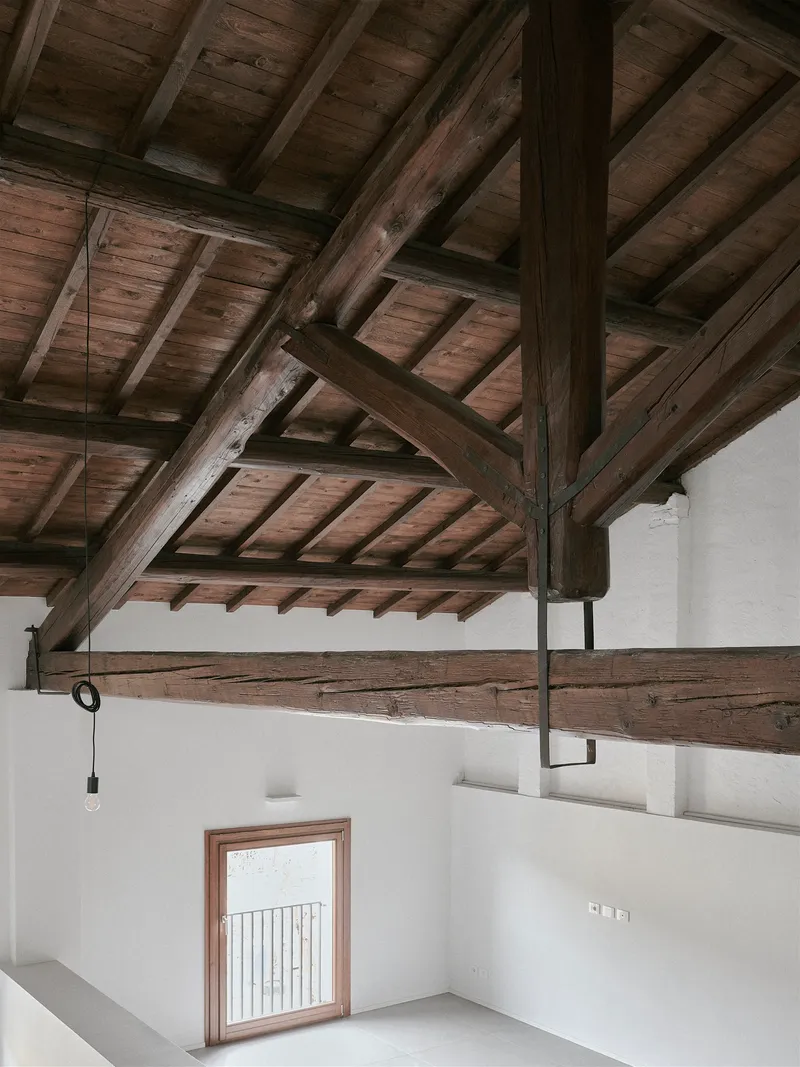
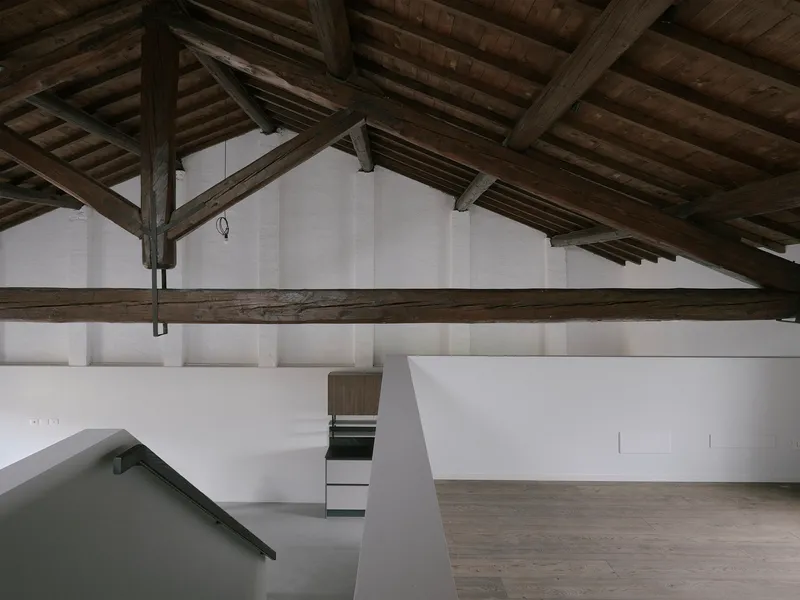
The key spatial move is the introduction of staggered floor levels that subdivide the tall barn void without destroying it. From the mezzanine gallery, you look down into the living space below and up into the roof structure above. Metal railings define the edge without closing it off. The result is a house that feels domestic at the scale of each room but expansive when you pause and register the full height of the original shell.
Tésa architetture was careful about loads. New floor packages and ceiling heights were calibrated to integrate mechanical systems without altering the legibility of the original organism. The vaulted structures, found in good condition, were preserved and left exposed wherever possible. The arched openings at the lower level survive as spatial markers, reminders of the stable doors and cellar entries that once punctuated the ground floor.
Light, Windows, and the Resin Floor
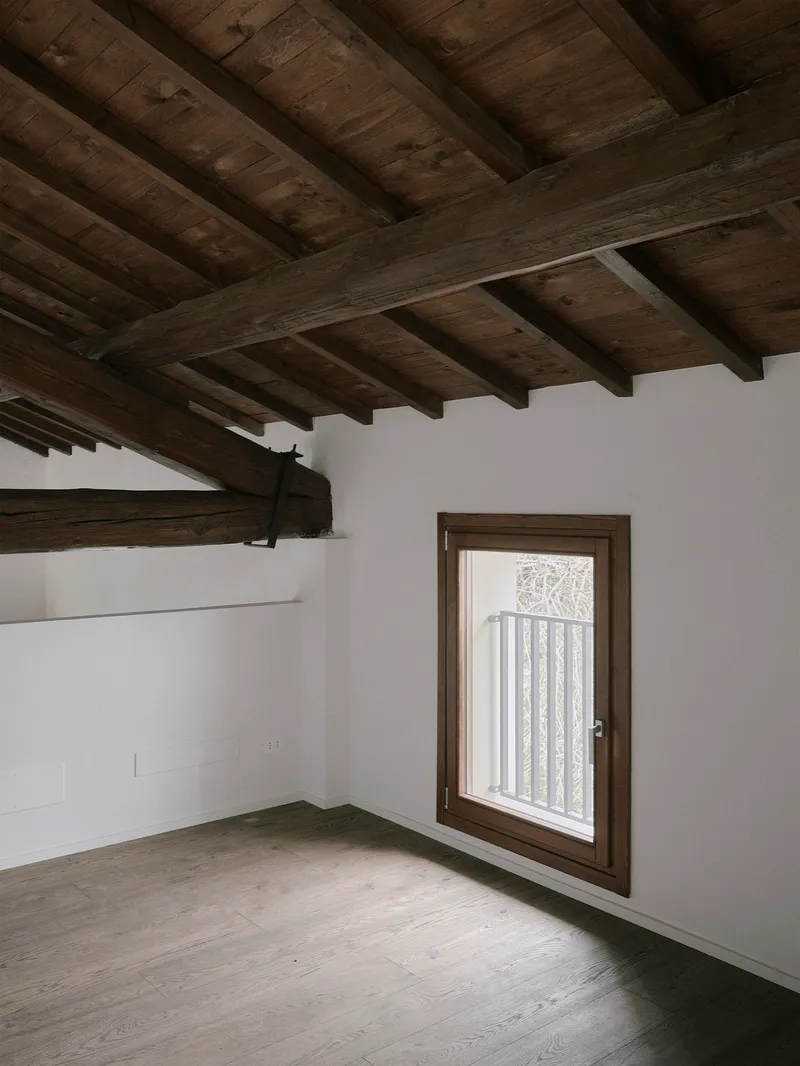
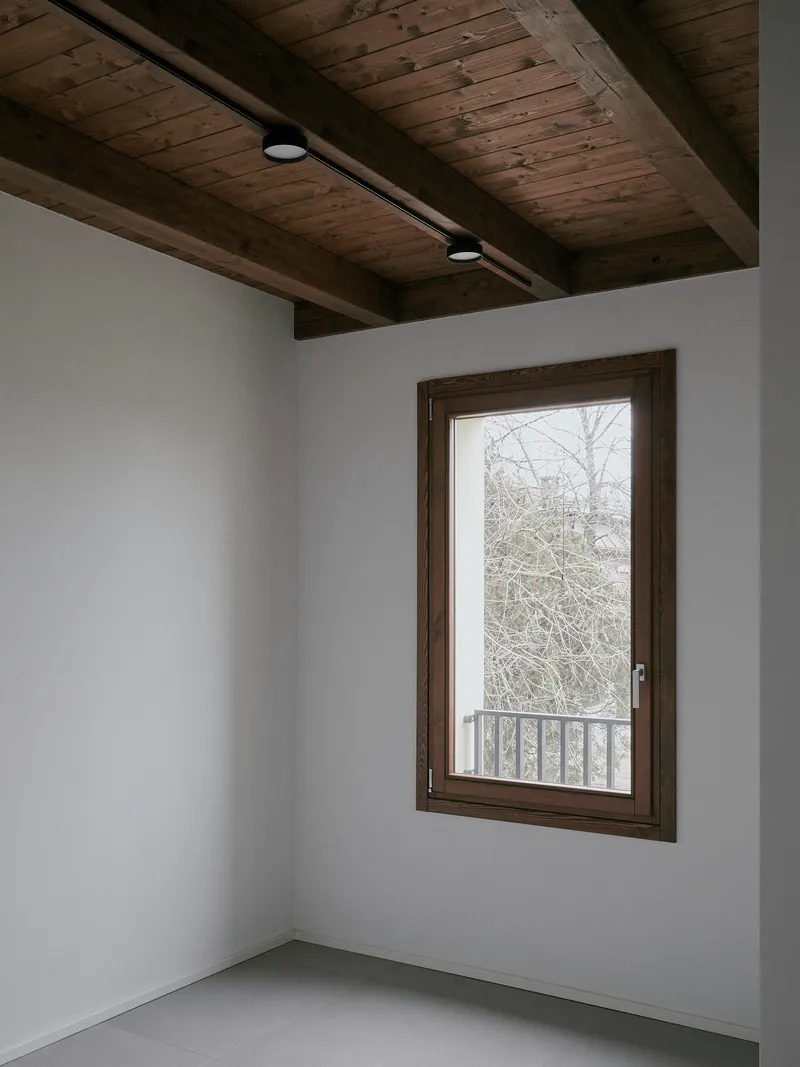
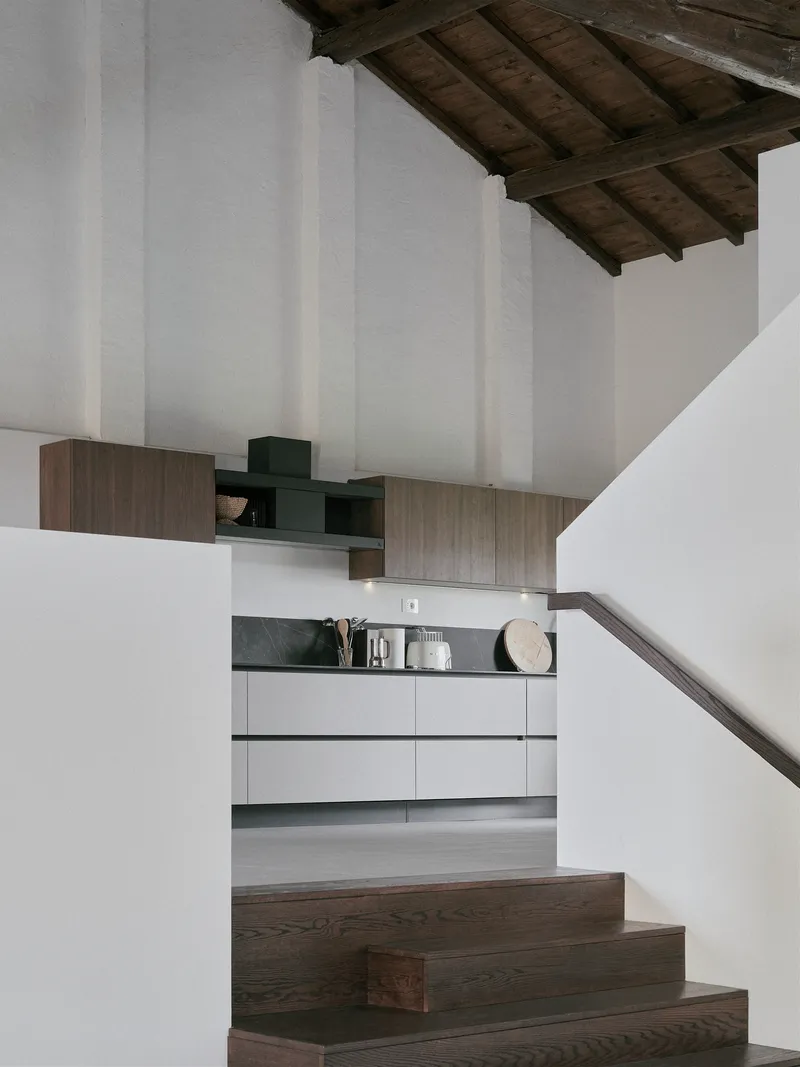
New timber-framed casement windows are set into the thick plaster walls, and from the upper levels they open onto views of bare trees and the flat Emilian horizon. Track lighting follows the line of the wooden ceiling, supplementing daylight without competing with it. The kitchen is glimpsed through the open treads of the staircase, its countertop and fixtures framed by the slope of the original roof.
On the ground floor, a continuous resin finish replaces the old barn floor. It is smooth, pale, and deliberately abstract, a surface that belongs to no historical period. Against this neutrality, the rough texture of the existing masonry and the grain of the timber trusses become more vivid. The contrast is the point: Tésa architetture wanted the pre-existing materiality to emerge, and a quiet background is the most effective way to let it.
Craft in the Details
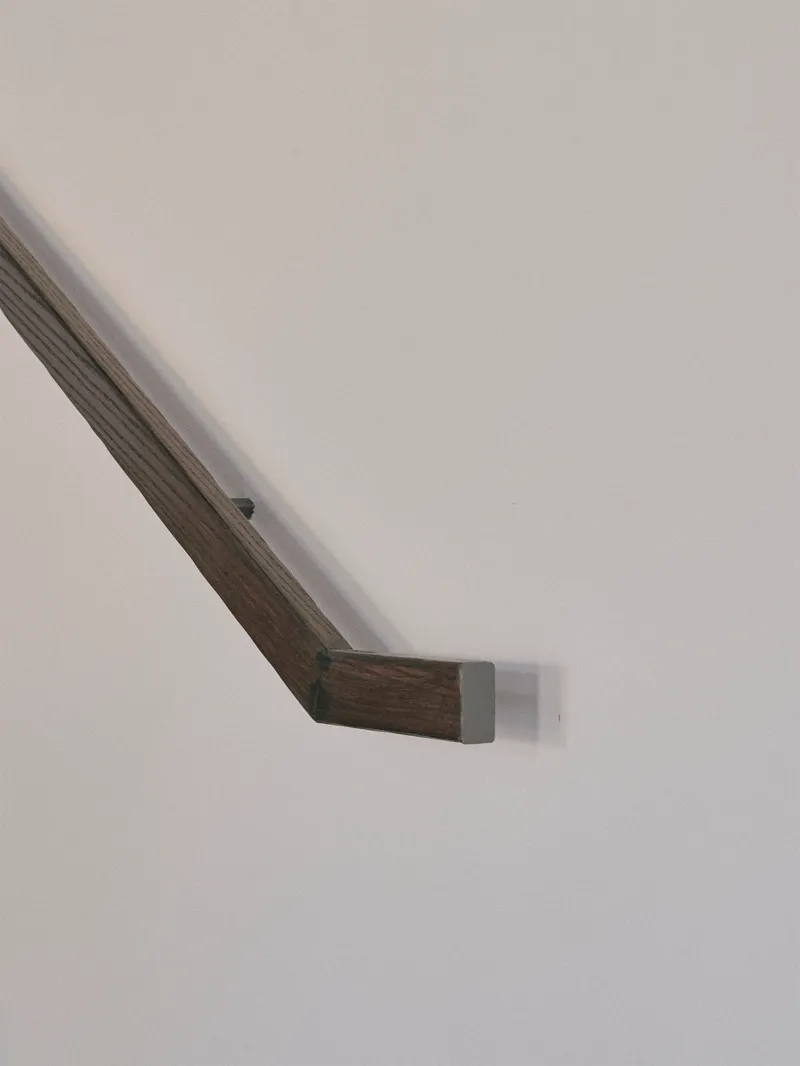
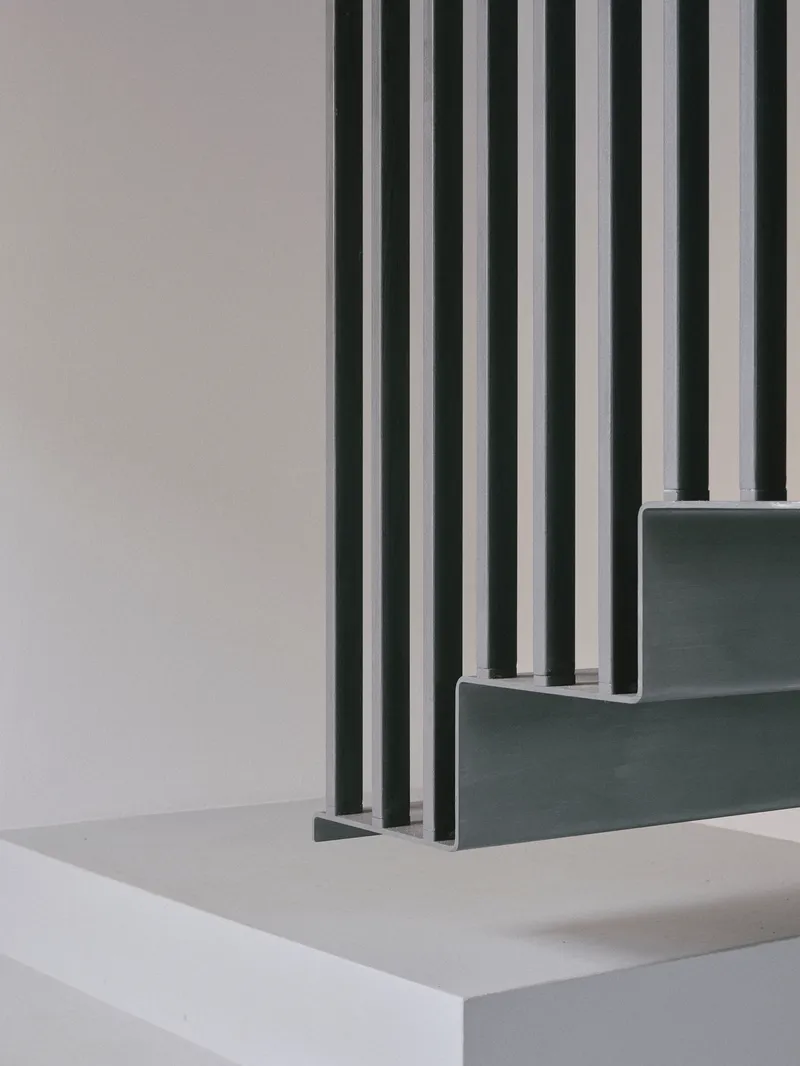
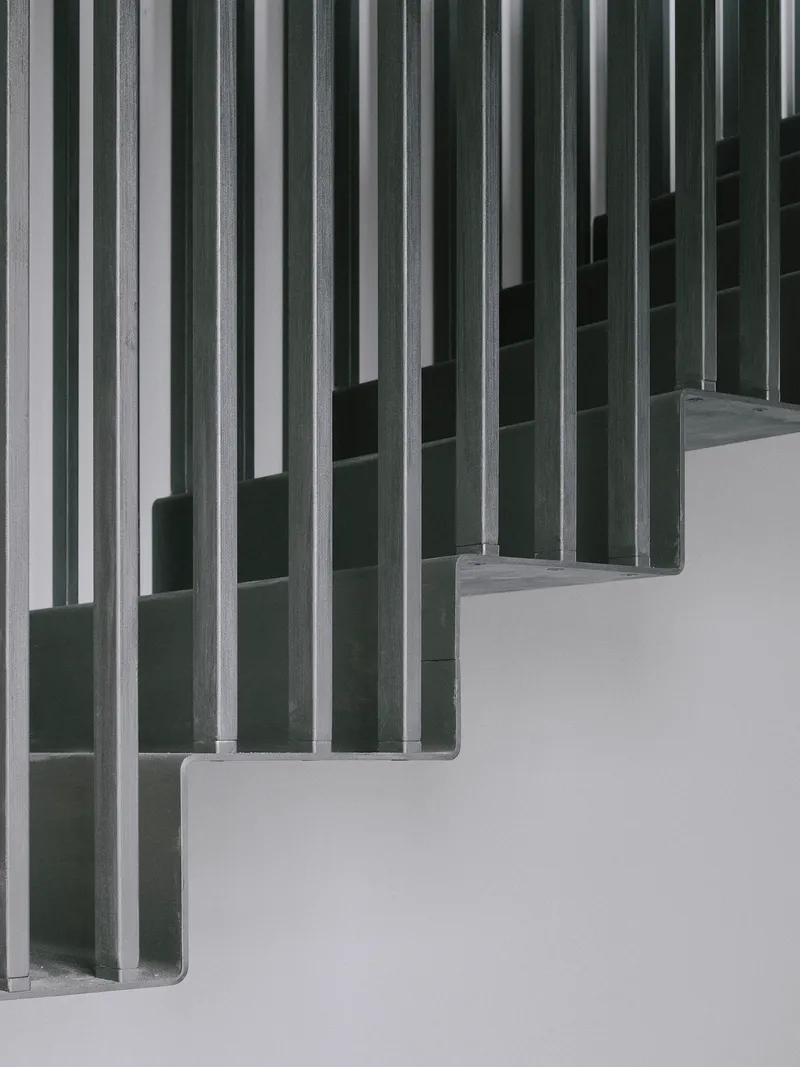
Close inspection reveals the care invested in junctions and fittings. A timber handrail is mounted to the white wall with a simple metal bracket, its geometry precise. Grey stair treads are pierced by vertical metal rods that double as balusters, a detail that keeps the staircase visually open while meeting code. Vertical timber slat screens create a rhythmic partition against white plaster, filtering light and sight without closing down the space.
These are not showy details. They work because they are consistent with the larger strategy: iron, wood, white wall, nothing else. When a project limits its vocabulary this severely, every joint and every threshold has to be resolved with precision, or the whole thing falls apart. Here, it holds.
Thresholds and Circulation
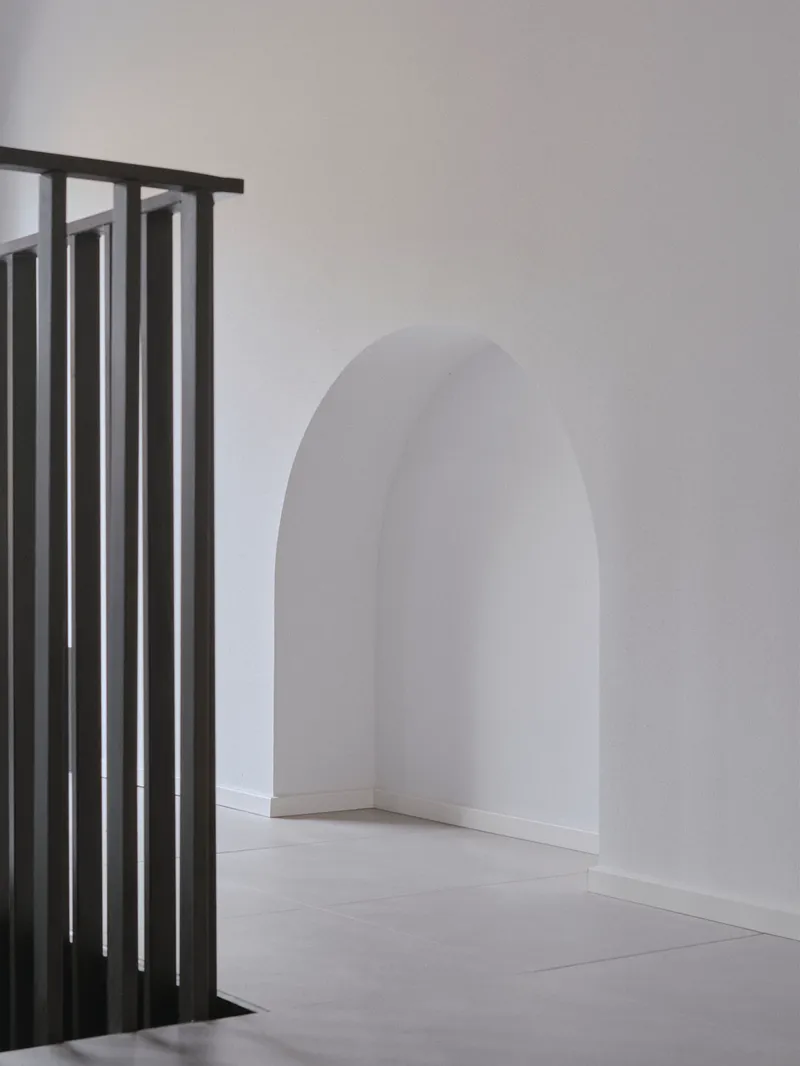
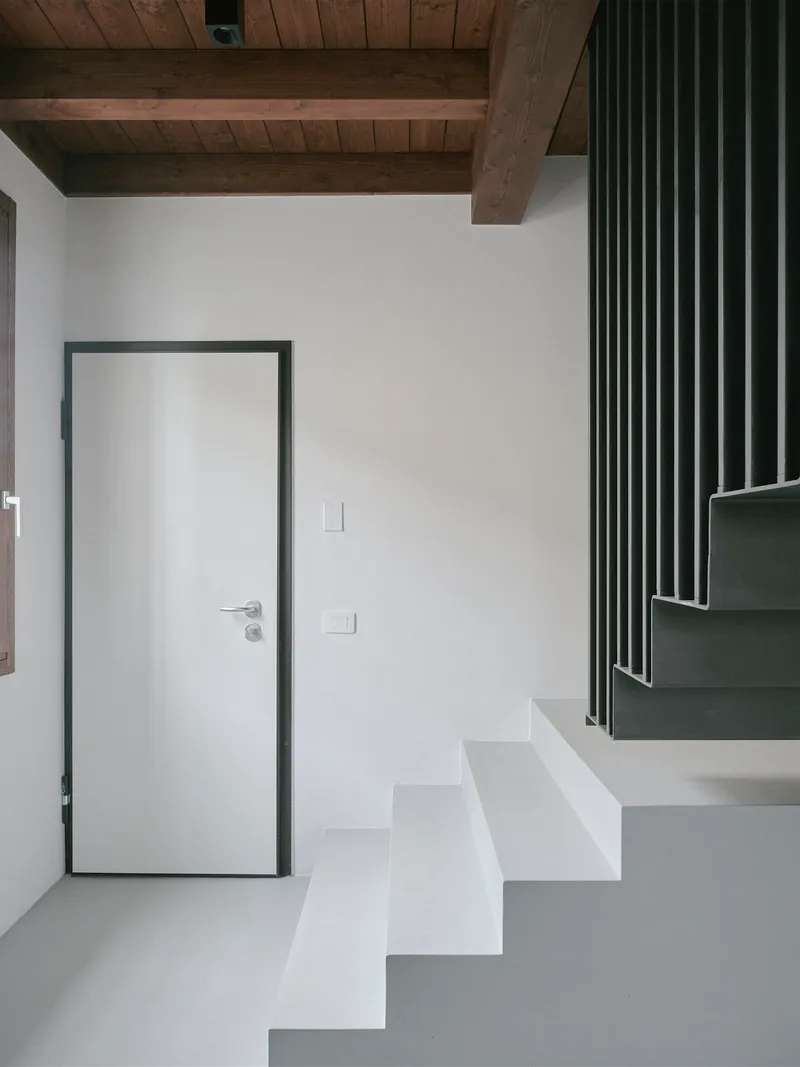
The arched doorways of the original barn survive as transitions between rooms, their curves a counterpoint to the rectilinear new insertions. Metal slat balustrades run alongside them, marking level changes without obscuring the masonry. At the entry, a white door sits beneath exposed timber beams, the staircase with its metal balustrade visible immediately beyond. The sequence is clear: you enter, you see the stair, you understand the vertical organization of the house in a single glance.
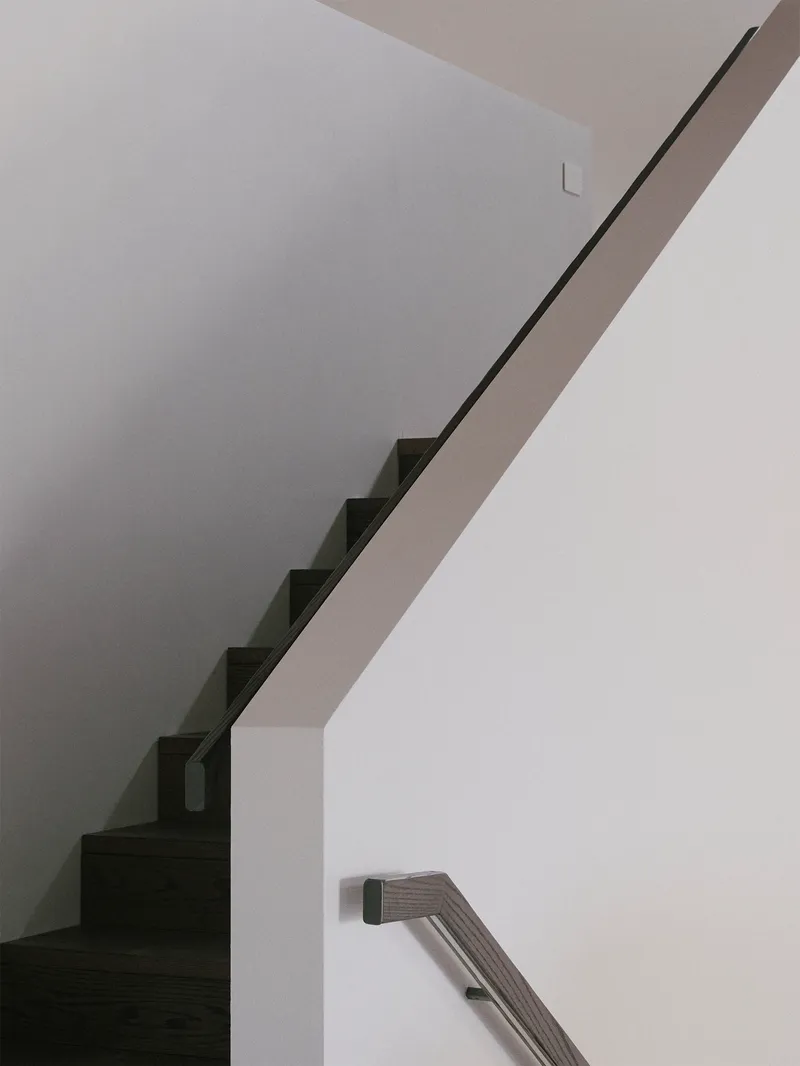
A cantilevered staircase with a thin metal handrail ascends along white walls in another part of the house, its form more minimal than the central timber stair. The two staircases serve different wings, reflecting the mirrored plan logic visible in the drawings. Circulation is never hidden; it is the architecture.
Plans and Drawings
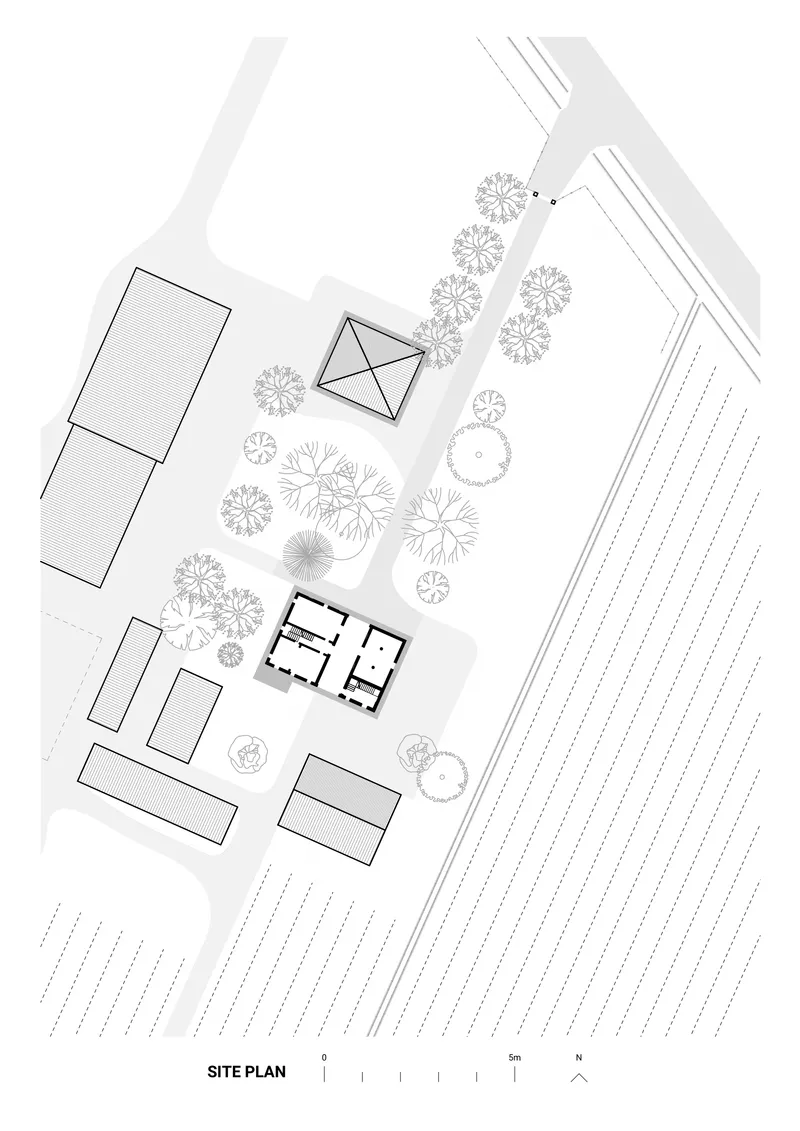
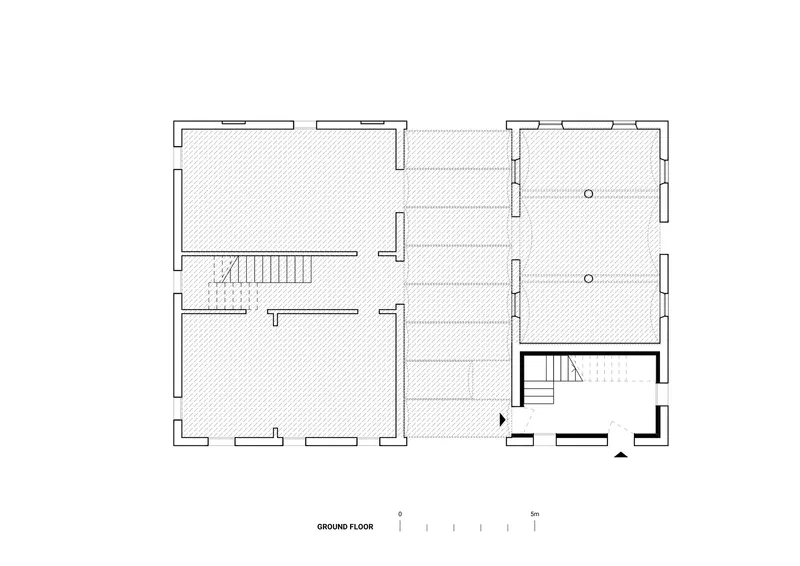
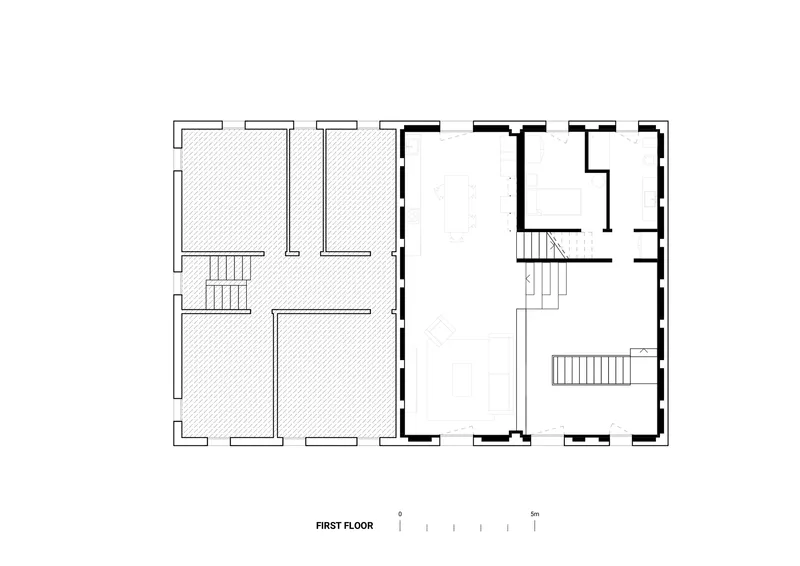
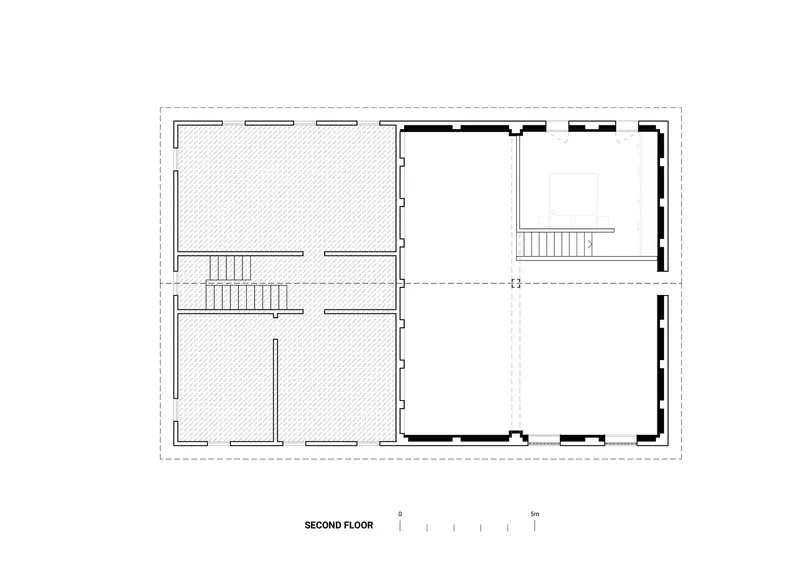
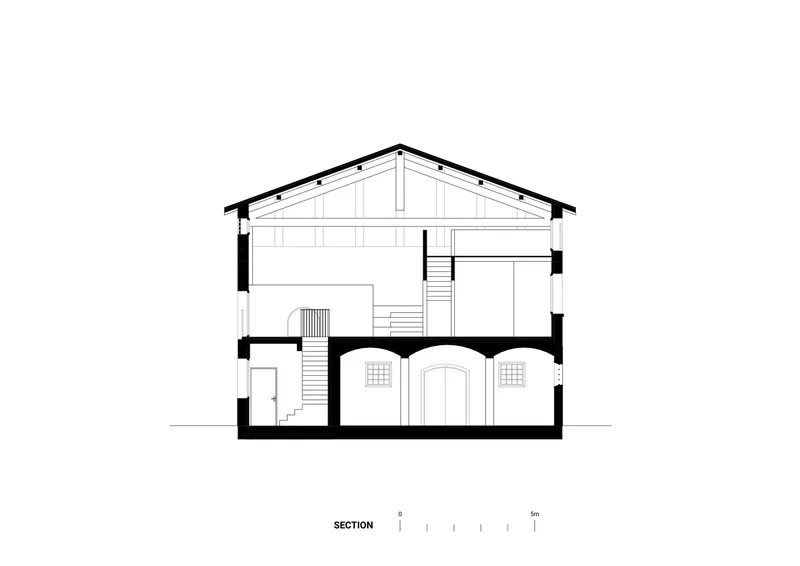
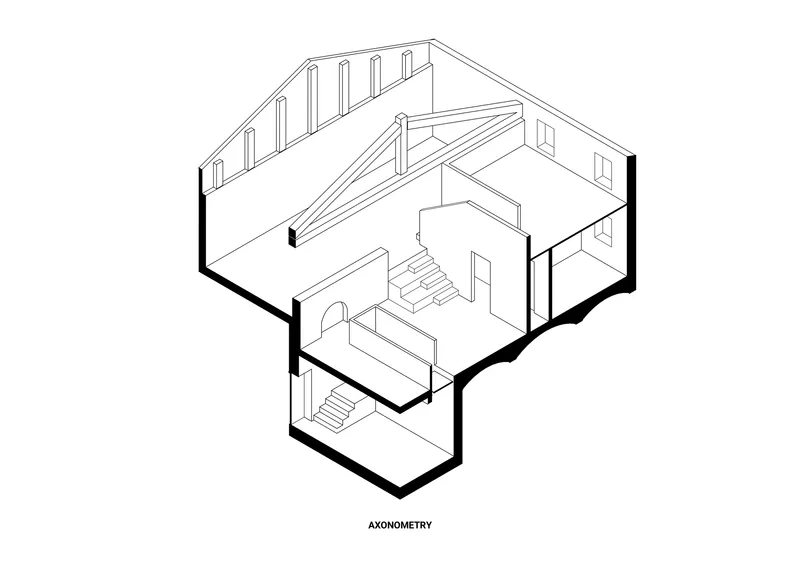
The site plan confirms the isolation of the building within its agricultural plot, with scattered trees and linear field patterns defining the immediate context. The ground floor plan shows a central corridor flanked by rooms on either side, with two staircases providing access to the upper levels. First and second floor plans reveal a mirrored arrangement, and hatched walls distinguish existing masonry from new construction. The section drawing is the most revealing: it exposes the pitched roof structure, the multilevel interior with its staggered floors, and the arched cellar openings at the base. The axonometric, meanwhile, makes the spatial logic of the central staircase and exposed trusses legible in a single image.
Why This Project Matters
Barn conversions are so common in European architecture that they risk becoming a genre with predictable outcomes: exposed bricks, industrial lighting, an open-plan kitchen. Casa NP avoids the clichés by taking the existing building seriously as a typological artifact. The Reggiano-Modenese barn is not just any agricultural structure; it is a specific regional building type with a dual organization of living and working, and the staggered levels introduced by Tésa architetture are a direct response to that duality. The project demonstrates that adaptive reuse works best when the architect understands what the building was before deciding what it should become.
The four-year timeline, from 2022 to 2026, also matters. Measured work takes time. Preserving vaulted ceilings, calibrating new floor levels to accommodate services without overloading the old structure, and resolving every junction in a three-material palette is not fast work. The result is a house that feels inevitable rather than designed, which is the hardest thing to achieve and the surest sign that the architects knew exactly what they were doing.
Casa NP Renovation by Tésa architetture. Carpi, Italy. 140 m². Completed 2026. Photography by Riccardo Sforzi.
About the Studio
Share Your Own Work on uni.xyz
If projects like this are the kind of work you want to make, uni.xyz is a place to publish your own, find collaborators, and enter design competitions.




Popular Articles
Popular articles from the community


Lunar Spiral: Space Architecture Shaped by the Mathematics of the Universe
Lunar Spiral reimagines space architecture through Fibonacci geometry, lunar regolith, levitating habitats, and self-sustaining Moon living.

The Earth Pod: 3D Printed Homes for Resilient Refugee Communities
The Earth Pod reimagines refugee housing through 3D printed homes made from clay, combining resilience, self-sufficiency, and rapid shelter.

Riyadh For All: Intergenerational Urban Design for Active Aging in Rabat
Riyadh For All reimagines urban design in Rabat with intergenerational co-living, adaptive courtyards, and Moroccan cultural exchange today.

The Musturak Paradise: Senior Living Architecture for a Connected Future in Temara, Morocco
The Musturak Paradise reimagines senior living architecture in Temara via private homes, social spaces, culture, community, and shared care.


Similar Reads
You might also enjoy these articles

Bao Huynh Watercolor Atelier: A Serene Art Retreat in Hội An
Bao Huynh Watercolor Atelier in Hội An blends multifunctional art spaces, sustainable design, local materials, and family-friendly living in a serene environment.

Atelier Macri Concept Store Interior Design by CASE-REAL
Atelier Macri store features a "ko" counter, walnut wood details, cork displays, blending retail, gallery, and seamless customer experiences.

Manuel Vargas Izquierdo Stadium and High-Performance Sports Center: Architectural Excellence in Jalpa de Méndez
The Manuel Vargas Izquierdo Stadium blends sustainable design, inclusive sports facilities, and cultural-inspired architecture, revitalizing Jalpa de Méndez’s public spaces.

KAKR Buluh Awar Hall: Revitalizing Community and Ecology Through Bamboo Architecture
Community built bamboo hall revitalizes Buluh Awar village, empowering youth, restoring ecology, celebrating vernacular craftsmanship through sustainable architecture and culture.




Comments (0)
Please login or sign up to add comments
No comments yet. Be the first to comment!