
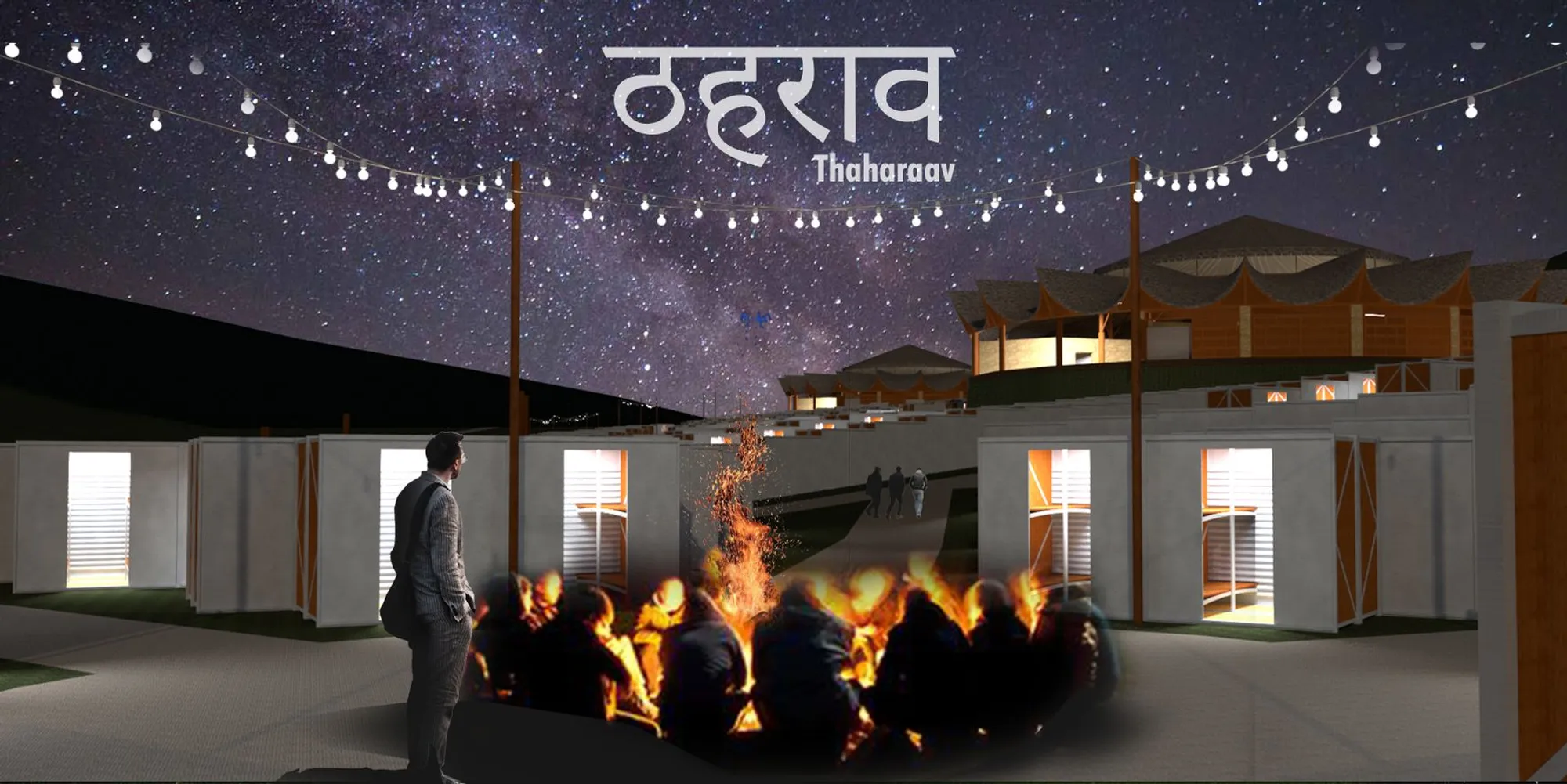
THAHRAAV: Origami-Inspired Modular Shelters for the Amarnath Yatra
A foldable transit camp system using aluminum, sal wood, and bamboo that transforms flat-packed modules into pilgrimage rest stops along one of India's har


Every year, thousands of devotees walk the Amarnath Yatra through some of India's most punishing high-altitude terrain, seeking spiritual renewal in conditions that offer very little physical comfort. The trails lack structured rest environments, and whatever temporary shelter exists tends to be makeshift at best. THAHRAAV proposes something more considered: a modular architecture system rooted in origami logic, where a flat-packed surface unfolds into a fully inhabitable shelter. Each unit can serve as a sleeping pod, a food stall, a dispensary, or a storage cabin, all from the same compact kit of parts. The fold is both metaphor and mechanism, turning minimal material into maximum spatial utility.
The project is a People's Choice Award entry in the Encamp competition on uni.xyz and was designed by Ramiz Akhthar, Madhukar Gupta, Chitta Ranjan, and Amarnath PS. Set along one of India's most spiritually charged pilgrimage routes, THAHRAAV reimagines the transit camp not as a collection of tents but as a precisely engineered system of culturally sensitive, climate-adaptive modules designed for pilgrims, porters, and support teams alike.
From Flat-Pack to Full Shelter in a Single Fold Sequence
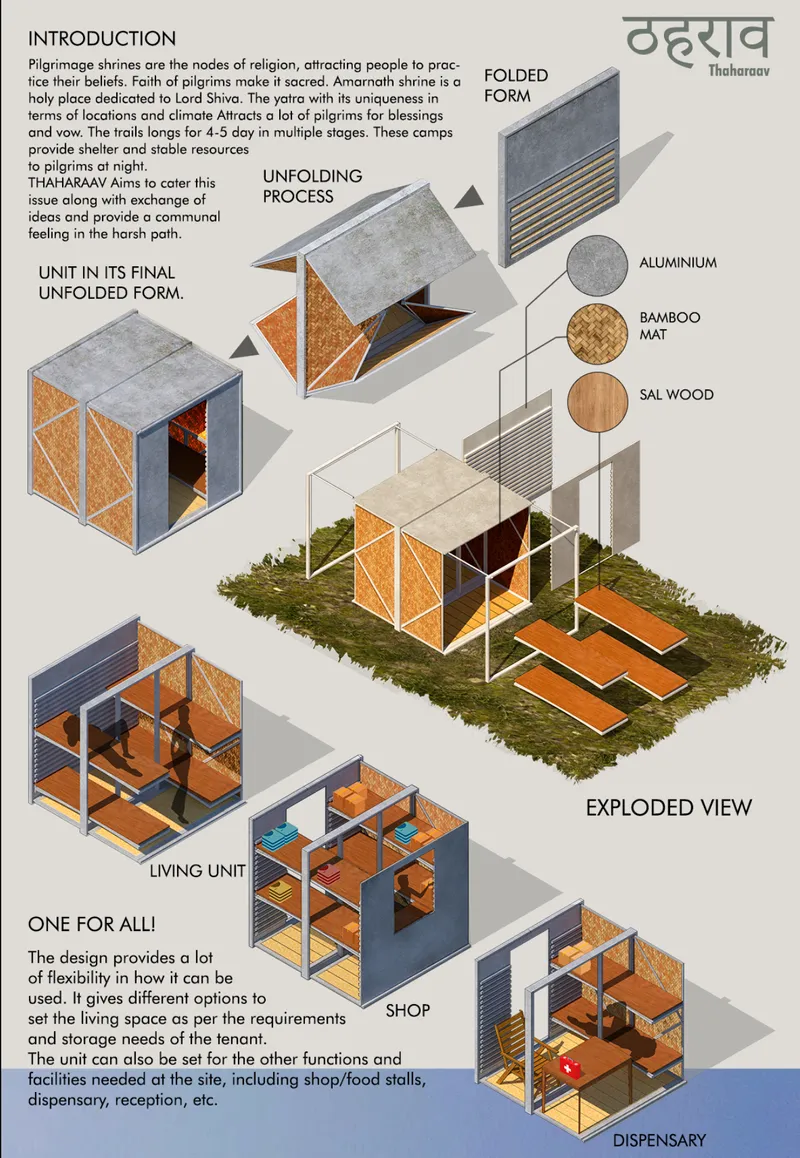
The axonometric diagram above reveals the construction logic behind each foldable modular pod. Built from an aluminum frame, sal wood structural elements, and bamboo mat infill panels, the unit is designed to be transported by foot or pony in its flat-packed state, then unfolded into a robust shelter through a quick assembly mechanism. The exploded view makes the layering sequence transparent: floor panels, structural frame, bamboo mat infills, roofing, and sliding shutters each lock into place in a precise order. This clarity is not just aesthetic. It means small teams of workers, porters, or local artisans can assemble, repair, or replace individual components without specialized knowledge, democratizing the construction process at the campsite.
What makes the system genuinely compelling is its multifunctionality. A single unit can be configured as a living pod for overnight rest, a shop or food stall selling essentials, a first-aid dispensary, a reception desk, or a storage cabin. The same square footage serves different programmatic needs depending on the stage of the pilgrimage or the demands of a particular campsite. This is modular architecture pushed beyond formal cleverness into real operational adaptability.
Woven Bamboo Against the Himalayan Sky
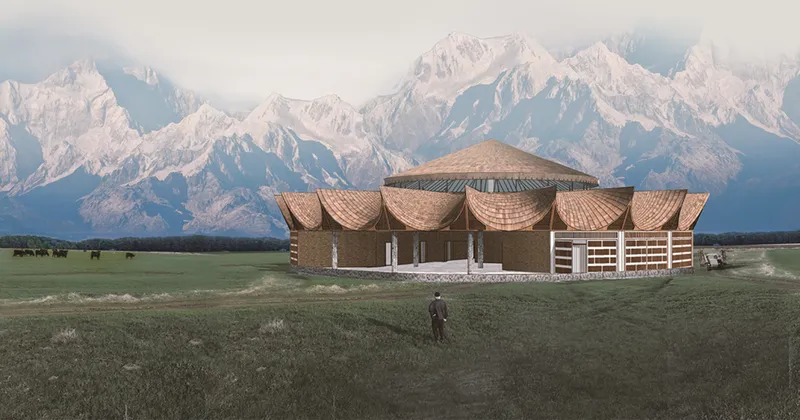
The rendered facade view shows how the bamboo mat panels create a woven texture that reads as both handcrafted and systematically produced. Scalloped roof forms rise against the snow-capped peaks of the surrounding Himalayan landscape, establishing a visual language that respects the terrain rather than competing with it. The material palette of bamboo, aluminum, and sal wood is lightweight yet durable enough to withstand the region's volatile climate, where temperatures, wind, and precipitation can shift dramatically within hours. The choice of bamboo as an infill material also minimizes waste: panels can be locally sourced, easily replaced, and composted at end of life. Sustainability here is not a marketing claim but a practical constraint addressed through material intelligence.
Night Camp as Gathering Space
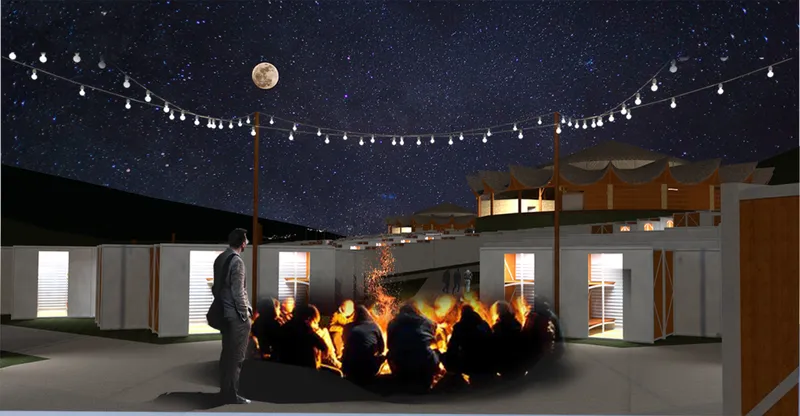
The night rendering captures something that most temporary shelter projects overlook entirely: the social life of the camp after dark. Modular units are arranged around a central fire pit, with string lights strung overhead creating an intimate precinct under the stars. For pilgrims who have walked exhausting high-altitude trails, this communal gathering space offers more than physical rest. It supports the cultural exchange and shared ritual that have always been central to pilgrimage routes. The arrangement is not arbitrary; it reflects THAHRAAV's ambition to design for community as explicitly as it designs for shelter. The modules define edges and enclosures, while the open center draws people together.
A Permanent Core That Shifts Purpose with the Seasons
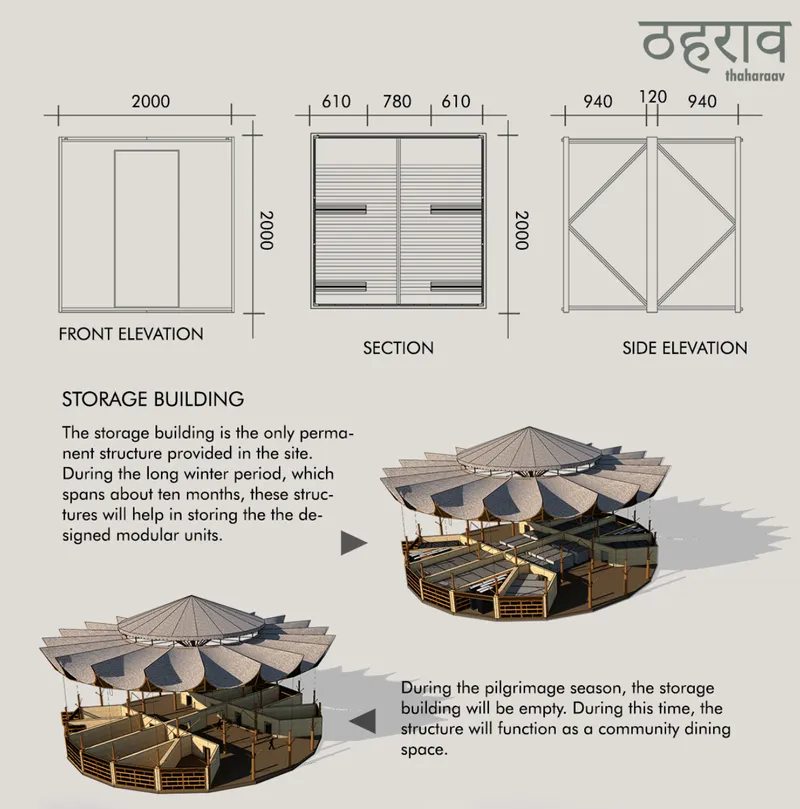
The elevation and section drawings reveal the storage building, the only permanent structure on the site. Its radiating petal forms and umbrella roof create a distinctive silhouette, but the real innovation is programmatic. For roughly ten months of the year, when heavy snow renders the site inaccessible, the building serves as a protected vault where all modular units are stored. During pilgrimage season, it transforms into a community dining hall that facilitates langar services, social gathering, and cultural exchange. This seasonal flip between storage vault and communal hub means the permanent footprint on the landscape is justified year-round, with no dead space in either configuration.
Why This Project Matters
THAHRAAV treats temporary architecture with the same rigor and intentionality that most designers reserve for permanent buildings. The origami-derived folding system is not a formal gimmick but a genuine operational strategy: it solves transport logistics on trails accessible only by foot or pony, enables rapid deployment by non-specialist labor, and supports multiple programmatic uses from a single module type. The material palette of aluminum, sal wood, and bamboo is chosen for climate performance and repairability, not novelty. Every decision traces back to the specific constraints of the Amarnath Yatra route.
More broadly, the project asks a question that extends well beyond pilgrimage infrastructure: what would it take to design modular systems that genuinely respect the communities and landscapes they serve? Ramiz Akhthar, Madhukar Gupta, Chitta Ranjan, and Amarnath PS answer by grounding their design in the realities of seasonal occupation, harsh terrain, and collective spiritual practice. The result is a transit shelter system that is portable without being flimsy, adaptable without being generic, and communal without being chaotic. It is a serious proposal for a type of architecture that too often gets treated as an afterthought.
View the Full Project
About the Designers
Designers: Ramiz Akhthar, Madhukar Gupta, Chitta Ranjan, AMARNATH PS
Enter a Design Competition on uni.xyz
uni.xyz runs architecture and design competitions year-round that reward proposals with spatial conviction and real site intelligence.
Project credits: THAHRAAV by Ramiz Akhthar, Madhukar Gupta, Chitta Ranjan, AMARNATH PS Encamp (uni.xyz).




Popular Articles
Popular articles from the community


Riyadh For All: Intergenerational Urban Design for Active Aging in Rabat
Riyadh For All reimagines urban design in Rabat with intergenerational co-living, adaptive courtyards, and Moroccan cultural exchange today.

Co-life: Sustainable Architecture for Age-Friendly Community Living
Co-life reimagines sustainable architecture for seniors through courtyards, rammed earth, shared gardens, and spaces designed for belonging.

The Earth Pod: 3D Printed Homes for Resilient Refugee Communities
The Earth Pod reimagines refugee housing through 3D printed homes made from clay, combining resilience, self-sufficiency, and rapid shelter.

The Musturak Paradise: Senior Living Architecture for a Connected Future in Temara, Morocco
The Musturak Paradise reimagines senior living architecture in Temara via private homes, social spaces, culture, community, and shared care.


Similar Reads
You might also enjoy these articles

Lunar Spiral: Space Architecture Shaped by the Mathematics of the Universe
Lunar Spiral reimagines space architecture through Fibonacci geometry, lunar regolith, levitating habitats, and self-sustaining Moon living.
The Main Dream: Modular Architecture for Play, Learning, and Community
A modular playground turns recycled plastic into adaptable spaces where refugee children can play, build, learn, and reconnect.

Play: Fragments of Their World
Familiar architecture becomes modular playground design, creating safe spaces where displaced children can learn, connect, imagine and play.

Wadi Rum Observatory: Desert Architecture Designed for the Night Sky
Wadi Rum Observatory turns desert architecture into a quiet instrument for astronomy, hiding research spaces under Jordan's starlit terrain.

Comments (0)
Please login or sign up to add comments
No comments yet. Be the first to comment!