
Thames Christian School and Battersea Chapel: A Civic and Climate-Responsive Landmark in South London
A civic school and chapel combining courtyards, natural ventilation, shared halls, and sustainable design to foster community, learning, and regeneration.


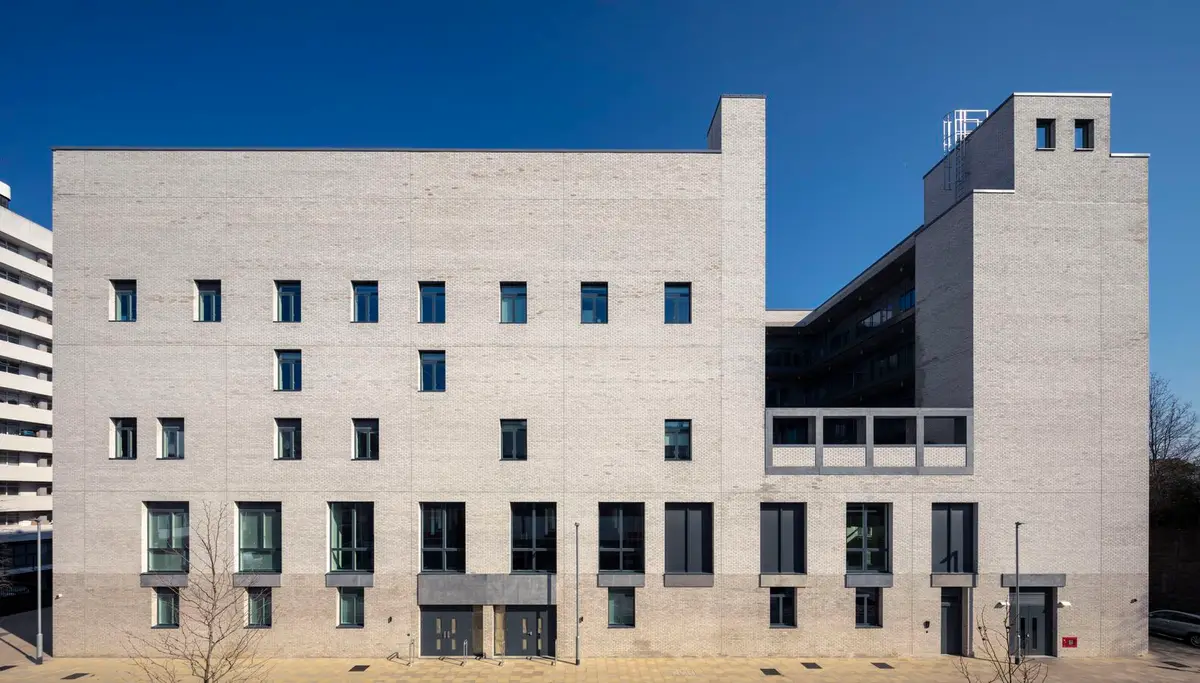
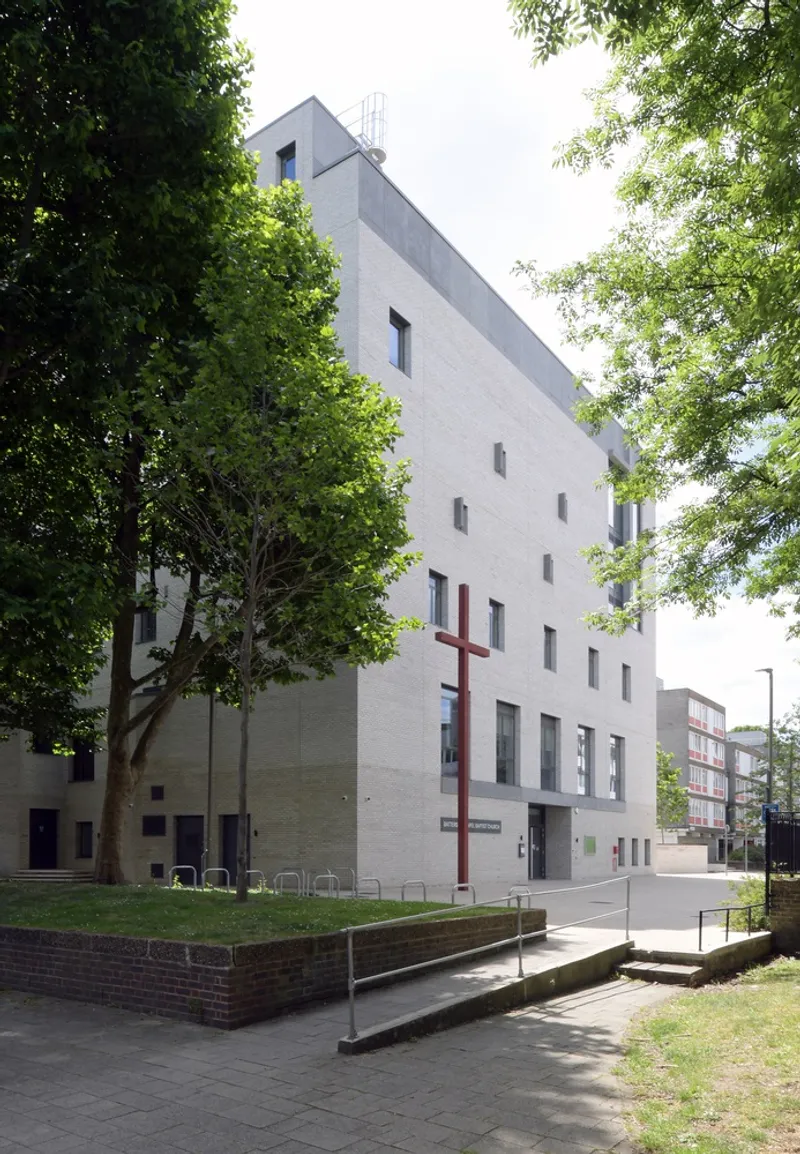
The Thames Christian School and Battersea Chapel by Henley Halebrown is a contemporary educational and religious complex that redefines how schools and places of worship can coexist within dense urban environments. Located beside Clapham Junction railway station in South London, the project unites an independent secondary school and a Baptist church within a single six-storey, 5,000-square-metre building, while simultaneously contributing to the regeneration of the Winstanley & York Road Estate.Rooted in Henley Halebrown’s long-standing interest in architecture that shapes collective experience, the building is organized around a central spatial idea: the creation of concentric, intuitive gathering spaces that eliminate conventional circulation hierarchies. Rather than relying on corridors, the project is structured around halls, courtyards, and shared volumes that encourage interaction, orientation, and social cohesion.
A Shared Plinth and Civic Presence
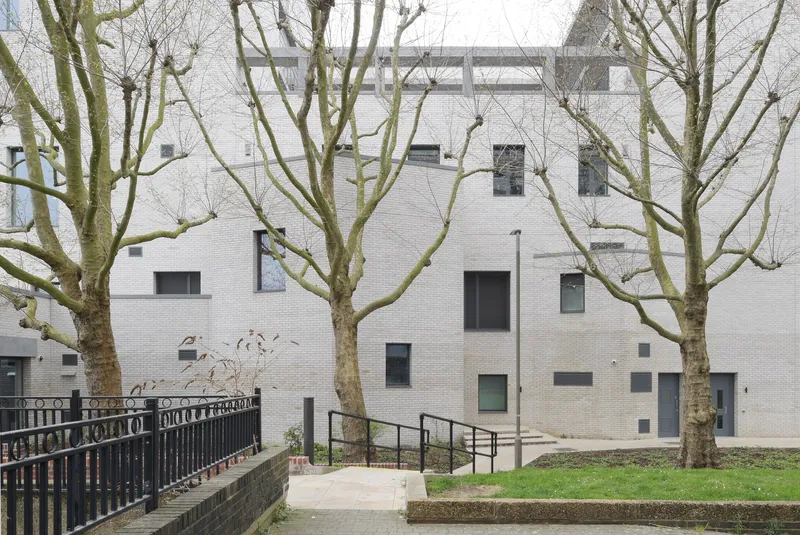
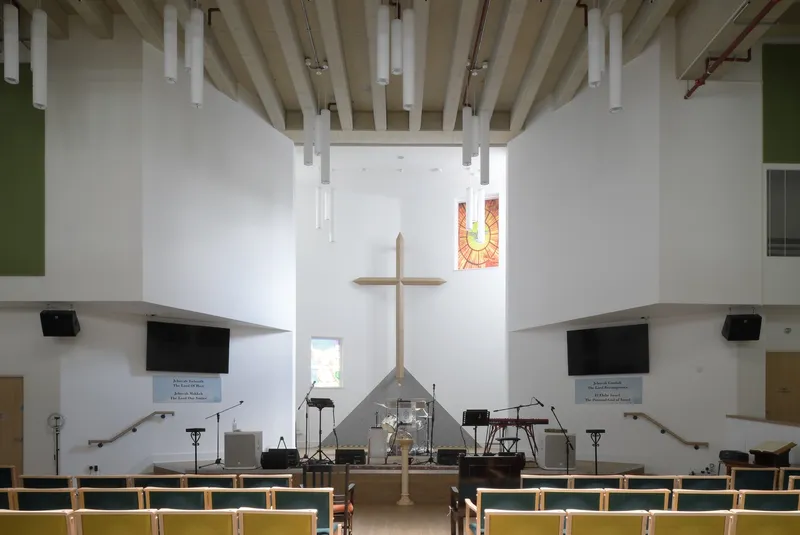
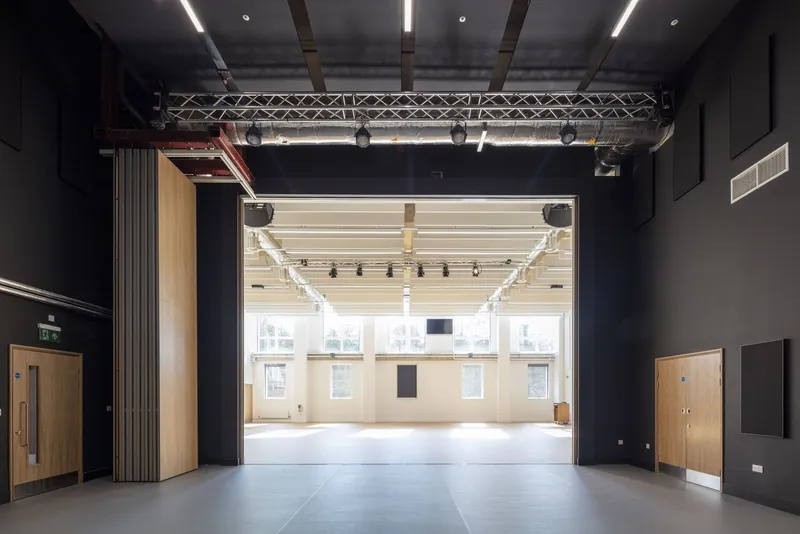
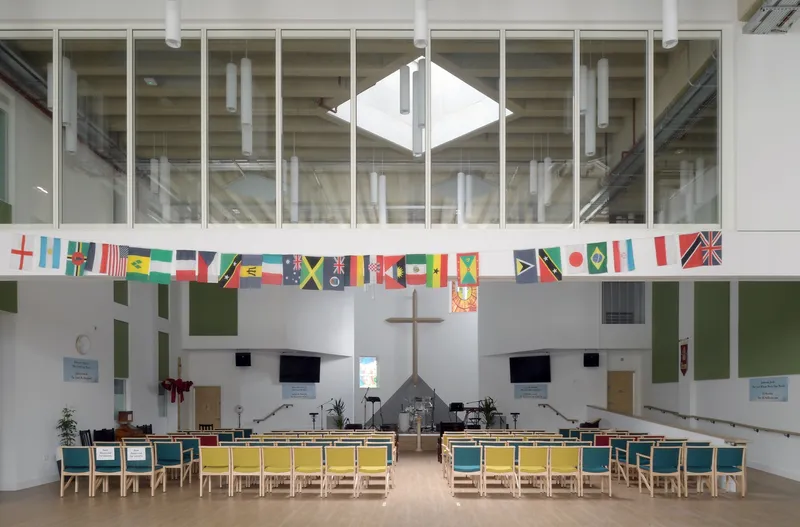
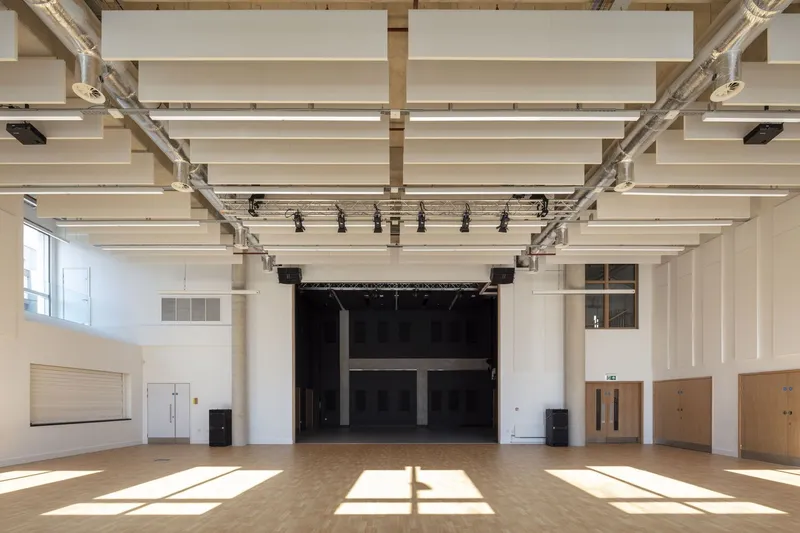
The chapel and school are unified by a robust two-storey rectilinear plinth, lending the building the gravitas and presence of a civic institution. This base accommodates the community hall, sanctuary, and school hall, spaces that are flexible and shared between users. The chapel’s hall and sanctuary can merge into a larger volume for baptisms and significant events, while the school hall supports dining, performances, assemblies, and physical education, remaining accessible to the wider community outside school hours.This shared infrastructure reinforces the project’s democratic ethos, allowing spaces to both unite and differentiate users depending on occasion and scale. As the architects describe, the building explores how architecture can “configure the way people gather,” shaping moments of intimacy, hierarchy, and collective identity.
Courtyards in the Sky and a Corridor-Free School
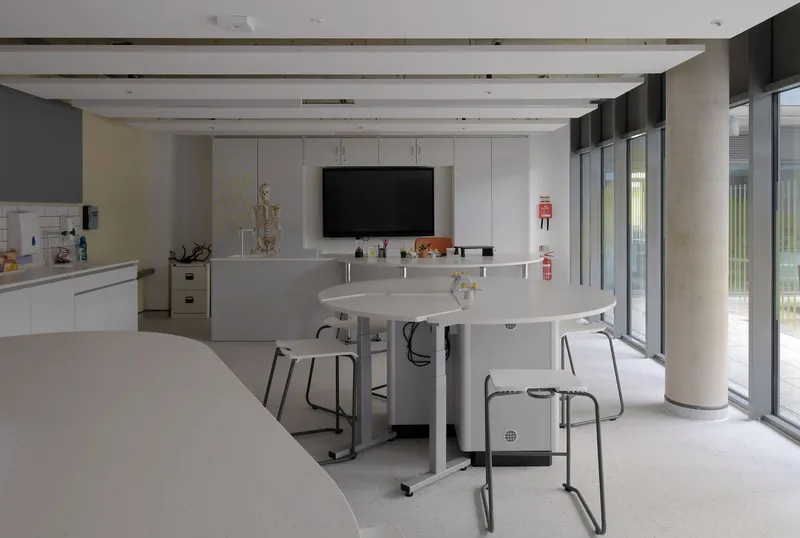
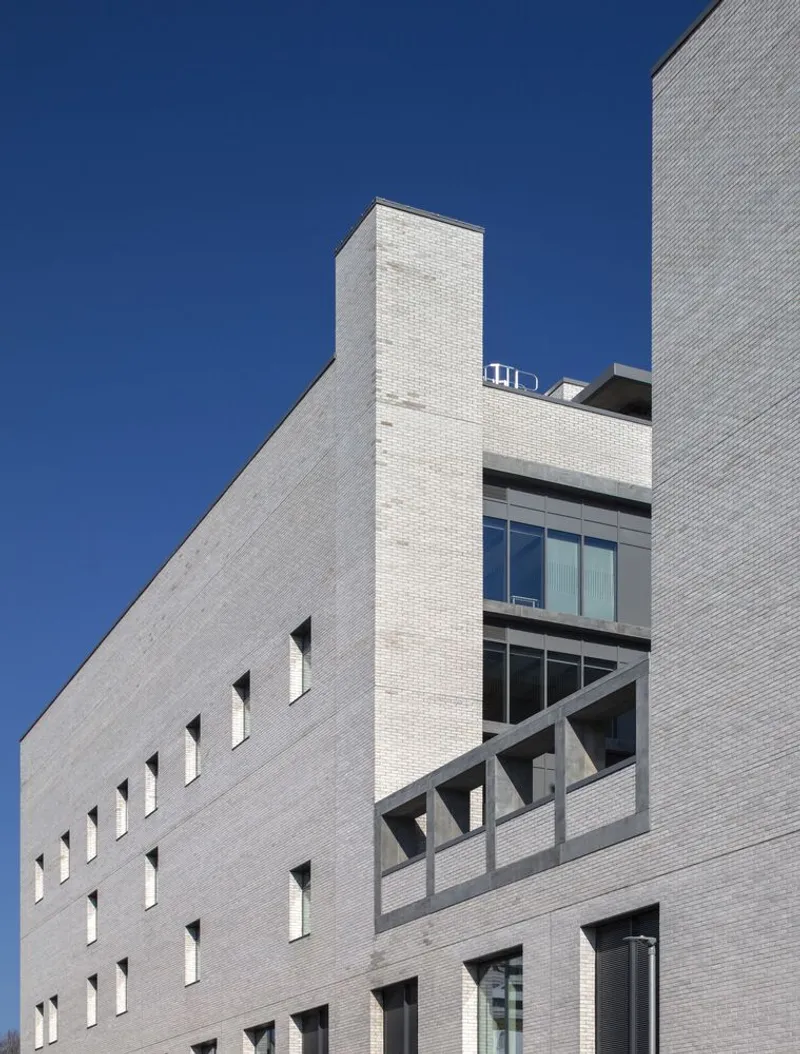
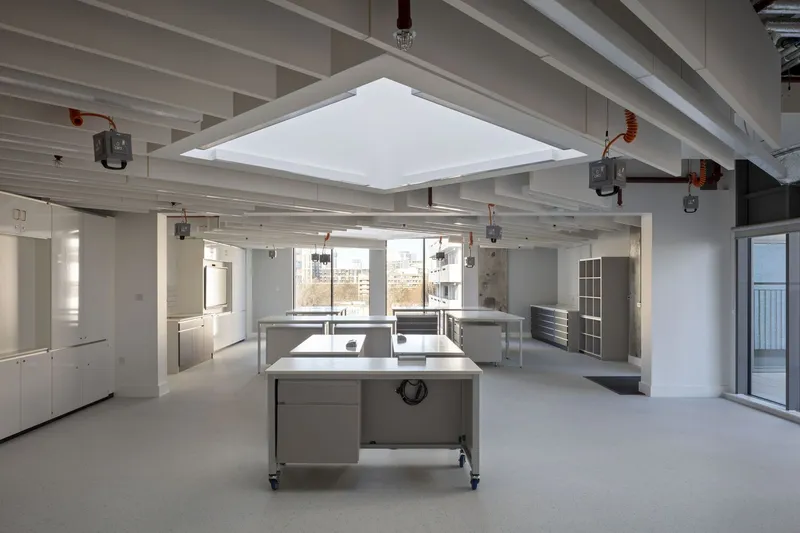
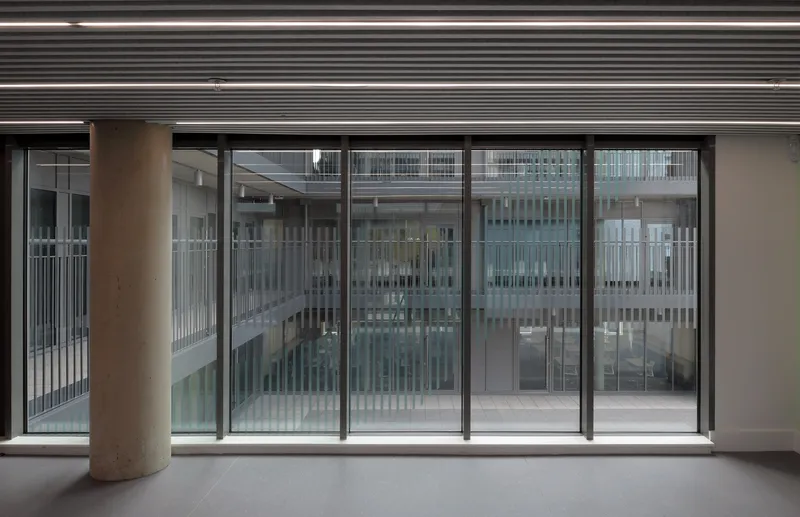
Above the plinth, the school unfolds across four storeys in an S-shaped plan, a form carefully calibrated to respond to the surrounding railway infrastructure and residential context. Bound by train tracks and overlooked by mid- and high-rise housing, the elevated classrooms create a protected internal world, insulated from noise while remaining open to light and air.East- and west-facing open-air courtyards punctuate the upper levels, forming what Henley Halebrown describe as “worlds in microcosm.” These spaces blur the boundary between interior and exterior, functioning as circulation, social space, and environmental buffer. External gallery walkways shade classrooms, enabling generous daylight and natural cross-ventilation, while eliminating the need for mechanical cooling.Specialist teaching spaces for Art, Drama, Music, Design, Computing, and Science are dispersed throughout the plan rather than isolated, reinforcing curriculum diversity and encouraging movement across the school. Libraries, study areas, and common rooms provide quieter, reflective environments that balance the more animated communal spaces.
Materiality, Context, and Urban Integration
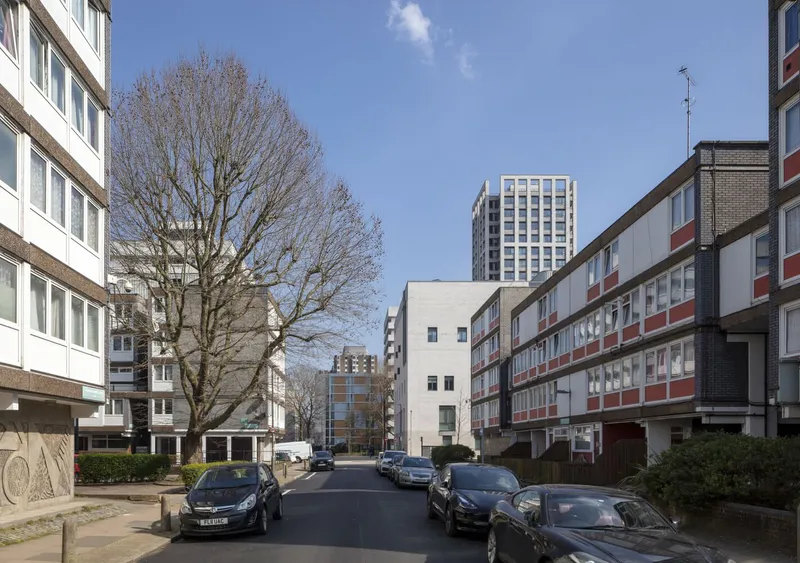
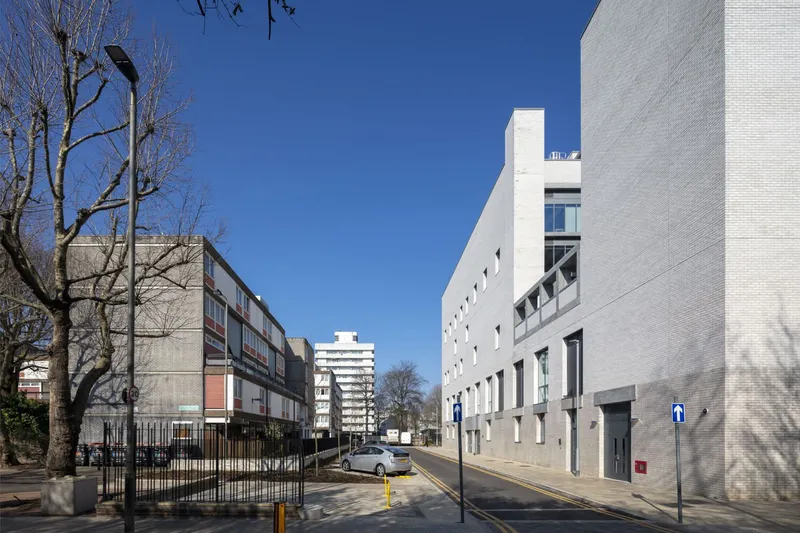
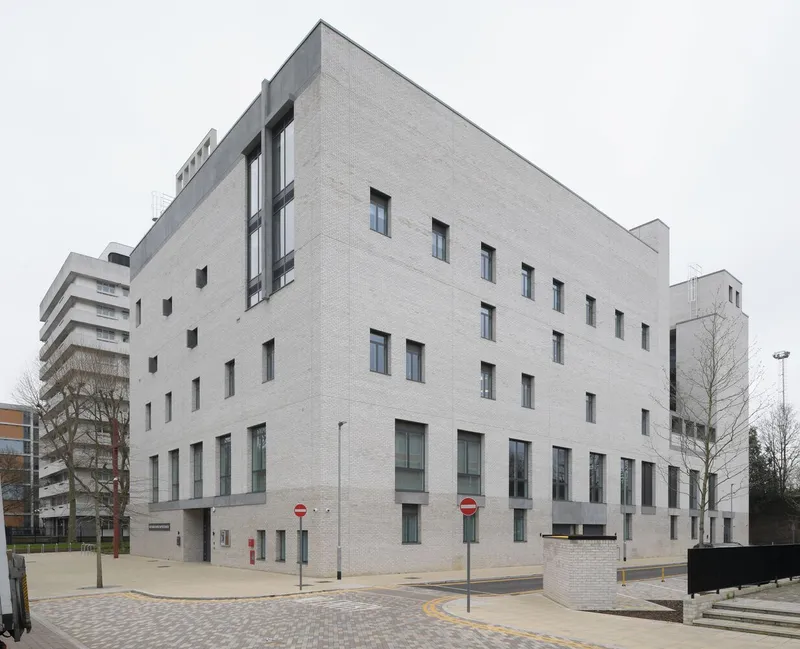
The building’s cream brick façade and grey precast concrete elements establish a calm dialogue with the surrounding streetscape, aligning with local material tones while maintaining a distinct institutional identity. Its scale and composition give the chapel and school a clear civic presence, transforming the complex into a neighborhood landmark that reflects the values of its users.Rather than functioning as a sealed object, the architecture embraces liminality. Walls become inhabited thresholds, circulation spaces become social landscapes, and the building acts as an extension of the city rather than a retreat from it. This approach reinforces Henley Halebrown’s broader philosophy of creating “landscapes inside buildings,” where public and private realms continuously overlap.
Environmental Performance and Sustainable Design
Environmental performance is central to the project’s architectural logic. The S-shaped plan reduces external noise from Clapham Junction by up to 15 decibels, allowing classrooms to operate comfortably at external noise levels of approximately 55dB. This acoustic mitigation enables natural ventilation, significantly reducing both operational and embodied carbon associated with air-conditioning systems.A fabric-first environmental strategy underpins the design, with deep external galleries providing passive solar shading to south, east, and west-facing classrooms. During recent periods of extreme summer heat, the school reported that all teaching spaces remained comfortably occupied without overheating.By externalizing circulation, the building improves its net-to-gross efficiency, minimizing conditioned internal space and reducing the need for internal partitions. These combined strategies have resulted in the project achieving BREEAM Excellent certification, positioning it as a benchmark for sustainable educational architecture in the UK.
Architecture, Well-Being, and Everyday Experience
Beyond performance metrics, the project challenges the notion of hermetically sealed learning environments. Through open-air circulation and direct engagement with climate, pupils and staff remain connected to weather patterns, daylight cycles, and seasonal change. This sensory awareness supports mental well-being and encourages climate-responsive behaviors, grounding daily routines in a tangible relationship with the environment.At Thames Christian School and Battersea Chapel, architecture becomes both infrastructure and experience: a setting that nurtures education, worship, and community life while responding intelligently to urban density, sustainability, and human connection.
All photographs are works of
Nick Kane, David Grandorge


Popular Articles
Popular articles from the community


FCC Arquitectura Expands a Portuguese Granite House with a Board-Marked Concrete Wing
In Portugal, JV House pairs a cleaned-up whitewashed and granite dwelling with a timber-shuttered concrete extension, courtyards and a garden pool.


Manzana Morphosis: Stretching Barcelona's Grid into a Living Landscape for 2050
A radical reworking of the Eixample manzana turns density into a tool for generous public space, vertical ecology, and environmental performance.

ETEH Reworks the Shared Spaces of São Domingos School in Brazil Around Timber, Color and Hanging Plants
At São Domingos School in Brazil, 436 m² of hall, refectory and library are recast with timber joinery, a yellow and blue code and trailing greenery.

Cube Design Draws an Ecological Corridor Between Two Shenzhen Hills with the Nankai Building
Beside Shenzhen's container docks, the Nankai Building pairs stacked balconies with a climbing green screen to connect two hillsides across its height.

Similar Reads
You might also enjoy these articles


Hodi-Mandai Geram
Project Function: Preservation and revitalization of the Intangible heritage and socio-spatial identity of the Hodi by Housing, Cultural Memory Center, Sacred Grove, landscape, local tourism economy


Olio Towers: A Mid-Rise for Performers That Fuses Housing, Rehearsal, and Stage
Located blocks from Houston's Theater District, this modular tower stacks living units around a central performance atrium.

Oasis: Modular Green Housing Carved into Dhaka's Urban Fabric
A shortlisted Plugin Housing entry reclaims unauthorized settlements in Dhaka with stepped concrete volumes, green roofs, and ventilation-driven design.

Black Hole: A Floating Megastructure for the Post-Physical Era
Emiliano Mazzarotto envisions a spherical, self-scaling arena where e-sports, digital hotels, and holographic stadiums replace traditional public space.

Explore Chapel Competitions
Discover active competitions in this discipline

Challenge to design public laboratory

Challenge to reimagine the Iron Throne

Photograph architecture without architects

Illustrate the lost glory of Angkor Wat - Render Challenge
Comments (0)
Please login or sign up to add comments
No comments yet. Be the first to comment!