

The Arc: A Coastal Pier Reimagined as Rio's New Cultural Interface
A sweeping waterfront athenaeum in Rio de Janeiro turns the pier typology into a communicative landscape of sound, structure, and gathering.


What happens when a pier stops reaching straight into the ocean and starts curving along it instead? In Rio de Janeiro, the answer is a continuous spatial arc that reframes the relationship between city, shore, and sea. The Arc replaces the linear dock with a sweeping gesture that frames panoramic views of Guanabara Bay, the city skyline, and the horizon, while embedding within its structure something unexpected: an open-air athenaeum for learning, performance, and collective listening.
Conceived by designers Zeynep Uz and Cihan Polat, The Arc is a coastal architecture proposal that treats the pier not as an extension into water but as a communicative landscape. Set against Rio's reputation as the "city of sounds," the project asks how architecture can operate as both a medium of collective expression and a platform for social connection. The result is a hybrid infrastructure of shell roofs, tensile walkways, and rhythmic vertical screens that transforms the waterfront into a place for observation, gathering, and cultural exchange.
A Curve That Frames the Entire Bay
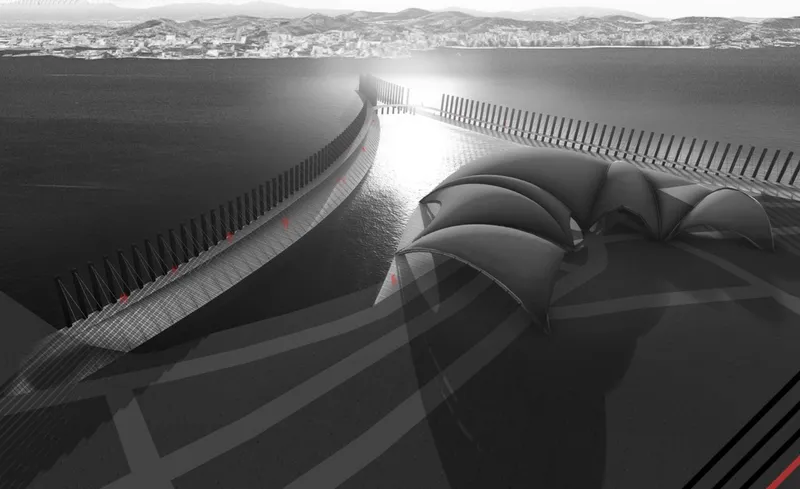
Seen from above at sunset, the defining move becomes clear: the pier does not project outward but arcs along the water's edge, creating a continuous promenade that captures shifting perspectives of the ocean, the city, and the opposing shore. The curving shell roof structures and the slatted perimeter wall establish a rhythm that mirrors the coastline itself, while the geometry creates sheltered pockets and open plazas at strategic intervals. It is a single architectural gesture that generates enormous spatial variety.
This curvature is not decorative. It positions The Arc within contemporary coastal architecture thinking, where resilience, adaptability, and sensory immersion guide the design. By bending rather than thrusting, the pier reduces its confrontation with tidal forces while maximizing the length of its public waterfront. The promenade becomes a place where visitors are always in motion, always encountering a new framed view.
Tensile Structure as Spatial Score

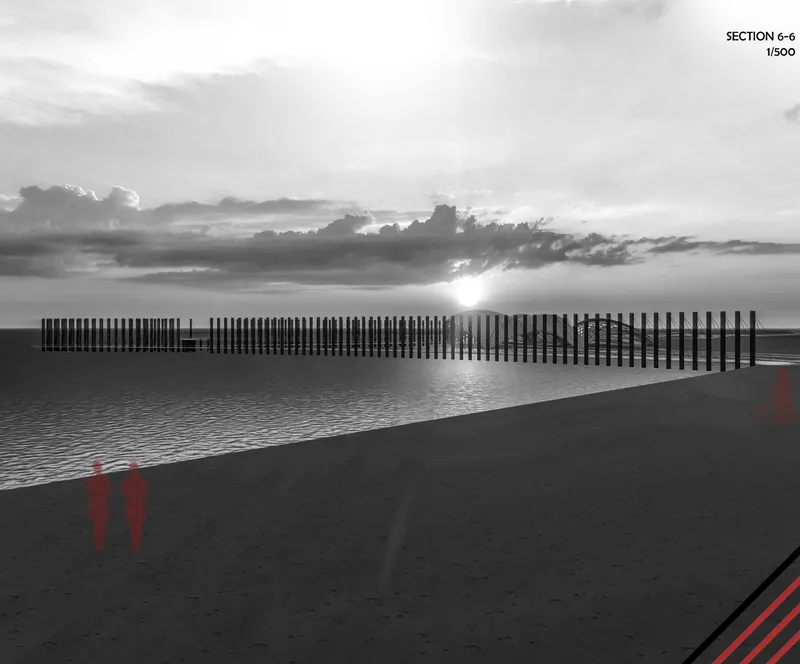
The section drawings reveal how The Arc's structure works: vertical pillars rise from the water like rhythmic markers, anchoring cable-supported walkways in an interplay of tensile and compressive forces. The cable stays radiate outward from slender masts, supporting elevated deck surfaces that offer sequences of framed views, from the expanse of the bay to the undulating roof forms of the cultural pavilions. Their alignment and spacing evoke both musical rhythm and maritime infrastructure, grounding the project in its coastal identity.
From across the water, the vertical slatted wall reads as a permeable screen rather than a barrier. Under a dramatic dusk sky, the rhythmic verticals filter light and wind, creating a constantly changing surface that breathes with weather and time of day. The effect is cinematic: the city appears and disappears behind the slats as visitors move along the deck, turning a walk into a sensory narrative.
The Athenaeum Opens to Sky and Sound


At the heart of The Arc sits a reinterpretation of the athenaeum: not a walled institution but an open-air environment shaped by Rio's climate, topography, and acoustic character. The symmetrical rows of vertical slatted walls flanking the central deck create a processional approach toward the cable-stayed bridge and the shell-roofed pavilions beyond. The timber deck plaza, framed by angled slatted walls, funnels visitors toward the radiating shell roof pavilion, where semi-open shells and tensile structures form acoustically engaging pockets for performance, learning, and communal listening.
Uz and Polat argue that architecture in the digital era must reflect the fluid nature of modern knowledge exchange. The athenaeum here is not a container for books but a spatial instrument: its structural rhythm, material transitions, and shifting elevations invite interpretation and dialogue. Where music, waves, and human activity form a continuous composition in Rio's streetscape, The Arc provides the architectural framework to amplify that interplay. The pier becomes, in the designers' terms, a spatial communicator.
Why This Project Matters
Pier design has long defaulted to the linear: a boardwalk extending into the ocean, a jetty for fishing or boarding. The Arc challenges that assumption by demonstrating that the pier typology can accommodate civic complexity. By curving along the waterfront rather than cutting across it, the project generates a diversity of spatial conditions, from intimate acoustic shells to expansive elevated walkways, within a single continuous structure. It is a compelling argument for treating coastal infrastructure as cultural architecture.
What elevates the proposal beyond formal ambition is its engagement with Rio's acoustic identity. The decision to anchor the programme in sound and communication, rather than commerce or tourism alone, gives the project a conceptual specificity that many waterfront visions lack. Uz and Polat have produced a scheme that treats the pier as a medium, not just a destination, and in doing so, they suggest a richer model for how cities might inhabit their coastlines.
View the Full Project
About the Designers
Designers: Zeynep Uz, Cihan Polat
Enter a Design Competition on uni.xyz
uni.xyz runs architecture and design competitions year-round that reward proposals with spatial conviction and real site intelligence.
Project credits: The Arc by Zeynep Uz, Cihan Polat.




Popular Articles
Popular articles from the community


Conexión: Biophilic Design Reimagines High-Rise Living in Hong Kong
Conexión reimagines high-rise living in Hong Kong through biophilic design, green facades, shared spaces, daylight, water and nature within.

Riyadh For All: Intergenerational Urban Design for Active Aging in Rabat
Riyadh For All reimagines urban design in Rabat with intergenerational co-living, adaptive courtyards, and Moroccan cultural exchange today.
AL-JANNAH: Sustainable Architecture and Permaculture for Afghan Widows
AL-JANNAH uses sustainable architecture and permaculture to create resilient oasis of housing, learning, work and renewal for Afghan widows.

Co-Life: Senior Housing Design That Reconnects Older Adults With the City
Co-Life reimagines senior housing design through healing gardens, shared streets, workshops, and a sustainable community across generations.

Similar Reads
You might also enjoy these articles

The Musturak Paradise: Senior Living Architecture for a Connected Future in Temara, Morocco
The Musturak Paradise reimagines senior living architecture in Temara via private homes, social spaces, culture, community, and shared care.

The Leaf Center: Cultural Center Architecture for Social Integration in Amsterdam
Cultural center architecture becomes a bridge at The Leaf Center, connecting international students with Amsterdam through art and exchange.
Conexión: Biophilic Design Reimagines High-Rise Living in Hong Kong
Conexión reimagines high-rise living in Hong Kong through biophilic design, green facades, shared spaces, daylight, water and nature within.

Wander to Wonder: Modular Playground Design for Children in Kutupalong Refugee Camp
Wander to Wonder uses modular playground design to create flexible, imaginative play spaces for children in Kutupalong refugee camp.


Explore Cultural Architecture Competitions
Discover active competitions in this discipline



Challenge to reimagine the Iron Throne


Photograph architecture without architects


Illustrate the lost glory of Angkor Wat - Render Challenge


Bring back Drive In's
Comments (0)
Please login or sign up to add comments
No comments yet. Be the first to comment!