
The Ark: An Egg-Shaped Vertical Colony Built to Outlast a Ruined Climate
A shortlisted Apocalypse 2020 entry that wraps farms, ponds and homes inside a 3D-printed lattice egg, turning shelter into a closed-loop ecosystem.


Most apocalypse architecture digs in: bunkers, walls, sealed vaults that keep the world out and the people in. The Ark takes a stranger and more hopeful position. It treats survival as an act of cultivation, enclosing humans, animals and plants inside a single protective shell and asking them to keep each other alive. The building is less a refuge than a working ecosystem, where crops purify air, water steadies the climate, and residents become stewards of a closed loop.
Designed by Patricia Ayuso and Alex Rodriguez, the project was shortlisted in Architecture of the Apocalypse 2020. Its premise is a near future in which climate change, pollution, rising seas, extreme weather and resource scarcity have made much of the planet uninhabitable. The designers' answer is an encapsulated vertical colony that can stand above flooded valleys, misty rivers or desert ridges, carrying a functioning slice of nature inside it.
An Egg Lifted on Legs, Bridging Back to the Land

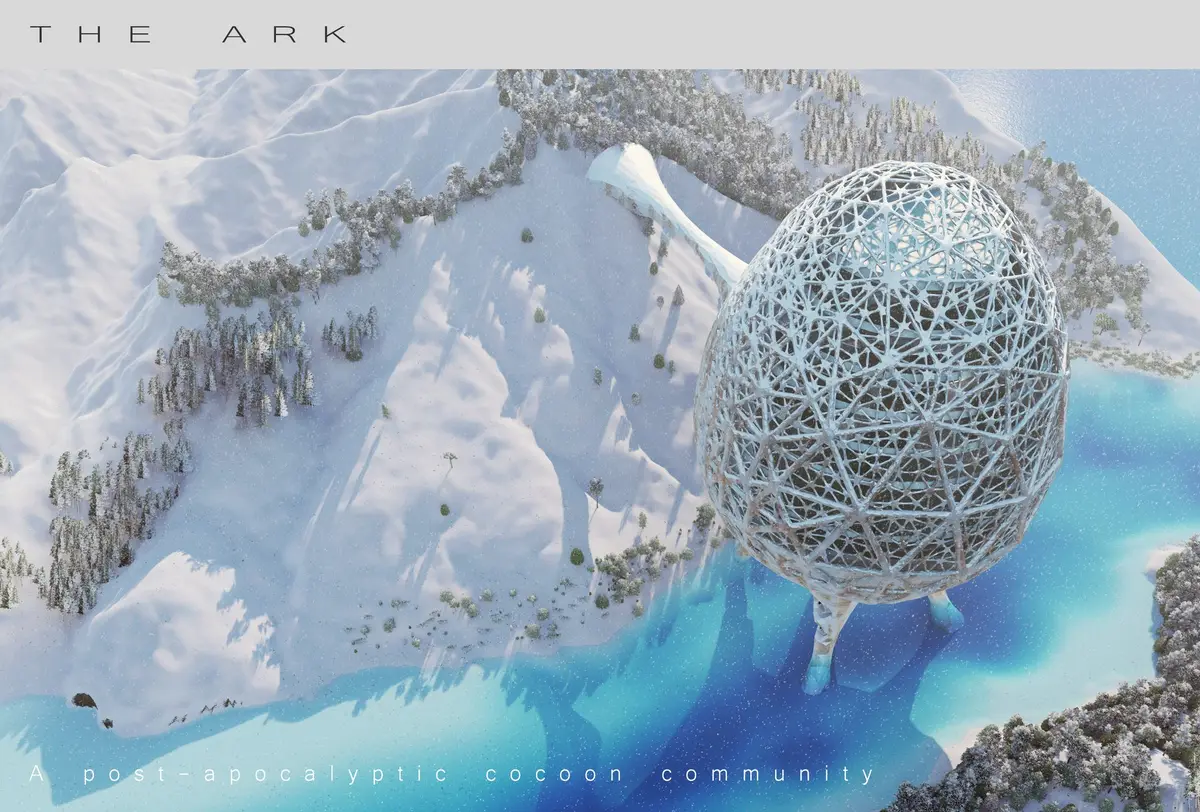
The opening rendering sets out the project's central formal bet: the egg. Ayuso and Rodriguez borrow nature's most efficient vessel for protecting life, and the biomimetic logic is sound. A doubly curved shell distributes load across its whole surface, giving maximum strength for minimal material. Here that shell reads as an open lattice, raised on two legs above a green lake, with a single walkway reaching out to the wooded hillside. The gesture matters. The Ark is sealed against contaminants and storms, yet it still keeps one deliberate thread of contact with the ground it has left behind.
The construction strategy follows the same thinking. The shell is proposed as a 3D-printed structure, assembled robotically to reduce the risks of human labour in hostile conditions, and wrapped in multi-layer insulation comparable to aerospace systems. The intent is an airtight envelope whose interior stays stable no matter what the exterior climate does. The airship drifting overhead is a small but telling detail: in this world, movement between settlements happens above a damaged surface, not across it.
Ring Balconies Stacked Around a Central Pond
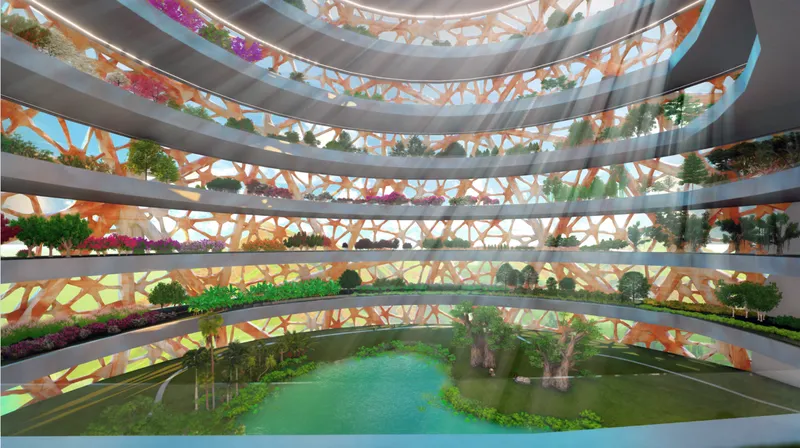

Inside, the project shifts from fortress to landscape. Curving ring balconies step up the inner face of the shell, each one planted with trees and shrubs and overlooking a pond at the base. Light falls through the orange lattice in visible rays, and this is where the scheme earns its credibility. The openings are radiation-protected, so each level receives the sunlight its planting zones need without exposing residents to danger. Agriculture, living space, research facilities and communal areas share this vertical arrangement, so food production is never a hidden back-of-house function; it is the view from every floor.
The atrium floor brings the idea down to human scale. Pale timber paving, mature trees, patches of sunlight and two children at the water's edge describe a place for daily life rather than grim endurance. The pond is doing quiet technical work, regulating humidity and temperature and acting as a reservoir, but the designers let it read first as a gathering point. The proposal insists that recreation, education and social space belong in a survival architecture, and these views make that argument more convincingly than any diagram could.
Working With Rising Water Instead of Resisting It
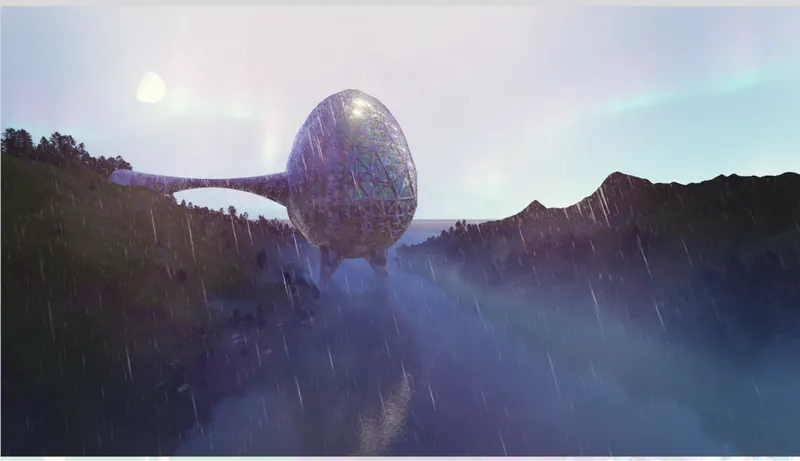
The rain-soaked river scene reveals the Ark's most pragmatic layer: its energy strategy. Standing on slender legs with a long bridge arm stretching across the mist, the structure is positioned to meet a rising waterline rather than flee it. If water levels climb, turbines embedded in the system convert moving water into power, while wind turbines capture atmospheric flows. Flood and storm, the very forces that drove people into the shell, become its fuel.
Heat follows the same circular logic. Warmth generated inside is collected and redistributed for internal climate control, with the designers suggesting it could even assist recovery of the environment outside. The pale moon and faint aurora in this image give the scene an eerie calm, and it suits the scheme. The Ark does not dramatise catastrophe; it absorbs it and keeps running.
From Single Shelter to a Colony Across the Desert

The final rendering multiplies the idea. Four egg-shaped pods stand on legs across ochre desert ridges, a dark ravine below and a low sun on the horizon. Seen together, the Ark stops being a one-off monument and becomes a repeatable unit, adaptable to terrain as different as a lake basin and an arid canyon. The legs make this possible, lifting each pod clear of uneven or hostile ground while the shell carries the same internal ecosystem wherever it lands.
This scattered settlement pattern hints at a broader social model. Each pod is a self-sustaining community organised around collective responsibility, with residents farming, maintaining, researching and innovating. Linked by bridges and airships, a field of such vessels begins to look like the outline of a post-collapse civilisation: dispersed, resilient, and anchored by the living systems each shell protects.
Why This Project Matters
Speculative competitions often reward spectacle, and the Ark has plenty of it: the glowing lattice, the airship, the aurora. Its real strength, though, is the coherence between form and function. The egg is chosen for structural efficiency, the openings are calibrated for both crops and safety, the water serves as climate control and reservoir, and the energy systems feed on the very conditions that threaten the building. Every major move connects back to the idea of a closed loop, which is why the shortlisting feels earned.
More importantly, Ayuso and Rodriguez reframe what survival architecture is for. Instead of preserving humans in isolation, the Ark preserves relationships between people, plants, animals and water, and treats those relationships as the infrastructure. That shift has value well beyond a fictional apocalypse. As cities confront rising seas and unstable climates now, a building that thinks like an ecosystem is not science fiction so much as an early sketch of a necessary practice.
View the Full Project
About the Designers
Designers: Patricia Ayuso, Alex Rodriguez
Enter a Design Competition on uni.xyz
uni.xyz runs architecture and design competitions year-round that reward proposals with spatial conviction and real site intelligence.
Project credits: The Ark by Patricia Ayuso, Alex Rodriguez Apocalypse 2020 (uni.xyz).


Popular Articles
Popular articles from the community


David Macias Steps a Doorless Stone and Plaster House Down a Tropical Colombian Hillside
In the humid hills of Colombia, Threshold House replaces the front door with an open void and terraces its 850 m² down the slope instead of fighting it.

Architekt Andreas Gruber Scatters 23 Dark Timber Chalets Across a South Tyrolean Forest Edge
In Molini di Tures, Amonti Chalets breaks a resort into a hamlet of gabled timber houses, with parking, storage and services pushed into the slope.

LT2A and OPEN Architectes Thread a Brick and Glass High School Through a Wooded Belgian Campus
In Braine-l'Alleud, a 3,000 m² wing for Collège Cardinal Mercier pairs pale brick with a glazed colonnade, deferring to a small chapel and a dense wood.

Juan García Correa, John González and Claudia Rueda Sink a Circular Amphitheater into a Manizales Engineering Building
On the La Nubia campus in Manizales, Colombia, the S1 Building folds labs and offices into a hillside of ramped lawns that double as a campus route.

Similar Reads
You might also enjoy these articles
Healing Façade: A Modular Chapel System That Restores Ethiopia's Sacred Forests
Winner of the Eco-Chapel competition, this circular timber façade collects water from air to rebuild soil and reforest degraded Ethiopian landscapes.
Kaffeebühnen: Where Coffee Shop Architecture Becomes a Civic Stage in Vienna
A linear sequence of timber boxes, transparent shells, and open yards turns the Viennese café tradition into a public performance space.
Eco Chapel: A Modular Forest Pavilion That Grows Like the Landscape It Protects
Hexagonal timber modules weave through existing trees, turning a chapel into a living system for prayer, education, and reforestation.


Urban Forest: A Vertical Ecosystem for 5,000 Workers in Singapore's Changi Business Park
Radially stacked pods and layered green decks turn a 7-acre plot into 47 acres of ecological workspace projected for 2040.

Explore Apocalyptic Architecture Competitions
Discover active competitions in this discipline

Challenge to imagine architecture inspired by fiction

Challenge to design luxury tourism on rails

Challenge to reimagine the Iron Throne

Photograph architecture without architects
Comments (0)
Please login or sign up to add comments
No comments yet. Be the first to comment!