
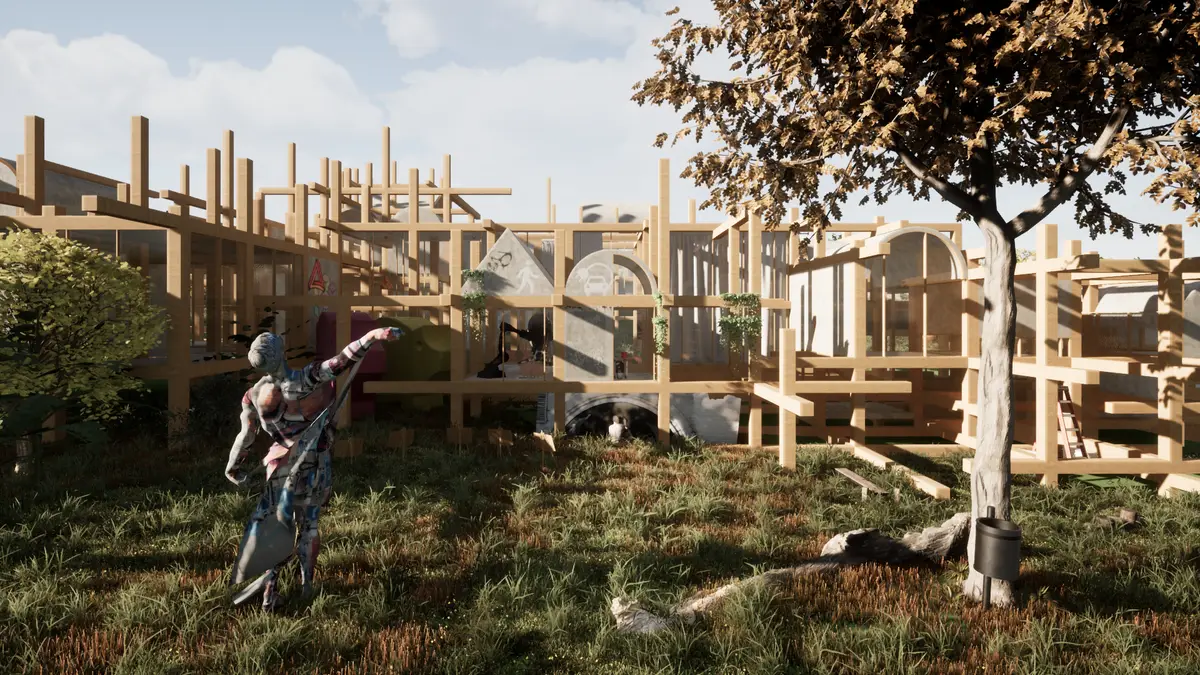
The Artistory
Expandable Atmospheres

Although the design started here in our studio, it evolved based on how we imagined our ancestors would interact around a blank canvas or an empty room in the current days. Let us clarify by starting with a difficult question: “what is space?”. For us, it cannot simply be defined as a room or a group of rooms enclosed by walls or windows, neither a home nor an office. With this in mind, we start our journey through the concept of atmosphere.
As we cannot define the atmosphere in our own terms, we must use metaphysical fundamentals to understand that, in order to propose a space that would promote creativity and human development, the form and the wellbeing, the attribute and the substance, it must be bidirectionally influenced.
Simultaneously, we shouldn’t impose a subjective view on the “ideal atmosphere”. With that in mind, we started imagining how we became architects and how other artistic disciplines evolve from the traditional practice into nowadays’ work experience.
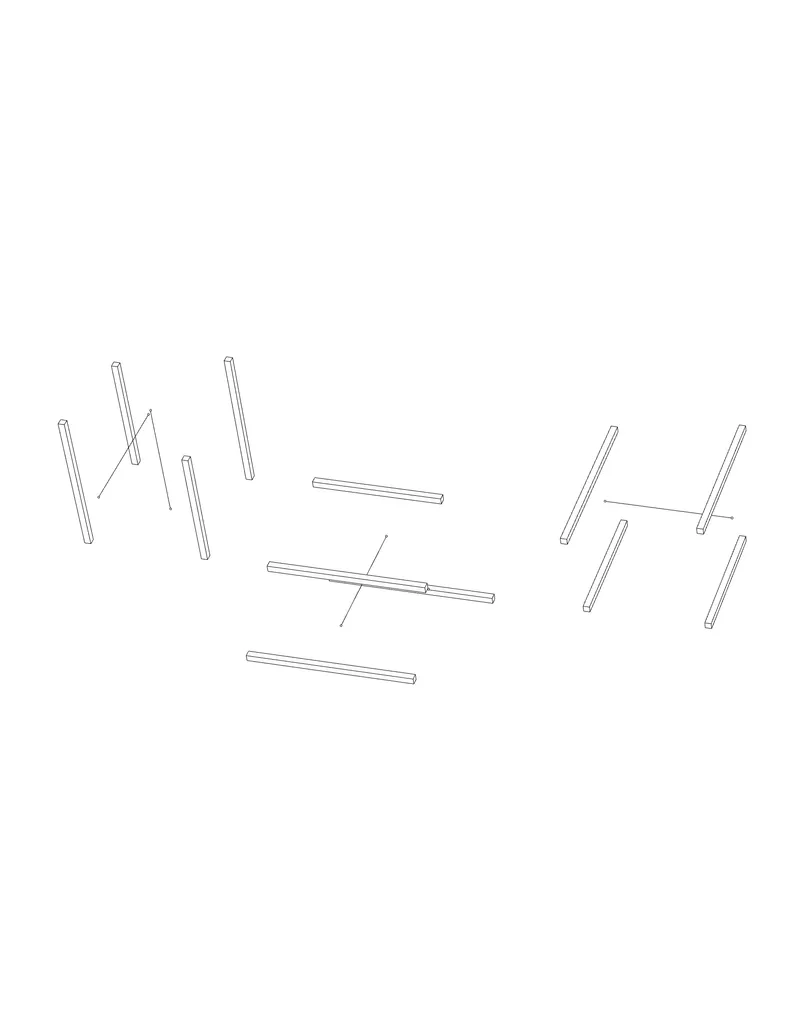
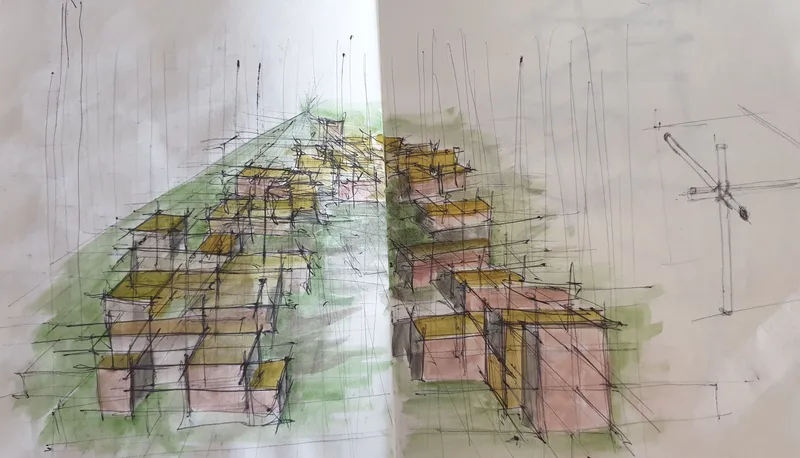
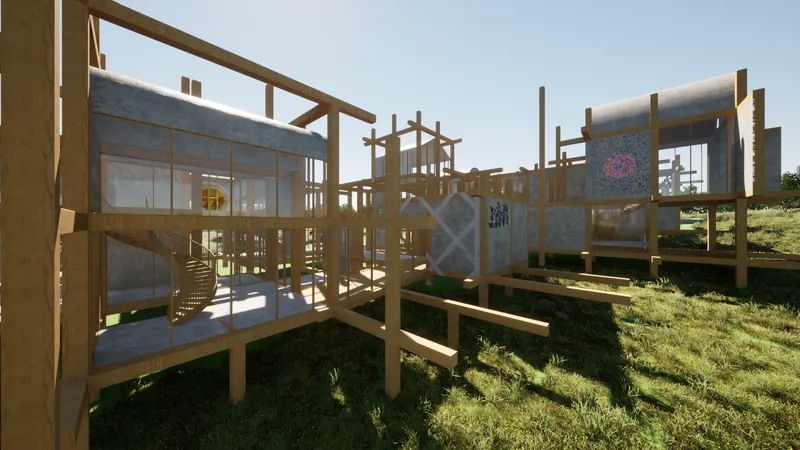
While trying to avoid the “box” shape, in one of our iterations, we minimized the amount of material and came up with twelve edges. Enough for structural purposes yet using the minimum amount of material as possible. The cubic shape would also allow future reconfiguration, expansion or disassembling if necessary. Additionally, as we wanted to decrease the impact of a new building, the structural floor of each space was elevated from the ground allowing rainwater and native vegetation to follow their natural path.
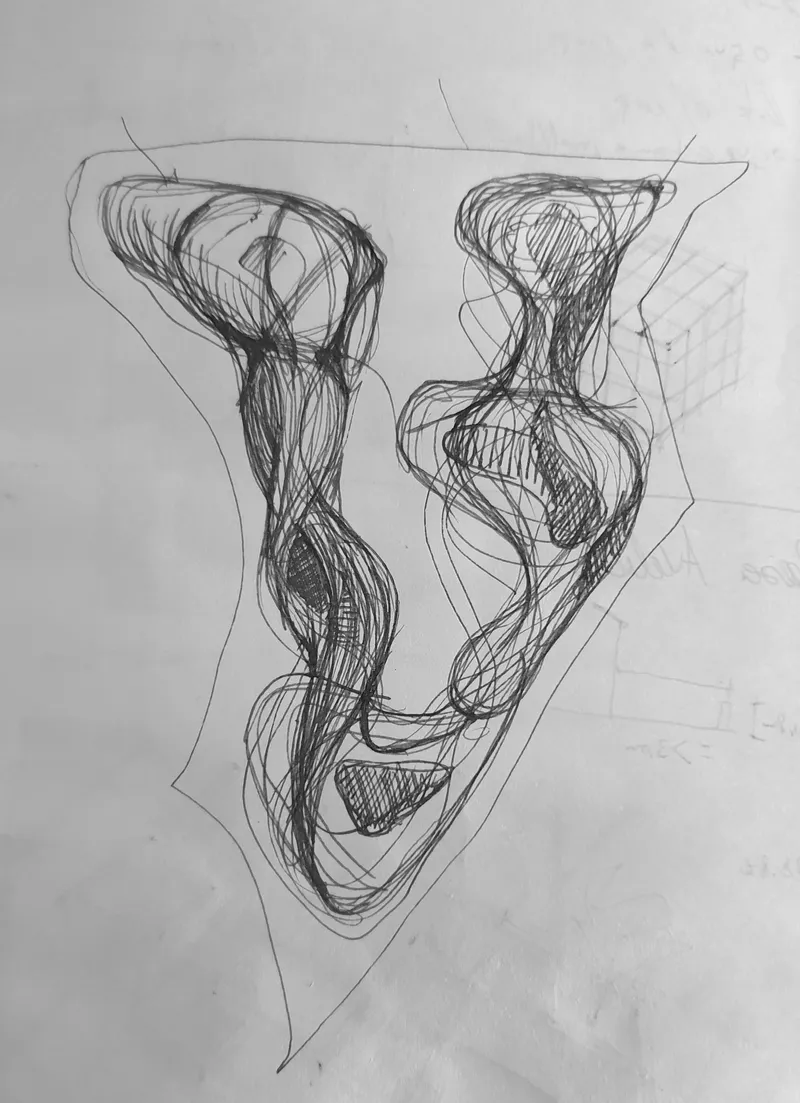
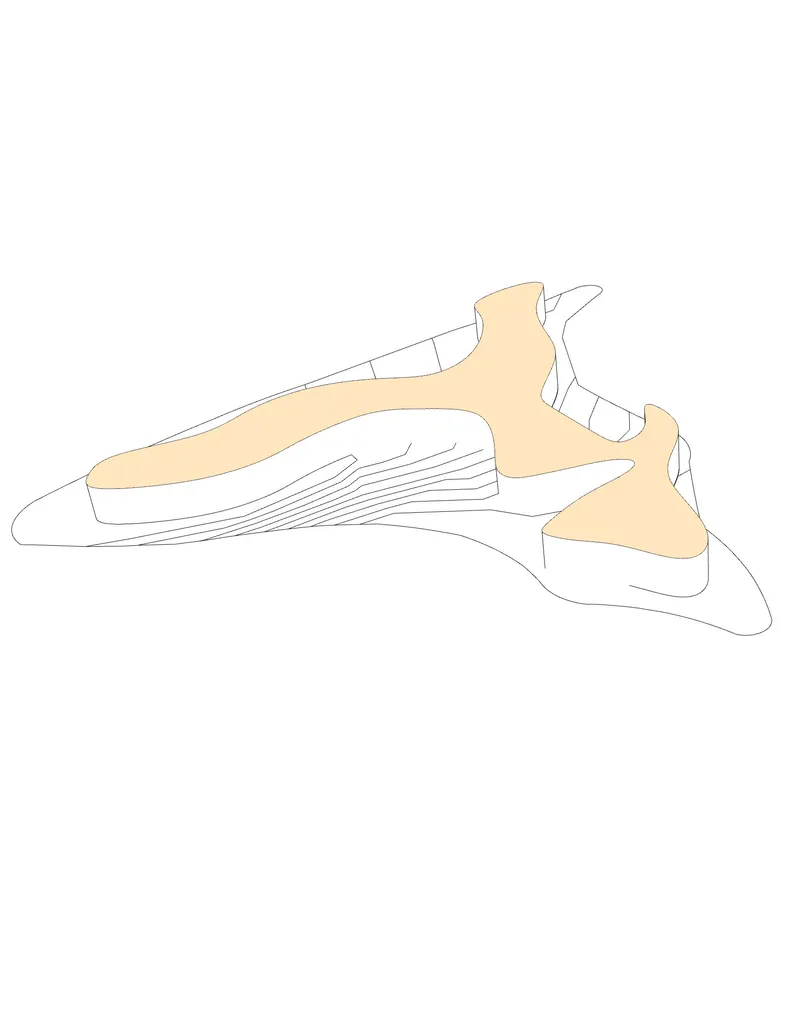
The first iteration was necessary to analyse which areas of the topography would have higher sunlight exposure. As a result, a mesh with the areas with a higher number of sunlight hours was retrieved, defining an organic shape enclosing the areas with better sun exposition. Considering the topography differences the shape should also adapt in Z-axis, increasing the number of floors but also maintaining its distance to the ground.
After the stabilisation of the building’s limit shape, a “wave function collapse algorithm” was used to fill the envelope with the modules defined by eight beams and four columns.
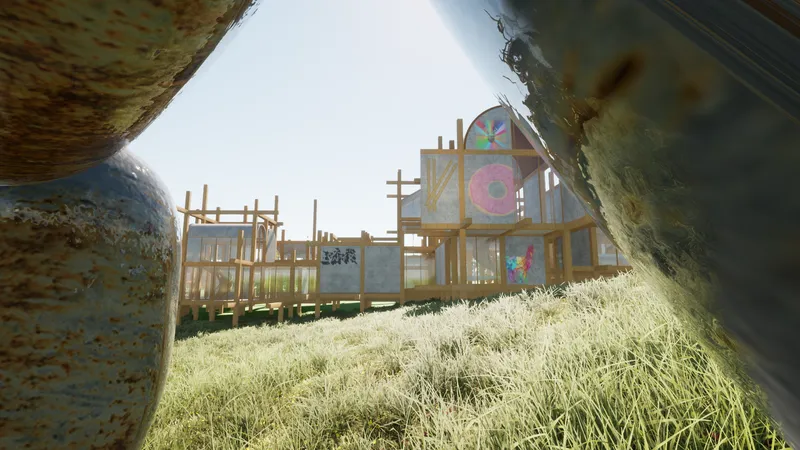
The relation between the different elements resulted in a non-alignment, visible in the boxes that were applied to the limit shape faces. This effect was part of our principle to define an unfinished appearance in parallel to the deconstructivism movement.
 As we cannot define how the building will be used and will evolve, we wanted to promote its status of “in development” building from the beginning. This should promote the occupancy of spaces and the use of structural elements in a way that cannot be predicted or constricted.
To achieve the desired form, five iterations were promoted. In every adaption, the relation and space between elements, the number of boxes, and their shapes were considered. The principle of shape/form finder was fundamental for the creation of the initial shape that was adapted according to the development of the interior spaces and atmospheres.
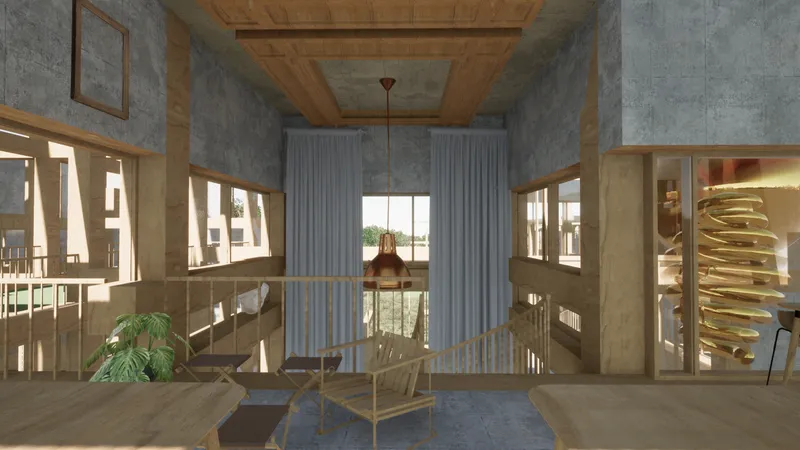
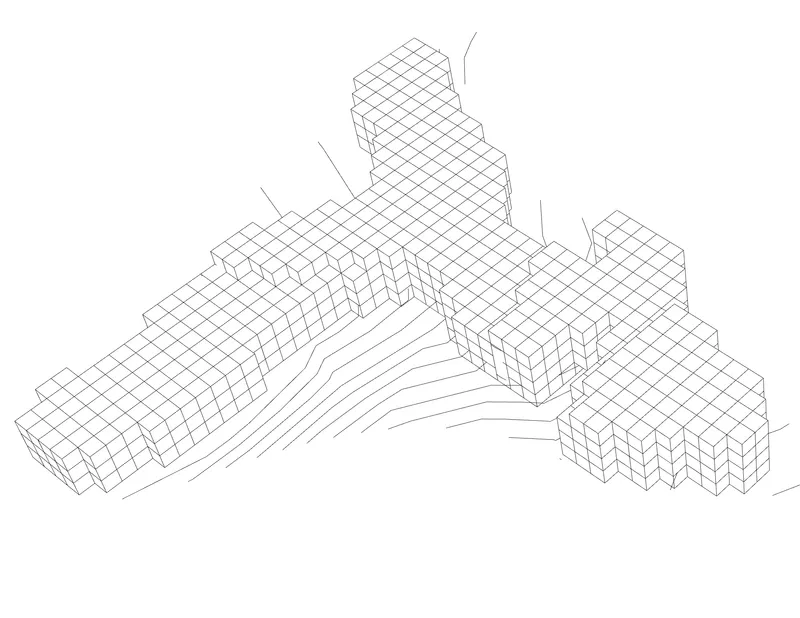 Spatially, the proposal is defined by one main floor connected by three ramps used to adapt the project to the topography. Independently from the purpose that makes the user go inside, he/she could travel from one side to the other without having to go back. The first level is inviting and establishes the first layer of contact between the users, artists or not, and the “pieces of art”, either in development or finished. Some places are harder to reach and that is where we will find the workplaces that require a higher level of focus or isolation. You are not immediately invited but you can reach them through the galleries that anticipated what is being done in that specific studio or workshop room. A second and third level are created to elevate the view and create distance when necessary. The combination and repetition of modules exist both vertically and horizontally, promoting different moments to work in teams or to work solo. The different levels also allow the creation of more private exterior space, where artists can take a break from the creative process or even bring their work outside.
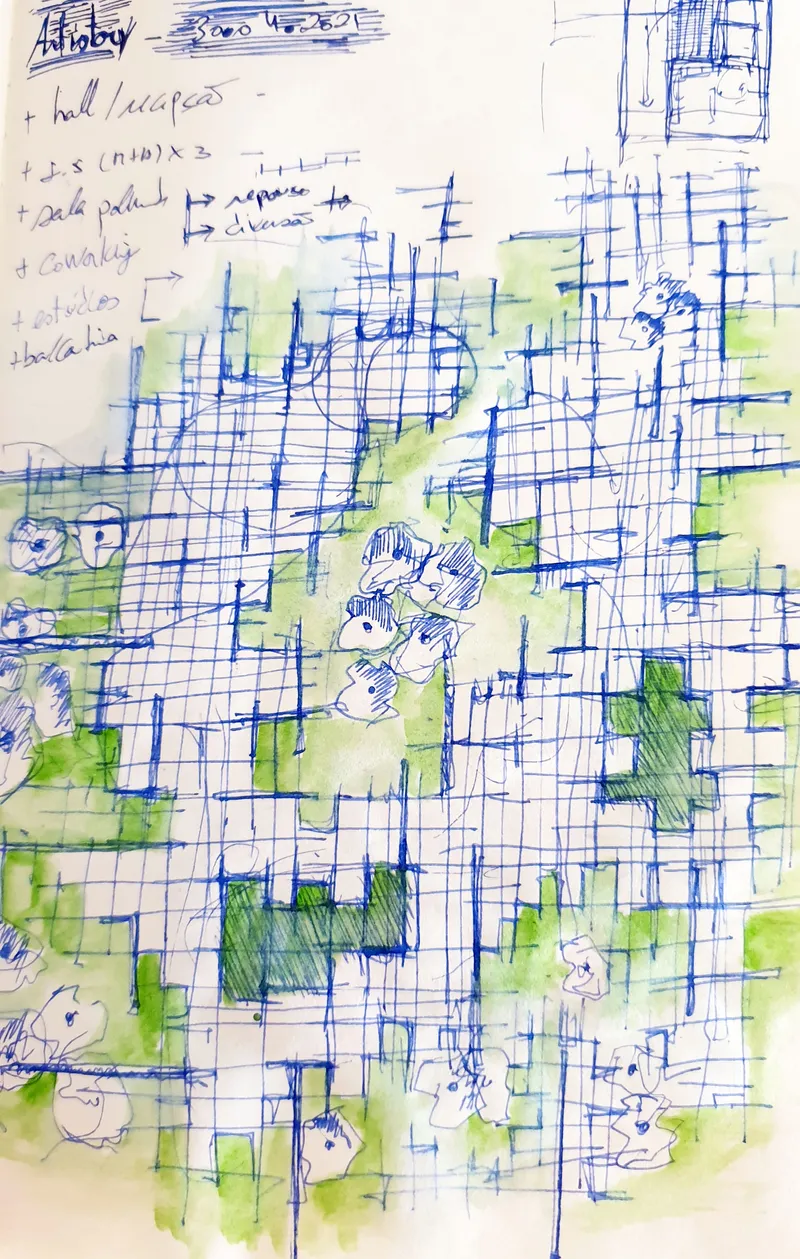
At a certain point of the project, and while the programme was being developed, it was necessary to reduce the density of elements in certain parts of the project and keep others with high structural density to emphasize the transition between atmospheres and workspaces. The idea was to open the space to a piece of art, a tree, or even to the building itself, after a denser area.
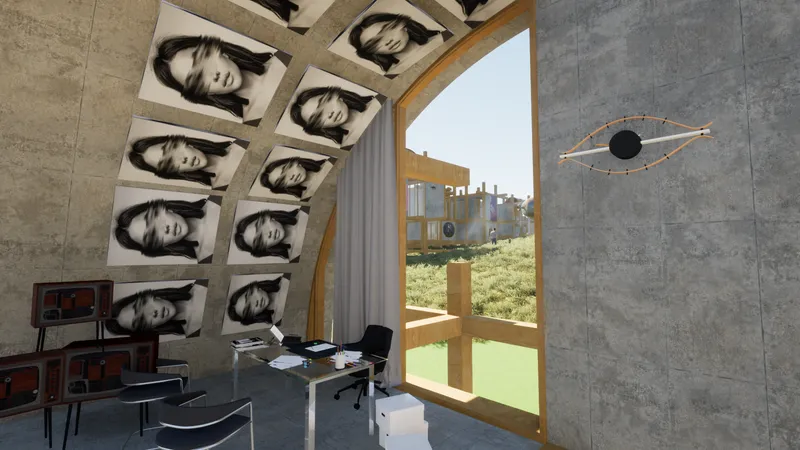
In the end, programmatically, the building offers the necessary technical areas, mainly positioned to block the noise from the exterior movement, a group of workshop rooms and studios open to a more ephemeral use, and, at higher levels, far away from the entrances, more “complex” studios, where the windows’ area is reduced or increased according to the use and with a close relationship with the natural space.
Regarding a future expansion, or a possible reshape or disassembling of the building, it is proposed a structural system with cross-laminated timber, wood frame windows, green roofs and a system of solar panels that supports the main electrical and mechanical “native” systems necessary for usage. Considering the fixing system between columns and beams, the proposal opens the possibility for expansion and evolution without wasting the main material elements initially considered.
Globally, the intent was escaping a rigid usage of each space. We manipulated atmospheres that will promote changes during the building’s lifecycle. The way we create and see art is not the same as several years ago and will not be the same in future years. If artists should write their one story, we thought this building should do it too, inside and outside of these walls. The attempt to control would have been an unnecessary exercise that would, most likely, result in a building providing the wrong answer.


Popular Articles
Popular articles from the community


Singing Woman: An Opera House That Performs Before the Curtain Rises
Ovidiu Cristian Pavel's conceptual opera house translates Estonia's choral identity into a sculpted waterfront landmark facing the Baltic Sea.
Faces of the Soviet Avant-Garde: Turning Moscow's Street Names into an Open-Air Museum
A network of sculptural installations across a Moscow residential district transforms forgotten architect names into spatial encounters with cultural memor

The Amber Palace Opera: A Geological Fiction Surfaces on Tallinn's Baltic Waterfront
Pierre Brillard reimagines a Baltic legend as a public landscape, opera house, and waterfront promenade rooted in Tallinn's coastal identity.

Cloaked Colonization: A Mobile Underwater Habitat That Moves Like a Fish
Micah Abaya's shortlisted EHC Pacific entry reimagines ocean settlement as a dispersed network of self-sustaining architectural organisms.

Similar Reads
You might also enjoy these articles
The Rhythm of Seasons
A Farmers' Market Connecting Nature and the City

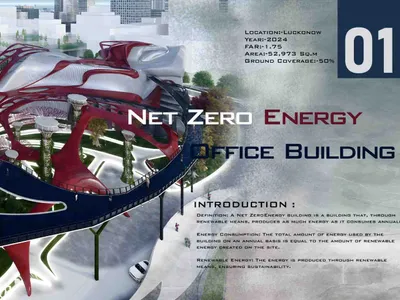
More Than a Building-Designing a Living System
More Than a Building-Designing a Living System
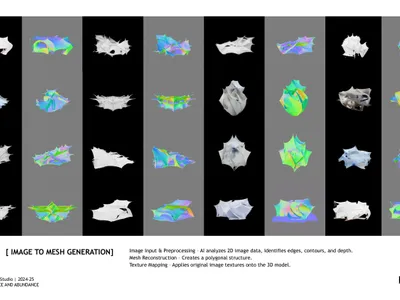
Base Beyond
DESERT COMPOUND ARID: TOURISM OF ABSENCE AND ABUNDANCE

Explore Grasshopper 3D Competitions
Discover active competitions in this discipline


Challenge to visualize a collision of the future and past

Challenge to visualize future spaces of waste

Challenge to visualize slums of 2080

Challenge to illustrate the ruins of Petra
Comments (0)
Please login or sign up to add comments
No comments yet. Be the first to comment!