
The Black Taj: A Parametric Pavilion Built on Myth, Memory, and Mughal Duality
Across the Yamuna from the Taj Mahal, a dark, rippled counterpoint reimagines the legend of a monument that was never built.


What happens when you design the building that history refused to complete? The legend of a Black Taj, a dark twin to Shah Jahan's white marble mausoleum, has circulated for centuries without material evidence. Rather than settling the debate, this project treats the myth as a productive architectural problem: if the Taj Mahal represents purity, permanence, and divinity, what spatial and material language would embody its opposite? The answer here is a parametric pavilion whose dark, rippled surfaces absorb rather than reflect, pulling visitors into a meditation on mortality, memory, and the cyclical nature of imperial ambition.
Designed by Indrajeet and Chaitra, this shortlisted entry to the The Black Taj competition situates a contemporary pavilion across the Yamuna River from the Taj Mahal. The project does not attempt a symmetrical replica. Instead it stages a dialogue between past and present, light and shadow, white marble and a dark mass that emerges from parametric geometry. The concept reinterprets Mughal architectural tradition through digital design tools and minimalist abstraction, producing a structure that questions legacy as much as it honors it.
Landscape as Narrative: Pathways That Abstract the Charbagh
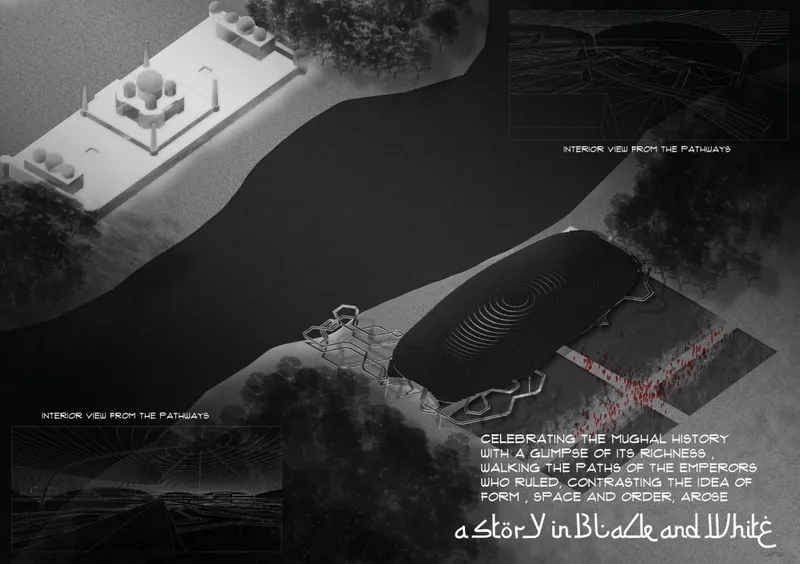
The aerial axonometric reveals how the pavilion sits within a wider landscape strategy. Interlacing pathways reference the Mughal charbagh, the classical four-part garden layout, but render it in abstraction. Volumes are connected across the terrain by diagrammatic routes that guide visitors through a sequence of spatial thresholds rather than along a single ceremonial axis. The model sections visible in this drawing show how each volume occupies a distinct position in the topography, reinforcing the idea that the visitor's journey is not a straight line but a gradual immersion into the project's symbolic narrative.
Decoding Duality: Grid Studies, Sections, and Historical Precedent
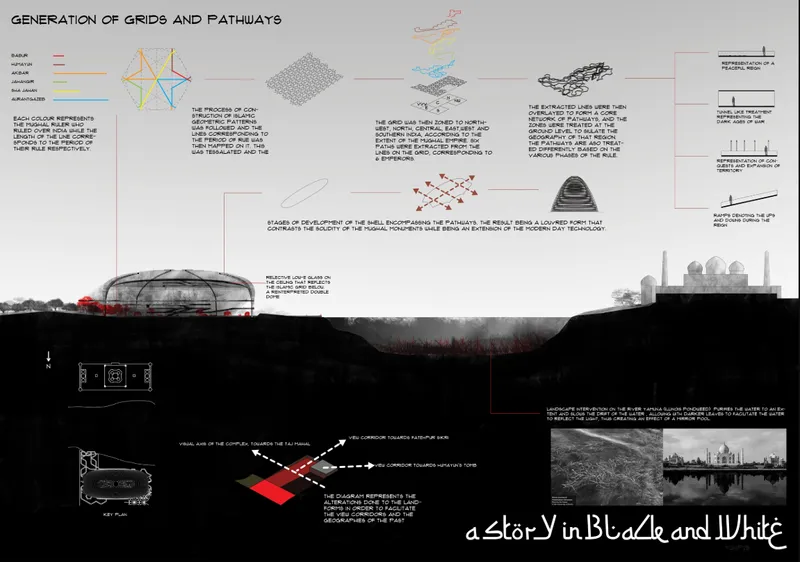
The composite presentation panel lays out the analytical backbone of the project. Grid studies trace how Mughal geometry, rooted in symmetry and proportion, translates into the parametric language of the pavilion. Section drawings cut through the dark mass to show interior spatial relationships, while historical photographs anchor the design in the reality of the site and its monumental neighbor across the river. The interplay of these elements on a single panel makes the conceptual argument legible: every contour of the new structure emerges from a reading of its precedent, not from formal whimsy.
The panel also makes explicit the symbolic framework. White represents purity, divinity, and permanence as embodied by the existing Taj Mahal. Black reflects mortality, introspection, and the unseen side of imperial splendor. Together they narrate the cyclical nature of human ambition, from the luminous to the obscure. The designers ground this philosophical pairing in concrete architectural decisions: material darkness, surface ripples that fragment reflected light, and an orientation that positions the pavilion in perpetual visual conversation with its white counterpart.
Concentric Contours: An Arched Pavilion Rising from Terraced Ground
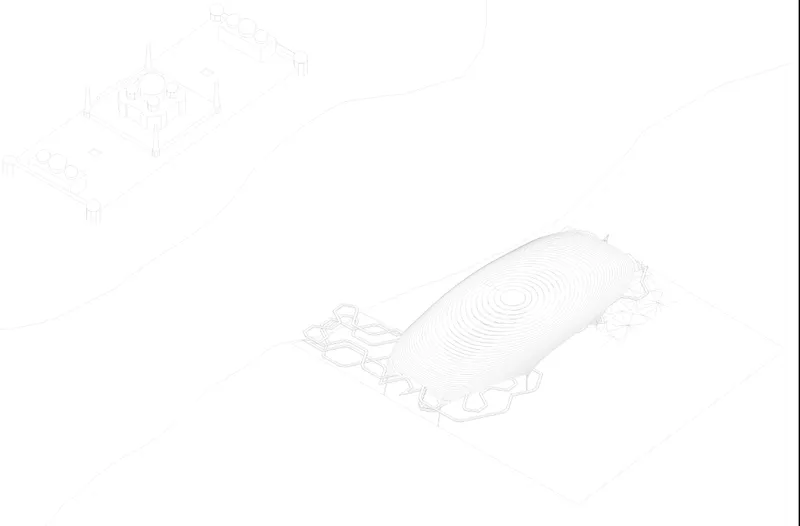
The isometric line drawing strips the pavilion down to its structural logic. An arched form rises from terraced topography, its roof defined by concentric contours that layer outward like geological strata or the rings of a tree. The terracing integrates the building into the landscape rather than placing it on top of it, a move that reinforces the project's thematic concern with burial, memory, and the gravitational pull of history. The layered rings recall parametric design's capacity to generate complex surfaces from simple rules, and here they serve a double function: structural articulation and symbolic resonance with the Mughal tradition of intricate, repeating geometric patterns.
Cut Through Time: The Pavilion in Dialogue with the Domed Complex
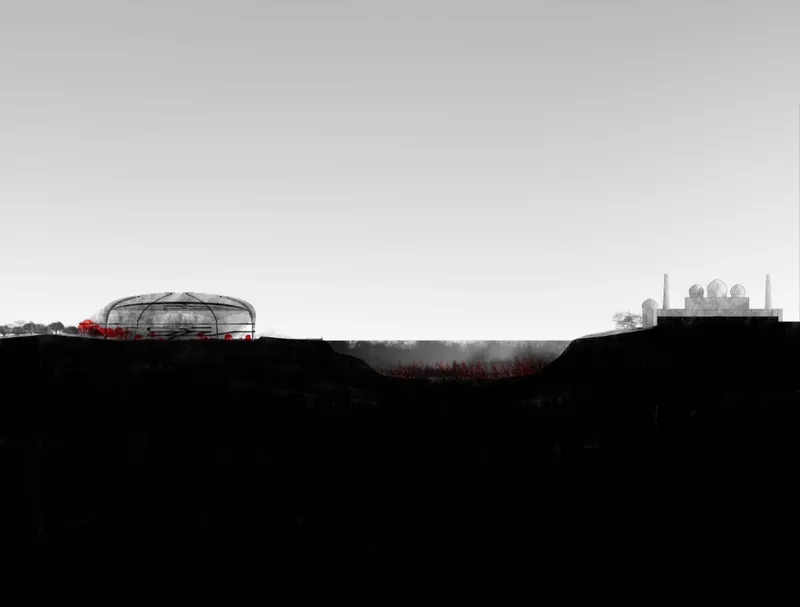
The section drawing is the most powerful image in the set. It slices through the arched pavilion to reveal how it is set into the terrain, with the domed complex of the Taj Mahal visible in the background across the river. The spatial relationship is not one of competition but of counterpoint. Where the Taj rises above its plinth in classical composure, the Black Taj sinks into the earth, its arch framing a void rather than enclosing a tomb. The section makes clear that the interplay of shadow and light is not metaphorical decoration but a spatial condition designed into the building's cross-section, intensifying as visitors move deeper into the structure.
The drawing also reveals the scale of the intervention relative to its historic neighbor. The pavilion is not monumental in the same way; it operates at a more intimate register, inviting close engagement rather than distant awe. This is a deliberate choice. The designers position the Black Taj as a space of introspection, a contemporary time capsule that bridges centuries of cultural evolution without competing for the skyline.
Why This Project Matters
Heritage architecture projects often fall into one of two traps: slavish recreation or contextless provocation. Indrajeet and Chaitra avoid both. Their pavilion is rooted in specific site conditions, the Yamuna riverbank opposite the Taj Mahal, and in a specific cultural myth, but it deploys parametric tools and minimalist abstraction to produce something that belongs to neither the 17th century nor to a placeless digital future. The result is a structure that both honors and interrogates legacy, asking how empires are remembered and what architectural form that remembering might take.
The project's strength lies in its refusal to resolve its central tension. Black and white, permanence and decay, monument and void: these pairings are held in suspension rather than collapsed into a single message. As a competition entry, the Black Taj demonstrates that speculative design at its best does not answer questions but sharpens them. The myth of the Black Taj has persisted precisely because it represents everything the real Taj is not. By giving that absence a spatial form, this project transforms legend into architecture and architecture into a lens for reading history.
View the Full Project
About the Designers
Enter a Design Competition on uni.xyz
uni.xyz runs architecture and design competitions year-round that reward proposals with spatial conviction and real site intelligence.
Project credits: The Black Taj – A Story in Black and White by Indrajeet, Chaitra The Black Taj (uni.xyz).


Popular Articles
Popular articles from the community


Conexión: Biophilic Design Reimagines High-Rise Living in Hong Kong
Conexión reimagines high-rise living in Hong Kong through biophilic design, green facades, shared spaces, daylight, water and nature within.

Little Red Riding Hood: Architectural Design as a Journey Through Fear, Light, and Storytelling
Little Red Riding Hood reimagines the fairy tale through architectural design shaped by fear, light, scale, memory, uncertainty, and choice.

The Ocean Hive: Sustainable Architecture for a Self-Sufficient Civilization at Sea
The Ocean Hive imagines sustainable architecture at sea, where modular habitats, algae, wave power and ocean waste sustain a growing colony.

The Musturak Paradise: Senior Living Architecture for a Connected Future in Temara, Morocco
The Musturak Paradise reimagines senior living architecture in Temara via private homes, social spaces, culture, community, and shared care.

Similar Reads
You might also enjoy these articles

ALGAL REALM: A Bio-Integrated Lunar Habitat Design for Life Beyond Earth
ALGAL REALM reimagines lunar habitat design with algae-powered life support, 3D-printed regolith, and vertical living for a lunar future.

Cinema Futurismo: Futuristic Architecture Reimagining the Future of Cinema
Cinema Futurismo merges futuristic architecture, holographic projection, intimate seating, and landscape into a new social cinema.
Little Red Riding Hood: Architectural Design as a Journey Through Fear, Light, and Storytelling
Little Red Riding Hood reimagines the fairy tale through architectural design shaped by fear, light, scale, memory, uncertainty, and choice.
Playducation: Modular Architecture That Turns Play Into a Space for Learning
Playducation transforms modular architecture into a flexible world of play, learning, and healing for children in refugee settlements.

Explore Mughal Architecture Competitions
Discover active competitions in this discipline

Challenge to reimagine the Iron Throne

Photograph architecture without architects

Illustrate the lost glory of Angkor Wat - Render Challenge

Design challenge to reuse E-waste
Comments (0)
Please login or sign up to add comments
No comments yet. Be the first to comment!