
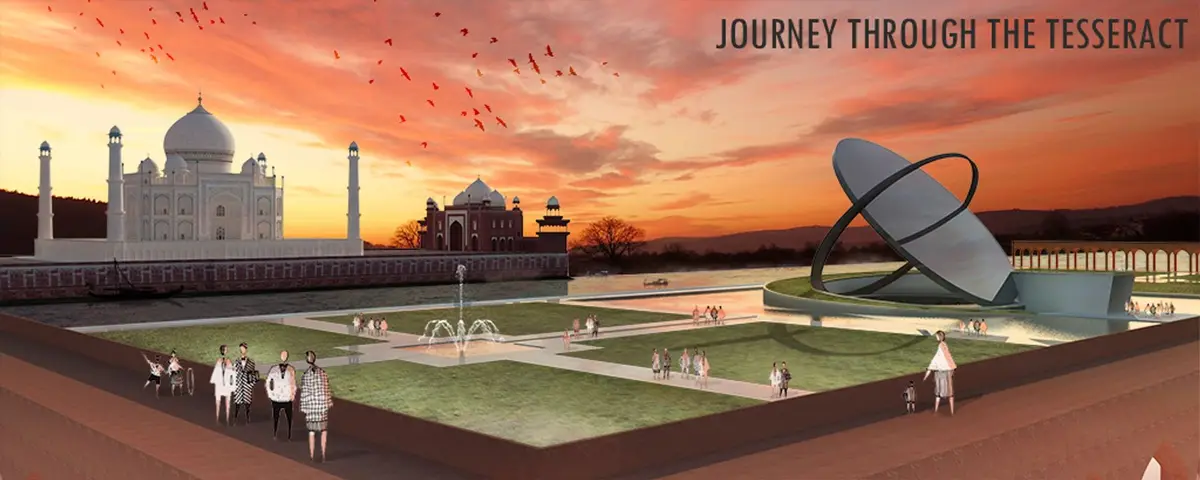
The Black Taj: A Tesseract Descent into Shah Jahan's Memory
A shortlisted competition entry transforms an ancient well into a nine-chamber vertical gallery narrating the emperor's life through light, shadow, and geo


What if the Black Taj Mahal was never meant to be a building at all, but an experience? A descent, literally, into the psyche of the emperor who dreamed it? That is the provocation at the center of this proposal, which takes the enduring myth of Shah Jahan's rumored black marble mausoleum and reframes it as an immersive vertical journey through nine chapters of a ruler's life. Instead of reconstructing a phantom monument, the designers have built an argument: that the most powerful architecture is the kind you move through emotionally before you comprehend it spatially.
Designed by Ananna, Shariful Anik, Tansen, and Rafia, this shortlisted entry in the The Black Taj competition proposes a contemporary structure sited across the Yamuna River from the Taj Mahal in Agra. The formal generator is the tesseract, a four-dimensional cube, which serves as both structural canopy and conceptual engine: a metaphor for bending time and space to access buried histories. Beneath it, a historic well is converted into a cylindrical gallery, pulling visitors downward through light installations, projections, and ambient soundscapes that reconstruct fragments of Mughal grandeur.
A Well as Narrative Shaft
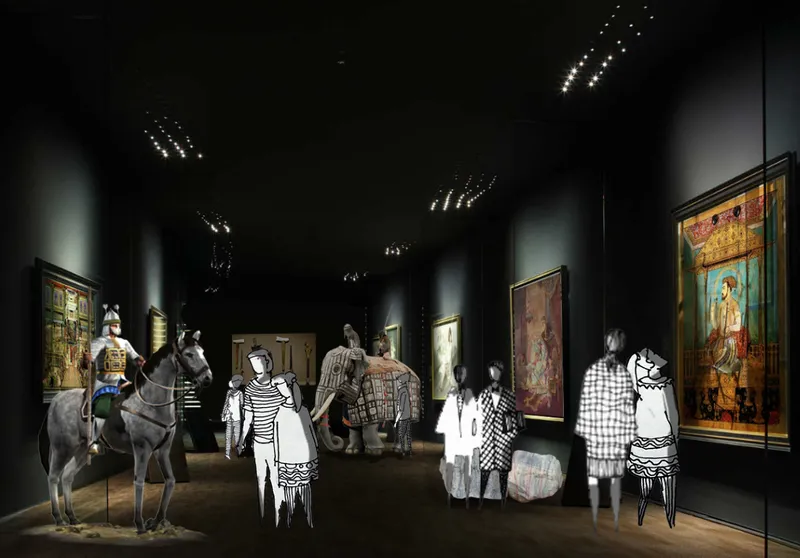
The gallery interior reveals how the designers translate biography into spatial sequence. Black walls absorb ambient light while illuminated artifacts punctuate the darkness, creating focal points that draw visitors forward through the nine experiential chambers. Each chamber corresponds to a chapter of Shah Jahan's life: from the luminous warmth of "Birth of a Master Builder" to the sensory silence of "The Black Capsule," where the architecture itself darkens and light recedes. The descent is both literal and metaphorical. Visitors move physically downward while the emotional register shifts from celebration to grief, from power to confinement.
The final chamber is the most arresting conceptual move. "The Black Taj" is not seen directly; it is perceived as a phantom reflection of the white Taj Mahal, visible only through the surface of water at the base of the well. The building you came to find exists only as an inversion, a shadow glimpsed from below. It is a conclusion that honors the myth precisely by refusing to materialize it.
The Tesseract Above, the Cylinder Below
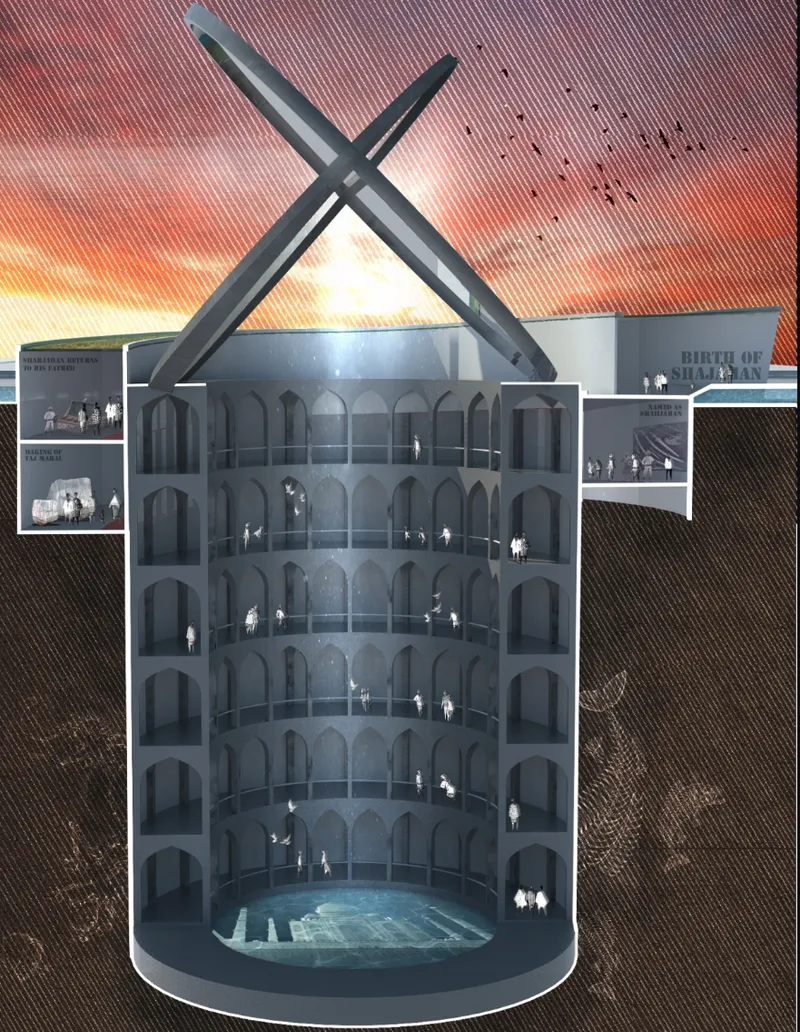
The section drawing makes the structural logic legible. Above grade, crossed beams supporting a textured ceiling define the tesseract volume, a form that casts dynamic shadows shifting with the sun's movement across the day. Below, the cylindrical atrium unfolds as a stack of arcaded levels, their rhythmic arches drawing directly from Mughal architectural vocabulary but stripped to a modern minimalism. The juxtaposition is deliberate: the tesseract embodies infinity and dimensionality, while the cylindrical descent anchors the experience in physical depth and geological weight.
Materiality reinforces the narrative arc. Polished stone and reflective metal at the upper levels give way to diffused glass and the rough textures of brick and earth as visitors descend. Natural light dominates at the top; artificial illumination takes over below. The boundary between illusion and reality blurs progressively, guiding the journey from clarity into mystery. It is a carefully calibrated gradient, not a sudden threshold.
Mughal Geometry Reinterpreted
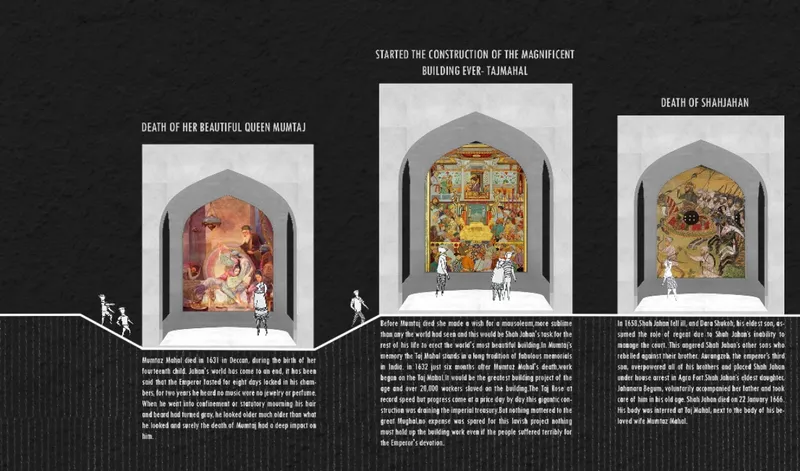
The exhibition panel illustrates how the designers engage with historical source material without resorting to pastiche. Three arched niches frame historical paintings against a black background, accompanied by contextual text. The proportional system of the arch, the symmetry, the framing: all are borrowed from Mughal architecture, but their deployment in a darkened contemporary gallery transforms them from ornamental devices into curatorial instruments. They organize the visitor's gaze and establish a rhythm of looking that echoes the sequential experience of the descent itself.
Among the nine chambers, "The Mirror" stands out as a particularly potent spatial idea: a contemplative room where the emperor confronts his own reflection, representing regret and loss. "Spiral of Time" follows, distorting perception through mirrored corridors. These are not decorative flourishes. They are architectural mechanisms for producing specific emotional states, rooms engineered to make visitors feel the weight of a life marked equally by ambition and confinement.
Why This Project Matters
The instinct to build the Black Taj as a dark twin of the white one would be the obvious response to this competition brief. By refusing that path, this team has made a more difficult and more interesting argument: that the legend's power lies precisely in its immateriality. Designing for experience rather than replication, they honor the emotional architecture of history, the way memory, perception, and time fold into each other long after the stone has been laid.
The tesseract framing is more than a formal conceit. It provides the conceptual scaffolding for an architecture that operates in multiple dimensions simultaneously: vertical descent, chronological narrative, sensory modulation, and mythic resonance. For a student team, the ambition of coordinating all four registers into a coherent spatial sequence is notable. The result is a proposal that treats architecture not as object but as medium, a vessel for the kind of storytelling that only built space can deliver.
View the Full Project
About the Designers
Designers: Ananna, Shariful Anik, Tansen, Rafia
Enter a Design Competition on uni.xyz
uni.xyz runs architecture and design competitions year-round that reward proposals with spatial conviction and real site intelligence.
Project credits: The Black Taj - Journey through the Tesseract by Ananna, Shariful Anik, Tansen, Rafia The Black Taj (uni.xyz).


Popular Articles
Popular articles from the community


Opera on the Sea: Driftwood Logic Shapes a Timber Opera House on Estonia's Coast
Trevor Orgill's opera house translates the entangled drift of floating timber into a civic building where wood, water, and music converge.

Singing Woman: An Opera House That Performs Before the Curtain Rises
Ovidiu Cristian Pavel's conceptual opera house translates Estonia's choral identity into a sculpted waterfront landmark facing the Baltic Sea.


FCC Arquitectura Expands a Portuguese Granite House with a Board-Marked Concrete Wing
In Portugal, JV House pairs a cleaned-up whitewashed and granite dwelling with a timber-shuttered concrete extension, courtyards and a garden pool.

Aquadapt: An Underwater Habitat That Rewrites Its Rooms by the Hour
Curved modules ring the seabed while one shell shifts from breakfast room to cinema, farm and football pitch as residents' needs change.

Similar Reads
You might also enjoy these articles
Aquadapt: An Underwater Habitat That Rewrites Its Rooms by the Hour
Curved modules ring the seabed while one shell shifts from breakfast room to cinema, farm and football pitch as residents' needs change.

Play: Fragments of Their World: Remembered Architecture Rebuilt as a Modular Playground for Refugee Camps
Tom Gardner abstracts domes, arches and towers from the homelands of displaced families into a kit of child-scaled play parts for camp settlements.
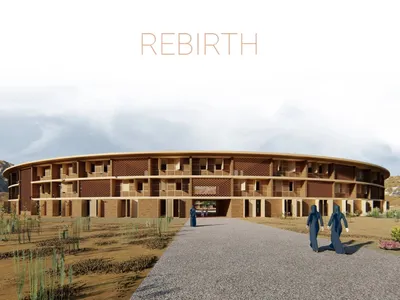
REBIRTH: A Circular Settlement Where Afghan Widows and Their Children Rebuild Life Together
A shortlisted Resile entry turns the circle into a protective ring of timber and brick, gathering homes, classrooms and gardens around a shared landscape.
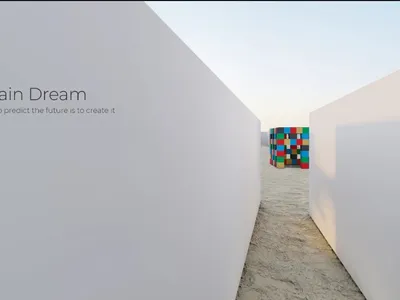
The Main Dream: A Recycled Plastic Kit That Lets Refugee Children Build Their Own Playground
Thirty-centimetre interlocking cubes that connect on three axes turn play into construction, letting children author the spaces they occupy.


Comments (0)
Please login or sign up to add comments
No comments yet. Be the first to comment!