
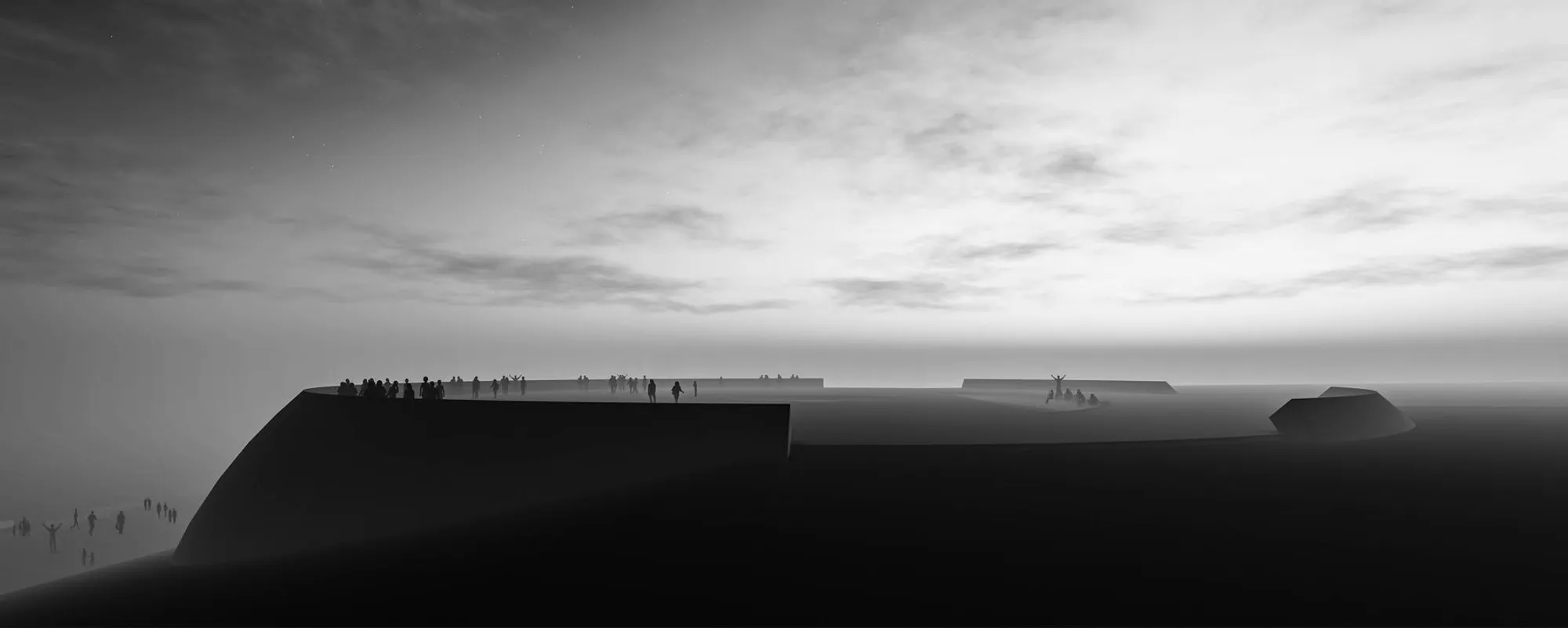
The Black Taj: An Invisible Monument That Frames the Visible One
Pranav's winning entry reimagines Shah Jahan's mythical counterpart as a void architecture on the Yamuna's northern bank.


What if the most powerful architectural gesture is not to build, but to carve out emptiness? On the northern bank of the Yamuna River in Agra, directly opposite the Taj Mahal, a site has lingered in myth for centuries: the supposed location of Shah Jahan's never-built Black Taj, the dark twin to his luminous mausoleum. Rather than proposing a tangible replica or a competing monument, this project takes the radical position that absence itself can be architecture. A sliced Mughal dome, hollowed and aligned to frame the White Taj across the water, turns the void into a spatial instrument, making the invisible legible and the mythical inhabitable.
Designed by Pranav, "Presence in Absence" is the winning entry of The Black Taj competition on uni.xyz. The project reinterprets the Taj Mahal not as a static monument but as one half of an eternal duality: form and void, light and shadow, presence and absence. By translating Shah Jahan's poetic vision of love and eternity into a spatial narrative rooted in myth, materiality, and metaphysical thought, Pranav delivers a design that refuses to compete with the Taj and instead becomes its silent counterpart.
A Conceptual Framework Built on Duality
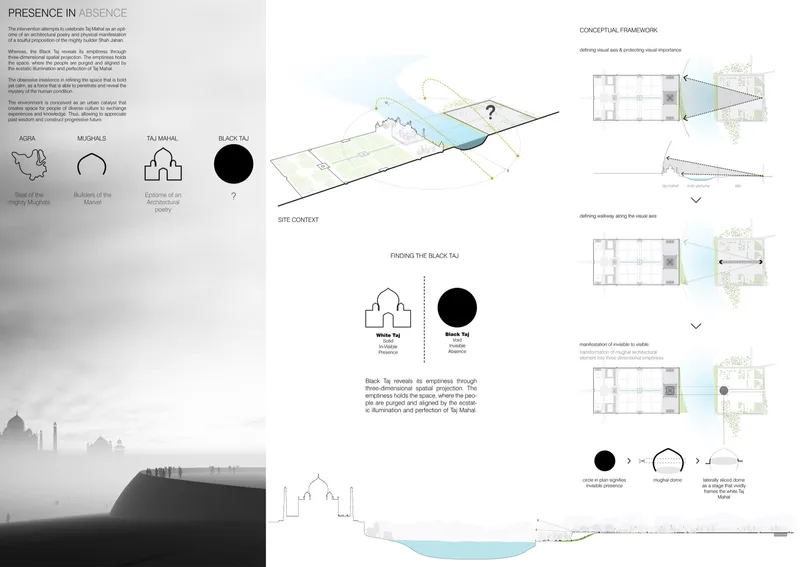
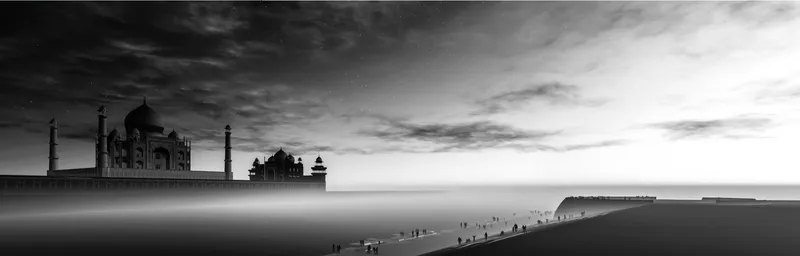
The opening board lays out the project's full intellectual armature: diagrams, plans, sections, and a hauntingly misty view of a domed form rising from the riverbank. The Taj Mahal occupies the role of protagonist, embodying visible presence, solidity, permanence, and the weight of history. The Black Taj, by contrast, embodies invisible absence: emptiness, transience, and the unknown. Pranav does not treat this polarity as mere rhetoric. It becomes an operational design strategy, generating an immersive experiential field where visitors engage with absence as a form of presence.
The silhouette image reveals how this reads at the ground level. A domed monument complex rises above low mist while visitors walk on the sand below, encountering the architecture not as a building to enter but as a threshold to look through. Controlled geometry and visual alignment ensure that the Taj Mahal's prominence is never diminished; instead, it is amplified by the void that frames it. The Black Taj becomes a lens, a stage, and a spatial projection that holds emptiness as an active force.
From Circle to Dome Slice: The Morphological Logic
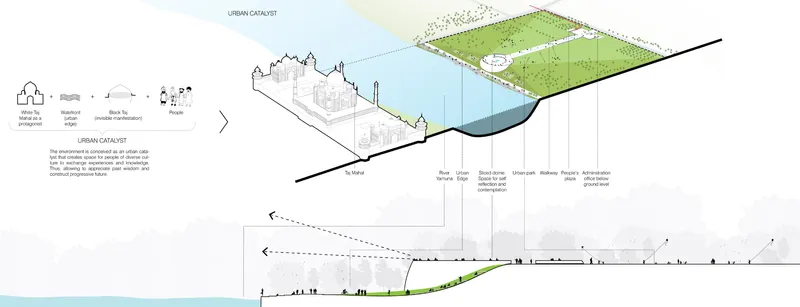
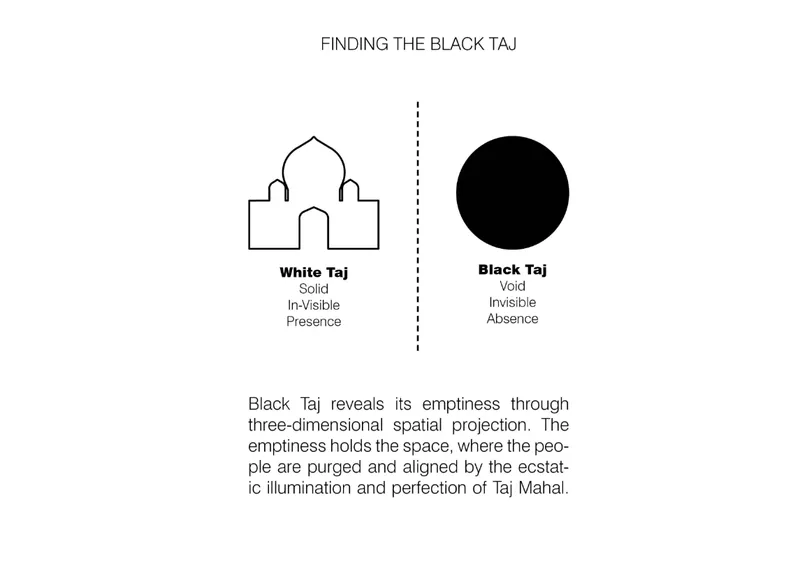
Pranav's conceptual diagrams trace a precise morphological sequence. The process begins with the circle, symbolizing invisible presence, which transforms into a Mughal dome and then into a laterally sliced form that frames the Taj Mahal across the river. One diagram places a line drawing of a domed form alongside a solid black circle representing the void, making the conceptual leap visible in a single frame. The axonometric drawing shows how this abstract logic materializes: a green roof terrace extends along a waterway, its section revealing the spatial relationship between the intervention and the river below.
What makes this transformation compelling is its discipline. Every spatial gesture aligns with the visual and metaphysical axis of the Taj Mahal, preserving the monument's sanctity while expanding its narrative into the realm of abstraction. The sliced dome is not arbitrary sculpture; it is architecture derived from the Mughal vocabulary itself, evolved from form to void through a legible geometric operation.
Site Strategy: Sculpting the Yamuna's Northern Edge
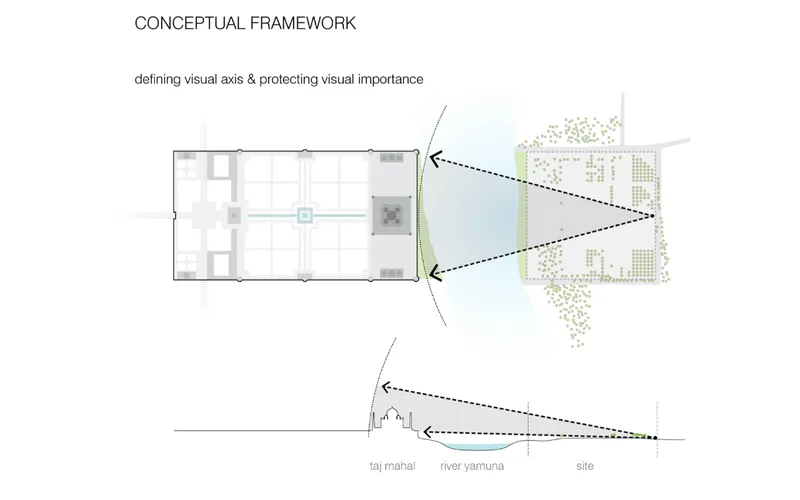
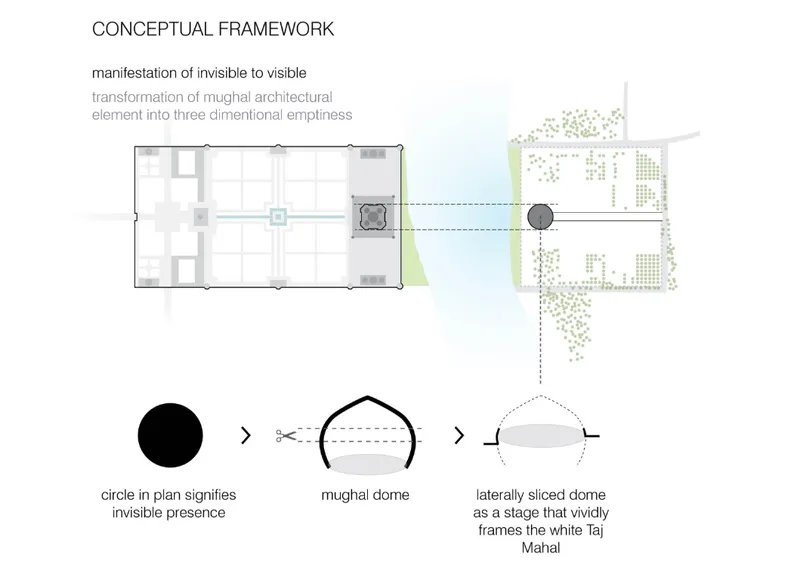
The floor plan, site plan, and section drawings reveal how the intervention engages its specific terrain. Set along the northern bank of the Yamuna, the project extends the visual and spiritual axis of the Taj Mahal across the river. Rather than occupying the site with mass, the design sculpts sightlines that protect and amplify the Taj's visual prominence while creating an urban edge that acts as a contemplative interface between land, water, and sky. The site plan shows how walkways, riverfront plazas, and contemplative zones form a network that reactivates the long-neglected relationship between the Taj and Agra's citizens.
The conceptual transformation diagram further clarifies the design's generative logic: circle to dome, dome to slice, slice to site-specific intervention. Floor plans and site plans sit above the morphological sequence, grounding abstraction in topography. The result is not a competing structure but a civic space that transforms the void across the Yamuna into an urban catalyst, inviting people to walk, reflect, and rediscover the Taj Mahal's eternal dialogue with light and shadow.
A Green Threshold Between City and Monument
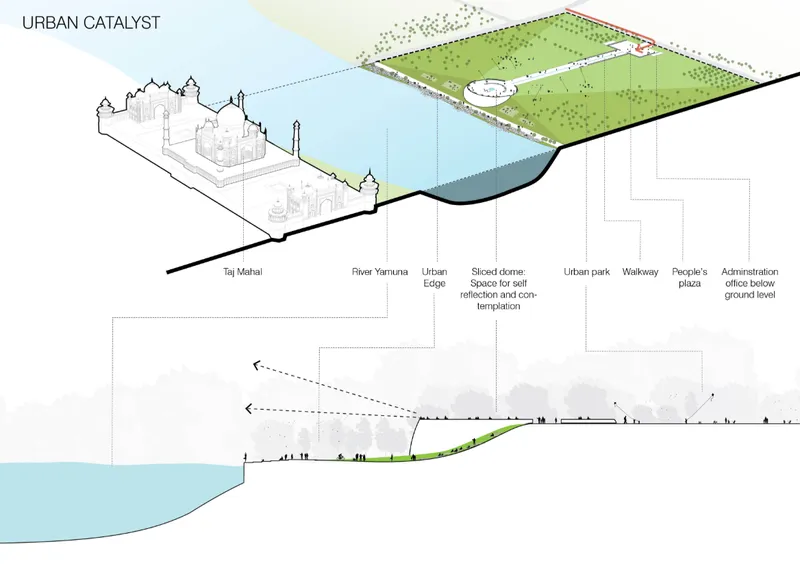
The sectional diagram reveals the project's most generous spatial move: a green roof structure spanning over the river's edge, connecting the urban fabric to a park landscape on the opposite side. This is where the project transcends conceptual exercise and becomes a genuine piece of urbanism. The intervention defines a new ground plane, a habitable threshold where the infrastructure of contemplation meets the infrastructure of daily life. The green roof is not decoration; it is the mechanism by which the Black Taj becomes an inhabited landscape rather than an object to admire from a distance.
By merging historical reference with contemporary architectural thinking, Pranav positions the Black Taj as a platform for reflection and collective memory. It is a place where people of diverse backgrounds can engage in dialogue between heritage and modernity, where the riverbank transforms from neglected periphery into active cultural ground. The section makes this ambition legible: architecture as connective tissue, bridging the monumental and the everyday.
Why This Project Matters
Heritage architecture competitions often produce two kinds of responses: reverent replicas that add nothing to the discourse, or provocative gestures that ignore context entirely. Pranav's entry avoids both traps. By grounding the mythical Black Taj in a rigorous conceptual framework, tracing a clear morphological sequence from Mughal dome to contemporary void, the project earns its abstraction. It does not dismiss history; it extends it through spatial inversion, making the invisible legible without diminishing the visible.
More importantly, the project refuses to stop at symbolism. The network of walkways, plazas, and green roof landscapes turns a conceptual provocation into a viable urban strategy for Agra's neglected northern riverbank. The Black Taj becomes not just a reflection of Shah Jahan's unfulfilled dream, but a proposal for how contemporary architecture can hold myth and civic utility in the same gesture. That dual ambition, conceptual rigor paired with real spatial generosity, is what makes this a deserving winner.
View the Full Project
The Black Taj - Presence in Absence - GPPB50
View the full project with all boards on uni.xyz.
uni.xyzAbout the Designers
Designer: Pranav
Enter a Design Competition on uni.xyz
uni.xyz runs architecture and design competitions year-round that reward proposals with spatial conviction and real site intelligence.
Project credits: The Black Taj - Presence in Absence - GPPB50 by Pranav The Black Taj (uni.xyz).




Popular Articles
Popular articles from the community


The Earth Pod: 3D Printed Homes for Resilient Refugee Communities
The Earth Pod reimagines refugee housing through 3D printed homes made from clay, combining resilience, self-sufficiency, and rapid shelter.

The Musturak Paradise: Senior Living Architecture for a Connected Future in Temara, Morocco
The Musturak Paradise reimagines senior living architecture in Temara via private homes, social spaces, culture, community, and shared care.

Hill & Cross Opera: Sculptural Opera House Architecture Shaped by Tallinn’s Landscape and Identity
Hill & Cross Opera reimagines opera house architecture in Tallinn through its sculptural hill, civic plaza, glass wave and a luminous cross.

Riyadh For All: Intergenerational Urban Design for Active Aging in Rabat
Riyadh For All reimagines urban design in Rabat with intergenerational co-living, adaptive courtyards, and Moroccan cultural exchange today.


Similar Reads
You might also enjoy these articles

Lunar Spiral: Space Architecture Shaped by the Mathematics of the Universe
Lunar Spiral reimagines space architecture through Fibonacci geometry, lunar regolith, levitating habitats, and self-sustaining Moon living.
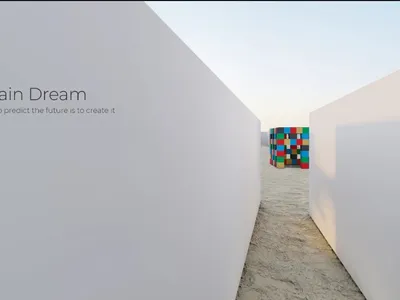
The Main Dream: Modular Architecture for Play, Learning, and Community
A modular playground turns recycled plastic into adaptable spaces where refugee children can play, build, learn, and reconnect.

Play: Fragments of Their World
Familiar architecture becomes modular playground design, creating safe spaces where displaced children can learn, connect, imagine and play.

Wadi Rum Observatory: Desert Architecture Designed for the Night Sky
Wadi Rum Observatory turns desert architecture into a quiet instrument for astronomy, hiding research spaces under Jordan's starlit terrain.


Explore The Black Taj Competitions
Discover active competitions in this discipline



Challenge to reimagine the Iron Throne


Photograph architecture without architects


Illustrate the lost glory of Angkor Wat - Render Challenge


Design challenge to reuse E-waste
Comments (0)
Please login or sign up to add comments
No comments yet. Be the first to comment!