
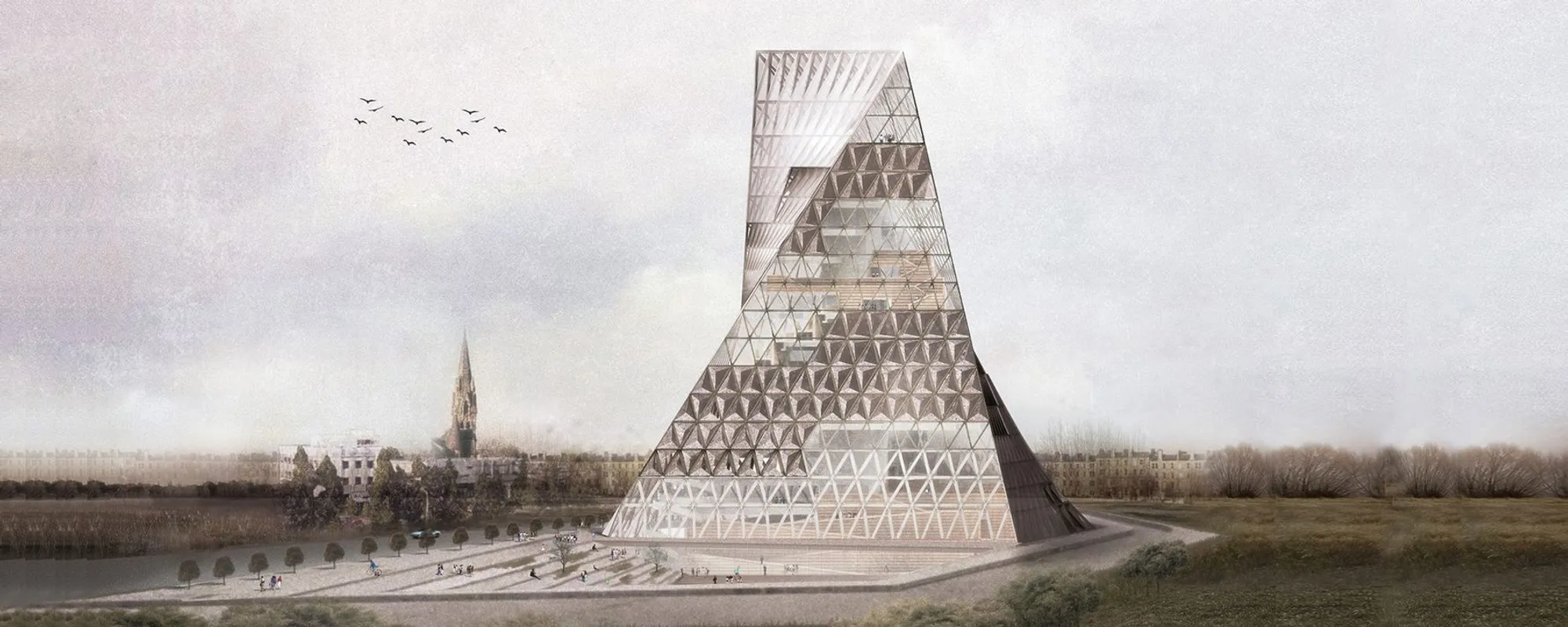
The Book Tower: A Spiraling Pyramid That Turns Every Citizen into a Knowledge Performer
A triangulated glass tower reimagines the civic library as a participatory stage for learning, sharing, and urban discourse.


What happens when a library stops being a warehouse of books and starts behaving like a stage? The Book Tower proposes exactly that: a spiraling pyramidal form wrapped in a triangulated glass skin, designed not just to house knowledge but to perform it. The building's program is organized around three principles, self-learning, communication, and creation, and its circulation pulls visitors upward through layered zones of exhibition, reflection, and exchange. The library here is no longer an institution you visit quietly. It is a civic instrument that positions every citizen as a participant.
The project won the Libgen 2019 competition and was designed by Jiayong Lu, Zhengshuai Hu, Hua Xing, and Zhiyuan Zhang. Their ambition was to evolve the library into what they call the city's "vital think tank," bridging institutional learning with spontaneous public discourse. The result is a building that refuses to separate the act of reading from the act of speaking, the act of contemplation from the act of gathering.
A Triangulated Skin That Frames the City
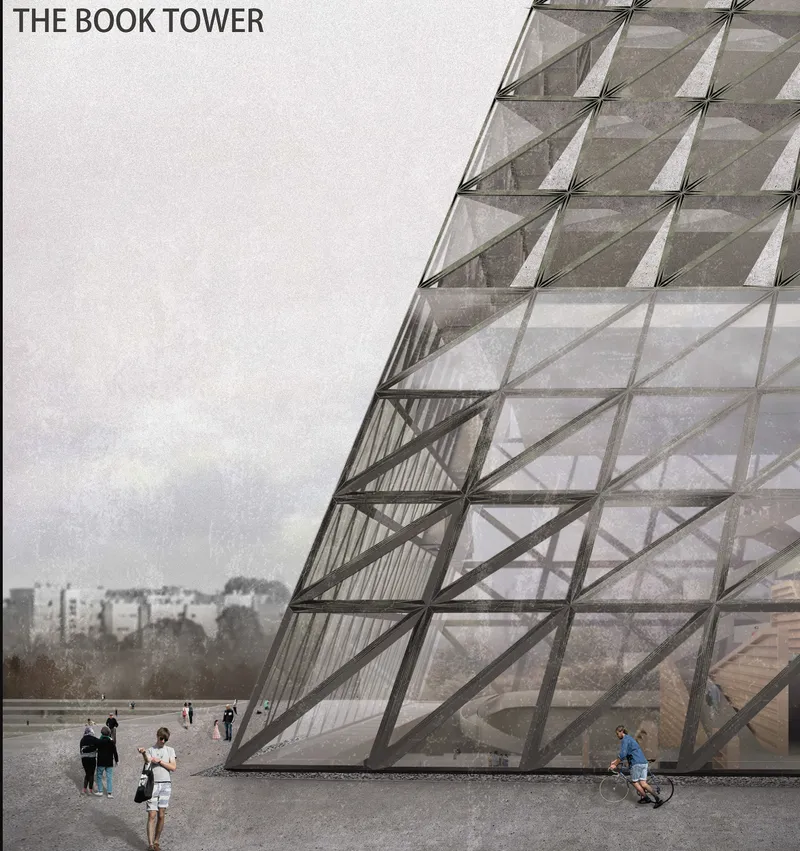
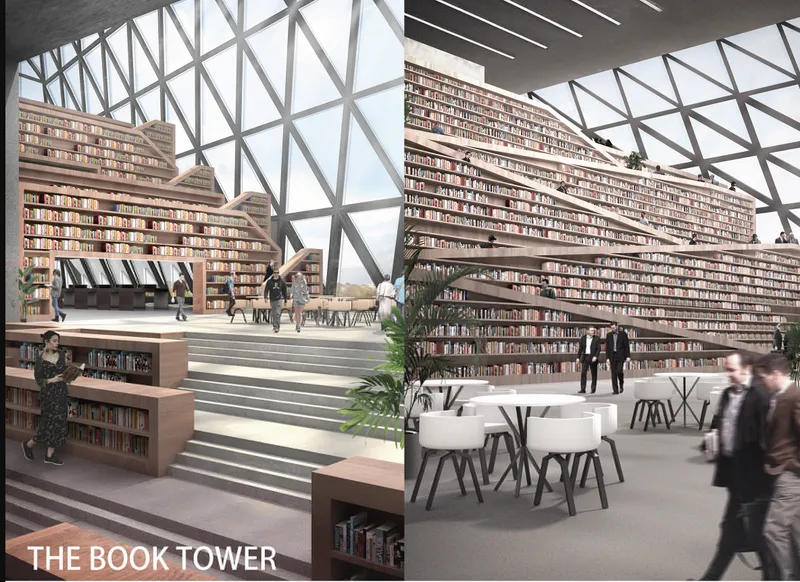
From plaza level, the Book Tower reads as a faceted crystalline form, its diagrid facade rising sharply above a public ground plane populated with visitors and cyclists. The large glass panels serve a triple purpose: they flood interior reading halls with daylight, offer panoramic views that anchor the act of learning within the city's visual fabric, and provide a dynamic geometry that controls solar gain for energy efficiency. The angled surfaces catch light at shifting angles throughout the day, giving the tower a visual identity that is always in motion.
Step inside, and that structural diagrid becomes the dominant spatial experience. The interior reading hall reveals tiered bookshelves climbing beneath an exposed steel framework, with skylights punching light deep into the section. The relationship between structure and program is intimate: the diagrid is not a decorative overlay but the organizing logic that shapes shelf heights, sightlines, and the quality of natural light reaching each reading position.
Spiraling Upward Through Zones of Exchange
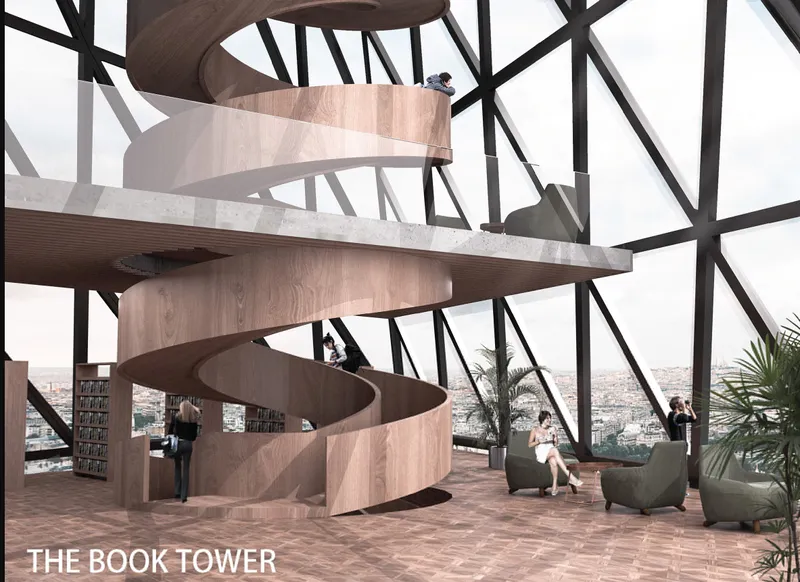
The tower's spiraling timber staircase is more than vertical circulation; it is the experiential spine of the entire project. Winding within the steel diagrid frame, the staircase offers continuously shifting views of the surrounding cityscape, ensuring that movement through the building is never neutral. You ascend through distinct zones of activity: from ground-level exhibition and public gathering spaces to mid-level communication and collaborative areas, up to quieter self-learning environments near the top. The spiral form enforces a deliberate pacing, encouraging both interaction and contemplation as visitors rise.
The choice of timber for the staircase against the steel diagrid creates a material dialogue between warmth and precision, between the handmade and the engineered. It is a subtle signal that the building values both the intimate, personal dimension of reading and the structural ambition of a civic monument.
Stacking Program Within a Triangular Envelope
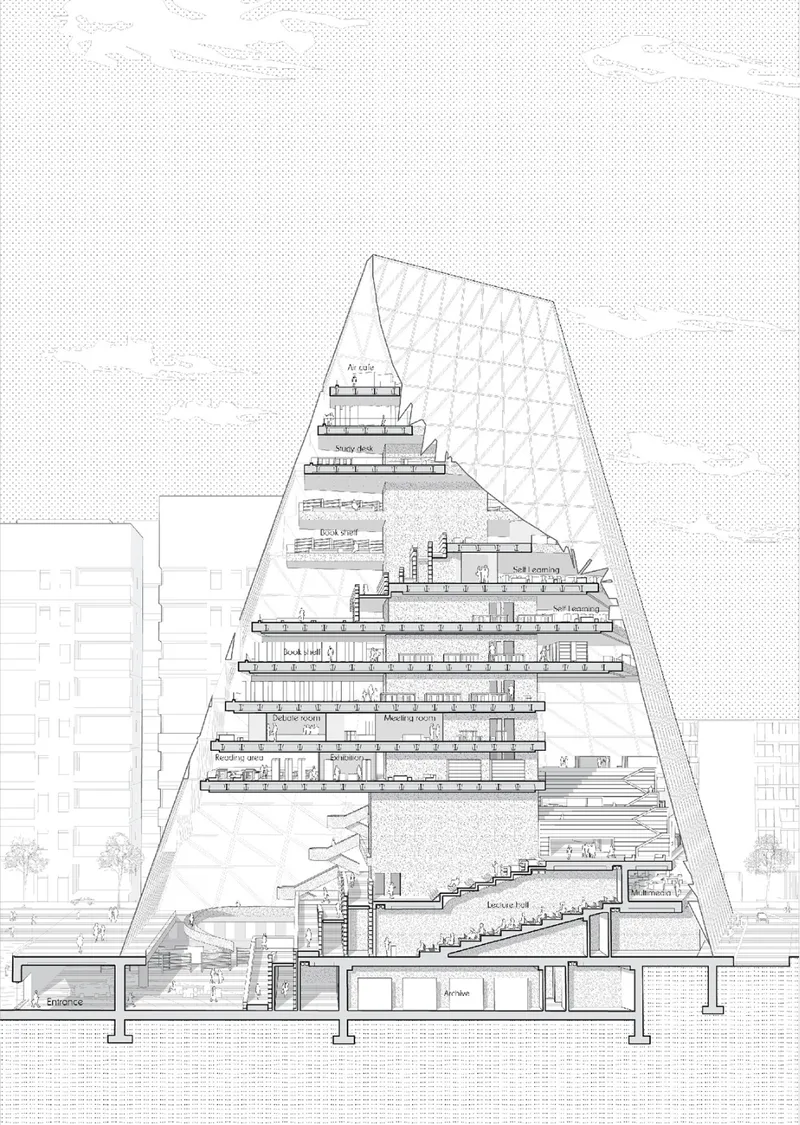
The section drawing reveals the tower's organizational clarity. Stacked floor plates are set within the triangular envelope, each plate slightly different in area as the form tapers upward. Below grade, additional spaces extend the program underground, accommodating support functions and expanding the building's capacity without inflating its above-ground footprint. The section makes visible how the three guiding principles, self-learning, communication, and creation, are mapped vertically: the public domain occupies the generous lower floors, while more focused, private enclaves emerge as the plan narrows toward the peak.
Structural Logic as Architectural Identity
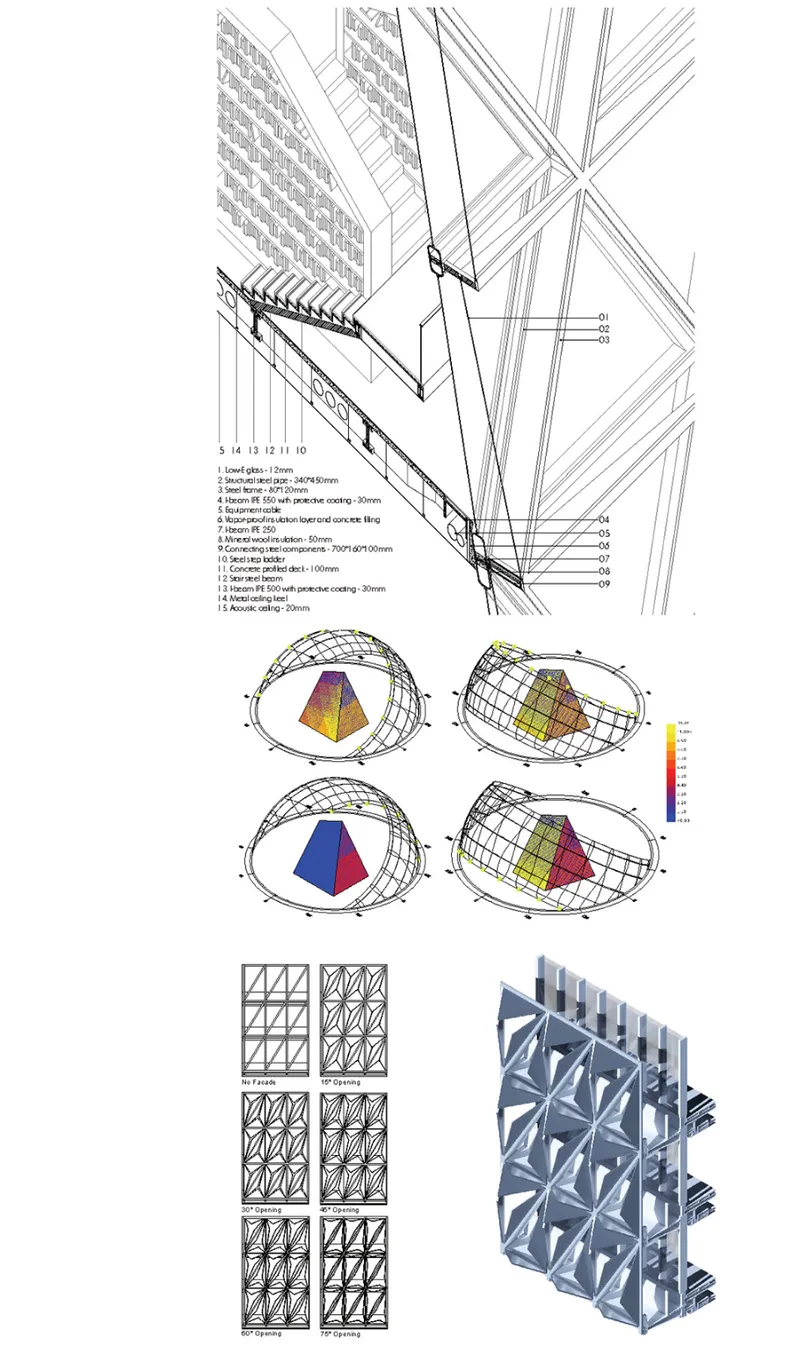
The technical drawings lay bare the rigor behind the tower's expressive form. Facade details, structural diagrams, diagrid patterns, and axonometric views together demonstrate that the building's visual character emerges directly from its engineering. The diagrid is not a stylistic decision applied after the fact; it is the load-bearing system that enables the tapered pyramidal geometry, the column-free interior spans, and the expansive glazing. The axonometric views clarify how floor plates relate to the enclosure, and how the facade's triangulated pattern modulates at different elevations to respond to structural loads and environmental conditions.
Why This Project Matters
The Book Tower reframes an old question, what should a library be in the information age, with a convincing spatial answer. Instead of retreating into nostalgia or surrendering entirely to digital ephemerality, the designers propose a hybrid: a physical monument that insists on the value of gathering, sharing, and performing knowledge in person, while using its architectural form to signal openness and continuous evolution. The spiraling section, the transparent skin, and the programmatic layering all work in concert to argue that the library's relevance depends on its willingness to become a stage for civic life.
What distinguishes this project from other tower-as-library proposals is the precision with which structure, program, and experience align. The diagrid is simultaneously load path, daylight filter, and visual identity. The spiral staircase is simultaneously circulation, viewing platform, and social condenser. Nothing in the Book Tower exists for only one reason. That economy of means, paired with genuine ambition about the library's public role, makes the project a compelling prototype for contemporary civic architecture.
View the Full Project
About the Designers
Designers: Jiayong Lu, Zhengshuai Hu, Hua Xing, Zhiyuan Zhang
Enter a Design Competition on uni.xyz
uni.xyz runs architecture and design competitions year-round that reward proposals with spatial conviction and real site intelligence.
Project credits: The Book Tower by Jiayong Lu, Zhengshuai Hu, Hua Xing, Zhiyuan Zhang Libgen 2019 (uni.xyz).



Popular Articles
Popular articles from the community


The Musturak Paradise: Senior Living Architecture for a Connected Future in Temara, Morocco
The Musturak Paradise reimagines senior living architecture in Temara via private homes, social spaces, culture, community, and shared care.

The Ocean Hive: Sustainable Architecture for a Self-Sufficient Civilization at Sea
The Ocean Hive imagines sustainable architecture at sea, where modular habitats, algae, wave power and ocean waste sustain a growing colony.

The Earth Pod: 3D Printed Homes for Resilient Refugee Communities
The Earth Pod reimagines refugee housing through 3D printed homes made from clay, combining resilience, self-sufficiency, and rapid shelter.

Play: Fragments of Their World
Familiar architecture becomes modular playground design, creating safe spaces where displaced children can learn, connect, imagine and play.

Similar Reads
You might also enjoy these articles

Day and Night Park: A Time-Based Urban Newsstand in Beijing
A temporary urban newsstand in Beijing blending travel, light, and reading through poetic colors, compact form, and community-focused design.

Modernist Patio Renovation in El Masnou, Barcelona by Oliver Segura Arquitectura + Cebrià Arquitectura
Modernist patio renovation blending tradition and innovation with a movable pool, leveled floors, and Catalan materials in El Masnou.

Alto Residencial Coop: Cooperative Housing Development in Santiago de Compostela by Carbajo Barrios Arquitectos
A linear cooperative housing complex blending white volumes and perforated metal façades, enhancing community living, natural light, privacy, and urban integration.
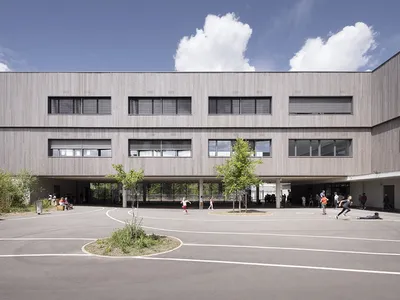
Vil Genis School by BPA ARCHITECTURE – Massy, France
Vil Genis School in Massy, France, features sustainable design, south-facing classrooms, community integration, accessible spaces, and modern educational architecture.



Comments (0)
Please login or sign up to add comments
No comments yet. Be the first to comment!